Reading view

Life after death: From burned trees to bleached corals, how dead organisms live on as the building blocks of new life

People’s knee-jerk reaction to seeing death in nature is often not positive. The burn scar left by wildfire on a once-forested hillside, or a ghostly white coral reef, may evoke tragedy and despair. But in nature, most plants and animals are recycled back into new life.

The fallen branches and leaves that crunch under your boots as you step on the forest floor are providing nutrients for new growth as they decompose. Empty shells can become the foundations for new sea life to grow. Dead organic matter left over after a harvest supports soils and the production of food that feeds people worldwide.

These remnants of life can set both the pace and outcome of ecosystem recovery, enabling life to persist and thrive, or preventing it from doing so.

Ecologists, like us, refer to this as ecological memory, where remnants of the past influence how ecosystems look and behave in the present. Similar to human memories, traumatic events can have the strongest influences in nature: Fires, storms, heat waves and outbreaks of pests or disease can cause widespread death of plants and animals, leaving behind abundant and lasting physical remains.

In a new paper published in Science Advances, working with colleagues around the country, we show how death plays nuanced and powerful roles in nature’s afterlife.

In some cases, dead organisms prevent life from returning after an extreme event. In other cases, they make ecosystems more resilient by fueling regeneration of new life and hastening recovery. Understanding this afterlife and its influence on ecosystems will be increasingly valuable for helping ecosystems recover in a changing climate.

Foundation species – nature’s architects

Our study focused on a set of ecologically important organisms, known as foundation species. These are abundant and iconic organisms, such as trees, grasses, oysters and corals, that create the natural infrastructure on which entire communities of organisms exist.

Foundation species can be found everywhere, from the depths of the oceans to the summits of mountains. Because they are so abundant while alive, they can remain abundant after they die. And their influence can carry on in an afterlife that shapes the trajectories of ecosystems, either supporting recovery to the ecosystem’s original structure or transforming it into a new one.

Trees of different ages grow from a fallen log.
A fallen log serves as a nursery for a new hemlock tree in British Columbia, Canada, hence the nicknames nursery log or nurse log. Seeds often struggle to establish themselves on the ground, but decaying trees provide soft, nutrient-rich environments with less competition or risk from soil fungus. Wing-Chi Poon, CC BY-SA

To investigate how the dead remains of foundation species affect the ability of their living counterparts to establish, grow and survive, we tapped into a U.S. National Science Foundation network of Long Term Ecological Research. Scientists at these sites track populations of foundation species across a diversity of ecosystems that have experienced different extreme events.

We looked at coral reefs, mangrove forests, salt marshes, kelp forests, oyster reefs, tropical rainforests, temperate rainforests, hemlock forests, tallgrass prairies and boreal forests, ranging from the tropics to just shy of the Arctic Circle.

We found that, following extreme events, the dead affect the living more commonly than we expected. The dead foundation species either significantly increased or decreased living foundation species in nine out of the 10 ecosystems we studied – the kelp forest was the only exception.

In roughly half of the cases, dead foundation species hampered the ability of their living counterparts to reestablish, grow and survive after extreme events.

Take the tropical montane rainforest of Puerto Rico. This ecosystem is periodically walloped by hurricanes that strip its canopy and blanket the forest floor with tree branches and leaves. This layer of debris chokes off sunlight needed by the seedlings below and reduces the number that emerge to replace the trees lost during the storm, ultimately slowing the forest’s recovery.

Kai Kopecky clears dead coral skeletons from a research site. Lauren Enright

The South Pacific coral reefs of Moorea present a more extreme example. Marine heat waves that cause coral bleaching can transform these reefs into something fundamentally different: ghost towns of dead skeletons overgrown by seaweeds. The nooks and crannies of the standing coral skeletons provide an opportunity for the seaweeds, which compete with coral for reef space, to proliferate and take over the reef, preventing the return of corals.

But in the other cases we studied, we found that dead organisms actually promote the regeneration of their living counterparts.

For example, the mangrove forests of the Florida Everglades actually benefit from storm-generated debris. During a hurricane, leaf litter blown or washed out of the canopy ended up in the complex network of roots below, providing a pulse of nutrients that enhanced the production of new roots and hastened mangrove recovery.
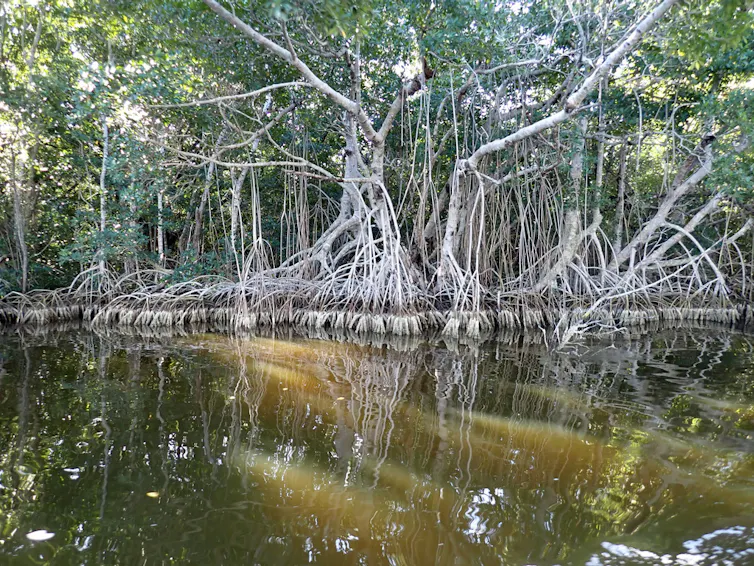
Mangroves put down roots in a coastal area.
When mangroves are torn up by storms, they can rebuild on top of one another. The recovery can take years, so frequent storms make recovery slower. Tommy Shannon/Florida Coastal Everglades LTER, CC BY-SA

In the Eastern hemlock forests of New England, an outbreak of a tree-killing pest – the woolly adelgid – left behind wide swaths of standing dead trees. But unlike the dead skeletons on a bleached reef, these dead trees often help new hemlock saplings grow by maintaining a favorable climate on the ground below.

The question now is, how can humanity use this information to fortify the resilience of ecosystems after extreme events?

How humans can help

As humans, many of us rely on therapy to help manage how traumatic memories affect our lives. We can also help ecosystems manage the remnants of dead organisms after disasters in several ways.

On land, standing dead trees are sometimes felled to create “nurse logs,” which release nutrients that nourish living trees. Dead grass litter is removed using prescribed burning to create better conditions for new grass to grow. On the coasts, dead oyster shells are deposited onto mud flats, and the rubble of coral skeletons is either stabilized or removed to create more solid substrates where new oysters and corals can settle, grow and thrive.

Workers on a barge with mounds of oyster shells push them into the water with a hose.
Workers aboard a barge laden with 680 bushels of clam and oyster shells use high-pressure hoses to blast them into the Mullica River in Port Republic, N.J. The shells are collected from restaurants in Atlantic City, dried and placed into the river, where they become the foundation for new oyster colonies as free-floating baby oysters attach to them and start to grow. AP Photo/Wayne Parry

As rising temperatures create more frequent extreme events and trigger more die-offs, dead foundation species will be useful to help guide ecosystem recoveries afterward.

Where there is life, there is death

When you’re in nature, whether hiking in a forest or snorkeling on a tropical reef, your attention is typically drawn to the life that exists in these places. But if you take a closer look, you may notice that death is all around, too.

Death is an integral part of life. The quicker we all learn to embrace its capacity to be a transformative force, and find ways to use the remnants left in its wake, the better we will be able to help nature and ourselves thrive into the future.

The Conversation

Kai Kopecky receives funding from the National Science Foundation and the LTER Network Office.

John Kominoski works for Florida International University.
  •  

Pope Leo XIV compares AI to the Industrial Revolution – as new alternatives to big AI firms take shape

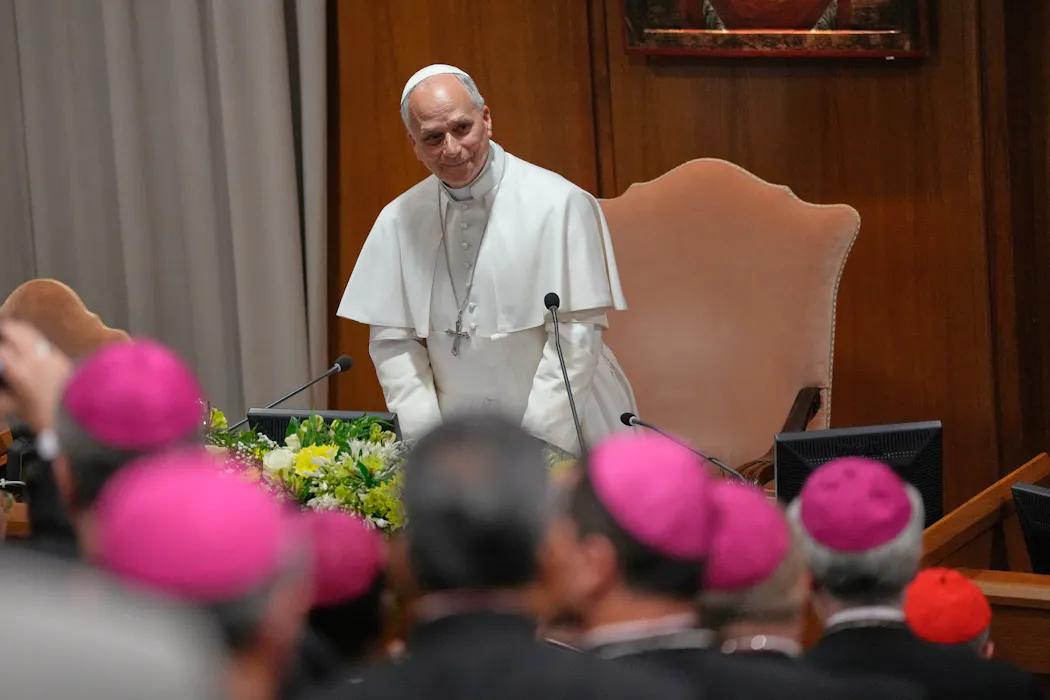
Pope Leo XIV attends the presentation of his first encyclical, Magnifica Humanitas, at the Vatican on May 25, 2026. AP Photo/Alessandra Tarantino

With the release of his encyclical letter Magnifica Humanitas on May 25, 2026, Pope Leo XIV has signaled that he wants the church to respond to artificial intelligence much as a predecessor, Pope Leo XIII, responded to upheavals during the Industrial Revolution over a century ago.

Since the first act of his papacy – choosing his name – the current pope has repeatedly invoked the earlier Leo’s 1891 encyclical Rerum Novarum. That document, which waded into the political and economic debates of the time, denounced the excesses of the Gilded Age and pointed toward a more just social order. Now, Leo XIV has used his first major statement to the world to present a new Rerum Novarum for the age of AI.

Rerum Novarum was more than just a theological text. It helped reshape economic policy around the rights of workers, serving as a spiritual foundation for European social democracy and the 1930s New Deal programs that still undergird economic life for working Americans today. It also spurred a movement of entrepreneurs to transform the economic system from within.

Understanding its influence is key to seeing the potential of Leo XIV’s encyclical.

From guilds to cooperatives in the industrial era

In his time, Leo XIII rejected both unfettered capitalism and revolutionary socialism. He invoked the medieval guilds, in which craftspeople self-organized, and asserted the rights of industrial workers to organize as well. This was a radical statement at a time when unions often faced violent suppression from employers and police.

But in contrast to communist agitators, he didn’t want to do away with private property. He argued that to bring out the best in human beings, as creatures made in the image of God, governments should “induce as many as possible of the people to become owners.”

A half-length portrait of a man in papal robes.
Pope Leo XIII. Francesco De Federicis (1853–1908) via Wikimedia Commons

This was more of a vision than a detailed plan, but Catholics in many countries started trying to figure out what the vision meant in practice.

The English writers G.K. Chesterton and Hilaire Belloc, for instance, tried to systematize his vision in a movement they called “distributism,” which proposed policies for land redistribution and a revival of guilds. In the United States, economist and Catholic priest John A. Ryan argued in favor of cooperatives – businesses that could be co-owned by workers, consumers or small-business owners.

Ryan went on to be an important adviser for the New Deal in the United States, which used cooperatives as a powerful tool for economic development through farmer co-ops, rural electric associations and the credit union system.

The spirit of Rerum Novarum continued to spread. Starting in the 1950s, the largest network of worker cooperatives in the world, the Mondragon Corporation in Spain’s Basque region, was founded by a Catholic priest. It was a direct result of Leo XIII’s encyclical.

My own career has been in its shadow. As a media scholar and a Roman Catholic – and an advocate for efforts to build cooperative tech platforms – I sometimes think of my own work as applying Rerum Novarum to the online economy. With Magnifica Humanitas, the pope appears to be making a similar argument for the age of artificial intelligence.

A tale of 2 cities

Once again, society is going through an economic upheaval: New technologies are changing the nature of work, political systems are under strain, and wealth inequality is staggering. In Magnifica Humanitas, Leo XIV argues that an intervention akin to Rerum Novarum is needed.

A person holds copies of a document titled Magnifica Humanitas.
Copies of Leo XIV’s first encyclical, Magnifica Humanitas, were distributed at the Vatican on May 25, 2026. AP Photo/Alessandra Tarantino

The guiding metaphor of Magnifica Humanitas is the choice between two biblical scenes: the Tower of Babel and the rebuilding of Jerusalem under the prophet Nehemiah.

The first is a story about the dream of a city that sets out to erect a single building as high as the heavens. Babel, as Leo XIV writes in the encyclical, is a city “built on pride and the claim to self-sufficiency.” In the biblical account, the project collapses as the world’s common language is scattered into many diverse ones.

The pope contrasts this with the story of the Hebrew prophet Nehemiah, who lived in the fifth century B.C.E., when Jews were returning from exile to a ruined Jerusalem. Nehemiah organized the city’s rebuilding through a collaborative process based on shared responsibility. While united in prayer, the city’s various families and professions could each put their distinctive marks on their work.

The current AI industry, he argues, is in danger of becoming a new Tower of Babel. Just a few companies control this powerful technology supposedly poised to transform work, politics and society for everyone.

He warns that many AI leaders are enthused by ideologies that propose to trade human limits for the godlike powers of machines. Some are even cheerfully embracing a world where human labor is no longer central to the economy. Leo also fears that human choice is becoming more removed from the execution of war.

In the face of all this, the encyclical calls on people everywhere to adopt “the pressing duty to remain profoundly human” – to be neither “spectators” nor “commentators” but to take an active role by participating in what he calls “the construction sites of history.” Some already are.

Construction sites for a different kind of AI

A female worker stands in front of AI-powered robotic arms in an automated factory.
A few large AI companies dominate the technology and decide how people can use it, but alternative models are beginning to emerge. greenbutterfly/iStock/Getty Images Plus

It is easy to see the emerging AI industry in Babel-like terms – a few massive tech companies build the models and provide access to them on their terms. But other paths are still possible. My colleagues and I have been documenting cases that could be the germ of a different kind of AI industry – one more aligned with what the pope is calling for.

Just as during the Industrial Revolution, a more just future begins with workers resisting against the abuses of the present. From Hollywood to Nairobi, workers have been fighting for dignity as AI changes their professions. Magnifica Humanitas stresses the importance of decent jobs to a healthy society, and workers’ demands can help identify what the future of work should look like.

Other approaches begin among AI developers themselves. In Switzerland, a collaboration between government and academia has produced Apertus, a foundational model based on fully documented designs and data sources – a far cry from the opaque and at times illegal practices of leading AI companies. Some of Apertus’ developers have created a consumer cooperative, enabling users to co-own their interface with the model.

Cooperative ownership like this allows users to tune AI experiences more intentionally toward their needs. The large U.S. farmer co-op Land O’Lakes, for example, has created AI-enabled tools that provide analysis and guidance for its members based on the data that they collectively co-own. The more nascent Transkribus in Europe is co-owned by research institutions that collectively train their AI software to transcribe texts for historical research. These kinds of systems follow Leo XIV’s call to “manage data as a common or shared good.”

It is telling that even among leading AI companies such as OpenAI and Anthropic, the founders attempted to build unusual corporate governance structures to insulate their products from profit motives. Governments could encourage more appropriate ownership designs or outright require them for high-risk industries like AI.

If Rerum Novarum is any guide, the impact of Magnifica Humanitas will depend on the creative entrepreneurship and policy experiments to put it into practice – and this work has already begun.

The Conversation

Nathan Schneider and his lab receive financial support from various funders, most recently the Siegel Family Endowment. He chairs the board of Metagov, an organization whose work informed this article, and he has interacted with several of the entities discussed here.

  •  

A lot of ‘recycled’ plastic is being burned overseas – and causing widespread pollution linked to health problems

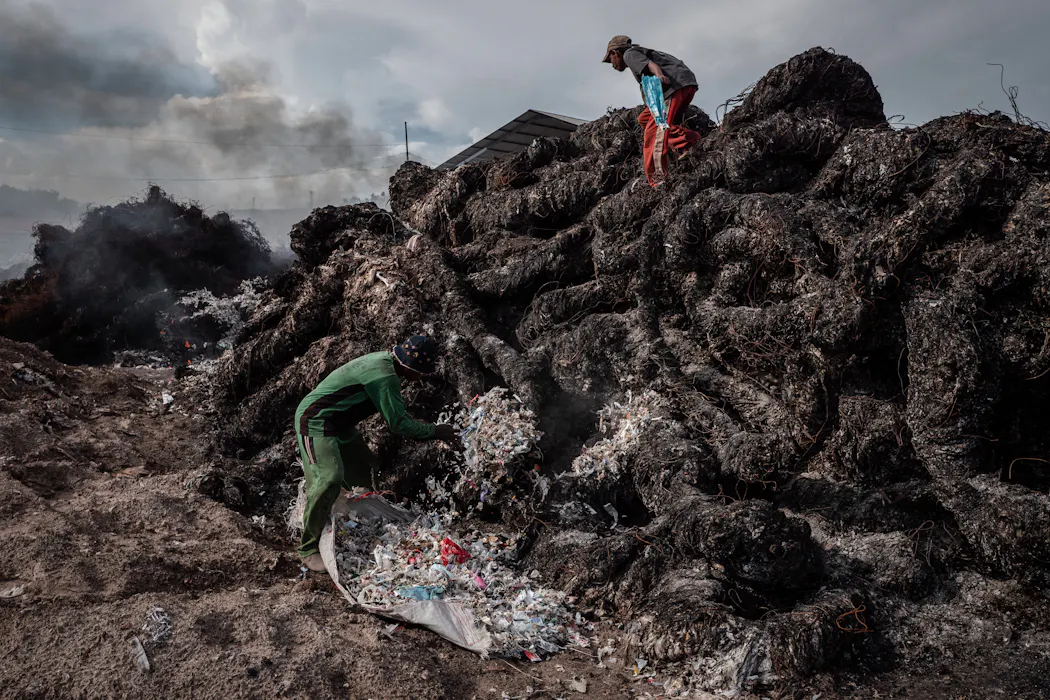
Workers prepare to burn imported plastic waste at a dump in East Java, Indonesia, in 2018. Ulet Ifansasti/Getty Images

Picture a pile of trash the size of Manhattan and taller than one and a half Empire State Buildings. That’s how much plastic waste the world is predicted to be generating every year by 2050 if nothing is done to change course.

It’s easy to think of recycling as the solution, but the vast majority of plastic waste now ends up in landfills, or worse.

A large amount of plastic waste gets shipped overseas. In a new study, my colleague and I analyzed what happens when plastic waste is shipped to lower- and middle-income countries, where open burning is a common way of dealing with excess waste. The result, we found, is pronounced increases in toxic air pollution.

Hundreds of thousands of tons of plastic waste thrown in recycling bins in the US actually ends up getting shipped to other countries.

Plastic waste burning and health impacts

Between 40% and 65% of total municipal solid waste is openly burned in low- and middle-income countries, largely as a result of 2 billion people around the world having no municipal solid waste collection.

Open burning occurs both intentionally and unintentionally, the latter when open dump sites containing organic waste spontaneously combust due to heat generated as the waste degrades.

A woman carries a basket with plastic waste from a large pile in a room.
A worker carries a basket of plastic waste, wood and coconut husks to be used as fuel to fry tofu at a factory in Sidoarjo, Indonesia, in 2025. Burning waste is a common way to cut fuel costs, but studies have found high levels of microplastics in the tofu from these factories, toxic ash inside the buildings and hazardous levels of air pollution. Robertus Pudyanto/Getty Images

When plastic burns, it releases particularly toxic air pollutants. Fine particles can penetrate deep into people’s bodies, along with gases that include carbon monoxide, styrene gas and hydrogen cyanide. It also releases persistent organic pollutants such as polycyclic aromatic hydrocarbons and dioxins. These particles and gases have been linked to health risks ranging from respiratory and cardiovascular disease to cancer and reproductive and neurological disorders.

The ash from open burning can also contaminate soil and groundwater with persistent organic pollutants, heavy metals and other toxicants, creating more chances for people to be exposed to them through food and water.

The global plastic waste trade

Large amounts of plastic waste are shipped around the world – some to be recycled and much to simply be disposed of in landfills or incinerated. In 2024, 9.34 million metric tons of plastic waste imports were reported, according to the United Nations.

Where this exported plastic waste ends up has been shifting.

In 2018, China stopped importing plastic waste, causing the total amount of plastic waste moving among countries – at least through official channels – to drop dramatically. Between 1992 and 2016, China’s plastic waste imports made up 45% of global imports.

In 2018, the flow moved to other countries, largely in Southeast Asia but also other locations, including Turkey. In 2018, Indonesia became a net importer of plastic waste. The majority of this waste came from Western Europe, Australia and North America.

What happened to Indonesia’s air quality

We harnessed data from multiple monitoring systems, including satellite observations and cargo ship tracking signals, to understand where these plastic waste imports went and how much air pollution was released by openly burning this waste.

As of 2020, the World Economic Forum and Indonesia’s government estimated that 48% of Indonesia’s plastic waste is openly burned.

We found that particulate matter air pollution – of great concern for health – increased an average of 3.3% at the locations of large open waste dump sites in Indonesia after China’s ban in 2018-19 relative to expected business as usual, based on data from 2012-17. We found increases up to 1.68 micrograms per cubic meter.

Based on risk estimates from a global study of mortality associated with long-term exposure to outdoor fine particulate matter, this corresponds to an approximate 1.5%, 1.9% and 3.5% increase in mortality risk from chronic obstructive pulmonary disease, lung cancer and lower respiratory infections, respectively.

New constraints on the plastic waste trade

In 2021, Indonesia restricted the import of nonhazardous waste to 15 specific ports and in 2025 banned the import of plastic waste altogether.

In mid-2025, Malaysia followed suit, allowing plastic waste only from countries that have ratified the Basel Convention on the Control of Transboundary Movements of Hazardous Wastes and their Disposal – a treaty that the U.S. has never ratified.

For these bans to be effective, these countries must also find ways to contend with illegal plastic waste shipments and paper imports contaminated by plastic waste.

A sankey flow chart shows where plastic waste went in 2024.
Where plastic waste exports went in 2024. The chart does not include waste disposed of within the country where it was produced. UN Comtrade, Ellen Considine, created with Flourish, CC BY-ND

Meanwhile, negotiations for an international, legally binding treaty on plastic waste, started in 2022, have stalled. In mid-2024 the European Union did pass a new regulation on waste shipments, prohibiting exporting plastic waste to countries outside the group of wealthy countries in the Organization for Economic Cooperation and Development from November 2026 to at least May 2029.

The effectiveness of these and future policies at reducing air pollution – and other kinds of environmental degradation – can be evaluated using methods like ours.

Ways to reduce plastic waste

As of 2021, only 5% to 6% of U.S. domestic plastic waste was recycled, according to estimates from the advocacy group Beyond Plastics and Bennington College. It is now even harder to export plastic waste to other countries that could “recycle” it.

Part of the problem is lack of capacity: The Association of Plastic Recyclers estimates that current plastic reclamation facilities in the U.S. and Canada could at most increase their plastic recycling by 35% to 44%, depending on the type of plastic, leading to a total recycling rate of 7% to 9%.

Ultimately, both decreasing plastic use and increasing recycling will likely be needed to solve the problem. Beyond consumer choices, packaging reuse – creating packaging and return systems that put the same materials back to work – can reduce the need for new plastics.

Recycling experts call for harmonized design standards to help streamline processing and deliver higher-quality recycled plastics, as well as extended producer responsibility fees or taxes to raise the cost of producing products that aren’t recyclable. The fees can provide needed funding to scale up recycling and other programs to reduce generation of plastic waste.

Since 2021, seven states have enacted extended producer responsibility laws focused on packaging: Maine, Oregon, California, Colorado, Minnesota, Washington and Maryland. However, it will take time to see the effects. Colorado’s final implementation plan, authorized in 2022, was approved only in late 2025. The first payment of extended producer responsibility fees to the Colorado Department of Public Health and Environment are scheduled to begin in mid-2026.

Ultimately, reducing and better managing our nation’s plastic waste can help prevent global health harms.

The Conversation

Ellen M. Considine does not work for, consult, own shares in or receive funding from any company or organization that would benefit from this article, and has disclosed no relevant affiliations beyond their academic appointment.

  •  

Is baby talk bad? Why ‘parentese’ actually helps babies learn language

Emphasizing the sounds of certain words to young children can help them retain language, not confuse them about speaking properly. MoMo Productions/DigitalVision via Getty Images

Many parents have heard the warning: Don’t use baby talk with babies and toddlers. Instead, caregivers are often encouraged to speak properly and use adultlike language, out of concern that simplified speech could confuse children or delay language development.

But my research, which I highlighted in in my new book, “Beyond Words,” suggests the opposite is true. The sing-song voice many adults instinctively use with infants, sometimes called “baby talk” but more accurately known as “parentese” or infant-directed speech, actually helps children learn language.

Far from confusing babies, exaggerating phrases like “Loooook at the doggie!” capture their attention, help them detect patterns in speech and strengthen social bonding.

And the funny mistakes children make along the way, such as saying “goed,” instead of “went,” or “mouses” instead of “mice,” are not signs that children are learning language incorrectly. They are evidence that children are actively working out the rules of language for themselves.

A man holds his hands away from his face and leans over a small baby lying on a bed and smiles.
Speaking ‘parentese’ to a child doesn’t involve nonsense words. BjelicaS/E+ via Getty Images

What parentese really is

When many people think of baby talk, they imagine nonsense phrases like “goo goo ga ga” or made-up words like “num nums.” But that’s not what linguists and developmental psychologists mean by parentese.

Parentese uses real words and grammatically correct sentences, but with exaggerated intonation, a higher pitch, stretched-out vowels and a slower rhythm. Think of the way a caregiver might naturally say: “Hi, baaaaby! Are you huuungry?”

There is little evidence that occasional playful nonsense words harm children’s language development. But studies suggest that parentese in particular helps babies pay attention to speech, recognize patterns and engage socially.

Adults across cultures tend to speak this way to infants instinctively. Even people who swear they never use baby talk often slip into it around babies.

Researchers have found that infants actually prefer listening to parentese over regular adult speech. The exaggerated sounds and slower pacing make language easier to process. Babies are better able to pick out individual sounds, notice word boundaries and recognize patterns. In other words, parentese helps tune babies into language.

It also strengthens emotional connection. Language learning does not happen in isolation. Babies learn through warm, responsive interaction with caregivers during feeding, play, bath time and everyday routines.

Interestingly, humans are not the only ones who respond to this style of communication. Studies have even shown that cats react more positively when people use a baby-talk voice with them.

Babies are not passive learners

Children do not learn language simply by copying adults word for word. They actively test hypotheses about how language works. That is why toddlers make predictable and surprisingly logical mistakes.

One common example is overgeneralization. A child learns that people form the past tense of many verbs by adding “-ed,” so they produce forms like “goed,” “eated” or “comed.”

These are not random errors. In fact, they show that the child has understood a grammatical rule and is trying to apply it consistently. The problem is simply that English is full of irregular exceptions. The same thing happens with plurals. Children may say “foots” instead of “feet” or “mouses” instead of “mice.” Again, the logic behind these errors is sound.

Linguists sometimes say that children are little scientists, constantly testing patterns and revising their understanding as they receive more input from the world around them.

Why toddlers call everything a ‘dog’

Young children also make predictable mistakes with meaning.

A toddler might learn the word “dog” and then use it for every four-legged animal they encounter. Linguists call this overextension. On the flip side, some children use words too narrowly. A child may use “dog” only for the family pet and not recognize that other dogs belong in the same category. Linguists call this tendency underextension.

These mistakes reveal how children organize and categorize the world around them. They are gradually mapping words onto objects, people and experiences.

Pronouns are another tricky area. Small children often confuse “me” and “you” because these words constantly shift depending on who is speaking. If a parent says, “I’ll pick you up,” the child hears themselves called “you.” But when they try to repeat the sentence, they may not yet understand that the labels switch from speaker to speaker.

This is why toddlers sometimes say things that sound unintentionally cute or confusing. But beneath the confusion is a sophisticated learning process.

Even the Cookie Monster gets it wrong

Children’s speech errors are so recognizable that they often appear in popular culture. Sesame Street’s character Cookie Monster famously says things like “Me want cookie,” while Elmo often refers to himself in the third person: “Elmo wants this.” These speech patterns mirror real stages of child language development. Young children commonly confuse pronouns or refer to themselves by name before mastering forms like “I,” “me” and “mine.”

Despite occasional complaints from adults, there is no evidence that hearing this kind of speech harms children’s language development. If anything, it reflects the natural experimentation children go through.

A Cookie Monster puppet stands near a black tarp with its mouth open and holds a cookie.
The Cookie Monster saying ‘Me want cookie’ won’t teach babies and young kids to speak incorrectly. Brian Killian/WireImage via Getty Images

‘Pasketti’ and ‘wabbit’

Pronunciation develops gradually too. Young children often simplify difficult sounds and groups of consonants. “Spaghetti” becomes “pasketti,” “rabbit” becomes “wabbit” and “yellow” may come out as “lellow.”

Speech-language specialists call these simplifications phonological processes. They are a normal part of development because some sounds are physically harder to produce than others. Sounds such as r, th, sh and ch tend to develop later because they require more precise control of the tongue and mouth.

Most children naturally outgrow these pronunciation patterns as their speech matures. However, persistent difficulties can sometimes signal a speech or language disorder, which may require professional support.

A graphic image shows a young child's head with various colorful thought bubbles inside.
Children don’t learn language by copying adults word for word. They learn through interaction, experimentation and repetition. DrAfter123/DigitalVision Vectors via Getty Images

Mistakes are part of learning

Parents are often under enormous pressure to do everything right, including helping their children learn to speak a language. But children do not learn language by avoiding mistakes. They learn through interaction, experimentation and repetition.

Parentese helps babies focus on speech and engage socially. The funny mistakes toddlers make reveal that they are actively piecing together the complex system of language and are often signs of normal development. Language acquisition is messy, creative and remarkably sophisticated.

Speaking in an exaggerated sing-song voice to a baby is not something parents and caregivers need to feel embarrassed about.

Far from harming language acquisition, it may help lay the foundation for it.

The Conversation

Karen Stollznow does not work for, consult, own shares in or receive funding from any company or organization that would benefit from this article, and has disclosed no relevant affiliations beyond their academic appointment.

  •  

A ‘super El Niño?’ Why it’s too early to forecast one with certainty, but not too soon to prepare

El Niño can mean a rainy U.S. Southwest, warmer winters in the North and less Atlantic hurricane activity – but not always. Bill Tompkins/Getty Images

Talk of a “super El Niño” developing in 2026 is gaining momentum, with concerns rising that this climate pattern could bring extreme rainfall, heat, drought and destructive flooding around the world.

The signals appear to be in place: The tropical Pacific is warming along the equator, and computer models point toward extreme conditions by the end of the year.

However, forecasting El Niño is not like predicting next week’s weather. Forecasts for El Niño typically aren’t reliable before late spring – not because scientists don’t understand the system, but because we understand its limits.

A global map showing a streak of high ocean temperatures off South America in the Pacific along the Equator.
Sea surface temperature data on May 12, 2026, shows warming along the equator west of South America, often a sign that El Niño conditions are developing. NOAA Coral Reef Watch

As an ocean-atmospheric scientist who studies El Niño, I spend a lot of time thinking about what scientists can forecast confidently – and what remains uncertain. Here’s what we know about the current event, what we still don’t, and why many regions should begin preparing now, even if a strong, or “super,” El Niño never fully materializes.

Why is El Niño hard to forecast in spring

The starting point for any El Niño forecast is the heat stored beneath the surface of the eastern equatorial Pacific Ocean. Computer models use data about those conditions to simulate how ocean temperatures will evolve over the coming months, and how they affect weather patterns around the world.

Right now, an exceptionally large reservoir of warm water sits beneath the surface there. In principle, this ocean heat should be a reliable signal of El Niño developing. In practice, what happens next depends heavily on what the atmosphere does.

The warm reservoir was shaped by a burst of wind activity in early 2026. Normally, the Pacific trade winds blow from east to west along the equator, pushing warm water toward Asia and leaving cooler water near South America. But in April, a pair of cyclones straddling the equator caused the wind direction to reverse. This short-lived reversal triggered a downwelling Kelvin wave – a pulse of energy beneath the ocean surface moving eastward along the equator.

That subsurface pulse has now reached the eastern Pacific, helping fuel intense warming off South America. At the ocean surface, this can resemble the early stages of a strong El Niño.

But there is a catch.

For El Niño to develop fully, the ocean and atmosphere need to lock into a feedback loop: Warmer surface waters weaken the trade winds, triggering more downwelling Kelvin waves that push warm water eastward and reinforce the warming. But that loop doesn’t engage automatically. It requires repeated bursts of eastward winds to sustain the process.

Until that feedback loop takes hold, the ocean-atmosphere system is in an unpredictable phase. It might tip into a super El Niño. It might not.

Spring is precisely when forecasts are most uncertain. Impressive early signals can fade if the winds don’t cooperate.

A line chart shows the relative oceanic Nino index, tracking sea surface temperature anomalies compared to average.
El Niño forms when surface temperatures in the tropical Pacific Ocean are about 0.5 degrees Celsius (0.9 Fahrenheit) warmer than normal for three months. A strong El Niño has temperatures over 1.5 C (2.5 F). The chart shows the Relative Oceanic Niño Index (RONI), a three-month running average that accounts for the background warming trend. Some forecasts still rely on the Oceanic Niño Index, based on absolute temperatures, which can overstate El Niño’s strength in a warming climate. NOAA

There’s a further complication: When models detect strong subsurface warming, they can simulate a stronger feedback loop than actually develops.

The result is that models can look too confident – even alarming – despite the system not being locked in. As of mid-May 2026, the wind patterns needed to amplify the warming have not clearly emerged.

We’ve seen this scenario play out before. In both 2014 and 2017, forecast models were pointing toward strong El Niño conditions by midyear. In both cases, the anticipated wind patterns never fully materialized and El Niño either stayed weak or returned to a neutral state. The early signals were real, but the expected follow-through didn’t happen.

So what do the forecasts suggest?

The current forecasts for 2026-27 still span a wide range in mid-May – from expecting weak to strong El Niño conditions.

How the winds behave in the coming weeks will determine what develops. If trade winds weaken again at the right moment, it could tip the system into self-sustaining warming – the kind that’s hard to stop.

As of mid-May, long-range weather forecasts weren’t showing strong eastward wind bursts on the horizon that could strengthen El Niño. In fact, quite the opposite was expected for the second half of May: a burst of winds blowing in the opposite direction. A full month without major eastward wind activity would be a meaningful brake on ocean warming.

The Pacific has loaded the dice for El Niño, and the National Oceanic and Atmospheric Administration’s May outlook reflects elevated odds of El Niño developing and potentially strengthening later in the year. By NOAA’s mid-June update, the picture should be substantially clearer.

El Niño intensity matters for weather worldwide

The difference between a weak El Niño and an extreme one is not subtle. It reshapes climate patterns across the globe – and with them, real-world risks.

If El Niño intensifies into a strong or “super” event, it can drive drought in the Amazon, fires in Indonesia, flooding in Peru and heavy rainfall in parts of California and southern South America. These effects could materialize by the Northern Hemisphere winter, when El Niño typically peaks.

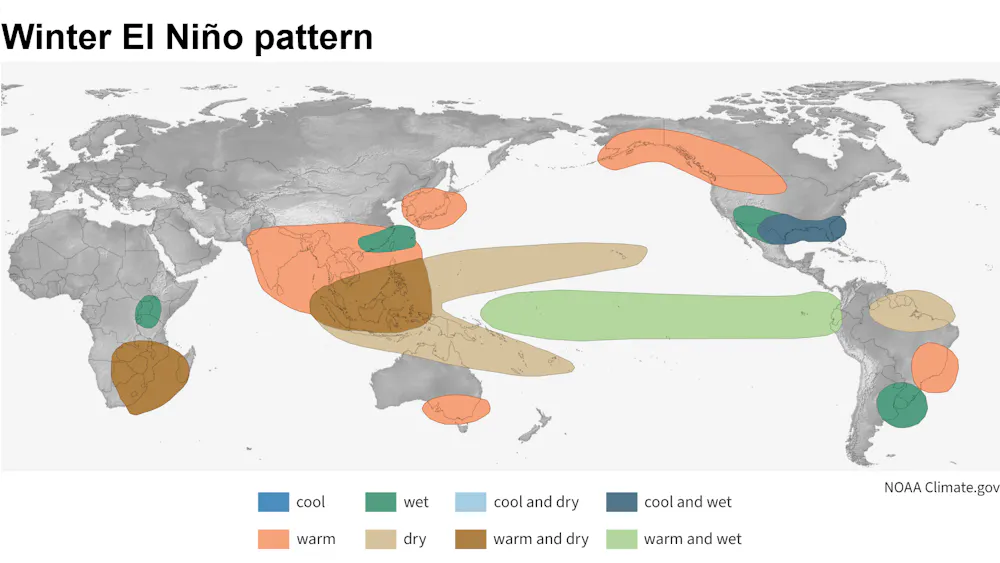
A world map shows cool, wet conditions across much of the southern U.S., warmer in the Northwest through Canada and Alaska.
How El Niño tends to affect the weather and climate around the world. El Niño’s affects vary based on many factors, so not every El Niño year will look exactly like this. NOAA

In some regions, the stakes are immediate.

In India, the monsoon rains, which support agriculture and water supplies for hundreds of millions of people, have historically weakened during strong El Niño events. Even modest shifts in monsoon strength can bring food and water shortages, and harm economies.

At the same time, when El Niño is strong, hurricane activity in the Atlantic is typically suppressed – a rare upside – while the eastern Pacific often becomes more active with storms.

NOAA scientists explain how El Niño affects weather across the U.S.

El Niño can even push global temperatures temporarily higher, as changes in cloud cover and the amount of heat the ocean releases alter the planet’s energy balance.

In contrast, a weak El Niño produces far more muted effects. This is why predicting intensity matters.

Using uncertain forecasts in real-world decisions

Because El Niño forecasts deal in probabilities, deciding how to prepare for the seasons ahead should be based on managing risk – not waiting for certainty.

El Niño’s impact does not occur everywhere at once. Some effects emerge quickly. Its impact on the Indian monsoon and Atlantic hurricane activity unfold over the summer and early fall.

Other impacts arrive later, toward the end of the year when El Niño peaks, bringing extreme rainfall to parts of South America between November and January. In Southeast Asia, scorching heatwaves often emerge even later, in April of the following year.

In regions like India, decisions about how to respond to El Niño risks cannot wait for more certainty. Communities need to prepare their water infrastructure now in case El Niño means the monsoon season brings too little rain.

Even where forecasts suggest reduced risks – such as a quieter Atlantic hurricane season – it would be a mistake to assume safety. Destructive hurricanes still hit in otherwise quiet years.

The Conversation

Pedro DiNezio receives funding from NSF and NOAA. He is affiliated with the ATLAS Institute at the University of Colorado.

  •  

Philadelphia’s 2026 sports calendar is packed – but fans are being priced out

A 16-ounce beer at Lincoln Financial Field in Philadelphia costs over $11. Robbie Jay Barratt/AMA via Getty Images

Sports have been part of America’s big birthday celebrations in Philadelphia dating back to the Centennial Exposition of 1876, which featured an international regatta and helped establish Philadelphia as a global center for rowing.

During the bicentennial festivities in 1976, the NHL, NBA and MLB all held their all-star games in Philadelphia, along with the NCAA Men’s Final Four. The city also hosted an exhibition between the Philadelphia Flyers and the Soviet Red Army hockey team, as well as the annual Army-Navy game.

For the semiquincentennial events in 2026, which have been branded America 250, Philadelphia is an epicenter of sports again.

This kicked off with the PGA Championship in May. Soon, the FIFA World Cup, MLB All-Star Game, golf’s U.S. Amateur Championship and the Philadelphia Cycling Classic, which comes back after a 10-year hiatus, will also descend upon the city.

As a researcher who studies and teaches about sports and the economics of fandom, I see the events coming to Philadelphia for America 250 as an opportunity to reflect on the growing financial inaccessibility of sports.

If excitement over these events feels reserved, it might be because so many Philadelphians have been priced out of them.

Exterior of large sports stadium
Lincoln Financial Field, home of the Philadelphia Eagles, will host six World Cup 2026 matches. Mitchell Leff via Getty Images

Live sports events are more unaffordable

Early signs of Philadelphia sports fans opting out of the growing unaffordability of sporting events came during the PGA Championship.

The tournament took place at the Aronimink Golf Club in Newtown Square, about 15 miles (24 kilometers) outside of Philadelphia. Prices to attend ranged from about US$79 for an early-week practice round to $299 for the third and fourth rounds. An all-inclusive ticket cost $1,433.

The tournament sold out nearly a year ago, but as the event approached, tickets on the resale market were being sold below face value. This shows both the impact on fan’s direct access to tickets and potential cooling of the resale market and fans.

With the first 2026 World Cup match approaching, thousands of tickets to U.S. matches remain unsold. These include group stage – or early tournament – matches featuring the U.S. team. A select number of $60 tickets were made available to national soccer federations for supporters, but the lowest price for tickets available to the general public for a group stage match in Philadelphia is $380.

While Philadelphia, unlike other U.S. cities, has not further inflated fans’ expenses by price gouging on public transportation and hotels, the costs are still too high for many if not most sports fans to afford.

Ticket prices, combined with a political climate not conducive to attracting international fans, has led to slower than expected sales for U.S. matches. According to the American Hotel and Lodging Association, FIFA has canceled up to 70% of the hotel reservations it had made in Philadelphia and other U.S. host cities.

A $6 All-Star Game ticket in 1976

Back in 1976, ticket prices for the all-star games and the Flyers’ exhibition topped out at $15. That’s the equivalent of about $88 today when adjusted for inflation.

Some tickets, like for the 1976 MLB All-Star Game, sold for as low as $6, or the equivalent of $35 today.

Face-value ticket prices for the 2026 MLB All-Star Game, however, range from $220 to $700 and are currently available only to full-season ticket holders. That’s just to attend the game. Fans who also want to attend the Home Run Derby or other events will have to pay more.

Adjusted for inflation, the cheapest MLB All-Star Game ticket today costs more than three times the highest-priced ticket cost 50 years ago.

Why tickets prices have soared

There are a number of reasons ticket prices for live events, including sports, have skyrocketed. The monopolistic practices of venue operator Live Nation, and its subsidiary Ticketmaster have contributed to this increase. In addition to service fees, Live Nation uses dynamic pricing, which raises ticket prices based on demand throughout the sale period.

The resale market is another contributing factor. Brokers and individual resellers use multiple accounts and artificial intelligence to snatch up tickets before fans can, and then resell them at a higher cost to make a profit.

Sports teams also continue to test the market and push ticket prices higher.

And finally, the size and composition of stadiums has changed dramatically in the past half-century in a way that leaves fewer affordable tickets for fans.

For example, Veterans Stadium, which opened in 1971 and served as the home for both the Philadelphia Eagles football team and the Philadelphia Phillies baseball team for over 30 years, offered more affordable tickets than the current Philadelphia stadiums. The Eagles moved into Lincoln Financial Field in 2003, and although it has a capacity slightly larger than the Vet, it has fewer seats when the luxury boxes are taken into account. In 2004 the Phillies moved into Citizens Bank Park, which featured nearly 20,000 fewer seats and an expanded club section.

Parking, hot dogs and beers add up

Beyond ticket prices, the entire fan experience also costs significantly more today.

In 1976, it cost $2 to park at Veterans Stadium. That equates to about $12 today. Standard parking for a Phillies game is now $30, and $50 for an Eagles game.

For the World Cup, parking passes are listed at between $115 and $155 for the group stage and $165 for the knockout stage. On the resale market, some parking passes are listed at over $600 for a single game.

Stadium concessions have also dramatically risen. A beer cost fans $1 in 1976 – the equivalent of $6 in today’s prices. Today a stadium beer in Philadelphia costs between $11.25 and $18. A hot dog back then cost about 75 cents, compared to $7-$10 today, with an expanding menu of food options costing $20 or more.

With tickets, parking and food, a family of four can expect to spend over $2,000 to attend an Eagles game.

Men in football jerseys wear cardboard boxes for Philadelphia cream cheese on their heads
Philadelphia Eagles fans tailgate before a game against the Green Bay Packers in Green Bay, Wis., on Nov. 10, 2025. AP Photo/Mike Roemer

Stadium upgrades lead to fewer cheap seats

Modern stadiums and arenas typically have a 25-year lifespan before they undergo a major renovation or teams decide to build a new stadium. All three venues at the Sports Complex in South Philadelphia are either undergoing or considering a major renovation or new construction.

The Sixers, Flyers and the new WNBA franchise are preparing to begin construction on a new stadium as a part of a larger $2.5 billion redevelopment plan at the complex. Citizens Bank Park is undergoing a $600 million renovation, while the Eagles are considering whether they will renovate Lincoln Financial Field or build a new stadium that could conceivably host the Super Bowl and more major events. It’s likely these renovations will usher in even more luxury boxes and another jump in ticket prices for Philadelphia sports fans.

Read more of our stories about Philadelphia and Pennsylvania, or sign up for our Philadelphia newsletter on Substack.

The Conversation

Jared Bahir Browsh does not work for, consult, own shares in or receive funding from any company or organization that would benefit from this article, and has disclosed no relevant affiliations beyond their academic appointment.

  •  

How employers can support workers when they take medical leave

Sometimes you can't plan ahead before taking medical leave. Drs Producoes/E+ via Getty Images

Car crash. Cancer diagnosis. Mental health crisis. Autoimmune disease flareup.

A serious medical condition can turn your life upside down in an instant, making everyday tasks feel overwhelming. And if you’re employed, you may find that work emails keep coming and your manager keeps calling – when the only job you should focus on is healing.

In these moments, a medical leave of absence from work can serve as a vital lifeline.

We are organizational behavior professors who research how people balance their personal and work lives. In a study published in the Journal of Applied Psychology in March 2026, we found that employers can design and enact medical leave policies in ways that support healing rather than adding more stress during what is already one of the hardest periods of an employee’s life.

We conducted interviews with 30 employees who had taken medical leave from a wide range of professions, such as teaching, management consulting, nursing and landscaping. We also interviewed 18 human resources professionals who manage the medical leave process. By systematically analyzing what people said during the interviews and looking for patterns, we determined what many employers are doing to help their workers heal.

2 in 3 Americans can take paid medical leave

Employees take medical leave when sick leave is not enough – when recovery will require weeks or months off.

But many workers make their jobs a higher priority than their health. Some fear being seen as less committed or losing their job if they take leave. Others simply cannot afford to lose income. As a result, many people work while getting chemotherapy, postpone surgeries doctors have told them they need, or forego other necessary treatments altogether, even when laws and workplace benefits may exist to protect them.

About 2 in 3 employed Americans had access to paid leave for their own serious health condition as of 2022, and about 9% of the people who had paid leave didn’t use it when they needed it.

Under the Family and Medical Leave Act, eligible U.S. workers who have worked for a company with more than 50 employees for at least one year can take up to 12 weeks off to heal from their own serious health condition, or to care for a loved one such as a new baby or seriously ill family member.

But that policy protects your job, not your paycheck. It’s up to your employer, or your state, to determine whether medical leave is paid or unpaid.

Colorado, Connecticut, Massachusetts and several other states mandate paid medical leave for their employed residents. Some big employers also provide paid medical leave, including Microsoft and Adobe.

A bald Asian businesswoman sits at her desk in a bustling modern office.
If you are undergoing intensive medical treatment, see if you can take time off to focus on the healing process. bankerwin/E+ via Getty Images

What to do when you need it

If your symptoms or treatments are making it hard to do your job, don’t wait to get started. Chances are that you need to take time off from work to heal. And you should not delay treatment to accommodate what’s going on at work.

Experiencing stress from your job when you’re ill or injured can be like gasoline on a fire – it can exacerbate health problems and make it much harder to bounce back. We were surprised by how many people we interviewed waited until their circumstances were dire before stepping away from work.

It’s also important to check what benefits are available to you.

You may qualify for protections under the Family and Medical Leave Act, which can keep your job safe while you recover. But it doesn’t apply in all cases, such as when employers have fewer than 50 workers.

To protect your paycheck, you may have access to a short-term disability policy through your employer benefits package that you can use in conjunction with the Family and Medical Leave Act.

Alternatively, you may already be paying into your state’s paid leave program through payroll deductions. These programs work like insurance, helping replace part of your income while you are on leave.

Your human resources department can serve as your first point of contact and can get you in touch with a leave coordinator, if your employer has one.

However, you do not have to share detailed information about your medical condition with your supervisor, or even HR, if you prefer to keep that information private. Your doctor only needs to provide documentation confirming that you have a serious condition and detailing how much time you need off.

Some employers also offer extra support through employee assistance programs, which can provide free counseling sessions, or financial and legal assistance.

Some best practices

We found that access to paid leave is important, but not sufficient, for helping workers heal.

Many large employers that effectively support workers in need of medical leave have trained specialists in their human resources departments who help employees understand their options. That makes it easier for workers to take enough time off to recover.

Employers that handle medical leave well also train managers on the basics.

They make sure managers know how to clearly communicate the available benefits to their subordinates, understand who is eligible for them, and know who from human resources can support workers throughout the process.

But a manager’s role ends there. Managers do not have discretion over when or whether an employee may take leave. Good managers know that, and understand that their role is to support their employees during what is likely one of the most difficult moments of their life.

Employers can proactively prepare for workers to take extended absences by cross-training employees ahead of time. Doing this signals that taking leave is acceptable, expected and supported. If the need for leave arises, workers are less likely to feel guilty about stepping away to focus on their health because they know someone else can temporarily cover their work.

We believe that the best employers ensure medical leave benefits are available from day one on the job.

Under federal law, workers must be employed for at least 12 months before they qualify for the Family and Medical Leave Act’s protections. But illness and injury do not happen on convenient schedules.

A car accident after 11 months on the job is just as devastating as one after 11 years. Someone who starts having unexpected seizures eight months into the job still needs the time away from work to seek treatment and a diagnosis. Employers that really want to support their employees and their well-being recognize this and do not make employees wait.

Even if you’re not a manager, you can play a role. If any of your coworkers are getting ready to take medical leave or are already on leave, you can support them by learning more about their daily tasks and helping fill the gaps.

The Conversation

Liza Barnes receives funding from the Society for Human Resource Management and the Academy of Management.

Ashley Hardin and Christina Lacerenza do not work for, consult, own shares in or receive funding from any company or organization that would benefit from this article, and have disclosed no relevant affiliations beyond their academic appointment.

  •  

When ICE ramped up enforcement, US-born workers didn’t see any economic gains

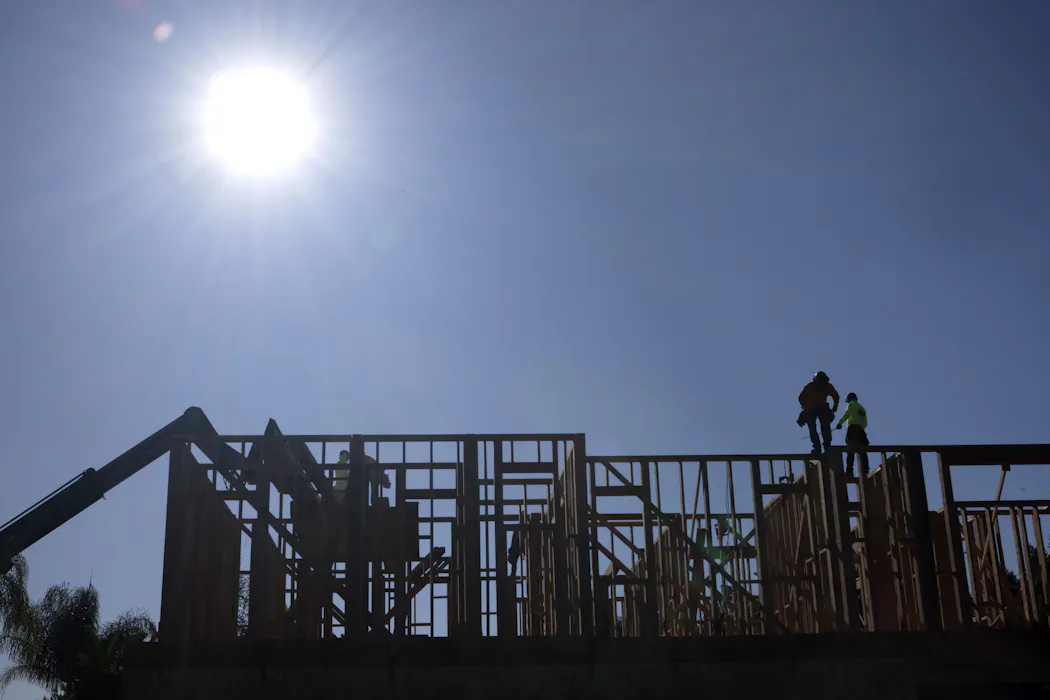
Despite the Trump administration's immigration crackdown, U.S.-born workers aren't seeing more jobs or higher wages, including in sectors with a high share of immigrant labor. AP Photo/Richard Vogel

President Donald Trump campaigned on a promise to strengthen the labor market. His immigration platform – including a pledge to conduct the largest deportation campaign in U.S. history – was central to that promise.

“For too long, Washington ignored how mass illegal immigration artificially suppressed wages, hurting working-class Americans – especially young men,” wrote Treasury Secretary Scott Bessent on X in July 2025. “But under President Trump, we now have a secure border, a blue-collar wage boom, and major investments from trade deals.”

The labor market tells a different story. In the first year of Trump’s second term, unemployment rose, hiring slowed and wage growth stagnated. The construction sector was hit particularly hard.

We’re scholars of labor markets, immigration and public environmental policy who have examined how these economic trends can be traced to the mass deportation campaign of Trump’s second term. Notably, while areas with heavier ICE enforcement saw a drop in employment among immigrants, there was no increase in either employment or wages among U.S. citizens.

A chilling effect on immigrant workers

Using data from October 2023 through November 2025, we looked at employment rates and wages for immigrant and U.S.-born workers in places that experienced sudden spikes in ICE arrests and compared them to places that did not.

In the regions where U.S. Immigration and Customs Enforcement ramped up its activity, we found a significant drop in the employment rate among likely undocumented immigrants who were neither detained nor deported. This was especially notable in sectors where such workers are heavily represented – such as agriculture, construction, manufacturing and wholesale markets – where we found a 4% drop in the employment rate.

These immigrants appeared to be staying home out of fear, a concern that’s widespread. In a Pew Research survey from summer 2025, 43% of foreign-born respondents said they feared deportation for themselves or someone close to them. We call this a chilling effect, since these people aren’t physically removed from the labor market. Instead, they changed their behavior because of ICE.

The chilling effect on employment in Trump’s second term is roughly double of what we found in prior work on mass deportations, when we looked at a program in President Barack Obama’s first term called Secure Communities. As we wrote in a companion paper co-authored with sociologist Caitlin Patler, a likely explanation is that ICE arrests during Trump’s second term have been far more indiscriminate and visible: The average number of daily ICE arrests was higher than any time in the past 10 years. The percentage of arrests conducted in public spaces – streets, workplaces, courthouses and school parking lots – more than doubled, rising from 19% to nearly 50% of all apprehensions. As a result, the intimidation effect was likely more widespread.

The broader effects

Trump pledged during his 2024 presidential campaign to focus ICE enforcement on criminals, especially violent offenders. In fact, we found the share of immigrants arrested by ICE who had a criminal conviction fell to a nearly record low in this time period, from roughly 60% in January 2025 to under 30% by the end of the year.

The economic effects have extended beyond immigrant workers. More broadly, many consumers have pulled back.

Other researchers have found that in cities with expanded ICE raids in 2025, consumer spending and economic activity fell. In February 2026, for example, Minneapolis officials estimated that the city’s economy lost US$203 million due to falling restaurant, hotel and retail revenues, as well as lost wages. Another analysis found that states with enhanced ICE enforcement saw aggregate credit- and debit-card spending drop by 1.7 percentage points compared with those that did not.

Scholars have found similar effects with foot traffic, which dropped sharply in areas where ICE expanded its activities. A Wharton study released in May 2026, for instance, estimated that foot traffic in areas heavily impacted by ICE operations dropped by 2.7%, with spending down by 6.2%, per week.

A view of mostly empty stores in the 24 Somali Mall in Minneapolis, Minn., on Jan. 15, 2026.
In areas with heavy ICE enforcement, economic activity and foot traffic have fallen. AP Photo/Abbie Parr

What happened to US-born workers?

Trump’s core political promise was that deportations would open up jobs for American workers. But we found the opposite: Employment among U.S.-born workers also declined in areas with heightened ICE activity. And employers didn’t respond by raising wages to attract more Americans to their workplace. Their demand for workers contracted instead.

At issue is the premise that foreign-born and U.S.-born workers directly compete for the same jobs. But the example of Trump 2.0 underscores a different dynamic. As we and other economists have documented, the labor market is not zero-sum. Immigrants and U.S.-born workers tend to fill complementary jobs rather than compete for identical ones.

Construction is a clear example. Fewer undocumented laborers on a job site means less work for the electricians, roofers and supervisors – roles more commonly held by U.S.-born workers who depend on those projects moving forward.

The broader stagnation of employment in the construction industry in 2025 fits this pattern. It also mirrors earlier findings that Obama-era deportations reduced homebuilding and pushed up new-home prices.

Immigration crackdowns are, of course, nothing new in U.S. history. In the early 1930s, President Herbert Hoover expelled 400,000 Mexican workers, which lifted neither wages nor employment of U.S.-born workers. Obama’s Secure Communities program in the 2010s had similar results.

And as our most recent research shows, mass deportations don’t create new job opportunities for American citizens. Presidents seeking to strengthen the labor market will need to look elsewhere.

The Conversation

Chloe N. East receives funding from the Russell Sage Foundation and NSF.

Elizabeth Cox receives funding from the Russell Sage Foundation and the National Science Foundation.

  •  

TMZ descends on Washington in a test of whether tabloid tactics can serve the public interest

Will the Hollywood gossip outlet be able to hold those in power to account? Gabriel Bouys/AFP via Getty Images

Headlines on sex, drugs, sports and divorce always attract eyeballs. In fact, the entire tabloid industry has been built on the public’s hunger for scandal and schadenfreude.

TMZ is no exception. Through the years, it has become the go-to source for celebrity gossip, salacious affairs and public meltdowns.

So what to make of TMZ’s decision to recently launch a Washington bureau – TMZ DC – to cover the Beltway’s feuds, scandals and power struggles?

While some congressional staffers have been apprehensive about this new venture, I’m excited to see how it plays out. I’ve studied and written about how aspects of TMZ’s business model and audience engagement tactics can be replicated by local media to serve the public good.

Now that the outlet is setting its sights on the nation’s political actors, there will be an opportunity to see whether its controversial methods translate into holding those in power to account.

You are now entering the ‘thirty mile zone’

Celebrity journalism had been around since the creation of 18th-century scandal sheets, which published gossip about European aristocrats, royals and political elites. In the 19th century, the penny press emerged in the U.S. – cheap newspapers that competed for the public’s attention by running articles detailing crimes, scandals and lurid accounts of city life. Newspaper publishers William Randolph Hearst and Joseph Pulitzer supercharged this approach through what became known as “yellow journalism,” a sensational, emotionally charged style of reporting that flourished in the late 1800s.

TMZ repackaged this model for the digital age.

After a three-year stint as host of the syndicated TV show “Celebrity Justice,” Harvey Levin founded TMZ in 2005 with backing from Warner Bros. The name is a nod to Hollywood’s “thirty mile zone” – the roughly 30-mile radius around Hollywood that the entertainment industry uses to determine whether film and TV productions are considered “local” shoots or “on location.”

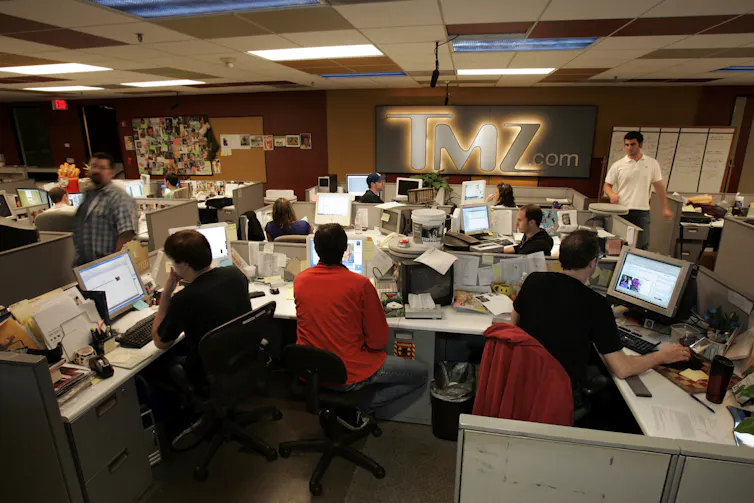
A crowded newsroom with cubicles and desktop computers.
TMZ’s former newsroom in Glendale, Calif., pictured in 2007. Ann Johansson/Corbis via Getty Images

From the start, TMZ has come under fire for its aggressive reporting tactics and its prioritization of speed over sensitivities.

Many of its posts hypersexualize women. Its articles often lack bylines, which allows it to promote its brand over the work of its reporters. The outlet has also allegedly cultivated a network of paid informants, which violates journalistic ethical norms. And it treats any and all celebrities as fodder for clicks, no matter how humiliating or intrusive the story.

TMZ has covered celebrity deaths in ways that most mainstream media outlets wouldn’t consider. It posted Michael Jackson’s autopsy report in an accessible PDF file. It published an article about Kobe Bryant’s death in 2020 before authorities had widely confirmed the news. And after One Direction member Liam Payne fell to his death in 2024, TMZ published a cropped photo of the corpse with identifying features. The ensuing outrage compelled the outlet to remove the images.

TMZ takes its talents to DC

TMZ’s content and approach were shaped by the web’s demand for speed, visuals and clicks.

However, while yellow journalism often resulted in articles that were exaggerated or misleading, TMZ usually takes pains to be rigorous and accurate in its reporting. The outlet’s journalists have become experts at records-based reporting, which involves scouring publicly available information or filing public records requests to build stories via court filings, property and tax records, police reports, financial disclosures, corporate filings or government databases.

TMZ’s attention to the dockets in Los Angeles-area courthouses has long given the outlet an edge in being the first to report on divorces – from those of Angelina Jolie and Brad Pitt and Britney Spears and Sam Asghari to, more recently, Nicole Kidman and Keith Urban’s split.

But more importantly, this type of document-based, investigative reporting is just the sort of approach that I think is needed to produce more public interest journalism. The focus simply needs to move from face-lifts and custody battles to lobbyists and insider trading.

Media scholar Patrick Ferrucci and I have explored how TMZ engages and holds its audience through a mix of original multimedia content, document-based reporting, sports-themed coverage and sensational headlines.

Yes, the outlet primarily focused on celebrities. But we wondered why traditional news organizations weren’t taking a page from TMZ’s book and covering elected officials like the paparazzi covered celebrities.

A reality show worth covering

This isn’t TMZ’s first attempt at covering national politics.

In 2007, there was a proposal for a Washington branch. However, its parent company, Time Warner, nixed the venture, deeming it too risky to mess with the bureaucrats that regulate its empire.

But with spectacle, personality clashes and corruption increasingly defining American politics – not to mention a former reality TV show host serving as president – it was only a matter of time before TMZ would have a second go at it. Plus, as TMZ DC Co-Managing Editor Charlie Cotton told Politico, the public deserves to know as much about public officials as they know about “The Real Housewives.”

TMZ already had a history of covering politics and bad actors. During the 2008 financial crisis, the outlet was able to channel its mean-girl energy into populist rage: After Congress approved US$700 billion to bail out banks, the outlet circulated images of bank employees partying with their bonus money.

In March 2026, before launching its Washington bureau, TMZ did something similar: It asked its audience to find photographs of members of Congress on vacation during a partial government shutdown that was forcing TSA employees to work without pay.

The call-out soon bore fruit. The outlet posted images of Sen. Lindsey Graham at Disney World that went viral, subjecting the South Carolina Republican to a news cycle’s worth of ridicule.

TMZ’s descent on Washington has also coincided with the rise of news influencers: social media users with hundreds of thousands – sometimes millions – of followers who post regularly about news and politics. They include V Spehar, Aaron Parnas and Heather Cox Richardson.

Quick to post and churn out content, their segments often go viral. In a nod to their digital clout, the Trump White House has even held influencer briefings.

TMZ’s reporters share similarities with these influencers. They don’t necessarily have a traditional journalism background, nor do they strictly adhere to journalistic values. Ethics can be cast aside for clout or virality. Both understand the power of bite-sized content, with TMZ pioneering the short-form blog post to break news, and influencers using their own authentic voice to gain audience trust.

Now, TMZ is pulling from the best practices of these influencers: Its staff will increasingly post short videos of themselves on social media breaking down stories. Talking directly to the camera via vertical video feels more like personal interaction instead of a stagnated and removed broadcast. This can be a key driver of audience engagement and trust.

Though it hasn’t been a paragon of ethics, TMZ has largely earned the trust of the public and – perhaps begrudgingly – of legacy media.

Time will tell if TMZ DC can become a watchdog in today’s fractured media environment. But with today’s political ecosystem now driven as much by virality as policy, I think TMZ is well positioned to go hard after the hypocrisy, backroom deals and scandals of the nation’s elected officials.

The Conversation

Angelica Kalika does not work for, consult, own shares in or receive funding from any company or organization that would benefit from this article, and has disclosed no relevant affiliations beyond their academic appointment.

  •  

A newly rediscovered moth species in Florida may already be at risk

For decades, the Florida sack-bearer moth was hiding in plain sight among collections of other sack-bearer moths around the U.S. Ryan St Laurent

To the untrained eye, the Florida scrub ecosystem isn’t much to look at. Scattered in patches around coastal and inland Florida, the scrub landscape is dominated by shrubs and short oaks, all growing out of sandy soil.

“Scrub” is truly an apt name for it.

But this habitat is home to a number of unique plant and animal species, including the threatened Florida scrub-jay, the only bird found only in Florida.

The list of specialized scrub animals grew longer this spring when I officially named – and found in the wild – a species of moth unique to the Florida scrub.

I’m an evolutionary biologist and entomologist, serving as curator of entomology at the University of Colorado Boulder Museum of Natural History. In March 2026 I, along with my collaborators, Scott Wehrly and Jeff Slotten, published an article in ZooKeys describing this new moth from the Florida scrub.

I colloquially refer to it as the “Florida sack-bearer,” but it’s formally known as Cicinnus albarenicolus, Latin for “white sand dweller.” The name “sack-bearer” indicates that it belongs to a small family of moths known as Mimallonidae whose caterpillars make sacklike cases that they haul around, kind of like the way a hermit crab carries around a shell. There are just over 300 sack-bearer species, with only six, including our new one, known from North America.

deep white sand and shrubs with a few larger trees in the distance
Florida scrub makes up 70% of Ocala National Forest. Ryan St Laurent

The discovery

The recent publication of our scientific paper was the first time the scientific community learned of the moth’s existence, but it is the culmination of more than a decade of work.

I have been studying sack-bearers throughout my professional career, which started as an undergraduate at Cornell University, where I worked in the Cornell University Insect Collection. It was in this collection that a small sample of sack-bearer moths collected in Florida, with a chunky body and pink-hued wings spanning about 1.25-1.5 inches (3-4 centimeters) – medium size for a moth – caught my eye.

I began to wonder whether perhaps this moth was a separate species of sack-bearer, because it looked quite different from the more beige-colored Melsheimer’s sack-bearer that is common all over the eastern United States, including Florida. But I did not yet have enough data to substantiate my theory.

Then as a graduate student at the University of Florida, I delved into learning more about sack-bearer evolution. Whenever I had a free moment, I spent time in the field looking for wild individuals of the still-unnamed Florida sack-bearer. But still, no luck.

Then I spent three years as a postdoctoral fellow at the Smithsonian National Museum of Natural History. Even though I was primarily working on a completely different group of moths, I had not forgotten about the Florida moth. And there, in the Smithsonian collections, I found a single specimen of a Florida sack-bearer from 1960.

Fortunately, it was a recent enough specimen to yield a good DNA sample. This allowed me to get the final piece of information that I was looking for: a DNA sequence to confirm that this moth was distinct from its relatives.

The genetic results were unequivocal: The Florida species was clearly distinct, thus confirming my long-held suspicions that this was a new, undescribed species of moth. This was the final piece of information I needed to start writing the paper formally describing and naming the new moth.

man wearing headlamp looking at moth
The author used a special light to attract the moth in the wild. Photo by Jeffrey Slotten

Encounter in the wild

As excited as I was to describe a new species, I feared that the moth might already be extinct, since no recent specimens existed and the Florida scrub habitat is highly degraded, down to about 10% of what ecologists estimate was present prior to European settlement.

But I contacted various moth collectors in Florida to see whether anyone had seen this moth recently, and to my surprise one of them had. The co-authors on the Zookeys paper, Jeff Slotten and Scott Wehrly, helped me discover a small set of specimens from the 2010s and 2020s that Scott had collected. This discovery, in late 2025, allowed me to add some new specimens to the paper and update the text reporting this newly discovered collection of more contemporary samples of Florida sack-bearers.

Knowing that all sightings of this moth occurred between March and May, I traveled to Florida in April. I was hoping to see it for myself and learn more about its active times, habitat requirements, diet, mating habits and other aspects of its biology – all still completely unknown. Since the recent specimens were all male, I set the goal to find a female, which would be the first one seen in over 60 years. Finding a female would also be an opportunity to collect eggs.

On April 18, 2026, I traveled to a new site that I had scoped out back in grad school, and sure enough, at 8:49 p.m., I found a female at my specialized moth light trap. This female was followed by two others, and I was able to collect eggs. Hopefully this summer these will yield a bunch of caterpillars so my colleagues and I can observe the moth’s full life cycle and learn more about this elusive insect.

What makes the Florida sack-bearer so special?

Without knowing more about it, it’s challenging to articulate what this moth’s larger role in the ecosystem might be. And that is precisely why this discovery is important.

One possibility that is already becoming clear is that this species may be an excellent indicator of Florida scrub health and how different forest management techniques affect the scrub ecosystem. My recent field work indicates that this particular moth may be thriving in areas experiencing more recent and frequent prescribed burns, but this hypothesis needs further study. My hope is that studying this moth will give a better sense of how to manage scrubs in order to protect this and other species with similar habitat requirements.

The evolution of the Florida sack-bearer also remains a puzzle. Just how did it get to Florida in the first place? White sand scrubs are thought to be older than yellow sand scrubs of Florida and are formed from ancient sand dunes. Perhaps the Florida sack-bearer is an ancient relic of a time when Florida was very different from today.

By studying this moth and its distribution in the state, we may better understand how sack-bearers arrived in North America from Central and South America millions of years ago.

pinkish moth on branch
The author found a female Florida sack-bearer in the wild. Ryan St Laurent

What’s in a name?

In total, only 19 specimens of the Florida sack-bearer were known to me at the time of its formal description. Only three of those were collected after 1964, and those all came from locations near Ocala, Florida. The other 13 specimens are from just five white sand scrub habitats scattered across peninsular Florida. While the news that the moth persists in at least a couple of places is welcome, sites that supported this moth back in the 1960s may no longer have enough scrub habitat due to substantial habitat loss.

It’s possible that this moth has been discovered just in time to realize it’s at risk of going extinct. But my hope is that by naming this rare moth, our team has enabled conservationists and legislators to fight for its protection.

The Conversation

Nothing to disclose.

  •  

Summer between high school graduation and college is a critical time for preventing risky behaviors – here’s how parents can play a key role

Teens experience newfound freedoms as they enter college. FatCamera/E+ via Getty Images

Early summer is a valuable time for parents and young people to prepare for the transition to college in the fall.

As first-year college students arrive on campus every fall, a predictable pattern unfolds. Rates of heavy drinking spike, social pressures intensify, and the risk of sexual assault, injury and other harms increases.

Many parents feel trepidation about their teens navigating this landscape of opportunity and risk. And unfortunately, too often, students don’t receive guidance from schools or caregivers as they make this major life transition.

Research suggests that the summer before college can be a critical window to help students prepare for the social and emotional realities they are about to face, and to reduce risks before they begin. And parents and caregivers can play a key role.

We are a sociologist and a research scientist, and each of us studies different aspects of prevention science.

When we went to college in the 1980s and early 2000s, the dominant message to families was to step back and let students figure things out on their own, and we struggled to adjust. Looking back, we wish our families had received clear guidance and resources for how to stay connected and support us during this transition.

A perfect storm

While students may legally be adults when they leave for college, key parts of the brain – particularly those involved in judgment, impulse control, emotional regulation and decision-making – are still developing well into their mid-20s. At the same time, the parts of the brain tied to reward, emotion and social belonging are especially sensitive during this stage of life.

This combination can make young people more likely to prioritize immediate rewards, peer acceptance and emotional reactions over careful assessments of risk – especially in environments with fewer guardrails and greater access to alcohol and other drugs.

Students are also navigating enormous change: separation from family, pressure to fit in, loneliness, uncertainty and the challenge of building a new identity and social network. Even positive transitions such as moving or getting a new job can create significant stress.

Many students turn to alcohol and other substances to manage stress, reduce anxiety and navigate social belonging in environments where substance use is often normalized – or even expected.

Unfortunately, substance use impairs judgment, increases impulsivity and amplifies vulnerability to a range of other high-risk behaviors and harms. And this struggle, as one of us, Beverly Kingston, experienced, can be more than a phase.

The risks are real, but they can be addressed

The spike in drinking and other risky behaviors during the transition to college is not inevitable. And parents and other adults in young peoples’ lives matter during this developmental transition to adulthood, more than many realize.

For instance, research clearly shows that parents’ attitudes and norms around drinking play a big role in how their children engage with alcohol, both as teens and in adulthood. When students believe their parents are permissive about alcohol, they are more likely to drink and binge-drink.

Even well-intended efforts to encourage “safe” drinking send the wrong message. Many parents believe letting teens drink at home in a supervised environment is safer, but decades of research in the U.S. and internationally show that this unintentionally signals to teens that drinking is acceptable and contributes to higher alcohol use later on.

Yet when parents communicate clear expectations and have honest conversations about alcohol, it can reduce risk and support healthier decision-making. Conversations about binge drinking, peer pressure, stress and decision-making can help students navigate environments where alcohol use is often normalized.

One of us, Clara Hill, works on research related to a tool for navigating these conversations, a parent handbook called “First Years Away from Home: Letting Go and Staying Connected.” In a randomized clinical trial, the most rigorous type of research study available, students whose parents used this handbook during the summer before college were significantly less likely to start or increase substance use during their first semester.

However, the focus of the handbook is not only on substance use. It also serves as a tool kit to guide parents in talking to their young adults about values, expectations and relationships.

Small group of young adults standing in a circle holding sparklers in a festive setting.
With the freedoms that come with college, kids find themselves in a lot of situations where alcohol and other substances are easily accessible. SolStock/E+ via Getty Images

Support, not surveillance

Many students say they want their parents involved in their lives – just not overly involved. They want emotional connection, guidance and support while also being trusted to grow into independent young adults.

To achieve this balance, parents may find it helpful to think of themselves as holding three important roles during the college years. These roles are the cheerleader, who provides emotional support; the coach, who supports autonomy by helping students clarify their values and problem-solve; and the safety monitor, who communicates clear expectations around issues of potential harm and checks in about health and risk behaviors.

Different scenarios – roommate conflicts, poor grades, mental health struggles – will call for parents to embody new parenting roles during this time, distinct from what children needed during adolescence or childhood.

Support can begin with honest conversations before students ever arrive on campus. Parents can talk with their students about stress, loneliness, belonging, alcohol and substance use, relationships, values, safety and how to respond when things do not go as planned.

Looking back, both of us entered college carrying expectations and fears we did not fully understand. When the transition became harder than expected, it fell to us to navigate loneliness, uncertainty and the pressure to fit in.

Finding the right balance

Parents, too, often feel adrift; they want to help, but may receive mixed messages from the media and from colleges about how much they should be involved in their new college student’s life.

Feeling pressure to optimize their young adult children’s success, while also being cautioned against “helicopter parenting,” can lead parents to step back more than necessary when it comes to offering guidance and support.

Today, researchers know much more about what helps young people navigate this major life transition and thrive. Students do not stop needing support when they leave home, and parents do not have to disappear in the name of independence; parents can lovingly support young adults’ growing autonomy.

When students are surrounded by connection, guidance and support, the transition to college can be healthier, safer and less overwhelming. And the time to begin building that support is before students ever arrive on campus.

The Conversation

Clara Hill works for Washington State University, where the "First Years Away from Home: Letting Go & Staying Connected" handbook was developed. She receives funding to disseminate the handbook to universities in Washington State from State Opioid Relief funds, which are granted by the Substance Abuse and Mental Health Administration (SAMHSA) to the Washington State Health Care Authority.

Beverly Kingston does not work for, consult, own shares in or receive funding from any company or organization that would benefit from this article, and has disclosed no relevant affiliations beyond their academic appointment.

  •  

Where did language come from? Nobody really knows, but the theories are fascinating

Sriharu Kapu/Unsplash

Humans are the only species known to use fully symbolic language: a system capable of expressing abstract ideas, imaginary worlds and endless combinations of meaning. But how did we get there?

The origins of language have fascinated philosophers, scientists and storytellers for thousands of years. Despite all our advances in linguistics, archaeology and cognitive science, we still don’t know exactly how language began.

That uncertainty hasn’t stopped people from trying to solve the mystery. In fact, some of the earliest theories of language’s origins are among the strangest and most entertaining ideas in the history of science.

Bow wow, ding-dong

In the 19th century, scholars proposed a flurry of curious theories to explain how speech first emerged. Many of these theories were given playful nicknames by the German philologist Max Müller, who intended them partly as satire. Yet the theories were genuine attempts to tackle one of humanity’s biggest questions.

German philologist Max Müller gave playful nicknames to competing theories of language’s origins. Public domain, via Wikimedia Commons

The most famous is probably the Bow-Wow Theory. This suggested language began through imitation of natural sounds. Early humans, according to this theory, copied the noises around them: animal cries, splashing water, thunderclaps and birdsong. Words such as “buzz”, “hiss”, “bang” and “splash” seem to support the idea because they sound like what they describe.

But there is a problem. Different languages hear the same sounds differently. English dogs go “woof” or “bow-wow”, but in Turkish they go “hev-hev”, while Indonesian dogs go “guk-guk”. Even animal noises, it turns out, are filtered through culture and language.

And onomatopoeic words (words that imitate sounds) make up only a tiny fraction of our vocabularies. Most words sound nothing like their meanings. For instance, there is nothing inherently tree-like about the word “tree”.

That brings us to the Ding-Dong Theory, which argued that sounds and meanings are naturally connected in some deeper, almost mystical way.

Some words do seem to fit their meanings uncannily well. “Mini”, “teeny” and “itsy-bitsy” feel small and delicate. “Lump”, “rump” and “plump” sound heavier and rounder.

Modern linguists call this sound symbolism. One famous experiment asked participants to match two nonsense words, “bouba” and “kiki”, to two shapes: one rounded and one jagged. Most people matched “bouba” with the soft shape and “kiki” with the sharp one.

The effect is real, but it is limited. Most language still appears to be arbitrary, which means there is no natural reason why a particular sound should mean a particular thing.

Pooh-pooh, la-la, ye-he-ho

Other theories focused less on imitation and more on emotion and social interaction.

The Pooh-Pooh Theory proposed that speech began with instinctive emotional cries such as “ouch”, “oh” or perhaps less publishable exclamations uttered after stubbing a toe. According to this idea, language evolved from spontaneous vocal reactions to pain, surprise, fear or joy.

Again, though, there are complications. Interjections vary widely across languages. English speakers say “ouch”. Greeks say “aou”. Czechs might exclaim “ach”. Emotional sounds are not nearly as universal as they seem.

Then there is the wonderfully named Yo-He-Ho Theory, which suggested language emerged from rhythmic chants used during collective labour, like sailors chanting “yo-heave-ho” while hauling ropes, or workers singing together to coordinate physical effort.

The theory may sound quaint, but modern researchers do think rhythm, cooperation and social bonding played important roles in human evolution. Language is, after all, deeply social.

Charles Darwin speculated that speech evolved from musical expression. Herbert Rose Barraud, Public domain, via Wikimedia Commons

Another proposal, the La-La Theory, linked language to music. Charles Darwin entertained the possibility that speech evolved from musical calls used in courtship and emotional expression. Before humans spoke, perhaps we sang?

Some modern theories echo this idea. One hypothesis suggests that, as early humans began walking upright, parents increasingly needed to soothe babies from a distance. Sing-song vocalisations, cooing and proto “baby talk” may have helped strengthen emotional bonds and eventually paved the way for speech.

Gestures, symbols and brains

Today, most scientists think no single theory fully explains language origins. Instead, language probably emerged gradually through a combination of gestures, vocalisations, facial expressions, social cooperation and increasing cognitive complexity.

Some researchers argue that language began with gestures before shifting to speech. Others believe language evolved as a tool for social bonding, allowing larger groups of humans to cooperate and share information. Still others see language as tied to the evolution of symbolic thought itself: our ability to imagine, plan, remember and communicate abstract ideas.

Biology is also a factor. Humans have developed unusually precise control over the tongue, lips and vocal tract. We have evolved specialised brain regions linked to language processing.

But anatomy alone cannot explain language. Parrots can mimic speech sounds. Many animals communicate. None, however, appear to possess grammar and symbolism on the human scale. And, frustratingly, early language leaves no evidence behind. Spoken words don’t fossilise.

That lack of evidence is one reason the topic became so controversial that, in 1866, the Société de Linguistique de Paris banned discussions about language origins altogether, dismissing the field as hopelessly speculative.

Saraswati, Hindu goddess of knowledge and speech – Raja Ravi Varma (1894) Public domain, via Wikimedia Commons

Of course, theories about language origins also appear in religion and mythology. In Greek mythology, the messenger god Hermes was associated with language and communication. In the Hindu tradition, the goddess of knowledge and speech Saraswati bestowed Sanskrit upon humanity. In the Judeo-Christian tradition, language was a gift from God, who enabled Adam to name the animals in the Garden of Eden.

These stories reflect something deeply human: our urge to explain where language came from, because language itself feels almost magical. Every theory of language origins captures a small piece of the puzzle. Imitation, emotion, rhythm, music, gesture, cooperation and symbolic thought probably all played some role.

But none can provide a complete answer. The truth is that language evolved so long ago, and likely so gradually, that we will never pinpoint a single moment when it began, unless someone invents a time machine.

The birth of language will probably remain one of humanity’s greatest unsolved mysteries. Still, the theories themselves tell us something important. Humans are always trying to explain what makes us human. And language may be the most human thing of all.

The Conversation

Karen Stollznow does not work for, consult, own shares in or receive funding from any company or organisation that would benefit from this article, and has disclosed no relevant affiliations beyond their academic appointment.

  •  
❌