Reading view

Who are the main contenders to replace Keir Starmer as prime minister?

It has become a given in Westminster circles that Keir Starmer’s tenure as prime minister could be nearing its end. This is because, fairly or unfairly, the UK public have made up their minds – and they do not like him.

Labour MPs know this all too well, having seen the level of animosity on the doorstep during recent election campaigns in England, Wales and Scotland. They just didn’t immediately know what to do about it. But then Wes Streeting quit as health secretary, criticising Starmer in his resignation letter for what he said was a “vacuum” where political vision was required.

Recent UK history is full of precedents when prime ministers found their position untenable. For the Conservatives, Theresa May, Boris Johnson and Liz Truss were all removed eventually. But such a course of action comes with costs: to party unity, to market sentiment, and in terms of how the voters view political shenanigans.

This is why, until now, the more thoughtful voices in the Labour party either kept their counsel or argued for caution. But a significant number of Labour MPs believe that a change at the top is now inevitable.

Streeting, Rayner or Burnham

From the right of the party, Streeting, the combative former health secretary, is the key figure to challenge Starmer. But he still requires the backing of at least 81 fellow Labour MPs.

A Streeting bid for the leadership would be supported by much of the media, but what many regard as his lukewarm re-tread of old Blairite orthodoxies would limit his appeal with the party membership. And members play a significant role in leadership contests.

By contrast, a likely candidate of the so-called “soft left”, former deputy prime minister Angela Rayner, has now cleared up her tax affairs and is more popular with the party rank-and-file. But she would alienate much of the London commentariat.

What neither Streeting nor Rayner possess is genuine cut-through with the wider British public. And this is where the current mayor of Greater Manchester, Andy Burnham, comes in. Burnham does not have a parliamentary seat and, although he intends to contest the Makerfield constituency made vacant by Josh Simons’ decision to step aside, it is not guaranteed that he will win. Given Labour’s current unpopularity, the party cannot assume it would win a by-election anywhere.

And even if Burnham did scale that hurdle, there is a real danger that his replacement as the Labour candidate for the mayoralty would lose to Reform UK. This would allow party opponents to portray Burnham’s move as an indulgence at the expense of the party.

Nevertheless, if the political stars were to align and Burnham navigates his passage back to Westminster in time for a leadership challenge, he would be a formidable opponent. Burnham not only outpolls his main rivals among Labour members, he also enjoys rare net approval ratings with the public (+6, compared with -12 for Rayner and -20 for Streeting). Labour MPs will be paying particular attention to those numbers.

There is strong reason to believe that Rayner will have a crucial role in how this plays out. This could either be by standing for leader herself or through working with Burnham. Either way, she is in an incredibly influential position.

And what would Labour and the country look like under new leadership? The revolving door at the top partly reflects the extent of the challenges (economic, political, cultural) that the country faces. Voters have not seen rises in their real living standards for two decades, are truly angry and deeply polarised.

The UK is divided on how to go forward, and so is the Labour Party. That is why potential challengers to Starmer really should be careful what they wish for. Much of the political instability of recent years is down to the collective obsession with politics as a short-term and personality-based kind of show business.

But this ignores the more worrying long-term developments in financial markets that indicate that there is no faith in the UK’s ability to tackle its structural problems any time soon. The eventual winner of Labour’s leadership drama may inherit the throne just as money markets’ patience with the UK runs out.

The Conversation

Charles Lees does not work for, consult, own shares in or receive funding from any company or organisation that would benefit from this article, and has disclosed no relevant affiliations beyond their academic appointment.
  •  

Battleground Vienna: Austrian intelligence officer convicted of spying for Russia belongs to a long tradition

Egisto Ott is no James Bond. But the stories the 63-year-old Austrian told a Viennese jury recently would make good plotlines. Ott worked as an intelligence officer in Austria’s now-defunct Federal Office for the Protection of the Constitution and Counterterrorism. He was also moonlighting for the Russians.

Prosecutors say Ott, who was sentenced to four years in prison on May 20, handed over information to fellow Austrian Jan Marsalek, the fugitive former executive of the collapsed payments firm Wirecard. Marsalek ran a cell of Bulgarians who were convicted in London in 2025 of spying for Russia. They called themselves the “minions”.

In 2023, the London Metropolitan police in cooperation with MI5 secured chat messages between Marsalek and the minions, which led to Ott. It turned out Ott had provided sensitive data on dissidents, investigative journalists and a Russian intelligence defector. The trial also revealed that Ott had obtained the infamous “canoe-trip-mobiles”.

In 2017, high-ranking Austrian civil servants went on a canoe trip in a tributary of the Danube River. They managed to fall into the water and had their phones sent in for repairs. Their mobile data was copied by Ott and subsequently ended up in Moscow, along with Marsalek’s favourite Viennese chocolate cake, a Sachertorte. According to the chat messages, the minions had a stressful time finding the correct one (there are rival Sachertorte recipes).

What sounds like a comic opera has a sinister backstory. Since the 1950s, Austria has hosted several international organisations that are regularly targeted by intelligence services. These include Opec (the Organization of Petroleum Exporting Countries), the International Atomic Energy Agency and the United Nations Office on Drugs and Crime.

However, Austria’s reputation as a spying hub dates back even longer. The Austrian capital, Vienna, was known for espionage before and after the second world war. Arnold Deutsch, the recruiter of the Cambridge Five spy ring that passed information to the Soviet Union, hailed from Vienna. Its leading light, Kim Philby, was also talent-spotted by Soviet intelligence in the city in 1933.

But Vienna was never just a playground for Soviet intelligence. After the war, when the city was divided into four sectors for allied occupation, the UK’s foreign intelligence service, MI6, started its most creative cold war operations. Peter Lunn, head of MI6’s Vienna station, built listening stations in the city to tap Soviet phone lines.

He hid his listening tunnels underneath ordinary shops in the British zone. The first tunnel was built beneath a police station. Later, MI6 built another tunnel under a jewellery shop and then installed intelligence officers posing as a young, rich couple in a Viennese villa. While they were partying upstairs, their colleagues listened in to Russian military traffic downstairs.

The only surviving witness of a listening station today is Sir Rodric Braithwaite, whom I first interviewed in 2024. As a 19-year-old conscript, Braithwaite worked with British Army Field Security in the Aspang listening station, next to the Aspang Bahnhof (a train station on the outskirts of Vienna).

It wasn’t an uplifting experience. He sat there for long shifts with earphones on, handling old equipment and pressing recording buttons. But his memories of the tunnel are valuable because to this day MI6 has not released any photos, let alone recordings, that were made during these operations.

The Third Man

They have also not revealed the details of another highly creative intelligence operation. In 1948, a British team arrived in Vienna to film The Third Man, a thriller set in the city. They were eager to shoot scenes in the Soviet sector.

Four key people involved in the making of the film were working for British intelligence: novelist Graham Greene, director Carol Reed, “Austria advisor” Elizabeth Montagu and, most importantly, producer Sir Alexander Korda. Korda’s film production company had been providing covers for British intelligence officers in Europe since the 1930s.

Whether the filming of The Third Man was connected to Lunn’s tapping operations, or whether MI6 had to smuggle something out of the Soviet sector, is a matter of conjecture. But “odd people” appeared on the set.

Carol Reed in Amsterdam in January 1950.
The director of The Third Man, Carol Reed, in Amsterdam in January 1950. Jack de Nijs / Wikimedia Commons, CC BY

The film’s sound engineer, Jack Davies, remembered a British technician who turned up out of the blue. After filming, the technician vanished completely and Davies never came across him again – something rather unusual in the small world of British film technicians.

The script girl, Angela Allen, who I first interviewed for my book Das Haus am Gordon Place (Vienna ‘48) in 2024, also realised that something odd was going on. She noticed that Carol Reed was under enormous stress in Vienna and kept himself awake with Benzedrine. He stopped taking the drug once they were back in England, filming in London studios.

Allen, who is 97 now, wasn’t surprised to find out years later that Korda was working for the British intelligence services. She told me: “He had enormous charm. He could make his people do everything for him.”

Perhaps that is one reason why Ott and Marsalek failed. To succeed as a spy in Vienna, you need to be a great illusionist like Alexander Korda.

The Conversation

Karina Urbach’s book about spies in Vienna, Das Haus am Gordon Place (Vienna ’48), won the German crime award. Her interviews with Angela Allen and Sir Rodric Braithwaite can be watched here: https://vimeo.com/1086100608

  •  

What Iran’s absence from the Venice Biennale reveals about art and politics

Just days before the opening of the 2026 Venice Biennale, organisers announced that Iran would no longer participate.

A short statement posted to the Venice Biennale website on May 4 said: “With regard to the National Participations in the 61st International Art Exhibition…it has been announced that the Islamic Republic of Iran will not participate.” No explanation was given. I believe that silence is itself revealing.

Iran’s withdrawal is less a sudden decision than the result of converging geopolitical and economic pressures that are reshaping both the global art world and Iran’s place within it.

At the most immediate level, the withdrawal reflects the material realities of crisis. With internet access restricted, international flights suspended and communication networks severely disrupted, even the basic logistics of participation – coordinating, shipping and installing artworks – probably became nearly impossible for Iran.

These conditions have been compounded by intensifying economic pressures, including the sharp devaluation of the Iranian rial, which has made international cultural engagement increasingly difficult to sustain.

An explanation of the Venice Biennale.

Such constraints point to a fundamental condition of contemporary art: global exhibitions rely on infrastructures of mobility and communication that are easily destabilised by conflict and sanctions.

The timing is also significant. The decision comes amid renewed military tensions and escalating political rhetoric surrounding Iran’s position in the global order. In such moments, when political discourse edges toward existential threat, the stakes of cultural visibility are heightened. At the same time, sustaining cultural presence becomes more difficult.


Read more: Middle East conflict looks increasingly like a war nobody can win


More revealing still was the lack of any announced artist, curatorial framework or exhibition concept for Iran’s pavilion, even days before the Biennale’s opening.

Iran’s presence at the Venice Biennale has historically been organised through state institutions, with oversight exercised by the ministry of culture and Islamic guidance since the Iranian revolution (1978-79). As with many national pavilions, this model positions art as a form of cultural diplomacy. But in Iran’s case, it has often produced a disconnect between official representation and contemporary artistic practice.

This gap is significant. The Venice Biennale, often described as the “Olympics of the art world”, remains structured around national pavilions, with each country responsible for presenting its cultural identity on a global stage. Yet, as critics have long argued, it has never been a neutral platform, but a space where art and geopolitics intersect.

More broadly, biennials are deeply embedded in political and institutional contexts, rather than existing outside them. Within this framework, they are often understood as sites of cultural soft power, where nations project influence through artistic production.

National representation in crisis

Iran’s withdrawal must also be understood in relation to the wider turmoil surrounding the 2026 biennale itself. This year’s edition has been marked by extraordinary controversy, including disputes over the involvement of Russia and Israel, calls for boycotts and the resignation of the entire international jury just days before the opening.

These events expose the fragility of the biennale’s longstanding claim to neutrality. Rather than existing outside politics, it has become a site where geopolitical tensions are actively staged and contested.

To exhibit at the biennale is never neutral: it means entering a highly visible arena shaped by competing narratives of legitimacy and power. For the Islamic Republic, this raises a deeper tension. The biennale’s national pavilion model requires countries to present a coherent cultural identity through contemporary art. Yet Iran’s artistic landscape is anything but singular. It is shaped by internal contradictions between state and independent practices, censorship and experimentation and local production and diasporic circulation.

The entire jury resigned just days before the opening.

These tensions are difficult to reconcile within a state-managed exhibition framework. The very premise of the pavilion – art as national representation – sits uneasily with a system in which artistic expression is subject to ideological and institutional control.

At the same time, the Biennale embodies forms of global circulation, cultural competition and visibility tied to international art markets that do not always align with the cultural and political ethos of the Islamic Republic. Representation therefore involves negotiating how a nation appears, to whom, and on whose terms.

The current moment makes this tension even more acute. As political rhetoric escalates and the possibility of large-scale destruction is invoked in global discourse, cultural visibility becomes more urgent. Art offers one of the few spaces through which narratives beyond conflict and diplomacy can emerge. Yet for Iranian artists, cultural presence is becoming more fragmented, shaped by diasporic networks, constrained by national borders and limited by economic and infrastructural pressures.

Iranian artists, particularly those working through independent and diasporic networks, have for decades operated beyond the frameworks of state representation, with their work circulating internationally through alternative artistic circuits. Iran’s missing pavilion, then, does not signal the disappearance of Iranian art. Rather, it reveals the precarious conditions through which that art circulates.

Iran’s absence from the Venice Biennale also highlights the limits of the national pavilion model. The system has frequently been criticised for reducing complex artistic practices to simplified national identities, even as contemporary art now operates through transnational networks that exceed the boundaries of the nation-state.

In Venice this year, the missing pavilion reflects an art world shaped as much by political crisis as by artistic production. Iranian art is not absent from the global stage. Yet the conditions under which it circulates and remains visible have become increasingly fragile.

The Conversation

Katayoun Shahandeh works for SOAS University of London.

  •  

The Bayeux Tapestry tells only the winner’s story – but the other side can be found in old English texts

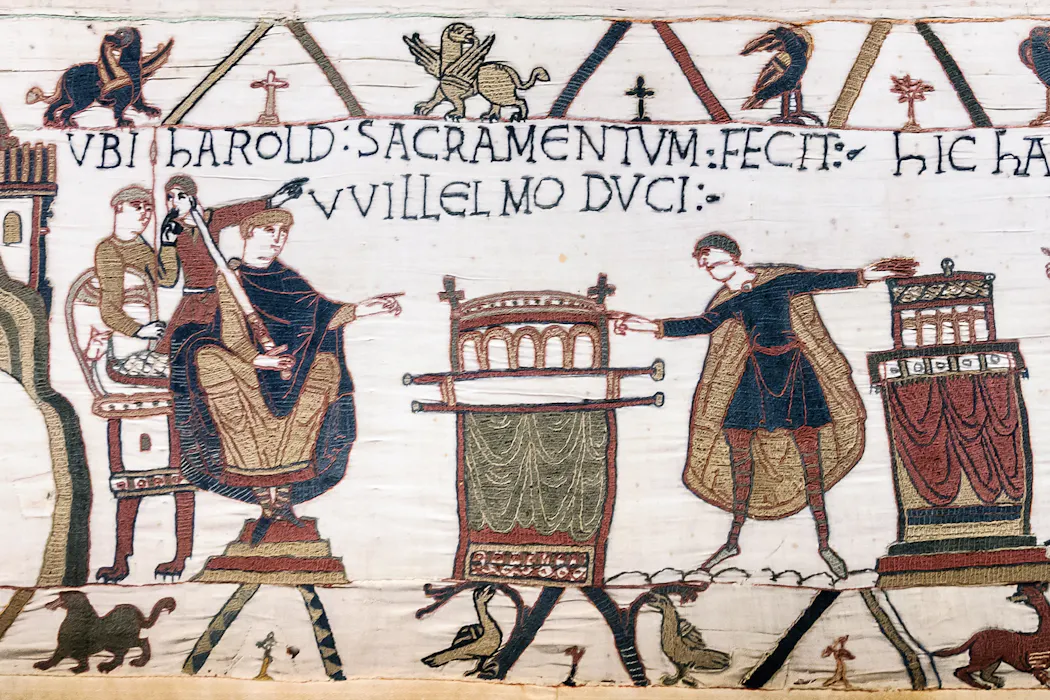
King Harold swearing oath on holy relics to William, Duke of Normandy Wikimedia, CC BY

As the Bayeux Tapestry comes to London, the year 1066 and the Norman Conquest are in the spotlight. The tapestry – an embroidered cloth nearly 70 metres long, created soon after the events it depicts – tells the story of the Battle of Hastings in 1066 and William of Normandy’s triumphant defeat of Harold Godwinson, King of England.

The tapestry depicts William of Normandy as the victor, and Harold as a slippery oath-breaker who promises the English throne to William then goes back on his word. But it shows little of the wider impact of the battle on English people – except for one glimpse, just after William’s ships land at Pevensey on England’s south-east coast, when we see a woman and child fleeing a burning building, torched by Norman soldiers.

So what did 1066 feel like from an English perspective? What was it like to live through the Norman Conquest? Remarkable English documents, written in the thick of events, give us an astonishing insight into the side of the story not depicted on the famous tapestry.

The battle on October 14 1066 had far-reaching consequences for England (and later, more of Britain), as the land passed into Norman control. By 1086, only 8% of the total landed wealth of England was still held by English people, with the other 92% in Norman possession. Language, culture and tradition were trodden under the feet of the new occupying force.

Even more than a century later, the Conquest remained a raw and open wound. Around 1196, the English monk William of Newburgh writes that, whenever it rains, the battlefield at Hastings “sweats real and seemingly fresh blood”.

But some English sources have the power to take us right back into 1066 itself.

Contemporary accounts

The Life of King Edward (Vita Ædwardi Regis), was written between 1065 and 1067 and so takes us through the Norman Conquest in real time. The Life was commissioned for the wife and widow of King Edward the Confessor, Edith, who was also the sister of his successor King Harold II. It was written in Latin, probably by a Flemish monk. It’s a clever piece of political spin, setting out to bolster Edward’s reputation – including his posthumous standing as an emerging new saint.

But, unexpectedly, The Life of King Edward finds itself in the teeth of the Norman Conquest, where it struggles to find words for the devastation that has struck England and its ruling dynasties.

Book I of The Life was completed before the Battle of Hastings and deals with the exploits of the powerful Godwin family, including Edith’s father, Earl Godwin of Wessex, and her brother, Harold – who caught an arrow in the eye (probably) at Hastings.

Book II of the Life opens in crisis and despair. In the silence between the books, the Battle of Hastings has happened. Now, Edith’s husband Edward and her brothers (Harold, Leofwine and Gyrth, as well as Tostig who died at Stamford Bridge) are dead, together with other English nobles and perhaps four thousand English fighters. England’s power lies in tatters.

The writer appeals to Clio, muse of history, for help, as he desperately searches for words. “Alas!” the text exclaims, “What will you say?”

What’s fascinating here is that we don’t actually get a direct account of 1066. Instead, the author of this text is dumbfounded. What we see is a writer reeling from this catastrophic blow to the English ruling elite, talking us through the impossibility of his attempt to chronicle it. Shocked silence speaks louder than words, letting us in on the trauma of the English defeat.

How can anyone articulate the horror that has just unfolded? “What madman,” the author asks, “could write of this?” And how can he present this book to his noble patron, Edith, when – instead of a celebration – it’s now a catalogue of personal loss and the kingdom’s ruin?

Today, the Bayeux Tapestry is incomplete, its final scenes lost long ago. Scholars presume it ended with a depiction of William’s triumphant coronation as King of England. The Life of Edward, instead, shows us an alternative ending: loss, grief and desolation for the English.

Moving to later, a generation after 1066, we find a more considered, deliberate response to the Norman Conquest from defiant English voices.

Monks at Peterborough Abbey continued making year-by-year additions to their monumental Chronicle of English history (often called the Anglo-Saxon Chronicle), written in monasteries across England since the time of King Alfred the Great.

On the death of William the Conqueror in 1087, the monks wrote an epitaph – a poem summing up the life of this mighty king and his legacy. The first line takes us straight inside the reality of life under Norman occupation.

Castelas he let wyrcean ond earme men swiðe swencean (He had castles built and wretched men sorely oppressed)

We glimpse the militarised landscape engineered by the Normans, with castles – their new technology of war and control – built across the country.

The Chronicle poem laments William’s “harshness”, his greed and cruelty to his people. Spitting with irony, it reflects on how he loved his royal forests, lavishing care on boars, hares and stags, while his destitute subjects would be blinded for killing a deer.

“Woe, alas,” the poem proclaims, “that any man should be so proud, / raise himself up and reckon himself over all men”. Just as William has tallied up his new possessions in England – the record of his lands and property in the great Domesday Book – the Chronicle poem takes its own cool and careful accounting to William’s life, and finds it wanting. This is guerrilla poetry, written in English, quietly holding out against the consequences of 1066.

Beyond the Bayeux Tapestry, these medieval documents remind us that every story has another side, and that history is not written only by the victors.

The Conversation

Catherine Clarke does not work for, consult, own shares in or receive funding from any company or organisation that would benefit from this article, and has disclosed no relevant affiliations beyond their academic appointment.

  •  

Who are the main contenders to replace Keir Starmer as prime minister?

It has become a given in Westminster circles that Keir Starmer’s tenure as prime minister could be nearing its end. This is because, fairly or unfairly, the UK public have made up their minds – and they do not like him.

Labour MPs know this all too well, having seen the level of animosity on the doorstep during recent election campaigns in England, Wales and Scotland. They just didn’t immediately know what to do about it. But then Wes Streeting quit as health secretary, criticising Starmer in his resignation letter for what he said was a “vacuum” where political vision was required.

Recent UK history is full of precedents when prime ministers found their position untenable. For the Conservatives, Theresa May, Boris Johnson and Liz Truss were all removed eventually. But such a course of action comes with costs: to party unity, to market sentiment, and in terms of how the voters view political shenanigans.

This is why, until now, the more thoughtful voices in the Labour party either kept their counsel or argued for caution. But a significant number of Labour MPs believe that a change at the top is now inevitable.

Streeting, Rayner or Burnham

From the right of the party, Streeting, the combative former health secretary, is the key figure to challenge Starmer. But he still requires the backing of at least 81 fellow Labour MPs.

A Streeting bid for the leadership would be supported by much of the media, but what many regard as his lukewarm re-tread of old Blairite orthodoxies would limit his appeal with the party membership. And members play a significant role in leadership contests.

By contrast, a likely candidate of the so-called “soft left”, former deputy prime minister Angela Rayner, has now cleared up her tax affairs and is more popular with the party rank-and-file. But she would alienate much of the London commentariat.

What neither Streeting nor Rayner possess is genuine cut-through with the wider British public. And this is where the current mayor of Greater Manchester, Andy Burnham, comes in. Burnham does not have a parliamentary seat and, although he intends to contest the Makerfield constituency made vacant by Josh Simons’ decision to step aside, it is not guaranteed that he will win. Given Labour’s current unpopularity, the party cannot assume it would win a by-election anywhere.

And even if Burnham did scale that hurdle, there is a real danger that his replacement as the Labour candidate for the mayoralty would lose to Reform UK. This would allow party opponents to portray Burnham’s move as an indulgence at the expense of the party.

Nevertheless, if the political stars were to align and Burnham navigates his passage back to Westminster in time for a leadership challenge, he would be a formidable opponent. Burnham not only outpolls his main rivals among Labour members, he also enjoys rare net approval ratings with the public (+6, compared with -12 for Rayner and -20 for Streeting). Labour MPs will be paying particular attention to those numbers.

There is strong reason to believe that Rayner will have a crucial role in how this plays out. This could either be by standing for leader herself or through working with Burnham. Either way, she is in an incredibly influential position.

And what would Labour and the country look like under new leadership? The revolving door at the top partly reflects the extent of the challenges (economic, political, cultural) that the country faces. Voters have not seen rises in their real living standards for two decades, are truly angry and deeply polarised.

The UK is divided on how to go forward, and so is the Labour Party. That is why potential challengers to Starmer really should be careful what they wish for. Much of the political instability of recent years is down to the collective obsession with politics as a short-term and personality-based kind of show business.

But this ignores the more worrying long-term developments in financial markets that indicate that there is no faith in the UK’s ability to tackle its structural problems any time soon. The eventual winner of Labour’s leadership drama may inherit the throne just as money markets’ patience with the UK runs out.

The Conversation

Charles Lees does not work for, consult, own shares in or receive funding from any company or organisation that would benefit from this article, and has disclosed no relevant affiliations beyond their academic appointment.
  •  

How tarot readers are using AI – and what it says about our growing reliance on chatbots for emotional support and advice

Tarot readings can encourage self-reflection. But what happens when you turn to AI to interpret the cards? Ilya S. Savenok/Getty Images for Sally Hansen

If you’ve ever turned to artificial intelligence to try to figure out how to handle a tricky situation with a friend or colleague, you’re far from alone. For many, AI has become a modern oracle – a source of guidance, emotional support or clarity in moments of uncertainty – though critics worry that they could lead to emotional dependence on the technology.

Of course, the urge to seek answers from forces beyond ourselves is hardly new. For generations, people have turned to psychics, astrology charts or tarot cards for reassurance.

Once fringe, these practices have increasingly become mainstream. According to a 2025 Pew Research survey, nearly 1 in 3 Americans consult tools such as tarot or astrology at least once a year, interest that’s thought to largely be fueled by Gen Z and social media.

Now, we’re seeing these two forces – AI and occult practices – meeting in strange and fascinating ways. An increasing number of tarot readers, from novices to seasoned practitioners, have been turning to AI to help make sense of their tarot readings.

What makes this pairing so striking is that interpretation is the whole point of tarot. And yet AI often brings little knowledge of your history or your unique situation when it dispenses advice.

In a study published in April 2026, we examined which aspects of the practice that tarot readers were delegating to AI, and how the technology was shaping their interpretations.

Watching what happens when readers hand that important interpretive step to AI may offer a glimpse of what helpful AI guidance could look like – and where it could go wrong.

The mainstreaming of occult practices

Tarot cards are experiencing a revival.

Tarot did not start out as a spiritual or fortune-telling tool. It began as a popular card game in the Italian Renaissance, before spreading across Europe.

Over time, readers and occultists layered the cards with mystical symbolism drawn from Kabbalah, Egyptology, numerology and other mystical and symbolic traditions. In the early 20th century, the British publisher William Rider & Son released the Rider-Waite-Smith deck, which became the most popular tarot deck in the English-speaking world.

Whereas only a handful of tarot decks were being published in the early 1970s, today thousands of tarot and oracle decks are in circulation. A standard tarot deck contains 78 cards, each carrying its own symbolic meaning. Practitioners use the cards to sit with hard questions, which can range from difficult relationships to world events: Should I leave my partner? Is this job worth it? What’s going to happen with Donald Trump and the Strait of Hormuz?

After cards are pulled, their meanings are interpreted through the lens of the reader’s question, circumstances and life history.

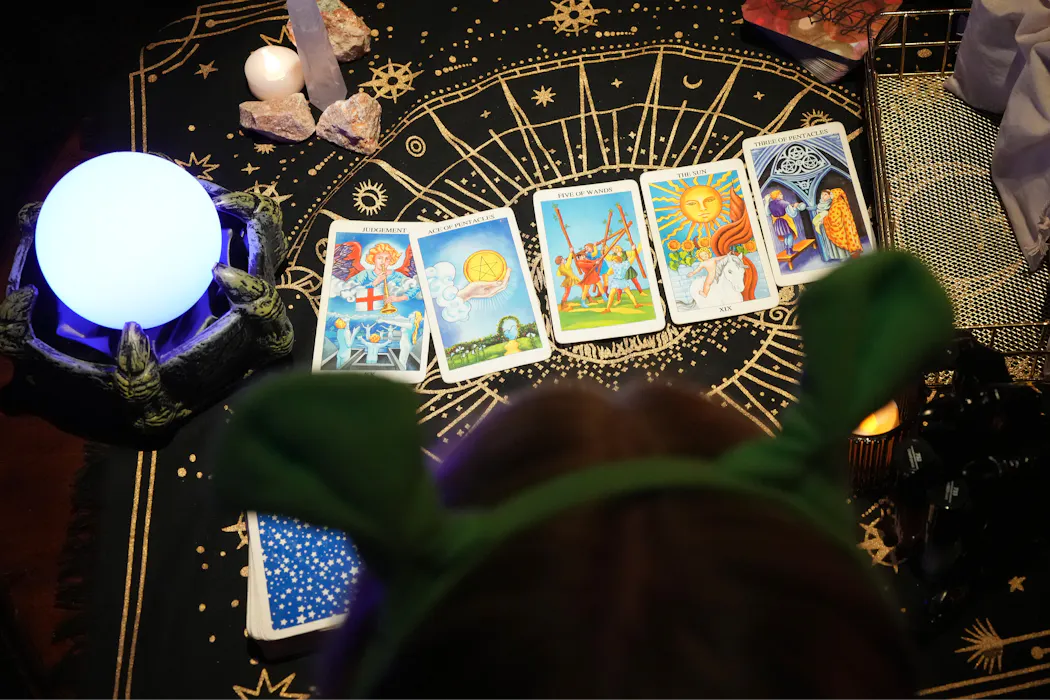
Someone asking about a relationship and drawing the Tower card, for instance, might read it as impending rupture, or as false assumptions finally giving way. Which reading fits depends on the other cards, the specific question and what the reader already knows about their own situation.

This stands in contrast to AI, which is primed to produce a seemingly definitive answer, even when it’s unaware of the nuances of your situation and context.

The adoption of AI in tarot reading

For our study, we interviewed 12 tarot practitioners about their use of AI in readings they did for themselves.

They generally found themselves pulled in two directions.

On the one hand, they often sought explicit guidance from AI in the process of self-reflection. By using AI to interpret the cards, they could sidestep the frustration of interpreting many cards in light of the question asked.

Say someone drew the Fool and the Ten of Wands for a question about a career change. The Fool points toward a leap into the unknown, while the Ten of Wands speaks to burnout and an unsustainable load.

But do the cards say, “Leave, you’re exhausted and something better awaits”? Or “Leave, and the new job will be just as demanding”?

Rather than sit with that ambiguity, some readers simply ask the AI for the meaning of the reading.

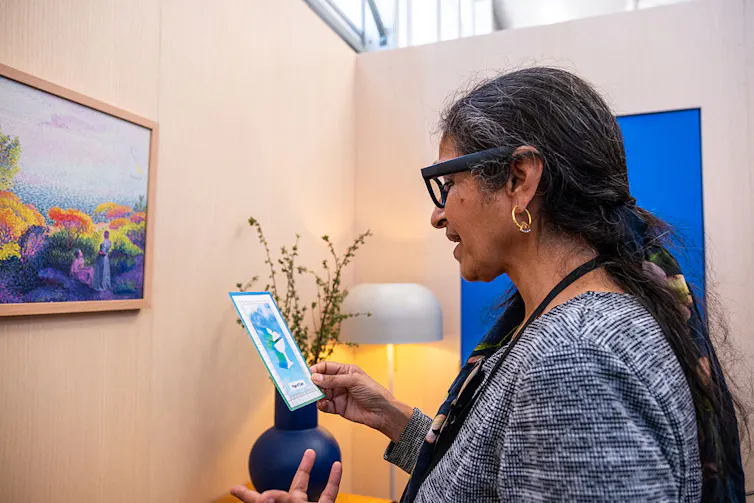
A middle-aged woman wearing glasses smiles and gazes at a large, blue tarot card in her right hand.
An attendee at Google’s 2025 I/O developers conference wears Android XR glasses with Gemini AI, which she’s using to interpret a tarot card. Camille Cohen/AFP via Getty Images

For more challenging readings, AI’s “yes man energy” helped them feel more confident about their interpretations. This was true for cases where participants both drew physical tarot cards and then interpreted them with AI, or used AI to directly simulate tarot readings.

These uses of AI are seductive. They make the act of self-reflection less demanding. But within the broader tarot community, we found a lot of criticism of AI, and there were concerns about how the sycophantic nature of the technology could undermine people’s intuition and reasoning.

AI as a tool for critical engagement

On the other hand, the tarot readers we interviewed also used AI as a tool to challenge their own biases and assumptions – blind spots in their readings, or what they might be missing in their own interpretation of the cards.

Along these lines, they used AI to generate alternative perspectives so they could compare the different interpretations and see which resonated more. And some even asked for an “objective reading” of the cards, because AI appears to have no skin in the game and be unburdened by personal biases or motives.

Many readers did this when they didn’t want to “bug” or “pester” their friends for help with a reading. Instead, they relied on chatbots in a one-sided relationship that feels supportive – an example of what scholars call parasocial interaction.

Some interviewees even treated bizarre AI-generated outputs or hallucinations as meaningful precisely because they were random and unintended, the same way that a card drawn at random feels like it carries a secret message.

What does this mean for the future of AI?

AI is becoming a powerful new oracle in its own right.

In one recent survey, researchers found that up to 87% of generative AI users are consulting the technology for “personal applications,” which includes advice and emotional support for relationship conflicts and mental health struggles.

Sometimes these chatbots are genuinely helpful. But at the same time, advice seekers can also become emotionally dependent. Some rely on the technology for companionship and guidance instead of friends and family. Chatbots have also been found to nurture delusional beliefs and even lead to self-harm.

Meanwhile, professionals that regularly give guidance are using AI in their practice, from lawyers to therapists and even priests. Pope Leo XIV recently urged priests to resist the temptation to use AI to write sermons.

We think it’s important to make sure the technology isn’t seen as an all-knowing source of truth. It can certainly open up users to new ideas, but it should be a tool to enhance self-reflection, rather than one that serves as a substitute for it.

In some cases, that’s what the tarot readers in our study did. They tapped into their own capacity for reflection by using AI to explicitly challenge their own biases and assumptions. This points to an alternative blueprint for the future of AI – one in which the technology doesn’t simply hand you answers but keeps you actively engaged in the process of finding them.

The Conversation

The authors do not work for, consult, own shares in or receive funding from any company or organization that would benefit from this article, and have disclosed no relevant affiliations beyond their academic appointment.

  •  
❌