Reading view

How migration became a key to World Cup success

Morocco had more foreign-born players than any other nation at the 2022 Fifa World Cup. Abdelrahman Emam / Shutterstock

Few would have predicted Morocco’s success at the 2022 Fifa World Cup. Heading into the tournament, they were ranked 22nd in the world and had never progressed beyond the round of 16.

Yet they beat Belgium, Spain and Portugal – countries that both then and now rank inside the world’s top ten – on their way to becoming the first African nation ever to reach the semi-final.

Morocco’s run was not only remarkable (and thoroughly deserved). It also sparked debate beyond football because 14 of the players in their 26-man squad were foreign-born, more than any other nation in the tournament.

The 2026 World Cup will feature more foreign-born players than any previous edition. Nearly a quarter of the 1,248 players selected for national teams were born in a different country from the one they will represent.

In some squads, the proportions are far higher than this – 96% of Curaçao’s players were born abroad, as were 85% of the Democratic Republic of the Congo’s and 73% of Morocco’s. Overall, foreign-born players make up the majority of footballers in eight of the tournament’s 48 squads.
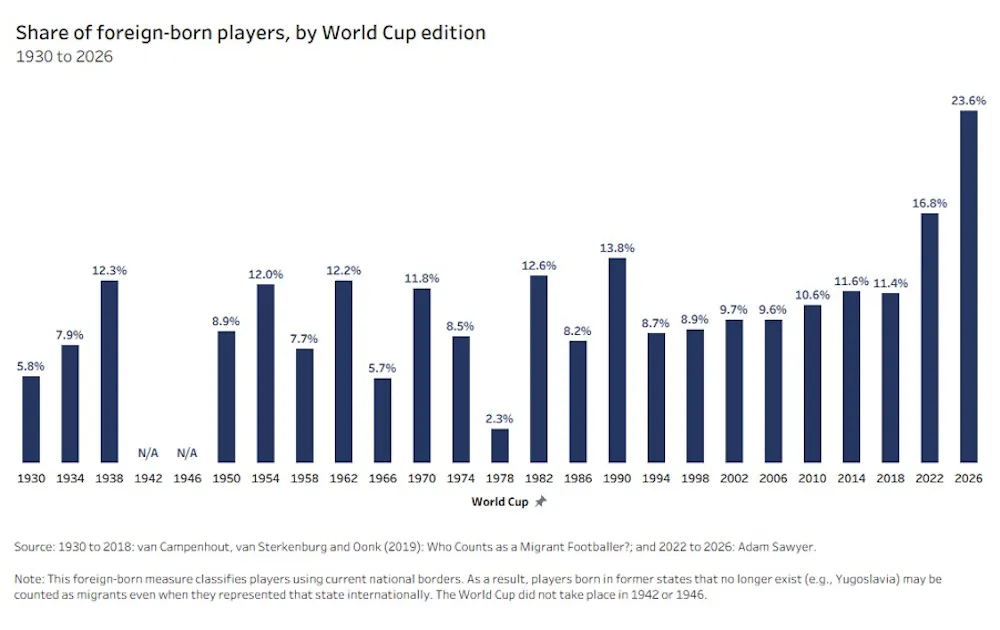
A bar chart showing the proportion of foreign-born players at football world cups since 1930.
CC BY-NC-ND

Migration has been part of the World Cup story since its inception. At the tournament’s third edition in 1938, for example, 12% of players represented a country other than the one in which they were born.

This was in part because Fifa didn’t introduce regulations governing football players’ eligibility for national teams until 1962, meaning it was not uncommon for players to represent multiple countries throughout their careers.

Some players represent countries other than those in which they were born because they are eligible through a parent or grandparent. These players often emerge from diaspora communities created by earlier waves of migration.

One example is 2018 World Cup finalist Ivan Rakitić, who was born and raised in Switzerland but chose to represent Croatia. In a 2025 interview, Rakitić explained that when he had to choose between the two countries, his heart told him he should play for Croatia.

Other players qualify through residency requirements. Pepe, for example, was born in Brazil but played in four World Cups for Portugal between 2010 and 2022 after becoming a Portuguese citizen at the age of 24.

Yet foreign-born players are only part of the story. World Cup squads also contain many second-generation migrants. France’s 2018 World Cup-winning squad is perhaps the best-known example: 12 of their 23 players had African parents.

Such patterns are not random. France’s squad reflected the country’s colonial and postcolonial links with north and west Africa. Similarly, since the mid-2000s, Switzerland’s national team has increasingly been shaped by migration from the former Yugoslavia following the conflicts and displacement that accompanied its breakup in the 1990s.

England’s 2026 squad also tells a story about the country’s migration history. Alongside Marc Guéhi, who was born in Ivory Coast, at least nine players had a parent born overseas. Most have family roots in former British colonies in Africa and the Caribbean, reflecting patterns of post-second world war migration to the UK.

At the same time, 24 players born in England have been selected by other World Cup teams. This includes five representing Scotland and 19 playing for countries beyond the British Isles (including the US, New Zealand and Ghana).

Does this matter on the pitch?

Relatively little research has examined whether national teams with more migrant players perform better on the pitch. But the available evidence suggests they do.

One study from 2022 analysed every World Cup between 1970 and 2018 and found that teams with more foreign-born players generally progressed further in the tournament. On average, each additional foreign-born player was associated with roughly 0.15 additional matches played.

The relationship remained even after accounting for broader differences between countries, suggesting that migration may provide advantages beyond those associated with wealth or footballing tradition alone.

Another study from 2023 examined European national teams competing in World Cups and European Championships between 1970 and 2018. Using players’ surnames to estimate their ancestral origins, it measured the diversity of backgrounds within each squad and found that more diverse teams tended to perform better on average.

Specifically, the research found that a one standard deviation increase in diversity led to an increase in goal difference (the number of goals a team scores minus the number of goals they concede) of around 1.3 per match on average.

There are at least two factors that might explain these results. First, migration can expand the pool of players available to a national team. Ghana’s squad for the 2026 tournament draws heavily on diaspora communities in western Europe. This allows it to recruit players developed in some of the world’s strongest football systems.

Second, migration may increase the diversity of skills available within a squad. Football players need specific physical traits and technical skills to succeed on the pitch. Central defenders, for example, are usually tall and physically strong. More attacking players, on the other hand, often require speed.

A more diverse population will probably provide a larger pool of potential players for each position, resulting in better complementarity at the team level.

This does not mean that migration wins World Cups. Argentina won the 2022 World Cup without a single foreign-born player in their squad. Success also depends on population size, economic wealth and coaching. Lionel Messi playing for your team helps, too.

Nonetheless, the limited evidence available indicates that migration may influence international football beyond simply changing the make-up of the teams competing.

If Morocco’s 2022 squad had been limited to players born and raised in Morocco, would they still have reached the semi-finals? We’ll never know for sure. But if Curaçao do so this time around, the role of migration in footballing success may become harder to ignore.

The Conversation

The 2022 and 2026 data on the share of foreign-born players selected in World Cup squads was compiled and analysed by Adam Sawyer, co-founder and director of research at Relevant Research, which provides technical and logistical support to immigration researchers.


  •  

Birds masturbate, and that’s perfectly normal

mycteria/Shutterstock

For captive animals, engaging in natural behaviour is a pillar of the animal welfare framework. But when it comes to sex, one important behaviour has been largely ignored, and sometimes even punished: masturbation.

Solo sex is surprisingly common across the animal kingdom. It is well documented in primates. Tortoises are surprisingly vocal during their solo lovemaking endeavours, if not very graceful. Camels masturbate by rubbing their penises in the sand and porcupines make inventive use of all sorts of objects.

Our new study could change how other scientists view masturbation in birds and improve their welfare.

Masturbation also seems to be common in birds. A quick internet search brings up an abundance of video clips on social media and dedicated posts on bird-keeping forums, largely from worried or bemused hobbyist bird keepers.

It has often been treated as an abnormal problem behaviour in captive birds (particularly parrots). Folklore husbandry has assumed it is the undesirable outcome of stress, bad health or poor environment. Bird keepers often therefore discourage masturbation via punishment or veterinary interventions such as diet or care changes and, sometimes, even drugs and surgery. Despite the welfare implications, masturbation in birds had been largely unexplored by the scientific community.

We set out to change that, by investigating the distribution and evolutionary history of masturbation in birds for the first time. We studied 120 species of bird across 22 major groups, gathering data from the scattered scientific literature, online reports and community forums, and surveys of bird experts.

Colourful parrot ducks behind wing.
There’s no need to shame parrots for solo sex. Wirestock Creators/Shutterstock

Our study found that masturbation is widespread across birds with a strong evolutionary history, meaning that it’s an ancient trait probably similar in closely related species. Although we found more records of masturbation in male birds, it occurs in both sexes and across all age groups.

Solo sex also seems to be linked to species that mate with multiple partners, supporting the idea that it might help to increase reproductive success when there is a high degree of competition over fertilisation. For instance, in males it may flush out old sperm to leave newer (better condition) sperm for mating. In females it may increase sexual arousal to help with sneak mating with males other than their partner.

Wild behaviour

Crucially, we discovered that masturbation is actually less common in captivity than the wild, and more common in birds reared by their own parents than by humans. What this tells us is that masturbation in birds is neither an unnatural behaviour, nor a consequence of captivity. Given this finding, it is important that birds are not prevented from masturbation. Of course, as with any behaviour, there may be extreme cases where chronic masturbation could indicate underlying health or husbandry issues.

Avian self-pleasure is usually a rather inelegant affair, in which a bird rubs their cloaca (a shared orifice for both excretion and reproduction) against an object, like a branch, twig or toy. This is often accompanied by a lot of flapping and self-satisfied vocalisation.

One potential reason for the lack of scientific studies exploring avian masturbation may be because the cloaca is thought to have fewer nerve clusters, and therefore lower sensitivity, than our own genitals.

Clearly however, birds are getting some satisfaction from masturbation, so perhaps there is more to a bird’s sensations during sex than has previously been recognised. Further exploration of this could have important implications for both welfare and captive breeding programmes. While sexual pleasure may not be exactly the same experience as for mammals, it is wildly premature to dismiss the idea that birds also feel pleasure.

The Conversation

The authors do not work for, consult, own shares in or receive funding from any company or organisation that would benefit from this article, and have disclosed no relevant affiliations beyond their academic appointment.

  •  

Victorians called burnout ‘overwork’ – and they cured it by holidaying in France

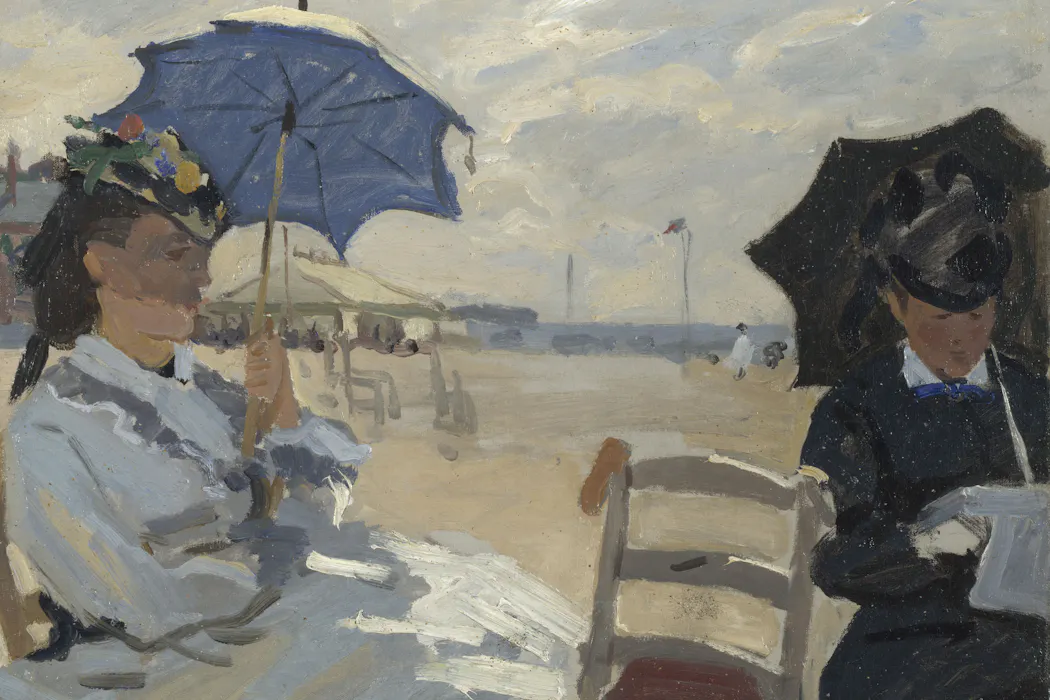
The Beach at Trouville by Claude Monet (1870). The National Gallery, London

Burnout feels like a thoroughly modern concept – one borne from our age of global digital communication and long office hours. But the Victorians also had an idea of burnout, one they termed “overwork”.

The Victorian doctor, C.H.F. Routh, for example, published On Overwork and Premature Mental Decay: Its Treatment, which ran to four editions between 1873 and 1888. Although the language differs, the underlying concerns are similar. Victorian overwork was a new development in their era of empire and industrialisation, with its railways and telegraphs which enabled rapid global communication and an ever-quickening speed of life.

The Victorians were undoubtedly followers of what the philosopher Thomas Carlyle described as the “Gospel of Work”. But they were also acutely aware of the health problems which could come from devotion to this new religion.

In America, neurologist George Beard had introduced the concept of neurasthenia, a condition linked to the overstrain of nerves. But in Britain, overwork was viewed as altogether more manly – and indeed almost a badge of pride.

As now, with our concepts of executive burnout, overwork was very much associated with mental activity and the professional classes. It therefore excluded the overburdened working classes from consideration. Doctors were a particular cause for concern.

Routh cites the case of Dr Golding Bird, a successful physician, who advised him to ease off in his work. He told him to take an annual six weeks holiday: “otherwise you will find yourself, at my age, a prosperous practitioner, but a dying old man”. Bird was still practising, but died a few weeks later at the age of 39.

Travel for health

For those suffering from overwork and other forms of illness or malaise, the primary prescription (for the professional classes) was travel to a health resort, preferably in Europe.

In 1870 the Scottish publisher William Chambers printed Wintering at Menton, an account of his own breakdown of health from overwork, following his time as Lord Provost of Edinburgh and his subsequent recovery. He writes in amazement of the beauties of the landscape in this spot on the French Riviera, its blue skies and caressing climate, and asks his contemporaries to reconsider their lives. Too many were dropping into their graves, having “succumbed in the feverish, and we might almost say, insane, battle of life. Too long and too diligently have they stuck to their professional pursuits.”

Menton became the favoured spot for the British to recuperate from overwork and other forms of breakdown of health. This was due in large part to the publication by Dr James Henry Bennet of a series of works, including Menton and the Riviera as a Winter Climate (1861), and the numerous editions of Winter and Spring on the Shores of the Mediterranean (1865-75).

The latter offered a guide to health travel, sampling all the resorts around the Mediterranean coast, but concluded that Menton offered the best climate and conditions for recovery.

Illustration of the coast in Menton
An illustration of Menton from Bennet, Winter and Spring on the Shores of the Mediterranean. Gutenberg

The reasons for the extraordinary influence of Bennet’s work can be traced to his narrative of his own recovery, which formed a preface to all his books:

Five and twenty years devoted to a laborious profession and the harassing cares which pursue a hard-worked London physician, broke down vital powers. In 1859 I became consumptive, and strove in vain to arrest the progress of the disease.

Believing himself to be dying, Bennet headed for the Riviera. But finding himself under the “genial sky” of Menton, and “freed from the labours and anxieties of former life”, he found to his great surprise that his health improved. He decided to spend winter there every year, and set up a practice. Menton, as a consequence, grew from a small village to a major health resort, complete with its own English quarter.

The medical climatology revolution

Bennet was a leading figure in the development of what was termed “medical climatology”. This was the belief that many conditions (including consumption, or tuberculosis), could actually be cured, or at least arrested, by moving to a resort with the right climate.

In part this movement was in response to the choking smog of industrial cities. “Diseases of the chest”, as they were known, inevitably fared better amid the pure air and blue skies of the Riviera in winter.

Bennet’s form of treatment was viewed as almost revolutionary at the time. Invalids were to escape the hot, close confines of an English sickroom and stride out into the hills, absorbing the rays of the sun and the pure air, while feasting their senses on the wonders of nature around them. No medicine required.

It was also a prescription for the elderly, or infirm. They could be driven out each day to a different, sheltered and sunny spot: “The range of observation is thus increased without fatigue, the glorious scenery of the district is seen and enjoyed in its ever-varying phases, and the mind is refreshed by change.” It is an inspiriting vision of what might be possible in late-life care today.

For those suffering from overwork, Bennet recommended a minimum of three full winters spent in the resort. This was a far cry from the short stays in spas in the 18th century, or our own quick “wellness” breaks.

What he offered was a concept of “legitimate idleness”, where the hardworking professional could lead a “quiet, contemplative life”, basking in the sun “like an ‘invalided’ lizard on his wall”.

Queen Victoria brought her son Leopold, a haemophiliac, to “beloved and beautiful Mentone” and writers and artists, from Robert Louis Stevenson and Aubrey Beardsley to Katherine Mansfield, flocked to the resort. They left extraordinary records of the pleasures and pains of their times in medical exile.

My own book, In Quest of a Cure: Literary and Medical Cultures of the Health Resort, explores many of these lives – in Menton, Davos and elsewhere – and the changing patterns of treatment. For cases of overwork, and other conditions, time was of the essence: in place of the hurry and worry and snatched time of Victorian city life, time was to be extended, as invalids relaxed into a state of “legitimate idleness” amid the healing powers of nature.

This article features references to books that have been included for editorial reasons, and may contain links to bookshop.org. If you click on one of the links and go on to buy something, The Conversation UK may earn a commission.

The Conversation

Sally Shuttleworth's research for this article was funded by an Advanced Investigator Grant, 'Diseases of Modern Life: Nineteenth-Century Perspectives' from the European Research Council (Seventh Framework, grant number 340121).

  •  

Marianna Martines: the infuriating reason you’ve never heard of this brilliant 18th-century composer

Imagine if the only musical artists from the 1980s you had access to were Madonna, Prince and Michael Jackson. Others, such as David Bowie, Whitney Houston or George Michael are not available because, we’re told, these artists fail to exhibit the same type of creativity as the other three “geniuses”.

It’s clearly madness, yet this in a nutshell is the gatekeeping situation that exists in classical music today.

Zoom back to the 1780s and the musical landscape was astonishingly diverse, with composers across the globe writing bucketloads of music not only for the church, but for theatres, salons, concerts and performance at home. And, contrary to what we seem meant to believe, none of this music was auditioned by a panel of experts with the “best of the best” selected for our moral betterment.

But what we have access to today from the classical era is the tiniest fraction of what was composed then. And of that fraction, we hear a still smaller subset, dominated by just three composers: Mozart, Haydn and Beethoven – as classical music website Bachtrack’s 2025 statistics attest.

Many significant composers haven’t survived as part of the modern classical canon. Take Marianna Martines (1744–1812), for example. She was an extremely popular Viennese composer, singer and keyboardist whose prolific compositional output was so highly rated in her own time that she was the first woman to be inducted into the Accademia Filarmonica di Bologna as a “master” composer.

Performing regularly for Austria’s empress Maria Theresa and sharing the keyboard with Mozart for four-hand duets at her own popular musical salons, she was at the heart of a booming Viennese musical culture.

Where is her music today?

Talent flourishes with investment, and Martines had it all: money, time, geography, social networks and an elite education. In fact, court poet and famed opera librettist Pietro Metastasio personally oversaw her education from childhood.

Martines’ compositional catalogue is substantial, including – strikingly – several large-scale choral-orchestral works such as the impressive Dixit Dominus (1774), 12 keyboard concerti (four of which survive), and 31 keyboard sonatas (three of which survive). Her music isn’t just fine – it is exceptionally good. Just listen for yourself. So why do we not hear her music today?

It wasn’t that she lacked contemporary advocates, and it wasn’t even that she was immediately forgotten after her death. Indeed, she was significant enough to have active detractors who worked to discredit her authority, as music scholar Judith Valerie Engel details in her research.

The problem, then, was not absence of talent, nor even absence of recognition, but the failure of later institutions to keep investing in the conditions that ensure music like Martines’ is heard.

Ensemble music – particularly larger forms such as choral and orchestral music – requires a rather different type of investment. We’re not able to access it without the complex and expensive assembly of notated scores, instruments, large spaces and dozens of people with specialist skills who know how to transform those dots on the page into musical sounds.

At the root of this are repetition and publication, both in text and in sound. Text, for the obvious reason that without access to printed materials – and I mean well-edited printed materials – the music cannot be played and therefore endure.

Music publishers have long been gatekeepers of musical taste, providing editorial credibility and a supply of materials to the market. This curatorial role was usurped by record producers, who determine what gets recorded and circulated – the new modern legitimising “text” of a musical work, as it were.

Repetition is absolutely essential. This crazy process of putting dots of ink on paper to communicate complex sonic and emotional ideas means that musical works rarely reveal their secrets the first time they are played.

In re-performance and re-recording, musical problems are solved and the infinite dimensions of the possible sound worlds are explored. This dialogue between performers does two crucial things in the establishment of a work within the canon. First, it refines the quality of performance and, with that, enhances the evaluation of the work itself. Second, the frequency of performance or recording generates familiarity – a significant driver of musical preference.

My heart genuinely aches when I think about how different my own life would have been had I grown up listening to Marianna Martines’ music alongside that of her contemporaries. So many limiting myths about women’s inherent musical – and therefore artistic and intellectual – abilities might never have taken root in my subconscious.

While in general the ability to produce knowledge and exert influence is increasingly moving away from historical centres of power, public reclamation of received music history still lags far behind, despite the herculean efforts of numerous musicians, musicologists and advocates.

The good news is that listeners have more ability than ever to discover the music that moves them. The intellectual shackles imposed by commercial and academic institutions when it comes to deciding what constitutes “good” music are slowly losing their potency. There is no doubt though, we are now facing a new era of curatorial power in the form of AI algorithms that shape the discovery of music and much else besides.

However, restorative projects such as this first recording of Marianna Martines’s complete surviving keyboard works provide that essential first step of the music’s modern publication.

It is now possible for listeners to discover this music, and for musicians to begin the long, necessary dialogue with it. Only then are we able to reclaim our rightful musical heritage.

The Conversation

Cayenna Ponchione-Bailey does not work for, consult, own shares in or receive funding from any company or organisation that would benefit from this article, and has disclosed no relevant affiliations beyond their academic appointment.

  •  
❌