Reading view

The ‘Divine Ponytail’, drug scandals and the OJ Simpson chase: looking back at the 1994 US World Cup

As the world prepares for the 2026 FIFA World Cup – to be hosted by Canada, Mexico and the United States throughout June and July – many sports fans have been looking back to 1994, the last time it was hosted in North America.

The 1994 World Cup was spectacular, chaotic and ultimately, a great success.

Its opening day was also one of the craziest days in world sports history – but that’s only part of the story.


Read more: From ‘USA94’ to now: how soccer has changed since the last American World Cup


A controversial host

The US was chosen as host in 1988, ahead of Brazil and Morocco.

The decision was controversial: soccer was not a popular national sport in the US, it did not have a professional league, and hadn’t qualified for a World Cup since 1950.

A national poll taken three weeks before the first game indicated 71% of Americans were not aware the tournament was about to happen.

The draw

The draw, to decide which countries would play each other in the group stage, was held in Las Vegas in December 1993.

It was attended by famous actors, musicians, supermodels and athletes, and was intended to gain as much attention as possible.

The late Robin Williams stole the spotlight with his improvisation, jokes at the expense of FIFA officials and enthusiasm for speaking gibberish to foreign dignitaries instead of their own languages.

The 1994 US World Cup featured so much action, even before it started.

Opening ceremony

The star-studded opening ceremony was held in Chicago in front of a sold-out crowd of 67,000, with another 750 million watching on television around the world.

It was hosted by Oprah Winfrey (who fell off the stage), and featured famous musicians such as Richard Marx and Diana Ross (who missed a penalty from five metres as part of a choreographed stunt).

Then-president Bill Clinton officially opened the tournament.

The opening ceremony was memorable in many ways.

A wild first day

The first day of the World Cup – June 17 1994 – was one of the craziest days in US sports history. Along with the opening ceremony and games, other sporting events to occur on this date included:

  • game 5 of the NBA finals between the New York Knicks and Houston Rockets
  • a tickertape parade for the New York Rangers after they broke a 54-year drought to win ice hockey’s Stanley Cup
  • golfing great Arnold Palmer played the last US Open of his career at 64 years old
  • Ken Griffey tying Babe Ruth’s record for 30 home runs in the first half of a Major League Baseball season.

Amazingly, these events were all overshadowed and interrupted by an even bigger sports-related moment: nearly 100 million people in the US tuned in to watch a car chase across southern California involving former American football star OJ Simpson who was arrested for murder.

ESPN made a popular documentary about the events of this day titled “June 17th, 1994”.

The on-field action

Once the games began, “USA 94” gave fans far more than a novelty tournament in a new market. It was a World Cup of firsts:

  • player names appeared on shirts for the first time, helping new viewers follow the action, and more points were given for a win in group matches to encourage more attacking play

  • the US’ 1-1 draw with Switzerland at the Pontiac Silverdome became the first World Cup match played indoors

  • the Brazil-Italy final finished 0-0 after extra time and became the first World Cup final decided by penalties.

The host nation also gave its new audience something to cheer about. The US reached the knockout stage, then faced Brazil on July 4: Independence Day. Brazil won 1-0, but the symbolism was hard to miss – the underdog host had pushed one of football’s great powers on the country’s biggest national holiday.

There were bigger shocks elsewhere. Bulgaria became the tournament’s great surprise story, beating defending champions Germany and reaching the semi-finals. Romania, led by Gheorghe Hagi, knocked out Argentina in a 3-2 thriller.

Saudi Arabia produced one of the goals of the tournament when Saeed Al-Owairan ran from deep inside his own half to score against Belgium.

Saeed Al-Owairan’s wonder goal against Belgium.

For a World Cup sometimes remembered through scandal and celebrity, the football itself delivered.

In the end, Brazil won the final after extra time, but not as the carefree entertainers many people expected. This Brazil was organised, tough and powered by Romário and Bebeto.

Then came the image that still defines the tournament: Roberto Baggio, Italy’s famous “Divine Ponytail”, sending the final kick over the bar and handing Brazil its fourth men’s World Cup title.

Other notable incidents

One of soccer’s greatest players, Argentina’s Diego Maradona, scored a goal against Greece, but failed a drug test after his next game.

He was withdrawn from the tournament before he could be banned but stayed in the US as a commentator.

The goalposts collapsed during the Romania vs Mexico match, causing a lengthy delay.

To appease European broadcasters, most games started around midday US time. As a result, some fixtures were played in extreme temperatures.

Colombia defender Andres Escobar scored an own goal against US that resulted in his team being knocked out of the competition. When he returned to Colombia, he was shot dead by gangsters amid speculation his error had cost drug barons millions in gambling losses.

The legacy of ‘USA 94’

The 1994 World Cup’s lasting legacy was soccer becoming more popular in the US.

A successful professional soccer league (Major League Soccer) was set up after the event.

The US also hosted, and won, the women’s soccer World Cup in 1999.

In the end, the 1994 tournament exceeded expectations.

More than 3.5 million spectators attended it, an average of nearly 70,000 a match: still records 32 years and seven world cups later.

The Conversation

The authors do not work for, consult, own shares in or receive funding from any company or organisation that would benefit from this article, and have disclosed no relevant affiliations beyond their academic appointment.

  •  

Hidden in plain sight: the race to discover new species before they’re gone

JOY PAN/Getty

When most people imagine scientists discovering new species, they probably still picture an expedition into the unknown.

A naturalist travels somewhere remote, perhaps on a wooden ship, and traipses through the jungle to encounter an animal or plant never before described by science. The intrepid explorer brings back specimens or observations to a museum, where they can be compared, named and described.

There is some truth to this stereotype. Between 1854 and 1862, scientist Alfred Russel Wallace travelled through the Malay Archipelago, discovering animals and insects unknown to Western science. This led him to the theory of evolution by natural selection, contemporaneously with Charles Darwin.

Antarctica had its own era of discovery. In 1840, scientists on a French expedition encountered what we now know as Adélie penguins. Imagine seeing penguins for the first time: strange black-and-white birds waddling over the ice, sliding on their bellies, leaping from freezing seas.

Of course, “discovery” is a loaded word. Many animals and plants described by Western science were already known to Indigenous peoples and local communities. What changed was their entry into the formal scientific naming system – the global process by which species are compared, classified and recognised.

Today, scientists are still finding new life in remote places and hidden inside the DNA of animals we thought we already knew.

We still explore unknown worlds

Scientists still discover species this way: by probing Earth’s nooks and crannies and travelling to remote places to study what lives there.

Last year, I was onboard the scientific vessel R/V Falkor (too) in Antarctica’s Weddell Sea, where one scientific team was searching for seafloor methane seeps.

These are not just geological curiosities. Methane seeps create unusual habitats that harbour strange communities of life fuelled not by sunlight, but by chemicals rising from below. Scientists have already found new microbial diversity at Antarctica’s first known active methane seep.

Not all hard-to-reach worlds are underwater. In Papua New Guinea’s Southern Fold Mountains, camera traps captured a shy, ground-dwelling bird slipping through rugged limestone forest. Scientists described it as a new species in 2025, the hooded jewel-babbler.

But there is another kind of discovery happening too.

White microbial mats underwater are telltale signs of seeping methane. Andrew Thurber, CC BY-ND

Hidden species in familiar animals

Some species are not hidden because they live at the bottom of the sea or deep in a mountain forest. They are hiding in plain sight.

Gentoo penguins are a good example. With their bright orange bills and comic waddle, they are familiar to anyone who has visited Antarctica. To most observers, they are simply “gentoos”.

But our new research shows gentoo penguins are not one widespread species, but four. Our 2020 study first showed major genetic and physical differences between gentoo penguins from different islands.

Now, using whole genomes – the complete set of genetic instructions inside an animal – and ecological modelling, we found these penguins are not just separated by distance, but have adapted to different Southern Ocean worlds.

A large colony of Gentoo penguins on the ice with the ocean behind.
Gentoo penguins on Cuverville Island, Antarctica. David Stanley/flickr, CC BY-ND

Learning to see in higher resolution

Discoveries like this are often called “hidden” species. They look very similar to their relatives, but if we study their DNA, body measurements, behaviour and ecology, it’s clear they are separate species.

Species discovery has always depended on the tools available. Early naturalists relied on what they could collect: feathers, skins, eggs and bones. These museum collections are like time machines and remain incredibly important.

Today, whole genomes tell us if animals have different coding. Ecological models show whether animals live in different environmental conditions. Mathematical approaches test whether groups are evolving independently.

In other words, we are learning to see biodiversity in higher resolution.

This sharper view is changing how we understand familiar animals. For a long time, giraffes were considered one species, but genetics suggests they are four. My own work on forest birds in Madagascar found a new species of Newtonia bird.

The Tapanuli orangutan is a powerful example. This Indonesian great ape from Sumatra was described as a new species in 2017, based on genomic, anatomical and behavioural evidence. It was extraordinary to recognise a new great ape in the 21st century, and sobering to realise fewer than 800 may remain.

Again and again, the message is the same. The natural world is more complex than we know. And sometimes, by the time we recognise that complexity, a species may already be in deep trouble.

An orangutan sits in a leafy tree.
The Tapanuli orangutan is a species of orangutan restricted to South Tapanuli in the island of Sumatra in Indonesia. It is one of three known living species of orangutan. Prayugo Utomo/Creative Commons, CC BY

Why names matter

Taxonomy – the science of naming and classifying life – can sound like an old-fashioned labelling exercise. But it’s how we map life on Earth.

Conservation laws, threatened species lists and monitoring programs usually work at the species level. If several species are mistakenly treated as one, a declining species can be hidden inside a larger group that looks secure.

As we stand at the precipice of Earth’s sixth mass extinction, this has never been more important.

Recognising hidden biodiversity does not solve conservation problems by itself. But it helps us ask better questions. Which species are increasing? Which are declining? Which have not been counted for decades?

These questions are urgent, because we are racing to understand biodiversity while climate change and habitat loss reshape life on Earth.

Even now, in an age of satellites and genome sequencing, Earth still has secrets. Not only in the most remote places, but in the first animals we learn to recognise as children: penguins, giraffes, orangutans.

The closer we look, the more life reveals itself. Our task now is to keep looking and protect the richness that was there all along.

The Conversation

Jane Younger receives funding from the Australian Research Council, National Geographic Society, Rolex, WIRES, the Marine Megafauna Research Fund, and Lindblad-National Geographic. She is affiliated with the University of Tasmania and Senior Editor of Ecology & Evolution.

  •  

Game changers: how a stroke of paint transformed basketball, and the athletes who play it

When basketball was invented by medical doctor James Naismith in 1891 – to keep American football players active during winter – all baskets were worth two points, regardless of where they were shot from.

Games were dominated by tall players who usually shot from close to the basket.

It was often very crowded near the basket and there were fewer opportunities for smaller players.

This all changed when the 3-point line was introduced.

History of the 3-point line

The 3-point line was temporarily trialled in a few college games and minor professional leagues from the 1940s to the early 1960s, but was seen as more of a gimmick.

It gained more popularity after it was introduced in the American Basketball Association (ABA) (a competitor league to the NBA) during the 1967–68 season.


Sports can change dramatically in the blink of an eye. Sometimes, these moments create immediate shockwaves. Other times, it’s not until much later that their impact become obvious. This is part of a rolling series that explores key (and sometimes long forgotten) moments in sports history.


Read more: Game changers: how a rainy week led a frustrated Don Bradman to reinvent cricket


The ABA wanted to make basketball more interesting and exciting. It viewed the 3-pointer as the equivalent to a home run in baseball and believed it would “give smaller player a chance to score and open up the defence to make the game more enjoyable to fans”.

The ABA merged with the NBA in 1976 but the NBA did not immediately introduce the 3-pointer because many traditional coaches and players were against it.

It was finally introduced for the 1979–80 season, with Chris Ford from the Boston Celtics shooting the first one.

The International Basketball Association (1984) and other national leagues followed this move during the next decade.

It changed basketball, slowly

The 3-point line did not make a big difference straight away.

Players still preferred to shoot from closer to the basket because there was a higher chance of success. Teams did not practise 3-pointers and generally only used them when trying to win a game in the final few seconds.

The San Diego Clippers scored the most 3-pointers for the 1979–80 season, with 177 (2.2 per game). Brian Taylor from the Clippers had the most individual 3-pointers (90).

Times have changed.

During the 2024–25 season the Celtics scored the most 3-pointers: 1,475 (17.8 per game) and every team in the NBA scored more than 900. Some 139 players made 100 or more.

League 3 point trend. NBA

How 3-pointers became more popular

A few key events contributed to 3-pointers becoming more popular.

The inclusion of a 3-point contest at the NBA All-Star weekend in 1986 made the shot more respected. It helped that the first three were won by popular Celtics All-Star Larry Bird.

From 1994 to 1997 the NBA moved the 3-point line closer to the basket (from 7.24 metres to 6.71m) to encourage more scoring in games.

While it did not improve the trend of lower scores and the line was moved back, teams did start to shoot more threes.

The Steph Curry phenomenon

In the 2010s, the rise of the Golden State Warriors sparked a 3-point revolution.

Led by two-time MVP Steph Curry, the Warriors’ heavy reliance on the 3-pointer helped them make the NBA Finals five years in a row, winning three championships.

Curry, who is more than 10cm shorter than the average NBA player, is credited with changing the game by regularly shooting “deep threes” from way behind the 3-point line. This allowed him more time to shoot over taller players.

It also changed how other teams defend because they have to cover more space to defend him. Consequentially, his teammates enjoy increased scoring opportunities.

Curry is the most successful 3-point shooter in NBA history. Kids now want to “be like Steph”.

WNBA All-Star Caitlin Clark has also been influential increasing the popularity of 3-pointers.

The role of analytics

Statistics-focused executives such as Daryl Morey also played a key role in the increasing popularity of 3-pointers.

They realised teams could score more points by shooting 3-pointers, even if they shot a slightly lower percentage.

For example, if a team takes ten 3-point shots and make 40% (four) of them, they will score 12 points (4x3 = 12). This is more than they will score if they take ten 2-point shots and make 50% (five) of them (5x2 = 10).

Under Morey’s leadership, the Houston Rockets became the first NBA team to attempt more 3-pointers than 2-pointers in a season. They did this from 2017 to 2020, when they won three consecutive division titles.

A statistical analysis across ten seasons from 2009–10 to 2018–19 also showed teams that took more 3-point shots had a higher probability of winning.

This rise in 3-pointers has come almost exclusively at the expense of mid-range shots.

Mid-range shots are shot from outside the paint but inside the 3-point line (roughly 3–7m from the basket).

The percentage of total shots from mid-range has plummeted from 31% in 2010–11 to just 13% a decade later, while shots in the paint (close to the basket) have remained relatively steady.

League wide % of all field goal attempts. NBA

The 3-point line has improved the game by adding variety in offence, spreading players out and allowing players of different sizes and skills to be successful.

However, fans, players and commentators are starting to wonder whether there are now too many 3-pointers being shot.

Too much of a good thing?

The increased emphasis on 3-pointers in the NBA has coincided with a decline in viewership. Although these may not be related, it has sparked concerns.

NBA Commissioner Adam Silver noted that while game attendance remained strong and fans enjoy the skill on display, he acknowledged some teams’ attacking plays can appear “cookie cutter” as teams mimic each other’s 3-point-heavy tactics.

NBA legend Shaquille O’Neal also stated the 3-point craze made games feel predictable, where “every team is running the same plays”.

Time for a change?

Suggestions from former players, coaches, commentators and spectators include moving the line further back, reducing the space available for shooting 3-pointers from the corner of the court, increasing overall court dimensions, adding a 4-point line or even capping teams’ 3-pointer attempts.

Silver says the league is open to exploring tweaks if they improve the balance between inside and outside play.

There are no plans to change yet, as any rule change will trigger flow-on effects for offence and defence that may not improve the game.

The Conversation

The authors do not work for, consult, own shares in or receive funding from any company or organisation that would benefit from this article, and have disclosed no relevant affiliations beyond their academic appointment.

  •  

The ‘Divine Ponytail’, drug scandals and the OJ Simpson chase: looking back at the 1994 US World Cup

As the world prepares for the 2026 FIFA World Cup – to be hosted by Canada, Mexico and the United States throughout June and July – many sports fans have been looking back to 1994, the last time it was hosted in North America.

The 1994 World Cup was spectacular, chaotic and ultimately, a great success.

Its opening day was also one of the craziest days in world sports history – but that’s only part of the story.


Read more: From ‘USA94’ to now: how soccer has changed since the last American World Cup


A controversial host

The US was chosen as host in 1988, ahead of Brazil and Morocco.

The decision was controversial: soccer was not a popular national sport in the US, it did not have a professional league, and hadn’t qualified for a World Cup since 1950.

A national poll taken three weeks before the first game indicated 71% of Americans were not aware the tournament was about to happen.

The draw

The draw, to decide which countries would play each other in the group stage, was held in Las Vegas in December 1993.

It was attended by famous actors, musicians, supermodels and athletes, and was intended to gain as much attention as possible.

The late Robin Williams stole the spotlight with his improvisation, jokes at the expense of FIFA officials and enthusiasm for speaking gibberish to foreign dignitaries instead of their own languages.

The 1994 US World Cup featured so much action, even before it started.

Opening ceremony

The star-studded opening ceremony was held in Chicago in front of a sold-out crowd of 67,000, with another 750 million watching on television around the world.

It was hosted by Oprah Winfrey (who fell off the stage), and featured famous musicians such as Richard Marx and Diana Ross (who missed a penalty from five metres as part of a choreographed stunt).

Then-president Bill Clinton officially opened the tournament.

The opening ceremony was memorable in many ways.

A wild first day

The first day of the World Cup – June 17 1994 – was one of the craziest days in US sports history. Along with the opening ceremony and games, other sporting events to occur on this date included:

  • game 5 of the NBA finals between the New York Knicks and Houston Rockets
  • a tickertape parade for the New York Rangers after they broke a 54-year drought to win ice hockey’s Stanley Cup
  • golfing great Arnold Palmer played the last US Open of his career at 64 years old
  • Ken Griffey tying Babe Ruth’s record for 30 home runs in the first half of a Major League Baseball season.

Amazingly, these events were all overshadowed and interrupted by an even bigger sports-related moment: nearly 100 million people in the US tuned in to watch a car chase across southern California involving former American football star OJ Simpson who was arrested for murder.

ESPN made a popular documentary about the events of this day titled “June 17th, 1994”.

The on-field action

Once the games began, “USA 94” gave fans far more than a novelty tournament in a new market. It was a World Cup of firsts:

  • player names appeared on shirts for the first time, helping new viewers follow the action, and more points were given for a win in group matches to encourage more attacking play

  • the US’ 1-1 draw with Switzerland at the Pontiac Silverdome became the first World Cup match played indoors

  • the Brazil-Italy final finished 0-0 after extra time and became the first World Cup final decided by penalties.

The host nation also gave its new audience something to cheer about. The US reached the knockout stage, then faced Brazil on July 4: Independence Day. Brazil won 1-0, but the symbolism was hard to miss – the underdog host had pushed one of football’s great powers on the country’s biggest national holiday.

There were bigger shocks elsewhere. Bulgaria became the tournament’s great surprise story, beating defending champions Germany and reaching the semi-finals. Romania, led by Gheorghe Hagi, knocked out Argentina in a 3-2 thriller.

Saudi Arabia produced one of the goals of the tournament when Saeed Al-Owairan ran from deep inside his own half to score against Belgium.

Saeed Al-Owairan’s wonder goal against Belgium.

For a World Cup sometimes remembered through scandal and celebrity, the football itself delivered.

In the end, Brazil won the final after extra time, but not as the carefree entertainers many people expected. This Brazil was organised, tough and powered by Romário and Bebeto.

Then came the image that still defines the tournament: Roberto Baggio, Italy’s famous “Divine Ponytail”, sending the final kick over the bar and handing Brazil its fourth men’s World Cup title.

Other notable incidents

One of soccer’s greatest players, Argentina’s Diego Maradona, scored a goal against Greece, but failed a drug test after his next game.

He was withdrawn from the tournament before he could be banned but stayed in the US as a commentator.

The goalposts collapsed during the Romania vs Mexico match, causing a lengthy delay.

To appease European broadcasters, most games started around midday US time. As a result, some fixtures were played in extreme temperatures.

Colombia defender Andres Escobar scored an own goal against US that resulted in his team being knocked out of the competition. When he returned to Colombia, he was shot dead by gangsters amid speculation his error had cost drug barons millions in gambling losses.

The legacy of ‘USA 94’

The 1994 World Cup’s lasting legacy was soccer becoming more popular in the US.

A successful professional soccer league (Major League Soccer) was set up after the event.

The US also hosted, and won, the women’s soccer World Cup in 1999.

In the end, the 1994 tournament exceeded expectations.

More than 3.5 million spectators attended it, an average of nearly 70,000 a match: still records 32 years and seven world cups later.

The Conversation

The authors do not work for, consult, own shares in or receive funding from any company or organisation that would benefit from this article, and have disclosed no relevant affiliations beyond their academic appointment.

  •  

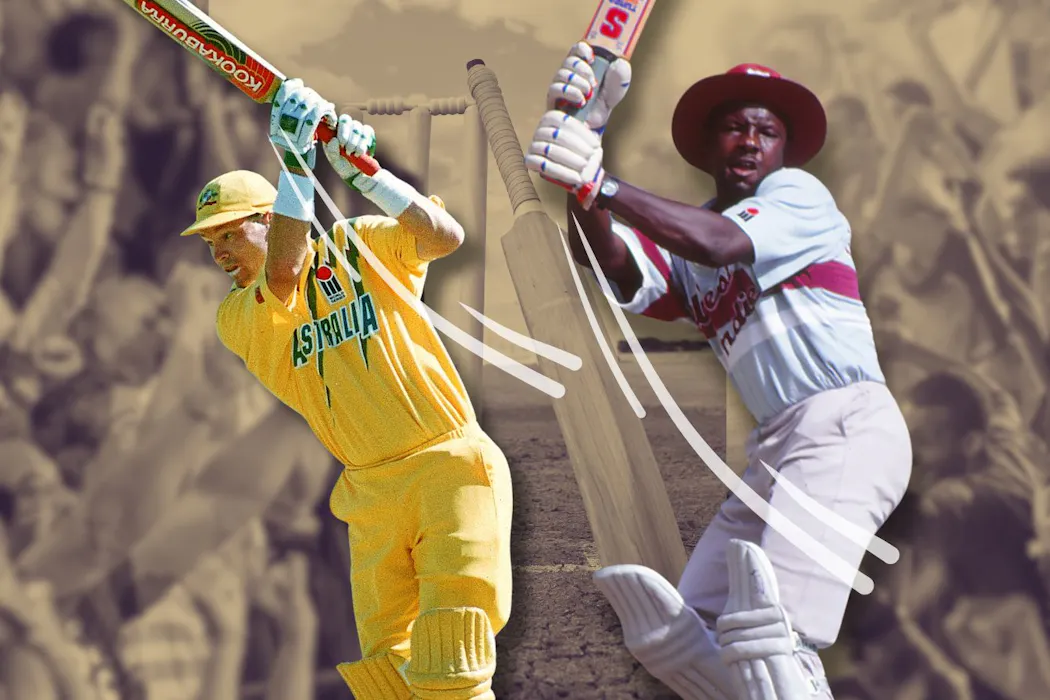
Game changers: how a rainy week led a frustrated Don Bradman to reinvent cricket

Getty Images/The Conversation

Sir Donald Bradman needs little introduction.

Cricket – and possibly world sport’s – most dominant figure, “The Don” is known for his staggering batting feats, including a scarcely believable batting average of 99.94, and his leadership of Australia’s 1948 team nicknamed the “Invincibles”.

However, few would know Bradman was a key figure behind cricket’s transformation from time-consuming five-day matches to the chaotic world of one-day and Twenty20 (T20) games that dominate the sport’s calendar, broadcasts and finances today.

And it was all sparked by Melbourne’s oft-criticised weather, some worried bean-counters, and a bright idea.


Sports can change dramatically in the blink of an eye. Sometimes, these moments create immediate shockwaves. Other times, it’s not until much later that their impact become obvious. This is the first story in a rolling series that explores key (and sometimes long forgotten) moments in sports history.


Read more: Game changers: how soccer’s mega-money era was sparked by a little-known Belgian athlete


The first one-day international

Domestic one-day matches of between 40 and 60 overs a side had been played in India and England since the 1950s.

These shorter, more dynamic games were aimed at attracting new spectators.

However, they had not been considered for international matches.

The first one-day international (ODI) in 1971 was an accident: an unscheduled match played as a last-minute replacement for a Test abandoned due to heavy rain.

According to Australia’s captain Bill Lawry, the match was conceived by Bradman for financial reasons. Facing heavy financial losses the English and Australian cricket boards agreed to play a game on what would have been the last day of the Test.

Around 46,000 spectators saw Australia win after each side was allotted 40 eight-ball overs.

It was a financial hit, popular with spectators and deemed an “overwhelming success” by the media.

But growth of this format was slow, mainly due to the conservative nature of international boards.

The next ODI did not happen until August 1972, and other countries did not start playing them until 1973.

Remarkably, considering the amateur status of women athletes at the time, the first limited-overs World Cup was a women’s tournament in England in 1973 – two years before the maiden men’s World Cup was played.

One-day cricket’s popularity soon soared, especially after the men’s World Cup in 1975.

Kerry Packer’s World Series Cricket, launched in 1977, confirmed its place on the international cricketing calendar and played a huge role in the shorter format’s popularity.

The media baron was desperate to showcase cricket on Channel Nine but his TV rights bid was rejected by the Australian Cricket Board. Aggrieved, Packer instead set up a breakaway competition, signing many of the world’s best players.

The new-look competition featured brightly coloured team kits, white balls, games under lights and batters wearing helmets – all of which are still in place today.

How ODIs changed cricket

Test cricket was, and often still is, criticised for being too slow and boring.

The limited number of overs in ODIs increased the speed of the game: batters looked to score more quickly and take more risks, which resulted in more boundaries.

Clive Lloyd, who captained the West Indies to two World Cup wins, called limited-overs cricket the greatest innovation for the sport. He specifically referred to improved standards of fielding and tactical awareness.

ODIs have greatly increased athleticism: batters need to be stronger to hit more boundaries and quicker to ensure they are fast enough when running between wickets.

Fielders need to be faster and more athletic to stop boundaries and extra runs. They also need stronger arms to throw the ball faster.

In 1992, fielding restrictions were introduced for the first 15 overs, only allowing two fielders outside of a 30-yard circle. This promoted early aggressive batting.

These fielding restrictions forced captains to rethink field placements and bowling rotations.

While Australia scored 191 runs to win the first ODI, current teams regularly surpass 300.

Scoring has increased because of power hitting, bigger bats, specific training and better running between wickets.

Boundary ropes introduced for player safety also reduced the distance required to hit a boundary.

Bowlers have had to develop more variations, such as slower balls, to make it harder for them to score runs.

In this shorter format, the importance of all-rounders (players who can bat and bowl competently) has increased greatly.

Wicketkeepers are also expected to be better batters. Former Australian wicketkeeper Adam Gilchrist had success opening the batting, which gave his team more flexibility to include other batters and all-rounders.

Player uniforms also evolved.

One-day clashes originally used traditional white clothing, but colour uniforms introduced a new dimension for televised cricket. They have been used permanently since the 1992 World Cup.

As the format evolved, player names and then numbers were gradually added to playing tops, making identification easier for commentators and spectators.


Read more: Game changers: how one team’s dominance transformed rugby league forever


Continuing relevance

Limited-overs cricket laid the platform for even shorter formats such as T20s, the Hundred and even ten over games.

Ironically, these innovative formats now threaten the continued relevance of 50-over cricket.

Analysis of more than 340 ODI matches played in Australia between 1985 and 2015 shows average attendances have declined over time. In the 1980s, games in Australia regularly drew crowds of more than 35,000, but in recent years attendance has struggled to regularly reach 25,000 per match.

However, major events like World Cups can still draw large crowds. The 2023 tournament was attended by a record 1.25 million people and made Australian captain Pat Cummins “fall in love with ODI cricket again”.

ODIs have given fans decades of drama and achievement.

Older fans still remember classic games such as Australia’s tied 1999 World Cup semifinal against South Africa, and Michael Bevan’s last-ball four to beat the West Indies on New Year’s Day in 1996.

Michael Bevan’s last-ball four against the West Indies captivated Australian audiences.

But 50-over cricket now faces a challenge to stay relevant alongside more exciting and more profitable T20 tournaments.

If ODIs are to keep their place in a busy cricket calendar, they must continue evolving to ensure they maintain player and audience interest.

The Conversation

The authors do not work for, consult, own shares in or receive funding from any company or organisation that would benefit from this article, and have disclosed no relevant affiliations beyond their academic appointment.

  •  

Breathing two-billion-year old air: MONA’s Hard Core is an artistic journey through deep time

Museum of Old and New Art/Flickr, CC BY-SA

The structure of the Museum of Old and New Art (MONA) is cut directly into Hobart’s Berriedale Peninsula – walls carved from roughly 250-million-year-old sandstone that formed when Tasmania was still part of the supercontinent Gondwana.

It’s the perfect setting for Berlin-based French-Swiss artist Julian Charrière’s latest exhibit, Hard Core. This is not just an exhibition about rocks. It is about how we humans fit into deep time, and how we dig up, reshape and use rocks that took millions of years to form.

Viewed through an earth scientist’s eyes, Charrière’s sprawling exhibition feels like an abstract field trip, moving between ancient rocks, glacial boulders, volcanic products, and the materials that underpin modern life.

Portrait of artist Julian Charrière standing beside a rocky outcrop in a mountainous landscape. He wears a green jacket and backpack and looks into the distance.
Portrait of Julian Charrière. Museum of Old and New Art/flickr, CC BY

Humans as a geological force

Many of Charrière’s works explore a simple but powerful idea: the things we consume are bound to deep time. The rocks, minerals and metals underpinning modern life took thousands to millions of years to form, yet we extract them in an instant.

The first work is Not All Who Wander Are Lost (2019). It shows four glacial erratics: boulders carried by glacial ice and deposited far away from where they formed. The name derives from the latin errare, which means “to wander”.

The boulders, roughly waist to chest high, were all collected from the same Swiss valley (though each one began its journey from a different source).

Large glacial erratic boulder displayed on drill cores in a dark gallery. Metal rods placed among the cores reference metal resources extracted from the Earth.
Not All Who Wander Are Lost is a 2019 work made of four ‘glacial erratics’. Museum of Old and New Art/flickr, CC BY

The erratic rocks sit atop a row of “drill cores”, long cylinders of rock usually extracted from deep underground. Like flipping through the pages of a book, scientists can study drill cores to get clues into the Earth’s history and resources.

Charrière has broken the cylinders and repaired them with metals such as brass, aluminium and stainless steel — materials that come from rocks themselves.

The contrast is uncomfortable. While geological processes moved these rocks over thousands of years, humans now shift them across the world, cut into them and remake them into modern materials.

This work isn’t simply about glaciation or mining; it’s about humanity’s growing role as a geological force.

Breathing two-billion-year-old air

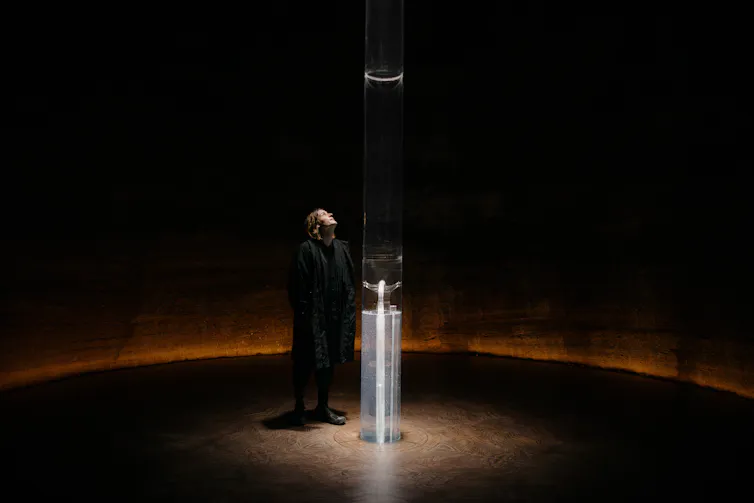
Charrière’s fascination with the natural world is clearest in Breathe (2026), a permanent installation that opened with Hard Core. It draws on the ancient rocks of the Pilbara in Western Australia, home to some of the world’s largest banded iron formations.

These began forming around 2.4 billion years ago during the Great Oxidation Event, when photosynthesising microbes began releasing oxygen into Earth’s oceans and atmosphere. Without this oxygen, complex life, including humans, may have never evolved.

Charrière describes Breathe as a kind of time machine. A reactor and electrolyser (developed with scientists) releases oxygen locked in the rocks into a circular chamber visitors enter one at a time.

Artist Julian Charrière stands beside a tall transparent column inside a circular, dimly lit chamber. The illuminated installation, Breathe, extends from floor to ceiling and is designed to release oxygen extracted from ancient rocks.
Julian Charrière beside the Hofmann apparatus in Breathe (2026), which releases oxygen extracted from ancient rocks. Museum of Old and New Art/flickr, CC BY

For a brief moment, they are the only person on Earth breathing air that has been trapped in rock for more than two billion years. Geological history usually feels remote, but Breathe removes that distance.

Inside the volcano

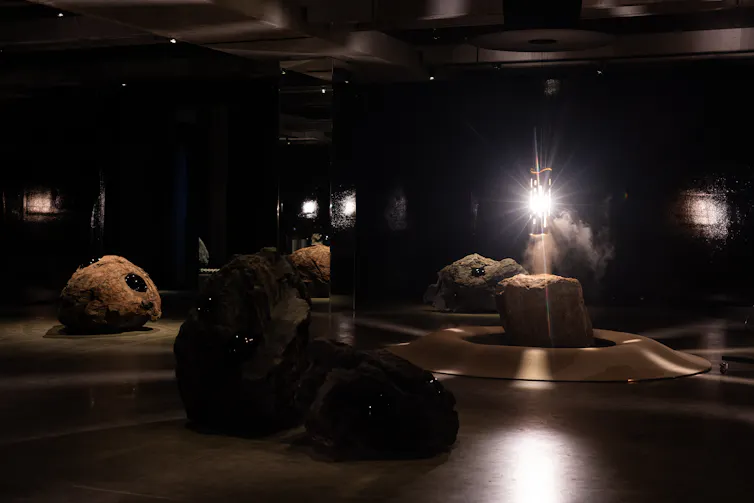
As a volcanologist, I was drawn to a cavernous space Charrière described as the “core” of his Hard Core exhibition. Surrounded by mirrored walls, this space rumbles, vibrates and flashes with light, creating an unsettling sensation of standing inside a volcano.

The space brings together several separate but interconnected works.

A Stone Dream of You (2024) features sculptures made from real volcanic lava bombs (lumps of molten rock flung from a volcano) and polished obsidian spheres (volcanic glass), while Thickens, pools, flows, rushes, slows (2020) is a striking sculpture made from shards of obsidian.

Installation view of Hard Core by Julian Charrière at MONA. Large volcanic rocks and lava bombs are arranged in a dark, mirrored gallery around a bright central light source, creating the impression of a volcanic chamber.
The ‘core’ of the ehxibit is a cavernous mirrored room, featuring sculptural works alongside an immersive sound installation. Museum of Old and New Art/flickr, CC BY

Both of these sit alongside Stone Speakers, a 4D sound installation playing recordings from five different active volcanoes around the world. Though distinct, the works are arranged together to create the atmosphere of a volcanic caldera.

Visitors can lie down and feel the seismic data resonating through the floor and their body — Earth’s restless pulse made physical.

A few other pieces kept me thinking after I left. In Atlas (2025), a Precambrian stromatolite is slowly polished into a sphere by rotating grinders. It was mesmerising, though I felt uneasy watching such an ancient object wear away.

Ancient stromatolite fossil held between metal rollers in a mechanical framework. Water flows over the rock as the machine gradually grinds it into a smooth spherical shape.
Atlas is a kinetic work in which an ancient stromatolite fossil is slowly ground into a sphere. Museum of Old and New Art/flickr, CC BY

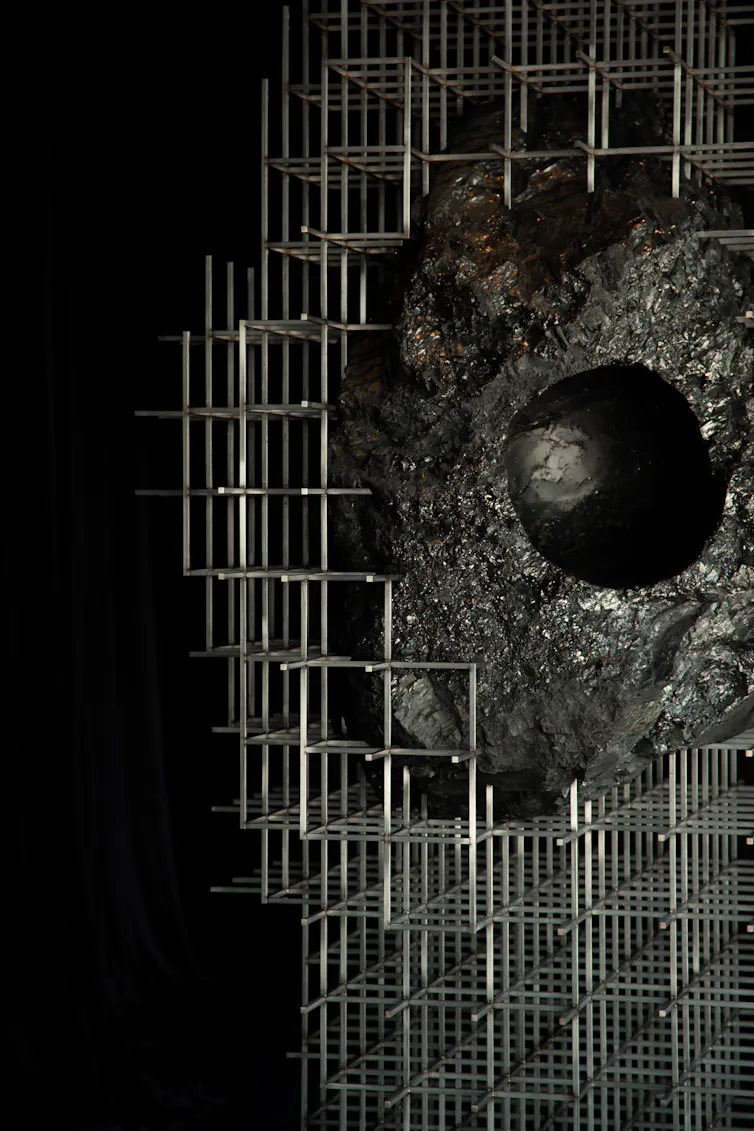
Another work, Soothsayer (2021), is a large lump of coal held at eye level, in a steel scaffold, with a cavity that’s big enough for a human head. Visitors are invited to stick their head in and breathe the air.

This piece flips the idea of burying your head in the sand. It asks you to sit for a moment with the coal’s deep past, and the fossilised life it’s made from.

Large black lump of coal suspended within a steel scaffold structure in a dark gallery space. A smooth, head-sized cavity is carved into the coal, inviting visitors to place their head inside the sculpture.
In Soothsayer, visitors can stick their head into a large, hollowed out piece of coal. Museum of Old and New Art/flickr, CC BY

Rocks as storytellers

Hard Core reminded me why I became a geologist. I love telling the stories of the extraordinary journeys rocks have been on – fragments of Earth’s deep history preserved beneath our feet.

Charrière goes one step further with this exhibition. His work highlights how humans are now part of those stories. We aren’t separate from the geological world, but are actively reshaping it.

Charrière invites us to see rocks differently: not as scenery, resources, or museum objects, but as storytellers carrying the history of the planet, and increasingly, our own.

Hard Core is showing at MONA until March 29, 2027.

The Conversation

Hannah Moore is affiliated with not-for-profit organisation, Australian Earth Science Education.

  •  

Game changers: how a stroke of paint transformed basketball, and the athletes who play it

When basketball was invented by medical doctor James Naismith in 1891 – to keep American football players active during winter – all baskets were worth two points, regardless of where they were shot from.

Games were dominated by tall players who usually shot from close to the basket.

It was often very crowded near the basket and there were fewer opportunities for smaller players.

This all changed when the 3-point line was introduced.

History of the 3-point line

The 3-point line was temporarily trialled in a few college games and minor professional leagues from the 1940s to the early 1960s, but was seen as more of a gimmick.

It gained more popularity after it was introduced in the American Basketball Association (ABA) (a competitor league to the NBA) during the 1967–68 season.


Sports can change dramatically in the blink of an eye. Sometimes, these moments create immediate shockwaves. Other times, it’s not until much later that their impact become obvious. This is part of a rolling series that explores key (and sometimes long forgotten) moments in sports history.


Read more: Game changers: how a rainy week led a frustrated Don Bradman to reinvent cricket


The ABA wanted to make basketball more interesting and exciting. It viewed the 3-pointer as the equivalent to a home run in baseball and believed it would “give smaller player a chance to score and open up the defence to make the game more enjoyable to fans”.

The ABA merged with the NBA in 1976 but the NBA did not immediately introduce the 3-pointer because many traditional coaches and players were against it.

It was finally introduced for the 1979–80 season, with Chris Ford from the Boston Celtics shooting the first one.

The International Basketball Association (1984) and other national leagues followed this move during the next decade.

It changed basketball, slowly

The 3-point line did not make a big difference straight away.

Players still preferred to shoot from closer to the basket because there was a higher chance of success. Teams did not practise 3-pointers and generally only used them when trying to win a game in the final few seconds.

The San Diego Clippers scored the most 3-pointers for the 1979–80 season, with 177 (2.2 per game). Brian Taylor from the Clippers had the most individual 3-pointers (90).

Times have changed.

During the 2024–25 season the Celtics scored the most 3-pointers: 1,475 (17.8 per game) and every team in the NBA scored more than 900. Some 139 players made 100 or more.

League 3 point trend. NBA

How 3-pointers became more popular

A few key events contributed to 3-pointers becoming more popular.

The inclusion of a 3-point contest at the NBA All-Star weekend in 1986 made the shot more respected. It helped that the first three were won by popular Celtics All-Star Larry Bird.

From 1994 to 1997 the NBA moved the 3-point line closer to the basket (from 7.24 metres to 6.71m) to encourage more scoring in games.

While it did not improve the trend of lower scores and the line was moved back, teams did start to shoot more threes.

The Steph Curry phenomenon

In the 2010s, the rise of the Golden State Warriors sparked a 3-point revolution.

Led by two-time MVP Steph Curry, the Warriors’ heavy reliance on the 3-pointer helped them make the NBA Finals five years in a row, winning three championships.

Curry, who is more than 10cm shorter than the average NBA player, is credited with changing the game by regularly shooting “deep threes” from way behind the 3-point line. This allowed him more time to shoot over taller players.

It also changed how other teams defend because they have to cover more space to defend him. Consequentially, his teammates enjoy increased scoring opportunities.

Curry is the most successful 3-point shooter in NBA history. Kids now want to “be like Steph”.

WNBA All-Star Caitlin Clark has also been influential increasing the popularity of 3-pointers.

The role of analytics

Statistics-focused executives such as Daryl Morey also played a key role in the increasing popularity of 3-pointers.

They realised teams could score more points by shooting 3-pointers, even if they shot a slightly lower percentage.

For example, if a team takes ten 3-point shots and make 40% (four) of them, they will score 12 points (4x3 = 12). This is more than they will score if they take ten 2-point shots and make 50% (five) of them (5x2 = 10).

Under Morey’s leadership, the Houston Rockets became the first NBA team to attempt more 3-pointers than 2-pointers in a season. They did this from 2017 to 2020, when they won three consecutive division titles.

A statistical analysis across ten seasons from 2009–10 to 2018–19 also showed teams that took more 3-point shots had a higher probability of winning.

This rise in 3-pointers has come almost exclusively at the expense of mid-range shots.

Mid-range shots are shot from outside the paint but inside the 3-point line (roughly 3–7m from the basket).

The percentage of total shots from mid-range has plummeted from 31% in 2010–11 to just 13% a decade later, while shots in the paint (close to the basket) have remained relatively steady.

League wide % of all field goal attempts. NBA

The 3-point line has improved the game by adding variety in offence, spreading players out and allowing players of different sizes and skills to be successful.

However, fans, players and commentators are starting to wonder whether there are now too many 3-pointers being shot.

Too much of a good thing?

The increased emphasis on 3-pointers in the NBA has coincided with a decline in viewership. Although these may not be related, it has sparked concerns.

NBA Commissioner Adam Silver noted that while game attendance remained strong and fans enjoy the skill on display, he acknowledged some teams’ attacking plays can appear “cookie cutter” as teams mimic each other’s 3-point-heavy tactics.

NBA legend Shaquille O’Neal also stated the 3-point craze made games feel predictable, where “every team is running the same plays”.

Time for a change?

Suggestions from former players, coaches, commentators and spectators include moving the line further back, reducing the space available for shooting 3-pointers from the corner of the court, increasing overall court dimensions, adding a 4-point line or even capping teams’ 3-pointer attempts.

Silver says the league is open to exploring tweaks if they improve the balance between inside and outside play.

There are no plans to change yet, as any rule change will trigger flow-on effects for offence and defence that may not improve the game.

The Conversation

The authors do not work for, consult, own shares in or receive funding from any company or organisation that would benefit from this article, and have disclosed no relevant affiliations beyond their academic appointment.

  •  

Instagram can now read all users’ private messages. Will this make kids safer or just boost ad targeting?

Meta's CEO Mark Zuckerberg in 2019. Anthony Quintano, CC BY-NC

As of May 8 end-to-end encryption is no longer available on direct messages on Instagram.

Meta, in announcing the policy reversal, said it had done so because few people used the feature. But this has raised questions about its impact on user privacy and whether it will improve child safety on the platform.

Instagram has long been a focal point for discussion about online safety – whether in relation to body image concerns, cyberbullying or sexual extortion. This policy change by Meta directly affects how safety and moderation are implemented in private messages.

This is important considering research has found that perpetrators first contacted roughly 23% of Australian sexual extortion victims on Instagram, the second most frequent method of contact, behind Snapchat (at 50%).

What is end-to-end encryption?

End-to-end encryption is a way of scrambling a message so only the sender’s and recipient’s devices can read it. The platform carrying the message, in this case Instagram, can’t access it.

This same technology is present by default on WhatsApp, Signal, iMessage, and (since late 2023) Facebook Messenger.

Meta’s CEO Mark Zuckerberg first promised to bring end-to-end encryption across Meta’s messaging products back in 2019, under the slogan “the future is private”.

Instagram tested encrypted direct messages in 2021. It rolled them out as an opt-in feature in 2023.

End-to-end encrypted direct messages never became the default, and the low adoption rate of opting in to use the feature is Meta’s justification for removing it. As a spokesperson told The Guardian:

Very few people were opting in to end-to-end encrypted messaging in DMs, so we’re removing this option from Instagram.

There is a circular logic to this: Meta has killed off a feature it buried so deep that most users never knew it existed, then cited low usage as the reason for its removal.

What does this mean for Instagram users?

In practical terms, every message you send on Instagram now travels in a form Meta can read.

Meta’s privacy policy lists the content of messages users send and receive among the data it collects. In principle, this enables the company to use this data to personalise features, train artificial intelligence (AI) models, and deliver targeted advertising.

While Meta has publicly committed not to train its AI models on private messages unless users actively share them with Meta AI, it has made no equivalent public commitment about advertising.

That leaves open the possibility that Meta could use unencrypted Instagram direct messages for ad targeting. And without encryption, Meta’s AI commitment is now backed by policy alone, not by the technology itself.

A clear reversal

This reads as a clear reversal of Meta’s privacy-first posture which Zuckerberg announced seven years ago.

Meta has been under sustained pressure from law enforcement, regulators and child protection organisations who argue end-to-end encryption creates spaces where platforms can’t detect child sexual exploitation and grooming. Australia’s eSafety Commissioner has been clear that the deployment of end-to-end encryption “does not absolve services of responsibility for hosting or facilitating online abuse or the sharing of illegal content”.

This argument deserves to be taken seriously. The harms are real and disproportionately fall on young people.

However, sexual extortion research shows perpetrators don’t tend to stay on the platform where they make first contact, with more than 50% of sexual extortion victims saying perpetrators asked them to switch platforms.

Meta still uses end-to-end encryption on its other platforms, such as WhatsApp and Facebook Messenger, and it needs to apply a consistent approach to child safety. Predators routinely ask victims to switch platforms, so the company’s safety approach needs to work for Instagram and their end-to-end encrypted services.

A false choice

Meta and privacy advocates often frame this as a choice between end-to-end encryption or child safety. But that’s a false choice. It’s not an “either-or” situation, even if they make it sound like one.

The technology already exists to detect harmful content while keeping messages encrypted in transit. It just has to run in the right place: on the user’s device, before the device encrypts and sends the message, or after it receives and decrypts it.

On-device approaches have a contested history, and any deployment must be genuinely privacy-preserving by design. But technology companies must weigh the objection against the harms that continue to occur. A safety by design approach is needed.

On-device safety measures have been demonstrated at scale with Apple’s on-device nudity detection for images sent or received via Messages, AirDrop and FaceTime. A 2025 study demonstrated high-accuracy grooming detection using Meta’s AI model designed specifically for on-device deployment on mobile phones.

Recently, both Apple and Google have started to take measures towards app store–based age verification in some jurisdictions.

The highest-profile real-world deployment of these is Apple enabling device-level privacy-preserving age verification in the UK.

Social media and private messaging companies, along with operating system vendors (Microsoft, Apple, and Google), all have a role to play in ensuring harmful content is detected, whether or not end-to-end encryption is used. Progress has been slow. But we, as a community, need to demand more from these companies.

The Conversation

Joel Scanlan is the academic co-lead of the CSAM Deterrence Centre, which is a partnership between the University of Tasmania and Jesuit Social Services, who operate Stop It Now (Australia), a therapeutic service providing support to people who are concerned with their own, or someone else's, feelings towards children. He has received funding from the Australian Research Council, Australian Institute of Criminology, the eSafety Commissioner, Lucy Faithfull Foundation and the Internet Watch Foundation.

  •  

Fenian: the anti-Irish history behind Kneecap’s defiant new album title

Heavenly Recordings/Kneecap

Irish hip-hop group Kneecap recently released their latest album, called “Fenian”.

A proud reclamation of a painful derogatory slur, Fenian is a word that connects Irish people to a history in which they were sometimes seen as less than human.

A title packed with meaning

The word originally comes from “Fianna”, which is linked to an ancient Irish mythology. The Fianna were small groups of male Irish warriors led by the legendary hero, Fionn mac Cumhaill.

Today, however, the term is more commonly known for its association with Irish nationalism.

Since at least the 17th century, Irish people have endured religious and cultural oppression under British rule – which largely targeted the Irish Catholic population.

In the 19th century, various nationalist groups fought for Irish independence, sometimes violently. This included the Irish Republican Brotherhood, whose members were called Fenians.

The word’s meaning eventually expanded to become a derogatory term for supporters of Irish independence.

A screenshot of a webpage showing various meanings and uses of the term 'Fenian'.
A screenshot from Kneecap’s website explaining the different meanings of ‘Fenian’. Kneecap

Anti-Irish stereotyping

But there’s more to this word than just its political significance. It is also entwined with a history of anti-Irish racism, also known as “hibernophobia”.

In the 19th century, interest in human evolution led to a pseudo-scientific theory called social Darwinism.

This discredited theory claimed all human “types” could be placed along a hierarchy of evolution. White Europeans were at the top, as the most “evolved”. This twisted logic was used to justify the subjugation of people in colonised territories worldwide, including Australia.

Irish Catholic people were given a position in this hierarchy – towards the bottom. Historians argue the designation of Irish Catholic people as a backwards “race” was used to rationalise their oppression. If they were an inherently “savage” people, then they were unfit to run their own government.

Fenians supposedly embodied the worst elements of the Irish character: stupidity, violence and brutishness. From this viewpoint, Fenian violence became seen as an expression of a supposedly inherent Irish character – not as a response to the British rule in Ireland.

Cartoons were published that dehumanised Fenians and drew on centuries of anti-Irish stereotyping. Fenians were drawn as “terrorists” with exaggerated facial features, making them look like chimpanzees.

In one typical example from 1866, a thuggish, simianised Fenian man menaces a beautiful feminised version of “Britannia”. Anti-Irish cartoons were even published in Australia.

A xenophobic 1886 cartoon shows a caricaturised ‘Fenian’ next to a women called ‘Brittania’. Punch v.49-52 (1865-67)

This history of anti-Irish racism still normalises anti-Irish jokes today.

Who are Kneecap?

Kneecap is a rap and hip-hop trio from Northern Ireland.

The group shot to fame following the release of their 2024 semi-autobiographical film. Their music is gritty, rude and defiantly anti-colonial – belonging to a long line of Irish activists fighting to get “Brits out” of Ireland.

Kneecap want to bring Irish people together, regardless of religion, and reunite Northern Ireland with the Republic of Ireland. The six counties of Northern Ireland were separated from the rest of Ireland in the 1921 Partition. They remain part of the United Kingdom.

Kneecap rap in English and Irish, and have been credited for revitalising the Irish language. Irish only achieved official language status in Northern Ireland in 2022, after being suppressed for much of the 20th century.

The chorus in Kneecap’s latest title song, also called Fenian, features a crowd jubilantly chanting “F-E-N-I-A-N”. The messaging is clear: they accept the label. In fact, they celebrate it.

The track was written as one of the band members, Mo Chara, faced charges of terrorism brought against him by the British government. In November 2024, Mo Chara allegedly committed a terrorist act by waving a Hezbollah flag at a London concert.

Kneecap is outspoken in its support for the Palestinian people, connecting the group to a longer history of Irish nationalists advocating for other colonised peoples.

The charges were dismissed. As Mo Chara observed in a recent interview, he’s not “the first Irish person to be called a terrorist”.

Who can use ‘Fenian’?

Although Kneecap celebrate being called “Fenians”, this word can still be understood as a cultural slur.

Recently, the band claimed it was forced to “censor” its album posters by blanking out the word Fenian. London transport authorities allegedly refused to publish the uncensored version.

Kneecap knows the power and the pain of this label, and they use it with intention. With a sense of tongue in cheek, they explain their use of the term refers to members of “a secret socialist society of sound cunts”. But they also acknowledge it can be weaponised as a derogatory slur. Context is everything.

“Fenian” can’t be untangled from a painful history of anti-Irish racism, which arguably lingers today.

It is appropriate for Kneecap to reclaim the word as a statement of cultural defiance. They use it as an empowering rejection of stigma. But it is problematic for others to use it without thinking of its deeper meaning.

The Conversation

Ciara Smart does not work for, consult, own shares in or receive funding from any company or organisation that would benefit from this article, and has disclosed no relevant affiliations beyond their academic appointment.

  •  

Amanda Lohrey’s UFO novel captures the uncertainties of reason, doubt and belief

Danie Franco/Unsplash

Amanda Lohrey’s Capture plays out as a sequence of conversations in strange rooms.

The centre of the novel is the consulting room of psychiatrist James Mather, lately stripped of all its therapeutic paintings and suggestive curios to a state of clinical blankness. There is also the apartment where the psychiatrist and his former lover regard each other from “two enormous couches in the centre of the room”. And there are the rooms of a shiatsu sensei, cavernous and empty, except for a “big glass aquarium of shimmering fish”.

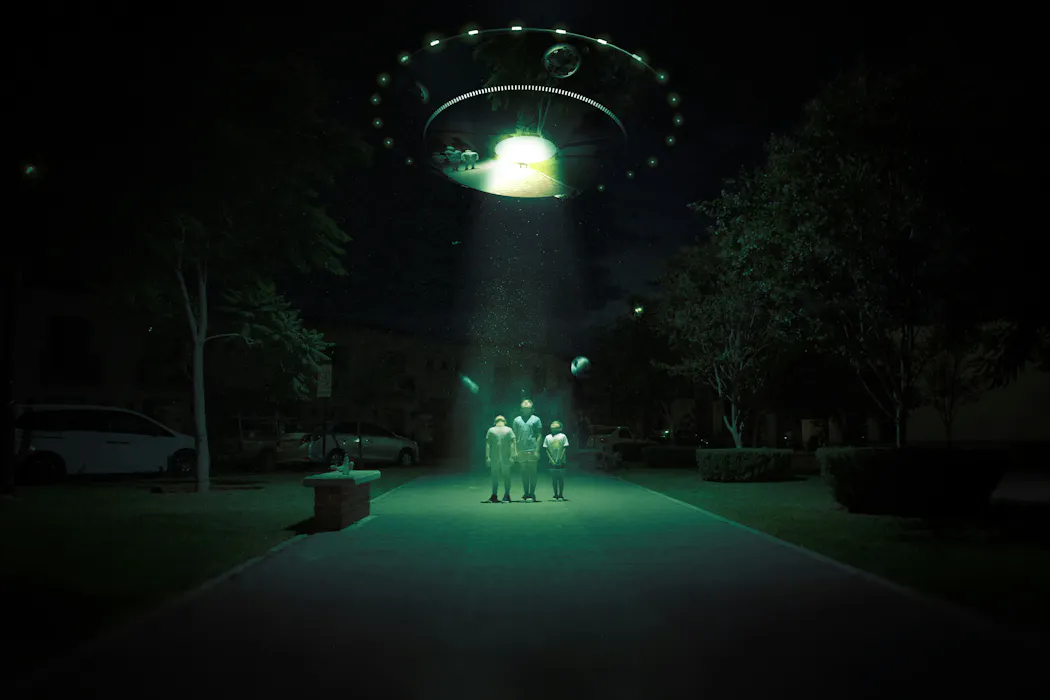
Shadowing all these rooms, in this novel of the ordinary and the divine, are the dream-interiors of UFOs. James is studying people who claim to have been abducted by aliens, and Capture is partly composed of his interviews with them. “I wake up in this weird room, this weird shiny room,” says Mary, a beautician.

But it feels like every room in Lohrey’s novel is a weird shiny room, where humans are studied with curiosity and partial incomprehension.


Review: Capture – Amanda Lohrey (Text Publishing)


Lohrey was raised as a Catholic in postwar working-class Hobart. Though she fled the faith as a teenager, her fiction has always been concerned with the personal and political dimensions of belief.

Her later career works – including the multi-award-winning The Labyrinth (2021) and The Conversion (2023) – all focus on myth, dreams and the limits of rationality. In these novels, a lonely and adrift protagonist takes on a quixotic project in the hope of giving their life a meaning and a shape.

In Capture, Lohrey sketches James as a quietly self-doubting rationalist. Though he deals in symbols and narratives, he puts himself in the science camp. He does not read fiction because it “mostly lacks substance”. He keeps himself free from the “weeds of superstition”.

His assistant, Lucy Cheng, is one of “you people in the humanities”: a historian with a doctorate on 19th-century medicine, who has a “healthy scepticism of the DSM” and an awareness of psychology’s history of oppression. “What, at any given moment,” Lucy asks, “is credible science?”

To his colleagues, James is a man “radiating complacency”, yet his glassy demeanour is already faintly rippled with uncertainty. “We make it up as we go along,” he replies to Lucy’s question. “Unless we are adhering to a rigidly prescribed set of doctrines, how else could it be?”

James wields his doubt as a professional virtue, but it also affects him in a more gnawingly existential way. After a long career, he is approaching retirement with a sense of incompleteness. Having broken his back coming off a motorbike in his twenties, the arthritic pain in his spine keeps returning him to a body he would prefer to transcend.

So he takes up the alien capture research on a whim, as a last hurrah and a grand distraction. “By immersing myself in another reality I might disengage my mind from its prison of flesh and bone,” he thinks, “for in my worst moments, pain threatened to unhinge my sense of self.”

What he expects is an enjoyably diverting cavalcade of Roswell truthers and hillbillies: “in my preparatory reading,” he says, “I have gained the impression that captives belonged to a lower socio-economic category, the kind of people prone to paranoid fears, and dreams so vivid they cannot be distinguished from reality.”


Read more: Intellectual fearlessness, politics and the spiritual impulse: the remarkable career of Amanda Lohrey


Everyday epiphanies

There is something here of the liberal political imagination in the age of Trump, which too readily blames the rise of a post-truth world on poor people who are easily tricked.

At first, the psychiatrist seems confident in his ability to explain away the experiences of his subjects. He concludes that his first case, Anthony, may be suffering “unconscious grief at the prospect of having no heirs,” which has “induced a psychotic episode”.

James’s favoured technique is to get patients talking on their pet topic, watching how they light up and how they construct their narratives. He encourages the beautician Mary to detail the art of eyelash extensions, while he savours “the accuracy, indeed a kind of eloquence, with which she describes her technique.”

He does the same to everyone. He encourages his assistant Lucy’s young son to monologue about Transformers, and his grown-up son to rhapsodise about bread baking. “I am content to listen as he describes his art,” he says.

This is how the psychiatrist understands other humans, but these are also moments when he finds humans to be at their most obsessive, arcane and alien. Rituals and icons – the “everyday epiphany” of a fresh loaf of bread, or the plastic gods of a small child – belong to a realm of shamanic experience James cannot fully comprehend. “My psyche is stripped bare of consoling ritual,” he says, “and what remains is the pain in my spine.”

Amanda Lohrey. Text Publishing

The emotional core of the novel is a scene in which James contemplates the evening rituals and icons of his wife. He recalls “watching Deborah prepare for bed, an unvarying ritual of small observances, never rushed”. In her absence, her presence is felt as a “constellation of intimate traces”.

On the bureau opposite the bed, Deborah keeps a framed photograph from 1870 that she discovered during her archival research. It shows a bargemaster’s wife and baby aboard a canal boat. The boat’s confined living space is decorated like a shrine.

Every night before turning out her lamp my wife glances at this icon. On many nights it’s the last thing she sees. Why? It is so unlike Deborah to romanticise the past. My instinct tells me that these late-night glances are a rite of mourning, but for what? Could it be that some infant, some lost or unborn child, lives aboard the boat of my wife’s dreams?

James considers showing the photograph to his assistant Lucy, to see what another woman might make of it, but he thinks better of it: “It is not, after all, my shrine.”

Alien otherness

His wife and her household gods are a dark canal James cannot fathom. So he is unsettled when he interviews Bernard, a draughtsman with the city planning authority, who claims to have experienced a religious awakening in his close encounter with a UFO, and who mourns every day for his absent alien gods.

In a pair of wonderfully freewheeling scenes, James takes his incomprehension to a folklorist and to a theologian. The latter suggests that this is “just one of the many symptoms of the god-shaped hole in our culture […] We’ve been deprived of metaphysical hope so we take it where we can find it.”

The confidence James took into the project is already evaporating. His subjects are sober and middle class; their stories, though extraordinary, are “linear, consistent and rational”. Every one of his theories seems inadequate.

This leaves him to contemplate the ultimate horror: that these experiences cannot be adequately captured by the language of psychiatry as delusions or symptoms, projections or wish fulfilments. What if these things actually happened? What if the gods are real?

“I have arrived in a cul-de-sac of unknowing,” he says. “I no longer believe that I can account for and interpret the reality of others.”

When Flick, the folklorist and James’s ex-lover, tries to talk him out of his newfound doubts about doubt, the psychiatrist resorts to the language used by alien abductees themselves. Only those who witnessed the interviews in his consulting room, he says, can really understand:

Her logic is impeccable but rankles with me. You were not in the room, I want to say. You were not in the room. In the room there’s an electricity, a vibration; it’s a different order of experience. Outside the room, it’s all words. And after all her theories are applied, in my mind there remains a surplus of meaning.

And so it comes back to a conversation in a room: to the psychiatrist’s art, which is also the novelist’s art, of reading the vibrations: probing, diagnosing and interpreting the alien otherness of human consciousness. What if, Lohrey asks, the textures of everyday life – with all of its attachments and private obsessions – are too much for the psychiatrist or the novelist to capture?

The Conversation

Robbie Moore does not work for, consult, own shares in or receive funding from any company or organisation that would benefit from this article, and has disclosed no relevant affiliations beyond their academic appointment.

  •  

Game changers: how a rainy week led a frustrated Don Bradman to reinvent cricket

Getty Images/The Conversation

Sir Donald Bradman needs little introduction.

Cricket – and possibly world sport’s – most dominant figure, “The Don” is known for his staggering batting feats, including a scarcely believable batting average of 99.94, and his leadership of Australia’s 1948 team nicknamed the “Invincibles”.

However, few would know Bradman was a key figure behind cricket’s transformation from time-consuming five-day matches to the chaotic world of one-day and Twenty20 (T20) games that dominate the sport’s calendar, broadcasts and finances today.

And it was all sparked by Melbourne’s oft-criticised weather, some worried bean-counters, and a bright idea.


Sports can change dramatically in the blink of an eye. Sometimes, these moments create immediate shockwaves. Other times, it’s not until much later that their impact become obvious. This is the first story in a rolling series that explores key (and sometimes long forgotten) moments in sports history.


Read more: Game changers: how soccer’s mega-money era was sparked by a little-known Belgian athlete


The first one-day international

Domestic one-day matches of between 40 and 60 overs a side had been played in India and England since the 1950s.

These shorter, more dynamic games were aimed at attracting new spectators.

However, they had not been considered for international matches.

The first one-day international (ODI) in 1971 was an accident: an unscheduled match played as a last-minute replacement for a Test abandoned due to heavy rain.

According to Australia’s captain Bill Lawry, the match was conceived by Bradman for financial reasons. Facing heavy financial losses the English and Australian cricket boards agreed to play a game on what would have been the last day of the Test.

Around 46,000 spectators saw Australia win after each side was allotted 40 eight-ball overs.

It was a financial hit, popular with spectators and deemed an “overwhelming success” by the media.

But growth of this format was slow, mainly due to the conservative nature of international boards.

The next ODI did not happen until August 1972, and other countries did not start playing them until 1973.

Remarkably, considering the amateur status of women athletes at the time, the first limited-overs World Cup was a women’s tournament in England in 1973 – two years before the maiden men’s World Cup was played.

One-day cricket’s popularity soon soared, especially after the men’s World Cup in 1975.

Kerry Packer’s World Series Cricket, launched in 1977, confirmed its place on the international cricketing calendar and played a huge role in the shorter format’s popularity.

The media baron was desperate to showcase cricket on Channel Nine but his TV rights bid was rejected by the Australian Cricket Board. Aggrieved, Packer instead set up a breakaway competition, signing many of the world’s best players.

The new-look competition featured brightly coloured team kits, white balls, games under lights and batters wearing helmets – all of which are still in place today.

How ODIs changed cricket

Test cricket was, and often still is, criticised for being too slow and boring.

The limited number of overs in ODIs increased the speed of the game: batters looked to score more quickly and take more risks, which resulted in more boundaries.

Clive Lloyd, who captained the West Indies to two World Cup wins, called limited-overs cricket the greatest innovation for the sport. He specifically referred to improved standards of fielding and tactical awareness.

ODIs have greatly increased athleticism: batters need to be stronger to hit more boundaries and quicker to ensure they are fast enough when running between wickets.

Fielders need to be faster and more athletic to stop boundaries and extra runs. They also need stronger arms to throw the ball faster.

In 1992, fielding restrictions were introduced for the first 15 overs, only allowing two fielders outside of a 30-yard circle. This promoted early aggressive batting.

These fielding restrictions forced captains to rethink field placements and bowling rotations.

While Australia scored 191 runs to win the first ODI, current teams regularly surpass 300.

Scoring has increased because of power hitting, bigger bats, specific training and better running between wickets.

Boundary ropes introduced for player safety also reduced the distance required to hit a boundary.

Bowlers have had to develop more variations, such as slower balls, to make it harder for them to score runs.

In this shorter format, the importance of all-rounders (players who can bat and bowl competently) has increased greatly.

Wicketkeepers are also expected to be better batters. Former Australian wicketkeeper Adam Gilchrist had success opening the batting, which gave his team more flexibility to include other batters and all-rounders.

Player uniforms also evolved.

One-day clashes originally used traditional white clothing, but colour uniforms introduced a new dimension for televised cricket. They have been used permanently since the 1992 World Cup.

As the format evolved, player names and then numbers were gradually added to playing tops, making identification easier for commentators and spectators.


Read more: Game changers: how one team’s dominance transformed rugby league forever


Continuing relevance

Limited-overs cricket laid the platform for even shorter formats such as T20s, the Hundred and even ten over games.

Ironically, these innovative formats now threaten the continued relevance of 50-over cricket.

Analysis of more than 340 ODI matches played in Australia between 1985 and 2015 shows average attendances have declined over time. In the 1980s, games in Australia regularly drew crowds of more than 35,000, but in recent years attendance has struggled to regularly reach 25,000 per match.

However, major events like World Cups can still draw large crowds. The 2023 tournament was attended by a record 1.25 million people and made Australian captain Pat Cummins “fall in love with ODI cricket again”.

ODIs have given fans decades of drama and achievement.

Older fans still remember classic games such as Australia’s tied 1999 World Cup semifinal against South Africa, and Michael Bevan’s last-ball four to beat the West Indies on New Year’s Day in 1996.

Michael Bevan’s last-ball four against the West Indies captivated Australian audiences.

But 50-over cricket now faces a challenge to stay relevant alongside more exciting and more profitable T20 tournaments.

If ODIs are to keep their place in a busy cricket calendar, they must continue evolving to ensure they maintain player and audience interest.

The Conversation

The authors do not work for, consult, own shares in or receive funding from any company or organisation that would benefit from this article, and have disclosed no relevant affiliations beyond their academic appointment.

  •  

Hidden in plain sight: the race to discover new species before they’re gone

JOY PAN/Getty

When most people imagine scientists discovering new species, they probably still picture an expedition into the unknown.

A naturalist travels somewhere remote, perhaps on a wooden ship, and traipses through the jungle to encounter an animal or plant never before described by science. The intrepid explorer brings back specimens or observations to a museum, where they can be compared, named and described.

There is some truth to this stereotype. Between 1854 and 1862, scientist Alfred Russel Wallace travelled through the Malay Archipelago, discovering animals and insects unknown to Western science. This led him to the theory of evolution by natural selection, contemporaneously with Charles Darwin.

Antarctica had its own era of discovery. In 1840, scientists on a French expedition encountered what we now know as Adélie penguins. Imagine seeing penguins for the first time: strange black-and-white birds waddling over the ice, sliding on their bellies, leaping from freezing seas.

Of course, “discovery” is a loaded word. Many animals and plants described by Western science were already known to Indigenous peoples and local communities. What changed was their entry into the formal scientific naming system – the global process by which species are compared, classified and recognised.

Today, scientists are still finding new life in remote places and hidden inside the DNA of animals we thought we already knew.

We still explore unknown worlds

Scientists still discover species this way: by probing Earth’s nooks and crannies and travelling to remote places to study what lives there.

Last year, I was onboard the scientific vessel R/V Falkor (too) in Antarctica’s Weddell Sea, where one scientific team was searching for seafloor methane seeps.

These are not just geological curiosities. Methane seeps create unusual habitats that harbour strange communities of life fuelled not by sunlight, but by chemicals rising from below. Scientists have already found new microbial diversity at Antarctica’s first known active methane seep.

Not all hard-to-reach worlds are underwater. In Papua New Guinea’s Southern Fold Mountains, camera traps captured a shy, ground-dwelling bird slipping through rugged limestone forest. Scientists described it as a new species in 2025, the hooded jewel-babbler.

But there is another kind of discovery happening too.

White microbial mats underwater are telltale signs of seeping methane. Andrew Thurber, CC BY-ND

Hidden species in familiar animals

Some species are not hidden because they live at the bottom of the sea or deep in a mountain forest. They are hiding in plain sight.

Gentoo penguins are a good example. With their bright orange bills and comic waddle, they are familiar to anyone who has visited Antarctica. To most observers, they are simply “gentoos”.

But our new research shows gentoo penguins are not one widespread species, but four. Our 2020 study first showed major genetic and physical differences between gentoo penguins from different islands.

Now, using whole genomes – the complete set of genetic instructions inside an animal – and ecological modelling, we found these penguins are not just separated by distance, but have adapted to different Southern Ocean worlds.

A large colony of Gentoo penguins on the ice with the ocean behind.
Gentoo penguins on Cuverville Island, Antarctica. David Stanley/flickr, CC BY-ND

Learning to see in higher resolution

Discoveries like this are often called “hidden” species. They look very similar to their relatives, but if we study their DNA, body measurements, behaviour and ecology, it’s clear they are separate species.

Species discovery has always depended on the tools available. Early naturalists relied on what they could collect: feathers, skins, eggs and bones. These museum collections are like time machines and remain incredibly important.

Today, whole genomes tell us if animals have different coding. Ecological models show whether animals live in different environmental conditions. Mathematical approaches test whether groups are evolving independently.

In other words, we are learning to see biodiversity in higher resolution.

This sharper view is changing how we understand familiar animals. For a long time, giraffes were considered one species, but genetics suggests they are four. My own work on forest birds in Madagascar found a new species of Newtonia bird.

The Tapanuli orangutan is a powerful example. This Indonesian great ape from Sumatra was described as a new species in 2017, based on genomic, anatomical and behavioural evidence. It was extraordinary to recognise a new great ape in the 21st century, and sobering to realise fewer than 800 may remain.

Again and again, the message is the same. The natural world is more complex than we know. And sometimes, by the time we recognise that complexity, a species may already be in deep trouble.

An orangutan sits in a leafy tree.
The Tapanuli orangutan is a species of orangutan restricted to South Tapanuli in the island of Sumatra in Indonesia. It is one of three known living species of orangutan. Prayugo Utomo/Creative Commons, CC BY

Why names matter

Taxonomy – the science of naming and classifying life – can sound like an old-fashioned labelling exercise. But it’s how we map life on Earth.

Conservation laws, threatened species lists and monitoring programs usually work at the species level. If several species are mistakenly treated as one, a declining species can be hidden inside a larger group that looks secure.

As we stand at the precipice of Earth’s sixth mass extinction, this has never been more important.

Recognising hidden biodiversity does not solve conservation problems by itself. But it helps us ask better questions. Which species are increasing? Which are declining? Which have not been counted for decades?

These questions are urgent, because we are racing to understand biodiversity while climate change and habitat loss reshape life on Earth.

Even now, in an age of satellites and genome sequencing, Earth still has secrets. Not only in the most remote places, but in the first animals we learn to recognise as children: penguins, giraffes, orangutans.

The closer we look, the more life reveals itself. Our task now is to keep looking and protect the richness that was there all along.

The Conversation

Jane Younger receives funding from the Australian Research Council, National Geographic Society, Rolex, WIRES, the Marine Megafauna Research Fund, and Lindblad-National Geographic. She is affiliated with the University of Tasmania and Senior Editor of Ecology & Evolution.

  •  
❌