Reading view

How much is a bat worth? Protecting these tiny insect-eaters isn’t just good for farms – their deaths cost taxpayers and the wider economy

A healthy bat hangs in a cave, resting up to eat its weight in bugs at dusk. Liz Hamrick/TVA

Most Americans tend to think about bats only around Halloween, but the U.S. economy benefits from these furry flying mammals every day.

Bats pollinate plants, including many important food crops, when they stop by flowers to drink nectar. Their guano is mined from caves for fertilizer. And they eat a lot of bugs – the kinds that bother people (think mosquitoes) and others that destroy crops that humans depend on for food.

Sadly, bat populations are declining rapidly in North America. A driving force is a fungal disease known as white-nose syndrome, which has spread among bats throughout the United States. When a bat population crashes, fewer bats are around to eat bothersome insects. All those additional insects can do serious damage.

So, when bats disappear, farms become less productive, and that has broad implications for the agricultural economy, human health, rural governments and even financial markets.

Bats love to eat the bugs that bother people

First, consider how many insects bats eat.

A reproductive female big brown bat can eat its body weight in insects every night in the summer, precisely when farmers are growing food.
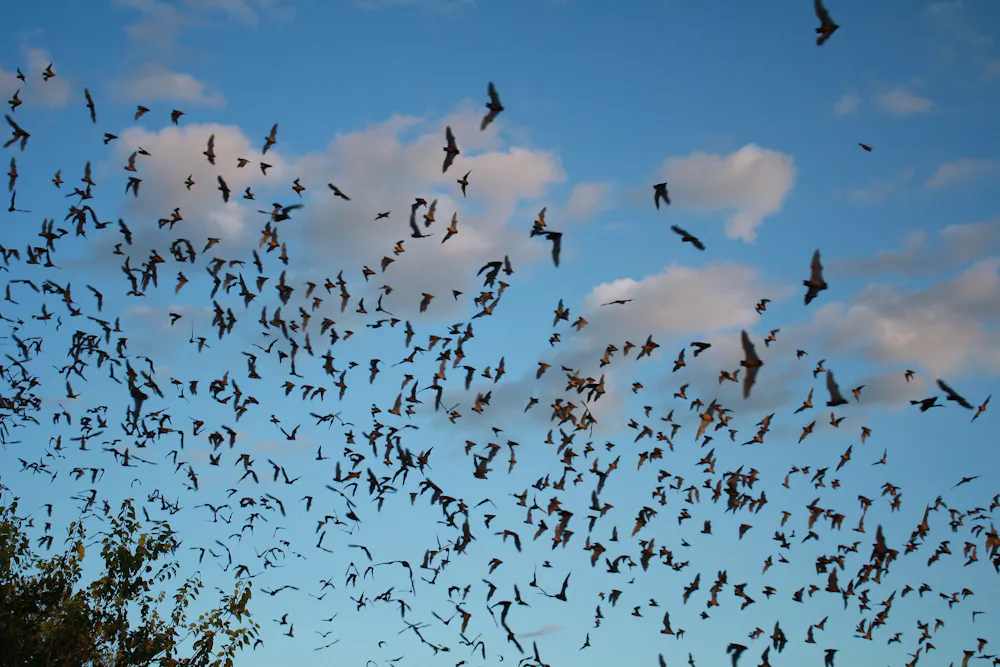
Hundreds of bats fly out of a cave.
Mexican free-tailed bats head out of Bracken Bat Cave, near San Antonio, Texas, for an evening of feasting on insects. In summer, the cave is home to the largest bat colony in the world. Ann Froschauer/U.S. Fish and Wildlife Service

One of those insects is the cucumber beetle, which matures from rootworm – a scourge of U.S. cornfields. Rootworm destroys more than 340 million bushels of corn across the U.S. Midwest and South each year, even as farmers spend US$1 billion annually on pesticides to control outbreaks.

A colony of 150 big brown bats can consume 600,000 cucumber beetles in a single year. If each female cucumber beetle – assuming half are female – had 110 rootworm larvae, the typical brown bat colony would prevent the production of 33 million rootworms.

Farmers experience economic damage when rootworm concentrations exceed about 0.5 per corn plant. Typical planting densities exceed 30,000 corn plants per acre in the Midwest. Therefore, the rootworms that would have hatched could damage more than 2,000 acres of corn – if bats weren’t around to eat the cucumber beetles first.

That is a significant amount of pest control provided by bats!

The disaster known as white-nose syndrome

In the winter of 2006, the fungus that causes white-nose syndrome, the aptly named Pseudogymnoascus destructans, was first detected in the U.S. near Albany, New York.

From there, it spread across the country, infecting 12 species of bats, three of which are listed as endangered under the Endangered Species Act. A 2010 study found white-nose syndrome had killed between 30% and 99% of the bats in infected colonies.

A little brown bat with the telltale signs of white-nose syndrome, a fungal infection that saps the bats’ energy. Ryan von Linden/New York Department of Environmental Conservation

As of March 2026, the fungus causing white-nose syndrome had been detected in 47 states, reaching as far west as California, Washington and Oregon. White-nose syndrome spreads primarily through bat-to-bat contact, though humans also contribute to the spread when cave explorers carry the fungus from one cave to another.

Despite coordinated efforts by state and federal wildlife agencies to limit access to caves where bats live and slow the transmission, white-nose syndrome continues to spread rapidly. When bats get infected, they wake up early from hibernation and use more energy over the winter. This depletes their fat reserves and causes them to die of starvation, leading to plummeting populations.

Bats’ role in food production

After white-nose syndrome arrives in an area, the loss of bats has significant consequences for farmers.

Yields fall as pests consume crops. To protect their crops, farmers purchase more chemical pesticides, so their costs rise as yields decline. The estimated agricultural losses from white-nose syndrome exceeded $420 million per year as of 2017.

A bat hovers by a large flower as it feeds on nectar.
A lesser long-nosed bat (Leptonycteris curasoae) feeding on an agave blossom in Arizona, spreading the flower’s pollen in the process. Rolf Nussbaumer/imageBROKER

Greater pesticide use is also associated with human health problems that can be avoided if bat populations remain healthy.

Losing bats hurts local governments financially

The story does not stop at the farm.

Counties in all U.S. states tax agricultural land based on its “use value” – in other words, based on how profitable the land is in agriculture. Without healthy bat populations, lower profits shrink the tax base, leaving county governments with less revenue.

Those governments must respond by reducing services, raising taxes or increasing how much money they borrow – often at a greater cost of borrowing. The effect is especially pronounced in rural counties, where agriculture makes up a large share of property tax revenue.

Our recent research finds that rural county governments lost almost $150 per person in annual revenue after the arrival of white-nose syndrome. For an average-size rural county, that is nearly $2.7 million in lost revenue each year.

How losing bats can hit the bond markets

The loss of county revenue makes municipal bond investors nervous. Buying a municipal bond is a bit like lending money to the county, and the interest rate is what the county pays you for taking on that risk.

When bats disappear, the risk goes up, and the county has to pay about 11.47 hundredths of a percentage point more in interest. That may sound small, but it is 27% larger than the typical risk premium investors already demand from county governments.

The higher interest rate raises borrowing costs for county governments. For example, the borrowing costs on a typical 15-year, $1 million bond would increase by more than $33,000.
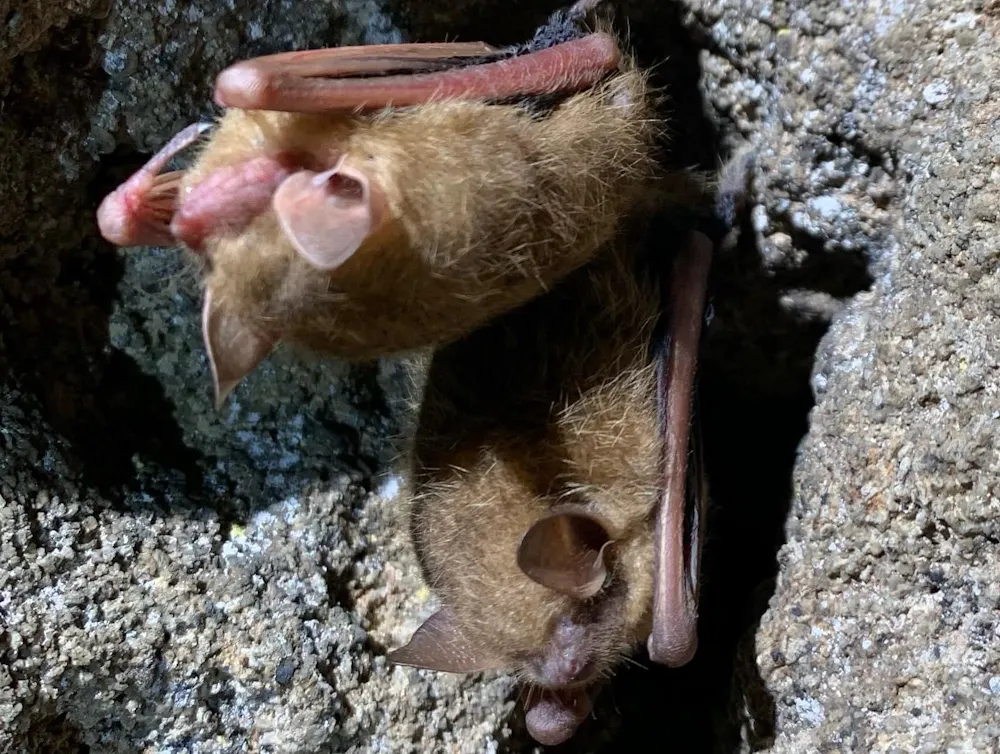
Two bats hanging in a cave.
Bats snuggle up in a cave. Liz Hamrick/TVA

Higher yields also mean lower bond prices for investors, including retirement funds. For example, our research suggests that investors would discount a $1 million bond issued by a rural county by nearly $14,000 if that county’s bats have become infected by white-nose syndrome.

Economic benefits of saving bats

The good news is that the benefits from healthy bat populations create opportunities to make money from bat conservation.

Farmers can increase their incomes. Local governments can recover property tax revenue to fund public services, such as road maintenance, health infrastructure and public schools. Bond investors can earn financial returns from healthier bat populations.

No silver bullet exists for protecting or restoring bat populations affected by white-nose syndrome, but promising efforts are underway.

A fungal vaccine is being tested by the U.S. Geological Survey and partners. Designing artificial roosts and adding cave protections can also help preserve healthy bat populations. Researchers are also working to better understand bat resistance to the disease to explore whether improving resistance alone can stabilize bat populations.

As these solutions develop, opportunities will emerge for farmers, local governments and investors to earn financial returns through bat conservation. In other words, saving bats isn’t just good ecology – it’s good economics.

The Conversation

Eli Fenichel receives funding from the Knobloch Family Foundation. He is a professor at Yale University in the School of the Environment.

Anya Nakhmurina and Dale Manning do not work for, consult, own shares in or receive funding from any company or organization that would benefit from this article, and have disclosed no relevant affiliations beyond their academic appointment.
  •  

Blackout risks are rising – why neighboring power grids can’t just send extra electricity where it’s needed

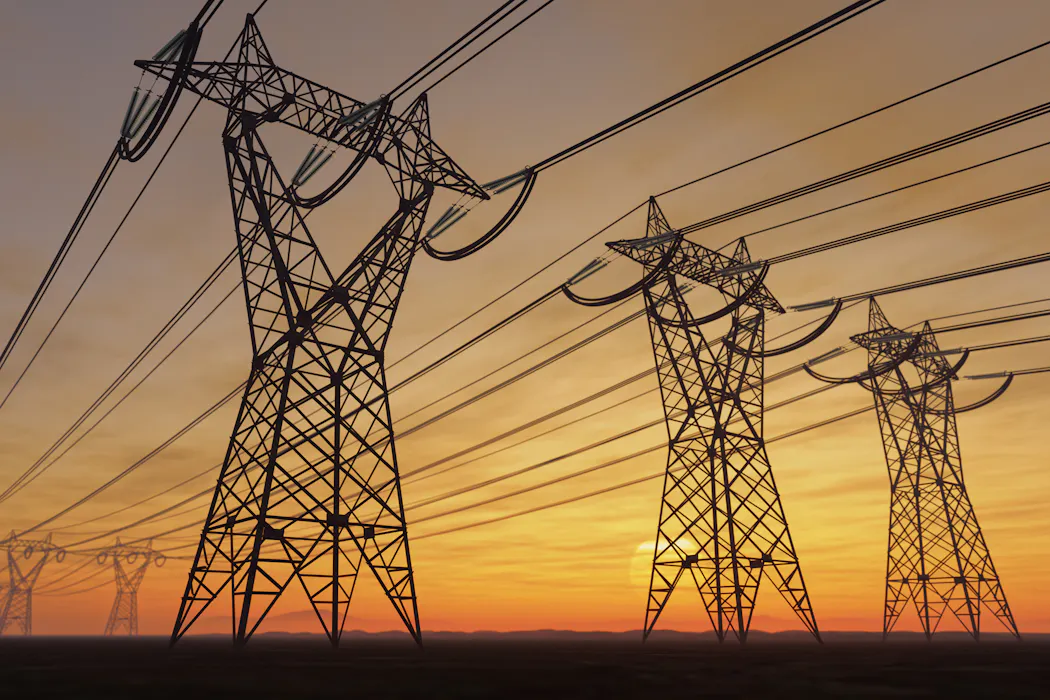
Transmission lines can carry power long distances, but the U.S. grids aren't all connected. imaginima/iStock/Getty Images Plus

Extreme weather is posing a growing threat to the power supplies Americans rely on.

In 2021, a fierce winter storm left millions of Texans without electricity and water for days. Hurricane Helene in 2024 knocked out power to about 5 million customers across the U.S. Southeast.

Beyond the immediate human and economic toll, major blackouts like these often leave behind the same unsettling contrast: One region goes dark while nearby places still have power.

This raises a question: If electricity is still available somewhere nearby, why can’t it be sent where it is needed most?

Two satellite images show how much of the Atlanta area lost power in Hurricane Helene.
Hurricane Helene left much of Georgia in the dark for several days starting in late September 2024. The satellite image on the left is a normal August night in the Atlanta region. The one on the right shows the same area on Sept. 28, 2024. Lauren Dauphin/NASA Earth Observatory

There has to be a wire into the crisis

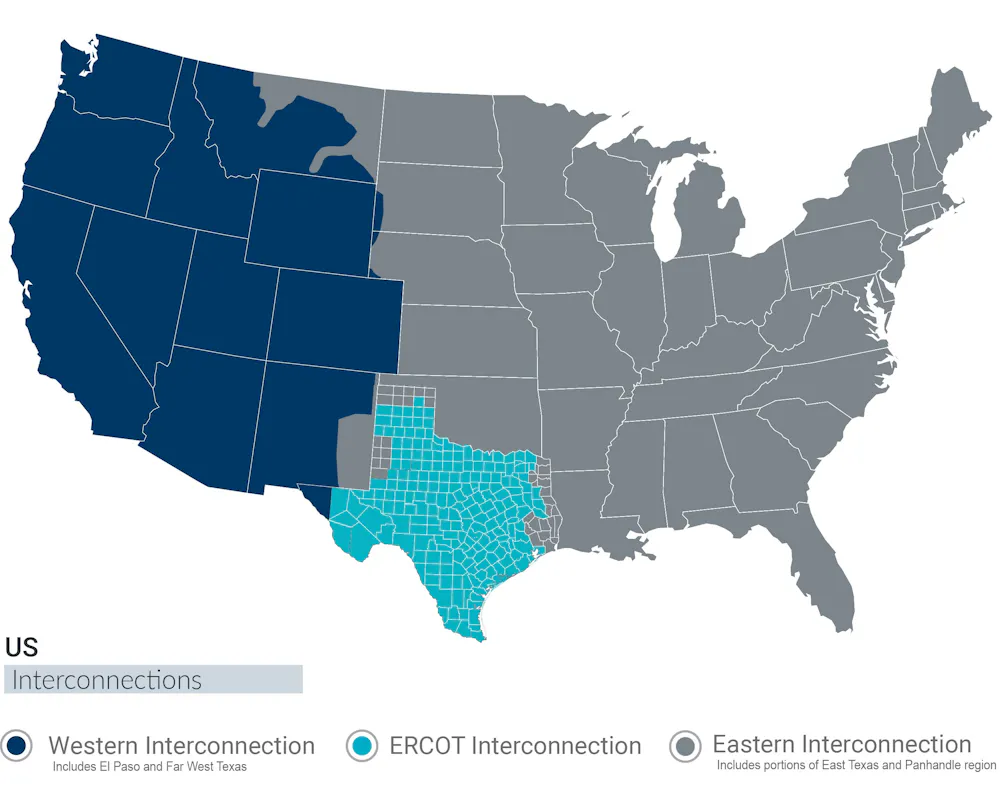
The U.S. bulk power system is not one seamless national grid, but three major grid regions known as interconnections – the Eastern, Western and ERCOT – Electric Reliability Council of Texas – systems. There are very few transmission lines between them, so if one has too little power, the others may not be able to help much.

Map shows three regions
There are few links between the U.S. Eastern, Western and ERCOT interconnections. ERCOT

That limited connectivity made the 2021 Texas blackout far more severe: As the storm knocked out gas lines and power generators, ERCOT was forced into the largest deliberate electricity shutoff in U.S. history. Operators cut power to millions of customers to avoid a total grid collapse.

More than 4.5 million Texans lost power, and hospitals across the state struggled with electricity and water shortages. At that time, the total power ERCOT was able to import from the neighboring systems could cover only about 6% of the demand.

Today, there are proposals to build more transfer capacity between Texas and neighboring grids. The Southern Spirit Transmission project, announced by the Department of Energy in 2024, would include a 320-mile transmission line connecting Texas with Louisiana and Mississippi. According to the DOE, the project could improve the Texas grid’s resilience during periods of high demand and extreme weather. If this line had existed in 2021, it could have reduced the scale of the power losses by roughly 15%, enough to keep electricity flowing to 600,000 additional Texas homes during peak demand.

A map shows a line from Mississippi to the Texas border.
Pattern Energy is developing the 320-mile Southern Spirit Transmission line to connect Texas’ power grid and the Southeastern transmission grids for power sharing. Pattern Energy

The wire has to survive the disaster

That physical constraint on where power can flow begins with how the U.S. grid is organized.

At the broadest level, it is divided into the three independent interconnections. Within those larger networks, multiple regional grids can share power with one another. But moving electricity across them still depends on the availability of transmission paths.

A map shows the regional power system operators and three regions without a formal power market structure.
Seven major regional grid operators within the U.S. interconnections help manage power flows, electricity markets and reliability, typically across multistate regions, but they don’t cover all of the area. In large parts of the Northeast, Southwest and Southeast, independent utilities generate and transmit their own power without a formal power market structure. Federal Energy Regulatory Commission

Extreme weather can damage transmission lines and substations, making it impossible to bring in additional electricity.

Hurricane Ida showed why this matters.

In August 2021, all eight transmission lines feeding New Orleans were damaged by the storm and knocked out of service. That left the whole city without normal grid power and set the stage for a recovery that took weeks in some of the hardest-hit areas. Across the wider network, the storm also disabled 216 substations and more than 2,000 miles of transmission lines. When the main lines for electricity are broken, nearby power cannot flow in.

A large transmission tower lies on its side, twisted, after a hurricane.
Hurricane Ida crumpled a huge transmission tower carrying high-voltage power lines into New Orleans in August 2021. AP Photo/Gerald Herbert

The answer to bolstering power grids is not just to build more high-voltage transmission lines. It is also important to harden the transmission corridors that already exist so they can withstand extreme weather and be restored more quickly after a disaster.

In New Orleans, that is already shaping investment. Entergy New Orleans, the city’s main electric utility, has an accelerated grid-hardening plan that aims to replace existing utility poles with more fortified poles to withstand higher winds and selectively move some lines underground in high-risk areas. The first phase, scheduled through 2026, covers about 63 miles of power lines at a cost of $100 million.

At the federal level, the Federal Energy Regulatory Commission has required transmission providers to report how they assess risks to transmission assets, how those risks affect system operations and how they plan to reduce them, including under extreme heat and cold.

The hidden regulatory rules for sharing power

When the power goes out in one area, a nearby grid may look fine and keep its own lights on, but that does not mean its surplus power can be easily shared. Federal standards require transmission providers to have enough electricity available in reserve to serve their own local homes and businesses safely. In plain terms, only excess electricity above that safety threshold can realistically be treated as power available to help neighboring grids during an outage.

Decisions also have to be made quickly, and the logistics for sending power from one company have to be arranged before the blackout begins. The grid facing power shortages must know which sources will send extra power, which lines can carry it and what to do if the transfer creates overloads elsewhere.

The emergency operations manual used by PJM, which coordinates electricity flows across large parts of the Midwest and mid-Atlantic region, says operators are expected to act immediately when their power demand exceeds the supply to stabilize the grid. If the shortage lasts too long, protective systems begin disconnecting parts of the grid to stop a wider collapse. Once those systems are disconnected, even power that arrives later may no longer reach the areas where it is needed most.

Neighboring grids to the rescue

In early September 2022, a brutal heat wave pushed California’s power grid to the brink. On Sept. 6, the state hit an all-time record power demand of 52,061 megawatts.

That same evening, when the system was most strained, a crucial lifeline of about 8,000 MW of electricity flowed in from neighboring areas. This massive external support met 12.5% of the local demand, successfully maintaining the power supply for millions.

Analyses after the heat wave confirmed what had averted the crisis. The California Independent System Operator, or CAISO, concluded that “imported electricity from neighboring balancing authorities played a key role in maintaining system reliability” during those critical hours.

Crucially, this rescue relied on established sharing agreements. Beyond prescheduled transfers, CAISO reported that power generators in the Western Energy Imbalance Market – a system launched in 2014 to help Western power systems share electricity in emergencies – dynamically delivered an extra 1,000 MW of emergency power.

That event proved how having real-time, cross-regional coordination mechanisms already in place can ultimately save a grid under siege. Similar arrangements already exist elsewhere in the United States. PJM and MISO, the Midcontinent Independent System Operator, have a process for scheduling electricity flows when the regions know help will be needed. Utilities in the Southeast use an exchange platform to trade power closer to the time it is needed.

While different regions use different designs, the broader lesson is the same: Outside help is most likely to work when the grid has a usable transmission path, spare electricity to share and a system for moving that power before the emergency begins.

Yan Wen, a postdoctoral research scientist in electrical engineering at the University of Tennessee, contributed to this article.

The Conversation

The authors do not work for, consult, own shares in or receive funding from any company or organization that would benefit from this article, and have disclosed no relevant affiliations beyond their academic appointment.
  •  

Canada is kicking its US booze habit as trade tensions persist

One of the most visible ways that Canada responded to President Donald Trump's tariffs was by sharply restricting U.S. alcohol sales. AP Photo/Jill Colvin

Almost a year and a half after President Donald Trump began slapping tariffs on nearly all U.S. trading partners, Canada’s pushback has reordered the economic relationship between Ottawa and Washington.

Canadians are pulling back on U.S. travel, boycotting U.S. goods and protesting in droves – further galvanized by Trump’s call for Canada to become the 51st U.S. state.

But the example of one sector in particular, U.S. alcohol, shows how quickly access to an important market can disappear – and how difficult it can be to regain.

From 2022 through 2024, Canada accounted for roughly 35% of U.S. wine exports, more than 15% of U.S. beer exports and as much as 13% of U.S. distilled spirits exports. Within just one year of Trump returning to office, Canada’s imports of U.S. alcohol cumulatively have plunged over 70%, thanks to a mix of both tariff and nontariff retaliatory measures.

It’s a sharp reversal from Canada’s traditional role as a top foreign destination for American beer, wine and spirits. That relationship reflected both long‑standing consumer preferences as well as geographic proximity and largely tariff‑free access through agreements like the North American Free Trade Agreement and its successor, the United States-Mexico-Canada Agreement.

As an agricultural economist working on trade issues related to alcohol, I see Canada’s alcohol sector as a textbook example of how market access for politically exposed goods can quickly unravel. And for American beer, wine and spirits producers – and for the farmers who grow the barley, grapes and corn that go into these products – the recent experience highlights how trade disputes often hit food products hardest. If a trade ban becomes entrenched, it opens a way for consumers to develop a taste for domestic as well as other foreign alternatives.

Two Canadian protesters wearing rain ponchos and carrying flags stand on the Peace Bridge border crossing in Buffalo, N.Y., on a gray and rainy day.
President Donald Trump’s tariffs and talk of Canada as the 51st U.S. state have sparked a sustained backlash by Canadians. These protesters gathered near the Peace Bridge border crossing in Buffalo, N.Y., on April 2, 2025. AP Photo/Adrian Kraus

The Trump tariff shock

Before Trump’s tariffs and talk of Canada as the 51st U.S. state, U.S. alcohol occupied substantial shelf space in major alcohol-consuming provinces such as Ontario, British Columbia and Québec. In 2024, these exports to Canada constituted more than 20% of Canada’s alcohol imports, totaling US$744 million. For most U.S. producers, Canada served not only as a key export destination but as a stable and relatively low‑risk entry point into international markets.

That changed in February 2025, when Trump, citing a national security emergency, imposed 25% tariffs on Canada and Mexico. Those tariffs – which were overturned by the Supreme Court in February 2026 – marked the first time that law was used to authorize broad tariffs.

Canada responded by slapping retaliatory tariffs of 25% on roughly $30 billion of U.S. goods and signaling it would significantly expand countermeasures if tensions persisted. It also enacted nontariff countermeasures, most notably by letting provincial liquor authorities remove U.S. beer, wine and spirits from store shelves. These tools, which fall within Canada’s system of shared federal and provincial powers, sharply restricted market access for American producers.

Immediately after Trump’s announcement, eight of Canada’s 10 provinces imposed partial or full bans on U.S. alcohol imports by instructing their liquor boards to stop importing and selling U.S. alcohol altogether. In many cases, American products were physically removed from store shelves and online platforms – sometimes with instructions to target imports from U.S. “red” states that had supported Trump.

U.S. wine exports were hit hardest, plunging from $460 million to just $103 million, while distilled spirits fell from $238 million to $89 million and beer exports from $47 million to $17 million. Collectively, these declines slashed total U.S. alcohol exports to Canada from $744 million to $208 million, wiping out $536 million in trade.

The spat quickly became testy. The alcohol boycott is one of the reasons Trump and White House officials have called Canada “mean and nasty to deal with,” in the words of U.S. Ambassador to Canada Pete Hoekstra.

The trade war’s latest turn

Those provincial restrictions remained in place even after the two countries reached a partial deal exempting about half of USMCA‑compliant goods from ongoing tariffs in summer 2025, leading Canada to scale back some retaliatory levies. However, the de facto trade bans on U.S. alcohol remain in place.

Alcohol resurfaced again recently as a flash point, when the top U.S. trade official, Jamieson Greer, said in April 2026 that existing U.S. levies on Canadian industrial goods would stay in place and might even be toughened until Canada walked back its alcohol restrictions. That threat drew a sharp retort from Canadian Prime Minister Mark Carney.

Meanwhile, the trade dispute hasn’t prompted Canadians to drink less alcohol overall. Instead, their consumption has largely shifted to other countries, especially for wine. United Nations trade data shows that in 2024, American wine accounted for 21% of all imported wine in Canada before dropping to only 5% in 2025. That year, imports from major wine exporting countries not only increased but roughly offset the decline in imports from the U.S. For distilled spirits, the U.S. slipped from 24% in 2024 to only 10% in 2025, while beer has dropped from 13% to 5%. At the same time, Canadian imports of beer, wine, and spirits from other countries increased by 9%, 15%, and 7%, respectively.

“What’s different this time is that people aren’t just swapping one bottle, they’re rethinking the whole bar,” said Craig Peters, CEO of Canada’s Barnburner Whiskey, in an interview with the online magazine VinePair. “Traditionally, those rail spots were locked up by big U.S. brands for decades. Now, we’re seeing bars, especially independents, completely reset and go Canadian across the board.”

The Conversation

Andrew Muhammad has received funding from the U.S. Department of Agriculture and the Southern U.S. Trade Association to address issues related to U.S. distilled spirits trade.

  •  

How out-of-work fishermen saved the American Revolution

Ships like these played a vital role in the American Revolution. wynnter/iStock via Getty Images Plus

George Washington knew his forces could not win the American Revolutionary War without some measure of sea power. “It follows then as certain as that night succeeds the day,” he later wrote in a letter, “that without a decisive naval force we can do nothing definitive, and with it everything honorable and glorious.”

The problem was that the American commander did not have a navy.

As a professor of early American history, I have taught courses on the American Revolution for more than 20 years and have written two books on its maritime dimensions. Washington’s solution wouldn’t come from a French shipyard or a congressional committee. It would come from a group of angry, out-of-work New England fishermen.

Supplying the army from the sea

In 1775, American ground forces managed to lay siege to the British army in Boston, but Washington needed provisions and military stores to sustain pressure on this key commercial hub. Looking out across the Atlantic Ocean, he noticed supply ships arriving in droves from Great Britain – unescorted – to supply the British army in Boston with guns and ammunition.

Unbeknownst to them, the British had already handed the American commander the ships and mariners he needed to capture those resources.

The Sons of Liberty, a network of political activists, had angered the British government by resisting taxes and commercial regulations – from the 1765 Stamp Act, which taxed printed documents, to the 1773 Tea Act, which controlled what tea leaves made their way into North American cupboards.

To punish rebels for their treason, Parliament passed the Restraining Act of 1775, banning New Englanders from fishing on the Atlantic Ocean. Overnight, thousands of skilled mariners – men who spent their lives wrestling 100-pound cod out of the freezing, storm-tossed North Atlantic – were out of a job. They weren’t just unemployed; they were furious. These fishermen left their work tools and ships behind, picked up weapons and joined the siege of Boston alongside American farmers.

Ashley Bowen, who lived and worked in Marblehead, Massachusetts, the principal fishing port in America at the time, recorded in his journal on May 22, 1775, “the fishermen are enlisting quite quick.”

A letter from a French diplomat to the foreign minister in Paris confirmed the news a couple of weeks later: “4,800 sailors seeing they were going to be deprived of their fishing rights, deserted their ships and joined their compatriots under arms.”

A black-and-white image shows John Paul Jones standing in the midst of a battle on a ship
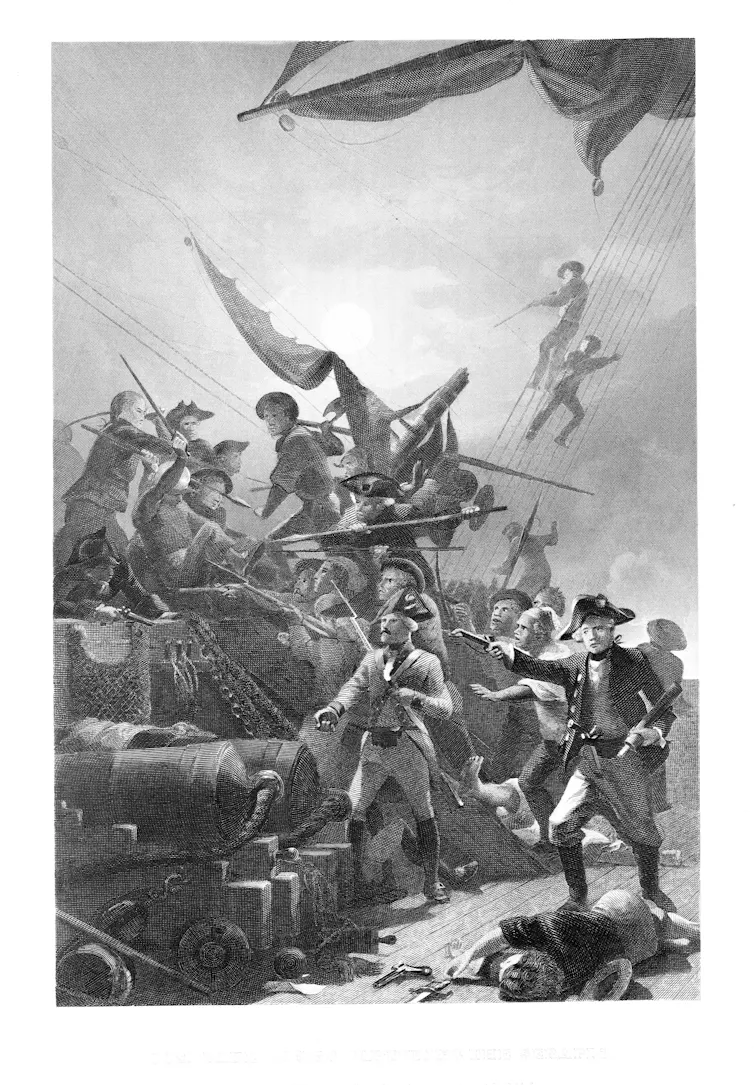
John Paul Jones, known as the Father of the American Navy, commanded sailors during the American Revolutionary War. Christine Kohler/iStock via Getty Images Plus

Creating the first navy

Washington, commissioned by Congress as commander in chief of all American armed forces in June 1775, saw an opportunity. He didn’t wait for Congress to build new frigates. Instead, he reached out to John Glover, a fish merchant from Marblehead and a commissioned officer under his command.

Washington’s plan was simple: Take the sturdy, salt-stained schooners used for fishing and turn them into armed, seagoing predators.

The first of these was Glover’s own fishing vessel and trade ship, Hannah. She wasn’t a formidable man-of-war but a 78-ton workhorse that spent summers at the Grand Banks and winters hauling rum and sugar from the Caribbean. Washington armed the trade ship with a few cannons, manned her with fishermen and sent her out to hijack British supply ships to help his army win the siege of Boston.

Just two days after the Hannah was underway, her crew captured the Unity, a sloop loaded with naval stores and lumber, supplies sorely needed by British forces in Boston.

Between August and October 1775, Washington outfitted a fleet of schooners at Congress’ expense to intercept British supply ships off the coast of New England. These vessels and crews, whose wages were paid by the American government, constituted what many historians consider America’s first navy. Washington reminded each captain that they sailed “at the Continental Expense.” These orders from Washington and the payments made by Congress made these ships official American warships, operating under the authority of what would become the federal government.

These recruits didn’t need nautical training; they were seasoned seafarers who had battled rough waters and gale force winds. On Oct. 13, 1775, George Washington wrote to his brother, John Augustine Washington, that the fishermen were “soldiers … who have been bred to the sea.”

In 1776, Washington informed the governor of Connecticut, who had asked to draft seamen from Washington’s regiments for his own naval expedition, that he could not spare any. “I must depend chiefly upon them for a successful opposition to the Enemy,” Washington explained.

A black-and-white image shows two ships at battle
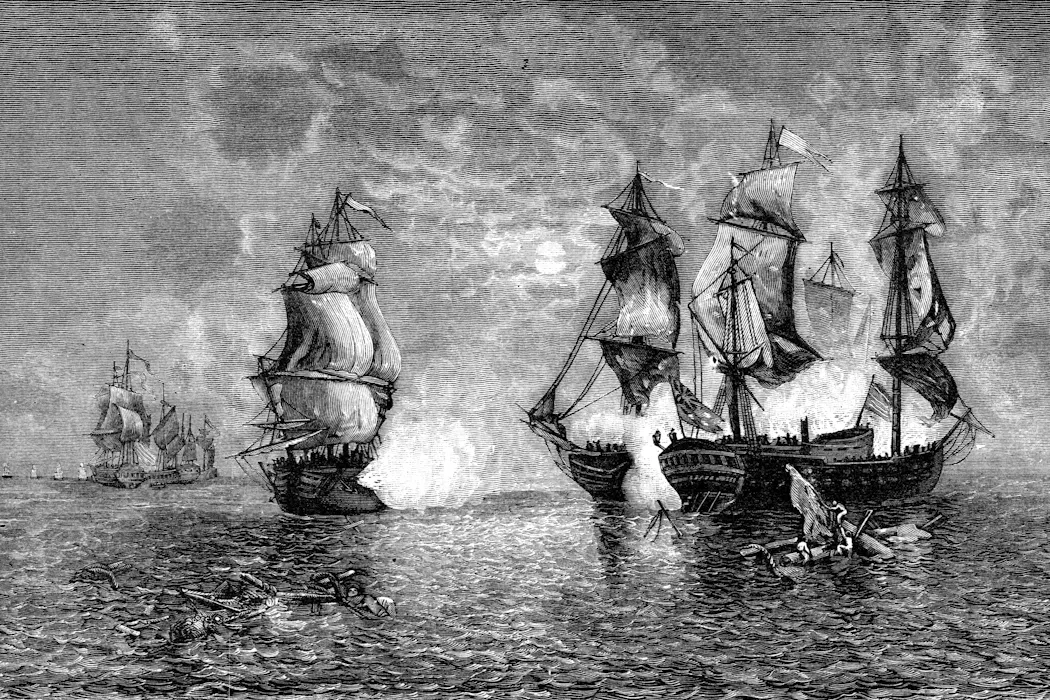
An American navy ship defeats a British navy ship, 1779. Christine Kohler/iStock via Getty Images Plus

Keeping the Revolution alive

This fleet of converted fishing boats punched above its weight: In the early years of the war they captured 55 British vessels. One such prize, the Nancy, was transporting 2,000 muskets, 30 tons of musket balls and a massive 15-inch brass mortar – supplies the American army desperately needed for the war effort.

Because the British navy was spread too thin, with too few warships available to police the Atlantic coastline, the armed fishing vessels were able to disrupt supply lines and keep the Revolution alive through its infancy. By the time the British realized the threat, the damage was done.

On Feb. 26, 1776, just a few months after Washington launched his fleet, British Admiral Molyneux Shuldham wrote in a report to his superiors that his forces in Boston were low on everything from naval supplies to weapons. What little they could find had to be purchased “at the most extravagant prices.”

The British government had not assigned military convoys to trans-Atlantic shipments at the start of the conflict in 1775. Now, Shuldham recommended arming the supply ships themselves, since valuable stores were being intercepted by rebels in small vessels, “however attentive our Officers to their Duty.”

He concluded the report with an ominous note, explaining that he simply did not have the resources to do everything that was being asked of him – support the army, blockade rebel ports and protect British ships bound for Boston: “I must beg leave to observe to you the very few Ships I am provided with to enable Me to Co-operate with the Army, Cruize off the Ports of the Rebels to prevent their receiving Supplies, or protect those destined to this place from falling into their hands.”

This article’s main image caption has been updated to use a broader term for the vessels shown.

The Conversation

Christopher Magra does not work for, consult, own shares in or receive funding from any company or organization that would benefit from this article, and has disclosed no relevant affiliations beyond their academic appointment.

  •  
❌