Reading view

How businesses with ties to Jeffrey Epstein saw norms – and even share prices – suffer

Beyond the well-known names, Jeffrey Epstein's network of contacts had infiltrated the boardrooms of hundreds of major U.S. companies, with clear consequences for corporate conduct. Martin BUREAU/AFP via Getty Images

The release of the Jeffrey Epstein files in early 2026 wasn’t just a scandal about one man. It was an unexpected window into the hidden architecture of American corporate power.

When the U.S. Department of Justice published more than 3 million pages of documents on Jan. 30, 2026, most of the media focused on the famous names. But the files also revealed something broader and more troubling. Epstein’s network had infiltrated the boardrooms of hundreds of major U.S. companies, with clear consequences for corporate misconduct affecting employees and the broader business culture.

I’m a scholar of corporate finance and governance who has studied the vast reaches of Epstein’s business connections. Fellow economists Marina Gertsberg, Ekaterina Volkova and I found that the disgraced financier effectively wired corporate America into a denser, more tightly interconnected network. Companies with more Epstein-connected directors registered measurably worse governance failures over time, regardless of their size or the prominence of their executives.

There’s a bigger point as well. Networks that appear valuable because they provide access and connectivity can also encourage a social environment with serious governance problems. The Epstein files revealed a network that was hidden, vast and tied to clearly disqualifying conduct.

A hidden architecture of elite connections

The vast majority of corporate connections to Epstein went unreported by the media. Following the files’ release, journalists understandably focused on the most prominent and sensational cases. In the two weeks after the news broke, my colleagues and I found that fewer than 1 in 4 companies with Epstein-connected directors were mentioned in the news.

Our research went much further. We searched the entire document load for the names of every CEO and board member who served at a publicly listed U.S. company between 2006 and 2026, which totaled 92,698 individuals. We then used artificial intelligence to classify each document match, distinguishing meaningful contact with Epstein from accidental mentions.

What we discovered was striking. More than 2,000 public-company directors had direct contact with Epstein, either through emails or in-person meetings. Of these, about 1,000 were part of five or more communications, the threshold we used to identify the most tightly connected individuals. And we found that companies with more Epstein-connected directors experienced much worse governance over time – measured through negative media attention about executive misconduct, fraud and corruption.

Using data from RepRisk – a company that systematically tracks corporate misconduct across media, regulatory and NGO sources – we discovered that every time a board added a director who had meaningful Epstein contact, it was associated with about 1.7 more governance failures per year. In addition, there were 3.4 more incidents that breached the environmental, sustainability and governance pledges of the director’s company.

Some of the best-known cases underscore this finding. Jes Staley, who privately described Epstein as one of his closest friends, resigned as CEO of Barclays in November 2021 after the bank disclosed a regulatory probe into that relationship and found he had misled investigators. Barclays then clawed back 17.8 million British pounds in awards, or about US$24 million, and the U.K. watchdog Financial Conduct Authority fined and banned him from working in financial services.

Former Barclays CEO Jes Staley, in a dark coat, arrives at the High Court in London, United Kingdom, on March 14, 2025, to challenge his ban from the UK finance sector.
Former Barclays CEO Jes Staley was fined and banned from the U.K. financial service industry over his ties to Jeffrey Epstein. Tayfun Salci/Anadolu via Getty Images

Another example is Leon Black, who stepped down as chairman and CEO of Apollo Global Management in 2021 after an independent review found he had paid Epstein $170 million for tax and estate-planning advice, far more than initially disclosed. Apollo restructured its governance in the process.

There are also instances at the company level where connections to Epstein were followed by governance failures: Deutsche Bank paid a $150 million regulatory penalty for compliance issues tied to Epstein’s accounts, while JPMorgan Chase settled survivor claims for $290 million.

The effects were strongest for the most intensive connections. Directors who had documented in-person meetings with Epstein were 2.5 times more likely to be accused of misconduct, with 5.2 total incidents a year per connected director.

These aren’t just correlations. When an Epstein-connected director died during the period we studied – an event outside any firm’s control – their company subsequently saw a big drop in misconduct incidents in the years that followed. In short, this relationship reflected something real and causal, not just that badly governed firms were more likely to tolerate such connections in the first place.

These connections weren’t just associated with greater governance problems. In the cases where CEOs or board members were mentioned in Epstein-related news in the two weeks after the files’ January release, we found that their companies’ share prices also took a hit, falling about 3%. This tells us that investors considered Epstein contacts to be relevant for company valuations.

Too close for comfort?

Beyond individual firms, Epstein’s network reshaped the structure of corporate America itself. We found that board members in his network tended to cluster more tightly than nonconnected members.

When we mapped connections among board members, adding Epstein-mediated links increased the network’s density by 353%. In other words, it sharply reduced the degrees of separation among major companies by more than a factor of three. This increase in density is similar to what might be seen in other elite networks, such as graduating from an Ivy League school.

Before accounting for Epstein ties, the average connection between two businesses required more than two jumps between boards. Including the ties, they were typically separated by fewer than two.

The effect was especially pronounced in finance and technology, including giants such as JPMorgan Chase, Goldman Sachs and Morgan Stanley. In this sector, 32 of 50 companies had at least one Epstein-connected director, while network density increased by 550%. In tech, Epstein’s ties actually bridged two previously disconnected clusters of firms, joining Microsoft, Apple, Cisco and IBM into a single connected network. Manufacturing and healthcare, by contrast, were less affected.

It’s about norms, not just networks

A natural question is whether talking to Epstein simply suggests that person was well connected – and that firms try to put well-connected people on their boards.

To test this, we considered two scenarios. Under one, Epstein expanded executives’ access to elite contacts and opportunities, potentially benefiting their firms. Under the other, exposure to Epstein’s network spread a culture of boundary-crossing behavior, making questionable conduct seem more normal.

Our research points to the second explanation. If a company became more embedded and better connected within the Epstein network, it wasn’t associated with worse governance outcomes. But when boards outside that network had members who served on other boards with Epstein-connected directors, those indirect ties consistently predicted more misconduct incidents.

A full reckoning for many of these business, in terms of governance and reputation, may still lie ahead. But investors, board-nominating committees and regulators now have the data to ask harder questions about who sits in corporate boardrooms – and whose company they kept.

The Conversation

Michaela Pagel does not work for, consult, own shares in or receive funding from any company or organization that would benefit from this article, and has disclosed no relevant affiliations beyond their academic appointment.

  •  

Maps are powerful political tools shaping a nation’s past, present and future – counter maps allow everyday people to reclaim the narrative

Turtle Island is what some Indigenous peoples call North America. This counter map is oriented to the east, the direction of the rising sun. The Decolonial Atlas, CC BY-NC-ND

Throughout time, maps have been useful tools for those in power to stake their claim over territories and markets. Politicians start nationwide redistricting battles to ensure partisan control, weakening the power of voters. The Trump administration’s geopolitical posturing over Greenland builds on a long history of imperialism aided by maps. And in ancient Rome, the Peutinger map depicted vast ideas of empire by placing Rome at the center of the world.

But maps can also tell hidden stories about politics and power that help people reclaim access to their own spaces and futures. These include counter maps – that is, maps that rework existing assumptions – to expand on the dominant narratives about a place to include viewpoints that were previously excluded.

As an urban and architectural designer, mapper and spatial politics researcher, I’ve seen how maps shape urban spaces and the stories told about them. I’ve also seen how maps have the power to question these stories, opening up other meanings a place can have that are shared by everyday residents and workers.

More than just digital wayfinding aids, maps are strategic tools of world-building. Maps show how certain ideas and boundaries that people may think are fixed can be rendered flexible. Anyone can make a map, and because maps are instruments of spatial storytelling, the possibilities they reveal about places are actually endless.

Who makes the maps?

Geographer Mark Monmonier famously described how to lie with maps. He pointed out that mapmakers who have power, like governments and companies, use selective editing to advance specific goals or disseminate a brand.

The Shell Oil road maps of the 1950s are a useful example of maps as marketing. With a large logo on the front and the Shell north star compass on the inside, these maps were provided free in gas stations across the country. They advertised the brand while facilitating auto travel by delineating roads and major features, including mileage charts on the backs so motorists could plan gas stops. The maps omitted competing transit systems like bus routes.

Vintage map with San Diego street names listed and marked, the Shell Oil logo placed in the center of a compass
This 1956 Shell Oil road map of San Diego notably excludes public transit lines. Shell Oil Company/David Rumsey Map Collection, David Rumsey Map Center, Stanford Libraries, CC BY-NC-SA

Public agencies and public-private partnerships also advance agendas via maps. The Home Ownership Loan Corporation redlined maps of the 1930s show even more directly how the government and real estate industry used maps to exclude certain communities. These maps were made for almost every major American city, and the zones they marked as risky for lenders coincided with neighborhoods where African Americans lived, thus taking them out of the home ownership market.

One can look today to gerrymandering efforts in states like Texas and Florida to see how maps are used to control who has access to the levers of democracy. These redistricting cases were done outside of a typical census year in order to win more congressional seats in the 2026 elections.

Remapping the ‘behind the scenes’

If maps are used to systematically shut minority neighborhoods out of property markets, then remapping these systems can reveal how the strings of government and private industry are pulled to exclude these neighborhoods, and whom this exclusion benefits.

In my book “Radical Atlas of Ferguson, USA,” I remap this American city to show what happens behind the scenes in regional and municipal planning, revealing why such stark conditions of inequality persist there.

The suburb of Ferguson, in North St. Louis County, Missouri, made it into the national spotlight in 2014 after a white police officer shot and killed Michael Brown Jr., an unarmed Black teenager. The community response to this injustice helped to spur the Black Lives Matter movement.

With the maps in this book, I layered in new stories to unpack the strained political and economic context underlying Ferguson. For example, historian Walter Johnson points out that there are several major Fortune 500 companies located just blocks from where Brown was killed. While those companies receive heavy tax subsidies and public development incentives for their physical growth, the rest of the municipality’s spending for necessities like public schools and sidewalks remains underfunded. By highlighting these facets of the landscape, maps can show who actually controls the imaginations of urban planners and politicians.

Map of Missouri with Ferguson highlighted, showing property crime grades
While financial institutions also commit property crimes (red hashmarks) through subprime mortgages, these are rarely included in property crime maps that typically only highlight property and vehicle theft, burglary and arson. Patty Heyda/Radical Atlas of Ferguson, USA via Belt Publishing

Remapping helps policymakers become more aware of biases within the data they use for mainstream neighborhood assessments and municipal map-making. Maps showing seemingly objective crime data, for example, often reinforce ideas of risk in minority neighborhoods. But when property crime in North St. Louis County, where a majority of Black residents live, is overlaid with the white-collar mortgage fraud crimes of 2008 – a dataset not readily available in typical municipal catalogs – it becomes evident how this area was targeted by subprime mortgage lenders. Broadening how people evaluate data and its sources can shift attention to the underlying forces shaping the statistics.

Remapping can also combine layers of seemingly unrelated information to discover new links between spatial details. For example, why is voter turnout so low in the ward where Brown was killed? A map of racial demographics combined with polling locations reveals there is not only no polling place in the majority African American ward, but also physical barriers – including an elevated rail line and stream corridor – that prevent residents from easily accessing City Hall and other polling places.

Map of Ferguson showing voting locations, public transit lines and majority Black communities by ward.
Maps reveal the physical barriers behind low voter turnout in Ferguson, Mo., including a lack of polling places and no public transit to City Hall. Patty Heyda/Radical Atlas of Ferguson, USA via Belt Publishing

Maps for the people

As those in power continue to politicize maps, the practice of remapping can serve the broader public by making those systems of power more visible to everyone.

Counter maps have inspired activists to edit previously omitted information back into mainstream accounts. Mapmaker Andrew Middleton introduced me to one example: a petrofuturist view of the Shell Oil maps. These counter maps show the roads documented in the Shell Oil maps underwater based on projected sea level rise due to climate change – which is caused predominantly by the burning of fossil fuels produced by companies including Shell.

Maps are scaled geographical projections, ensuring legibility and usefulness. They are understood by people of all ages. They communicate graphically across languages, and they’re portable. When maps and counter maps uncover and layer the otherwise unseen relationships that shape a place, they assert new forms of collective memory, offering more meaningful versions of public authority.

The Conversation

Patty Heyda does not work for, consult, own shares in or receive funding from any company or organization that would benefit from this article, and has disclosed no relevant affiliations beyond their academic appointment.

  •  

How Amazon workers made glamour a form of protest

GettyImages

Strutting down the catwalk in a Cindy Castro frock, 37-year-old Amazon worker Samari Jomar Mercado looked like an ethereal punk-rock fairy: sleeve tattoos, lace bag on her wrist and a white ribbon billowing from her nape like a flag. After a dramatic pivot and pit pose, she paused to salute her rapturous crowd.

“For years she worked 10 hours a day, six days a week … lifting heavy items at a fast pace,” emcee Lisa Ann Walter announced as Mercado sauntered by. “She circulated a petition among her co-workers and filed an OSHA complaint about air quality … and is here today to show others that you don’t have to be afraid to speak up.”

Ball Without Billionaires,” the May 4, 2026, fashion show in New York’s Meatpacking District, featured models who were employees from Amazon, Whole Foods and The Washington Post. The goal was to protest the Met Gala that was set to take place 5 miles away, a star-studded soiree co-chaired by Amazon founder Jeff Bezos and his wife, Lauren Sánchez Bezos.

“So let those billionaires have their Met Party,” scoffed co-host Gabriella Karefa-Johnson. “We’re going to do something way more fabulous down here!”

As I watched reel after reel of the Ball Without Billionaires spill from my Instagram feed, it was clear that the downtown labor rally worked precisely because the runway models really – to wield the term made mainstream by drag queen RuPaul – “werked.”

The word has its origins in queer ballroom parlance. According to media scholar madison moore, it refers to “a type of aesthetic labor … seen on the body [that] highlights the effort that goes into making memorable aesthetic moments happen.”

In other words, the poise, verve and bravado displayed by the models were part of the activism that was on display – not merely a front for a larger cause.

“[G]reat style is never simply style for style’s sake,” writes moore in “Fabulous: The Rise of the Beautiful Eccentric.” “It’s also a form of protest, a revolt against the forms and systems that oppress and torture us all every day.”

In fact, in a time when artificial intelligence imperils the livelihoods – and lives – of laborers across economic classes, sumptuous spectacle can be an act of resistance in its own right.

I would never claim that glamour could undo the exploitative, demoralizing reality of so many jobs in the Bezos era. But political movements that reject the mysterious pleasures of artifice are only doing themselves a disservice by excluding those who otherwise would be ideologically aligned with them.

Pleasure vs. purity tests

Purity tests related to flashy femininity have been around for a long time.

But as I argue in my recent book “Lipstick,” self-adornment can be an act of willful self-determination and creativity; a love of visual panache need not be wholly shunned as a sign of materialism and superficiality. It can even unite people across differences through joyful sartorial flourishes in public space.

So why aren’t more people signing up for decadent dissidence?

Whether it’s stigmas against shiny fabrics or traffic-stopping lip shades, anti-glamour sentiments go all the way back to the late 19th century, a period when early feminism overlapped with Victorian mores around feminine modesty and virtue.

While not all feminists back then rejected frippery, those with the loudest voices tended to come from elite New England families that prized simplicity and self-restraint.

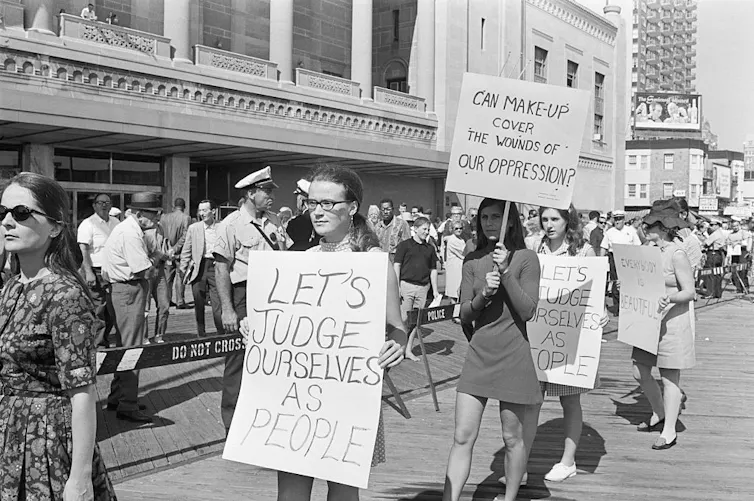
Nearly a century later, many feminists saw glamour as a tool of oppression. During the 1968 Miss America protests in Atlantic City, New Jersey, demonstrators from the National Women’s Liberation Movement threw items associated with restrictive beauty standards – including cosmetics, false eyelashes, hairspray, girdles and bras – into a “Freedom Trash Can.”

Women march and hold signs, including one that reads 'Can make-up cover the wounds of our opression?'
Demonstrators from the National Women’s Liberation Movement picket the 1968 Miss America Pageant in Atlantic City, N.J. Bettmann/Getty Images

The antipathy of left-wing movements toward glamour usually stems from justified concerns over the harms of what Karl Marx dubbed “commodity fetishism.” When a satin skirt or silk scarf is valued primarily for the status endowed upon its wearer – rather than its functionality as clothing – products take on a mystical status. This can obscure economic realities, including the all-too-common exploitation of the workers who made the clothing.

In his seminal 1972 book, “Ways of Seeing,” art critic and socialist John Berger argued that glamour was merely the “happiness of being envied” and that people were trying to transform themselves through buying more and more products they didn’t really need.

So it’s no wonder that anyone wary of misogyny and capitalism might also be wary of fashion and beauty culture – which, at least superficially, augurs only the transient thrill of surface-level gratification.

That said, I think a sanctimonious stance against glamour only winnows the coalition of people willing to speak truth to power.

Beauty as resistance

During my research for “Lipstick,” I surveyed nearly 100 cisgender women, transgender women and nonbinary people between the ages of 18 and 78. Whether painting one’s pout was deemed empowering or degrading often reflected the feminine expectations of different generations.

Those who came of age in the past three decades of the 20th century were often more ambivalent about what lipstick – and bright makeup in general – signaled to others. Part of that tension comes from makeup being seen as an obligation – of womanhood, of courtship, of work attire – which, as I argue in “Lipstick,” often precludes it from being a form of creative expression.

On the other hand, when self-adornment isn’t tied to the pressure to conform, it can become a practice that privileges play, experimentation and transformation.

In her essay “Beauty Laid Bare: Aesthetics in the Ordinary,” the late radical feminist bell hooks argues that “[l]earning to see and appreciate the presence of beauty is an act of resistance in a culture of domination that recognizes the production of a pervasive feeling of lack, both material and spiritual, as a useful colonizing strategy.”

To take it a step further, everyday glamour among the marginalized and working class reveals that a fierce look has little to do with luxury designers and their exorbitant price tags. The blue collar can also bedazzle.

Don’t ‘throw out the bubblebath and the baby’

Much contemporary anti-glamour sentiment betrays a strain of misogyny, even when wielded by women of good intent.

Some of this antagonism falls under what independent scholar Sophie Lewis calls “feminist machismo.” As examples, Lewis points to feminist legal scholar Catherine MacKinnon dismissing femininity as women kowtowing to their own sexual degradation and columnist Moira Donegan mocking the “girlish silliness” of Katy Perry.

In Lewis’ forthcoming book “Femmephilia” – a text that extols both bombshell Marilyn Monroe and Beat poet Diane Di Prima – the author wryly asserts, “In villainizing the power and pleasure of the womanish tout court, cultural feminists throw out the bubblebath and the baby.”

History provides multiple instances in which feminists not only fought against the patriarchy but also unabashedly embraced feminine pleasure.

At New York mayor Zohran Mamdani’s inauguration, singer-songwriter Lucy Dacus sang “Bread and Roses,” a labor and suffragist anthem based on a 1912 strike of the same name. Led largely by immigrant women who wanted higher pay and better working conditions at their Massachusetts textile factory, the strikes were the first in which song played a crucial role.

“We want bread, but we want roses, too!” read one of the picket signs, suggesting that a good life is not made of mere subsistence but of sweet-smelling extras.

Whether it’s “Bread and Roses” or “Bread and Lipstick,” the credo is the same: People need beauty and pleasure – and, yes, even glitz – to make life worth living. Events like Ball Without Billionaires seem to usher in a new chapter in activism – one in which solidarity might also be forged in stilettos.

“I have never felt so much love and empowerment with a crowd,” Mercado told her Instagram followers a few days after her runway debut. “Labor is art, art is culture and culture is ours. We demand better and we deserve better.”

The Conversation

Eileen G'Sell does not work for, consult, own shares in or receive funding from any company or organization that would benefit from this article, and has disclosed no relevant affiliations beyond their academic appointment.

  •  

How employers can support workers when they take medical leave

Sometimes you can't plan ahead before taking medical leave. Drs Producoes/E+ via Getty Images

Car crash. Cancer diagnosis. Mental health crisis. Autoimmune disease flareup.

A serious medical condition can turn your life upside down in an instant, making everyday tasks feel overwhelming. And if you’re employed, you may find that work emails keep coming and your manager keeps calling – when the only job you should focus on is healing.

In these moments, a medical leave of absence from work can serve as a vital lifeline.

We are organizational behavior professors who research how people balance their personal and work lives. In a study published in the Journal of Applied Psychology in March 2026, we found that employers can design and enact medical leave policies in ways that support healing rather than adding more stress during what is already one of the hardest periods of an employee’s life.

We conducted interviews with 30 employees who had taken medical leave from a wide range of professions, such as teaching, management consulting, nursing and landscaping. We also interviewed 18 human resources professionals who manage the medical leave process. By systematically analyzing what people said during the interviews and looking for patterns, we determined what many employers are doing to help their workers heal.

2 in 3 Americans can take paid medical leave

Employees take medical leave when sick leave is not enough – when recovery will require weeks or months off.

But many workers make their jobs a higher priority than their health. Some fear being seen as less committed or losing their job if they take leave. Others simply cannot afford to lose income. As a result, many people work while getting chemotherapy, postpone surgeries doctors have told them they need, or forego other necessary treatments altogether, even when laws and workplace benefits may exist to protect them.

About 2 in 3 employed Americans had access to paid leave for their own serious health condition as of 2022, and about 9% of the people who had paid leave didn’t use it when they needed it.

Under the Family and Medical Leave Act, eligible U.S. workers who have worked for a company with more than 50 employees for at least one year can take up to 12 weeks off to heal from their own serious health condition, or to care for a loved one such as a new baby or seriously ill family member.

But that policy protects your job, not your paycheck. It’s up to your employer, or your state, to determine whether medical leave is paid or unpaid.

Colorado, Connecticut, Massachusetts and several other states mandate paid medical leave for their employed residents. Some big employers also provide paid medical leave, including Microsoft and Adobe.

A bald Asian businesswoman sits at her desk in a bustling modern office.
If you are undergoing intensive medical treatment, see if you can take time off to focus on the healing process. bankerwin/E+ via Getty Images

What to do when you need it

If your symptoms or treatments are making it hard to do your job, don’t wait to get started. Chances are that you need to take time off from work to heal. And you should not delay treatment to accommodate what’s going on at work.

Experiencing stress from your job when you’re ill or injured can be like gasoline on a fire – it can exacerbate health problems and make it much harder to bounce back. We were surprised by how many people we interviewed waited until their circumstances were dire before stepping away from work.

It’s also important to check what benefits are available to you.

You may qualify for protections under the Family and Medical Leave Act, which can keep your job safe while you recover. But it doesn’t apply in all cases, such as when employers have fewer than 50 workers.

To protect your paycheck, you may have access to a short-term disability policy through your employer benefits package that you can use in conjunction with the Family and Medical Leave Act.

Alternatively, you may already be paying into your state’s paid leave program through payroll deductions. These programs work like insurance, helping replace part of your income while you are on leave.

Your human resources department can serve as your first point of contact and can get you in touch with a leave coordinator, if your employer has one.

However, you do not have to share detailed information about your medical condition with your supervisor, or even HR, if you prefer to keep that information private. Your doctor only needs to provide documentation confirming that you have a serious condition and detailing how much time you need off.

Some employers also offer extra support through employee assistance programs, which can provide free counseling sessions, or financial and legal assistance.

Some best practices

We found that access to paid leave is important, but not sufficient, for helping workers heal.

Many large employers that effectively support workers in need of medical leave have trained specialists in their human resources departments who help employees understand their options. That makes it easier for workers to take enough time off to recover.

Employers that handle medical leave well also train managers on the basics.

They make sure managers know how to clearly communicate the available benefits to their subordinates, understand who is eligible for them, and know who from human resources can support workers throughout the process.

But a manager’s role ends there. Managers do not have discretion over when or whether an employee may take leave. Good managers know that, and understand that their role is to support their employees during what is likely one of the most difficult moments of their life.

Employers can proactively prepare for workers to take extended absences by cross-training employees ahead of time. Doing this signals that taking leave is acceptable, expected and supported. If the need for leave arises, workers are less likely to feel guilty about stepping away to focus on their health because they know someone else can temporarily cover their work.

We believe that the best employers ensure medical leave benefits are available from day one on the job.

Under federal law, workers must be employed for at least 12 months before they qualify for the Family and Medical Leave Act’s protections. But illness and injury do not happen on convenient schedules.

A car accident after 11 months on the job is just as devastating as one after 11 years. Someone who starts having unexpected seizures eight months into the job still needs the time away from work to seek treatment and a diagnosis. Employers that really want to support their employees and their well-being recognize this and do not make employees wait.

Even if you’re not a manager, you can play a role. If any of your coworkers are getting ready to take medical leave or are already on leave, you can support them by learning more about their daily tasks and helping fill the gaps.

The Conversation

Liza Barnes receives funding from the Society for Human Resource Management and the Academy of Management.

Ashley Hardin and Christina Lacerenza do not work for, consult, own shares in or receive funding from any company or organization that would benefit from this article, and have disclosed no relevant affiliations beyond their academic appointment.

  •  

Maps are powerful political tools shaping a nation’s past, present and future – counter maps allow everyday people to reclaim the narrative

Turtle Island is what some Indigenous peoples call North America. This counter map is oriented to the east, the direction of the rising sun. The Decolonial Atlas, CC BY-NC-ND

Throughout time, maps have been useful tools for those in power to stake their claim over territories and markets. Politicians start nationwide redistricting battles to ensure partisan control, weakening the power of voters. The Trump administration’s geopolitical posturing over Greenland builds on a long history of imperialism aided by maps. And in ancient Rome, the Peutinger map depicted vast ideas of empire by placing Rome at the center of the world.

But maps can also tell hidden stories about politics and power that help people reclaim access to their own spaces and futures. These include counter maps – that is, maps that rework existing assumptions – to expand on the dominant narratives about a place to include viewpoints that were previously excluded.

As an urban and architectural designer, mapper and spatial politics researcher, I’ve seen how maps shape urban spaces and the stories told about them. I’ve also seen how maps have the power to question these stories, opening up other meanings a place can have that are shared by everyday residents and workers.

More than just digital wayfinding aids, maps are strategic tools of world-building. Maps show how certain ideas and boundaries that people may think are fixed can be rendered flexible. Anyone can make a map, and because maps are instruments of spatial storytelling, the possibilities they reveal about places are actually endless.

Who makes the maps?

Geographer Mark Monmonier famously described how to lie with maps. He pointed out that mapmakers who have power, like governments and companies, use selective editing to advance specific goals or disseminate a brand.

The Shell Oil road maps of the 1950s are a useful example of maps as marketing. With a large logo on the front and the Shell north star compass on the inside, these maps were provided free in gas stations across the country. They advertised the brand while facilitating auto travel by delineating roads and major features, including mileage charts on the backs so motorists could plan gas stops. The maps omitted competing transit systems like bus routes.

Vintage map with San Diego street names listed and marked, the Shell Oil logo placed in the center of a compass
This 1956 Shell Oil road map of San Diego notably excludes public transit lines. Shell Oil Company/David Rumsey Map Collection, David Rumsey Map Center, Stanford Libraries, CC BY-NC-SA

Public agencies and public-private partnerships also advance agendas via maps. The Home Ownership Loan Corporation redlined maps of the 1930s show even more directly how the government and real estate industry used maps to exclude certain communities. These maps were made for almost every major American city, and the zones they marked as risky for lenders coincided with neighborhoods where African Americans lived, thus taking them out of the home ownership market.

One can look today to gerrymandering efforts in states like Texas and Florida to see how maps are used to control who has access to the levers of democracy. These redistricting cases were done outside of a typical census year in order to win more congressional seats in the 2026 elections.

Remapping the ‘behind the scenes’

If maps are used to systematically shut minority neighborhoods out of property markets, then remapping these systems can reveal how the strings of government and private industry are pulled to exclude these neighborhoods, and whom this exclusion benefits.

In my book “Radical Atlas of Ferguson, USA,” I remap this American city to show what happens behind the scenes in regional and municipal planning, revealing why such stark conditions of inequality persist there.

The suburb of Ferguson, in North St. Louis County, Missouri, made it into the national spotlight in 2014 after a white police officer shot and killed Michael Brown Jr., an unarmed Black teenager. The community response to this injustice helped to spur the Black Lives Matter movement.

With the maps in this book, I layered in new stories to unpack the strained political and economic context underlying Ferguson. For example, historian Walter Johnson points out that there are several major Fortune 500 companies located just blocks from where Brown was killed. While those companies receive heavy tax subsidies and public development incentives for their physical growth, the rest of the municipality’s spending for necessities like public schools and sidewalks remains underfunded. By highlighting these facets of the landscape, maps can show who actually controls the imaginations of urban planners and politicians.

Map of Missouri with Ferguson highlighted, showing property crime grades
While financial institutions also commit property crimes (red hashmarks) through subprime mortgages, these are rarely included in property crime maps that typically only highlight property and vehicle theft, burglary and arson. Patty Heyda/Radical Atlas of Ferguson, USA via Belt Publishing

Remapping helps policymakers become more aware of biases within the data they use for mainstream neighborhood assessments and municipal map-making. Maps showing seemingly objective crime data, for example, often reinforce ideas of risk in minority neighborhoods. But when property crime in North St. Louis County, where a majority of Black residents live, is overlaid with the white-collar mortgage fraud crimes of 2008 – a dataset not readily available in typical municipal catalogs – it becomes evident how this area was targeted by subprime mortgage lenders. Broadening how people evaluate data and its sources can shift attention to the underlying forces shaping the statistics.

Remapping can also combine layers of seemingly unrelated information to discover new links between spatial details. For example, why is voter turnout so low in the ward where Brown was killed? A map of racial demographics combined with polling locations reveals there is not only no polling place in the majority African American ward, but also physical barriers – including an elevated rail line and stream corridor – that prevent residents from easily accessing City Hall and other polling places.

Map of Ferguson showing voting locations, public transit lines and majority Black communities by ward.
Maps reveal the physical barriers behind low voter turnout in Ferguson, Mo., including a lack of polling places and no public transit to City Hall. Patty Heyda/Radical Atlas of Ferguson, USA via Belt Publishing

Maps for the people

As those in power continue to politicize maps, the practice of remapping can serve the broader public by making those systems of power more visible to everyone.

Counter maps have inspired activists to edit previously omitted information back into mainstream accounts. Mapmaker Andrew Middleton introduced me to one example: a petrofuturist view of the Shell Oil maps. These counter maps show the roads documented in the Shell Oil maps underwater based on projected sea level rise due to climate change – which is caused predominantly by the burning of fossil fuels produced by companies including Shell.

Maps are scaled geographical projections, ensuring legibility and usefulness. They are understood by people of all ages. They communicate graphically across languages, and they’re portable. When maps and counter maps uncover and layer the otherwise unseen relationships that shape a place, they assert new forms of collective memory, offering more meaningful versions of public authority.

The Conversation

Patty Heyda does not work for, consult, own shares in or receive funding from any company or organization that would benefit from this article, and has disclosed no relevant affiliations beyond their academic appointment.

  •  
❌