Reading view

PM Shehbaz credits 'political-military partnership' for Pakistan's recognition as US-Iran mediator, changed image

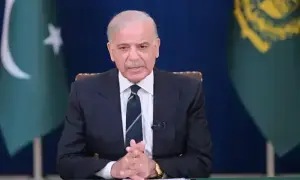
Prime Minister Shehbaz Sharif has termed Pakistan’s emergence as a key mediator between the US and Iran as a “shining moment in our history”, crediting the “political-military partnership” for the change in the country’s image internationally.

The premier made these remarks during an interview with The Sunday Times, as Islamabad remained engaged in efforts for de-escalation between the US and Iran.

“It’s one of the shining moments in our history. Pakistan is acknowledged worldwide as an honest mediator and as a country in which international leadership has full trust and faith. It’s our shining hour, and I feel a very proud Pakistani — as do 240 million Pakistanis,” he was quoted as saying in the interview published on Saturday night.

The PM’s expressed optimism even as military pressure and fears of renewed confrontation continue to shape the conflict that began with US-Israeli strikes on Iran in late February.

While a deal for a complete end to the war is yet to happen, hostilities have largely ceased since the two sides agreed on a Pakistan-brokered ceasefire on April 8. Following the ceasefire, a first round of historic direct US-Iran talks was held in Islamabad on April 11 and 12, with Pakistan playing the role of a mediator. The talks had ended without an agreement, but also without a breakdown.

With challenges in convening a second round, Islamabad continues its peace efforts. The latest development on this front is Interior Minister Mohsin Naqvi’s visit to Iran, where he has held meetings with Iranian President Masoud Pezeshkian and Parliament Speaker Bagher Ghalibaf.

Diplomatic sources said the visit was linked to Pakistan’s continuing efforts to revive the stalled Iran-US peace process after President Donald Trump rejected Tehran’s latest response to American proposals.

In his interview with The Sunday Times, PM Shehbaz said he was “hopeful” of a second round of direct talks between the US and Iran, leading to lasting peace.

“By a stroke of good luck, we have been placed in this prestigious position,” he said.

“Fortunately, Iran trusts Pakistan as does the US administration — and also the Gulf states — and I’m grateful to Presidents Trump and Pezeshkian for accepting our invitation,” he added.

The PM said Pakistan’s efforts for peace were ongoing, adding that “peace is never won easily”.

“You have to have patience, sagacity and ability to move things despite the most difficult challenges.

“As we speak, we’re still doing our best to ensure that this peace effort achieves a long-lasting peace through another session here in Islamabad, and we are hopeful that will happen,” he said.

He further noted, “Our international image has completely changed through this partnership of our political and military hierarchy.”

The premier went on to praise Chief of Defence Forces and Chief of Army Staff Field Marshal Asim Munir, saying: “What we are seeing is team efforts of the political and military leadership. I must acknowledge that the Field Marshal has played a critical role, which will be recorded in history.”

He also commended the efforts of Deputy Prime Minister and Foreign Minister Ishaq Dar, who he said had been “engaging his counterparts and making untiring efforts”.

He was also asked about recent border tensions between Pakistan and Afghanistan, and reports of civilians’ killing in Afghanistan in attacks by Pakistan — an allegation that Islamabad has denied.

In his reply, PM Shehbaz said, “Our country is facing an onslaught of terrorism again despite our best efforts — whether it’s from Kabul, the TTP, the BLA and other externally sponsored proxies.”

He added, “With Afghanistan, we had no other choice but kinetic action against terrorist hideouts and support infrastructure. We have lost hundreds of police and soldiers. What do you do? We sent peaceful messages to Kabul, telling them we have to stay neighbours forever, we share a boundary spanning over 2,000km and that if there is peace, there will be prosperity for both of us.

“Those messages have been conveyed to Kabul not once but dozens of times. Our only demand was that they commit not to let those terrorist outfits operate from Kabul.”

The PM further stated, “What should we do? Have lunch or dinner with them while our innocent people are being killed? It’s our unwavering commitment to wash the stigma of terrorism from the face of this country. It’s a war we are fighting not just for Pakistan but the world over.”
  •  

Pakistan hails PCA's decision in IWT proceedings, says it affirms limits on India’s water-control capability

Pakistan expressed on Sunday “utmost satisfaction” over a supplemental award by the Permanent Court of Arbitration (PCA) that it said affirmed Islamabad’s position of the Indus Waters Treaty placing “substantive limits on India’s water-control capability” on Indus River system’s western rivers.

The decision pertained to maximum pondage — a technical term for the maximum volume of water that could be stored in a reservoir — in Indus Waters Treaty proceedings arising from design disputes concerning the Ratle Hydroelectric Plant and the Kishenganga Hydroelectric Project in occupied Kashmir, a statement issued by the Pakistan government said.

According to the statement, the supplemental award was issued on May 15. However, the decision has not been publicly shared by the PCA as yet.

Pakistan had first instituted arbitral proceedings against India regarding the Indus Waters Treaty (IWT) in 2016. And while India continues to boycott the proceedings, the court shares its procedural updates and decisions with both Indian and Pakistani Indus water commissioners ex-officio.

The IWT, brokered by the World Bank in 1960, allocates the three western rivers — Indus, Jhelum and Chenab — largely to Pakistan, and the three eastern rivers — Ravi, Beas and Sutlej — to India.

In April 2025, India announced a unilateral suspension of its obligations under the IWT following an attack on tourists in occupied Kashmir’s Pahalgam that killed 26 — an incident New Delhi blamed on Islamabad without evidence.

In June 2015, the PCA, which provides a framework for international disputes, issued a supplemental award of competence, stating that India cannot unilaterally hold the treaty in abeyance.

According to the government of Pakistan’s statement, the latest supplemental award by the PCA affirmed Islamabad’s “central position that the treaty places substantive limits on India’s water-control capability on the western rivers”.

“These limits are not formalities. They apply at the planning and design stage and cannot be satisfied merely by a later assurance of operational restraint.

“Pondage for a run-of-river Plant must be justified by real project needs, actual expected operation, site hydrology, hydraulic conditions, power-system requirements, and the information and explanation required under the treaty,” the statement said.

It added that building on the PCA’s Award on Issues of General Interpretation of the IWT on August 8, 2025, the supplemental award gave practical effect to the standard that installed capacity and anticipated load must be realistic, well-founded and defensible.

“Installed capacity must correspond to actual expected operation, hydrologic and hydraulic data, and treaty requirements. Anticipated load must correspond to actual expected operation and to the projected needs of the power system the plant is intended to serve,” it said.

This, the statement said, addressed a core IWT concern that “India cannot justify increased pondage through imagined capacity, artificial load curves, unrealistic peaking assumptions, or bare assertions of compliance with paragraph 15 release limits”.

“Paragraph 15 remains an operational constraint, but it is not a substitute for an evidence-based justification of the water-control capacity sought. Any different operating pattern must be supported by specific information and underlying data produced by India,” it said.

Paragraph 15 of the treaty elaborates on “interference with the waters” under the pact.

The statement said the award also strengthened Pakistan’s review rights.

“India must provide Pakistan with sufficient information and explanation to assess treaty compliance. If India fails to do so, it fails to carry its burden of establishing that the proposed maximum pondage satisfies Paragraph 8(c) of Annexure D,” it stated.

The said provision elaborates on the design of any new run-of-river plant, stating that the “maximum pondage in the operating pool shall not exceed twice the pondage required for firm power”.

According to the Pakistan government’s statement, the PCA also confirmed that “any applicable minimum-flow obligation must be taken into account in calculating pondage required for firm power where such obligation exists and is not otherwise satisfied. Paragraph 15 release requirements do not automatically satisfy such an obligation”.

It said Pakistan “also notes the Court’s earlier holding that the awards of a court of arbitration are final and binding on the parties and have otherwise controlling legal effect for subsequent treaty bodies on relevant questions of treaty interpretation”.

“Pakistan will place these interpretations before the neutral expert process, consistent with treaty procedures and applicable confidentiality arrangements,” it added.

The statement further said that Pakistan remained committed to the Indus Waters Treaty, its dispute-resolution procedures, and the peaceful settlement of water-related differences.

“Pakistan will continue to protect its rights under the IWT and will pursue every lawful and diplomatic means to ensure that hydroelectric projects on the western rivers are designed and operated strictly within treaty limits.

“The award is a strategic consolidation of Pakistan’s treaty position: maximum pondage must be realistic, evidence-based, hydrologically grounded, power-system justified, treaty-compliant, and incapable of inflation through artificial assumptions,” the statement read.

India rejects decision

Earlier, the Indian foreign ministry issued a statement rejecting the PCA’s decision.

“The illegally constituted so-called Court of Arbitration (CoA) has, on May 15, 2026, issued what it termed an award concerning maximum pondage supplemental to the award on issues of general interpretation of the Indus Waters Treaty.

“India categorically rejects the present so-called award, just as it has firmly rejected all prior pronouncements of the illegally constituted CoA,” the statement said.

It said India “never recognised the establishment of this so-called CoA. Any proceeding, award, or decision issued by it is null and void”.

The statement added that India’s decision to hold the Indus Waters Treaty in abeyance remained in force.

  •  

Zilhaj moon sighted, Eidul Azha to fall on May 27

The Ruet-i-Hilal Committee announced on Sunday that the Zilhaj moon had been sighted and Eidul Azha will be celebrated on May 27.

The announcement came after the committee met earlier today in Karachi for the moon sighting, while meetings of zonal committees were also convened in Islamabad, Lahore, Quetta and Peshawar.

Addressing a press conference after the meetings, Ruet-i-Hilal Committee Chairperson Maulana Abdul Khabeer Azad said skies were mostly clear in the country today except in some areas.

Resultantly, moon sighting testimonies were received from Karachi and other cities of Sindh, Mardan, Rawalpindi, Peshawar and some other areas.

“Hence, it has been unanimously decided that first Zilhaj 1447 AH will be on May 18 (Monday) while Eidul Azha will fall on May 27 (Wednesday),” he said.

Earlier this week, the Pakistan Space and Upper Atmosphere Research Commission (Suparco) had also forecast that Eidul Azha was expected to fall on May 27 as the “new moon of Zilhajj 1447 AH is expected to be born on May 17 at 1:01am”.

At sunset the same day, the age of the new moon would be approximately 18 hours and 30 minutes, it said in a statement, estimating an interval of 60 minutes between “sunset and moonset along the country’s coastal belt”.

“Based on these astronomical parameters, the chances of sighting the Zilhajj crescent on the evening of May 17 are considered favourable,“ Suparco said, adding it would be subject to clear weather conditions and visibility near the horizon.

“Consequently, the 1st Zilhajj 1447 AH is anticipated to fall on Monday, May 18, marking the conclusion of the holy month of Zilqad,” it said.

Therefore, Eidul Azha will fall on May 27, Suparco said.

  •  

PM Shehbaz thanks Qatari PM for 'strong endorsement, support' of Pakistan-led peace efforts

Prime Minister Shehbaz Sharif held a phone call with his Qatari counterpart on Sunday and thanked the leadership of Qatar for its “strong endorsement and support of Pakistan-led peace efforts”.

According to a statement shared by PM’s spokesperson for foreign media Mosharraf Zaidi on X, the premier had a “warm and cordial conversation” with Qatar’s Sheikh Mohammed bin Abdulrahman bin Jassim al Thani, and the two leaders exchanged views on the evolving regional and international situation.

“The prime minister thanked the leadership of Qatar for its strong endorsement and support of Pakistan-led peace efforts aimed at de-escalation and promoting regional peace and stability,” the statement added.

It said that PM Shehbaz expressed his “deep appreciation for Qatar’s constructive role in regional diplomacy and for building a consensus in support of ongoing mediation efforts”.

Both leaders agreed on the need for continued close coordination and dialogue among all stakeholders to address common challenges, it added.

The statement further said while “conveying his warm greetings and best wishes” to the Qatari prime minister, PM Shehbaz told him that he was looking forward to welcoming him to Pakistan on an official visit very soon.

The two sides agreed to maintain regular high-level contacts to follow up on the outcomes of the conversation, the statement added.

Later, PM Shehbaz also posted on X that he had received a phone call from the Qatari prime minister.

“We exchanged views on the evolving regional and international situation and reaffirmed our shared commitment to peace, dialogue and regional stability.

“I deeply appreciated Qatar’s constructive diplomatic role and conveyed my gratitude to His Highness Sheikh Tamim bin Hamad Al Thani, Amir of the State of Qatar, for Qatar’s strong support for Pakistan-led peace efforts aimed at de-escalation,” he said.

PM Shehbaz said he was looking forward to the Qatar PM’s visit to Pakistan soon, adding that “Pakistan and Qatar will continue to work closely together for peace and stability in the region and beyond”.

Separately, Deputy Prime Minister and Foreign Minister Ishaq Dar has discussed “evolving regional situation” in a telephonic conversation with Egyptian Prime Minister Badr Abdelatty, the Foreign Office (FO) said.

“FM Abdelatty appreciated Pakistan’s sincere efforts for promoting regional peace and stability,” it said.

The FO said that they also discussed matters related to the regional consultative forum of the Foreign Ministers of Pakistan, Saudi Arabia, Turkiye, and Egypt.

It added that the discussion also covered ongoing engagements pertaining to the UN Security Council and broader multilateral diplomatic developments.

“FM Abdelatty also commended Pakistan’s successful humanitarian facilitation in the repatriation of 20 Iranian and 11 Pakistani seafarers via Singapore, who had been aboard vessels seized by the United States,” it stated.

“Both sides agreed to remain in close contact and continue consultations on regional and international developments,” the FO said.

FM Abdelatty reiterated the invitation to FM Dar to visit Egypt for bilateral consultations at his earliest convenience, it said.

The telephone calls take place as Pakistan remains engaged in efforts for de-escalation between the United States and Iran, even as military pressure and fears of renewed confrontation continue to shape the conflict that began with US-Israeli strikes on Iran in late February.

While a deal for a complete end to the war is yet to happen, hostilities have been largely ceased since the two sides agreed on a Pakistan-brokered ceasefire on April 8. Following the ceasefire, a first round of historic direct US-Iran talks was held in Islamabad on April 11 and 12, with Pakistan playing the role of a mediator. The talks had ended without an agreement, but also without a breakdown.

With challenges in convening a second round, Islamabad continues its peace efforts. The latest development on this front is Interior Minister Mohsin Naqvi’s visit to Iran, where he has held meetings with Iranian President Masoud Pezeshkian and Parliament Speaker Bagher Ghalibaf.

Diplomatic sources said the visit was linked to Pakistan’s continuing efforts to revive the stalled Iran-US peace process after President Donald Trump rejected Tehran’s latest response to American proposals.

The sources in Islamabad said the unscheduled trip was part of Pakistan’s continuing shuttle diplomacy aimed at preventing the negotiations from collapsing entirely after momentum generated by earlier rounds of talks in Islamabad slowed sharply.

The visit, officially framed around bilateral and border security cooperation, came as the fragile ceasefire continued to hold unevenly amid intermittent tensions around the Strait of Hormuz and prolonged disruption to global energy shipping.

  •  

Pakistan 'critical counter-terrorism partner' in US fight against IS-K: Centcom

The US Central Command has termed Pakistan a “critical counter-terrorism partner” that is “central” to the fight against the militant Islamic State-Khorasan (IS-K) in South Asia.

The remarks were made by Centcom Commander Navy Admiral Bradford Cooper, who testified before the Senate Armed Services Committee earlier this week on the progress of ‘Operation Epic Fury’ — Washington’s campaign against Iran that began on February 28 and is paused for now.

A statement issued after the briefing on May 14 also had remarks from Cooper on the US engagement in South and Central Asia.

He told the committee that the “shared” threat of external operations emanating from Afghanistan continued to be “an animating force among our partners”.

“Pakistan, especially, is a critical CT partner that is central to the fight against ISIS-K in the region,” Admiral Cooper said, adding that Washington and Islamabad’s “strong military-to-military partnership has produced tangible results against high-value individuals with American blood on their hands”.

Admiral Cooper further told the committee that the “military-to-military partnership” was also “key” to Centcom’s support to Pakistan after the September 2025 floods.

He maintained that “these tangible, mutual wins are direct reflections of our enduring friendship and shared resolve”.

“Our Central Asian partners, likewise, are keeping a wary eye towards Afghanistan-based terrorist threats,” he added.

The development reflects the continuing partnership on counter-terrorism between the two countries.

In March 2025, shortly after becoming the US president for a second time, Donald Trump announced that the person responsible for killing 13 US service members during the withdrawal from Afghanistan in 2021 had been arrested with the help of Pakistan and was now on his way to the United States to face justice.

The 2021 Abbey Gate bombing killed 13 US service members and approximately 170 Afghan civilians during the chaotic US withdrawal from Afghanistan. The militant Islamic State (IS) group had claimed responsibility for the killings.

In a public gesture of appreciation, Trump had thanked Islamabad for its role in the capture, saying: “I want to thank especially the government of Pakistan for helping arrest this monster.”

Then, in June 2025, Centcom commander Army General Michael Kurilla had praised Pakistan as a “phenomenal partner in the world of counter-terrorism”, citing the nation’s struggle against terrorism in Balochistan and against terrorist groups like the IS-K.

Hailing a “phenomenal partnership” with Islamabad, Gen Kurilla had highlighted that Pakistan has “gone after ISIS Khorasan (IS-K) killing dozens of them.”

In the US-Pakistan Counterterrorism Dialogue held in August last year, the US said that it was committed to countering terrorism in all its forms.

The same month, the US listed the Balochistan Liberation Army (BLA) as a Foreign Terrorist Organisation — a move long desired by Pakistan.

On Friday, Interior Minister Mohsin Naqvi, in a meeting with the US Assistant Secretary of State for South and Central Asian Affairs Paul Kapur, said that Pak-US ties had strengthened during US President Donald Trump’s tenure.

  •  

Kundi calls on PM to 'take interest' in KP's issues, says told CM Afridi to focus on governance not Adiala

Khyber Pakhtunkhwa Governor Faisal Karim Kundi called on the Centre to address his province’s issues, asserting that Prime Minister Shehbaz Sharif “should take interest” in the matter.

At the same time, he also said he had conveyed to KP Chief Minister Sohail Afridi to focus on the “province’s governance rather than Adiala” — a reference to the PTI’s efforts and frequent protests outside the jail in Rawalpindi for party founder Imran Khan’s release.

Kundi made these remarks while speaking to the media in Islamabad after he met KP CM Afridi at the Governor House in Peshawar earlier in the day.

Speaking to the media, he warned that the “people of KP have reached a point where if they take to the streets tomorrow, nobody could be held responsible for it”.

Kundi urged the federal government to address KP’s issues, including the suspension of CNG supply and restrictions on wheat movement.

“If Punjab has issues with supplying wheat to KP, then allow us passage to ensure supply from Sindh,” Kundi said, claiming that KP authorities had been told to transport wheat from Sindh “via Balochistan and not through Punjab”.

He maintained that as a “representative of the Centre,” he had spoken to all sides, including relevant provincial ministers.

He urged PM Shehbaz to “take interest” in the province’s issues, warning that eventually “people will be forced to take to the streets”.

“When you do not give them roti, and there is no one to listen to their problems, they will certainly take to the streets,” Kundi warned.

On working with the PTI-led provincial government, Kundi assured cooperation “as long as it’s about the peace, harmony and issues of the province”.

He said he told CM Afridi that he should “focus on the governance, rather than Adiala,” citing the province’s governance, security, and corruption issues.

“Who will be responsible for governing the province if you are sitting outside Adiala for five days of the week?” Kundi said, advising the KP CM to “hand over the Adiala issue to PTI and act as the CM instead”.

Kundi quipped that there should be “two PTIs — one to focus on governance and one for Adiala”.

Earlier in the day, Kundi met CM Afridi at the Governor’s House. During the meeting, Kundi said in a post on X, he “highlighted key governance gaps affecting people of KP, including disruptions in essential supplies and public relief systems”.

KP governor maintained that he told the KP CM that the provincial government “must step forward with immediate [and] practical measures to ensure effective service delivery and address public concerns”.

He also stressed the need for protection of KP’s constitutional rights and “enhanced welfare and operational support for KP police”.

Kundi had spoken about KP’s issues during a media talk on Friday as well, saying that he had raised the issue of the suspension of CNG supply and with the federal government, and alleged the Centre was treating the province unfairly.

He had also termed the ban on the movement of wheat a serious issue and said that KP residents should not be punished for voting for PTI. He had urged the federal government to sit with the KP authorities to resolve wheat and gas supply issues.

Last week on May 10, Kundi met with PTI leaders and discussed KP’s constitutional and economic rights, stressing the need to present a firm case before the federal government to ensure “justice and fair treatment”.

Since taking charge as the province’s chief executive in October 2025, CM Afridi has repeatedly accused the Centre of stalling the release of funds allocated to KP, particularly those committed to the merged districts under the National Finance Commission (NFC) Award.

He had also condemned the Punjab government’s tighter controls on inter-provincial movement of wheat and flour through a permit regime to curb price hikes within the province.

The province has also been affected by a deepening CNG crisis in April that brought economic activity to a near standstill, with hundreds of filling stations shut and millions of citizens struggling for affordable fuel.

  •  

Islamabad, Baku developing ties within Pakistan-Turkiye-Azerbaijan trilateral framework: President Aliyev

Islamabad and Baku are developing their ties under a trilateral framework involving Pakistan, Turkiye and Azerbaijan, President Ilham Aliyev said on Sunday.

The Azeri president met with Punjab Chief Minister Maryam Nawaz in Baku, where CM Maryam arrived on a three-day visit on Saturday to represent Pakistan at the 13th UN World Urban Forum (WUF13).

“President Ilham Aliyev also emphasised that Azerbaijan-Pakistan relations are currently developing within a trilateral framework involving Azerbaijan, Türkiye, and Pakistan,” read a statement issued by the Azeri president’s office on the meeting.

During the meeting, the two sides “commended the development of fraternal relations and strategic partnership between Azerbaijan and Pakistan”.

“They discussed cooperation in political, economic, diplomatic, defence, and other fields, while also highlighting the importance of interregional cooperation and the strong potential for further expanding trade ties,” the statement said.

It was also highlighted during the meeting that “centres based on Azerbaijan’s ‘ASAN Khidmet’ experience have been established in Pakistan”.

Expressing satisfaction with participating in WUF13, the Punjab CM thanked Aliyev “for the invitation and praised the excellent organisation of the event”. “She emphasised that important global issues related to urban planning would be discussed in Baku,” the presidency said.

Noting that the beauty of Baku had deeply impressed her, Maryam “described the Azerbaijani capital as a remarkable example of harmony between culture and modern urban planning”, it added.

The chief minister said that during her trip, she visited the grave of Azerbaijan’s founder, Heydar Aliyev, and honoured his memory with deep respect and reverence.

Maryam conveyed the greetings of Prime Minister Shehbaz Sharif, as well as her father and ex-premier Nawaz Sharif, to Aliyev. Aliyev expressed his gratitude for the greetings and asked that his own greetings be conveyed to PM Shehbaz and Nawaz, the statement added.

The Azerbaijan president “recalled the friendly relations” between Heydar Aliyev and Nawaz.

The PML-N later shared a video from the meeting, with captions stating that Maryam “emphasised that Pakistan’s strategic location and nuclear status are vital for regional balance”.

Meanwhile, a statement carried by state broadcaster Radio Pakistan said the two sides discussed bilateral relations and cooperation in trade and other sectors.

It said the Azerbaijani president lauded “Pakistan’s responsible mediatory role for peace in the region”.

“He appreciated the diplomatic measures initiated by Prime Minister Shehbaz Sharif and his team,” the statement said.

It added that CM Maryam said PM Shehbaz’s “untiring efforts for Pakistan’s economic progress are the foundation for progress, peace, and stability in the country”.

Ali Mustafa Dar, Maryam’s brother-in-law who was appointed as her adviser on artificial intelligence and special initiatives a few months ago, was also part of the delegation.

“An honour accompanying my leader Chief Minister Punjab Maryam Nawaz Sharif to today’s meeting with the President of Azerbaijan H.E. Ilham Aliyev,” he wrote on X.

Maryam to address UN World Urban Forum

CM Maryam will also “represent Pakistan at the UN Urban Forum Leaders Summit and deliver Pakistan’s vision for safe, resilient and inclusive cities to the world”, according to Punjab Senior Minister Marriyum Aurangzeb, who is accompanying her.

On Monday, the chief minister will inaugurate the Pakistan Pavilion, “showcasing Punjab’s transformational initiatives, including Apni Chhat Apna Ghar, one of the world’s fastest and largest affordable housing programmes with 160,000 loans approved”.

Aurangzeb highlighted that 100,489 families had “already moved into homes they can finally call their own”.

Earlier this week, President Aliyev spoke to PM Shehbaz on the phone, with the latter conveying his best wishes for WUF13.

The premier “expressed confidence that the forum, under Azerbaijan’s stewardship, would serve as a valuable platform for advancing the global urban development agenda”, the Prime Minister’s Office had said.

“The two leaders agreed to maintain close contact and looked forward to their meeting, in person, later this year,” it added.

  •  

ISPR takes exception after Indian army chief says Pakistan should decide between being 'part of geography' or not

The Inter-Services Public Relations (ISPR) on Sunday took exception to the Indian army chief’s recent provocative remarks and cautioned New Delhi against pushing South Asia towards another conflict with “devastating” consequences for the region.

“Indian COAS gave a provocative statement during a recent interview that ‘Pakistan should decide if it desired to be part of geography and history’,” ISPR noted in a statement issued in response to Indian Army Chief Gen Upendra Dwivedi’s comments made a day earlier.

“Contrary to the delusional and hallucinational belief system and despite the omnipresent ill wishes that prevail in Hindutva-led India, Pakistan is already a country of consequence at global level, a declared nuclear power and an indelible part of South Asia’s geography and history,” the ISPR said.

It observed that the statement reflected that the “Indian leadership has neither been able to reconcile with the very idea of Pakistan nor it has learnt the right lessons, even after [the] passage of eight decades”.

“This hubristic, jingoistic and myopic mindset has repeatedly pushed South Asia towards wars and crises,” the military’s media affairs wing highlighted.

“Threatening a sovereign nuclear neighbour with elimination from ‘geography’ is not strategic signalling or brinkmanship; it is sheer bankruptcy of cognitive capacities, madness and warmongering despite knowing the reality that such geographic obliteration would certainly be mutual and comprehensive,” the ISPR warned.

It stressed that “responsible nuclear states reflect restraint, maturity, and strategic sobriety”, rather than speaking the “language of civilisational supremacy or national erasure”.

The ISPR advised the Indian leadership “not to attempt to push South Asia towards another crisis or war whose consequences would only be devastating for the complete region and beyond”.

“India needs to reconcile with Pakistan’s salience and learn to peacefully co-exist with it. Otherwise, any attempt to target Pakistan can trigger consequences that shall neither be geographically confined nor strategically or politically palatable for India,” the military further warned.

The ISPR highlighted that the “Indian narrative conveniently ignores India’s own historically documented record of being a harbinger of terrorism in the region, a state sponsor of terrorism, key source of regional instability, practitioner of transnational assassinations and a hotbed of disinformation campaign across the globe”.

“Delhi’s aggressive posturing stems less from confidence and more from frustration at its inability to harm Pakistan, that has been brutally exposed during Marka-i-Haq,” it added, referring to last year’s military escalation between the two neighbours.

At an interactive session in New Delhi on Saturday, Gen Dwivedi was asked about how the Indian army will respond if the “circumstances that led to Operation Sindoor last year” arose again, the Press Trust of India reported.

The Indian army chief reiterated New Delhi’s terrorism allegations against Pakistan, which the latter has vehemently rejected, and said that Pakistan had “to decide whether they want to be part of geography or history or not”.

Earlier this month, Pakistan marked the first anniversary of the May 2025 conflict between Pakistan and India, which included a four-day military escalation.

At a ceremony held on May 10 at General Headquarters (GHQ) in Rawalpindi to commemorate the victory, Chief of Defence Forces (CDF) and Chief of the Army Staff Field Marshal Asim Munir warned that any future “misadventure” against Pakistan will result in “extremely far-reaching and painful” consequences for the enemy.

A growing body of commentary from international analysts suggests that the next such crisis between the two nuclear-armed neighbours is not only more likely, but will prove dangerous, with fewer opportunities for outside powers to contain it.

  •  
❌