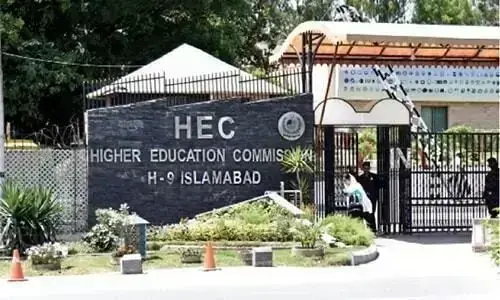
The Higher Education Commission of Pakistan (HEC) on Monday announced the launch of a “fully online and paperless” degree attestation system to facilitate students.
In December last year, the HEC said that it had initiated a project to revamp its degree attestation system by integrating cutting-edge blockchain technology, saying the project would be completed within six months. Meanwhile, the National Assembly Standing Committee on Government Assurances had also asked the Higher Education Commission (HEC) to reduce the turnaround time in degree attestation.
In a social media post on X, HEC Chairman Dr Niaz Ahmed Akhtar said, “HEC has revamped the Degree Attestation System (DAS) by introducing a fully online and paperless attestation mechanism to facilitate students and graduates across Pakistan.”
Under the new system, he explained, applicants will no longer be required to physically visit HEC offices or submit original documents.
“Applications for online attestation can now be submitted 24/7 through the HEC e-Services Portal,” he added.
He said that the new e-attestation certificate system was designed to provide a “secure, efficient, and user-friendly process,” with online verification available for attested documents and certificates.
According to information available on HEC’s official website, “This modern system is fast, convenient, and hassle-free, removing the need for applicants to visit HEC offices or submit original documents in hard copy. Applications can be submitted anytime (24/7) through the online portal at www.eservices.hec.gov.pk.”
Candidates can apply for the online degree attestation by creating an account and providing personal and academic details. The candidates will then upload the transcripts online for scrutiny by the HEC and verification of credentials by the respective universities.
The payment can be made online through 1-link.
After a final review, an e-attestation certificate will be issued against the documents applied for attestation. Applicants will be notified via SMS and email.
The applicants can also download the verifiable certificate from their online account at the HEC Portal.
Before this initiative, candidates had to send their documents via post to HEC or visit its offices to get their documents attested. The new project will now issue a verifiable e-certificate instead of a stamp, minimising the time and cost required by the manual process.
Khyber Pakhtunkhwa Chief Minister Sohail Afridi on Monday decried decisions taken behind closed doors, saying that the provincial government would oppose those decisions that went against peace in the province and the people’s interests.
He made the remarks during a visit to Bannu, after 15 police personnel were martyred and three sustained injuries after a suicide attack on the Fateh Khel police post.
According to a statement issued by the CM House, Afridi met the families of the martyred police personnel and also offered Fateha.
The statement said that he also visited the hospital to inquire about the health of the injured personnel and directed officials to provide them with the best possible healthcare facilities.
The statement quoted Afridi as saying that the KP police had shown bravery and courage against terrorism. He said that the people of the province had to stand up for their rights, otherwise the “imposed circumstances” would continue to prevail.
“We have been continuously saying that terrorists are again rearing their heads, but decisions behind closed doors have been imposed on us for the last 78 years,” he lamented, adding that the imposed policies had “pushed the province into a quagmire of unrest”.
“We have made immense sacrifices [in the fight] against terrorism. Further unrest is unacceptable,” he asserted.
“The provincial government and police will fight against terrorism together,” Afridi said, noting that the government would oppose every decision against peace in the province and the people’s interests.
He further noted that the sacrifices of the martyred officials would not be in vain, as establishing peace in the province was the government’s top priority.
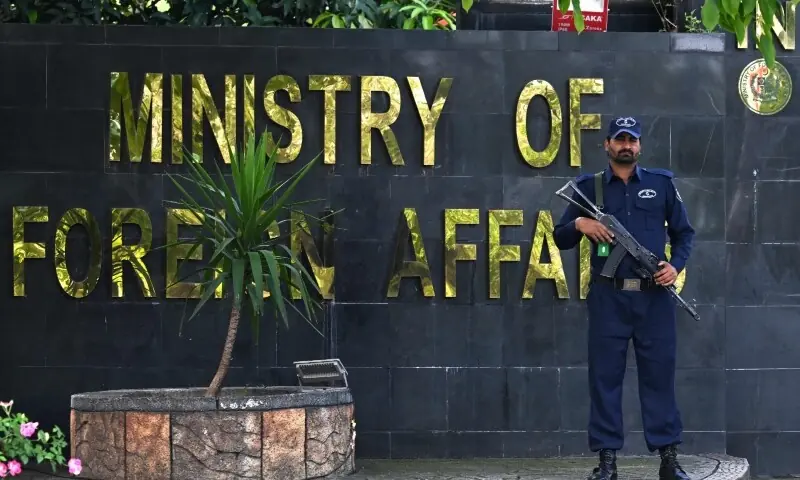
The Foreign Office (FO) said on Monday that the Afghan chargé d’affaires was summoned and handed a “strong demarche” over the suicide attack in Bannu, which claimed the lives of 15 police personnel.
In a statement, the FO said, “The Afghan chargé d’affaires was summoned to the Ministry of Foreign Affairs today to deliver a strong demarche regarding the cowardly vehicle-borne improvised explosive device (IED) attack carried out by terrorists of Fitna al Khawarij on the Fateh Khel police post in Khyber Pakhtunkhwa’s Bannu District on May 9.”
Fitna al Khawarij is a term the state uses for terrorists belonging to the banned Tehreek-i-Taliban Pakistan, while Fitna al Hindustan is a term designated by the state for terrorist organisations in Balochistan.
“The ministry conveyed that a detailed investigation into the incident, along with evidence collected and technical intelligence, indicates that the attack was masterminded by terrorists residing in Afghanistan,” the FO said.
“Reiterating Pakistan’s grave concern over the continued use of Afghan soil for terrorist attacks against Pakistan, it was impressed upon the Afghan side that Pakistan reserves the right to respond decisively against the perpetrators of this barbaric act,” the statement added.
It was also highlighted that the continued presence of various terrorist organisations on Afghan soil, and the permissive environment enabling their operations, were documented in reports by the United Nations Monitoring Team and other international organisations.
“The fight against terrorism is a common cause, and the Afghan Taliban must honour their commitment not to allow their territory to be used for terrorism against other countries,” the FO said.
It stated that Pakistan had repeatedly urged the Afghan Taliban regime to take concrete and verifiable action against Fitna al Khawarij, Fitna al Hindustan, and ISKP/Daesh elements operating from Afghan soil.
“Pakistan has also constructively engaged with the Afghan Taliban regime through several rounds of talks mediated by brotherly and friendly countries. However, the Afghan Taliban have consistently failed to commit to, or deliver, meaningful and verifiable action against these terrorist outfits,” the statement said.
“The Afghan Taliban regime has also been categorically informed that, if it continues to harbour these terrorist organisations, Pakistan will not compromise on its national security or on the safety and protection of its citizens,” the FO concluded.
At least 15 police officers were martyred and three others wounded late on Saturday night after terrorists rammed an explosives-laden vehicle into Fateh Khel police post in Bannu, followed by attacks from multiple directions with heavy weaponry and drones.
Bannu Regional Police Officer (RPO) Sajjad Khan confirmed that a total of 18 police personnel were on duty at the post when it was attacked. The initial assault began when terrorists drove a vehicle filled with explosives into the post.
Following the massive blast, militants opened heavy fire and launched a multi-pronged ground attack, according to authorities. “Fifteen were martyred and three sustained injuries,” the RPO said.
A senior administration official in Bannu told AFP the assailants also used quadcopters during the assault.
Recent Pak-Afghan ties
There has been a resurgence in terrorism in Pakistan since the Afghan Taliban returned to power in Kabul in 2021.
Islamabad has repeatedly urged the Taliban administration to dismantle terrorist sanctuaries on Afghan soil, particularly those linked to the banned TTP. Officials say those appeals have gone unheeded.
Operation Ghazab lil-Haq was launched on the night of February 26, following unprovoked firing by the Afghan Taliban from across the border.
From March 18 to 23, Pakistan observed a five-day temporary pause in the operation on the occasion of Eidul Fitr, with the FO later saying it would continue “until its objectives are achieved”.
De-escalation requests from Saudi Arabia, Qatar and Turkiye were part of the reasons behind the pauses announced by both sides, according to their respective statements.
In early March, Chief of Defence Forces and Chief of Army Staff Field Marshal Asim Munir had said that peace between Pakistan and Afghanistan could only prevail if the Taliban regime “renounced their support for terrorism and terrorist organisations”.
In April, the two countries held talks in China’s Urumqi and agreed to avoid any escalation in their armed conflict.
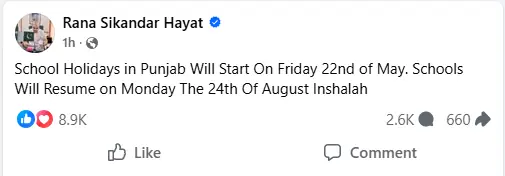
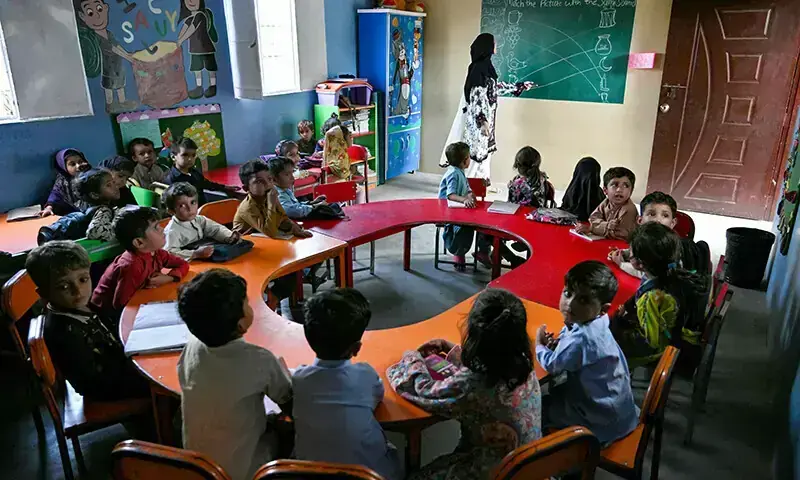
Punjab Education Minister Rana Sikandar Hayat on Monday announced a three-month-long summer vacation for schools in the province.
In a statement released by his spokesperson, he said that the summer break would begin on May 22 and would end on August 23.
He said that schools in the province would then open on August 24.
The minister also posted the same on his official Facebook account.
Last month, schools in the province were advised to alter working hours or declare early summer holidays due to excessive heat, which has prevailed over parts of the country over the past few weeks.
The Punjab Disaster Management Authority had issued urgent directives to educational institutions and district administrations across the province in view of a heatwave.
The advisory had stated that schools should alter working hours or declare early summer holidays if excessive heat persisted; suspend all outdoor sports and activities immediately; ensure uninterrupted availability of clean, cold drinking water; maintain functional ventilation, fans, and cooling systems; and tell students to wear loose, light-coloured clothing.
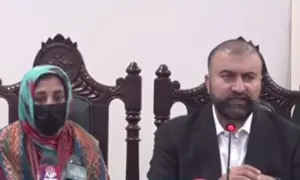
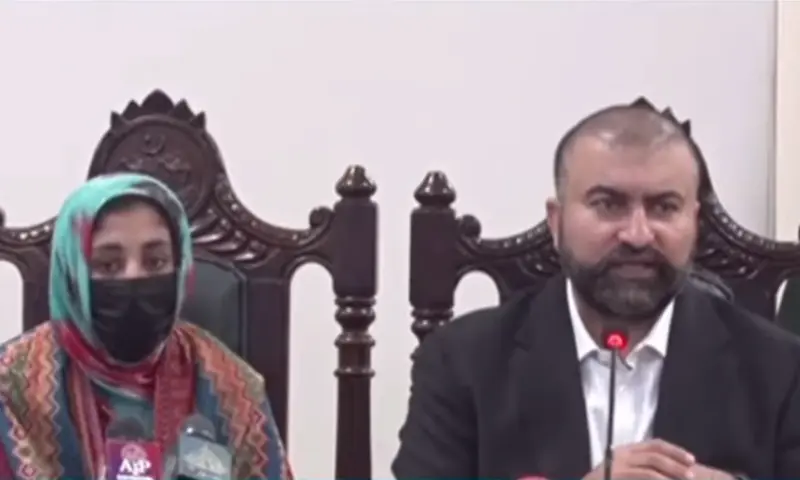
Balochistan Chief Minister Sarfraz Bugti said on Monday that a plot to coerce a girl into carrying out a terrorist attack in Islamabad had been thwarted by intelligence agencies.
The girl, who was reportedly arrested before she could carry out a suicide bombing, will be released to her father under supervision instead of facing trial, he said.
The chief minister, in a press conference alongside the suspect, emphatically denounced the perpetrators of exploitation against Baloch women and girls. He stressed that their actions had no connection at all to Baloch tradition or history.
“We are faithful to our tradition,” he said, adding, “These people have no connection to Balochiyat, and the way they are using our women in this war is shameful. I am so ashamed that I cannot even tell the media the details.”
According to details shared by Bugti, the girl’s name had initially appeared on social media as a missing person, but an investigation by intelligence agencies ascertained that she was allegedly training at a terrorist camp.
Terming the investigation’s results as “very unfortunate”, Bugti noted that the method of exploitation by the terrorists involved “honeytrapping” women, then blackmailing them. In this case, by threatening to kill the girl’s father if she did not comply with their orders, the chief minister added.
“The plan was to perform a suicide attack in Islamabad,” the chief minister said.
He contended that the objective of the attack, which he alleged was orchestrated by agents of India’s intelligence agency Research and Analysis Wing (RAW), was to sabotage the improved reputation Pakistan was currently enjoying on the international stage.
The Balochistan CM said the girl perhaps did not know that Islamabad was the target and was to be told at the last minute, commending the intelligence agencies for foiling a major plan.
In addition, he stressed that the girl had been exploited in an egregious way and slammed those who were responsible for it, asking, “They would exploit their own Baloch girls? Their own daughters, their own sisters … and to please international masters? Can you conceive of it?”
“Then they say, ‘We are Baloch and these are Baloch traditions and a Baloch cause’ — there is no cause, no Balochiyat. It is a curse on this Balochiyat.”
Bugti said the girl’s story had caused him great pain and was a cause for shame, asserting that it showed the difference between the state and the terrorists: “I always say we should be opening doors to Oxford and Harvard for these girls, and they want to exploit them and put them in suicide jackets.”
He also denounced that the terrorists would proceed to upload video clips of such women and girls to social media as propaganda, calling it “heroism”, to recruit more women for their plans. He challenged the notion presented by the terrorists that women were “a part of this war”.
“Historically, Baloch women have never been a part of war. Historically, Baloch women have been a part of peace — when tribes fight, if a woman comes in between them, the fight ends. If a woman is there, her brother’s life is spared; if a woman is there, her father and son’s murders are called off … these were our traditions,” he noted.
“What kind of tradition has you exploiting girls for your vested interests like this? I do not have words to tell you the details,” the Balochistan CM remarked.
“We have decided that we are returning this girl to her father respectfully and with political and tribal guarantees,” Bugti said, adding that the father was a poor man.
“We have requested that he keep an eye on his daughter and, of course, our oversight will be present somewhere; we will watch them.”
He emphasised that they were releasing the girl because she was underage: “We could have tried her, but seeing the evidence of exploitation … I cannot sleep tonight.
“This is what they are doing to our Baloch daughters? To our Baloch sisters? They should be ashamed.”
The chief minister highlighted the “capacity and capability” of the intelligence agency that had saved Pakistan from losing face.
“So much destruction was going to happen; that was a given,” he noted. “But in Pakistan, if a woman carries out a suicide bombing … you can imagine its impact on Pakistan at this time, on an international level.”
Pakistan recorded a second consecutive month of improving security indicators in April 2026, with militant attacks and related casualties declining markedly, according to a report released by the Pakistan Institute for Conflict and Security Studies (PICSS).
According to the data, Balochistan also experienced a notable improvement, with militant attacks falling from 59 in March to 18 in April, a 69pc reduction.
In March, Bugti said security forces had arrested a “would-be” female suicide bomber in Khuzdar, with the help of “human intelligence”. At the time, he said the arrested woman would be interrogated in the “presence of female police personnel”, stressing that the state was cognisant of its responsibility to ensure that she suffered “no physical harm, moral harm or harassment”.
In December of last year, a major terror plot was thwarted in Karachi as law enforcers detained a teenage girl hailing from Balochistan, according to Sindh Home Minister Ziaul Hasan Lanjar.
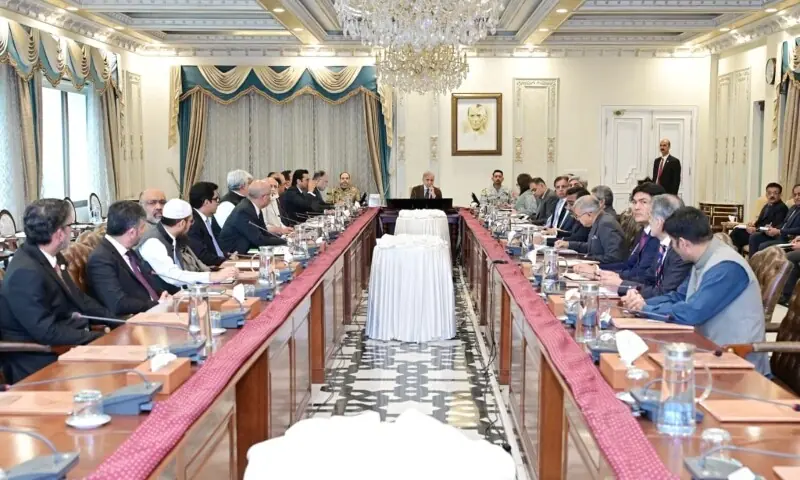
Prime Minister Shehbaz Sharif was told on Monday that Pakistan’s information technology exports were expected to reach $4.5 billion to $4.6bn, according to the Prime Minister’s Office (PMO).
The development came as the premier chaired meeting to review the affairs of the Ministry of Information Technology and Telecommunication.
During the meeting, the premier was told that the number of domestic internet connections had increased from 1.9 million in 2024 to 5.1m in 2026. He was also told that IT exports were expected to reach between $4.5bn-$4.6bn during the current fiscal year, the PMO said.
Further, the premier was told that the recent 5G spectrum auction had generated $509m dollars in revenue.
The meeting was also told that, under efforts to promote artificial intelligence, “Indus AI Week” was organised in February 2025 across 30 cities, attracting over 100 international delegates and featuring 88 pavilions.
The meeting was told that fibre connectivity had been provided to government schools and health units in Islamabad, and the provision of free internet hotspots in the capital was in its final stages. It was also informed that e-learning pods were being installed in Saidpur Model Village and Fatima Jinnah Park, the PMO statement said.
In his remarks, PM Shehbaz said that promoting the IT sector and increasing IT-related exports remained among the government’s top priorities.
He directed that work on establishing Asaan Khidmat Centres in Gilgit-Baltistan and Azad Jammu and Kashmir be expedited. He said that efforts should also be made in coordination with provincial governments to introduce the same facilities.
The prime minister said that cooperation from provincial and district-level governments should be sought to reduce the digital gap between urban and rural areas in the IT sector.
Pakistan’s youth possess immense potential in the IT sector, which must be “fully utilised”, he said.
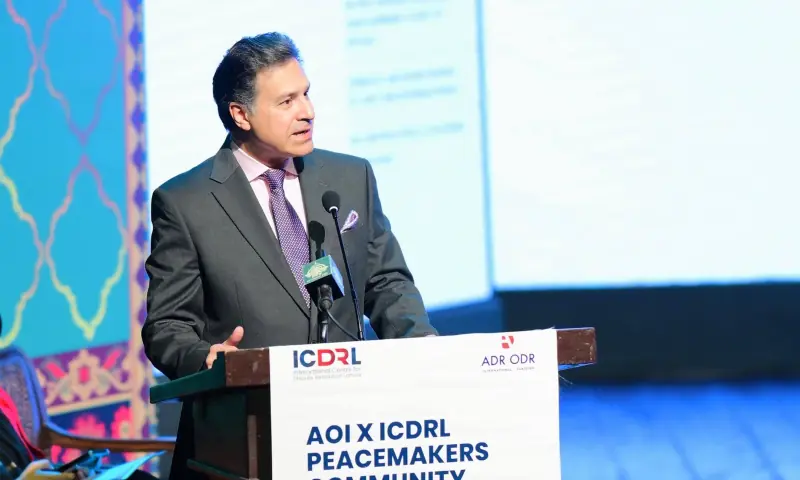
Justice Miangul Hassan Aurangzeb has called on the judiciary to encourage alternative dispute resolution (ADR) and detailed the Supreme Court’s ongoing efforts to establish a mediation centre.
In remarks aired on television on Monday, the SC judge stressed the need for mediators to be referred more cases, saying, “For that, the courts have to be willing to refer cases to mediation and must never think that by doing so, they are shying away from their primary responsibility of adjudication.”
He noted that, having already paid lawyers, parties were reluctant to pay a fee for mediators and, therefore, some mediation centres had a policy of pro-bono mediations.
“To encourage parties to go into mediation, what we have decided now is to train as many judges as mediators, and also officials in the high court and the Supreme Court who are law graduates, who will be willing to conduct mediation in their own pay scale,” the judge said.
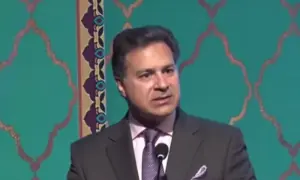
Justice Aurangzeb, along with Lahore High Court’s Justice Jawad Hassan, was presenting a keynote address at the launch event in Islamabad of “ADR ODR International x ICDRL Peacemakers Community (AIPC)”, linked to the International Centre for Dispute Resolution Lahore (ICDRL).
Justice Aurangzeb also said that the SC was in the process of establishing a “court-annexed mediation centre”, with financial assistance from the United Nations Development Programme (UNDP).
He highlighted that the SC now had two accredited, trained mediators and that the law ministry was starting a programme on Monday to train more mediators.
“By the end of this year, I hope to take the number to at least a dozen, so that parties who cannot afford to pay for the mediators are referred to the mediation centre, which will be housed in the Supreme Court […] for mediation to be conducted free of cost,” the judge said.
He further noted, “When being responsible for choosing lawyers to be trained as mediators, I had to bear in mind that they had to represent the entire spectrum of law, ranging from banking law, service law, civil disputes, land disputes and so on and so forth.”
Justice Aurangzeb observed that there was no shortage of mediators in Pakistan, adding that they were “experts in different fields”.
“You cannot be expecting mediators to work pro bono,” he said, emphasising that mediation was a “very lucrative part of the profession”.
However, Justice Aurangzeb also warned against the “counterproductive effect” of referring cases to mediation, with mediation becoming a “time-consuming device”.
He contended, “The experiment of mandatory mediation can start off with a few laws.”
While asserting that mediations will be more common in Pakistan, Justice Aurangzeb said, “But we are at the nascent stage. Do remember: our journey started in 2022. In Turkiye, it started in 2013 and by 2022, they had three million cases decided through a process of mediation.”
He highlighted that the figure for Turkiye was now at a staggering 9m. “Alternative dispute resolution mechanisms have to be adopted to address this issue,” he asserted.
Speaking about the SC’s planned mediation centre, he recalled, “The chief justice was very reluctant to give me the best space in the SC for this purpose. The mediation centre has to be nice, it has to have a nice view. People have to come there and be comfortable.
“So I have taken the nicest view overlooking Constitution Avenue,” he added. The judge explained that this was inspired by his visit to Turkiye’s chamber of commerce, where he was told that the mediation room with a scenic view of the Bosphorus had more successful mediations than the one with a dull view.
SC’s former senior puisne judge Syed Mansoor Ali Shah has previously repeatedly called for adopting the ADR mechanism.
Days after taking oath in October 2024, Chief Justice of Pakistan (CJP) Yahya Afridi had nominated Justice Shah as the chairman of the SC’s three-member ADR Committee. This came as the court began taking steps in line with the Case Management Plan 2023 — a brainchild of Justice Shah — to address the growing backlog of cases.
In a first, the Islamabad High Court (IHC) in November 2023 formally inaugurated a mediation centre, aimed at reducing the backlog of cases in the IHC and the district courts.
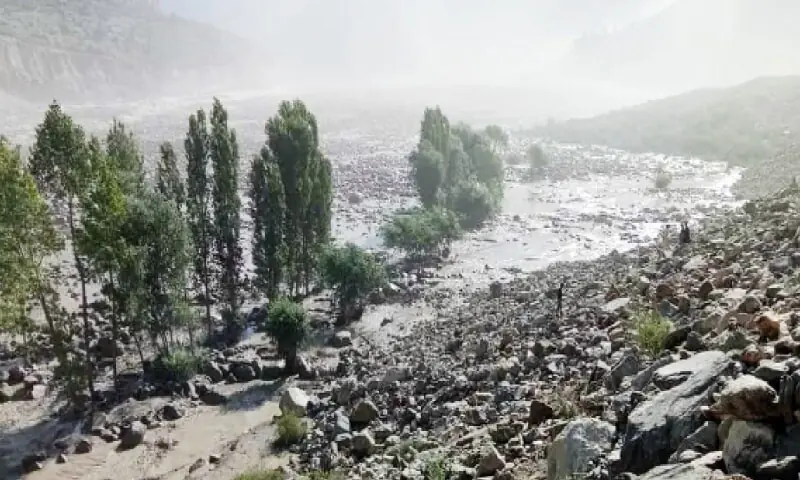
The Pakistan Meteorological Department (PMD) has issued an alert for glacial lake outburst floods (Glof) for Khyber Pakhtunkhwa and Gilgit-Baltistan, it emerged on Monday.
According to the alert issued by the PMD on Sunday night, a moderate westerly wave was expected to enter the upper regions of the country. It said that the weather system was expected to hit KP and extend to Gilgit-Baltistan by Monday.
During this period, the department predicted widespread rain and wind-thunderstorms, with isolated heavy falls in mountainous catchments.
“The weather patterns significantly elevated the risk of Glofs, debris flow, and flash flooding in vulnerable areas, especially in Swat, lower Chitral, Dir, Upper Hazara, Kohistan, Hoper, Ghulkin, Shishper, Ghizer, Hunza, Nagar, Ghanche, Shigar and Astore,” it said
The Met department advised people in glacial valleys to avoid proximity to riverbanks and stream beds during the rainfall; monitor local nullahs for sudden changes in water colour (muddiness) or unusual sounds (grinding rocks); and secure livestock and essentials on higher ground.
It also directed the disaster management authorities to ensure round-the-clock preparedness and maintain active communication with technical focal persons in remote valleys. Authorities were also asked to disseminate weather alerts through text message and social media platforms to ensure timely public awareness.
“All concerned departments and residents of vulnerable areas have been urged to remain vigilant and take precautionary measures to avoid any untoward situation during the forecast period,” it said.
Separately, the KP Provincial Disaster Management Authority (PDMA) issued instructions to the deputy commissioners of Upper Chitral, Lower Chitral, Upper Dir, Swat, Upper Kohistan and Mansehra.
It directed the officials to undertake proactive monitoring and surveillance of vulnerable Glof sites to ensure timely early warning and response.
The district administrations were also told to conduct evacuation drills in at-risk communities to ensure full preparedness and to ensure that safe evacuation sites were fully stocked and ready for utilisation.
They were also asked to alert the population residing in low-lying areas, ensure that the communities in vulnerable areas were forewarned and ensure the availability of rescue personnel.
It also advised local residents and tourists to avoid unnecessary movement near streams, waterways and rivers. The authority directed people living in low-lying areas to remain alert and move to safer locations in case of an emergency. The PDMA urged people to immediately move to safe places if they noticed sudden changes in water flow or heard mudslides or falling rocks.
It also directed the district administrations to coordinate with the departments concerned for the timely restoration of roads in case of any blockage. “In case of heightened risk, controlled breaching of vulnerable Glof sites may be coordinated with the concerned departments, to prevent sudden outburst events,” it said.

 Login
Login