Reading view

Nigeria says joint strikes with US kill 175 IS fighters

Nigeria’s military on Tuesday said that joint airstrikes with the United States had killed 175 Islamic State (IS) fighters in the country’s northeast, including the militant group’s global second-in-command.

The remote region has been gripped by an extremist insurgency since 2009, first by Boko Haram, then its offshoot and rival, the Islamic State West Africa Province (ISWAP).

According to the United Nations, more than 40,000 people have been killed and two million others displaced.

US and Nigerian forces killed Abu Bilal al-Minuki, an IS leader described as the “most active terrorist” in the world, at a remote village in the northeast last weekend.

The Nigerian military said on Tuesday that 175 IS militants had so far been “eliminated from the battlefield”.

“The joint strikes have resulted in the destruction of ISIS checkpoints, weapons caches, logistical hubs, military equipment and financial networks used to sustain terrorist operations,” it added.

As director of global operations for IS, al-Minuki provided strategic guidance on media and financial operations and “the development and manufacturing of weapons, explosives and drones”, according to the Nigerian military and the US Africa Command (Africom).

After the announcement of al-Minuki’s death, Nigeria’s President Bola Ahmed Tinubu thanked his US counterpart, Donald Trump, for his “leadership and unwavering support”.

He said he looked forward to “more decisive strikes against all terrorist enclaves across the nation”.

Senior figures

According to Tuesday’s military statement, the operations in the last few days have killed other key IS figures.

They include Abdal Wahhab, said to be a “senior leader” of ISWAP, “responsible for coordinating attacks and distributing propaganda”.

Abu Musa al-Mangawi was said to be a high-ranking ISWAP member, while Abu al-Muthanna al-Muhajir was a “senior media production team manager and close confidant to al-Minuki”.

Boko Haram and ISWAP have recently stepped up their attacks on villages, police stations and workers such as loggers and fishermen, as well as military bases, causing the deaths of several civilians and senior army officers.

The upsurge in attacks prompted Tinubu to declare a nationwide state of emergency in 2025 and the US president to threaten Nigeria with military intervention.

Trump has claimed that Christians in Nigeria were being “persecuted” and victims of a “genocide” carried out by “terrorists”. The government in Abuja and most experts reject the claim and point out that the violence generally affects Christians and Muslims without distinction.

The US military, in coordination with the Nigerian authorities, carried out airstrikes on December 25 last year in the northwestern state of Sokoto, targeting what Washington called jihadists.

Northern Nigeria has been grappling with violence from criminal gangs known locally as bandits, who frequently carry out attacks on villages and mass kidnappings for ransom.

Africom has also taken action against IS and al-Shabaab militants in Somalia, intensifying airstrikes since the beginning of the year.

  •  

Taijul puts Bangladesh on brink of Test series win over Pakistan

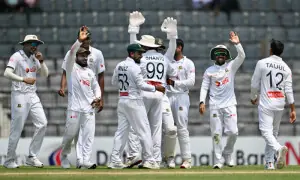
Bangladesh are three wickets away from a famous Test series win at home after spinner Taijul Islam took 4-113 to rattle Pakistan despite a rearguard by the opposition batters on Tuesday.

Pakistan ended day four on 316-7, needing another 121 runs for victory in what would be a record chase of 437 on the fifth and final day in Sylhet.

Mohammad Rizwan, on 75, and Sajid Khan, on eight, were unbeaten at the close of play.

Left-arm spinner Taijul struck key blows, including Babar Azam for 47 and Salman Agha on 71, to keep Bangladesh in the hunt for their first-ever Test series win over Pakistan at home.

Pakistan’s Mohammad Rizwan plays a shot during the fourth day of the second Test cricket match between Bangladesh and Pakistan at the Sylhet International Cricket Stadium in Sylhet on May 19, 2026. — AFP

Bangladesh, who won the opener of the two-match series, also closed in on back-to-back Test series victories over Pakistan —having whitewashed them 2-0 on Pakistani soil in 2024.

Pakistan slumped to 162-5 and were heading towards a tame defeat before Rizwan and Agha put on 134 runs to raise hopes of Test cricket’s highest chase.

Indies currently hold the record for the 418 they scored to beat Australia in Antigua in 2003, while Pakistan have never successfully chased more than 377.

Pakistan lost their overnight openers early before captain Shan Masood and Azam steadied the ship with a counter-attacking partnership that guided them to 101-2 at lunch.

Pakistan’s captain Shan Masood (R) celebrates with teammate Babar Azam (L) after scoring a half-century (50 runs) during the fourth day of the second Test cricket match between Bangladesh and Pakistan at the Sylhet International Cricket Stadium in Sylhet on May 19, 2026. — AFP

But the afternoon session shifted the momentum back in the hosts’ favour.

Bangladesh removed Azam after wicket-keeper Litton Das took a stunning catch behind the stumps off Taijul.

Nahid Rana then cleaned up Saud Shakeel with a wide yorker for just six, and Taijul snared Masood for a determined 71, with Mahmudul Hasan Joy taking a sharp catch at short leg.

Pakistan slipped to 200-5 at tea, but it was the stubborn sixth-wicket stand between Rizwan and Agha that frustrated Bangladesh.

But Taijul then deceived Agha with a well-disguised arm ball to rattle his stumps and Hasan Ali fell without scoring two overs later, caught by captain Najmul Hossain Shanto at first slip.

Rizwan and Sajid then batted out the remaining overs.

However, Bangladesh pace bowling coach Shaun Tait remained confident the side would get over the line on day five.

“I think we’ll bowl them out. I hope,” he said.

“Our guys stayed in the fight, stayed in the contest. They got on top of us for a period of time but to take those two wickets towards the end — we went into the changing rooms fairly happy.”

Pakistan batting coach Asad Shafiq said: “I have a lot of hope because of the way we responded as a batting unit today. If this partnership between Rizwan and Sajid goes long, I am very optimistic. “

  •  

In pictures: Iran stages mass weddings for couples ready for war 'sacrifice'

Iranian authorities held mass public weddings in Tehran for couples who signed up to a state-sponsored scheme declaring their readiness to sacrifice their lives in the war against the US and Israel.

The ceremonies conducted late on Monday involved hundreds of couples in several major squares in the capital, including more than 100 in the vast Imam Hossein square in central Tehran, according to reports in Iranian media.

They were broadcast on state TV in a bid to boost wartime morale, with US President Donald Trump repeatedly threatening new military action against Iran amid a shaky ceasefire which halted the fighting that began on February 28.

Those involved had signed up, according to Iranian media, for the so-called “self-sacrifice” scheme (janfada in Persian) where people pledged to put their lives on the line in the war by, for example, forming human chains outside power stations.

Iranian authorities say millions of people, including top figures such as Parliament Speaker Mohammad Bagher Ghalibaf and President Masoud Pezeshkian, have put their names forward.

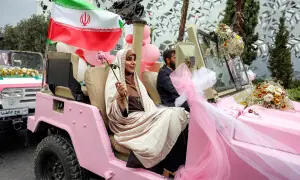
Couples arrived at the Imam Hossein square in military jeeps with mounted machine guns and were married on a stage in a ceremony presided over by a cleric, AFP images showed.

A bride and groom couple rides in a military jeep arriving for a public mass wedding ceremony at Imam Hossein Square in Tehran on May 18, 2026. — AFP
A cleric waves while riding as a groom with his bride in a military jeep as they arrive for a public mass wedding ceremony at Imam Hossein Square in Tehran on May 18, 2026. — AFP
A bride and groom couple rides in a military jeep arriving for a public mass wedding ceremony at Imam Hossein Square in Tehran on May 18, 2026. — AFP

The stage was festooned with balloons and with a giant image of Supreme Leader Ayatollah Mojtaba Khamenei, who has yet to appear in public since being elevated to the position after the assassination of his father and predecessor Ali Khamenei on the first day of the war.

A bride and groom couple rides in a military jeep arriving for a public mass wedding ceremony at Imam Hossein Square in Tehran on May 18, 2026. — AFP

“Certainly, the country is at war, but young people also have the right to marry,” one young woman in a white bridal dress, who was not named, said beside her groom in footage published by the Mehr news agency.

Bride and groom couples attend a public mass wedding ceremony at Imam Hossein Square in Tehran on May 18, 2026.  — AFP
Bride and groom couples attend a public mass wedding ceremony at Imam Hossein Square in Tehran on May 18, 2026. — AFP
A bride and groom couple attends a public mass wedding ceremony at Imam Hossein Square in Tehran on May 18, 2026. — AFP

A man in a dark suit, beside his bride-to-be, said they were happy the occasion marked the anniversary of the marriage of Imam Ali, revered by Shias, to Fatima, the daughter of Prophet Muhammad (PBUH).

“We received their blessings. Furthermore, we came to offer our best wishes to the people in the streets,” he said.

Mehr said 110 couples had taken part in the Imam Hossein square ceremony alone. The AFP images showed crowds of well-wishers clasping roses and watching on.

Since the start of the war, Iranian authorities have held major pro-government gatherings on a near-daily basis in a bid to highlight popular mobilisation amid the conflict.

Revellers attend a public mass wedding ceremony at Imam Hossein Square in Tehran on May 18, 2026. — AFP
Sparks fly as bride and groom couples arrive for a public mass wedding ceremony at Imam Hossein Square in Tehran on May 18, 2026. — AFP

Header image: A bride and group couple rides in a military jeep arriving for a public mass wedding ceremony at Imam Hossein Square in Tehran on May 18, 2026. — AFP

  •  

Thailand cuts visa-free stays, citing crime by foreigners

Thailand is drastically cutting the length of visa-free stays for tourists from more than 90 countries in an effort to curb crime involving foreign nationals, officials said on Tuesday.

Tourism is vital to the Southeast Asian nation’s economy, but foreign arrivals are yet to return to their pre-Covid highs.

A recent series of high-profile arrests of foreigners has included cases linked to drug offences, sex trafficking and foreigners operating businesses such as hotels and schools without proper permits.

Under Thailand’s current tourism scheme, travellers from more than 90 countries — including Europe’s 29-nation Schengen area, the United States, Israel and several South American countries — are eligible to visit for up to 60 days without a visa.

Thailand’s cabinet approved reducing visa-free stays for travellers from those countries on Tuesday, Tourism Minister Surasak Phancharoenworakul told reporters in Bangkok.

The new visa-free duration would be decided on a country-by-country basis, with most foreign nationals granted stays of up to 30 days, while some could receive only 15 days, Surasak said.

Foreign Minister Sihasak Phuangketkeow said last week that the plan to reduce visa-free stays was part of a crackdown on transnational crime.

Thailand was not targeting any specific country, he said, but rather individuals abusing the visa system by committing crimes in the country.

Tourists provided “benefits, such as boosting the economy, but the current scheme has allowed some people to exploit it,” government spokesperson Rachada Dhanadirek told reporters on Tuesday.

The visa-free period was previously capped at 30 days but was extended to 60 days in July 2024 as part of government efforts to boost tourism and the economy.

Tourism accounts for more than 10 per cent of Thailand’s GDP, although visitor numbers remain below pre-pandemic levels.

Foreign arrivals dropped by about 3.4pc in the first quarter of this year compared to the same period in 2025, with visitors from the Middle East down by nearly a third, according to tourism ministry data.

Thailand expects about 33.5 million foreign tourists this year, up from nearly 33m visitors last year, the government has said.

  •  

Putin trip aims to show China ties unshakeable after Trump pomp

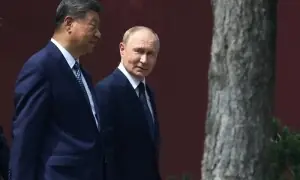
Russian President Vladimir Putin arrives in Beijing on Tuesday for talks with his Chinese counterpart and his “long-time good friend” Xi Jinping, intending to show their ties are unshakeable days after a visit by Donald Trump.

The confirmation of Putin’s trip came just hours after Trump wrapped up his visit on Friday, the first by a US president to China in nearly a decade and one aimed at stabilising their turbulent relations.

Putin and Xi are set to discuss how to “further strengthen” Russia and China’s strategic partnership and “exchange views on key international and regional issues”, according to a Kremlin statement.

Their ties have deepened since Russia’s invasion of Ukraine in 2022, with Putin visiting Beijing every year since.

Setting warm tones for the visit, the two leaders exchanged “congratulatory letters” on Sunday to mark 30 years of their countries’ strategic partnership.

Xi said cooperation between Russia and China had “continuously deepened and solidified”, according to Chinese state media.

And in a video message to the Chinese people released on Tuesday, Putin said relations have reached “a truly unprecedented level” and that “trade between Russia and China continues to grow”.

“The close strategic relationship between Russia and China plays a major, stabilising role globally. Without allying against anyone, we seek peace and universal prosperity,” Putin added, without mentioning any third country.

The two leaders are also expected to sign a joint declaration after the talks.

‘Dear, old friends’

When Putin last visited Beijing in September 2025, Xi welcomed him with open arms as an “old friend” — language the Chinese leader did not extend to Trump last week.

Putin, who in turn called Xi his “dear friend”, will be keen to show the world their relations are unaffected by Trump’s visit.

While Putin’s visit is not expected to receive the same pomp as Trump’s, “the Xi-Putin relationship does not require that kind of performative reassurance”, said Patricia Kim from the Brookings Institution in Washington.

Both sides view ties as “structurally stronger and more stable” than China-US ones, she added.

While Beijing has regularly called for talks to end the war in Ukraine, now over four years long, it has never condemned Russia for sending in troops — presenting itself as a neutral party.

Trump and Xi discussed Ukraine last week, but the US president left China without a breakthrough.

“Xi will almost certainly brief Putin on his summit with Trump,” Kim said.

The lack of clear outcomes from the Xi-Trump meeting though “likely reassures Moscow that Xi did not strike any understanding with Trump that would materially undercut Russian interests”.

Appetite for oil

Putin will be hoping for China to deepen its commitment to Moscow, after Trump told Fox News during his visit that Beijing had agreed to buy US oil to feed its “insatiable” appetite for energy.

With Russia reliant on sales to China to sustain its war effort, “Putin does not want to lose that support”, Asia Society’s Lyle Morris told AFP.

“Putin will likely be keen to hear from Xi about China’s next step in the Middle East,” added Morris, after “Trump signalled clearly that he hopes Beijing will play a leading role”.

When it comes to the US-Israeli war on Iran though, China and Russia may have different priorities.

“(China) relies on the freedom of the world’s major waterways to sustain its economic activities, and would prefer that the standoff in the Strait of Hormuz end sooner rather than later,” James Char of Singapore’s Nanyang Technological University told AFP.

On the other hand, Moscow has “been benefitting economically from the fighting in Iran due to the relaxation of sanctions against Russian energy supplies, so may have a different view”.

After meeting Xi in April, Russia’s top diplomat Sergei Lavrov said Russia could “compensate” for China’s energy shortages as the war hits global supplies.

“Expanded energy ties may feature prominently at the meeting (as) Beijing seeks more Russian energy,” said Joseph Webster from the Atlantic Council.

“From Moscow’s perspective, shipping more oil east may be more attractive in the wake of Ukraine’s relentless campaign targeting Russian energy infrastructure,” he said.

  •  
❌