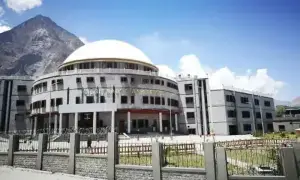
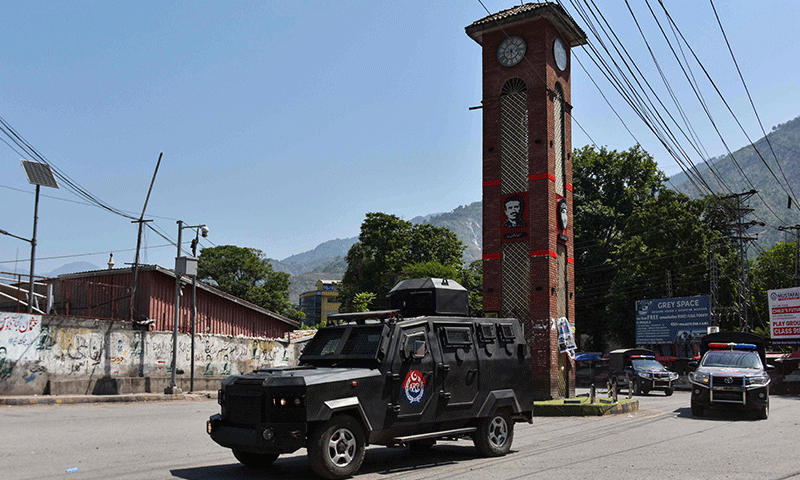
THE Gilgit-Baltistan Assembly will be elected today by the people of that region.
Yet again, themes like the region’s provincial status, the rights of its people, and ownership of its indigenous resources have headlined the run-up to the election. Each party has made many promises to the people, and they will vote today to decide whom to trust.
It is hoped that the turnout will be healthy, that the electoral process will not be hindered, and that the public’s mandate will be honoured. There are
THE Gilgit-Baltistan Assembly will be elected today by the people of that region.
Yet again, themes like the region’s provincial status, the rights of its people, and ownership of its indigenous resources have headlined the run-up to the election. Each party has made many promises to the people, and they will vote today to decide whom to trust.
It is hoped that the turnout will be healthy, that the electoral process will not be hindered, and that the public’s mandate will be honoured. There are good reasons to be wary. There have been too many similarities between the events of recent weeks and what transpired in the run-up to Pakistan’s 2024 general election.
One party’s candidates have again been expected to run without a single identifiable symbol, and its leadership has repeatedly complained of significant difficulties during poll campaigning. Other political parties, especially those in power in Islamabad, seem to have faced no such restriction. Much ink has been spilt over the need to respect the political process and to allow it to unfold organically. It can only be hoped that the announced results will reflect the will of the people.
It is important that whichever party ultimately forms the government puts the needs of the people of GB above everything else. It has been a long-running complaint that, regardless of which federal party wins the election, the GB government seems more entangled with Islamabad than in addressing the concerns of its constituents.
Considering the many promises made on the campaign trail in this regard, there will also be some expectation among the people of the region that their new government will press the question of the region’s constitutional status. This is a complicated matter, with implications that go well beyond simple governance and administration. The different aspects of this question must be reviewed and debated at length, not just in the Gilgit-Baltistan Assembly but also in both Houses of the Pakistani parliament.
However, now that the people of GB have been promised this by several prominent leaders, it should not be deferred until the next election cycle.
The region faces a unique set of challenges and constraints that must be addressed proactively. The people have the opportunity today to chart a course forward at the ballot box. It is hoped that they will make good use of it.
• Targets entire family of viruses, animal-borne strains; aims to thwart future pandemics; initial-phase trials of 39 participants succeeded; larger efficacy studies loom• Experts hail move as ‘pivotal leap’ for humanity• Approach could end need for regular flu vaccine updates
A “FUNDAMENTALLY new” vaccine designed entirely by artificial intelligence has been tested in people for the first time, in what researchers at the University of Cambridge describe as a potential breakthrough in the effort
• Targets entire family of viruses, animal-borne strains; aims to thwart future pandemics; initial-phase trials of 39 participants succeeded; larger efficacy studies loom • Experts hail move as ‘pivotal leap’ for humanity • Approach could end need for regular flu vaccine updates
A “FUNDAMENTALLY new” vaccine designed entirely by artificial intelligence has been tested in people for the first time, in what researchers at the University of Cambridge describe as a potential breakthrough in the effort to prevent future pandemics, BBC reported.
This experimental approach seeks to establish immunity against a broad range of viruses, including all known coronaviruses, rather than targeting a single circulating strain.
Traditional vaccine development typically relies on a currently circulating viral strain. However, certain viruses are adept at mutating, causing conventional vaccines to lose efficacy quickly. This is why seasonal flu and Covid shots require regular updates.
“We’re always behind,” Professor Jonathan Heeney of Cambridge told the BBC, noting his team’s goal is to reverse this dynamic. “What we’re trying to do is get ahead of the curve.”
The researchers claim it is the first time a vaccine’s key component has been designed entirely by AI and then trialled in people.
To achieve this, researchers compiled genetic codes — the biological instruction manuals — from coronaviruses documented by global surveillance programs. An AI system analysed these sequences to design a “super-antigen.” Antigens are essential components of vaccines that train the immune system to attack foreign invaders.
This super-antigen trains the immune system to defend against the entire family of viruses, providing immunity even if viruses mutate or a new infection jumps from animals to humans.
The technology is “surprising all of us”, Heeney said, adding it is “amazing what we can do with it for the good of humanity”.
“This is about making vaccines that protect us, not just from today’s viruses, but protect us from what can cause the next outbreak or disease,” Heeney said. “This is a fundamental shift in how we prepare for pandemics.”
Initial trials involving 39 participants assessed safety. A subsequent study of approximately 200 individuals will test how effectively the vaccine stimulates the immune system.
Findings published in the Journal of Infection indicated that the impact on the immune system was “modest,” yet the results continue to generate excitement.
Prof Saul Faust of the University of Southampton, who led some of the trial work, said the AI-driven approach “definitely has potential” and described it as “really exciting”.
“What’s really interesting is the technology is an awful lot better at designing vaccines for potential pandemics when viruses are changing,” he said.
While coronavirus research remains in early stages, the team is leveraging the technology to develop vaccines for other ailments. According to the report, they are conducting animal research into a universal seasonal flu vaccine to eliminate the need for annual updates. They are also developing a vaccine for the H5N1 bird flu.
Researchers are also exploring inoculations for viral hemorrhagic fevers, including Ebola species. The BBC highlighted that the ongoing outbreak in the Democratic Republic of Congo is caused by an Ebola species currently lacking a targeted vaccine.
Professor Andy Pollard, director of the Oxford Vaccine Group, who was not involved in the Cambridge study, told the outlet that the methodology is producing compelling evidence. “It’s fascinating data, and people wouldn’t have predicted they’d be able to generate these immune responses,” Pollard said.
Pollard cautioned that human trials will determine success, as human immune systems differ from those of laboratory mice. Broadly, Pollard characterised AI as a “game changer” for vaccine research, predicting it will accelerate development and “save lives”.
Professor Marian Knight, scientific director for the National Institute for Health and Care Research, described the trial as a “pivotal leap forward in our ability to deliver broad, lasting viral protection”.
“Another British science success story, this is a great example of how we can bring our research expertise together with AI to deliver new treatments,” UK’s Science Minister Lord Vallance said. “With the first human trials showing positive results, this work could help speed up the rollout of vaccines to benefit people all over the world for the long term.”
THE people of Gilgit-Baltistan joined Pakistan at the time of independence after liberating the region from Dogra rule. It was a unanimous aspiration to become part of the Muslim state.
Assuming the relationship would be formalised through constitutional inclusion and political empowerment, GB’s people aligned themselves with mainstream Pakistani political parties, unlike Azad Kashmir, where indigenous political parties continued to play a significant role.
Unfortunately, instead of the evolutio
THE people of Gilgit-Baltistan joined Pakistan at the time of independence after liberating the region from Dogra rule. It was a unanimous aspiration to become part of the Muslim state.
Assuming the relationship would be formalised through constitutional inclusion and political empowerment, GB’s people aligned themselves with mainstream Pakistani political parties, unlike Azad Kashmir, where indigenous political parties continued to play a significant role.
Unfortunately, instead of the evolution of a locally rooted political architecture or democratic compact specific to GB, governance came to be dominated by the PML-N, PPP and PTI, who viewed GB through the lens of national power politics, strategic utility, electoral expansion, patronage and resource control, rather than genuine political empowerment. Consequently, while there are elected governments, there’s no meaningful self-governance.
The first problem is the absence of a consistent ideological commitment by these parties to resolving GB’s constitutional status. Promises of autonomy, reforms and provisional provincial status are repeatedly made during elections, but not one party has delivered on their pledge when in federal power. The unresolved constitutional ambiguity serves the interests of centralised authority because it allows decisive control without assuming full constitutional obligations.
A second problem is the import of a confrontational mainland political culture into a socially sensitive and geographically isolated mountain society. Politics has become polarised around loyalties to party leadership in Islamabad. Local leadership often emerges not through grassroots struggle or public legitimacy, but patronage networks, loyalty to party centres and access to federal power. This weakens local institutions and stymies independent political consensus.
The PPP introduced the 2009 Gilgit-Baltistan Empowerment and Self-Governance Order, which created the current political structure. However, while the order established elected institutions, overriding authority remained concentrated within federally controlled structures. The PML-N focused on infrastructure and connectivity projects, but made little attempt at meaningful local empowerment.
The party was reluctant even to take ownership of the Sartaj Aziz Committee’s report because it recommended full constitutional rights for GB. (It also provided the intellectual basis for the Supreme Court’s landmark 2019 judgement.) Instead, the PML-N’s 2018 order diluted the spirit of the report and even rolled back several powers granted under the PPP’s 2009 framework.
People in Gilgit-Baltistan take part in elections and form governments, but the real levers of power are not in their hands.
The PTI raised expectations by discussing provisional provincial status and constitutional reforms. However, when proposals concerning fuller constitutional status were presented, the party effectively ensured the continuation of the restrictive 2018 governance framework.
All three parties converge on several core goals: maintaining political influence through patronage networks; using local elites dependent on federal authority; preserving centralised control over strategic geography and resources; avoiding a final constitutional settlement; expanding bureaucratic structures that cultivate political loyalties.
The result is a political culture in which elections become contests for access to state patronage rather than serious debates on constitutional rights, fiscal autonomy, institutional reform, environmental sustainability, or long-term development.
Another major impediment is the fragmentation of local political consciousness. Federal parties often exploit regional, sectarian, clan-based and constituency-level divisions for electoral advantage. The resulting divisions weaken the possibility of a unified political position capable of negotiating collective rights. Frequent shifts in political loyalty have normalised a culture in which the political process resembles an auction for legislative support.
The result is a paradoxical system. People participate in elections, elect representatives and form governments, yet the real levers of power remain externalised. The assembly administers limited local matters, while strategic decisions, constitutional questions, resource frameworks and fiscal dependency are controlled from elsewhere. Roads, contracts, bureaucratic appointments and symbolic projects dominate political discourse, while deeper questions of political dignity, resource ownership, etc, remain unresolved.
GB’s long-term challenge is to develop an indigenous political vision capable of transcending externally driven party competition. Such a vision must articulate demands for accountable governance, constitutional clarity, economic justice and genuine participation in decision-making.
Ultimately, GB’s tragedy lies not merely in flawed governance, but also in the normalisation of a political charade. Every five years, elections are held under a constitutionally undefined framework that changes governments without altering the actual structure of power. The process is at its core a ritualistic transfer of authority among federally controlled political actors while fundamental questions of constitutional status, political rights, institutional accountability, etc, remain unresolved.
This ambiguity facilitates elite capture through a flawed political system that enables control over local resources without meaningful accountability. Public resources continue to be consumed by expanding bureaucratic structures, patronage networks and non-development expenditures.
More troubling is the ill-defined governance structure in which critical decisions, including appointments to senior judicial and institutional positions, are made through opaque processes. Such a system effectively guarantees immunity for unaccountable decision-makers, while ordinary citizens continue to bear the burden of weak institutions, unemployment, and political uncertainty. This has reduced Sunday’s election to an exercise in futility.
Yet beneath this stagnant order, a transformation is taking place. A new generation is emerging in GB — educated, technologically connected, politically conscious and unwilling to accept symbolic representation in place of genuine rights and participation. This rising Gen Z, perhaps the most educated and politically aware generation in GB, may ultimately challenge the cycle of constitutional ambiguity and political misgovernance.
No political structure built upon perpetual ambiguity, exclusion and managed dependency can endure indefinitely. If meaningful constitutional reform, institutional accountability, and genuine empowerment are delayed further, we will witness not merely political dissatisfaction, but also a far more assertive and organised demand for full meaningful constitutional integration with Pakistan, irrespective of competing political and strategic considerations.
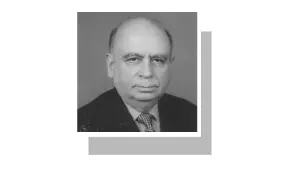
The writer, a former IGP Sindh, belongs to Gilgit-Baltistan.
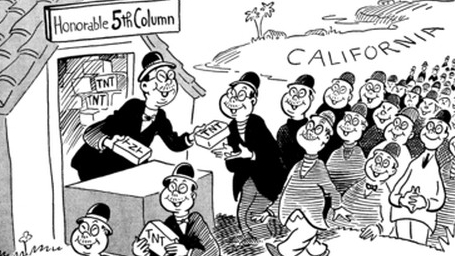
Can a prestigious institution with ties to a famous alum reconcile that relationship with the man’s racist past? Theodore Geisel, Class of 1925, is a Dartmouth alumnus whose children’s books and campus namesake sit alongside racist imagery, a contrast that raises questions about legacy and accountability. Madeline Kahn Ehrlich for The Dartmouth comes to grips […]
Can a prestigious institution with ties to a famous alum reconcile that relationship with the man’s racist past? Theodore Geisel, Class of 1925, is a Dartmouth alumnus whose children’s books and campus namesake sit alongside racist imagery, a contrast that raises questions about legacy and accountability. Madeline Kahn Ehrlich for The Dartmouth comes to grips […]
OBSERVERS across the world have long questioned the utility of Donald Trump’s now three-month-old war on Iran. But a growing number of voices from within the US president’s Republican party are saying that this futile and illegal conflict must end. A resolution calling for the withdrawal of US troops from Iran passed narrowly in the Republican-controlled House of Representatives recently, with four members of the US leader’s own party backing the resolution.
The move has expectedly incensed Mr T
OBSERVERS across the world have long questioned the utility of Donald Trump’s now three-month-old war on Iran. But a growing number of voices from within the US president’s Republican party are saying that this futile and illegal conflict must end. A resolution calling for the withdrawal of US troops from Iran passed narrowly in the Republican-controlled House of Representatives recently, with four members of the US leader’s own party backing the resolution.
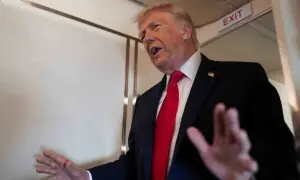
The move has expectedly incensed Mr Trump, who called it “unpatriotic”. Since the start of the war, most American lawmakers had only mildly been criticising the joint US-Israeli attack on the Islamic Republic. But now, with US mid-term elections in November inching closer, both Republican and Democratic lawmakers want to avoid the voters’ wrath at the ballot box.
Like people around the world, Americans are also paying high prices at the petrol pump and rising energy prices have sparked a global spike in inflation. Many Americans are rightly asking why they are paying the price — in blood and treasure — to protect Israeli militarism.
Moreover, the feeling that this misadventure must be brought to a close echoes across the American political spectrum. For example, House Democrats have called for an end to the “deeply unpopular and illegal war of choice”, while many conservative Republicans, including the MAGA wing, have lashed out against getting tangled in another ‘forever’ war. Only Israel and its hard-line Zionist supporters in the US have an interest in keeping the Iranian front open. Most other people of the world, including level-headed Americans, want a swift end to the war.
But the problem is that Mr Trump does not seem to have a workable game plan to extricate himself from this quagmire. For three months, he has been unable to bring to heel a militarily and economically much weaker foe. It was clear from day one that this mission was doomed to fail, and the reasons for attacking Iran kept changing. At times it was said that the Islamic Republic was being punished for its supposed crushing of internal dissent, at others it was to keep the world ‘safe’ from the Iranian nuclear ‘threat’.
All of these were flimsy pretexts for what was in reality an imperial mission to punish an unyielding foe, and forward the Israeli agenda for perpetual regional chaos. Mr Trump must listen to what his own lawmakers are saying. Instead of further escalation, he should, in all earnestness, work towards reaching a long-term ceasefire with Iran that Pakistan and other regional states are pushing for.
The deal must promise respect for sovereignty of all regional states, while all the Gulf’s littoral states should work together for a mutual security agreement without the interference of outsiders.
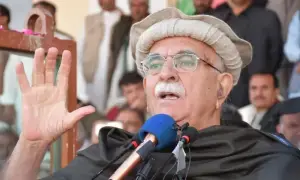
QUETTA: Police have registered a case against Opposition Leader in the National Assembly and PkMAP Chairman Mehmood Khan Achakzai, on charges of allegedly spreading hatred against state institutions and criticising the present government while addressing a public gathering.
Other party leaders have also been named in the FIR. The charges relate to an allegedly provocative speech made against state institutions.
The action was taken following a written complaint submitted by Abdul Wali Khan, son
QUETTA: Police have registered a case against Opposition Leader in the National Assembly and PkMAP Chairman Mehmood Khan Achakzai, on charges of allegedly spreading hatred against state institutions and criticising the present government while addressing a public gathering.
Other party leaders have also been named in the FIR. The charges relate to an allegedly provocative speech made against state institutions.
The action was taken following a written complaint submitted by Abdul Wali Khan, son of Abdul Ghaffar Khan, a member of the Shinzai tribe and a resident of Gulistan Kari.
According to the FIR registered at Gulistan Police Station, the complainant stated that, during a public meeting, Achakzai allegedly said that law and order in Balochistan continued to deteriorate and that the current government had completely failed to provide security to the public.
He allegedly described the government as a “Form-47 fake government” and proposed the formation of an alternative force by recruiting people from various tribes in competition with the Pakistan Army.
The FIR further alleged that the accused encouraged people across Pakistan to become Afghan proxies, thereby attempting to create hatred and unrest between state institutions and the public.
Acting on the complaint, police registered a case against Mehmood Khan Achakzai and others under Sections 153, 505, 131, 341, 147, and 149 of the Pakistan Penal Code, as well as under the Balochistan Sound System Regulation Act, 2016.
The wife of a Lebanese army captain, who was killed by Israeli bombardment, salutes as mourners carry her husband’s coffin at his home village in southern Lebanon.—AFP
• Woman, child among 12 killed in attacks on Zifta, Tyre• Beirut counts 3,491 Israeli strikes since April 17; fresh bombardment damages Unesco heritage site• Hezbollah denies contact with Trump
BEIRUT: An Israeli strike on southern Lebanon killed 12 people on Monday as Lebanese Defence Minister Michel Menas
The wife of a Lebanese army captain, who was killed by Israeli bombardment, salutes as mourners carry her husband’s coffin at his home village in southern Lebanon.—AFP
• Woman, child among 12 killed in attacks on Zifta, Tyre • Beirut counts 3,491 Israeli strikes since April 17; fresh bombardment damages Unesco heritage site • Hezbollah denies contact with Trump
BEIRUT: An Israeli strike on southern Lebanon killed 12 people on Monday as Lebanese Defence Minister Michel Menassa revealed Israel has carried out nearly 3,500 air strikes since a US-brokered ceasefire took effect in April.
The Lebanese health ministry said the dawn raid on the town of Zifta in the Nabatieh district resulted in seven deaths, including a Syrian child and a woman, and wounded eight others.
Meanwhile, an Israeli strike on Tyre in southern Lebanon on Monday killed five people and wounded eight, the health ministry said, as Israel said it would continue strikes despite Iranian threats.
“An Israeli enemy raid on the city of Tyre, near the Red Cross centre, resulted in five martyrs and eight wounded, four of whom were Red Cross paramedics,” the ministry said in a statement.
The continuing violence underscores the fragility of the ceasefire that came into effect on April 17.
Nearly 3,500 Israeli attacks
During a cabinet meeting on Monday, Menassa said that between April 17 and June 7, Israel conducted 3,491 air strikes, 407 controlled demolitions and six razing operations, flattening entire villages in southernmost Lebanon.
PM Nawaf Salam said the escalation has caused additional waves of displacement. More than 1 million people have been displaced and over 3,600 killed since Hezbollah drew Lebanon into the conflict on March 2 with rocket fire at Israel to avenge the US-Israeli killing of Iran’s supreme leader.
The heavy bombardment in Tyre also damaged a Unesco World Heritage site. Ali Badawi, the culture ministry’s regional director of archaeological sites for south Lebanon, said Sunday’s bombardment had “the worst impact” on Tyre’s ancient areas since the war began. “The amount of debris and damage at the site is high,” Badawi said. “Some archaeological artefacts were damaged when rubble fell on them, as debris fell over a large area, impacting a large number of elements at the site — columns, capitals, column bases, mosaics.”
Tyre’s ruins include Roman baths, a second-century triumphal arch and a hippodrome. Lebanese Culture Minister Ghassan Salame appealed to protect the sites, charging that Israel “does not respect” the Hague Convention on the Protection of Cultural Property.
‘No contact with Trump’
Amid the ongoing conflict, a senior Hezbollah official denied statements from US President Donald Trump suggesting the two sides had communicated.
Senior Hezbollah official Mahmud Qomati said in written remarks that “there has been no direct contact between President Trump and Hezbollah officials”.
Trump told reporters last Wednesday that “we actually spoke with Hezbollah for the first time, ever,” and later claimed he had a “very good call” with the group through highly placed representatives.
A DEMOCRACY needs an effective parliament. Has Pakistan’s parliament lived up to this responsibility? The evidence suggests it hasn’t. Parliament has underperformed. It has acted as little more than a rubber-stamp for the present government. This reflects a broader trend of democratic erosion in the country in recent years.
Several reports offer telling insights into parliament’s functioning. The most recent was released last week by a civil society organisation. It records the low attendance of
A DEMOCRACY needs an effective parliament. Has Pakistan’s parliament lived up to this responsibility? The evidence suggests it hasn’t. Parliament has underperformed. It has acted as little more than a rubber-stamp for the present government. This reflects a broader trend of democratic erosion in the country in recent years.
Several reports offer telling insights into parliament’s functioning. The most recent was released last week by a civil society organisation. It records the low attendance of members of the National Assembly in its proceedings.
According to Fafen (Free and Fair Election Network), only 20 per cent of MNAs attended all sittings of the Lower House in the 27th session in May. Thirty-three members did not show up for any sitting. The prime minister was absent from all nine sittings as were some ministers. The leader of the opposition, however, attended all of them. As many as 267 members out of 333 skipped at least one sitting of the session.
An earlier report by Pildat (Pakistan Institute of Legislative Development and Transparency) evaluated the National Assembly’s performance in the parliamentary year March 2025 to February 2026. It also found low attendance by members. The report pointed out that the Assembly’s lack of quorum was raised 19 times, with eight sittings adjourned due to the absence of members. Despite this low and declining engagement by MNAs, the ruling party has made no effort to address the recurring problem of empty benches.
Attendance is not the only indicator of parliamentary conduct. What matters most is how it performs its legislative and deliberative functions. This is arguably the most unedifying aspect of its performance. It is due principally to the attitude of the government, which enjoys a simple majority in the Assembly, but with its ally, the PPP, it has a two-thirds majority. The way constitutional amendments have been bulldozed through parliament in the past two years is a striking illustration of its attitude to parliamentary institutions.
A parliament that doesn’t assert itself surrenders its authority to others.
In 2024, when parliament adopted the 26th Constitutional Amendment, it was done in the darkness of night. Even the final text was not made available to lawmakers before it was tabled. The entire legislative process lacked transparency. It was over in hours, without any debate on an amendment of far-reaching implications for judicial independence. The controversial amendment made the judiciary subservient to the executive and seriously undermined the rule of law. Official coercion to secure the required two-thirds vote robbed the entire process of legitimacy.
The adoption of the 27th Constitutional Amendment in November 2025 followed a similar path. It was passed in just a couple of days. There was hardly any debate other than some speeches from treasury benches during which the opposition walked out. The amendment struck at the heart of the Constitution. It involved structural changes in the country’s judicial system including the creation of a Federal Constitutional Court, restructuring of the military high command and grant of sweeping constitutional privileges and immunities to key officeholders.
It sparked intense public controversy and evoked much criticism from the opposition, legal community, media and civil society. It was widely seen as another power grab by the executive. But again, the government rushed through the process. Treasury members and their allies made no effort to press for a full debate.
Another controversial bill, rushed through the NA in January 2026, was the Elections (Amendment) Bill. This limited public access to MPs’ asset statements by granting discretionary power to the Assembly Speaker or Senate chairman to withhold disclosures on unspecified ‘security grounds’. Opposition objections were cast aside to a law that undermined the principle of accountability of parliamentary members. These examples show how parliament has acted as a handmaiden of the executive. It has rubber-stamped actions that aggrandised the establishment’s powers.
As it is the majority party that sets the tone and substance for parliamentary activity, its stance is the principal reason for turning this Assembly into a passive and largely ineffective body. The PML-N leadership sees parliament as a means to maintain its party in power rather than as an instrument of governance or forum to articulate and debate policy. As in its previous stints in government, the party has not encouraged the Assembly to play an active role in both its legislative and deliberative functions.
With its majority, the ruling party should not be reluctant to encourage open parliamentary debate and allow members to freely deliberate on national issues. But it doesn’t see the value of parliamentary debate. It also doesn’t recognise the utility of parliament as a forum to ventilate opinion, change opinion and share opinion. Whether this reflects lack of confidence in its own backbenchers or understanding of how parliament should function, the outcome is marginalisation of the legislature’s role in the political system.
The PPP has also contributed to this outcome by not pushing for debate on key national and foreign policy issues or insisting that constitutional amendments should be deliberated upon and not rushed through the two chambers. As for the opposition, it has had to face incessant obstacles put in its path by an authoritarian set-up.
Even so, it has tried to generate pressure for debate and subject government actions to critical scrutiny. But its frequent walkouts and boycotts, albeit in protest against efforts to muzzle its voice, have proven to be counterproductive. It has left the field open for treasury benches to do whatever they want.
Parliament is as good as its members. Many are adept in constituency politics and are products of a culture of patronage. For them, a seat means a ticket to an elite club and access to state resources to shore up their local power base. Attendance is secondary and policy debates of little interest. The result is weak parliamentary oversight of executive actions.
Elected representatives repeatedly declare their commitment to parliamentary supremacy. But they are unwilling to lend substance to these pronouncements by their actions. Supremacy becomes a talking point, not a rulebook. A parliament that doesn’t assert itself surrenders its authority to others. A hollowed House does no service to democracy.
The writer is a former ambassador to the US, UK and UN.
THE federal budget is rightly bemoaned as a futile exercise. The space available for anything particularly creative — meaningfully redistributive or growth-enabling — is extremely limited. Instead, nearly every budget of the last decade and a half has been an exercise in managing the fiscal deficit under an IMF programme. Once that’s accounted for, the remaining scraps are distributed as largesse mostly between different arms of the state (and those close to those arms).
Every sitting government
THE federal budget is rightly bemoaned as a futile exercise. The space available for anything particularly creative — meaningfully redistributive or growth-enabling — is extremely limited. Instead, nearly every budget of the last decade and a half has been an exercise in managing the fiscal deficit under an IMF programme. Once that’s accounted for, the remaining scraps are distributed as largesse mostly between different arms of the state (and those close to those arms).
Every sitting government can, with some merit, claim to be the inheritor of a particularly bad situation. That this extractive revenue appetite is dictated by long-standing issues not of its own creation. That ballooning debt has to be serviced and for that more revenue is an inescapable necessity. That the luxury of pursuing growth does not exist, especially when the IMF looms large. That the straitjacket imposed by entrenched economic dysfunction cannot be thrown off so easily.
This would be an evadable charge if it’s a party’s first time in government. But if time spent as the face of the federal government lies in the double digits, perhaps some reflection and accountability are merited.
Stretching back to the previous assembly, this will be the current dispensation’s fifth straight budget (under three different finance ministers). Surely that’s enough time to muster some creativity and some resolve to escape the so-called straitjacket. Yet all one can fear is a familiar accounting exercise that aims to extract a few more rupees from a narrow, weary economic base.
All one can fear is a familiar accounting exercise that aims to extract a few more rupees from a narrow, weary economic base.
Within this base, it’s worth remembering that the vast majority of people are already reeling from a fresh cost-of-living crisis triggered by the imperialist war on Iran. With pump prices still at least 40 per cent higher than their pre-war base, and with second-order effects of pricier oil impacting at least 25pc of household spending, any further increase in the tax burden will be nothing short of disastrous.
On the income tax front, the salaried segment has already been recast as a pliant, low-effort source of nearly half a trillion rupees annually. Those below the threshold who can’t be milked through this mechanism are still paying through the sales tax and petroleum levy net. The latter two in particular remain regressive in their incidence and impact.
At a time when inflationary pressures have rendered real income growth stagnant for almost a decade, the increased direct and indirect tax burden represents an additional constraint on consumption. One hears plenty of stories of households actively downgrading their lifestyles under mounting financial pressure. Small car owners switching down to motorbikes; children being pulled out of category A or B schools and being sent to smaller, lower-cost ones. Spending on leisure making way for just the basic essentials.
To counter these anecdotes, some officials and government partisans often respond by pointing out pockets of high consumption in major urban centres. Look at all the jam-packed restaurants. Look at all the footfall in shopping malls. Look at all the new specialty coffee shops opening not just in Lahore, Karachi and Islamabad, but also apparently in Faisalabad and Gujranwala.
All of this is meant to do two things — the first is to undercut the story of economic hardship that depressing anecdotes (and the actual consumption surveys) tell us. The second thing is to provide a comforting story of economic progress that somehow exists beyond the data. For this reason, the notion of the informal economy is often trotted out — Pakistan may be ‘officially’ poor, but unofficially it’s doing much better.
There are two things wrong with this approach. The first is that it assumes that the informal economy somehow shows distributional patterns different from the formal economy. Yes, like in any developing country, there is a small segment of privileged high earners who can eat at restaurants and drink matcha. And yes, some of their income will be undocumented and derived from the informal sector.
However, this segment is small in relative terms. Pakistan just happens to be a very populous country. The top 1pc would still constitute 2.5 million people; a number large enough to occupy tables and shops in a few commercial localities in the top three to four cities of the country.
At the other end, the vast majority of those working in the informal sector are scrambling to meet basic subsistence requirements. There is no major accumulation taking place, no pockets being lined, and certainly not enough being made to contradict the poverty and hardship that recent survey accounts categorically reveal.
The second problem is that if one takes the ‘hidden prosperity’ argument at face value, it raises a far more serious question about the government’s ability to tax its citizens fairly. If undocumented wealth and high-end consumption driven by the informal economy are to be cited as proof of economic progress, then there is no good reason why more effort should not be directed at bringing them into the tax net with a view to easing the burden on those already ensnared.
On that front, somehow the government repeatedly throws its hands up in meek despair, sustaining unearned privileges of various elites and the tax avoidance and evasion of specific lobbies (such as large retailers and wholesalers).
In my view, if the budget is nothing other than an exercise in managing revenue, then there are only two metrics worth evaluating it on: to what extent does the government intend to cut down on its own waste and stop diverting resources towards improving the quality of life of its officials at the expense of the larger population? And to what extent is it spreading the burden outside a small formal sector and the hapless working Pakistanis currently caught in an extractive withholding and indirect tax regime?
The writer teaches politics and sociology at Lums.
• Clashes with law enforcers reported as rallies from various parts of region attempt to converge on Muzaffarabad• Several feared dead, two cops among scores injured• PM Rathore urges a return to talks• Five held from Muzaffarabad on suspicion of ‘links to foreign agencies’
MUZAFFARABAD: Parts of Azad Jammu and Kashmir (AJK) remained in the throes of a crippling shutter-down strike on Tuesday, which was punctuated by clashes between law enforcers and supporters of the recently-proscribed Joint A
• Clashes with law enforcers reported as rallies from various parts of region attempt to converge on Muzaffarabad • Several feared dead, two cops among scores injured • PM Rathore urges a return to talks • Five held from Muzaffarabad on suspicion of ‘links to foreign agencies’
MUZAFFARABAD: Parts of Azad Jammu and Kashmir (AJK) remained in the throes of a crippling shutter-down strike on Tuesday, which was punctuated by clashes between law enforcers and supporters of the recently-proscribed Joint Awami Action Committee (JAAC).
The AJK government has issued orders to initiate sedition proceedings against two JAAC figures, and also announced a Rs10 million reward for information leading to the arrest of four of the group leaders.
At the same time, AJK Prime Minister Faisal Mumtaz Rathore urged a return to the negotiating table in a bid to end the tensions that have gripped the region over the past few days.
The clashes occurred when protesters from different areas of Mirpur division, comprising Mirpur, Bhimber and Kotli districts, took out rallies in line with the JAAC’s plan, envisaging a long march towards neighbouring Poonch division, en route to Muzaffarabad.
In the lakeside city of Mirpur, hundreds gathered outside the Quaid-i-Azam Cricket Stadium. They later began marching towards Plaak bridge, where they were reportedly joined by another rally from Dadyal, led by Khawaja Mehran Arshad at the border of Kotli district.
On the outskirts of Mirpur, two policemen and some protesters were injured in a brief clash in Pind Sabharwal village, an official said.
However, most violent clashes took place in Kotli city, after a procession of hundreds arrived there from Khuiratta tehsil. Though officials remained tight-lipped, residents and members of the AJK cabinet told Dawn — on condition of anonymity — that several people, including a doctor and a woman, were killed and scores of others wounded in the clashes.
According to initial reports, the doctor was on the roof of his home when he was hit by a stray bullet.
The strike and the ongoing closure of internet and mobile data services in the region has made it difficult to obtain real-time information from AJK.
Earlier in the day, all cities, towns and villages across AJK observed a complete shutter down strike. Even the banks, medical stores and bistros were closed and public and private transport off the roads.
However, in many areas motorcycles and a few private cars were occasionally seen moving through the streets without any disturbance.
In Muzaffarabad – the ultimate destination of protesters – riot police had taken positions in and outside government buildings and main thoroughfares to meet any eventuality. However, the capital remained completely calm on Tuesday.
Meanwhile, the AJK legal fraternity boycotted judicial proceedings on a call by the AJK Bar Council, to protest the alleged arrest of senior lawyer Amjad Ali Khan, a core member of the JAAC.
Action against JAAC leaders
The AJK government issued orders to initiating sedition proceedings against JAAC leaders Shaukat Nawaz Mir, resident of Muzaffarabad, and Mehran Arshad Khawaja, resident of Mirpur.
A notification issued by the AJK Home Department accused both leaders of committing “sedition through their speeches, written material, videos and audios”.
The government has issued instructions to the Mirpur and Muzaffarabad senior superintendents of police (SSPs) under Section 196 of the Code of Criminal Procedure (CrPC) to review the available records/materials.
It also directed the SSPs to register a case against Mir and Khawaja, and submit a charge-sheet in court after completing the investigation.
The two men were also among a group of four JAAC figures for whom ‘head money’ of Rs10m was announced.
“The president of Azad Jammu & Kashmir has been pleased to fix Rs10m reward money to be granted to any person who provides information leading to the successful arrest of the following offenders belonging to the proscribed JAAC,” said another notification.
Those named in the notification include Shaukat Nawaz Mir, Umar Nazir Kashmiri, Khawaja Mehran Arshad and Sardar Aman Khan.
Five held over ‘suspicious links’
According to the state-run Associated Press of Pakistan, law enforcement agencies arrested five suspects in an intelligence-based operation, seizing laptops, mobile phones, and various communication devices.
During interrogation, information provided by one of the detainees led to the recovery of a large cache of arms, including seven automatic weapons, multiple grenades, and other military hardware.
According to APP, investigators have uncovered evidence pointing to their alleged contact with hostile foreign intelligence agencies.
‘Find a way out’
In a post on X, the AJK premier reiterated his call for the issue to be resolved through talks.
“Please come back to the negotiating table. I’m requesting everyone on daily basis to resolve matters through discussions instead of fire and blood,” Rathore wrote on X.
He added that the protesters’ “abusive comments, constant threats and senseless agitation” were not helpful to anyone in AJK.
“A political activist without the ability to debate and negotiate is like a pilot without the ability to fly an airplane. They both end up causing hurt and damage to people behind them,” the PPP leader remarked.
“Everyone recognises your rights and liberties,” the AJK PM assured, stressing that both sides needed to “remain calm and find a way out through talks”.
“The only weapon a political activist carries is his reasoning and negotiation skills,” he said.
Rights bodies concerned
Human rights watchdog Amnesty International expressed concern over the violent and sweeping crackdown on protests - including an internet shutdown, mass arbitrary arrests, and deadly use of force – and called on the authorities to take immediate steps to deescalate the situation.
Separately, the Human Rights Commission of Pakistan (HRCP) said it was “deeply concerned by the escalating confrontation” in AJK and the loss of life among both protesters and law enforcement personnel.
• Budget delay exposes Centre-province fiscal deadlock• NFC shares may be frozen under budget pressure• Critics say Centre ignores revenues kept outside divisible pool• Experts blame fiscal crisis on low tax collection, debt, federal spending• Raza Rabbani warns of phased rollback of 18th Amendment, NFC Award
WHEN Finance Minister Muhammad Aurangzeb rises to present his third budget, the usual questions will apply. Which sectors face fresh taxation? Will the salaried class get any relief? How mu
• Budget delay exposes Centre-province fiscal deadlock • NFC shares may be frozen under budget pressure • Critics say Centre ignores revenues kept outside divisible pool • Experts blame fiscal crisis on low tax collection, debt, federal spending • Raza Rabbani warns of phased rollback of 18th Amendment, NFC Award
WHEN Finance Minister Muhammad Aurangzeb rises to present his third budget, the usual questions will apply. Which sectors face fresh taxation? Will the salaried class get any relief? How much will the cost of living increase? Who will get tax benefits, and who will not?
But this year, there is an additional dimension worth watching closely. Will the budget clip provincial finances? Will the Centre freeze provincial shares under the current National Finance Commission (NFC) arrangement and push fresh expenditure obligations onto provinces — over and above their existing requirement to produce a primary surplus?
If it does, it would amount to a unilateral revision of the NFC arrangement through the back door of the budget.
When parliament adopted the landmark 18th Amendment in 2010, it was meant to settle a long-running devolution dispute between the provinces and the Centre. The 7th NFC Award corrected decades of fiscal imbalance, giving smaller provinces — particularly Balochistan and Khyber Pakhtunkhwa — a larger stake in national revenues. It was a moment of rare political consensus. Fifteen years on, that settlement is being unravelled: not through a constitutional amendment or fresh consensus, but through pressure and demands that provinces simply hand the money back.
The announcement of Budget 2026-27 has been postponed twice as the Shehbaz Sharif government, its coalition partners and provincial governments struggle to agree on the Centre’s demand for additional funds of more than Rs1.2 trillion for strategic needs. The National Economic Council meeting, last called for June 9, was postponed for the fourth time amid continuing negotiations over the federal demand to freeze provincial shares in the federal tax divisible pool.
Former Pakistan chief economist Rashid Amjad called it a potential tragedy. “That [7th Award and 18th Amendment] is the best thing which has happened to Pakistan; it empowers provinces and strengthens the federation. They say they want to decentralise powers but they don’t want to give up power in the federal government,” he said.
‘Precarious situation’
Whatever is known about the contours of the federal government’s demand mostly comes from Muzzammil Aslam, finance adviser to the PTI government in KP, as the ruling PML-N and its principal coalition partner continue their discussions behind closed doors.
Aslam says the Centre told provinces their financial shares under the NFC for the current year would not be increased next year, and that any amount above the current year’s share would have to be returned to the Centre. This demand comes over and above the Rs1.95 trillion cash surplus that provinces have already committed under the National Fiscal Pact pushed by the IMF.
Aslam warned the move would push provincial budgets into deficit. “I have not seen such a precarious situation in the past 21 to 22 years that I have been following budgets,” he told journalists after a meeting with a federal team led by Planning Minister Ahsan Iqbal.
He acknowledged that “the demand for the strategic purpose is not unjustified and is in the national interest, but Sindh and Punjab will have to show generosity.” He also noted that the matter was beyond the KP government’s powers and required consultation with jailed PTI leader Imran Khan before any decision could be taken.
On the constitutional bar on reducing provincial NFC shares during a fiscal year, Aslam said there was no clear answer on the table — though the Centre perhaps intended to transfer funds to provinces and then seek their return, a workaround that raises serious questions of its own. As he put it, “everybody is standing on their toes” to find a solution, with no way forward yet in sight.
Also worth watching will be the PPP: what concessions it is willing to give, if any, and in exchange for what. Many believe the party has little room to refuse in the current political dispensation, with the coalition watching each move closely.
NFC rollback?
Proponents of the current NFC arrangement argue that the Centre’s posture did not emerge overnight. For years, Islamabad has pushed the narrative that the 7th Award — which hands 57.5 per cent of revenues to provinces — is the primary driver of its fiscal distress, leaving it unable to service debt, fund defence or complete strategic projects.
Critics say this narrative is built on selective accounting. By expanding non-shareable levies over the years, the federal government has quietly grown its own fiscal base while publicly lamenting its diminished share. “GST was replaced by a levy on petroleum products precisely so it wouldn’t go into the divisible pool. If it had remained GST, it would have had to be divided with the provinces,” said Ali Salman of the Policy Research Institute of Market Economy (PRIME).
A former Punjab finance secretary was equally blunt: “The NFC Award did not create the fiscal crisis; it inherited one. Debt and FBR dysfunction had crept into this system decades before provinces received a rupee more. Massive currency devaluation in recent years worsened this crisis. None of that has anything to do with how the divisible pool is split.”
Amjad identified the real squeeze. “When you are in an IMF programme, there are very strict macro-framework restrictions under which you work,” he said, adding that the government had compounded its difficulties by entering conflicts on multiple fronts simultaneously, driving federal expenses upward. “The only way you can square the circle is for provinces to take on more of the federal expenditures and run bigger surpluses.”
Salman noted that while the federal government bears a disproportionate fiscal burden, the revenue failure is shared. The NFC Award had set a target of bringing the tax-to-GDP ratio to 15 per cent within five years — a target the Centre never achieved, and one provinces did little to support either. “The abysmally low tax-to-GDP ratio of around 10pc is the core of the problem,” said Amjad. “The federal government must curtail its expenditures if it can’t raise tax revenues.”
Radical solutions?
Veteran PPP leader Raza Rabbani, who played a key role in building consensus on the 18th Amendment, warned that the Centre’s moves amounted to a gradual undoing of the constitutional order established in 2010. “They are rolling back the amendment in phases, and simultaneously the NFC Award, instead of reducing their own expenditure,” he said.
He pointed to devolved ministries still operating at the federal level as an obvious starting point, and called for cuts to civil bureaucracy perks. If the federal government was unwilling to take those steps, Rabbani proposed a more radical solution: hand over tax collection entirely to provinces, place federal expenditure before the Council of Common Interests, and have provinces contribute a proportionate share. “If they can’t put their own house in order, then they should stop tax collection altogether,” he said.
Rabbani reserved his strongest words for what he described as unprecedented IMF interference. “Based on my experience in politics, the level of IMF dictation regarding the budget is unlike anything I have seen before. This degree of micro-management of budget targets by the IMF is unprecedented,” he said, adding that the new fiscal targets being imposed on provinces also originated with the fund. “If parliament is to simply rubber-stamp an IMF budget, that is a different matter altogether.”
Whether provinces will ultimately cover the fiscal hole for Islamabad — and whether the Centre can build the consensus it needs — remain the central questions hanging over this budget season.
• Rs4.7tr federal, provincial development plans may be revised• Federal PSDP may rise above Rs1.3tr; provincial ADPs could be trimmed• Mega projects face major cost, time overruns
ISLAMABAD: The National Economic Council (NEC) is set to meet on Monday (today) and may revise federal and provincial development plans worth Rs4.715 trillion for the next fiscal year amid conflicting fiscal needs of critical political and other institutional stakeholders.
The NEC — the highest economic decision-making
• Rs4.7tr federal, provincial development plans may be revised • Federal PSDP may rise above Rs1.3tr; provincial ADPs could be trimmed • Mega projects face major cost, time overruns
ISLAMABAD: The National Economic Council (NEC) is set to meet on Monday (today) and may revise federal and provincial development plans worth Rs4.715 trillion for the next fiscal year amid conflicting fiscal needs of critical political and other institutional stakeholders.
The NEC — the highest economic decision-making forum of the federation, led by the prime minister and comprising the four chief ministers and four federal ministers — has a four-point agenda for the meeting.
The first item pertains to a review of the Annual Plan 2025-26, approval of the Annual Plan 2026-27 and a presentation on key socio-economic indicators of the provinces.
This will be followed by a review of Public Sector Investment (PSI) 2025-26, the proposed PSI 2026-27 and confirmation of changes made in the PSDP 2025-26 through addendums, corrigendums and adjustments on the directives of the prime minister, including a cut of around Rs175bn. The meeting will also include presentations on provincial annual development plans by the four chief secretaries.
Besides, the NEC will take up a progress report of the Central Development Working Party (CDWP) from April 1, 2025, to March 31, 2026, and schemes approved by the CDWP and the Executive Committee of the National Economic Council (Ecnec) during the same period.
Projects face delays, overruns
The Planning Commission will also present highlights of the monitoring and evaluation report of mega projects.
According to the report, the PSDP 2025-26 portfolio comprised 801 projects, including 734 ongoing and 67 new initiatives being implemented by 40 ministries, divisions and state-owned enterprises. Out of 240 projects selected for monitoring during the current financial year, 170 had been monitored by March 2026, including specially assigned cases.
Priority monitoring was accorded to mega projects, government special initiatives, donor-funded interventions and slow-moving schemes.
The monitoring exercise revealed that delays in project completion were mainly caused by inadequate financing, weak project planning and preparation, delays in land acquisition and no-objection certificates, litigation, procurement bottlenecks, delayed release of provincial shares, weak project management capacity and changes in scope.
“Analysis indicates that approximately 25 per cent of ongoing projects are facing cost overruns, while nearly 79pc are experiencing time overruns, placing additional burden on public finances and affecting development outcomes,” the report said.
Senior government officials said the consolidated federal and provincial development programme for next year, approved by the Annual Plan Coordination Committee (APCC) last week, could see significant changes because of the Centre’s greater financial needs while protecting the primary budget surplus at 2pc of GDP, or more than Rs2.8tr, as committed to the IMF.
However, the annual plan projections for next year cleared by the APCC are expected to remain mostly unchanged.
Officials said the federal PSDP of Rs1.126tr cleared by the APCC may go beyond Rs1.3tr, while the size of provincial annual development plans could be lower than the Rs3.138tr indicated last week.
They said the PSDP summary for next year contained the Rs1.126tr allocation with a request for enhancement by the NEC.
They added that these changes would be finalised during the NEC meeting as political engagements continued with coalition partners to reach common ground.
Officials said the Centre’s push for Rs1.7tr in additional fiscal space from the provinces, on top of a cash surplus of close to Rs2tr, or about 1.4pc of GDP, for next year had now been reduced by almost one-third to around Rs1tr.
However, allocations for coalition partners’ schemes and ruling party parliamentarians are expected to remain largely unchanged at Rs87bn and Rs70bn, respectively, for next year.
Slippages, targets
The NEC will also be briefed on slippages in the economic growth target, mainly because of external factors, with next year’s GDP growth target set at 4pc and inflation projected at 8.2pc.
The commodity-producing sectors are targeted to expand by 3.9pc next year, driven by 3.8pc growth in agriculture and 4.5pc growth in large-scale manufacturing.
Agricultural growth is expected to be supported by recovery in important crops, projected at 3.6pc, cotton ginning at 2.5pc and livestock at 3.9pc.
The industrial sector is targeted to grow by 4pc in 2026-27, mainly due to a revival in large-scale manufacturing, alongside growth momentum in mining and quarrying, construction and energy, including gas and water supply.
The services sector is targeted to grow by 4.2pc, underpinned by stronger performance in wholesale and retail trade at 4.2pc, transport, storage and communications at 3.7pc, financial services at 4.5pc, and information and communication at 7.7pc.
“These targets are contingent on effective macroeconomic management and stable external conditions,” the Planning Commission warned.
It projected national savings for the next fiscal year at 14.3pc of GDP compared to 14.1pc in the current fiscal year. The investment rate is targeted to reach 15pc of GDP, against 14.4pc in the current fiscal year.
Highlighting a risk, the Planning Commission said the external sector could face pressure as easing import controls and debt repayments were likely to widen the current account deficit next year.

 Login
Login