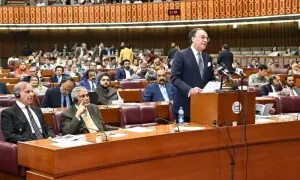
THEY all look the same and for good reason. Every budget over the past 10 years (and more) is pretty much the same with minor differences usually in the gimmickry being advanced in the name of a ‘revenue plan’. And it will be no different this time round when the budget for FY27 is announced.
There is a simple reason for this. A little more than a decade and a half ago Pakistan finally abandoned its last attempt to try and get serious tax reform through. Since then, successive governments have b
THEY all look the same and for good reason. Every budget over the past 10 years (and more) is pretty much the same with minor differences usually in the gimmickry being advanced in the name of a ‘revenue plan’. And it will be no different this time round when the budget for FY27 is announced.
There is a simple reason for this. A little more than a decade and a half ago Pakistan finally abandoned its last attempt to try and get serious tax reform through. Since then, successive governments have been rolling out various gimmicks, from amnesty schemes to ‘point of sale machines’ to do something that cannot be done with gimmicks. They are trying to document the growing services sector of the economy with these gimmicks, which is like trying to measure the ocean with a teacup.
Consider a little perspective first. Since the 1980s, the single fastest-growing sector of the economy has been services. It was slightly less than half of Pakistan’s GDP back in those days. Today, it is touching 60 per cent while the shares of industry and agriculture have shrunk. But today, services contributes less than 40pc of total revenues while the share of manufacturing can be as high as 55pc.
This is an important crux of the problem. The fastest-growing sector in Pakistan’s economy has made a diminutive contribution to its revenue effort. And there are a number of reasons why. First, successive governments have failed to undertake the kind of tax reforms necessary to keep abreast of the changes sweeping the economy where the services sector is a motor force for growth. For now, the bulk of the revenues contributed by this sector comes from banking and telecom — the low-hanging fruit.
Quite possibly, this is the one budget of the past decade or more which will be defined almost entirely by its revenue effort.
Documenting the transactions taking place in this sector is the first step to reaching them. And for decades there was one big idea on how to do that. It was called ‘value-added tax’, or VAT, and countries around the world implemented it with varying measures of success to help document their economies during periods of change, and help distribute the burden of the tax effort more widely. In some shape or form, the VAT was always on the agenda as a crucial structural reform measure of every IMF programme that Pakistan signed between 1988 and 2008, and there were many. The tax itself was passed into law in 1992, updated in 1996, but never really applied in value-added mode across the board. In 2008, it was supposed to be updated and modernised but the government of the time failed to ensure passage of the legislation so spectacularly that the IMF simply dropped it from all future reform agendas. Since then, it has been abandoned.
In abandoning it, however, a new question arose. If you are not going to use the VAT to document your economy, how exactly are you going to do it? The question was an important one because Pakistan’s economy was growing in directions that its tax machinery struggled to capture. And successive governments gave their own answers to this question.
This was the decade of gimmicks. We had amnesty schemes, proliferating withholding taxes, new taxes on banking transactions of non-filers, attempts to document the economy by triangulating multiple databases, reliance on data from point of sale machines and even one brief and doomed attempt to manually document the retail sector by serving tens of thousands of notices to them.
Of course, all of these failed because, as already stated, they amounted to attempts to measure the amount of water in the ocean using a teacup. Pakistan’s tax-to-GDP ratio stagnated in the single digits and intensified political struggles around the shrinking resource envelope of the state. We saw more gimmicks on the revenue side, like deemed incomes. We saw a ‘hard state’ approach to withdraw all exemptions or rebates offered to schoolteachers and university professors. They leaned harder on fuel taxes than any government in any period in the past. And they printed more money than any other government in any comparable decade in the past. All to help make ends meet at the centre.
Taken together, all these gimmicks made for an unseemly display of desperation. The growing resort to gimmickry was the state thrashing around within the shrinking confines of its resource envelope when it could not generate resources in quantities sufficient to keep pace with its expenditure growth. And they squeezed out a decade for themselves like this.
This was the overriding context within which all budgets in these years were made. And now the context is wrapping itself around them like the cloak of Nessus that once worn began to tighten around the wearer until its grip became inescapable and fatal.
This is what sets the stage for the forthcoming budget. Watch what rabbit they’ll pull out of their hat this time round to call a ‘revenue plan’ for the next fiscal year. They have to give relief to salaried people, and industry is near breaking point. They can’t lean more heavily on fuel or electricity taxes or deem more taxes into being out of foreign assets of the rich.
Keep an eye on the revenue plan they announce as well as the target for incremental revenues they have to pursue. They are chasing incremental revenues of up to 0.6pc of GDP, half of which will come from the federal government through slashing exemptions and their FBR transformation plan, including production monitoring and audits. This was their Achilles heel this year. Now their constraints are tighter still for next year, and options even more limited. Quite possibly, this is the one budget of the past decade or more which will be defined almost entirely by its revenue effort. If there is no attempt to break out of the constraints, then we’ll know we are all headed for the embrace of Nessus.
HEAT is becoming a defining feature of life in many parts of the world.
It influences how cities are built, how much electricity they consume, when people can work outdoors and, increasingly, how governments prepare for emergencies. The latest warning from the World Meteorological Organisation suggests that these pressures are likely to intensify. Global temperatures are expected to remain at or near record levels over the next five years, with a strong possibility that the world will experience
HEAT is becoming a defining feature of life in many parts of the world.
It influences how cities are built, how much electricity they consume, when people can work outdoors and, increasingly, how governments prepare for emergencies. The latest warning from the World Meteorological Organisation suggests that these pressures are likely to intensify. Global temperatures are expected to remain at or near record levels over the next five years, with a strong possibility that the world will experience its hottest year on record before the decade is out.
Scientists estimate that average temperatures between 2026 and 2030 will exceed 1.5°C above pre-industrial levels. Although this does not mean the Paris Agreement target has been permanently breached, it points to a future in which unusually hot years become increasingly common. The prospect of an El Niño event towards the end of 2026 may add further momentum, raising the likelihood of another exceptionally warm year in 2027.
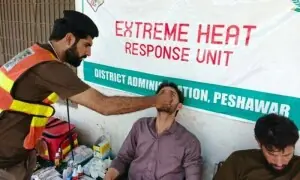
Pakistan is hardly a bystander to these trends. Summers have become longer and heatwaves more frequent. This year, Dadu recorded 51.5°C, while large parts of Sindh and Balochistan endured temperatures close to 50°C. Such conditions place enormous strain on electricity networks, reduce labour productivity and expose vulnerable groups to serious health risks. For those whose livelihoods depend on working outdoors, heat is not simply an inconvenience. It can determine how much work gets done and how much income reaches home.
Research published this year suggests that nearly 3.8bn people could face extreme heat conditions by 2050. Many of those most affected will live in developing countries where access to cooling remains limited and power supply is unreliable. Yet the challenge is not confined to traditionally hot regions. Record temperatures in 2025 stretched from Central Asia and the Sahel to parts of northern Europe, highlighting how rapidly climatic patterns are changing across continents.
Scientists estimate that extreme heat events are now almost 10 times more likely than they were a decade ago. Even countries accustomed to milder climates are beginning to confront risks that were once linked mainly with the tropics.
Pakistan’s adaptation efforts have often focused on floods — understandably so after the 2022 calamity. Heat, however, deserves equal attention. Urban areas need more shade and green spaces. Building standards should encourage passive cooling. Reliable electricity and public cooling facilities will become increasingly important during prolonged hot spells. Health systems must also be equipped to recognise and respond to heat-related illness.
The coming years are unlikely to resemble the climate many societies grew accustomed to during the last century. Planning for hotter conditions can no longer be treated as a peripheral environmental issue. It is increasingly becoming a question of public health, economic resilience and public safety.
THE insurgency in Balochistan has posed a different set of problems for the state, which is still struggling to fully understand its dynamics. Perhaps the biggest challenge is defining the unrest in the province and identifying the factors that are contributing to it.
Even as it tries to understand the insurgency, the state has become fixated on the youth, particularly the educated ones, whom it sees as leading the unrest. It sees them as the core of the problem, which it seeks to address throug
THE insurgency in Balochistan has posed a different set of problems for the state, which is still struggling to fully understand its dynamics. Perhaps the biggest challenge is defining the unrest in the province and identifying the factors that are contributing to it.
Even as it tries to understand the insurgency, the state has become fixated on the youth, particularly the educated ones, whom it sees as leading the unrest. It sees them as the core of the problem, which it seeks to address through narrative campaigns and a few incentives. In its search for quick fixes, it expects rapid results; when these don’t materialise, it stigmatises the very youth it seeks to influence.
A recent statement attributed to Balochistan Chief Minister Mir Sarfraz Bugti that Baloch youth pursuing PhDs at the state’s expense were conducting misleading research and supporting militancy reflected a hasty attitude. The statement drew sharp criticism from Balochistan’s political and civil society leadership and was perceived as an attempt by the state to silence critical voices that question poor governance, highlight flaws in the system, and expose the cost of electoral manipulation to political stability.
Since the beginning of the new phase of the insurgency in Balochistan, dozens of leading intellectuals, writers and journalists have been killed — from Prof Saba Dashtyari to Prof Ghamkhwar Hayat, who was recently killed in Noshki. On the one hand, the state claims that it has invested heavily in the education sector and set up dozens of universities across the province. On the other, it remains apprehensive about political and intellectual activities on university campuses.
The security institutions have a better understanding of religiously inspired militancy, having engaged with it since the Afghan-Soviet war and having developed a deeper knowledge of its character. It emerged from narratives once nurtured by the state for strategic purposes. It mainly relied on madressah students and youth educated in public-sector institutions affiliated with religious parties. Their worldview is different from that of Balochistan’s educated youth, who are more influenced by leftist and anti-colonial intellectual traditions of the Global South.
Dialogue remains part of the solution, particularly with those who are still willing to talk.
It took nearly two and a half decades for the state to develop an effective approach to address religiously motivated terrorism, which state institutions had, at times, themselves helped nurture. Even today, such militancy continues to pose several visible and hidden threats. Yet state institutions appear eager to crush an insurgency they don’t understand as well, and to do so in a much shorter period.
The state has a reasonably accurate diagnosis of Balochistan’s issues, but it errs in identifying the factors behind them. It is aware that the Balochistan problem has three dimensions: genuine political representation, the issue of missing persons, and a sense of deprivation. However, it continues to rely on the same remedies that have failed to produce results since the era of Gen Pervez Musharraf. It was during that period that a policy of zero tolerance towards dissent in the province took shape. The assassination of Nawab Akbar Bugti was a consequence of that approach.
For a brief period, the state softened its posture when the PPP government launched the Aghaz-i-Haqooq-i-Balochistan package. Over the following decade, however, the state pursued an ambiguous policy — involving neither carrot nor stick. Billions of rupees were spent on surrender schemes, many of which were viewed as dubious, while efforts to engage militant leaders in exile through dialogue were discouraged.
Ironically, that was perhaps the best time for negotiations, as the insurgency was still in the early stages of its transformation from a tribal-led movement into one increasingly driven by the educated middle class, particularly in the southern and western parts of the province.
Obviously, the time for talks with the exiled leadership has largely passed. The tribal leaders in exile no longer command the influence they once did, and those currently leading the insurgency appear unwilling to engage with the state. Yet dialogue remains part of the solution, particularly with those who are still willing to talk, whether they are nationalist groups, religiously inspired actors, rights-based pressure groups, or organisations such as the Baloch Yakjehti Committee.
However, the same confusion persists, and opinion within the state remains divided. Those who favour dialogue are in the minority, while proponents of a coercive approach continue to dominate policymaking. At the same time, the coercive strategy is not as muscular as many within the Balochistan government would like. The state continues to rely on familiar strategies and tactics that ordinary Baloch citizens understand all too well and are suspicious of — particularly regarding anti-terrorist squads.
At the narrative level, some institutions appear to be attempting to create divisions within Baloch society. This includes raising questions about a Baloch-Brahui divide. More recently, a Punjab-based activist associated with a banned religiously inspired terrorist organisation claimed that 40 per cent of insurgents belong to the Zikri faith. Many criticised this as another attempt to create rifts within Baloch society.
The question is whether such campaigns can achieve their intended purpose. Arguably, they strengthen the insurgents’ narrative by providing them with examples they can exploit to justify their position.
Another concern is that stigmatising Baloch youth fuels broader public resentment. A large number of young Baloch aspire to join public and private sector institutions across the country. In simple terms, they want to become part of the national mainstream. Narratives that portray them with suspicion can have a deeply negative impact on their aspirations and sense of belonging.
Running narrative campaigns is a delicate undertaking. If poorly conceived, they create more problems than they solve. This is particularly true when such campaigns emerge from an approach that itself lacks clarity and strategic coherence.
QUETTA: Police are investigating the motive behind the acid attack on a doctor from Civil Hospital Quetta, whose attacker was killed as he tried to flee, officials said on Monday.
Dr Mahnoor Nasir, who hails from Duki, was attacked while on duty on Saturday. The provincial government immediately shifted her to Aga Khan University Hospital in Karachi for specialised care.
After registering a case against the accused, Humayun Shah, investigators are now questioning hospital employees and close acq
QUETTA: Police are investigating the motive behind the acid attack on a doctor from Civil Hospital Quetta, whose attacker was killed as he tried to flee, officials said on Monday.
Dr Mahnoor Nasir, who hails from Duki, was attacked while on duty on Saturday. The provincial government immediately shifted her to Aga Khan University Hospital in Karachi for specialised care.
After registering a case against the accused, Humayun Shah, investigators are now questioning hospital employees and close acquaintances of the attacker to determine the real cause.
“We are investigating the tragic incident, keeping in view all aspects to trace out the people who could be behind this episode,” a senior police officer said.
Balochistan’s chief minister visited the hospital on Sunday night to check on Nasir’s health, assuring full cooperation for her recovery.
On Monday, Balochistan Governor Jaffar Khan Mandokhail telephoned Nasir’s father, Habibullah Khan Nasir, to offer arrangements for specialised treatment and plastic surgery abroad. Mandokhail emphasised that the provincial government is bearing all expenses related to her recovery from day one.
“The entire nation is proud of a brave daughter like Dr Mahnoor, and the people of Balochistan stand with her in this hour of difficulty,” Mandokhail said. He added that the government is utilising all available resources to ensure the safety and dignity of doctors and paramedical staff.
Meanwhile, the Young Doctors Association continued its strike across all government hospitals in Quetta, boycotting outpatient and other departments. The doctors have established a protest camp on the hospital premises, making speeches criticising health officials and demanding enhanced workplace security.
KARACHI: The investigating officer (IO) in a narcotics case has approached a court, seeking permission to record the voice samples of alleged drug baroness Anmol Pinky and her three accomplices in prison.
Pinky was arrested last month in connection with two cases registered at the Garden police station pertaining to the possession of drugs and an unlicensed weapon. She had already been booked in multiple other criminal cases prior to her arrest.
Following her arrest, the police also held Pinky’s
KARACHI: The investigating officer (IO) in a narcotics case has approached a court, seeking permission to record the voice samples of alleged drug baroness Anmol Pinky and her three accomplices in prison.
Pinky was arrested last month in connection with two cases registered at the Garden police station pertaining to the possession of drugs and an unlicensed weapon. She had already been booked in multiple other criminal cases prior to her arrest.
Following her arrest, the police also held Pinky’s three accomplices — Zeeshan-ur-Rehman, Sohail-ur-Rehman and Muhammad Sameer — who are also in prison on judicial remand in the drug case.
The IO of the Garden police station has filed an application before a judicial magistrate (South), seeking directions for the jail authorities to allow the recording of voice samples of Pinky and her three accomplices in prison for voice-matching evaluation.
Explaining the need to obtain the suspects’ voice samples, the IO stated in the application that during the investigation, the suspects’ mobile phones were legally seized as case property and their preliminary analysis revealed “critical incriminating evidence” consisting of multiple audio recordings and voice messages exchanged between the suspects and external operators.
He submitted that it was essential to determine the identity of the speakers, for which standard voice samples of all four suspects were required to be formally recorded.
The IO requested the court to issue directions to the jail authorities to provide access to the suspects for the lawful recording of their standard voice samples and to allow the samples to be forwarded to the FSL for forensic examination.
‘FUNDING, funding and regular funding’ is what Pakistani women athletes say they need most to compete internationally. Talent alone, they point out, cannot take them to the world stage; it must be backed by quality equipment, top-notch coaching, proper training facilities, nutrition and the means to travel and compete.
For most athletes, both male and female, except those supported by the departmental sports system such as the Pakistan Army, Wapda, the Higher Education Commission, National Bank,
‘FUNDING, funding and regular funding’ is what Pakistani women athletes say they need most to compete internationally. Talent alone, they point out, cannot take them to the world stage; it must be backed by quality equipment, top-notch coaching, proper training facilities, nutrition and the means to travel and compete.
For most athletes, both male and female, except those supported by the departmental sports system such as the Pakistan Army, Wapda, the Higher Education Commission, National Bank, Pakistan Railways, police and airlines, the struggle begins long before competition day: finding the resources simply to stay in the game. State patronage is limited, private sponsorship even scarcer — and for women, almost non-existent.
Even for female athletes with supportive families or relatively privileged backgrounds, funding remains a constant struggle. Eman Khan, who won the gold at the 2024 International Mixed Martial Arts Federation Asian Championships, receives only sporadic private sponsorships. To sustain her career in the intensely male-dominated and often ‘violent’ world of the martial arts, she relies on coaching others to fund her own training and competition expenses.
The barriers are even greater for girls from Pakistan’s remotest and poorest districts. Without sponsors or financial backing, many are forced to quit before their talent is ever discovered; this is not just an individual but also a national loss.
Stadiums are largely empty and media attention wanes when it comes to women playing sports.
In Jacobabad, the Star Women’s Sports Academy, the only women’s sports club in Larkana division, trains 32 girls from low-income homes in football, hockey, cricket and tennis for free. But with little funding and a severe shortage of equipment, many aspiring players are turned away. The club cannot afford to send athletes to private tournaments.
Founded in 2017 by hockey player Erum Baloch, in April the academy had to appeal on social media for basic gear — goalkeeping kits, hockey sticks and balls. Baloch, who teaches at a private institution, uses much of her own salary to keep the club — her passion — running. Help poured in from ordinary citizens and philanthropists. Even a sportswoman from Peshawar rushed to ensure the girls had the equipment they needed to continue playing. The appeal is a stark reflection of the lack of official support for women’s sports.
Similarly, last year, after reading about the plight of these athletes, the Australian high commission helped fund a hockey training camp for them in Islamabad.
However, ad hoc support and one-off training cannot produce national or international athletes. When coaches constantly scramble for basic equipment, training becomes inconsistent, eroding the very backbone of competitive sport.
Star Academy is far from the only women’s sports club trudging along with limited resources. Founders in Karachi, Hyderabad and Mirpurkhas say they often reach into their own pockets to keep girls playing — from water to rickshaw fares, they even buy shoes for those who cannot afford them. At the same time, they have to spend hours convincing hesitant parents to let their daughters continue.
But this financial strain is intertwined with harassment within the system. Coaches have observed that girls from poorer, more conservative homes — some describe their charges as ‘less educated, less confident and unable to speak in English’ — often become a target of sexual harassment. Many girls stay quiet for fear of being pressured to leave the sports premises — or the sport itself. Others, the coaches allege, are sidelined (even if talented) as ‘punishment’ for refusing the inappropriate advances of male officials who influence selection and careers.
Another reason why women’s sport remains chronically underfunded compared to men’s, said Dr Sadia Sheikh, founder of Pakistan’s first women’s sports club, Diya Academy (established in 2002), is that: “Women’s sports are less marketable.”
“Inn ki tau kal shadi ho jai ge; hum ko kiya return milay ga?” (Tomorrow these women will get married; if we invest in them, what returns will we get?) is a common excuse by corporations for turning them away, she said. This dismissive attitude, pointed out Dr Sheikh, is reinforced by the lacklustre viewership: stadiums remain largely empty and media attention wanes when it comes to women playing sports.
However, in sports such as cricket and football, there has been some positive development of late. The state and private sponsors are investing in female athletes. The latter receive enviable packages (though not equal to their male counterparts’) consisting of comfortable accommodation, good meals, daily allowances and even salaries or stipends, when compared to female athletes in other sports. They are even sent abroad for training and also get a chance to play against international teams.
Yet women in field hockey remain under the radar. It would be worth asking if our women’s national hockey team has qualified for the 2026 16-nation World Cup set to be held in Belgium and the Netherlands in August. Surely a country whose national sport is hockey must have a strong women’s team to be sent alongside its male counterpart!
Recently, Prime Minister Shehbaz Sharif approved budgetary allocations to promote sports and supported a sports endowment fund for veterans, while also pledging “all-out support” and equal opportunities for women in sport. However, a dedicated national fund for women athletes is yet to be announced.
But there is still time to act. The Pakistan Sports Board, along with the national federations, is drafting a four-year athlete development programme and has sought a budget increase from Rs1.2 billion to Rs4.9bn to support training, coaching, infrastructure and international participation.
Before the PM gives his final approval, and before flagship projects, such as the Rs2.85bn Arshad Nadeem High Performance Sports Academy in Islamabad or the Rs 241 million multi-purpose sports complex in Faisalabad move ahead, it is worth asking what place, if any, women athletes occupy in this vision.
Their struggles are systemic. The answer lies not only in more funding, but in fairer allocation, stronger governance, greater media visibility and genuine inclusion. Without that, financial investment will not change the game.
The writer is an independent journalist based in Karachi.
“My name is Ozymandias, king of kings:Look on my works, ye mighty, and despair!Nothing beside remains. Round the decayOf that colossal wreck, boundless and bareThe lone and level sands stretch far away.”
— Percy Bysshe Shelley, Ozymandias
“I am in blood,Stepped in so far that, should I wade no more,Returning were as tedious as go o’er.”
— William Shakespeare, Macbeth
PROLOGUE
This is and isn’t about America’s illegal war against I
“My name is Ozymandias, king of kings: Look on my works, ye mighty, and despair! Nothing beside remains. Round the decay Of that colossal wreck, boundless and bare The lone and level sands stretch far away.”
— Percy Bysshe Shelley, Ozymandias
“I am in blood, Stepped in so far that, should I wade no more, Returning were as tedious as go o’er.”
— William Shakespeare, Macbeth
PROLOGUE
This is and isn’t about America’s illegal war against Iran. It is primarily about hiding an empire in plain sight and now watching it unravel in plain sight.
The war against Iran becomes a consequential event in tandem with other structural weaknesses, a fillip of sorts. It reminds one of the Soviet war on Afghanistan. That war, in and of itself, did not bring down the Soviet Leviathan. The process inhered in the very make-up of the Soviet Union. The war just shoved it over the precipice. But let’s get on with our purpose here.
In August 2022, then-US President Joe Biden signed the CHIPS and Science Act into law. A $280 billion legislative package, it sought to revitalise domestic semiconductor manufacturing.
The act was a response to a startling vulnerability: the world’s most advanced chips, essential for everything from F-35 fighter jets to surgical equipment to artificial intelligence, are overwhelmingly manufactured by a single company, the Taiwan Semiconductor Manufacturing Company (TSMC), located on an island claimed as sovereign territory by America’s primary strategic rival, China.
This dependence is not an accident of geography or a supply chain anomaly. The semiconductor industry wasn’t even hobbled by Covid 19. Despite its complex and far-flung operations, the industry works smoothly. The US dependence is the logical endpoint of a decades-long corporate strategy that maximised profit by outsourcing physical production while retaining only the high-value design and marketing ends of the value chain, the so-called “Smile Curve” strategy.
The undoing of the United States in the Iran war may be far more significant than its defeats in Vietnam, Iraq and Afghanistan. It may well mark a historic milestone in the fraying of the position of the US as a global hegemon. But the seeds of this erosion of American dominance, argues Ejaz Haider, were laid long before its misadventure in Iran…
The Italian economist and sociologist Giovanni Arrighi, to whom I shall return, would have been amused to see the revered smile curve — taught at prestigious business schools and which encourages firms to outsource capital-intensive manufacturing to focus solely on high-margin research and development (R&D), branding and marketing — as a classic trap of late-stage capitalism.
In fact, the CHIPS Act stands as a state-level admission that this strategy, so profitable for individual corporations like Apple and NVIDIA, to name just two, has become a major geopolitical vulnerability for the US. This is the central paradox of America’s declining empire. The very mechanisms that generated unprecedented wealth have systemically dismantled the material and industrial foundations upon which that wealth ultimately rests.
The decline of the American empire is not a partisan talking point.
The US is a behemoth. It won’t just collapse one day like the Berlin Wall. Nor is a snapshot view the way to go. It is an ongoing structural process and a number of scholars have used longitudinal designs to analyse the trend lines.
I argue that it is a slow, systemic unravelling across interconnected domains.
First, the financialisation of capital, theorised most rigorously by Arrighi. Capital shifts from productive investment to speculative finance, generating short-term profits at the cost of long-term industrial vitality. It hollows out domestic industrial and political power, a process identified by American sociologist and political scientist Ho-fung Hung, who argues that off-shoring of production destroys the industrial ecosystem, skilled labour base and, ultimately, the social cohesion required for great power competition.
Second, the erosion of the alliance system. And no, it’s not just Trump. Three deeper currents are involved: the gradual unravelling of the post-WWII security architecture; the economic failure of neoliberalism; and the imperial outreach baked into the very idea of neoliberalism.
Third, the lateral diffusion of technologies, now commodified and everywhere. They help innovative and determined weaker powers offset the asymmetric advantage of bigger powers: Ukraine versus Russia; Hamas/Hezbollah/Houthis versus the US-Zionist duo; and now Iran versus the US-Zionist duo.
As I note later in this space, the war against Iran is a much bigger setback for the US than its wars in Vietnam, Afghanistan and Iraq.
Corollary: the post-WWII ‘Pax Americana’ is transitioning from a period of hegemonic stability, to use American historian Charles Kindleberger’s concept, into a protracted and likely irreversible, terminal crisis, to borrow Arrighi’s term. But let’s first begin with the peg: the war against Iran.
THE PRESENT
Since its inception, America has been at war: wars of choice, wars of conquest, wars for resources, wars to defend its hegemony, wars to spread “American values.” How or why does the Iran war stand out?
Foremost, the conflict has confirmed the structural limits of US coercive diplomacy in a shifting multipolar world. It has exposed acute structural vulnerabilities in defence economics and inventory endurance, as well as a critical absence of pragmatic post-war planning and a misreading of societal resilience. The conflict has also underscored the changing nature of global alignments in a multipolar world.
This comes with the collapse of coercive economic power. For four decades, the US has relied on sophisticated sanctions and lawfare to pressure Iran into subjugation. It has failed, showing the limits of sanctions, especially on fungible commodities. Even sanctions on non-fungible elements like technology can be circumvented. As in Iran’s case, the sanctioned state can develop indigenous expertise through varied strategies.
There’s clear evidence that Tehran has developed complex and sophisticated non-dollar lifelines with China and Russia, rendering unilateral sanctions increasingly ineffective. It has used an array of strategies to blunt the effect: interchangeability (can’t sell to X; sell to Y); value retention (barter, use of cryptocurrencies); substitution and evasion (relying on third parties, covert ship-to-ship transfers, use of shell companies).
Unlike the insurgencies in Vietnam, Iraq and Afghanistan, the US is not involved in ground combat in Iran (so far). It has relied on high-tech aerial and missile attacks through its formidable ISTAR (Intelligence, Surveillance, Target Acquisition and Reconnaissance) capabilities.
Iran has not responded through elusive, hit-and-run ground attacks. It has countered US technology through technology in a non-contact war. But its employment of technology is grounded in asymmetric capabilities: a large arsenal of ballistic missiles, cruise missiles, and one-way attack drones. The cost-exchange ratio, by most accounts, is unfavourable for the US.
For instance, the Iranian Shahed-136 one-way attack drone has an estimated unit cost of $20,000 (some estimates put it at around $10,000). It is a simple, slow-moving, and relatively easy to detect drone. But it is also cheap and plentiful. To intercept it with costly SM-2 or ESSM missiles creates a cost-exchange ratio of between 30 to one and 100 to one.
It is also a shoot-and-scoot system. Iran can afford to lose hundreds of such drones and produce some 1,000 per month. The US cannot afford to fire thousands of interceptors at them. And those interceptors take three to four years to manufacture. It is a cost-asymmetric war.
Similarly, the US has been pulling out assets from the Pacific to the Gulf. The USS Boxer amphibious group is an example. Diverting naval assets from the Pacific physically manifests deployment overstretch. As Robert Farley, visiting professor at US Army War College notes, resources needed to prevail in one theatre guarantee weakness in another. It’s the same with all force deployments and employments: “Every missile allocated to one target is unavailable for another.”
The contrast with Vietnam, Iraq and Afghanistan is instructive. In those theatres, the US was defeated by determined insurgencies, even as it bombed and bombed. The adversaries were willing to absorb enormous casualties, drag it out and inflict mission fatigue on the US. In both Iraq and Afghanistan, broadly speaking, the US won the conventional war expeditiously but then got bogged down.
In the Iran conflict, while Tehran has demonstrated the ability to absorb much pain, the US is not facing elusive insurgents but a state with a sophisticated missile programme, a sharp understanding of force employment, a network of allies across the region (Hezbollah in Lebanon, Ansar Allah in Yemen, and Hashd al-Shaabi in Iraq and Syria), and the ability to close the Strait of Hormuz, through which 20 percent of the world’s oil passes.
Iran has also demonstrated adaptation under fire, used the operational strategy of dispersal and delegation, exercised deception, demonstrated growing targeting capabilities through ISR, rapid repair of underground sites after US-Zionist bombing and consistently shifted locations for counterattack operations.
Can the US still bomb Iran? Of course. Will that be painful? Yes. Will Iran respond? Hell, yes. Would that raise the overall cost? You can bet your dime on it. It will be proof, yet again, that it is a slow grind and the US cannot achieve its objectives at a sustainable cost.
Yet, it is stuck, because to walk away means it loses credibility. Trump needs a win; Iran is not prepared to give him that. The war has changed the ground realities. There is no status quo ante. The objectives remain strategically incompatible — ie we might get a pause, even a long one, but the essential causes remain unaddressed. Spoiler alert: Zionist entity.
US President Donald Trump attending the return of the bodies of the first six American soldiers killed during the war with Iran on March 7, 2026: the lateral diffusion of technologies help innovative and determined weaker powers, such as Iran, offset the asymmetric advantage of bigger powers, such as the US | AFP
THE POINTILLIST EMPIRE: HOW IT BEGAN
American imperialism did not begin with grand pronouncements like the Monroe Doctrine or the Big Stick diplomacy of Theodore Roosevelt, though they give us a potent sense of a rising, expansionist power. It literally began with bird poop, which sounds about right if one were to understand imperialism as a crap enterprise.
The Guano Islands Act of 1856 allowed US citizens to claim uninhabited, guano-rich islands. The act set a precedent for later overseas acquisitions. Historian Daniel Immerwahr calls this a “pointillist” empire. This practical, resource-driven, and often hidden expansion set a pattern that would define America’s power and military bases for the next century.
The Mexican-American War (1846-1848) established the continental empire, seizing vast territories from Mexico. This wasn’t a war of liberation but a war of conquest, not manifest destiny but a fig leaf to cover the musty crotch of violent expansion, economic greed and racial supremacy. The 1848 Treaty of Guadalupe Hidalgo formalised the seizure of over half of Mexico’s territory.
The Spanish-American War of 1898 definitively projected American power overseas. Theodore Roosevelt’s Secretary of State John Hay, in a personal letter to Roosevelt, called it a “splendid little war.” By its end, the US had seized Cuba, Puerto Rico, Guam and the Philippines.
But the “splendid” label concealed a brutal reality, just like the payload of Trump’s “gorgeous B-2 bombers.” The subsequent Philippine-American War (1899-1902) resulted in Filipino genocide. That savagery has been systematically erased from American popular memory, even as Mark Twain was scathing in his condemnation and also did a fantastic job of calling out Rudyard Kipling for The White Man’s Burden.
But this wasn’t all. Immerwahr documents that American forces employed waterboarding (yes, much before the darned ‘War on Terror’), concentration camps (“black sites”), and scorched-earth tactics that would be recognisable to any student of colonial atrocities.
After World War I, US President Woodrow Wilson attempted a new form of imperialism: liberal internationalism, rather than direct territorial control. Much has been written about the “Wilsonian moment.” British historian and diplomat E. H. Carr called it a utopian project, divorced from the reality of power politics. In fact, it wasn’t. The project was essentially colonial and Wilson’s liberal internationalism fit it perfectly. The mandates were thriving.
The US Senate’s refusal to join the League of Nations left a vacuum that no amount of idealistic pronouncements could fill. War did come. Carr gives us insights into why it became inevitable. The US emerged from the war as the leading power. The post-WWII order was a direct lesson learned from the intervening two decades. No more “isolationism”. The US must play the role of the hegemonic stabiliser.
The core argument was simple and powerful: a stable world economy requires a single power to act as lender of last resort, maintain an open market for distressed goods, and coordinate macroeconomic policies. The US did that via the Bretton Woods system, the Marshall Plan and a vast security architecture that spanned the globe.
The quid for the quo? American dominance. The US was now fully involved. It bore the cost but the return on investment was handsome. It kept the US in the lead, even during the bipolarity of the Cold War and beyond. With the Berlin wall crumbling, American political scientist Francis Fukuyama became the mascot for neoliberalism. History had ended; all the wagon trains were destined for one town. Some might arrive late, but arrive they would.
Europe was pacified and rebuilt. Japan was demilitarised and transformed into a manufacturing powerhouse. The dollar became the world’s reserve currency, giving the US what French President Valery Giscard d’Estaing called “exorbitant privilege.”
For three decades, from 1945 to the early 1970s, this system appeared to confirm the virtues of hegemonic stability. Real GDP growth in Western Europe averaged nearly five percent annually, and the US share of world manufacturing output remained above 40 percent. But beneath the surface, the seeds of decline were already being sown.
ARRIGHIAN COUNTER
World-systems theorists like Immanuel Wallerstein and Giovanni Arrighi were not focused on immediate “imperial overstretch” in the manner of British historian Paul Kennedy. Kennedy argued that empires declined when their military commitments outpaced their economic base. The US, he warned, was suffering from imperial overreach.
For Arrighi, the decline was gradual and subtle. He argued that capitalist hegemonies move through repeating “systemic cycles of accumulation.” A phase of material expansion where capital is invested in production, infrastructure and trade, inevitably gives way to a phase of financial expansion, where capital seeks profit through speculation, lending and financial engineering.
The material foundation is hollowed out even as the financial superstructure appears to boom. This was the logic of capitalism. The “autumn” of each hegemon is marked by a dazzling financial belle époque that masks terminal decline.
The smile curve strategy is the purest expression of this financialisation and Apple is a textbook case. It designs its products, develops its chips, creates the operating systems, controls the branding, marketing and the retail experience. But it manufactures almost nothing. The iPhones and MacBooks are assembled by Foxconn in Zhengzhou and by Pegatron in Shanghai. The advanced chips are fabricated by TSMC in Taiwan. The displays come from Samsung in South Korea and LG Display.
Apple captures an estimated 80-90 percent of the profit from each device, while the suppliers who do the actual physical work fight over the remaining scraps. Business schools love this strategy because it maximises corporate profits and shareholder value.
But as Hung argues in his work on global value chains and the Arrighian counter, what maximises corporate profits does not necessarily maximise national power. In fact, it may systematically undermine it.
By outsourcing the middle of the smile curve, the US has drastically hollowed out its industrial ecosystem. Combine it with the faith in short, sharp wars of shock and awe through high-tech precision weapons and we get the full picture of what has happened in the war against Iran. This is very different from the WWII industrial base of America.
This brings us to TSMC and the chokepoint crisis. It manufactures chips designed by other companies (Nvidia, AMD, Qualcomm) rather than designing and selling its own chips. Over three decades, TSMC has built an unassailable lead in advanced process nodes. By 2025, it was manufacturing 92 percent of the world’s most advanced chips. The entire global technology industry (including the US military and intelligence apparatus) became dependent on a single cluster of fabs (fabrication plants) in Hsinchu, Taichung and Tainan.
China, which views Taiwan as a breakaway province to be reunited with the mainland by force if necessary, has the physical means to blockade or invade the island. Whether it would do so or should is a different debate. On ground, the People’s Liberation Army has been systematically building anti-access/area denial (A2/AD) capabilities, to prevent US intervention in a Taiwan scenario.
It’s a fairly absurd position from the US point of view! Its technological supremacy is guaranteed by a factory complex on an island which, in theory, its primary strategic rival could potentially seize or blockade.
To circle back to the CHIPS Act, this is the background. TSMC is now building a fab complex in Arizona. Intel is expanding in Ohio and Arizona. Samsung is building in Texas. But, as a 2023 Marketplace report noted, replicating TSMC’s “deep, deep process knowledge” will take years. The fab in Arizona has already faced delays, cost overruns, and labour disputes. Taiwanese engineers are reluctant to relocate to the United States. The set goes to Arrighi.
America’s weaponisation of the dollar has accelerated efforts by China, Russia and other BRICS members to create alternatives | Shutterstock
THE DOLLAR DILEMMA
The dollar’s role as the world’s primary reserve currency has been a central pillar of American power since the Bretton Woods agreement of 1944. This exorbitant privilege allows the US to borrow in its own currency, run persistent trade deficits without penalty and, crucially, impose unilateral financial sanctions on states, corporations, and individuals.
This weaponisation of the dollar has accelerated efforts by China, Russia and other BRICS members to create alternatives. China has been aggressively promoting its own Cross-Border Interbank Payment System (CIPS) as an alternative to Swift. The People’s Bank of China has signed bilateral currency swap agreements with dozens of countries, allowing trade to be settled in renminbi rather than dollars.
Russia has demanded payment in rubles for its natural gas exports. India has established a rupee settlement mechanism for trade. Brazil and China have agreed to trade in their own currencies. The Central Bank of Brazil has announced that it is diversifying its reserves away from the dollar.
And yet, the actual pace of de-dollarisation has been glacial. Several structural factors explain this “stickiness”, to use American political economist Benjamin Cohen’s term.
First, there is network stickiness. The dollar’s dominance is not simply a matter of policy; it is an issue of deep, self-reinforcing infrastructure. Global supply chains, commodity exchanges, derivatives markets, and correspondent banking networks are all built around the dollar.
Second, as various experts have argued, there is a lack of viable alternatives. The Chinese renminbi, despite China’s enormous economic weight, is not a free-floating, fully convertible currency. China maintains capital controls, a heavily regulated financial system, and a non-independent central bank. No foreign investor can be certain that their renminbi holdings would not be frozen or devalued by arbitrary state action.
The euro, the second-largest reserve currency, is hobbled by the Eurozone’s fragmented fiscal system and the lingering scars of the 2011 debt crisis. Gold is impractical for everyday transactions. And cryptocurrencies are far too volatile and illiquid to serve as a reserve asset.
Third is the absence of a deep, liquid and open bond market. A reserve currency requires a “safe asset” in which foreign central banks can park their surplus reserves. The US Treasury market, with $25 trillion in outstanding debt and extraordinary liquidity, is the only game in town. Result: while China and Russia publicly call for de-dollarisation, their central banks have themselves continued to accumulate US Treasury securities, because there is nowhere else to go.
Corollary: the near-term prognosis for de-dollarisation is not collapse but slow erosion. IMF data shows the dollar’s share of global reserves has declined from over 70 percent in 2000 to approximately 58 percent in 2025. This is not a precipitous decline, but it is a steady one. The debate is not if the dollar will lose its dominance but when.
I have no expertise in this area and I have relied on studying existing expertise. Most analyses measure the timeframe in decades, not years. From that, my understanding is that increasing uncertainty, further weaponisation of the dollar, continuing application of sanctions and asset freezes will (a) erode the confidence that underpins the entire system and (b) force experts (and governments) to find alternatives.
EPILOGUE: TERMINAL CRISIS
Two other issues are important but I am only flagging them here for paucity of space: the implosion of neoliberalism and its internal effects and the fraying of the transatlantic alliance. Both are exacerbated by Trump but neither is a direct result of his election. Both are extremely consequential.
The United States has not collapsed; not yet. Nor can it be defeated from outside. But it can crumble from within.
The future is not about a return to US hegemony, certainly not in a unipolar sense. The industrial base may be gone but it can be rebuilt, albeit not overnight. Alliances are frayed; trust cannot be easily restored. The fiscal position is precarious, with a $35 trillion US national debt. Internal politics is deeply polarised, with a significant portion of the American electorate believing that the system is rigged against them. A lot of these factors, singly and in combination with other factors, are self-reinforcing.
The future also lies in terra incognita, a contested transition to a multipolar world, whose contours remain unknown. A recent book by German political analyst Marc Saxer, Geopolitical Conflict in the Wolf World, is a sobering structural assessment of where the world and the US are headed.
“Homo homini lupus est” (Man is a wolf to man) is how Saxer begins. With that statement, we are back to Plautus and Hobbes. This is not mere rhetorical flourish. Saxer’s wolf world is an analytic category, a systemic condition characterised by the absence of a hegemon capable of enforcing rules, the demise of neoliberalism, the collapse of shared legal-normative frameworks, the return of great-power competition, the rise of Middle Powers, many with regional hegemonic aspirations, and the normalisation of coercion as a primary instrument of statecraft.
As I said to Saxer during the launch of his book in Lahore, for the Global South, it has always been a wolf world. Pax Americana did not keep the peace for the periphery. It financed selective peace on credit. The bill has now come due.
The writer is a journalist interested in security and foreign policies. X: @ejazhaider
• Clashes with law enforcers reported as rallies from various parts of region attempt to converge on Muzaffarabad• Several feared dead, two cops among scores injured• PM Rathore urges a return to talks• Five held from Muzaffarabad on suspicion of ‘links to foreign agencies’
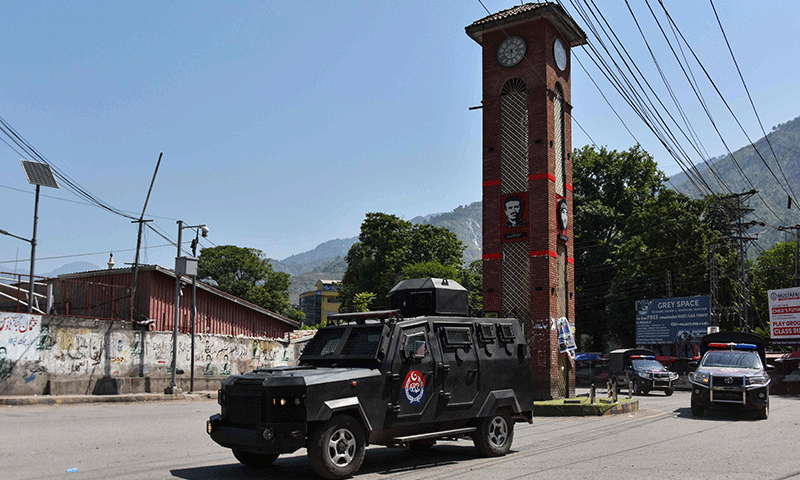
MUZAFFARABAD: Parts of Azad Jammu and Kashmir (AJK) remained in the throes of a crippling shutter-down strike on Tuesday, which was punctuated by clashes between law enforcers and supporters of the recently-proscribed Joint A
• Clashes with law enforcers reported as rallies from various parts of region attempt to converge on Muzaffarabad • Several feared dead, two cops among scores injured • PM Rathore urges a return to talks • Five held from Muzaffarabad on suspicion of ‘links to foreign agencies’
MUZAFFARABAD: Parts of Azad Jammu and Kashmir (AJK) remained in the throes of a crippling shutter-down strike on Tuesday, which was punctuated by clashes between law enforcers and supporters of the recently-proscribed Joint Awami Action Committee (JAAC).
The AJK government has issued orders to initiate sedition proceedings against two JAAC figures, and also announced a Rs10 million reward for information leading to the arrest of four of the group leaders.
At the same time, AJK Prime Minister Faisal Mumtaz Rathore urged a return to the negotiating table in a bid to end the tensions that have gripped the region over the past few days.
The clashes occurred when protesters from different areas of Mirpur division, comprising Mirpur, Bhimber and Kotli districts, took out rallies in line with the JAAC’s plan, envisaging a long march towards neighbouring Poonch division, en route to Muzaffarabad.
In the lakeside city of Mirpur, hundreds gathered outside the Quaid-i-Azam Cricket Stadium. They later began marching towards Plaak bridge, where they were reportedly joined by another rally from Dadyal, led by Khawaja Mehran Arshad at the border of Kotli district.
On the outskirts of Mirpur, two policemen and some protesters were injured in a brief clash in Pind Sabharwal village, an official said.
However, most violent clashes took place in Kotli city, after a procession of hundreds arrived there from Khuiratta tehsil. Though officials remained tight-lipped, residents and members of the AJK cabinet told Dawn — on condition of anonymity — that several people, including a doctor and a woman, were killed and scores of others wounded in the clashes.
According to initial reports, the doctor was on the roof of his home when he was hit by a stray bullet.
The strike and the ongoing closure of internet and mobile data services in the region has made it difficult to obtain real-time information from AJK.
Earlier in the day, all cities, towns and villages across AJK observed a complete shutter down strike. Even the banks, medical stores and bistros were closed and public and private transport off the roads.
However, in many areas motorcycles and a few private cars were occasionally seen moving through the streets without any disturbance.
In Muzaffarabad – the ultimate destination of protesters – riot police had taken positions in and outside government buildings and main thoroughfares to meet any eventuality. However, the capital remained completely calm on Tuesday.
Meanwhile, the AJK legal fraternity boycotted judicial proceedings on a call by the AJK Bar Council, to protest the alleged arrest of senior lawyer Amjad Ali Khan, a core member of the JAAC.
Action against JAAC leaders
The AJK government issued orders to initiating sedition proceedings against JAAC leaders Shaukat Nawaz Mir, resident of Muzaffarabad, and Mehran Arshad Khawaja, resident of Mirpur.
A notification issued by the AJK Home Department accused both leaders of committing “sedition through their speeches, written material, videos and audios”.
The government has issued instructions to the Mirpur and Muzaffarabad senior superintendents of police (SSPs) under Section 196 of the Code of Criminal Procedure (CrPC) to review the available records/materials.
It also directed the SSPs to register a case against Mir and Khawaja, and submit a charge-sheet in court after completing the investigation.
The two men were also among a group of four JAAC figures for whom ‘head money’ of Rs10m was announced.
“The president of Azad Jammu & Kashmir has been pleased to fix Rs10m reward money to be granted to any person who provides information leading to the successful arrest of the following offenders belonging to the proscribed JAAC,” said another notification.
Those named in the notification include Shaukat Nawaz Mir, Umar Nazir Kashmiri, Khawaja Mehran Arshad and Sardar Aman Khan.
Five held over ‘suspicious links’
According to the state-run Associated Press of Pakistan, law enforcement agencies arrested five suspects in an intelligence-based operation, seizing laptops, mobile phones, and various communication devices.
During interrogation, information provided by one of the detainees led to the recovery of a large cache of arms, including seven automatic weapons, multiple grenades, and other military hardware.
According to APP, investigators have uncovered evidence pointing to their alleged contact with hostile foreign intelligence agencies.
‘Find a way out’
In a post on X, the AJK premier reiterated his call for the issue to be resolved through talks.
“Please come back to the negotiating table. I’m requesting everyone on daily basis to resolve matters through discussions instead of fire and blood,” Rathore wrote on X.
He added that the protesters’ “abusive comments, constant threats and senseless agitation” were not helpful to anyone in AJK.
“A political activist without the ability to debate and negotiate is like a pilot without the ability to fly an airplane. They both end up causing hurt and damage to people behind them,” the PPP leader remarked.
“Everyone recognises your rights and liberties,” the AJK PM assured, stressing that both sides needed to “remain calm and find a way out through talks”.
“The only weapon a political activist carries is his reasoning and negotiation skills,” he said.
Rights bodies concerned
Human rights watchdog Amnesty International expressed concern over the violent and sweeping crackdown on protests - including an internet shutdown, mass arbitrary arrests, and deadly use of force – and called on the authorities to take immediate steps to deescalate the situation.
Separately, the Human Rights Commission of Pakistan (HRCP) said it was “deeply concerned by the escalating confrontation” in AJK and the loss of life among both protesters and law enforcement personnel.
WORLD Environment Day arrives as the planet edges deeper into climatic uncertainty. New global temperature records are being set with unsettling frequency, and the World Meteorological Organisation has warned that the years from 2026 to 2030 are likely to rank among the hottest ever observed. There is a strong possibility that another record-breaking year will emerge before the decade is out, while average global temperatures are expected to remain close to or above the 1.5°C threshold that gove
WORLD Environment Day arrives as the planet edges deeper into climatic uncertainty. New global temperature records are being set with unsettling frequency, and the World Meteorological Organisation has warned that the years from 2026 to 2030 are likely to rank among the hottest ever observed. There is a strong possibility that another record-breaking year will emerge before the decade is out, while average global temperatures are expected to remain close to or above the 1.5°C threshold that governments once hoped would help avert the worst impacts of climate change.
The warning may be global, but its implications are intensely local. In May, temperatures in parts of Sindh and Balochistan climbed towards 50°C, triggering heatwave alerts and heightening concerns about pressure on already strained power, water and health systems. At the same time, scientists continue to raise the alarm about the glaciers and snow reserves that feed the Indus basin. For a country whose agriculture, food security and energy production depend heavily on the Indus basin, changes in the region’s ice reserves carry consequences that extend far beyond the mountains.
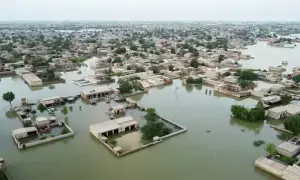
Pakistan knows all too well the consequences of environmental neglect. The catastrophic floods of 2022 inundated vast areas, displaced millions and inflicted losses running into billions of dollars. Yet, despite repeated reminders of the country’s vulnerability, environmental protection continues to occupy a peripheral place in policymaking. Climate adaptation efforts move slowly, urban expansion often proceeds with little regard for sustainability, forests remain under pressure and air pollution continues to burden public health. Shrinking green spaces leave cities increasingly exposed to extreme heat, while weak enforcement of environmental regulations allows ecological degradation to continue largely unchecked.
Pakistan is right to remind the world that it contributes only a tiny fraction of global greenhouse gas emissions and deserves greater international support. But that argument carries weight only if it is matched by seriousness at home. Fragmented planning, weak implementation and chronic underinvestment have left the country less prepared than it should be.
World Environment Day is often marked by pledges, ceremonies and symbolic gestures. This year, it should prompt something more. As the federal budget approaches, the government has an opportunity to demonstrate that climate resilience is finally being treated as a national priority. Adequate resources must be allocated for adaptation measures, disaster preparedness, water conservation, ecosystem restoration and more livable, heat-resilient cities.
Just as importantly, climate considerations must be embedded across development planning rather than confined to a handful of environmental programmes. Pakistan has received ample warning of what lies ahead. The upcoming budget should show that the state understands the scale of the challenge and is prepared to invest accordingly.
ISLAMABAD: Lawyers’ representatives from the federal capital on Tuesday demanded that future appointments to the Islamabad High Court (IHC) be made from among the Islamabad lawyers, as they voiced serious concerns over alleged corruption in the district judiciary.
The demands were made during a joint press conference held at the Islamabad High Court Bar Association following a meeting attended by representatives of the Pakistan Bar Council, Islamabad Bar Council, Islamabad High Court Bar Associa
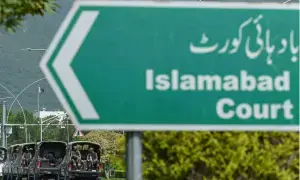
ISLAMABAD: Lawyers’ representatives from the federal capital on Tuesday demanded that future appointments to the Islamabad High Court (IHC) be made from among the Islamabad lawyers, as they voiced serious concerns over alleged corruption in the district judiciary.
The demands were made during a joint press conference held at the Islamabad High Court Bar Association following a meeting attended by representatives of the Pakistan Bar Council, Islamabad Bar Council, Islamabad High Court Bar Association and Islamabad District Bar Association.
Among those present were Pakistan Bar Council member Raja Rizwan Abbasi, Islamabad Bar Council member Raja Aleem Abbasi, Islamabad High Court Bar Association President Syed Wajid Ali Gilani, Secretary Barrister Qasim Nawaz Abbasi, Islamabad District Bar Association President Chaudhry Naeem Gujjar and Secretary Khawar Dhaniyal.
Addressing the media, Raja Aleem Abbasi said lawyers deliberated for more than three hours on issues confronting the legal fraternity, particularly the performance of the subordinate judiciary. He alleged that corruption complaints were being reported within the district judiciary and urged the authorities to take notice.
Bars representatives allege corruption in lower judiciary, call for judicial reforms
He called upon the National Judicial Policy-Making Committee to formulate a mechanism to address corruption allegations and improve accountability in the lower courts. He also proposed transfers of district judges to other provinces as part of broader judicial reforms.
Referring to the composition of the IHC, Abbasi argued that appointments to the court should be made from lawyers practising in Islamabad. He said judges in provincial high courts are generally appointed from within their respective provinces and maintained that the same principle should apply to the federal capital.
“The Islamabad High Court belongs to Islamabad and appointments should be made from the Islamabad Bar,” he said, adding that the legal community rejected recent decisions of the Judicial Commission regarding appointments and sought amendments to the Islamabad High Court Act.
Abbasi warned they could convene a nationwide lawyers’ convention if their concerns remained unaddressed.
Islamabad High Court Bar Association President Wajid Ali Gilani endorsed the demands raised by bar representatives and said the legal fraternity would organise a larger convention if necessary.
Barrister Qasim Nawaz Abbasi called for immediate action against judges found involved in corruption. He also maintained that several lawyers from the Islamabad Bar were qualified candidates for elevation to the high court.
District Bar Association President Chaudhry Naeem Gujjar echoed concerns regarding the subordinate judiciary and alleged that judicial officers frequently justified decisions by citing instructions from higher authorities.
The lawyers’ representatives concluded by reiterating their demand that appointments to the Islamabad High Court be made primarily from the Islamabad Bar and that judicial reforms focus on restoring public trust in the justice system.
QUETTA: Police have registered a case against Opposition Leader in the National Assembly and PkMAP Chairman Mehmood Khan Achakzai, on charges of allegedly spreading hatred against state institutions and criticising the present government while addressing a public gathering.
Other party leaders have also been named in the FIR. The charges relate to an allegedly provocative speech made against state institutions.
The action was taken following a written complaint submitted by Abdul Wali Khan, son
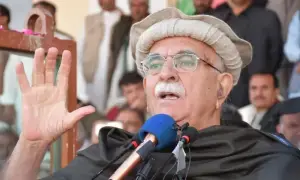
QUETTA: Police have registered a case against Opposition Leader in the National Assembly and PkMAP Chairman Mehmood Khan Achakzai, on charges of allegedly spreading hatred against state institutions and criticising the present government while addressing a public gathering.
Other party leaders have also been named in the FIR. The charges relate to an allegedly provocative speech made against state institutions.
The action was taken following a written complaint submitted by Abdul Wali Khan, son of Abdul Ghaffar Khan, a member of the Shinzai tribe and a resident of Gulistan Kari.
According to the FIR registered at Gulistan Police Station, the complainant stated that, during a public meeting, Achakzai allegedly said that law and order in Balochistan continued to deteriorate and that the current government had completely failed to provide security to the public.
He allegedly described the government as a “Form-47 fake government” and proposed the formation of an alternative force by recruiting people from various tribes in competition with the Pakistan Army.
The FIR further alleged that the accused encouraged people across Pakistan to become Afghan proxies, thereby attempting to create hatred and unrest between state institutions and the public.
Acting on the complaint, police registered a case against Mehmood Khan Achakzai and others under Sections 153, 505, 131, 341, 147, and 149 of the Pakistan Penal Code, as well as under the Balochistan Sound System Regulation Act, 2016.
THE government has postponed the announcement of the FY27 budget without offering any explanation for the decision. In the absence of an official announcement, speculation has been rife in the media about the reasons behind the delay. The most plausible explanation appears to be unresolved issues with the IMF, particularly with regard to fiscal space for relief and the transfer of some provincial resources to support federal spending.
According to unnamed official
THE government has postponed the announcement of the FY27 budget without offering any explanation for the decision. In the absence of an official announcement, speculation has been rife in the media about the reasons behind the delay. The most plausible explanation appears to be unresolved issues with the IMF, particularly with regard to fiscal space for relief and the transfer of some provincial resources to support federal spending.
According to unnamed officials quoted in media reports, Pakistan and the IMF have yet to agree on revenue mobilisation steps and the expenditure cuts required under the programme. The government is reportedly seeking room for tax relief, higher development spending and increased defence allocations, while the IMF wants continued fiscal discipline to secure a primary surplus equivalent to 2pc of GDP in the next fiscal year.
Indeed, the government is facing mounting pressure from businesses, households and other segments of society to provide economic relief and revive growth. As time passes, the pressure will intensify. With economic stabilisation yet to translate into tangible improvement in living standards, the country’s leaders are finding it increasingly difficult to ignore demands for relief.
However, tensions with the IMF are not the only plausible explanation for the postponement of the budget announcement. Differences between the ruling PML-N and its principal coalition partner, the PPP, over federal development allocations for projects in Sindh are also believed to have contributed to the delay.
There is also speculation that the PPP is resisting alleged attempts by the federal government to use the budget to reduce the provinces’ effective share of resources from the divisible tax pool under the NFC Award by fully or partly assigning certain federal expenditures to the federating units. The federal goal is to obtain more space and restore a fiscal balance in favour of the centre without formally altering the NFC formula through rigorous negotiations for a new award.
Briefly, the budget’s postponement exposes the extent to which the government is unable to finalise its fiscal framework without the IMF’s concurrence. It is a reminder of our continued dependence on multilateral financing and the limited policy autonomy that accompanies such reliance. It also signifies Pakistan’s continuing struggle to reconcile the IMF’s demand for fiscal discipline with domestic political and economic realities.
Whether, and to what extent, the administration succeeds in bridging these gaps with both the IMF and its coalition partner will become clear in the next few days as the budget is finalised. The government might have been in a stronger position today to tackle competing demands had it pursued the deep reforms needed to place the economy on a firmer footing for enduring growth in the last three years, instead of just suppressing the economy to show performance.

 Login
Login