NASA’s ambitious plan to put humans on the moon may hinge on the bathroom habits of a handful of University of North Dakota grad students. In the name of science, those researchers will test the limits of a mobile wastewater treatment system designed to convert human waste into plant nutrients and other sustainable materials. The trial will serve as a stress test of sorts, measuring how well the Divergent Deployable Wastewater Treatment Facility holds up to regular use and heavy loads in an envi
NASA’s ambitious plan to put humans on the moon may hinge on the bathroom habits of a handful of University of North Dakota grad students. In the name of science, those researchers will test the limits of a mobile wastewater treatment system designed to convert human waste into plant nutrients and other sustainable materials. The trial will serve as a stress test of sorts, measuring how well the Divergent Deployable Wastewater Treatment Facility holds up to regular use and heavy loads in an environment designed to mirror a lunar habitat.
It’s not pretty work, but someone has to do it.
“The tests will help NASA evaluate real-world operation, crew training needs, system reliability, and how wastewater simulants compare with actual human metabolic waste in an analog mission environment,” Ali Alshami, University of North Dakota Chemical Engineering professor and test participant, said in a statement.
The unassuming gray building could one day be an astronaut wastewater facility. Technicians prepared the Divergent Deployable Wastewater Treatment Facility for transport at NASA’s Kennedy Space Center in Florida on April 21, 2026. Image: NASA/Kim Shiflett
Treated astronaut poop will feed lunar plants
The mobile facility consists of three separate bioreactors, each tasked with handling a specific kind of waste. Feces, urine, and food waste are treated separately because each material contains different levels of salts, solids, carbon, nitrogen, and phosphorus. One reactor processes feces and food waste, converting it into nutrient-rich water that can feed plants. The other two handle urine and greywater from activities like showering and laundry, some of which can be filtered and recycled into clean drinking water. From an astronauts’ perspective, the experience should feel pretty familiar to life onboard the International Space Station (ISS). They use the toilet as normal, and it automatically diverts waste at the source, routing each type to its corresponding bioreactor.
The whole process takes place in a mobile, 8.5-by-24-foot trailer. In addition to the bioreactors, the unit also houses a vertical garden maintained by the converted wastewater. The goal is to kill two birds with one stone: process waste efficiently and then use it to sustain lunar agriculture. Both are essential if astronauts want any shot at building longer-term habitats on the moon or even Mars. To that end, NASA has ambitions to start constructing a semi-permanent lunar structure or “moon base” by 2029.
Where no one has gone before
Waste management in space has come a long way since the first moon missions. Back in the 1960s, NASA Apollo astronauts left behind 96 bags of human waste (filled with poop, urine, and vomit) on the lunar surface to save weight. Those bags are almost certainly still there.
Thankfully, decades of research mean astronauts no longer have to relieve themselves into a bag, at least not most of the time. The most recent Artemis mission featured a fully functional space toilet, though it malfunctioned almost immediately after liftoff.
Recycling wastewater has also seen major improvements. NASA had a breakthrough in 2023 when its life support system aboard the ISS managed to recover nearly 98 percent of all breath, sweater, and urine brought aboard by the crew. Future astronauts on prolonged spacewalks may also wear this Dune-inspired backpack that filters urine and sweat into drinking water in a single self-contained loop.
Mysterious and ancient human-made islands of timber and stone have endured amidst Scotland’s more well-known standing stones, Roman forts, and 18th century battlefields. Called crannogs, archeologists were initially not so sure what purpose these islands served, but were relatively confident that most of them date back to between the Iron Age (800 BCE to 400 CE) and the post medieval period (1550 to 1800). That is, until local diver Chris Murray found pottery fragments that were much older than
Mysterious and ancient human-made islands of timber and stone have endured amidst Scotland’s more well-known standing stones, Roman forts, and 18th century battlefields. Called crannogs, archeologists were initially not so sure what purpose these islands served, but were relatively confident that most of them date back to between the Iron Age (800 BCE to 400 CE) and the post medieval period (1550 to 1800). That is, until local diver Chris Murray found pottery fragments that were much older than they should have been.
Murray discovered the pottery remains from a crannog in the Isle of Lewis, part of the Outer Hebrides island chain on the country’s northwestern coast. Experts at the National Museum at Edinburgh were bewildered to discover that they were Neolithic (4000 to 2500 BCE), and thousands of years older than they would have guessed for remains associated with crannogs. Since then, archaeologists have been taking a closer look at these artificial islands and their true origin.
“[They are] these strange little circular islands that exist in all the different watery environments in Scotland and Ireland, typically in lakes or lochs, as they call them in Scotland. You would look at one and say it doesn’t look quite natural, because it looks very uniform, a very cohesive structure with lots of small portable stones on top,” Stephanie Blankshein, a maritime archaeologist at the University of Southampton, tells Popular Science. “They’re clearly something different.”
Fragments of a Neolithic pot found near the crannog. Image: University of Southampton.
The island builders
Archaeologists have known about crannogs for more than a century, but it is quite difficult to really investigate the structures because their timelines can be complex. People occupied them for multiple time periods, either continuously or with stretches of abandonment followed by reoccupation. What’s more, it’s difficult to excavate down to the artificial island’s oldest layers.
Murray’s discovery of pottery fragments in 2012 shouldn’t have come as a huge surprise. In the 1980s, one very confused archaeologist discovered Neolithic material at his presumed Iron Age site. However, the wider archaeological community simply deemed it as a strange, hyper-local anomaly, and moved on. The belief that the vast majority of crannogs date back no more than about 2,000 years endured for decades—including for most of Blankshein’s lifetime, she points out.
The waterlogged Neolithic pottery changed all of that, and Blankshein and colleagues started investigating the matter. They gathered and dated organic material and more pottery remains from six sights—five identified during Murray’s dive and the one from the 1980s. They confirm that both the pottery and the crannog were Neolithic, and ultimately found that 11 crannogs in the Outer Hebrides were from that period, with potentially many more around the same age in that region and beyond.
“I’m sure there are many, many more just waiting to be discovered,” Blankshein explains.
So, who were these Neolithic island-builders? It’s important to note that “Neolithic” doesn’t just refer to a time period, but also a lifestyle. Neolithic people were early farmers and pastoralists, and ancient DNA studies have revealed that Neolithic communities in Britain and Ireland were genetically distinct from the Mesolithic (about 9600 to 4000 BCE) hunter-gatherers who lived in the area before them.
Divers xxcavating underwater at the loch. Image: University of Southampton.
Advanced research techniques such as ancient DNA and isotopic analyses are also revealing where they came from. Neolithic people originated from the present-day Middle East and eventually spread across Europe. Some people migrated along the Mediterranean coast as far as west as Gibraltar, before moving north along the Atlantic coast to Britain and Ireland, where they ultimately replaced the Mesolithic communities.
In fact, researchers have traced the strongest genetic connections of Neolithic people in Scotland not to nearby France but to the Iberian Peninsula, Blankshein says. Britain’s early farmers may have been or descended from Neolithic seafarers. Notably, they would have made landfall a few centuries before the Neolithic crannogs in the Outer Hebrides started popping up.
The oldest crannog in the Outer Hebrides dates back to 3800 BCE, while the earliest Neolithic site in the United Kingdom in southern England is from around 4100 BCE.
“So it’s entirely possible that there was a very early arrival in Scotland as well, and essentially straight away they started building these islands,” says Blankshein. “So it seems like this may have been a tradition that they actually brought with them, or that they established very quickly after their arrival.”
A big Neolithic platform
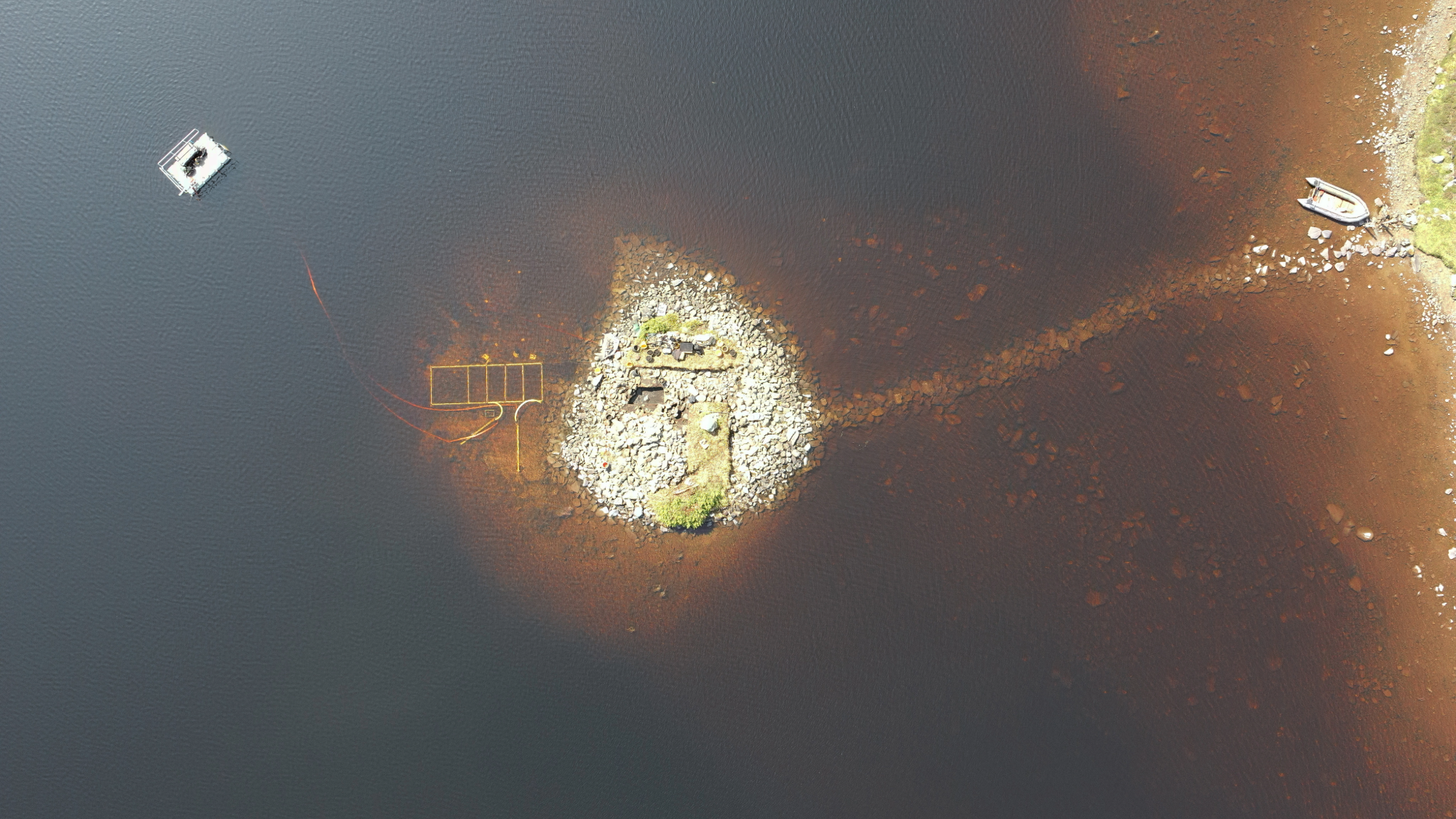
One of the crannogs that Blankshein’s team has studied in significant detail is the structure on the Isle of Lewis’ Loch Bhorgastail. It has already yielded hundreds of pottery shards, and they have also spotted pieces of timber embedded in the structure underwater. Importantly, the team could date that wood using standard carbon-14 dating. And unlike other crannogs, the Loch Bhorgastail crannog didn’t have any structures built on top of it (like a medieval castle) that could complicate excavations.
The team conducted their first serious excavation in 2021, expecting to reveal an island made of stone and reinforced with some timber. While they did not find full pieces of timber, bits of wood were scattered about, leading the maritime archaeologists to an entire underwater timber structure.
“We were just absolutely blown away because we started following this structure further and further back from the island. And by the end of the month of excavation, we hadn’t reached the end of it,” Blankshein says. “And that was about six meters [19.6 feet] that we had extended out. So we knew there was something quite interesting there.”
The wood dates to between 3500 and 3300 BCE, which is consistent with most of the other early Neolithic sites in the Outer Hebrides. When the team returned in 2023, they discovered that the timber platform wasn’t just extending from the stone base underwater, it was under the entire crannog itself.
The wooden platform beneath the Lock Bhorgastail crannog. Image: University of Southampton.
directly on the lochbed, potentially circular, and potentially featured stone reinforcements around the edges and/or stakes securing it. Core samples taken from the lake’s dirt and rock indicate that the loch’s water levels would have been lower at the time of its construction, so the platform could have sat under just a foot of water, or even been dry. Another possibility is that it was dry during the summer and underwater in the winter, and so was used seasonally.
The platform is also quite large, at around 75.5 feet (23 meters) in diameter. Now that the researchers have a good understanding of how big the platform was, the next natural question is what it was used for. This is a significantly harder inquiry to answer, and researchers have a number of different theories, according to Blankshein.
Broadly, it probably served several important purposes. The presence of food residue in the many pottery fragments indicate that people were consuming food on the island, thus it could have been a gathering place for a ritual feast or ceremony. As such, one of the theories is that it was used to host coming of age ceremonies. Since the wooden platform would have been on water, another hypothesis is that it could have represented a neutral and egalitarian meeting point.
Materials last touched over 5,000 years ago
In addition to phenomenal archaeological results, the Loch Bhorgastail crannog also prompted the team to develop a new technique for photogrammetry (stitching 2D pictures together to form a 3D model of a site) in shallow water. At these depths, photogrammetry is more difficult to execute than in the deep sea. They describe their method, which involves attaching two GoPro cameras to a rig, in a study recently published in the journal Advances in Archaeological Practice.
The team is finishing the final analysis of the Loch Bhorgastail site and are detailing the excavation results for a future paper.
“Working on such an ancient site is genuinely surreal,” Blankshein admits, speaking of the work in general. “Despite the huge lapse in time, there are moments underwater when the distance between past and present suddenly feels incredibly small—lifting pottery from the loch bed that was last touched by a Neolithic person over 5,000 years ago, or seeing bark still preserved on timbers beneath the sediments as if it had been placed there yesterday. Moments like that provide connections to the past I couldn’t have imagined before working on the site.”
The classic blanket fort is a simple structure. Entry level hideouts often only require a bedsheet and a couple of chairs, and it doesn’t take much effort to expand the floorspace to accommodate guests. Constructing an intimidatingly expansive blanket enclave is a much bigger feat of engineering, however. At least, that’s what it looks like from photos showcasing the newest Guinness World Record holder for the largest blanket fort. The current champions? Local residents and high schoolers in Las
The classic blanket fort is a simple structure. Entry level hideouts often only require a bedsheet and a couple of chairs, and it doesn’t take much effort to expand the floorspace to accommodate guests. Constructing an intimidatingly expansive blanket enclave is a much bigger feat of engineering, however. At least, that’s what it looks like from photos showcasing the newest Guinness World Record holder for the largest blanket fort. The current champions? Local residents and high schoolers in Las Vegas, Nevada.
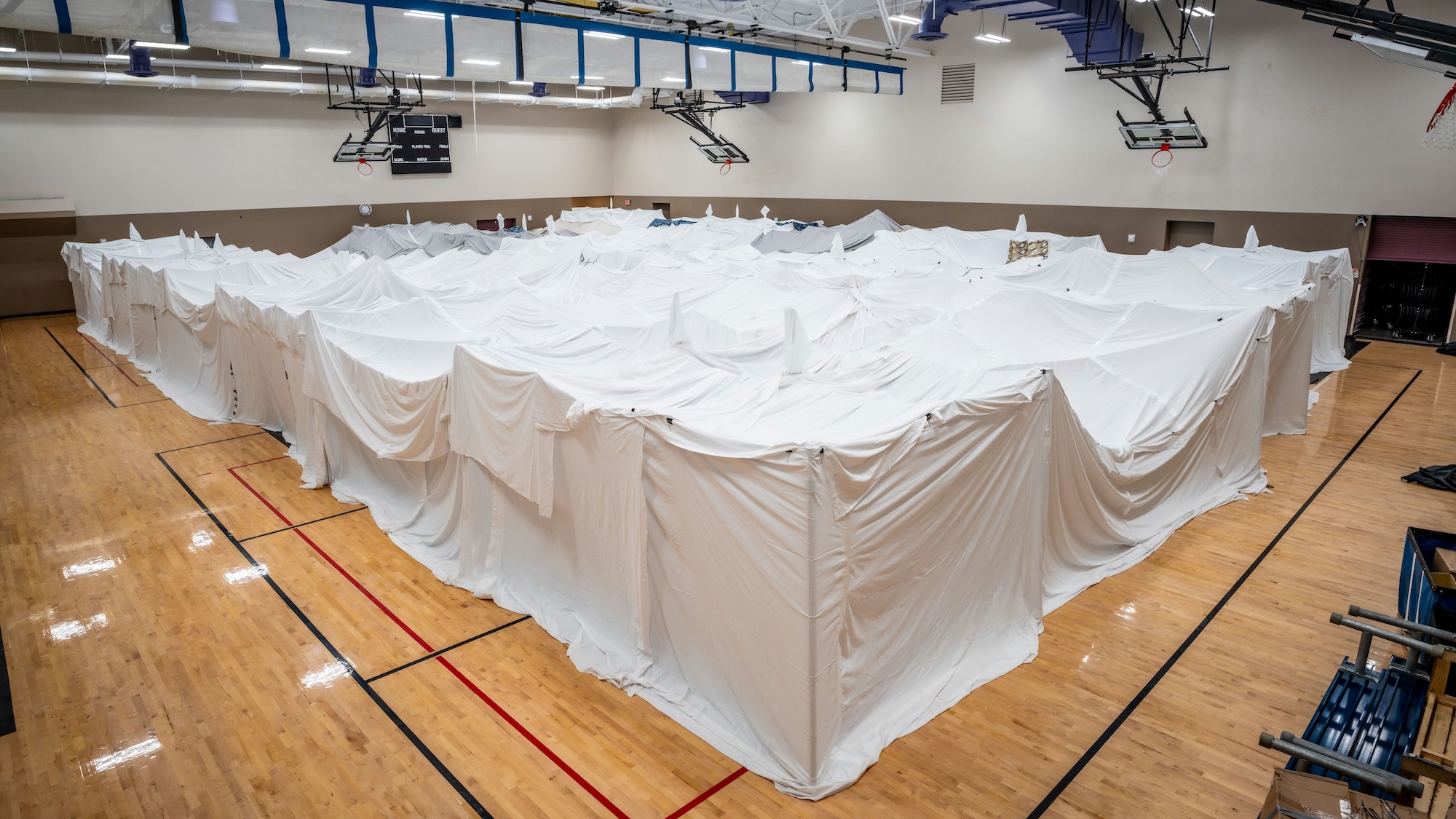
The fort needed to be tall enough to allow inhabitants to sit comfortably inside it. Credit: Robert Edward / Clark County, Nevada Robert Edward
At 14,103-square feet, the billowy project overshadows the previous record holder (12,291-square-feet) that was built in South Carolina in 2024. According to the official announcement from Nevada’s Clark County, the job necessitated a small army of volunteers and community partners using a design envisioned by engineering students at Las Vegas’ West Career & Technical Academy. All told, the blanket fort included hundreds of sheets draped over tent poles and anchored by ropes, pipes, and even binder clips.
Confirming the fort’s record breaking size required a visit from an official Guinness World Records adjudicator. The assessor didn’t simply measure the floorspace inside the Desert Breeze Community Center’s basketball court, though. Eligibility requirements included making sure there weren’t any gaps between sheets larger than one inch, ensuring all sheets touched the ground, and determining minimum height requirements that allowed a person to “sit comfortably” inside the tent.
An inspection from an official Guinness adjudicator was required before certifying the structure. Credit: Robert Edward / Clark County, Nevada
A good blanket fort’s temporary nature is part of its appeal, and the recordbreaking project has since been disassembled. After all, Desert Breeze Community Center still needs its gym for pickup basketball games.
Stonehenge is so much more than just a monumental feat of ancient engineering—it’s also a logistical marvel. Multiple generations of Neolithic designers relied on communal teamwork and clever construction techniques to precisely place each of the site’s gigantic megaliths about 5,000 years ago. Two primary types of stone known as sarcens and bluestones make up the formation. Paleoarchaeologists previously traced most of the sarcens to about 15 miles away to present-day Marlborough, England, whil
Stonehenge is so much more than just a monumental feat of ancient engineering—it’s also a logistical marvel. Multiple generations of Neolithic designers relied on communal teamwork and clever construction techniques to precisely place each of the site’s gigantic megaliths about 5,000 years ago. Two primary types of stone known as sarcens and bluestones make up the formation. Paleoarchaeologists previously traced most of the sarcens to about 15 miles away to present-day Marlborough, England, while many of the bluestones originated in Wales.
The famed Altar Stone is far more perplexing, however. The central, six-ton sandstone megalith likely came from a region in Scotland about 400 miles away. How a prehistoric society managed to scoot the boulder so far without complex tools or transportation methods has perplexed researchers for years.
Many researchers have theorized that melting Ice Age glaciers likely helped passively shift the Altar Stone closer to southern England’s Salisbury Plain around 2500 BCE, shortening the transport distance for Stonehenge’s creators. But in 2024, a team at Curtin University used chemical analysis to determine that glaciers simply weren’t the only factor behind the megalith’s move. Now, that same team has combined ice-sheet modeling and mineral grain dating to more precisely locate the Altar Stone’s original home. Their findings, published today in the Journal of Quaternary Science, further underscore how humans played a huge part in getting their centerpiece to Stonehenge.
“Rather than being carried naturally by ice, the evidence points to a deliberate, carefully planned movement across a challenging and varied landscape,” Anthony Clarke, a geochemist and study co-author, said in a statement.
Although glaciers possibly transported many large rocks as far south as Dogger Bank in the North Sea, Clarke explained that geological modeling showed that “no viable glacial pathways” ever linked the Altar Stone’s source region to Stonehenge. This further underscores how Neolithic communities were necessary to move it to its final spot.
“Transporting a stone of this size over such a long distance would have required planning, coordination and a deep understanding of the landscape—not to mention tremendous determination,” he added.
While the exact methods remain a mystery, Clarke and colleagues believe the Altar Stone was almost certainly moved in stages, possibly through a combination of overland and river travel routes.
“The stone would still have needed to be moved hundreds of kilometers by people,” Clarke concluded.
Dangerous, frontline firefighting jobs may get a bit safer thanks to new heat-sensing sensors designed by NASA. The sensors are made from commonly available household materials, and attach to the bulldozers firefighters use to clear vegetation and brush in a fire’s immediate path, triggering an alarm when temperatures reach extremely dangerous levels.
Knowing when a fire is hot might sound obvious, but many new so-called fire dozers are being outfitted with enclosures to protect their operato
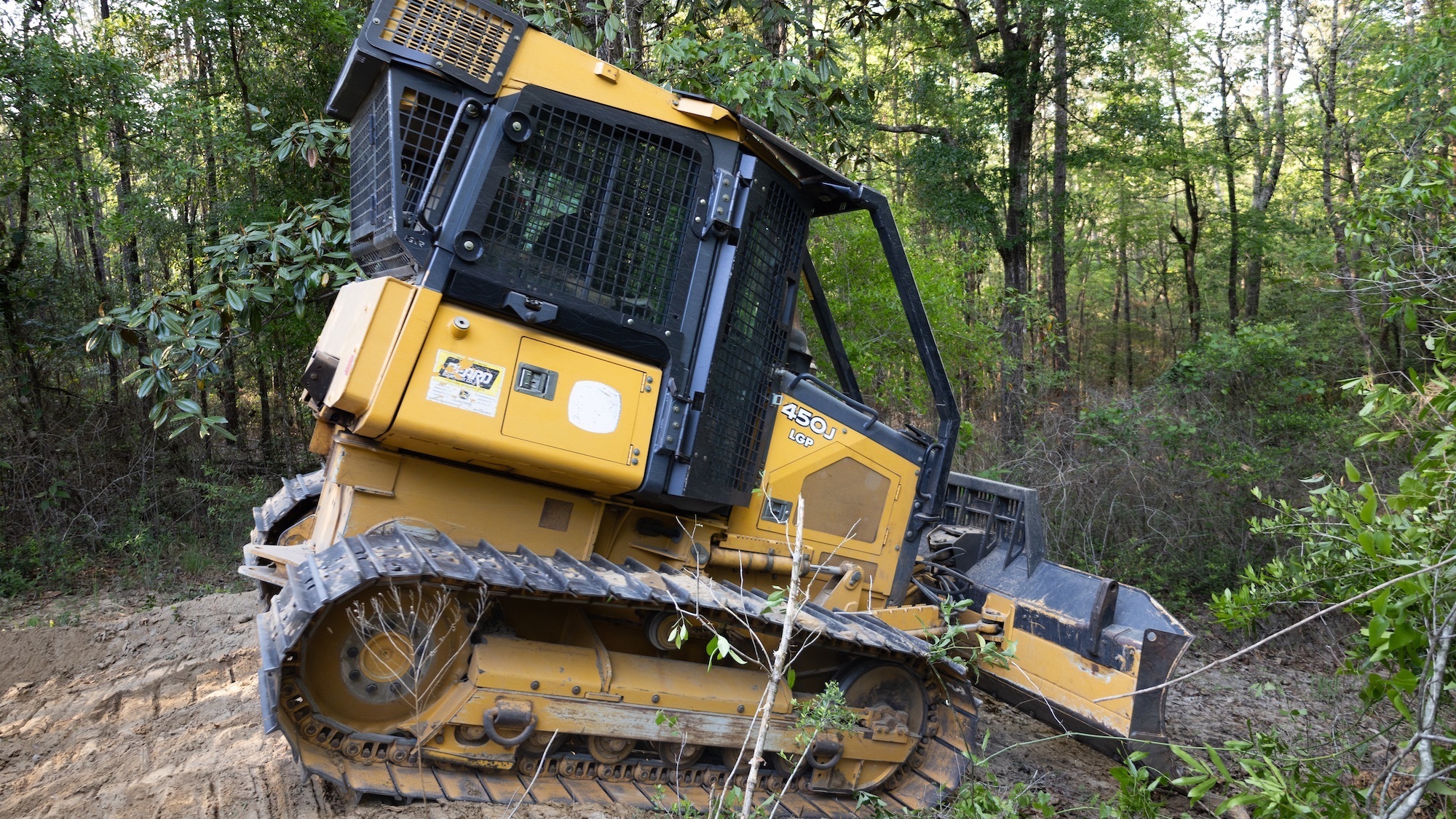
Dangerous, frontline firefighting jobs may get a bit safer thanks to new heat-sensing sensors designed by NASA. The sensors are made from commonly available household materials, and attach to the bulldozers firefighters use to clear vegetation and brush in a fire’s immediate path, triggering an alarm when temperatures reach extremely dangerous levels.
Knowing when a fire is hot might sound obvious, but many new so-called fire dozers are being outfitted with enclosures to protect their operators from the flames. That’s a welcome change, but it also reduces the operator’s ability to gauge the surrounding heat. These new sensors help solve that problem, protecting the driver and helping prevent the dozers from sustaining too much damage.
The sensor setup is simple by design. It consists of a standard thermocouple similar to those found in a home oven, which is then wired to an LED light in the dozer’s cabin. If the light starts blinking, it’s time to get out of Dodge.
The entire system is powered by something that’s probably laying around your house: AA batteries. Using a simple power source like this is part of an attempt to make every aspect of the design affordable and accessible. University of Alabama, Huntsville research scientist Ryan Wade emphasized that point in a NASA blog post. He explained that during a recent trial installing the sensor in a fire dozer, his team realized that they were missing a part. Rather than waiting to hear back from NASA and having a custom piece shipped to them, they simply walked down the street to a hardware store and solved the problem.
NASA Wildland Fires Program science integration manager Jennifer Fowler holds an LED light on the dashboard of a fire dozer belonging to the Alabama Forestry Commission (AFC). The LED light is connected to a thermal sensor mounted in the window of the dozer, which turns the light on when the radiant heat from a nearby fire reaches a dangerous threshold. FireSense scientists have been working with the AFC to develop and install these thermal sensors onto these dozers, which they showcased during a stakeholder event on April 23-24, 2026 at the Solon Dixon Forestry Education Center in Andalusia, Alabama. Image: NASA/Milan Loiacono.
“NASA’s expertise in this case comes not in the novelty of the instrument itself, but in figuring out how to solve the problem quickly and integrate that technology into their existing system,” Wade said.
That flexibility is what makes the approach so valuable for firefighters. Alabama Forestry Commission fire analyst Ethan Barrett says the devices so far work “exactly as intended.” In Alabama, at least, officials are planning to outfit their entire dozer fleet with the sensors. The sensor system was developed by NASA’s FireSense project, whose interest in it was twofold. The sensors will more immediately help firefighters on the ground as fire season approaches, but the data they collect will also prove invaluable for future research. By placing sensors in the dozers, NASA will gather reams of data about fire strength and intensity straight from the front lines.
It seems like every week there’s another example of a new robot modeled after a real creature in the animal kingdom. From dogs and bats, to roaches and desert lizards, the natural world is a constant source of inspiration for engineers. But while most robotics researchers use animals as a base for their machine’s movement, an ambitious team of Duke University engineers set out to make something entirely new: a robot whose form factor and movement aren’t derived from biology, but from the univers
It seems like every week there’s another example of a new robot modeled after a real creature in the animal kingdom. From dogs and bats, to roaches and desert lizards, the natural world is a constant source of inspiration for engineers. But while most robotics researchers use animals as a base for their machine’s movement, an ambitious team of Duke University engineers set out to make something entirely new: a robot whose form factor and movement aren’t derived from biology, but from the universe’s underlying physics.
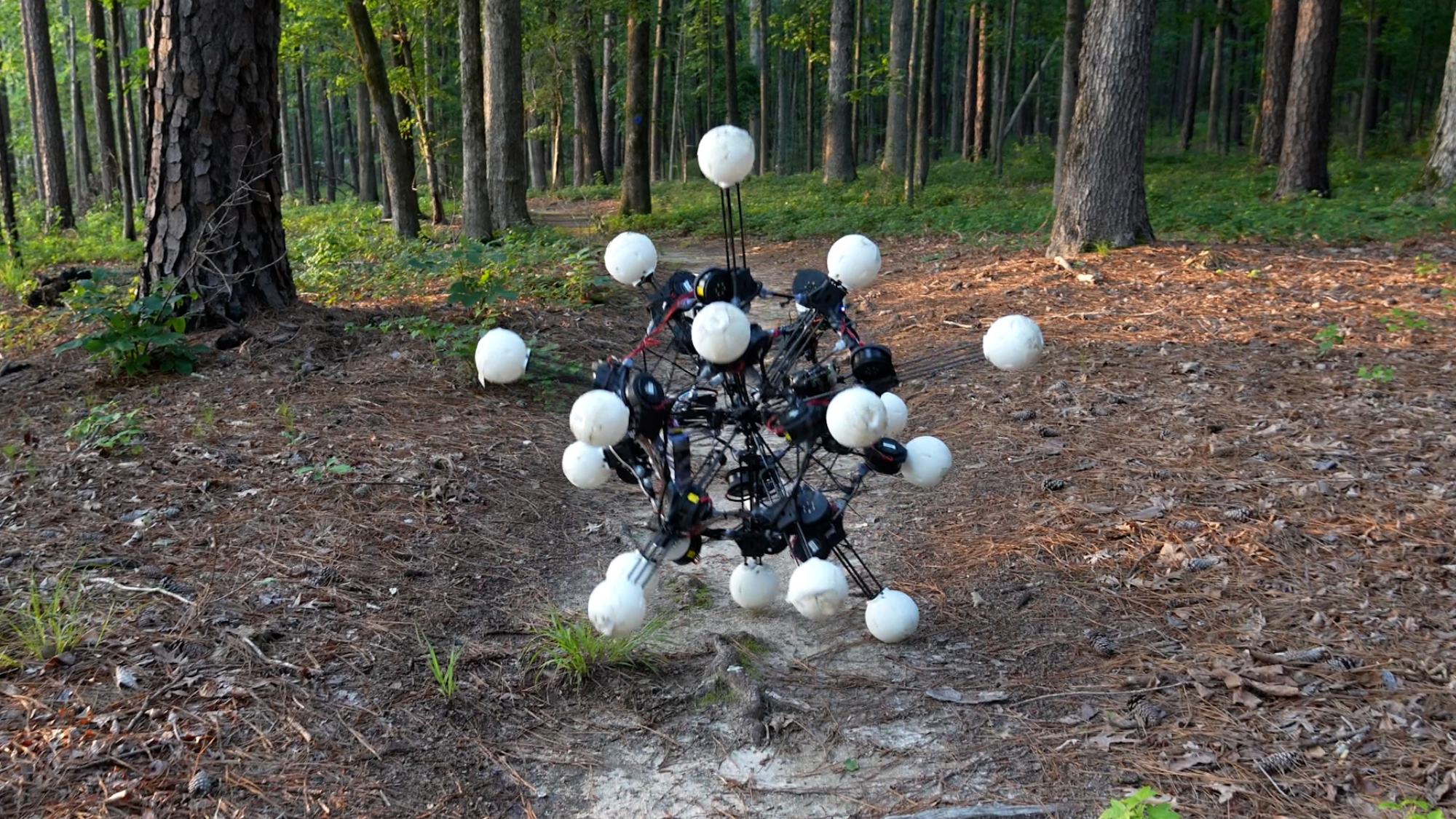
Say hello to Argus, a 20-legged, blob-looking robot capable of seeing in all directions at the same time and able to move almost instantly in any direction. The amorphous-looking sphere has no top or bottom, no left or right, and will keep trekking through sand, dirt, and gravel even when some of its legs are destroyed. It can also use its many legs to shimmy up narrow walls, a move similar to a wall jump in “Super Mario.”
The engineers behind Argus say their intriguing, if not slightly terrifying, creation isn’t just another incremental step forward in robotics. It’s the first member of a totally new category of “dynamically symmetric machines.” The findings were published this week in the journal Science Robotics.
“Watching Argus move is unlike watching any other robot we’ve worked with,” study co-author and Duke PhD student Jiaxun Liu said in a statement . “The first time we saw it navigate among trees and rough terrain, even under heavy collisions, we knew this was something different.”
Biological tradeoffs
Though somewhat human-looking, upright bipedal robots from companies like Figure and Tesla are all the rage these days, engineers have long looked to other animals to inspire their machines, because animals are simply better than Homo sapiens at certain tasks. Dogs and other quadrupeds are more agile, bats can fly, and bugs can scurry into hard-to-reach places.
However, at least in terms of movement, each of the pluses of these specific animals has also come with some minuses. Dogs and other quadrupeds are remarkably fast and nimble when moving forwards, but ask them to replicate that movement when moving backwards and you’re in for a problem.
With those inherent biological tradeoffs in mind, the team at Duke’s General Robotics Lab set out to make something completely different. Taking inspiration from underlying physics, they wanted to see if they could make a robot based around “dynamic symmetry,” which they define as the ability to generate forces and acceleration with uniform magnitude in all directions.
In other words, such a robot would take the idea of left or right and up and down and throw them out the window. Instead, it would be capable of moving in any direction, at any time, without any privilege given to one particular direction. The goal was essentially to build possibly the world’s first “omnidirectional” robot.
Argus keeps on coming—even when you break its legs
The design team eventually settled on a spherical core, or base, with a bunch of legs sticking out of it. They made multiple versions in a simulation, one with as few as eight legs and another with as many as 40. Eventually they settled on an even 20 legs for the physical build. Each of those legs is tipped with a camera that serves as one of Argus’ many eyes. Fitting, then, that it’s named after a many-eyed giant in Greek mythology. The researchers describe Argus as visually similar to a sea urchin, but even that’s selling it short. It doesn’t really look like anything in nature, which makes its uncanny movement in real-world testing all the more unsettling.
In testing, Argus could move in any direction just as quickly and comfortably as any other. The upside of that is that the blob is actually quite adaptable to different terrain despite its unusual appearance. It can easily traverse forest, wet surfaces, and sand, and could climb over certain obstacles. Argus’ ability to rapidly redistribute its weight also meant that it excelled at recovering when researchers tried to shove it off course. While Argus isn’t the first robot to right itself after getting pummeled by a researcher, what makes it unique is that it can redistribute its weight even if some of its legs get damaged or fail altogether.
In other words, you can chop off Argus’ legs and it will just keep coming.
Argus joins a family of DARPA-backed robots
The Duke researchers frame their interest in building this new category of machine as primarily motivated by pushing the boundaries of what’s possible in mechanical science. Still, it’s hard not to ignore the researchers’ most notable funder: the Pentagon’s Defense Advanced Research Projects Agency. Known for incubating some of the military’s most notorious research and development projects, DARPA is responsible for everything from Boston Dynamics’ beef Atlas humanoid to a massive, experimental manta ray inspired uncrewed underwater vehicle.
So, while it’s still not clear what exactly Argus will ever be used for, paper coauthor and postdoctoral researcher at Duke’s General Robotics Lab Boxi Xia says the experimentation and exploration was success in itself.
“Argus is an existence proof,” Xia said in a statement. “It shows that designing for dynamic symmetry isn’t just a theoretical curiosity. It produces a robot you can deploy in the wild, on uneven ground and in clutter, even in low-gravity settings. It changes what’s possible.”
A team of engineers at the University of California San Diego (UCSD) have developed a humidity-based image encoder that looks straight out of James Bond’s Q-Lab. The postage stamp-sized chip can store a hidden message that is only revealed when exterior humidity levels surpass 60 percent. The image can then be concealed again by bringing humidity back down. In practice, that means someone handed an object with the chip on it could simply breathe on it to unveil its secret message.
While it’s
A team of engineers at the University of California San Diego (UCSD) have developed a humidity-based image encoder that looks straight out of James Bond’s Q-Lab. The postage stamp-sized chip can store a hidden message that is only revealed when exterior humidity levels surpass 60 percent. The image can then be concealed again by bringing humidity back down. In practice, that means someone handed an object with the chip on it could simply breathe on it to unveil its secret message.
While it’s a potentially nifty tool for an undercover spy, the researchers say the encoder could also be used to reveal a security code on a credit card, or even serve as a visual indicator of climate changes in a particular area. In all of these cases, humidity essentially acts as a key. The findings were recently published in the journal Light: Science & Applications.
“You can imagine using this as a built-in security feature with the environment acting like a key that unlocks different pieces of information,” study co-author and UC San Diego electrical and computer engineering postdoctoral researcher Asad Nauman said in a statement.
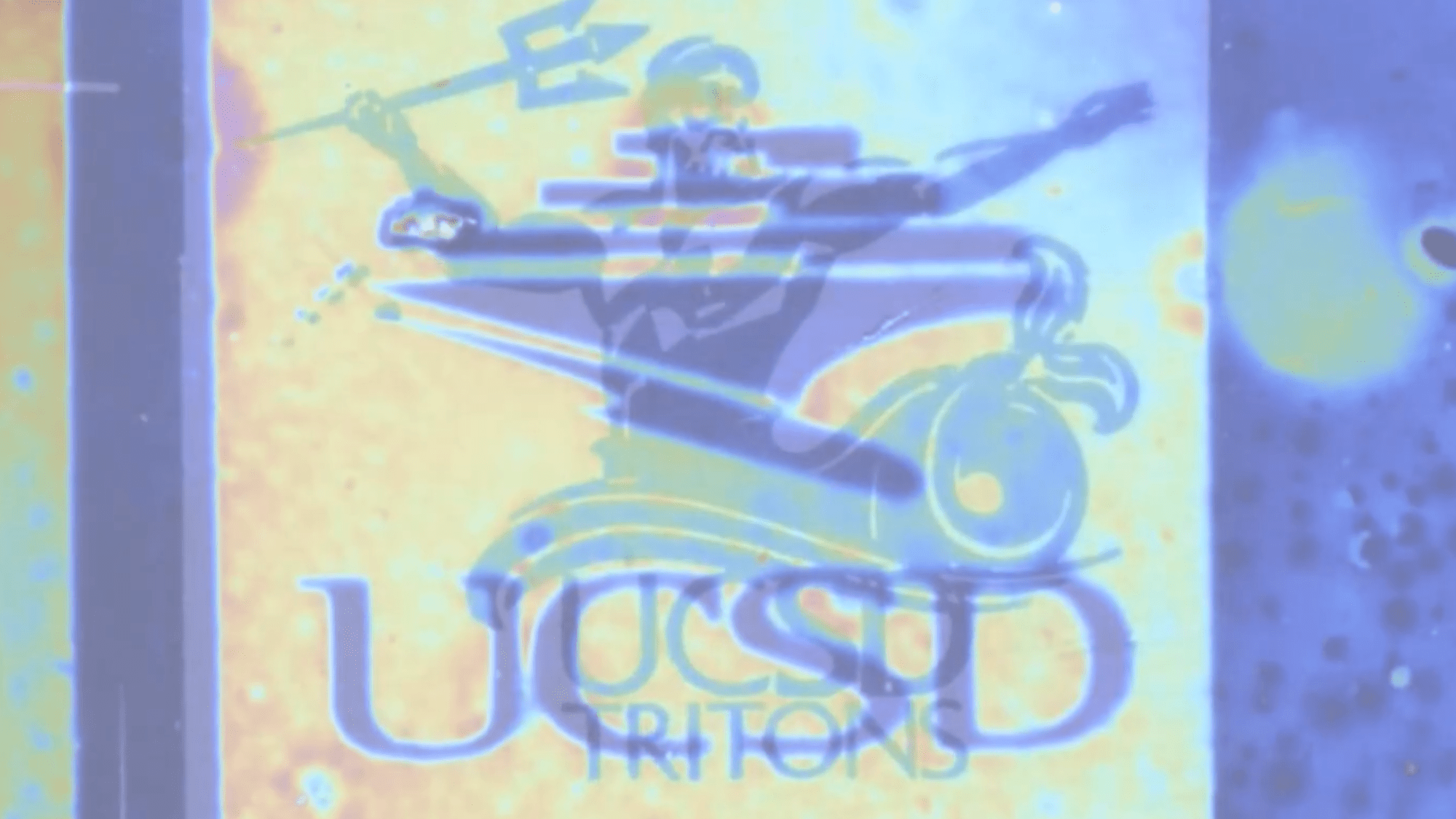
In a video demonstration, a clear blue image of a UCSD trident logo appears and then quickly begins to fade as the area around it brightens. After only a few seconds in, the UCSD library logo emerges. The image then fades back to the man with the trident before switching back once more to the library logo.
Hiding a message in plain sight
The chip consists of two separate hydrogel layers. The bottom layer, made of a phase-changing material called antimony trisulfide, essentially acts as a canvas onto which lasers can etch messages. These can be text or, as in the example above, full images. The top layer is made of a softer hydrogel material called azido-grafted carboxymethyl cellulose. This layer swells in humid conditions and shrinks in dry ones, which is why the hidden message becomes visible.
The transformation of the UCSD Triton logo to the UCSD library logo. Left to right: The UCSD Triton logo is visible at a 40% humidity level; the UCSD library logo begins to appear and overlap the Triton logo at a 60 percent humidity level; the UCSD library logo is solely visible at an 85% humidity level; and both images are overlapped at a 95 percent humidity level. Image: NDAO Lab
The first, low-humidity image or message is visible when humidity levels are at or below 40 percent. As humidity levels approach 60 percent, the hidden message starts taking shape. It is then fully visible at 80 percent humidity. The image reveal is also accompanied by a color shift due to small gaps between the two hydrogel layers. When the top layer swells and expands, the increased space between the layers alters the way light reflects off them, resulting in a shift from blue to red.
Of course, for any of this to work, a spy or other user would need to operate in an area with a predictable climate. Blowing on a message in a tropical environment where the air is already thick with moisture probably won’t do the trick. Still, in a pinch, it might beat having to write out long, intricate messages on finicky invisible ink.
Popular YouTuber and aircraft enthusiast Ramy RC built and flew what he’s calling the world’s largest remote-controlled (RC) version of a Boeing 777-9X jet. It’s not just big for an RC toy, it’s big, period.
With a wingspan of 33 feet and weighing 630 pounds, it’s roughly the same size as a human-piloted Cessna 150. The RC Boeing 777-9X may look identical to the real aircraft on the outside, but the plane is made mostly out of CNC-milled foam and carbon fiber. It has five actuators controll
Popular YouTuber and aircraft enthusiast Ramy RC built and flew what he’s calling the world’s largest remote-controlled (RC) version of a Boeing 777-9X jet. It’s not just big for an RC toy, it’s big, period.
With a wingspan of 33 feet and weighing 630 pounds, it’s roughly the same size as a human-piloted Cessna 150. The RC Boeing 777-9X may look identical to the real aircraft on the outside, but the plane is made mostly out of CNC-milled foam and carbon fiber. It has five actuators controlling the flaps, working landing gear, and is fully electric. In testing, the behemoth was able to taxi around a tarmac, lift off, and land several times.
Ramy has made a bit of a name for himself in the over-the-top RC plane-building world. He started off building models on his kitchen floor with limited time and resources, and videos of those early builds took off online. His audience has helped him scale up and pursue increasingly ambitious RC plane designs full-time. To date, he has over 200 videos showcasing massive RC versions of a ViperJet, a Boeing 787-9, and a C-17 Globemaster. Ramy’s most recent build prior to the new Boeing was the world’s largest RC Airbus A380, which came in at a staggering 800 pounds with a 32-foot wingspan.
The entire plane was built out of sections and 3D molded foam and attached together. Image: Ramy RC.
The Boeing 777-9X build started, like others, with a digital 3D model scaled down to 1/7 the size of the actual jet. With the proportions locked in, Ramy and his team then used a CNC mill to cut out separate foam parts for the plane’s fuselage, nose, and wings. Each section was reinforced with carbon fiber sheeting and sprayed with a thin layer of plastic for protection. Long runs of wiring were threaded through the plane to power systems like the wing flaps and landing gear doors. The whole aircraft is propelled by a pair of large electric ducted fans mounted where the real jet’s engines would sit.
Ramy decided to take a ride on top of his plane, Flintstones style. Image: Ramy RC .
Once assembled, Ramy used a remote control to taxi the plane around his outdoor tarmac. To drive home just how absurdly large the thing is, Ramy himself climbed on top and straddled his creation as it rolled around the facility. Once the team felt confident it was airworthy, they painted it white and blue with bold Boeing lettering along its side.
Ramy entrusted the plane’s maiden flight to a surprise guest: filmmaker Tyler Perry. The director is also an avid RC enthusiast and has credited these jumbo models like Ramy’s for helping him conquer his fear of flying. With the controller in his hands, the RC Boeing slowly powered up and its ground wheel started churning. It drove toward the end of the tarmac, then pitched up and went airborne, the buzz of its electric fans heard from the ground. Perry flew the plane for a few passes before bringing it down for a smooth landing worthy of a movie.

 Login
Login