Bringing Japanese culture to the table in a delicious and heartwarming way.
Japan has a wide variety of cultural values that underpin society in ways that are often unseen, and that includes the concept of mottainai. Literally translating as “wasteful“, this mindset holds a deep sense of regret when the potential value of something isn’t fully realised, and it encourages people to reuse, recycle and avoid unnecessary waste whenever possible, especially when food with gods is believed to be in
Bringing Japanese culture to the table in a delicious and heartwarming way.
Japan has a wide variety of cultural values that underpin society in ways that are often unseen, and that includes the concept of mottainai. Literally translating as “wasteful“, this mindset holds a deep sense of regret when the potential value of something isn’t fully realised, and it encourages people to reuse, recycle and avoid unnecessary waste whenever possible, especially when food with gods is believed to be involved.
Now Starbucks is bringing the concept of mottainai to the table by creating a new set of Frappuccinos made with mottainai bananas. So-called as the bananas were destined for landfill, due to superficial skin blemishes and size issues that prevent them from being sold through mainstream channels, Starbucks is now putting this fruit to good use, and saving tonnes of bananas in the process. After incorporating imperfect fruit in the recently released Banana Affogato Frappuccino, the chain is now giving us another way to enjoy the taste of bananas while helping the planet, with a brand new release called the Honey Banana Frappuccino.
▼ The new drink, which contains real honey, is priced at 687 yen (US$4.30) for takeout or 700 yen for dine-in.
Starbucks describes the Frappuccino as perfectly balanced, with juicy banana notes and a rich honey sweetness coming together to create a delectable “golden flavour“. At the bottom of the cup, you’ll find pulp made from mottainai bananas for added sweetness and texture, while white chocolate-flavoured syrup, honey, and banana powder, also made from mottainai bananas, is blended into the milky body of the drink. Finished with a topping of whipped cream and honey, the Frappuccino has a rich, mellow flavour and luxurious taste that makes it ideal for early summer.
While the new drink is said to be delicious as is, Starbucks recommends altering the taste with a couple of customisations. By adding chocolate chips and chocolate sauce, the slightly bitter taste of cocoa creates a dessert-like flavour, and by adding vanilla bean-flavoured syrup and caramel sauce you can enjoy added richness and depth.
Whichever way you have it, the new Frappuccino promises to be a dream drink for banana lovers, but it will only be on the menu for a limited time, while stocks last, from 5 June.
Source, images: Press release ● Want to hear about SoraNews24’s latest articles as soon as they’re published? Follow us on Facebook and Twitter!
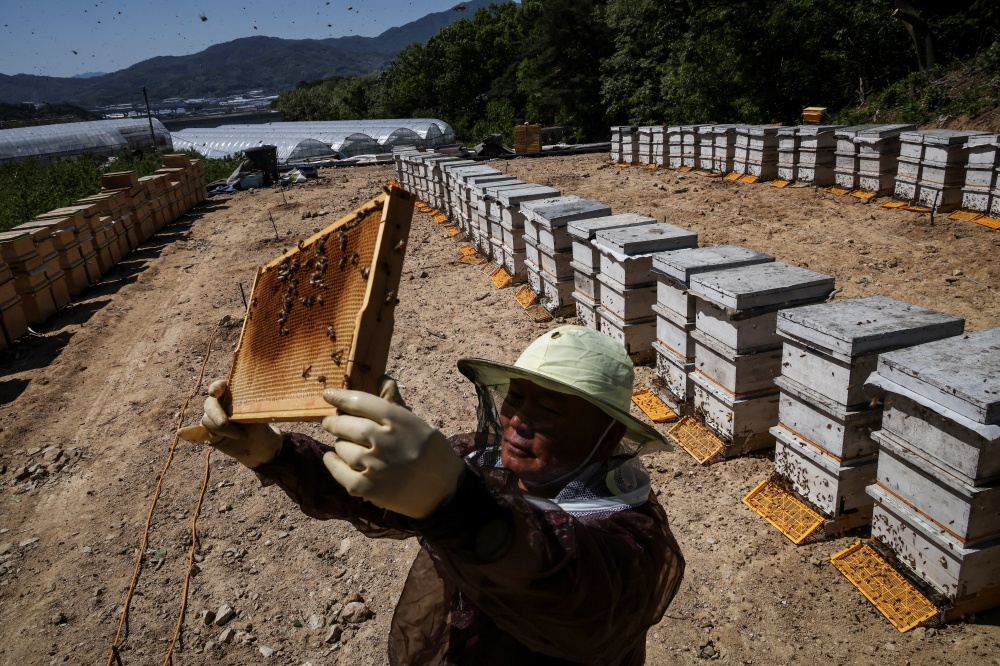
SANCHEONG COUNTY (South Korea), June 4 — Park Gyeong-je started tending beehives almost five decades ago, making it his livelihood because he liked spending time in nature. These days, however, the changing climate is making him question how much longer he and his fellow farmers can survive.The 65-year-old runs a beekeeping farm in South Korea’s southern Sancheong county, but he is a migratory beekeeper, meaning he criss-crosses the country with his hives to cha
SANCHEONG COUNTY (South Korea), June 4 — Park Gyeong-je started tending beehives almost five decades ago, making it his livelihood because he liked spending time in nature. These days, however, the changing climate is making him question how much longer he and his fellow farmers can survive.
The 65-year-old runs a beekeeping farm in South Korea’s southern Sancheong county, but he is a migratory beekeeper, meaning he criss-crosses the country with his hives to chase seasonal flower blooms. However, rising temperatures due to climate change are shortening seasons, causing flowers to bloom earlier and for shorter periods. The weather changes have also brought strong winds, which can make it harder for bees to find their way back to their hives. Mites and new diseases have also hit the bee population. “City people don’t notice seasons, but farmers feel them directly. Now it feels like only summer and winter remain,” Park told Reuters as he tended to his hives. He started with just eight back in 1979 and now has about 110. Together, they house roughly 8.8 million bees.
“Now, because of climate change, it is very hard for beekeeping farmers to survive,” Park said.
Park Gyeong-je, 65, a migratory beekeeper, stands among beehives at an acquaintance's family gravesite where he received permission from the family to keep hives as a second location for migratory beekeeping in Okcheon, South Korea, May 13, 2026. Park moves his bees around the country stacked on the back of three trucks and a van, travelling mostly in the evening while the bees sleep. Beekeepers exchange information about where flowers are in bloom and where conditions are good to figure out the best honey-making routes, he said. — Reuters pic
Global worries
Studies have shown that climate change has harmedbees globally, impacting honey production and many other outdoor and indoor crops, such as apples, strawberries and tomatoes, which need the insects for pollination. “A decline in the (bee population) ultimately affects the food supply,” said Yeh Sang-Wook, a climate and energy systems engineering professor at Ewha Womans University in Seoul. “The most fundamental substructure of the ecosystem that constitutes our entire natural world is, in a sense, being destroyed.” China was the world’s largest producer of natural honey in 2018, followed by Turkey and Argentina, according to data from the United Nations. Honey’s flavour reflects the different floral nectars the bees gather.
Most honey produced in South Korea is of the black locust variety, which is mild and floral, but there are also other types such as chestnut honey, which is less sweet and more earthy in flavour. In 2024, it exported 8.55 metric tons of natural honey, according to data from the World Integrated Trade Solution platform.
But Ministry of Agriculture data shows the number of hives for migratory beekeeping decreased by 14% to 813,279 from 2014 to 2023.
The total bee forage area in South Korea, meanwhile, was 146,000 hectares (360,000 acres) in 2020, about 70% less than it was in the 1970s to 1980s, according to data from the National Institute of Forest Science. In January, researchers from Kangwon National University warned in a pilot study that pollination activity by South Korean bees could plunge by an average of 53.5% between 2040 and 2060 compared to current levels if climate change continued.
South Korea has joined other countries including Germany and Greece with new urban projects to boost bees, including rooftop gardens. The South Korea Rural Development Administration, an agency under the agriculture ministry, told Reuters it was planning to breed stronger honeybees that can withstand climate change, plant trees that are attractive to bees because of their abundant nectar and introduce ‘smart beekeeping’ technologies.
Bees fly around Park Gyeong-je, 65, at the first location for migratory beekeeping in Gimcheon, South Korea, May 5, 2026. Park runs a beekeeping farm in South Korea's southern Sancheong county, but he is a migratory beekeeper, meaning he criss-crosses the country with his hives to chase seasonal flower blooms. However, rising temperatures due to climate change are shortening seasons, causing flowers to bloom earlier and for shorter periods. The weather changes have also brought strong winds, which can make it harder for bees to find their way back to their hives. — Reuters pic
More needs to be done
Park moves his bees around the country stacked on the back of three trucks and a van, travelling mostly in the evening while the bees sleep.
Beekeepers exchange information about where flowers are in bloom and where conditions are good to figure out the best honey-making routes, he said.
“In the past there were big climate differences between southern and central regions, so it was very good for producing honey. But now, because of global warming, flowers seem to bloom all at once nationwide,” he said.
Once Park finds the flowers and gets the neighbours’ consent, he releases the bees, wearing a hat with a mesh veil as he watches them extract the flowers’ nectar to take back to the hives and turn into honey. But while Park used to make four trips across South Korea to harvest black locust honey, as a result of premature blooming he now makes only two and honey production takes place on only one to two months of the year.
Park Gyeong-je, 65, a migratory beekeeper, checks the growth of the bee colony at his beekeeping farm in Sancheong, South Korea, February 21, 2026. Park runs a beekeeping farm in South Korea's southern Sancheong county, but he is a migratory beekeeper, meaning he criss-crosses the country with his hives to chase seasonal flower blooms. However, rising temperatures due to climate change are shortening seasons, causing flowers to bloom earlier and for shorter periods. The weather changes have also brought strong winds, which can make it harder for bees to find their way back to their hives. — Reuters pic
“Compared to the 1990s or early 2000s, the honey harvest has decreased by about 70%,” he said. “In the past it took about 20 to 23 days and we harvested 8 to 9 times. Now we can only do so 4 to 5 times.”
Farmers have been using artificial methods to try and increase the bee population but Park said he hoped institutions like South Korea’s agriculture ministry could research and supply technology to help bees survive the winter better as well as improve the management of temperature differences.
The ministry said it was investing a total of 48.6 billion won ($32.3 million) through to 2030 for research aimed at restoring bee health.
The number of households running bee hives plunged by more than a third from 2005 to the end of 2024, but Park is determined to carry on. He intends to expand the scale of his beekeeping operation by introducing smart farming systems including cameras inside the hives to provide real-time updates on the bee colonies’ growth.
His second daughter has also taken an interest in beekeeping and he is training her to take over the business one day.
“So as long as I stay healthy, I will keep beekeeping until the day I die. And even if I were to die and be born again as a human, I would still want to be a beekeeper,” Park said. — Reuters
These delicious cookies combine all the flavors you love in the buttery Greek dessert, packed into a healthy little oatmeal cookie. While honey counts as added sugar, it’s not refined. Still, it’s important to consume it in moderation. Our RD recommends 25g or less of added sugar per day so with only 5g added sugar these cookies make a perfect dessert that can fit into a healthy meal plan (1).
Active time: 15 minutes | Total time: 1 hour
Honey-Sweetened Baklava Cookies
Ingredients
1/2 cup (113
These delicious cookies combine all the flavors you love in the buttery Greek dessert, packed into a healthy little oatmeal cookie. While honey counts as added sugar, it’s not refined. Still, it’s important to consume it in moderation. Our RD recommends 25g or less of added sugar per day so with only 5g added sugar these cookies make a perfect dessert that can fit into a healthy meal plan (1).
Active time: 15 minutes | Total time: 1 hour
Honey-Sweetened Baklava Cookies
Ingredients
1/2 cup (113g) unsalted butter
1/2 cup (160g) honey
1/2 cup (65g) walnuts, chopped
1/2 cup (60g) pistachios, shelled and chopped
1 teaspoon cinnamon
1/2 teaspoon salt
1/4 teaspoon ground cloves
1 egg
1 teaspoon vanilla extract
1/2 cup (60g) whole-wheat pastry flour or whole-wheat flour
1/4 teaspoon baking soda
1 1/2 cups (148g) oats
Directions
Preheat oven to 350°F (177°C). Line two baking sheets with parchment paper and set aside. Melt the butter in a large sauté pan over medium-low heat. Continue to cook, swirling pan occasionally, until the foam subsides and the butter begins to turn golden brown and smells nutty, about 3 minutes.
Add the honey, walnuts, pistachios, cinnamon, salt and cloves and bring to a simmer. Cook, stirring constantly, until syrupy, about 2 minutes. Pour into a large mixing bowl and set aside to cool to room temperature, about 30 minutes.
Add the egg and vanilla to the honey mixture and stir to combine. Add the flour and baking soda and stir until no traces of flour remain. Add the oats, stirring to combine. The mixture will be very stiff.
Drop the batter by rounded tablespoonfuls 2 inches (5cm) apart on the prepared baking sheets. Bake, rotating baking sheets from top to bottom halfway through baking, until crispy on the edges and golden brown, 14–18 minutes, watching carefully during the last few minutes to make sure the cookies aren’t burning. Transfer to a wire cooling rack and let cool. Store in an airtight container for up to 1 week.
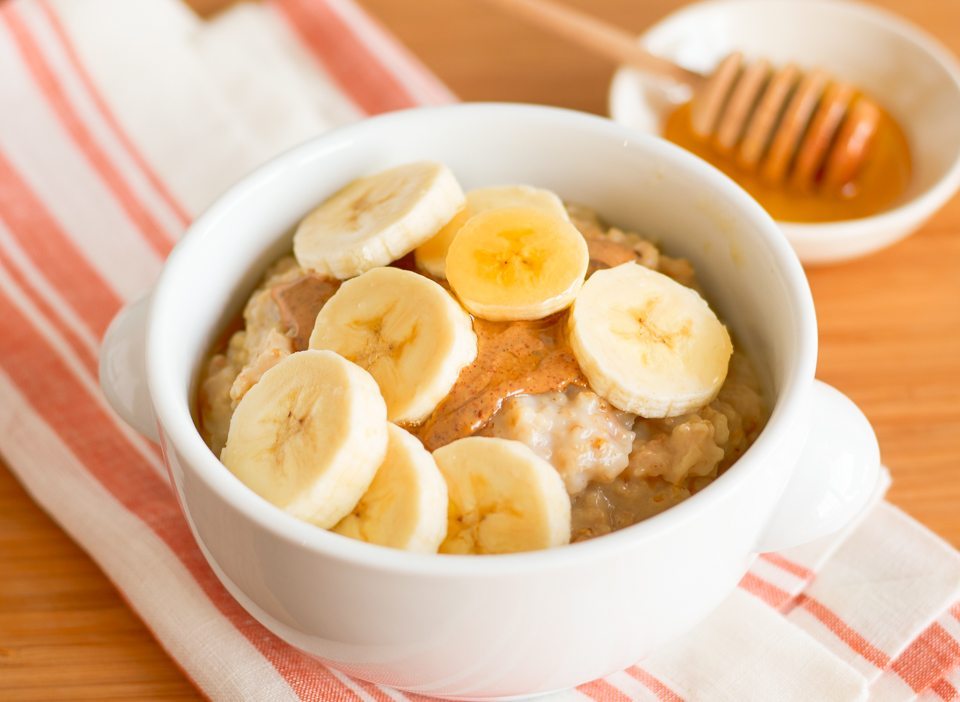
Say hello to your new breakfast bestie: the slow cooker. Use it to make our simple slow-cooked banana-nut oatmeal by adding pantry staples like oats, milk, nut butter and honey. This satisfying breakfast will keep you full for hours.
Active time: 5 minutes | Total time: 8 hours + 5 minutes
Slow Cooker Banana-Nut Oatmeal
Ingredients
Cooking spray
1 cup steel cut oats
3 cups water
1 cup low-fat (2%) milk
1/4 tsp salt
2 medium bananas, sliced
2 tbsp almond butter
2 tbsp honey
Directions
Lightly
Say hello to your new breakfast bestie: the slow cooker. Use it to make our simple slow-cooked banana-nut oatmeal by adding pantry staples like oats, milk, nut butter and honey. This satisfying breakfast will keep you full for hours.
Active time: 5 minutes | Total time: 8 hours + 5 minutes
Slow Cooker Banana-Nut Oatmeal
Ingredients
Cooking spray
1 cup steel cut oats
3 cups water
1 cup low-fat (2%) milk
1/4 tsp salt
2 medium bananas, sliced
2 tbsp almond butter
2 tbsp honey
Directions
Lightly coat a 4-quart slow cooker with cooking spray. Combine the oats, water, milk, and salt in the slow cooker. Cover and cook on low for 8 hours.
Spoon about 1 cup of oatmeal into 4 bowls. Top evenly with banana slices and drizzle with almond butter and honey.
Say goodbye to store-bought granola because you can now make your own using six simple pantry ingredients. Just toss rolled oats, oil, honey, vanilla, cinnamon and walnuts together then bake to a golden perfection.
Active time: 10 minutes | Total time: 35 minutes
Nutty Granola
Ingredients
6 cups (480g) rolled oats
1/4 tsp salt
1/2 cup (112g) canola oil
1/2 cup (160g) honey
2 tsp vanilla
2 tsp cinnamon
2 cups (234g) walnuts, roughly chopped (almonds work well too)
Cooking spray
Directions
Prehe
Say goodbye to store-bought granola because you can now make your own using six simple pantry ingredients. Just toss rolled oats, oil, honey, vanilla, cinnamon and walnuts together then bake to a golden perfection.
Active time: 10 minutes | Total time: 35 minutes
Nutty Granola
Ingredients
6 cups (480g) rolled oats
1/4 tsp salt
1/2 cup (112g) canola oil
1/2 cup (160g) honey
2 tsp vanilla
2 tsp cinnamon
2 cups (234g) walnuts, roughly chopped (almonds work well too)
Cooking spray
Directions
Preheat the oven to 300°F (149°C).
In a large bowl, combine the rolled oats and salt.
In a separate microwave-safe bowl, combine the oil, honey, vanilla, and cinnamon. Microwave for 30 seconds to soften the mixture, then whisk until well combined. Pour over the oat mixture and stir thoroughly to coat.
Add the walnuts and stir to combine. Spread the mixture evenly on a baking sheet coated with nonstick cooking spray.
Bake for 25 minutes, stirring every 10 minutes to ensure even browning, until the granola is golden brown.
Allow the granola to cool completely on the baking sheet, breaking up large clusters as needed. Store in an airtight container for up to 1 month.
raaen99 posted a photo:
Cavendish Mews is a smart set of flats in Mayfair where flapper and modern woman, the Honourable Lettice Chetwynd has set up home after coming of age and gaining her allowance. To supplement her already generous allowance, and to break away from dependence upon her family, Lettice has established herself as a society interior designer, so her flat is decorated with a mixture of elegant antique Georgian pieces and modern Art Deco furnishings, using it as a showroom fo
Cavendish Mews is a smart set of flats in Mayfair where flapper and modern woman, the Honourable Lettice Chetwynd has set up home after coming of age and gaining her allowance. To supplement her already generous allowance, and to break away from dependence upon her family, Lettice has established herself as a society interior designer, so her flat is decorated with a mixture of elegant antique Georgian pieces and modern Art Deco furnishings, using it as a showroom for what she can offer to her well heeled clients.
Today is Tuesday and in the kitchen of Lettice’s flat Edith, her maid-of-all-work, and Mrs. Boothby, Lettice’s charwoman* - who has come from her home in Poplar to do all the hard jobs Edith doesn’t do around the flat – are taking tea before commencing on their chores around the flat. Edith is grateful that unlike her previous positions, she does not have to scrub the black and quite chequered kitchen linoleum, nor polish the parquetry floors, not do her most hated job, black lead the stovetop. Mrs. Boothby does them all without complaint, with reliability and to a very high standard. She is also very handy on cleaning and washing up duty with Edith after one of Lettice’s extravagant cocktail parties. Edith’s only complaint is Mrs. Boothby’s heavy smoking in the flat’s kitchen, so whilst Edith takes her tea as she stands at the deal kitchen table cutting tart cases from some freshly made dough, Mrs. Boothby sits in a chair by the slightly ajar door leading from the kitchen out into the back outdoor delivery stairs where she blows at least some of her flumes of grey pungent smoke go as she draws contentedly on her latest cigarette as she peruses The Times and sips her own tea with noisy slurps.
Emblazoned on the front page, the main headline in bold black capital letters reads ‘GENERAL STRIKE** CALLED OFF’, with smaller headlines on individual articles beneath stating ‘Dramatic Peace Visit to Premier – Miners’ Executive Decision’, ‘Miners’ Defeat’ and ‘T.U.C.*** Basis for Renewal of Coal Negotiations’. Behind the upheld broadsheet, curlicues of greyish white smoke drift into a ray of mind morning sunshine pouring through the window, and Mrs. Boothby unleashes one of her heavy, fruity coughs, which causes the newspaper to shake in her hands, crumpling noisily.
Edith sighs. “Thank goodness that’s all over.”
Mrs. Boothby lowers the newspaper and looks quizzically at Edith. “What?” A puff of grey billowing smoke is cast forth from her cracked lips as she speaks. Her thin, pale face, heavy with a myriad of wrinkles and jowls twists questioningly. “Thank goodness what’s over, Edith dearie?”
“That,” Edith replies, nodding her head at The Times front cover as she presses her flower shaped cutter into the dough. “The General Strike.”
“Oh,” Mrs. Boothby acknowledges, shifting the newspaper in her hands so she can glance again at the headlines. “Oh that.”
“You must be pleased it’s over now too, Mrs. Boothby.”
Mrs. Boothby stares at the newspaper print for a few moments, her brow furrowing with concentration, almost as if it is the first time she was made aware of them.
“After all, you were the one who said you didn’t have time for the miners’ strike when it didn’t involve you.”
“Well,” she finally replies, coughing deeply again and clearing her throat. “Well dearie, I must say I’m glad the general disruption’s over, and I can catch the omnibus**** from ‘ome up the top of Tottenham Court Road.”
“Not all the disruption is over,” Edith interrupts Mrs. Boothby. “I am still struggling to get some of the staples for the pantry from Mr. Willison’s grocery*****. I’m only grateful that Hilda had spare flour for me to borrow to make these tarts.”
“Ooooh!” Mrs. Boothby enthuses before drawing on her cigarette again. She exhales another tumble of smoke like a steam shovel****** as she adds, “Luverly! What kind ‘a tarts you makin’, Edith dearie?”
“I’m making jam tarts for Miss Lettice and her guest this afternoon, but I’ll have enough dough spare to make a few treacle tarts for us*******.”
“Oh luverly!” Mrs. Boothby opines again. “I’m quite partial to a sweetheart*******.” She slurps her tea, and then adds, “Especially with me Rosie-Lee*********.”
“Well, you can’t have one now, Mrs. Boothby, but you can have one at lunch,” the young girl picks up the cut out dough and drops it lightly into an empty slot in the greased patty pan**********. “And one to take home, to Ken.” Edith smiles ass she mentions Mrs. Boothby’s grown-up disabled son.
“Ta,” Mrs. Boothby says, before her face crumples. “’Ere! What about a sweetheart for me to take ‘ome ‘n all?”
“I won’t be able to make enough spare for you to take two home, Mrs. Boothby, unless you take home the one I’m offering you with lunch.”
“’Ow many of them jam sweethearts youse makin’ will Miss Lettice ‘n ‘er guests eat, then?”
“It’s Mr. Bruton coming to tea, and he’s very partial to my jam tarts, Mrs. Boothby, so I always need to make extra.”
“Couldn’t ya make a nice give ’n take, instead?”
“A what, Mrs. Boothby?” Edith asks as she glances with wide eyes at the older woman.
“A give ’n take – cake, Edith dearie. Couldn’t cha make ‘em a cake instead?”
“Oh!” Edith chuckles as she understands a new piece of Cockney rhyming slang. “Oh no, Mrs. Boothby. A cake would require even more flour, and eggs too, which seem to be in short supply at Mr. Willison’s just now, as well as flour.”
“Yes, we was ‘it pretty ‘ard by food shortages in Poplar too.” Mrs. Boothby replies, nodding sagely. “’N far worse than ‘ere, I reckon, if a few eggs ‘n some flour all youse got to complain about.”
“Oh, I don’t doubt it, Mrs. Boothby. The East End always seems to have less of everything.”
“Except poverty and illnesses.” the old Cockney remarks wryly. “But as we’s all used to it in Poplar, so we knew we couldn’t rely on the government to ‘elp us. We ‘ad ter ‘elp ourselves***********.”
“What did you do, Mrs. Boothby?” Edith pauses in her task to listen to the older woman.
“Nahw, don’t you worry your pretty little ‘ead ‘bout Ken ‘n me, Edith dearie.” Mrs. Boothby lets the paper drip into her lap and wags the index finger of her left hand at Edith. “We done alright, Ken ‘n me.” She smiles wistfully. “I guess we’s ‘ardened by the lean times we’ve ‘ad over the years, so I’m like a squirrel,” She pauses for a moment and considers. “Nah, I’m probably more a rat than a squirrel, scavenging about places I clean up ‘ere in the West End where so much good food goes to waste, that I manage to keep a bit of food stocked by for a rainy day. Plus me and Lil Conway next door – you remember Lil don’t cha, Edith dearie?”
“Yes Mrs. Boothby, I remember your neighbour, Mrs. Conway. She’s the one you give the remnants of soap bars to, to wash the clothes and bodies of the children she looks after for the people around you.”
“That’s ‘er, Edith love!” Mrs. Boothby smiles warmly. “She’ll be chuffed that you remember ‘er. Anway, we pooled resources, as she tries to keep a bit of food aside for a rainy day too, so we didn’t starve, nor go wivvout much.”
“Well, I’m relieved to hear that, Mrs. Boothby. I’d imagine Ken would be beside himself if he didn’t get enough food, and he’d make trouble for you.”
“That ‘e would, dearie.” Mrs. Boothby chuckles. “You know my Ken so well nahw, don’t cha? You got a soft spot for ‘im ‘n all.” She wags her finger admonishingly at the young maid. “Spoil ‘im you do. Books to read and treacle sweethearts what ta ‘ave wiv ‘is tea.”
“I know Mrs. Boothby,” Edith admits. “But I can’t help it. I enjoy it.”
“I know you do, Edith dearie, but one day you’ll ‘ave other littluns what you’ll be wantin’ to spoil, ‘specially once youse married.”
“Shhhh!” Edith cries, raising her finger to her lips.
The old Cockney woman leaps in her seat and nearly spills some tea on the black and white chequered linoleum floor of the kitchen. The brittle ashy end of her cigarette breaks off and scatters on the floor instead.
“I still haven’t told Miss Lettice about that,” Edith whispers back. ‘And I don’t want her to know until Frank and me have set a date .”
“Sorry Edith dearie.” Mrs. Boothby replies in a hushed hiss. Then, clearing her throat a little awkwardly she returns to normal volume with another fruity cough as she changes the subject. “Anyway, goin’ back to Miss Lettice and her guests, well, they’s greedy buggers, scoffin’ the lot of tarts like that.” The old cockney mutters and shakes her head as she stubs out her cigarette in the black Bakelite************ ashtray.”
“You can say what you like, Mrs. Boothby,” Edith replies, sighing with relief as she watches the older woman snuff out her cigarette. “But Miss Lettice is my mistress. She must come first.” Her shoulders slump as she watches Mrs. Boothby fish out another rolled cigarette from the pocket on the front of her colourful floral printed pinny. “It’s the natural order of things.”
“Yes,” Mrs. Boothby hisses from between her teeth as she holds her cigarette between her lips whilst she fetches out her box of Swan Vestas*************, striking a match to then light her second cigarette. “The natural order. Them what’s got plenty first and then us last.”
“Now you’re starting to sound like Frank, Mrs. Boothby.” Edith chuckles. “Don’t tell me that the General Strike has turned you into a radical! I don’t know if I could manage Frank, Hilda, and you, Mrs, Boothby.”
Mrs. Boothby draws pleasurably upon her lit cigarette, making the embers on the end glow and the thin cigarette paper crackle as more of it is consumed by her sucking upon it. She then snorts two plumes of acrid smoke down her nostrils as she chuckles herself. “Na! I ain’t no radical, Edith dearie.” She pauses and reflects on the headlines again. “But I’ll tell you what I do fink.”
“And what’s that, Mrs. Boothby?”
Edith busies herself rolling out the last bit of pastry to try and fill an extra empty round in her patty pan to make a full tray of twelve, and thereby be able to send Mrs. Boothby home with two treacle tarts.
“Well, I may not get into all this political stuff, not ‘avin’ the vote************** to ‘ave my say, but, I think the Conservative government*************** behaved appallingly towards the poor miners, and I ain’t got no admiration for Mr. Baldwin no more****************. ‘E done wrong by them, ‘is own people, by not makin’ any concessions to ‘em. “Ow’s ‘e like to work longer ‘ours for nuffink. No wonder they’s still strikin’ up north, even if we ain’t dahwn ‘ere in London.”
“Yes, Frank has expressed the same opinion.” Edith unscrews a jar of strawberry jam and begins to drop a heaped teaspoon full into each of the prepared tart cases. “And I don’t think he’s wrong. I feel for their plight as well. As you say, Mrs. Boothby, working for longer and being paid less is nothing short of unfair. All the same, I do feel that the General Strike was too much.”
“Too much, Edith dearie?”
“Yes, Mrs. Boothby.” Edith replies resolutely. “I firmly believe that, as a general rule, we are law aboding citizens, otherwise how could we have an Empire on which the sun never sets*****************? I think that the strikers went too far and created too much disruption in attempting to force the government's hand******************.”
“Well, you may be right ‘bout some of that, Edith dearie, but I’ll tell you somefink else. Our local Whig******************* member for Towers ‘Amlets********************, Mr. Charlie Hatchett better watch out where ‘e goes in ‘is constituency. ‘E ain’t too popular dahwn Poplar way right about nahw.”
“Whyever not, Mrs. Boothby?”
“Well, it’s not like ‘e did anyfink to ‘elp the poor miners. They’s in a worse position nahw than they was before the strike.”
“But that’s not Mr. Hatchett’s fault, Mrs. Boothby. His party is in opposition, so doubtless Mr. Baldwin and his government overruled any attempts he made to defend the workers.”
Mrs. Boothby tuts and shakes her head. “Well, people round my way reckon ‘e’s a bit on the nose now, and ‘e ain’t no man of the people like ‘e campaigned on. If I could vote, I wouldn’t vote for ‘im right nahw, an’ that’s a fact.” She nods seriously as her mouth thins to become a mean little line dividing her upper and lower parts of her wrinkled face.
“Well,” Edith says as she finishes her spooning of jam into the tart cases and opens the tin of treacle and begins to spoon the thick and gooey golden sugary stuff into the remaining four empty cases. “I think that no matter what has or hasn’t happened, the sooner life returns to normal in the aftermath of the Great Strike, the happier I’ll be, and that’s a fact. I have a life to get on with, and I’d prefer to live it in peace and harmony.”
“And enough flour to make an extra treacle tart for me to take ‘ome.” Mrs. Boothby adds, stubbing out the end of her last cigarette.
Proudly Edith lifts the tray of twelve tarts off the scrubbed pine surface of the kitchen table and holds it up for Mrs. Boothby to see. In the patty pan there are eight strawberry tarts with fluted edges and four treacle tarts, also with fluted edges.
“Cor!” Mrs. Boothby gasps. “You’ve dunnit Edith dearie! You managed to make me an extra treacle sweetheart!”
Edith smiles at Mrs. Boothby proudly. “Only just, Mrs. Boothby, but I managed.”
“Luverly!” Mrs. Boothby enthuses as she looks at the tarts with hungry eyes.
*A charwoman, chargirl, or char, jokingly charlady, is an old-fashioned occupational term, referring to a paid part-time worker who comes into a house or other building to clean it for a few hours of a day or week, as opposed to a maid, who usually lives as part of the household within the structure of domestic service. In the 1920s, chars usually did all the hard graft work that paid live-in domestics would no longer do as they looked for excuses to leave domestic service for better paying work in offices and factories.
**The 1926 General Strike was a nine-day nationwide stoppage in the United Kingdom between the third and twelfth of May. It was called by the Trades Union Congress (TUC) to support over a million coal miners facing wage cuts and longer hours. Following "Black Friday" in 1921, miners faced a lockout after refusing "not a penny off the pay, not an hour on the day" wage reductions and longer hours. About one point seven million workers paralysed transport, printing, and heavy industries temporarily. Prime Minister Stanley Baldwin's Conservative government declared a state of emergency, using volunteers and the military to maintain essential supplies and transport. The government produced the British Gazette to counter the strikers' message. The TUC ended the strike on May the twelfth, 1926, fearing it was moving toward a revolutionary, anti-democratic action. The miners remained locked out until the autumn, eventually accepting lower pay and longer hours, without securing any concessions.
***The Trades Union Congress (TUC) is the national umbrella organization for trade unions in the United Kingdom, representing the majority of affiliated unions and millions of workers. Founded in 1868, and playing a major role in the 1926 General Strike, the TUC acts as the voice of British trade unionism, lobbying government, campaigning for worker rights, and fostering unity among workers. The TUC played a crucial role in forming the Labour Representation Committee in 1900, which later became the Labour Party in the United Kingdom.
****An omnibus is the original Nineteenth Century term for a large horse-drawn carriage or bus, meaning it was for all people. Being a Victorian, even though my the 1920s, buses were generally known as motor buses, with the horse-drawn variety long since replaced with petrol powered ones, Mrs. Boothby would have been likely to have continued to call them omnibuses because that was what she would have called them in her youth.
*****The General Strike was short lived, lasting only nine days, so there were not lasting food shortages in London in the immediate aftermath of the strike. Whilst transport was crippled and food deliveries were disrupted during the strike, the government’s emergency measures, including the establishment of regional food control officers in 1925 and military-escorted supply convoys during the strike, prevented severe food shortages. There were however, unavoidable disruptions to supply chains as life and deliveries returned to normal, so whilst there were not food shortages as such, there were some products and foodstuffs that were less available in the days following the General Strike.
******A steam shovel is a large, steam-powered excavating machine invented by William Otis in 1839, designed to dig and move massive amounts of soil or rock. Popular in the late 19th and early 20th centuries, these machines used cable-operated buckets and were essential for building railways, canals, and mining, eventually being replaced by diesel shovels in the 1930s.
*******Treacle tarts are enjoyed across society today, but they had their roots as a thrifty, lower-class staple before becoming a universally beloved British gastronomic classic. Because they were made from simple ingredients—bread, golden syrup, and pastry—they were a popular, high-calorie, and inexpensive treat. The lower classes in the 1920s—particularly working-class families in urban areas—often had high-calorie and high-fat diets, but these diets were typically low in essential vitamins and variety, often described as "deficient" rather than nutritious. Whilst the affluent began embracing a more "moderate," health-focused diet during this period, the poor relied on calorie-dense, inexpensive fillers to keep hunger at bay and give them strength to perform hard work.
********Sweetheart is rhyming Cockney slang for a tart.
*********Rosie-Lee is Cockney slang for tea, and it is one of the most well-known of all Cockney rhyming slang.
**********A patty pan is a small, shallow, and often scalloped-edged baking tin or paper cup used for making individual, bite-sized pastries, jam tarts, fairy cakes, or savoury patties. Historically, these pans were designed for small savory "patties" or pastries, but are now widely used for baking delicate sweets like mince pies, mini tarts, and butterfly cakes.
***********During the 1926 General Strike, East Enders faced more acute food shortages than places like the West End of the city. Therefore, citizens relied on local community and solidarity, for organising and distributing food, often done through strike committees, which generally implemented a system based on need. Workers took control of food distribution (like milk), while the government used the army to escort lorries.
************Bakelite, was the first plastic made from synthetic components. Patented on December 7, 1909, the creation of a synthetic plastic was revolutionary for its electrical nonconductivity and heat-resistant properties in electrical insulators, radio and telephone casings and such diverse products as kitchenware, jewellery, pipe stems, children's toys, and firearms. A plethora of items were manufactured using Bakelite in the 1920s and 1930s.
*************Swan Vestas is a brand name for a popular brand of ‘strike-anywhere’ matches. Shorter than normal pocket matches they are particularly popular with smokers and have long used the tagline ‘the smoker’s match’ although this has been replaced by the prefix ‘the original’ on the current packaging. Swan Vestas matches are manufactured under the House of Swan brand, which is also responsible for making other smoking accessories such as cigarette papers, flints and filter tips. The matches are manufactured by Swedish Match in Sweden using local, sustainably grown aspen. The Swan brand began in 1883 when the Collard & Kendall match company in Bootle on Merseyside near Liverpool introduced ‘Swan wax matches’. These were superseded by later versions including ‘Swan White Pine Vestas’ from the Diamond Match Company. These were formed of a wooden splint soaked in wax. They were finally christened ‘Swan Vestas’ in 1906 when Diamond merged with Bryant and May and the company enthusiastically promoted the Swan brand. By the 1930s ‘Swan Vestas’ had become ‘Britain’s best-selling match’.
**************The Representation of the People Act of 1918 granted the right to vote to women over thirty years of age who met minimum property qualifications (such as being a householder or married to one) or were university graduates. This enfranchised approximately eight and a half million women. However, women like Edith and Mrs. Boothby, not being property owners did not receive the vote until the Representation of the People (Equal Franchise) Act was introduced by government in 1928. This bill lowered the voting age for women to twenty-one, regardless of marital status or wealth, finally giving them the vote on the same terms as men.
***************In 1926, the United Kingdom was governed by the Conservative Party, led by Prime Minister Stanley Baldwin. Baldwin’s second ministry (1924–1929) held power during the 1926 general strike, and the nation was under the reign of King George V.
****************In working-class areas of London, such as Hackney and Poplar, there was strong sympathy post the General Strike for the miners, who were seen as having been treated "abominably" by mine owners. Many recognised that if the miners' pay was cut, other workers would be next. When the Trades Union Congress (TUC) called off the strike on May 12, 1926, without securing a deal, many supporters in London felt a sense of "disbelief, then anger". This was seen as a "betrayal" of the miners by their own leaders. Despite the strike’s collapse, support did not vanish. Sympathy shifted from active industrial action to supporting the miners and their families, who were left to survive on their own until November, facing severe hardship.
*****************Although not exclusively, the term an “Empire on which the sun never sets” most commonly is used when referring to the vast British dominion covering nearly a quarter of the earth's landmass, including India, Australia, Canada, and large parts of Africa, making the phrase literally true due to worldwide time zones.
******************Many ordinary Londoners, despite their sympathy, believed that while the miners' situation was dire, the strikers had gone too far in attempting to force the government's hand. The general sentiment was that the strike was a "noble fight" in theory but a "futile gesture" that ended in a major, and sometimes bitter, defeat for the workers.
*******************Historically, the British Liberal Party evolved from the Whigs. While Tories became the Conservative Party, the Whigs merged with radicals and Peelites in the 1850s to form the Liberals. The Whigs championed constitutional government and, over time, progressive reform, distinguishing them from the traditionally conservative Tories.
********************The London constituency of Tower Hamlets includes such areas and historic towns as (roughly from west to east) Spitalfields, Whitechapel, Bethnal Green, Wapping, Shadwell, Mile End, Stepney, Limehouse, Old Ford, Bow, Bromley, Poplar, and the Isle of Dogs (with Millwall, the West India Docks, and Cubitt Town), making it a majority working class constituency in 1925 when this story is set. Tower Hamlets included some of the worst slums and societal issues of inequality and poverty in England at that time.
This comfortable domestic kitchen scene is a little different to what you might think, for whilst it looks very authentic, it is made up entirely of 1:12 size dollhouse miniatures from my miniatures collection.
Fun things to look for in this tableau include:
The eggs, including the those broken in the bowl are all 1:12 artisan miniatures with amazing attention to detail.
On Edith’s deal table is a floured wooden chopping board on which she has rolled her dough, and is now busily cutting out flower shaped rounds with her cutter to create fluted tart cases in the patty pan to the left of the tray. Both pieces are 1:12 miniature artisan pieces made in the United Kingdom by an unknown artist. I acquired them from Kathleen Knight’s Doll’s House Shop in the United Kingdom. The blue and white pottery shell shaped spoon rest and the “enamel handled” spoon in the foreground. The tin of Macfie’s Finest Black Treacle, two jars of P.C. Flett and Company jam, are also 1:12 artisan miniatures made by Little Things Dollhouse Miniatures in Lancashire, with great attention to detail paid to their labels and the shapes of their jars and cans. There is a jar of Golden Shred Marmalade and Hale’s honey on the counter in the background which also come from Little Things Dollhouse Miniatures.
Robert Andrew Macfie sugar refiner was the first person to use the term Golden Syrup in 1840, a product made by his factory, the Macfie sugar refinery, in Liverpool. He also produced black treacle.
P.C. Flett and Company was established in Kirkwall in the Orkney Islands by Peter Copeland Flett. He had inherited a small family owned ironmongers in Albert Street Kirkwall, which he inherited from his maternal family. He had a shed in the back of the shop where he made ginger ale, lemonade, jams and preserves from local produce. By the 1920s they had an office in Liverpool, and travelling representatives selling jams and preserves around Great Britain. I am not sure when the business ceased trading.
Golden Shred orange marmalade still exists today and is a common household brand both in Britain and Australia. It is produced by Robertson’s. Robertson’s Golden Shred recipe perfected since 1874 is a clear and tangy orange marmalade, which according to their modern day jars is “perfect for Paddington’s marmalade sandwiches”. Robertson’s marmalade dates back to 1874 when Mrs. Robertson started making marmalade in the family grocery shop in Paisley, Scotland.
Edith’s Windsor chair is a hand-turned 1:12 artisan miniature which came from America. Unfortunately, the artist did not carve their name under the seat, but it is definitely an unmarked artisan piece.
In the background you can see a very modern and up-to-date 1920s gas stove. It would have been expensive to instal at the time, and it would have been the cook’s or maid’s pleasure to cook on and in. It would have included a thermostat for perfect cooking and without the need of coal, it was much cleaner to feed, use and clean. It is not unlike those made by the Roper Stove Company in the 1920s. The Roper Stove Company previously named the Florence-Wehrle Company among other names, was founded in 1883. Located in Newark, Ohio, the company was once the largest stove producer in the world. Today, the Roper Stove Company is a brand of Whirlpool.
The bright brass kettle on the stove comes from a miniature specialist stockist overseas.
On the bench in the background is a toaster: a very modern convenience for a household even in the early 1920s, but essential when there was no longer a kitchen range on which to toast the bread. Although toasters had been readily available since the turn of the century, they were not commonplace in British kitchens until well after the Great War in the late 1930s. Next to the toaster is a biscuit barrel painted in the style of English ceramic artist Clarice Cliff which is a hand painted 1:12 miniature made by Karen Ladybug Miniatures in England. It contains its own selection of miniature hand-made chocolate biscuits! Next to that stands a bread crock which is part of the same set from which the flour canister in the foreground comes from. The white porcelain teapot is covered with a snig fitting tea cosy, which has been hand knitted in fine lemon, blue and violet wool. It comes easily off and off and can be as easily put back on as a real tea cosy on a real teapot. It comes from a specialist miniatures stockist in the United Kingdom.

 Login
Login