Normal view

San Diego mosque shooting reflects how online rhetoric, media depictions and political discourse contribute to increased Islamophobia

People comfort one another near the scene of a shooting outside the Islamic Center of San Diego on May 18, 2026, in San Diego. AP Photo/Gregory Bull

Many Muslim Americans are fearful following a shooting at the Islamic Center of San Diego that left three worshipers dead. Investigators reportedly found hate speech and anti-Islamic writing inside the vehicle of the suspected shooters, who killed themselves soon after the attack.

The director of the Islamic Center, Taha Hassane, condemned the attack while also encouraging individuals to respond with tolerance and love. “All of us are responsible for spreading the culture of tolerance, the culture of love,” he said, while lamenting the conditions that had led to such violence.

The attack comes just one week before the celebration of Eid al-Adha, an annual festival celebrating the Prophet Abraham’s – Ibrahim in Arabic – willingness to sacrifice his son in obedience to God, and the conclusion of the annual Hajj – the pilgrimage to Mecca, one of the five pillars of Islam.

It also comes on the heels of ongoing tensions in the Middle East and increasing political rhetoric in the United States. Republicans in Congress held hearings during the week of May 13, 2026 titled “Sharia-Free America.” This reflects a long-standing anti-Muslim trope that portrays Muslims as invaders who want to impose sharia – Islamic religious law – on all Americans. Many Muslim Americans are concerned because the rise of anti-Muslim bigotry among politicians has been mostly met with silence.

Muslim Americans have been warning that the increased rhetoric targeting Islam and Muslims endangers their community. As a scholar who studies Islamophobia and its impact on Muslim Americans, I have observed how the war with Iran intensified anti-Muslim sentiment online. A study by the Center for the Study of Organized Hate found that in the first six days of the conflict, the average number of Islamophobic posts on X jumped from an average of 2,000 posts daily to 6,000.

Research consistently shows that negative portrayals of Muslims shape public attitudes toward them and can lead to increased discrimination, psychological harm and hate crimes like the shooting in San Diego.

Increase in Islamophobia

Islamophobia in the United States tends to surge during global conflicts, political campaigns and terrorist attacks. Human Rights First, an organization that works to promote human rights in the U.S. and abroad, documented surges in Islamophobia in 2015 following the Syrian refugee crisis, when a large number of people were displaced. That same year the 2015 attacks in Paris and shooting in San Bernardino, California, intensified public anxiety about terrorism. A surge in crimes against Muslims followed.

Islamophobic rhetoric in the U.S., in which Muslims were often framed as a security threat, intensified during Donald Trump’s 2016 presidential campaign and continued into his first presidency. Burton Speakman, a scholar of digital media, and I found an increasing acceptance of such rhetoric among the political right in social media posts from 2016-19.

Social media posts and comments showed an increasing use of dehumanizing language toward Muslims. In a study I conducted in 2020, a majority of 830 Muslim Americans reported encountering the most Islamophobic content on Facebook, followed by Twitter and Instagram. This shift was also reflected in the language and coverage of Islam in right-wing media, which often portrayed Muslims as invaders wanting to impose sharia and as a drain on social welfare.

Mainstream media can also amplify negative depictions of Muslims by often discussing Islam within the context of terrorism and portraying Muslims more negatively than other racial, ethnic or religious minority groups.

Hate crimes tend to increase alongside Islamophobic rhetoric. During 2016, a period with high rates of Islamophobic rhetoric, there were 307 reported incidents – the highest recorded number since immediately following 9/11. The numbers dropped in 2017 but were followed by an increase in 2024 with the start of the Israel-Hamas war. That year, 288 anti-Muslim hate crimes were reported.

A 2025 poll found that 63% of American Muslims reported experiencing religious discrimination, with many reporting at least one such incident every year since 2016.

Mental health of Muslim Americans

The cumulative effects of Islamophobia have an impact an American Muslims’ mental health and access to care.

A woman wearing a headscarf speaks with another woman reclining on a bed, who is also wearing a headscarf.
Higher rates of depression among Muslim Americans are associated with Islamophobia. triloks/ E+ via Getty images

Numerous studies since 9/11 link the high rates of discrimination experienced by the Muslim American community to higher rates of depression. Experiences of discrimination also lead some Muslim Americans to believe they are not viewed as being American.

Thirty-one percent of participants in my 2020 study described the impact of social media on their mental health. Many said they avoided displaying their Muslim identity in social media posts, supporting a Muslim political candidate on social media, or even sharing religious content or videos. Some just withdrew – 27% deactivated or deleted their social media accounts.

In addition, many Muslims reported feeling discouraged from seeking both physical and psychological treatment from non-Muslim providers. This leads Muslim Americans to significantly underutilize available services compared to other ethnic and religious minority groups.

A 2015 study found that nearly one-third of Muslim Americans reported experiencing discrimination in health care settings, which has an impact on their trust in providers. The majority reported rude treatment by providers, insensitivity regarding modesty requirements, or having their pain disregarded. One participant in that study said: “Going into a surgery, health care providers didn’t recognize the importance of me keeping my hijab on and wanting most of my body covered.”

In my 2023 study, a number of participants described personal experiences with mental health professionals who seemed not to see them as individuals beyond their religious affiliation. One participant described a provider as being “quick to attribute problems” to religion or culture. “I worry about them stereotyping and end up feeling as if I’m on the defense,” this participant said.

My most recent study, conducted in 2024, which is currently under review, asked 325 Muslim Americans who had used any psychological services about their health-seeking behavior: 56% said they were worried about provider bias; 57% were worried about being misunderstood.

Following Trump’s travel ban targeting several Muslim countries in 2017, a study conducted by researchers at the Yale School of Public Health found that many Muslim Americans skipped their primary care appointments. At the same time, their visits to the emergency room went up.

Addressing the challenges

In response, a number of initiatives have emerged at the local and national levels.

One approach involves increasing mental health literacy within Muslim communities and creating networks of mental health professionals working with Muslim clients.

For example, mental health professionals and community leaders are working to increase mental health literacy both digitally and through in-person education. Muslim community members learn about symptoms of mental health disorders through training, such as Mental Health First Aid. Online directories of Muslim mental health providers have also been created.

Another approach involves training mental health professionals. A team at Stanford University has created a six-part training module that provides therapists with knowledge of religious norms and an opportunity to reflect on their own possible biases.

Finally, Muslim researchers and providers have begun to develop therapies and resources that integrate Muslim beliefs and spiritual approaches with treatment. These include psychotherapy that is inspired by the Quran, the teachings of the prophet and spiritual practices such as self-reflection, prayer and mindfulness.

A vulnerable community

The war with Iran has fueled an increase in anti-Muslim rhetoric that has increasingly spilled into political discourse. In February 2026, for example, U.S. Rep. Randy Fine of Florida posted on X that “the choice between dogs and Muslims is not a difficult one.” In another post he wrote, “We need more Islamophobia, not less.” Similarly, U.S. Rep. Brandon Gill of Texas called for stopping the entry of “Muslims immigrating to America.”

The shooting at the Islamic Center of San Diego has deepened fear of harassment and violence among an already vulnerable community.

Muslim Americans can often feel powerless in the face of such hostility. Greater public awareness, stronger advocacy and efforts to address the mental health impacts of anti-Muslim hatred are critical for a community that already feels vulnerable.

This is an updated version of an article first published on April 17, 2026.

The Conversation

Anisah Bagasra receives funding from Meta for Content Policy research in 2019

How musical instruments have informed stage design over Eurovision’s history

Digital techniques like projection mapping, holograms and interactive performance now define the Eurovision contest’s production values. But this year’s UK act Look Mum No Computer has a more retro approach to technology.

A musician and YouTuber, Look Mum No Computer builds experimental synths from vintage equipment, sometimes even parts from toys and games consoles. His past projects include synths built into Sega Megadrives and Gibson Les Paul guitars, an orchestra of Star Wars robots, and his most popular YouTube video, a Furby orchestra.

Working for the past two years on our book Designing Eurovision: Performance Scenography on an International Stage, we have had the opportunity to track the history of Eurovision design and its current innovations.

Eurovision’s rules on musical performance and on-stage instruments would not always have accommodated an act like Look Mum No Computer, who tours with his own modular synth. In its early days in the late 1950s and 60s, all entries had to be performed by a live concert orchestra – limiting how far composers could follow transatlantic rock’n’roll trends.

The contest’s rules are determined by the European Broadcasting Union (EBU), which has overseen the annual contest for its member broadcasters since 1956. In 1973, the EBU began allowing prerecorded backing tracks, but insisted all instruments had to appear on stage. This rule allowed bands, like Yugoslavia’s Korni Grupa in 1974, to perform with their guitars and drums or to combine these with orchestral accompaniment like ABBA’s winning 1974 performance.

Electronic dance music was not such an easy fit when it started appearing in the 1990s. In 1996, the requirement for all instruments to be on camera meant Gina G’s UK entry Ooh Aah, Just A Little Bit had to bring PCs on stage.

Phasing out live orchestras altogether after 1998 upset some fans but modernised Eurovision’s sound. This move gave contest producers more space to employ new digital stage technologies, including video walls and LED floors. These made the broadcast more spectacular but dramatically increased its costs and environmental impact. It also caused issues of competitiveness since better-funded nations could invest in high-end digital staging with international creative teams, while those with lower budgets must be much more resourceful to be competitive.

Well before this transformation into a mega-event, however, musical instruments that were likely new to many Eurovision audiences were made focal points in how performances were staged. Switzerland’s 1976 entry by acoustic folk band Peter, Sue and Marc featured a clown playing a barrel organ. The Guadeloupian steel drums on Joëlle Ursull’s 1990 French entry White And Black Blues anticipated the staging of many percussion-driven pop acts that used traditional ethnic instruments in the 2000s.

Since on-stage instruments are played to prerecorded tracks and not wired for sound, Eurovision performances can feel different for instrumentalists than vocalists, who must always sing live – one rule that has endured throughout Eurovision’s history. All backing vocals also had to be live until 2021, when the EBU first allowed recorded backing during COVID.

Instruments on stage today are part of a much more complex scenography, harnessing the latest in lighting and digital design. The Norwegian folk metal band Gåte in 2024 presented a full digital spectacle, including video wall effects of crashing waves, dramatic lighting, and camera angle switches synced to their drum blasts. It also included the physical feat of guitarist Magnus Børmark throwing his instrument two metres into the air.

Eurovision’s “liveness” as a broadcast depends on complex technical programming and weeks of rehearsal to ensure every version of a contest performance is consistent, and meets competition rules. Asking how Look Mum No Computer’s work might translate to the Eurovision stage underlines how the contest’s relationships between musical instruments and digital design can make us reflect on what makes performances live and how technology has helped to visualise sound.

The Conversation

Catherine Baker received funding from the British Council to research the cultural relations and soft power of the Eurovision Song Contest in 2023. This article is based on a separate project and does not represent any previous project partners' views.

Amy Skinner does not work for, consult, own shares in or receive funding from any company or organisation that would benefit from this article, and has disclosed no relevant affiliations beyond their academic appointment.

Public trust in Australian police is declining. COVID sparked it – but there’s more to the story

New research released by the New South Wales Bureau of Crime Statistics and Research (BOCSAR) confirms what many Australians may already feel: trust in police is declining.

BOSCAR has been surveying NSW residents since 2007 and in releasing the 2026 data, the organisation states:

Confidence in the NSW criminal justice system has declined significantly since 2019 across all measures, and is at the lowest levels since BOCSAR’s survey began in 2007.

This comes just months after a 2026 Australian Productivity Commission report found perceptions of fair and equal treatment by police has declined more than 20% in the past decade.

So why is this happening, and why does it matter?

Why trust is crucial

Trust is one of the foundations policing relies on. When trust falls, people are less likely to report crime, cooperate with investigations, or call for help when they need it.

Our recent research examined anti-police sentiment in Australia. We found some Australians have moved well beyond simple frustration with police into genuine fear, anger and in some cases, an apathetic perspective that nothing will change.

When people feel that way, they disengage from the very system designed to keep them safe.

This matters right now because governments across Australia are debating youth crime, domestic violence, bail laws and community safety, and many are reaching for tougher “law and order” responses as the answer.

But tougher laws won’t deliver safer communities if the public doesn’t trust the institution responsible for enforcing them.

COVID was a pivotal moment – but not the whole story

COVID was a major turning point. Officers were tasked with enforcing lockdowns, mask mandates and border restrictions, placing them directly in conflict with frustrated communities.

For many Australians who previously had little direct contact with police, suddenly encountering them as enforcers of mask mandates and lockdown rules was a jarring experience.

As one former officer reflected in our recent research, the COVID response:

would be the single most negative thing the police force has done […] that’s had the biggest negative effect.

The pandemic also brought policing into the public spotlight in a way rarely seen before.

Our research found there was a dramatic increase in the overall volume of policing stories in the news during this period, and public commentary became noticeably more negative, especially around issues of trust, fairness and respect.

Constant news and social media coverage meant policing issues were front and centre for Australians in a way they hadn’t seen before.

But COVID was just one part of a much bigger picture. A number of other pressures were building at the same time that help explain why trust has fallen.

How trust can be eroded

Trust in government and institutions has been declining in the past decade across much of the western world.

Political polarisation, misinformation and a growing segment of the population who are deeply sceptical of state authority all added fuel to the fire.

At the same time, a series of high-profile incidents involving alleged police misconduct or excessive force intensified public calls for greater accountability and police reform. When isolated high-profile events occur, the public tends to generalise the behaviour of individual officers to the wider institution, leaving the broader policing organisation carrying the reputational damage for the actions of a few.

Police are also being asked more and more to respond to situations that go well beyond traditional law enforcement, including complex social issues and mental health crises.

Many of these situations involve layers of trauma, disadvantage, vulnerability, and systemic failures that policing alone cannot easily solve.

Our research found frustration with how police handle these issues is among the most consistent and emotionally charged themes in anti-police sentiment.

While some of that criticism is justified, it is worth acknowledging police are filling gaps left by overstretched health, social and community services. Even the most well-intentioned officer may struggle when sent to a mental health crisis or a complex family situation without the right training or support.

Police are often the first to acknowledge this tension.

What needs to change?

Trust can be rebuilt, but it requires more than tougher policing or better public relations.

Our research suggests everyday interactions matter. People are more likely to trust police when officers are respectful, explain their decisions and treat people fairly.

Trust is often built (or damaged) through small, routine encounters.

Accountability must also be genuine: public confidence is weakened when misconduct goes unpunished.

Transparent and independent oversight bodies that are genuinely separate from police organisations, and greater openness, are essential steps. The perception that police “investigate themselves and let each other off” (as one former officer in our research bluntly described it) is deeply corrosive to public trust.

At the same time, police cannot solve every social problem alone.

Expanding co-responder models – where mental health workers and social services respond alongside or instead of police to appropriate calls – may reduce pressure on officers and improve outcomes for communities.

Ultimately, the picture is serious, but it is not hopeless. Police are working hard under difficult circumstances and many communities still want a strong and trusted police service. But trust takes time, recurring commitment and reassurance.

This is a challenge – and also an opportunity.

The Conversation

For some of the cited research Katie Davenport-Klunder received funding from the Australian government through a Research Training Program (RTP) scholarship.

Kelly Hine and Nadine McKillop do not work for, consult, own shares in or receive funding from any company or organisation that would benefit from this article, and have disclosed no relevant affiliations beyond their academic appointment.

James Comey’s Instagram seashell post sits in a murky legal zone between protected political speech and criminal threat

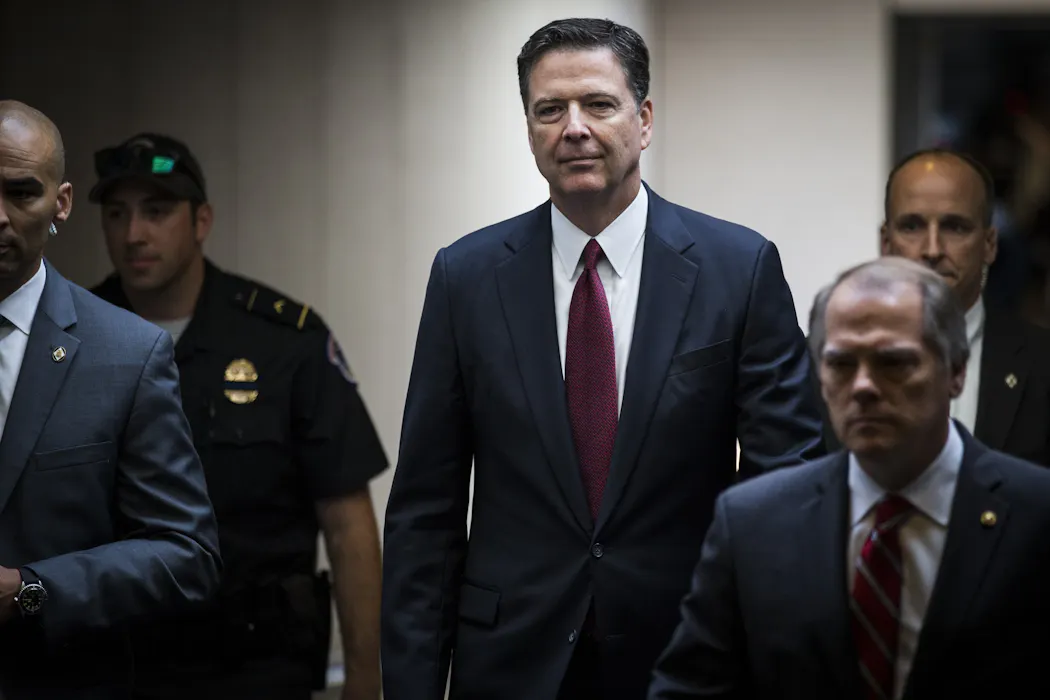
Did James Comey, former FBI director, 'knowingly and willfully' threaten, kidnap or 'inflict bodily injury upon the President of the United States'? Samuel Corum/Anadolu Agency/Getty Images

In the case of United States v. James Brien Comey Jr., the U.S. president’s security is pitted against the bedrock right to free speech enjoyed by Americans.

Two federal charges have been lodged against former FBI Director James Comey and are based on his Instagram post that depicted seashells spelling out “86 47.”

Comey’s post was interpreted by the U.S. Department of Justice as a threat to harm President Donald Trump. The indictment, obtained by the DOJ, alleges Comey violated two federal laws: 18 U.S.C. § 871, which makes it a crime to “knowingly and willfully” threaten, kidnap or “inflict bodily injury upon the President of the United States,” and 18 U.S.C. § 875, which criminalizes “communication containing any threat to kidnap any person or any threat to injure the person of another.”

Comey’s argument against the charges is likely to be twofold: (1) He lacked the requisite intent that the prosecutor needs to prove his case, and (2) even if he had the intent required by the statute, his speech is protected by the First Amendment. U.S. District Judge Louise Flanagan set Oct. 21 as the Comey case trial date.

I’m a scholar of constitutional and criminal law as well as the First Amendment. The charges against Comey exist in a legal gray area that includes the First Amendment and a series of court decisions over five decades that have gone back and forth over what dangers constitute speech that can be punished.

Three men standing in front of a curtain, flags and some official seals while one speaks at a lectern.
Ellis Boyle, U.S. attorney for the Eastern District of North Carolina, is flanked by acting Attorney General Todd Blanche, left, and FBI Director Kash Patel at a press conference on April 28, 2026, concerning charges against James Comey. Tasos Katopodis/Getty Images

Parsing the charges

In criminal law, there are generally two parts to most crimes – the criminal act and the criminal intent. The criminal act is referred to as the “actus reus.” The criminal intent is known as the “mens rea.”

Some crimes also require a particular result. For instance, murder requires a death of a person. A defendant can neither be charged with nor convicted of murder unless and until the victim dies. If the victim doesn’t die, then at most the defendant can be convicted of only attempted murder.

The criminal charges alleged in Comey’s case don’t require a result, however. The president need not be kidnapped or injured for someone to be charged with violating either of them.

But the prosecutor must still prove the criminal intent and the criminal act for both charges to stick in Comey’s case. In my view, the Justice Department will have a difficult time proving the mens rea against him.

Comey has consistently maintained that he didn’t know “86 47” implied violence against the president.

Meaning and purpose

Comey has stated he came across the shells that spelled out “86 47” while walking on a beach in North Carolina, took a picture and posted it on Instagram.

The term “86” is commonly used to mean “to throw out” or “to get rid of” in American slang. According to Merriam-Webster, the term “comes from 1930s soda-counter slang meaning that an item was sold out.”

Comey later removed the image from Instagram and posted a statement that read, “I posted earlier a picture of some shells I saw today on a beach walk, which I assumed were a political message. I didn’t realize some folks associate those numbers with violence. It never occurred to me but I oppose violence of any kind so I took the post down.”

Even though Comey has insisted that he thought it was a silly picture of shells arranged in a clever way to express a political viewpoint, the Trump administration argues that Comey not only knew the meaning of “86 47” but that he purposefully threatened the president.

What’s plausible?

The first crime charged in the indictment, 18 U.S.C. §871, requires the defendant to have “knowingly and willfully” threatened to kidnap or inflict bodily injury upon the president. This is the statute’s mens rea; the defendant must have known that he was threatening the president of the United States.

Comey’s statements suggest that he didn’t know the threatening nature of his Instagram post. Thus, he cannot be convicted of “knowingly” threatening the president if he didn’t know its meaning.

To convict Comey, the prosecutor must prove that he did, in fact, know the meaning of “86 47” when he posted it.

Comey’s career as a federal prosecutor and his tenure as the FBI director may work against him here. In my view, it’s more than plausible that Comey encountered the threatening version of the term “86” in his career. It’s also more than plausible that the term appears in documents, records and court filings that Comey has drafted and signed over his career, all of which could be used against him at trial.

But even if the Justice Department can prove Comey did, in fact, know the threatening nature of “86 47,” its case against him is not a slam dunk.

And that’s because of the First Amendment.

Testing what’s protected speech

A balding man stands in front of a soldier who is wearing a helmet.
A draft protester was convicted after declaring in 1966, ‘If they ever make me carry a rifle, the first man I want to get in my sights is L.B.J.’ His conviction was overturned by the Supreme Court. Yoichi Okamoto/PhotoQuest/Getty Images

As a constitutional law scholar, I’d expect Comey to argue that his Instagram post was protected speech.

Even though the laws charged in Comey’s case are generally valid and constitutional, criminal defendants can always argue that otherwise valid and constitutional laws are unconstitutional as applied to them and their particular case. Comey is likely to argue this in his defense, but it won’t be as straightforward as one might think.

The First Amendment is not absolute – not all speech and expression is protected by the Constitution.

In Chaplinsky v. New Hampshire from 1942, Justice Frank Murphy wrote that it’s “well understood that the right to free speech is not absolute at all times and under all circumstances.”

In 1969, the U.S. Supreme Court held in Watts v. United States that while “true threats” are not protected by the First Amendment, political hyperbole remains protected speech. The Supreme Court defines true threats as statements where the speaker means to communicate a serious expression of intent to commit an act of unlawful violence against a particular individual or group of individuals, but the speaker need not actually intend to carry out the threat.

Watts v. United States involved a threat against the sitting president of the United States, Lyndon B. Johnson. In that case, Robert Watts expressed his strong opposition to the military draft at a public rally, saying, “If they ever make me carry a rifle, the first man I want to get in my sights is L.B.J.” He was subsequently charged and convicted under the same statute, 18 U.S.C. § 871, used in Comey’s case.

The Supreme Court reversed the conviction, ultimately agreeing with Watts, who had maintained that his statement was “a kind of very crude offensive method of stating a political opposition to the President.”

As the court explained, quoting an earlier decision on press freedom, “For we must interpret the language Congress chose ‘against the background of a profound national commitment to the principle that debate on public issues should be uninhibited, robust, and wideopen, and that it may well include vehement, caustic, and sometimes unpleasantly sharp attacks on government and public officials.’”

Since Watts, countless defendants have faced similar charges for threatening the president. Many have been convicted.

In the 1970s, Eugene Hart was convicted of threatening the president after his brother reported Hart’s plan to assassinate President Richard Nixon. An appellate court affirmed his conviction, concluding that Hart’s verbal threat coupled with his detailed assassination plan couldn’t have been “uttered in jest or in the nature of a hyperbole.”

In the 1980s, David Hoffman was convicted of threatening President Ronald Reagan when he mailed a letter to the White House stating, “Ronnie, Listen Chump! Resign or You’ll Get Your Brains Blown Out.” And in 1999, Donald Adams was convicted of threatening the president when he approached the White House gates telling Secret Service officers, “I want to kill the president.”

But in those cases and others, the defendants took concrete steps that demonstrated their sincerity and conscious awareness of the threatening nature of their speech. In my estimation, both are absent in Comey’s case.

The Conversation

Wayne Unger does not work for, consult, own shares in or receive funding from any company or organization that would benefit from this article, and has disclosed no relevant affiliations beyond their academic appointment.

The market moves before Trump posts

It has long been the case that when a US President speaks, financial markets react.

But recently oil markets have been behaving a bit differently: sometimes the stock price moves before Trump posts. Millions of dollars are changing hands with some traders seeming to have made incredibly well-timed bets. Did some of them know something the rest of the market didn’t?

@realDonaldTrump made 1,341 Truth Social posts from January 25 to April 8. Our analysis of that 73-day window reveals 15 distinct events with unusual trading activity around Trump’s posts. In several of those events — including the most striking ones — the price had already moved sharply in the minutes before he posted.

➡️ Read the interactive story here

The Conversation

Timothy Graham receives funding from the Australian Research Council for the Discovery Project "Understanding and Combatting 'Dark Political Communication'", from the Universities Australia-German Academic Exchange Service Joint Research Cooperation Scheme, and from Meta Platforms Technologies.

Ella Chorazy receives funding from the Australian Research Council (ARC), for the Discovery Project 'Understanding and Combatting "Dark Political Communication"'.

Stephen Harrington receives funding from the Australian Research Council, for the Discovery Project 'Understanding and Combatting "Dark Political Communication"', and for the Discovery Project "Understanding Twenty-First Century Media Uses and Purposes".

The US and Europe are diverging on how to deal with Belarus — and that could benefit Putin’s loyal ally

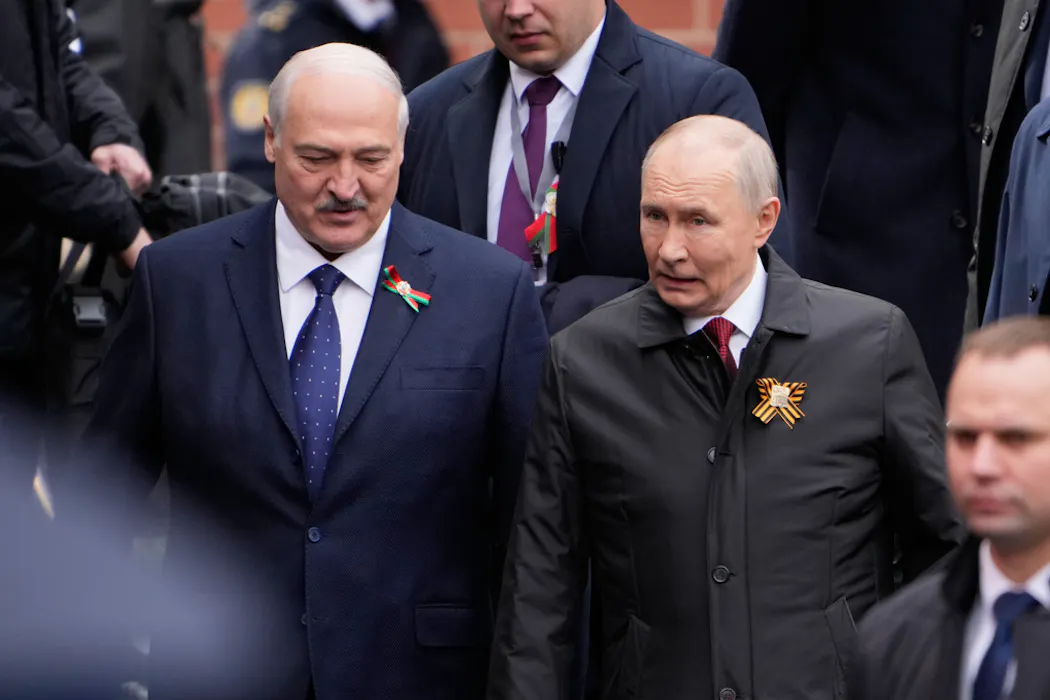
Belarusian President Alexander Lukashenko and Russian President Vladimir Putin attend the Victory Day military parade in Moscow on May 9, 2026. AP Photo/Pavel Bednyakov

When it comes to relations with Belarus, the Trump administration has been pursuing a dual approach of late.

In May 2026, President Donald Trump renewed the U.S. national emergency on Belarus, noting that the government of longtime Belarusian leader Alexander Lukashenko still posed an “unusual and extraordinary threat” to U.S. security and foreign policy.

The emergency, which in practice underpins the legal basis for targeted U.S. sanctions on the former Soviet republic, has been in force since June 2006, when President George W. Bush imposed it after a Belarusian election widely seen as undemocratic.

But just weeks before the latest renewal, the Trump administration eased U.S. sanctions on Belarus, including those affecting the country’s financial and fertilizer industries, in exchange for the release of 250 political prisoners.

This bargaining logic has history. Lukashenko has ruled Belarus since 1994 and has used political prisoners as bargaining assets with both Europe and the U.S. before, including in 2008 and 2015. The U.S. also tested engagement with the Moscow-aligned nation during Trump’s first term, when his then-secretary of state visited Belarus in February 2020 — the first such visit in 26 years.

But the mixed signals Washington is giving to Belarus stand in contrast to the United States’ allies in Europe.

Amid renewed concerns that Belarus could once again serve as a springboard for Russian attacks on Ukraine, the European Union has taken a harder line than the U.S. The bloc in April adopted a sanctions package aimed at Belarus and its ally Russian, with a strong focus on sanctions evasion, financial channels, trade restrictions and crypto. Not only does this differ from the two-track U.S. approach of sanctions and engagement, but it is also emblematic of the widening gulf of priorities between the U.S. and Europe under Trump.

As a scholar of Eastern Europe, I see the difference between U.S. and European views on Belarus as tactical in form and strategic in effect. Europe wants sanctions to constrain Belarus as part of the threat emanating from Russia. The Trump administration, however, wants sanctions flexible enough to produce visible deals. That mismatch gives Lukashenko more room to bargain and tests how much common ground remains between Europe and the U.S. on Russia.

Soldiers stands next to a securitized border wall.
Polish border guards are seen at a fence on the border between Poland and Belarus. AP Photo/Czarek Sokolowski

Europe’s security concerns

Since Russia’s full-scale invasion of Ukraine in 2022, Belarus has become far more central to European security.

In the eys of the EU, Belarus as a neighbor tied closely to Russia’s economy, military logistics and search for ways around Western sanctions.

The EU’s April 2026 package continued the bloc’s alignment of Belarus-related measures with Russia sanctions, especially in regard to enforcement and circumvention.

For the EU nations closest to Belarus, this is also about border security.

In 2025, Lithuania took Belarus to the International Court of Justice, accusing the Lukashenko government of organizing large-scale migrant smuggling into Lithuania.

Meanwhile, Lithuania, along with Estonia, Latvia and Poland, has existing or planned defense programs along NATO’s eastern flank, aimed in part at deterring potential Russian or Belarusian military incursions. Poland’s East Shield program commits US$2.7 billion to fortifications and terrain obstacles, while Estonia, Latvia and Lithuania are developing the Baltic Defense Line, which includes bunkers and obstruction elements near Russia and Belarus.

Further, in May 2026, Lithuania’s leaders were moved to bunkers after a suspected drone incursion linked to Russia’s war in Ukraine triggered an airspace alert — a reminder that border security is now a daily governance problem, not just a military planning issue.

That’s why the U.S. request in May for Lithuania, Poland and Ukraine to allow Belarusian potash transit was interpreted as pressure to carve out exceptions to the sanctions regime and reopen export corridors for potash fertilizer producer Belaruskali, rather than keep Belarus economically cut off. For Lithuania, Poland, and Ukraine, reopening transit would revive a revenue channel for Lukashenko through countries already worried about their borders with Belarus and Russia.

The US desire for quid pro quos

For the U.S., Belarus is part of a wider problem involving Russia’s war against Ukraine and the perceived danger that Belarus becomes so dependent on Russia — or China — that Western governments lose influence over its choices.

Europe’s approach continues a policy of keeping pressure on Belarus tied to pressure on Russia in a bid to restrict Russia’s options. Since the beginning of the full-scale invasion of Ukraine in 2022, and even before, Russian President Vladimir Putin has looked to Belarus to advance Russia’s strategic goals, including using the country as a staging ground against Ukraine and a way to force Ukraine and NATO’s eastern flank to devote resources to the Belarusian border.

The Trump administration has kept the legal sanctions framework in place. However, it is using it more flexibly than the Biden administration, whose approach was more closely aligned with the EU’s current sanctions-first view of Belarus as both a domestic repression problem and an extension of Russia’s war architecture.

A man in a suit sits at a desk.
President Donald Trump speaks to reporters as he signs executive orders in the White House. AP Photo/Evan Vucci

The shift under Trump is driven in part by broader trends. Years of pressure have pushed Belarus further toward non-Western partners. Belarusian trade with Russia doubled from US$29.5 billion in 2020 to $62 billion in 2025. Meanwhile, trade with China rose from $4.6 billion to more than $8.8 billion over the same period.

The same shift can be seen in the potash industry, a major source for fertilizer. Western sanctions began hitting Belarus’ potash sector in 2021, after Lukashenko’s crackdown on the 2020 protest movement, with the U.S. targeting major state-linked potash companies and Lithuania later halting transit of the fertilizer through the Baltic port of Klaipėda.

Before those restrictions on leading Belarusian potash companies, Belarus exported roughly 10 million to 11 million tons of the mineral a year through established routes to global markets. By 2025, the volume had recovered – but via alternative routes, largely through Russia. Belarus exported 11.6 million tons of potash fertilizers through Russian ports, and China became a major buyer, making Belarus Beijing’s second-largest potash supplier after Russia.

That gives the Trump administration a political and economic argument at home. It can say that the Biden-era expansion of sanctions produced few immediate political changes inside Belarus, while targeted relief has produced visible prisoner releases. Trump’s team can also present potash relief as practical at a moment when fertilizer costs are sensitive for U.S. farmers facing fertilizer shortages exacerbated by the war in Iran.

This all means the Trump administration is treating sanctions less as a stable wall of pressure and more as a lever for visible results.

How Lukashenko can exploit the EU-US split

For Lukashenko, the benefit of the transatlantic split is concrete. With the U.S., prisoners become the bargaining asset. If some are released, the U.S. can claim a result. If others remain jailed, Lukashenko keeps something to trade later. The human rights organization Viasna still counts more than 870 political prisoners in Belarus after earlier releases, which shows why the tactic works.

Lukashenka’s leverage with Europe, meanwhile, comes from perceptions of risk. In May 2026, French President Emmanuel Macron called Lukashenko and warned him against deeper involvement in Russia’s war. The call showed that Belarus has become too important to European security for European leaders to ignore.

Amid these transatlantic divergences, Belarus has been increasingly tied to Russia’s war-making capacity. Satellite imagery in early 2026 pointed to a possible Russian Oreshnik missile site in Belarus. Ukrainian officials have also said missile fragments from a May strike contained Belarusian microchips. And finally, more than 500 Belarusian industrial sites are reportedly involved in weapons production, military repairs, ammunition or logistics.

This is particularly where tactical differences between the U.S and Europe begin to harden into a political divide. The U.S. search for leverage appears to undercut Europe’s demand for pressure. Lukashenko gains bargaining power, and the West’s common position becomes harder to sustain.

The Conversation

Tatsiana Kulakevich does not work for, consult, own shares in or receive funding from any company or organization that would benefit from this article, and has disclosed no relevant affiliations beyond their academic appointment.

Trump and Lula at the White House: a relationship built on pragmatism and a broader regional calculus

Brazilian President Lula da Silva greets US President Donald Trump upon his arrival at the White House: the trip also serves a second, equally important function for Lula, as each item on the bilateral agenda maps directly onto a domestic electoral fault line. Ricardo Stuckert/PR, CC BY

For about three hours of closed-door talks between Brazilian President Luiz Inácio Lula da Silva and US President Donald Trump at the White House on May 7, 2026, many observers in the two countries held their breath. Since there was no official joint statement or press conference, they did not know what to expect. Despite the reported “chemistry” between both presidents at the United Nations General Assembly last September, bilateral tensions were far from resolved.

The meeting between both presidents could have gone many ways: on the surface, Brazil and the US currently stand more as geopolitical rivals than allies. Over the last few months, Lula has made several criticisms to what he saw as a renewed US unilateralism. The Trump administration, in turn, seems to be responsive to the former President Jair Bolsonaro family’s demands regarding free speech or organized crime.

But Lula wanted the conversation to succeed, not so much because of diplomatic concerns, but because he faces an uphill battle ahead of the October elections. His trip to Washington was, above all, a domestic political operation. Even if the meeting lacked specific results, the positive atmosphere reported by both presidents was a victory for Lula in the context of a presidential race that is already shaping up to be one of the most consequential in Brazil’s recent history.

Flávio Bolsonaro, the eldest son of the jailed former President Jair Bolsonaro, has mounted a formidable electoral challenge. Polls now show him in a statistical tie with Lula in a hypothetical runoff, which is a remarkable position for a candidate whose political inheritance includes a father convicted of attempting a coup d'état.

The far-right senator has made several trips to the United States over recent months, including an appearance at the conservative CPAC summit, projecting himself as the candidate who can restore Brazil’s relationship with Washington after years of what he characterizes as Lula’s anti-American drift. His pitch to Brazilian voters is simple and powerful: only a Bolsonaro can work with Trump.

That narrative has found purchase in a Brazilian electorate that is increasingly attentive to geopolitical alignments. This is not the Brazil of previous electoral cycles, where foreign policy was a footnote.

Trump as a lifeline

Since Trump’s return to the White House, the Bolsonarist movement has portrayed the U.S. president as a lifeline, not only capable of keeping Jair Bolsonaro out of jail but also helping his movement’s political comeback. Flávio has reportedly pledged significant concessions to Washington on rare earth minerals, narcoterrorism designations, and trade, presenting these as proof of loyalty to an administration that the Bolsonaro family views as friendly and like-minded.

Whether or not Trump reciprocates that loyalty in any meaningful way is almost beside the point. The image of members of the Bolsonaro dynasty in Washington, welcomed by the MAGA establishment, is itself an electoral asset.

This is precisely the vulnerability that Lula traveled to Washington to neutralize. By securing a White House meeting, the Brazilian president sent a clear signal to his domestic audience: the relationship with Washington is not broken, and it does not require a Bolsonaro to fix it. The Brazilian-only press conference that followed the meeting only served to reinforce this point.

But the trip serves a second, equally important function. Each item on the bilateral agenda maps directly onto a domestic electoral fault line for Lula. On trade and tariffs, Lula returns home able to claim that he is fighting to protect Brazilian exporters and consumers from the inflationary pressures of a trade war. On organized crime – specifically the potential US designation of drug gangs PCC and Comando Vermelho as foreign terrorist organizations – the president can portray himself as a defender of Brazilian sovereignty and judicial autonomy, resisting external interference in domestic security policy. On rare earth minerals and strategic resources, Lula can reframe what is, in essence, a negotiation over economic dependency as a story of Brazil’s rising geopolitical clout.

And on democracy itself, the contrast with the Bolsonaro family could not be starker: while the father languishes under house arrest for plotting a coup, they were not able to prevent Lula from being welcomed in Washington as a legitimate (and friendly) head of state.

Political pragmatism

It would be a mistake, however, to reduce Trump’s willingness to meet Lula to a mere diplomatic courtesy. The Trump administration has shown a consistent pragmatism beneath its ideological posturing. Its management of relations with Claudia Sheinbaum’s Mexico, its intermittent engagement with Venezuela, and now its reception of Lula all suggest that the White House can work with ideological opponents when strategic interests demand it.

Brazil, the largest economy in South America and a country with substantial reserves of the critical minerals that Washington covets for its industrial and defense supply chains, is too significant to be held hostage to electoral sympathies for the Bolsonaro family. There is also a broader regional calculus: as the United States asserts primacy across Latin America through what has become known as the “Trump Corollary”, having a cooperative Brazilian government is considerably more useful than a destabilized one.

None of this means that Lula’s Washington gambit will succeed electorally. Flávio Bolsonaro has proven to be a more disciplined and adaptable candidate than his father, and the transnational networks that animate the Bolsonarist movement extend well beyond Washington. A single White House photo-op carries only so much weight.

What the trip does illustrate, however, is the degree to which Brazilian electoral politics has become inseparable from the global contest over alignment, sovereignty, and great-power patronage. In that contest, Lula has made his move. It will hardly change the minds of those who, left or right, have already made up their minds about their candidates. But it shows to the centrist voter, if anything, that a pragmatic defense of Brazilian sovereignty can be much more efficient than ideological submission to foreign interests.

The Conversation

Guilherme Casarões não presta consultoria, trabalha, possui ações ou recebe financiamento de qualquer empresa ou organização que poderia se beneficiar com a publicação deste artigo e não revelou nenhum vínculo relevante além de seu cargo acadêmico.

Can ‘grip strength’ exercises actually help you live longer?

If you follow wellness channels on social media, you might’ve come across the claim that your grip strength – or how firmly you can squeeze something with your hands – can predict how long you will live.

This sounds far-fetched. Yet the science supports such a connection.

But as wellness influencers try to monetise this link, what started as something based on scientific evidence starts to get stretched. Now some influencers claim just strengthening your grip strength can help you live longer.

And it’s not just social media influencers. Mainstream media often follows some similar patterns, overlooking the complexity and nuance of the science and misrepresenting what it means for individuals.


So many ideas about what makes us sick, or keeps us well, sound plausible. Early studies might sound promising. But then something gets twisted. In this series, we investigate how a grain of truth ends up as a common health myth. And we untangle what went wrong along the way.


What the science says

The evidence consistently shows a person’s grip strength is a good indicator of their overall health and therefore can act as a proxy for how long they might live.

However, grip strength isn’t a driver of longevity. The strength of your hands doesn’t make your healthier. It indicates how robust the body is, from muscle and nerve function, to the health of your heart and veins, and how your body uses energy.

A typical way researchers have investigated the relationship between grip strength, health and longevity is to measure participants’ handgrip strength by getting them to squeeze a hand-held device called a dynamometer. Then they track participants over time, to see if they developed diseases and how old they were when they died.

For example, a study of around half a million British people aged 40–69 years found a 5kg lower grip strength was associated with an approximately 20% greater risk of dying during the follow up period, which was up to ten years.

The researchers also found muscle weakness, which they defined as having a grip strength of less than 26kg for men and 16kg for women, was associated with a higher overall risk of death as well as a higher risk of death from cardiovascular disease (heart attack and stroke), respiratory disease, chronic obstructive pulmonary disease and a number of cancers.

The link is stronger for older people

While the relationship between grip strength and health holds for all age groups, in older people it appears to be a particularly good predictor of death, heart attacks, stroke, falls and fractures.

This is because it seems to be exceptionally good indicator of age-related loss of muscle mass (known as sarcopenia), power and resilience in older people.

Consequently, some researchers suggest grip strength should be considered a “new vital sign” – alongside more traditional indicators of health such as temperature, pulse, respiration and blood pressure.

The reason grip strength is a less powerful predictor of longevity in younger people compared to older age groups is because most young people are near the upper end of physiological performance. Differences in young people’s health are relatively small compared to the “noise” introduced by measurement error or random variation.

As people age, however, their health varies much more, while the sources of error remain roughly the same. Consequently, this higher signal-to-noise ratio results in a much stronger relationship between grip strength and health in later life.

So how did this turn into hype?

The problem with the way some people communicate this is generally an issue of overreach. Things often get muddled and this association can sometimes be turned into a prescription.

When people conflate correlation with causation, they may claim that just doing exercises to improve your grip strength, without improving your overall health, can help you live longer.

But just because two variables are linked does not mean that one causes the other. Improving grip strength is not a magic path to longevity. Rather, it’s a marker or proxy of broader physiological robustness, which influences longevity.

Intriguingly, some reels and articles explain the science clearly and highlight that grip strength is a proxy and not a cause, but then, paradoxically, go on to describe ways of increasing grip strength. This undoubtedly undermines the message that the relationship is not causal.

One of the problems seems to be that influencers and journalists sometimes feel it’s not enough to just explain the science: they have to offer actionable health advice or a solution. This can lead to overreach, where advice is given that goes beyond what the evidence says.

In a nutshell

We’re all naturally drawn to simple metrics that promise insights into our health and longevity, and grip strength seems to be one of the more useful ones.

Grip strength is a simple and accessible marker that can help predict health and longevity, particularly in the elderly. But improving your grip strength in isolation won’t make you healthier or extend your life.

The most effective drivers of health and longevity remain the obvious ones: staying active, eating a balanced diet, sleeping well, maintaining social connections and managing stress.


Read more: How old are you really? Are the latest ‘biological age’ tests all they’re cracked up to be?


The Conversation

Hassan Vally does not work for, consult, own shares in or receive funding from any company or organisation that would benefit from this article, and has disclosed no relevant affiliations beyond their academic appointment.

Interest rates look set to hold, after inflation and fuel costs fell in April. But it’s unlikely to last

Inflation actually fell in Australia last month, thanks to temporary government fuel discounts that saw fuel prices come down by 7% from their record peaks in March.

New Australian Bureau of Statistics figures show the monthly consumer price index (CPI) rose 4.2% in the 12 months to April 2026 – down from 4.6% in March and lower than market expectations.

However, the underlying picture was less reassuring.

The closely watched “trimmed mean” measure rose to 3.4%, up from 3.3% a month earlier. (The trimmed mean is the average rate of inflation after “trimming” away the items with the largest price rises or falls, leaving the weighted average of the middle 70% of items.)


Australia’s latest inflation figures will give the Reserve Bank a reason to hold interest rates steady at its June 15-16 meeting, but not a reason to relax about inflation.

With fuel prices still much higher than before the Middle East war began, the risks of further spikes in inflation and more rate rises this year have not gone away.

How fuel discounts helped cool inflation

When oil prices surged following the war in Iran, which began on February 28, the immediate effect was obvious: petrol became more expensive, soaring nearly 33% higher in March.

The new ABS data showed fuel prices actually fell 7% in April. On April 1, the federal government dropped its fuel excise by around 32 cents per litre from April 1, as well as cutting road user charges for heavy vehicles.

Both of those discounts are set to end on July 1. The government is yet to decide whether to extend them.

But central banks worry less about the initial jump in fuel prices than about how higher transport and energy costs are feeding into many other prices across the economy.

Spreading oil price shocks

According to the new data, the largest contributors to annual inflation were housing, up 6.3%, transport, up 6.6%, and food and non-alcoholic beverages, up 2.8%.

These are essential parts of household budgets, which helps explain why inflation still feels acute for many families even as the headline rate has eased.

At the same time, the rise in trimmed mean inflation to 3.4% suggests price pressures are not limited to a few volatile items in the basket of goods used to measure inflation in Australia.


Read more: What exactly is inflation, and are interest rates the only option for dealing with it?


In a speech last week, Reserve Bank Assistant Governor Sarah Hunter warned this was exactly the risk policymakers were monitoring.

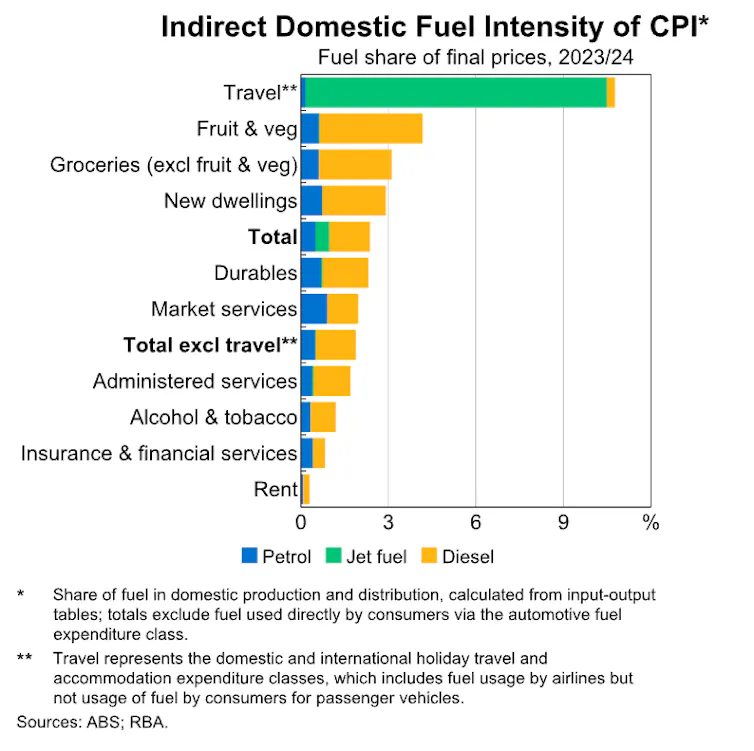
Hunter noted fuel accounts for around 2–2.5% of the cost of producing and distributing other goods and services in the CPI basket. Travel, transport and postal services, grocery items (particularly fruit and vegetables) and new home construction are all especially exposed, as Hunter highlighted with this chart.

The parts of Australia's economy most exposed to oil prices, led by travel, grocery items like fruit and vegetuables and new home construction.
The parts of Australia’s economy most exposed to oil prices, according to the Reserve Bank. RBA, May 2026

Oil also affects inflation indirectly through global supply chains of fertilisers, plastics and other industrial inputs. So higher oil prices can eventually feed into the prices of imported goods that are not obviously energy-related.

A likely interest rate hold – for now

Last month, Reserve Bank of Australia (RBA) Governor Michele Bullock warned more interest rate hikes may be on the way to fight inflation and get it back to the bank’s target of between 2–3%.

April’s softer-than-expected headline inflation number of 4.2% will reduce the case for another immediate rate rise at the bank’s June 15-16 meeting.

However, the rise in underlying inflation to 3.4% means Bullock is unlikely to sound relaxed after that meeting. Its concerns about “second-round effects” from higher oil prices have not gone away.

The Reserve Bank now faces a difficult balancing act. Higher oil prices reduce household purchasing power and slow growth. But if businesses pass rising costs through more broadly, inflation may stay above its 2–3% target for longer. That is the classic “stagflation” dilemma central banks fear.

In its May statement on monetary policy, the Reserve Bank revised up its inflation forecasts, saying it expected headline inflation to peak at 4.8%, while underlying inflation is projected to reach 3.8%. That suggests policymakers expect the oil shock to have a more persistent effect over coming quarters.

The Reserve Bank has already increased rates three times this year, lifting the cash rate from 3.6% to 4.35%.


There are now signs the economy is softening, giving the bank’s board more reason for pause.

The latest labour force data showed the unemployment rate rose to 4.5% in April, its highest level since December 2021. This is happening as households are under pressure from high interest rates, weak real income growth and elevated living costs.

Together, these figures strengthen the case for the Reserve Bank to keep rates on hold in June. But the rise in trimmed mean inflation means the Bank is still likely to emphasise caution, rather than signal Australia’s inflation problem has passed.

Looking ahead

The next few months will be critical. If global energy markets stabilise and supply disruptions ease, some inflation pressure could fade relatively quickly. That would give the Reserve Bank more confidence that inflation is moving back towards 2–3%.

But if oil prices remain elevated, or if businesses keep passing higher transport, freight and import costs through to consumers, the inflation problem could become more persistent.

The Reserve Bank is particularly alert to the possibility that repeated global inflation shocks – first the COVID pandemic, then supply chain disruptions, and now oil prices – may gradually change how businesses and households think about inflation itself.

That is why the Reserve Bank’s focus is shifting from the direct impact of higher petrol prices to the broader behavioural response across the economy.

Today’s data was therefore reassuring, but only up to a point. The headline number was better than expected. The underlying number was not.

That’s why the Reserve Bank will be cautious about declaring victory too early.

The Conversation

Stella Huangfu does not work for, consult, own shares in or receive funding from any company or organisation that would benefit from this article, and has disclosed no relevant affiliations beyond their academic appointment.

Taunting and degrading civilians in armed conflict is a clear violation of international law

Ben Gvir/X


In a video posted by Israeli National Security Minister Itamar Ben-Gvir on Wednesday night, detained activists from dozens of countries are shown kneeling on the ground with their foreheads on the floor and hands zip-tied behind their backs.

Some of the activists, who had been intercepted by Israeli forces on a flotilla in the Mediterranean Sea, are then pushed and dragged by Israeli personnel. Ben-Gvir is seen waving an Israeli flag and taunting them.

The video on his X account had a simple message in English: “Welcome to Israel”.

The video sparked widespread international condemnation. Australian Foreign Minister Penny Wong called it “shocking and unacceptable”, while the European Union’s foreign policy chief, Kaja Kallas, said the treatment of the detainees was “degrading and wrong”.

Even Mike Huckabee, the US ambassador to Israel and a stalwart supporter of Prime Minister Benjamin Netanyahu, called Ben-Gvir’s actions “despicable”, saying he had “betrayed the dignity of his nation”.

Netanyahu himself also publicly rebuked Ben-Gvir. He said Israel had the right to stop the flotilla, but the minister’s behaviour had damaged Israel’s image and did not reflect the country’s values.

Even though international lawyers like myself have expressed concern about this on multiple occasions, it bears repeating: international law matters in conflict zones.

So, what obligations does Israel have to treat those detained by its forces, and did the country violate the law?

Why were the activists detained?

Israeli forces began intercepting the Gaza-bound Global Sumud flotilla on Monday in international waters off the coast of Cyprus. Dozens of boats were stopped as they attempted to challenge Israel’s maritime blockade of Gaza.

The flotilla reportedly carried more than 400 activists from over 40 countries. Those on board included humanitarian volunteers, medical personnel, peace activists and civil society figures. Organisers said the vessels were carrying humanitarian relief supplies, including food, medicine and other aid intended for Palestinian civilians affected by the war and blockade of Gaza.

Israel disputed the flotilla’s aid-delivery purpose and described it as “a PR stunt at the service of Hamas”.

After those on board were arrested, they were reportedly subjected to violence, with some suffering suspected broken ribs and other injuries.

In a post on X, the Israeli Foreign Ministry claimed Israel was acting in full accordance with international law.

What does the law say?

Under international humanitarian law, those involved in the transport and distribution of relief supplies must be respected and protected during armed conflict. They are to be treated as civilians so long as they do not directly take part in hostilities.

Bringing aid to the civilians of Gaza does not amount to “direct participation in hostilities”. In fact, the International Court of Justice has ordered Israel to allow aid into Gaza given their obligations under the Genocide Convention.

International humanitarian law also says civilians may not be detained arbitrarily in conflict zones. If civilians are detained, however, they have certain rights under international law. They must:

Internment of civilians is only permitted when “absolutely necessary” for security reasons. It must end once those reasons no longer exist.

In addition, civilians detained during armed conflict must be treated humanely at all times.

They are to be protected from:

The phrase “public curiosity” has historically been understood to prohibit humiliating displays of detainees for propaganda, intimidation or public spectacle.

Intentional attacks against humanitarian personnel can amount to war crimes under the Rome Statute of the International Criminal Court.

Why does this matter?

The public humiliation and degrading treatment of the activists shown in the footage must be scrutinised and investigated. And Israeli officials must comply with their obligations under the law.

These protections exist precisely to preserve a minimum standard of humanity during conflict, and to ensure civilians and humanitarian actors are not stripped of their dignity for political theatre, intimidation or punishment.

When such conduct is normalised or left unchallenged, it risks undermining the broader international legal framework designed to protect all civilians caught up in armed conflict.

The Conversation

Shannon Bosch does not work for, consult, own shares in or receive funding from any company or organisation that would benefit from this article, and has disclosed no relevant affiliations beyond their academic appointment.

How much water and power will AI data centres use in Australia? Ironically, we don’t have the data to know

Daniele Levis Pelusi/Unsplash, CC BY-NC-SA

Australia’s data centre rush now rivals the mining boom. OpenAI chief executive Sam Altman last week said Australia could become a “data centre capital of the world”.

This would come at an environmental cost. Water use is a common concern. One report estimates AI centres could use billions of litres of water a year.

But what do the numbers say? Based on the value derived per megalitre, data centres look less threatening and more likely to be a highly economically productive use of water.

The bigger problems are energy and location. As a new report suggests, electricity demand from data centres could outstrip clean power from renewables and lead to new gas plants.

Before committing fully, we need granular detail on how much water and energy these centres use.

What value do we get from water?

In the 2023–24 financial year, Australian industries consumed about 17.6 million megalitres of water – about 30 times the water in Sydney Harbour.

Of this, agriculture, forestry and fishing consumed about two-thirds of the total – nearly 11.8 million ML. This water was used to produce goods valued at A$54.6 billion – roughly $4,600 for every megalitre consumed.

Compare this to “other industries”, the category covering data centres. A megalitre of water in this sector was valued at $2.3 million – 500 times more value than if used on a farm.

How much water do data centres use?

We can only make a rough estimate on water use due to a lack of clear data.

Research shows data centres need about 25ML of water per megawatt of capacity. Australia has about 300 data centres with about 1.3 gigawatts of operating capacity. Using these figures, Australia’s current data centres would use 15,000–35,000ML a year. That would be a fraction of 1% of the water used nationwide – close to a rounding error.

There are three caveats.

First, credible estimates of water use vary widely.

Second, most estimates – including this article – only count water used directly for cooling. Data centres can be remarkably frugal with this water and getting more efficient.

But data centres indirectly use substantially more in the water used to produce the electricity powering them. Coal, gas and hydro plants all need water.

Third, proposed new data centres are much, much larger than existing ones. Some are seeking between 5ML and 40ML a day.

Sydney is set for huge growth in AI data centres.

If all 41 in the pipeline or under assessment are built, they would directly use 15–20% of Sydney’s water supply within a decade.

Sydney would bear the strain on water supplies in return for an upfront economic benefit from construction and some ongoing jobs. But the economy wide $116 billion boost to GDP from AI adoption by all industries over the next ten years would be spread nationally.

It would make sense to locate data centres where water is more abundant and cheaper.

Energy is a bigger concern than water

At present, data centres use just over 2% of the electricity on the National Electricity Market.

This would almost triple to 6% within four years, according to Australian Energy Market Operator forecasts. The Clean Energy Finance Corporation estimates the figure could be 11% within a decade.

Energy use isn’t inherently bad. What matters is whether increasing demand will be met by renewables – or gas.

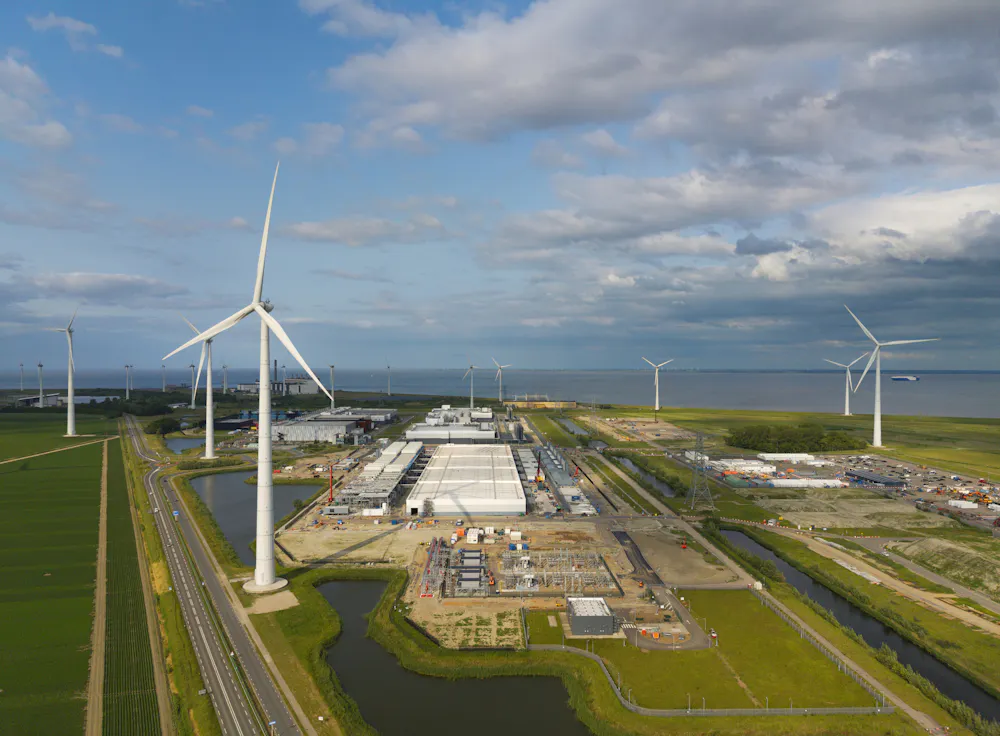
aerial view of wind turbines and a data centre warehouse set among green fields.
Data centres are hungry for energy. The question is how that demand will be met. Westend61/Getty

We need better data – on data centres

We can’t manage what we don’t measure. Data centres are a textbook example of a data gap impeding good policy.

The Australian Bureau of Statistics rolls data centres into a broader category.

This means we can’t access detailed statistics on how much water or energy data centres use. Nor how much they add to the national accounts.

The federal government has introduced new expectations on water use and efficiency for data centre operators. That’s something. But it’s not the same as a national picture that fits with existing official statistics. Only one data centre meets the new national water-efficiency rating.

Surprisingly, Australia’s National AI Plan has little focus on water and energy. State and federal water ministers have named data centres as an emerging threat to water security. A Senate inquiry is in progress.

We need to track water use better

Australia’s water accounts measure how much water every industry uses. But they don’t track how much water is lost to evaporation or value all water used. Water supply and sewerage are bundled together in even the most detailed view of the national accounts, meaning neither can be seen clearly.

So while data centres appear to be a high-value use of water, we can’t confirm it.

There are signs of change. Australia uses the international System of Environmental-Economic Accounting to track water use. This is being rewritten now, in part to address these issues. The national accounts have also begun treating damage to nature as a cost of production. Both shifts matter, no longer treating the environment as free lunch.

To finish the job, authorities will have to properly value all the water used by industries and disentangle data centre data from other industries. This would turn a noisy debate into a measurable one.

Time to keep tabs on AI

Based on the data we do have, we can say Australia’s data centre boom is neither the water villain some fear nor the cost-free miracle its promoters describe.

Instead, it looks like a high-value industry arriving at record speed which is relatively light on water use and fairly heavy on energy.

With better data in hand, the numbers – not the headlines – should decide where the next megalitre and the next megawatt should go.

The Conversation

Michael Vardon is a member of the Australian government's Technical Advisory Panel for Environmental-Economic Accounting and is on a United Nations team working on environmental-economic accounting.

If AI can translate instantly, why learn another language?

From live speech translation in video calls to auto-dubbing on TikTok, the technology to dissolve language barriers has arrived. Real-time translation powered by artificial intelligence (AI) is now embedded in everyday life.

Tools from OpenAI, Meta, Google and many others now offer near-instant translation across dozens of languages, and they keep improving.

All this raises a vital question. If machines can do this faster and more accurately than humans, is investing years in learning another language still worth it?

The logic is appealing. Humans have always offloaded cognitive work onto tools. Writing reduced demands on our memory. Calculators removed the burden of mental arithmetic. AI sits within this long tradition. Used well, it can support learning and expand access in ways that matter enormously.

But there’s a difference between using a tool to extend your capabilities and using it to avoid doing something altogether. That distinction becomes important when you are not just replacing a skill, but a form of cognitive and cultural engagement.

The effort is the point

Effort plays a central role in how we acquire knowledge.

Psychologists use the phrase “desirable difficulties” to describe challenges that may feel inefficient, but produce stronger long-term retention and understanding.

Struggling with grammar, searching for the right word, or constructing meaning across multiple languages engages brain networks that support memory, attention and cognitive flexibility. Over time, they consolidate knowledge far more deeply than passive exposure.

Sustained mental engagement contributes to what researchers call cognitive resilience – the brain’s capacity to maintain function as we age. Managing multiple languages is one form of this engagement. It requires the brain to resolve competition, monitor context and adapt dynamically.

These are not trivial demands. And they’re difficult to achieve if you just use translation tools passively, such as resolving the meaning of a foreign phrase with the click of a button.

What multilingualism research actually shows

The evidence on multilingualism is often presented as a simple “bilingual advantage”, a shorthand that obscures a more complicated picture. Some studies report benefits for attention or working memory, while others find no differences. The truth appears to be more selective.

Our recent study examined cognitive performance in 94 adults aged 18 to 83, using both visuospatial and auditory tasks across working memory, attention and inhibition. Put simply, we looked at how people process and respond to information they see or mentally map out in space (visuospatial) and information they hear (auditory). Examples include remembering sounds, focusing on visual patterns, or ignoring distractions.

Our study measured multilingualism as a spectrum, not a category. This allowed us to capture diverse language backgrounds and experiences. Multilingual participants spoke a range of languages with varying levels of proficiency and daily use, reflecting the linguistic diversity common within multicultural communities.

Across most tasks, multilinguals and monolinguals performed similarly. However, one pattern was striking. Individuals with richer, more diverse multilingual experience showed markedly better performance in visuospatial working memory. These effects were most pronounced in older people.

This suggests that multilingual experience doesn’t broadly enhance cognition, like some headlines claim. Instead, it may help preserve specific functions over time.

Separate population-level research has also linked multilingualism to later onset of Alzheimer’s disease and better overall ageing outcomes, though the mechanisms continue to be debated.

Overall, however, it appears that sustained use of multiple languages represents a form of mental activity with effects that accumulate across a lifetime.

What AI translation can’t replicate

AI translation excels at speed and accessibility. For many practical purposes, it works remarkably well. But it operates through pattern recognition, not lived understanding. It can struggle with cultural context, humour, register and emotionally embedded meaning, especially for languages with less representation in training data.

At best, AI captures literal dimensions of language while missing social ones. Consider the scene in the 2003 film Love Actually where Jamie, played by Colin Firth, delivers an awkward but sincere proposal to Aurelia in broken Portuguese.

It is moving because of the effort, vulnerability and intent his imperfect words carry. Resort to real-time translation software and what remains is information, not expression.

This is the deeper distinction: translation is not the same as participation. Learning a language involves understanding how people think, their values, and how meaning is shaped by context and history. This cultural literacy develops through interaction and experience. We can’t fully outsource that to systems that translate on demand.

The multilingual participants in our research spoke to this directly:

I definitely think in Telugu, but I remember numbers and count using English.

Afrikaans is the language of my heart and best used to express intense emotion. English is the language of business and used mostly in everyday life.

These are not descriptions of switching between translation modes. They are descriptions of inhabiting different selves.

AI will continue to change how we engage with language learning. It can personalise instruction, minimise barriers and provide feedback at scale. What it can’t do is replace the cognitive and cultural work that comes from learning a language. This work leads to a deeper relationship with how other people see the world, and with how you express yourself. And that difference still matters.

The Conversation

Olivia Maurice completed her PhD at the MARCS Institute, Western Sydney University.

Mark Antoniou receives funding from the Australian Research Council.

❌
Subscriptions