Normal view

Trump-Xi summit: 3 ways the US and China can compete without going to war

US President Donald Trump’s visit to Beijing this week may ease tensions at the margins of the US–China rivalry. But it will not change a central fact: neither side can escape the rivalry, and neither side can decisively win it.

The biggest challenge for Trump and Chinese leader Xi Jinping is whether they can compete without turning the world’s most consequential bilateral relationship into its most dangerous one. A war is not inevitable.

If Washington and Beijing want to keep their competition peaceful, they must try to accomplish a few basic things:

  • preserve military deterrence without turning it into provocation

  • channel their rivalry into institutions and public goods, such as infrastructure development, rather than a military confrontation

  • keep ideology from hardening every disagreement into a zero-sum struggle.

So, how can this be done?

1. Establish mutual restraint

Both countries will continue to build military capabilities and balance against each other. The danger comes when each side convinces itself that its actions are intended to deter hostilities, while the other interprets them as a provocation.

Nowhere is that danger greater than the impasse over Taiwan. For Beijing, Taiwan is a core sovereignty issue and a test of national resolve. For Washington, it is tied to US credibility as a security guarantor in the Indo-Pacific, regional stability, and its ability to deter coercive unification.

Both sides claim to be defending the status quo. Both believe the other is eroding it. And both are acting in ways that may be making the situation less stable.

The answer is not a unilateral concession by one side or the other. Rather, both sides need to establish mutual restraint, backed by clearer political reassurance.

For instance, China could reduce the scale and frequency of coercive military actions around Taiwan, such as military aircraft sorties, naval patrols and drone operations near the island. And the US could avoid steps that blur the line between support for Taiwan and support for formal independence.

Trust may be absent. But trust is not a precondition for stability. Clarity and restraint are.

This requires a serious framework for deterrence management, including:

  • sustained efforts to clarify red lines

  • reducing misperceptions about each other’s intentions and resolve

  • preventing competitive signalling from spiralling into a confrontation.

During the Cold War, Washington and Moscow eventually learned that an arms race without guardrails was too dangerous to sustain. Washington and Beijing have not yet reached that level of strategic maturity. They need to.


Read more: Trump-Xi summit will be no ‘Nixon in China’ moment – that they are talking is enough for now


2. Compete in safer arenas

Rivalries can be channelled into forms that are less dangerous than military conflict, and can sometimes even be productive.

That is already happening. The United States and China are competing through global institutions and alignments, from the Quad and AUKUS (on the US side) to the BRICS and the Shanghai Cooperation Organisation (on China’s side).

Both are trying to shape the rules, memberships and agendas of the regional and global orders in ways that advance their own influence and constrain the other’s.

On the surface, this can look like just another front in a new cold war. But institutional competition can be one of the safer forms of rivalry.

Competition can force institutions to adapt rather than stagnate. It can encourage new forms of regional cooperation. It can also push rival powers to provide public goods – such as infrastructure, development financing, technological investments and climate initiatives – in order to win support from others.

In infrastructure financing, for instance, China has used the Belt and Road Initiative and the Asian Infrastructure Investment Bank to expand its reach globally. The US and its partners have responded with initiatives of their own.

The competition between the two has been beneficial – and it has expanded the options available to developing countries.

This is also why a rush toward broad economic decoupling would be such a mistake. Some restrictions in sensitive sectors may be unavoidable. But a sweeping effort to sever economic ties would remove one of the few remaining guardrails in the relationship.

As long as the United States and China remain economically intertwined, both sides are incentivised to maintain stability and avoid conflict.

3. Lower the temperature

The US and China are not simply clashing over interests. They also have very different political and historical narratives.

US policymakers often cast the rivalry as a defence of the liberal order against authoritarian revisionism. Chinese leaders often see it as a struggle against containment, humiliation and foreign interference.

These are not just different rhetorical narratives. They shape what each side sees as threatening, acceptable or beyond compromise. They also help explain why the relationship has become so emotionally and politically charged.

Ideological competition is safest when it remains indirect. Neither Washington nor Beijing is likely to convert the other to its way of thinking. And neither is likely to persuade the wider world through their lectures on ideology.

The sounder strategy is to compete by example.

For the United States, it means showing that democratic governance can still deliver competence, cohesion and long-term economic vitality. For China, it means showing that its model can bring growth, social stability and international cooperation.

Both sides also need to recognise that ideological overreach is dangerous. The more Washington frames competition as a global struggle between democracy and autocracy, the more it encourages Beijing to see compromise as capitulation.

And the more Beijing wraps its foreign policy in narratives of anti-hegemony, the more likely Washington is to see its own restraint as weakness.

Engagement still matters for the same reason. If the United States and China stop talking, this ideological competition will harden and become more dangerous.

The greatest danger in the US–China competition is that both sides will come to see restraint as weakness, compromise as surrender and coexistence as impossible. Once that happens, catastrophe becomes far more likely.

The most realistic goal is not friendship, or even reconciliation. It is something harder and more modest: competition without war.

The Conversation

Kai He receives funding from the Australian Research Council and the Toda Peace Institute, an independent institute in Japan promoting policy-oriented peace research. He serves as a non-resident senior research fellow at the Toda Peace Institute.

Huiyun Feng receives funding from Australia Research Council.
Politicians have long misunderstood the ‘working class’. The rise of the far right shows how mistaken they have been

Class has always mattered, and now social democratic parties that sprung from a working class — including the Australian Labor Party – are finding out why.

Over many years, and in many countries, a growing view among political actors and within political science was that class was losing its punch. The line was something like this. The working class once voted for labour parties. The middle class voted conservative. But over many years) that difference between how the classes voted got smaller and smaller. In some places it disappeared.

The “decline of class” narrative suited the leaders of labour and social democratic parties.

They could safely adopt market-based neoliberal policies, with a human touch added, in the knowledge their base wouldn’t desert them. But their base was changing. It was becoming more middle class, more individualistic, more awake to the benefits of market solutions to complex problems.

Now, those politicians are shocked by the rise of far-right political parties that now claim to represent the working class. In Australia, One Nation is close to matching Labor — in some polls, it is already ahead.

In the United Kingdom, Reform is leading in all the polls, while the governing Labour party is below 20%. In Germany, the neo-nazi AfD is presently leading in all opinion polls, while the Social Democrats are below 14%.

In the United States, the Republican Party has gone full Trump, on an agenda with aspects that look eerily reminiscent of prewar Germany. In France, the National Rally candidate is ahead in all opinion polls for the next presidential election.

‘Blue collar’ is not the same as ‘working class’

In many countries, the labour and social democratic parties are mere shadows of their former selves.

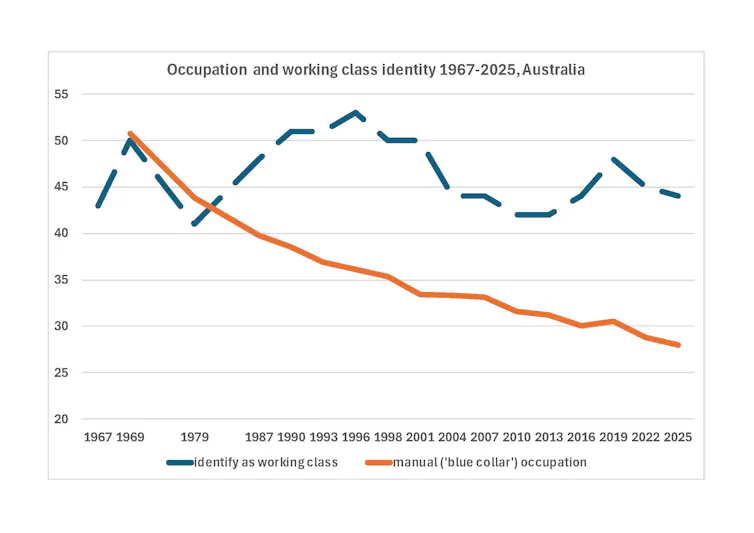
Perhaps the labour parties mistook the decline in “blue-collar” (manual) jobs for the decline of the working class. In Australia, the blue-collar share of jobs fell from 44% in 1979 to 28% in 2025. It’s fallen in the UK, the US and elsewhere.

Union membership, once a mostly “blue-collar” phenomenon, declined in most industrialised countries. It fell from an average of 30% of employees across the OECD in 1985 to 19% in 2005 and 15% in 2023. The fall was even greater in Australia.

But these changes did not reflect how likely people were to identify as working class.

In Australia, national attitude and election surveys give us a good idea of trends in people’s views. Between 1979 and 2007, the proportion of respondents in a standard national survey defining themselves as working class or lower class temporarily grew from 40%, to the low 50s in the 1980s and ‘90s, then back to 44% by 2007. In 2025, after a bit more movement, it was still 44% working class.

A chart with two lines, showing (in red) a gradual decline in blue collar occupations and *b) a variable but relatively flat proportion of peoploe identifying as working class.
Occupation x working class identity. Australian Election Study and Australian Bureau of Statistics, CC BY

A British survey in 1983 found 58% of people claimed to be working class. By 2005, those identifying as working class had barely fallen to 57%. In 2023, still 53% of people identified as working class.

In the US, where the phrase “working class” appeared absent from public discourse for decades until Trump, a differently worded question showed that in 1976, 51% of Americans thought of themselves as either working class or lower class. In 2006, the same survey showed 52% identifying as either working class or lower class. Within this period, numbers had fluctuated from year to year — but always between 48% and 55% expressed working or lower class identity.

A Gallup poll added “upper-middle class” to the options, and the proportion claiming working or lower class status was only 39% in 2006. In 2024, that number was 43%.

In Canada, the proportion identifying as working or lower class was 36% in 1980 and still 36% in 1995. In 2017, a different poll found 37% identified as working class.

In short, while “blue-collar” jobs have sharply declined almost everywhere, the experience of “working class” has been relatively stable, within some fluctuating bounds. Differences in class identity between countries seem more notable than differences over time, perhaps due to how questions are asked or how different cultures interpret them.

This is not to say that giving a “working class” response to a forced-choice survey question is the same as a deeply thought position on class. But if people no longer thought of themselves as working class, you would expect to see some pretty big changes over time in answers to these questions.

How the working class was left behind

Sure, jobs changed, a lot. But there has never been much middle-class glamour in the “white collar” jobs at the checkout counter, behind the hamburger hotplate or in the call-centre factory.

Class relations didn’t weaken. In fact, inequality worsened in many countries. Neoliberal policies, including those adopted by social democratic parties, made the rich much richer, but they slowed the growth in the wellbeing of the majority of people, and left the working class behind.

The proportion that thought big business had too much power, and income and wealth should be redistributed, became larger.

Unions lost ground not because their ideas became unpopular with workers. It simply became much harder for unions to recruit and retain members in the face of increasingly hostile employers, governments and laws.

Working class voters didn’t have solutions to hand. But nor were they offered any by social democratic parties that barely spoke their language. Now the door has been opened to far-right parties, presenting alternatives that appeal to some facing those class problems.

There’s life in class voting yet, just not in the way we thought of it.

The Conversation

Over the years David Peetz has received funding for research from the Australian Research Council, various unions and employers, the Fair Work Commission, state and national governments of both political flavours in Australia and overseas, the International Labour Organisation and the Organisation for Economic Cooperation and Development. He is presently employed by the Centre for Future Work.

Is baby talk bad? Why ‘parentese’ actually helps babies learn language

Emphasizing the sounds of certain words to young children can help them retain language, not confuse them about speaking properly. MoMo Productions/DigitalVision via Getty Images

Many parents have heard the warning: Don’t use baby talk with babies and toddlers. Instead, caregivers are often encouraged to speak properly and use adultlike language, out of concern that simplified speech could confuse children or delay language development.

But my research, which I highlighted in in my new book, “Beyond Words,” suggests the opposite is true. The sing-song voice many adults instinctively use with infants, sometimes called “baby talk” but more accurately known as “parentese” or infant-directed speech, actually helps children learn language.

Far from confusing babies, exaggerating phrases like “Loooook at the doggie!” capture their attention, help them detect patterns in speech and strengthen social bonding.

And the funny mistakes children make along the way, such as saying “goed,” instead of “went,” or “mouses” instead of “mice,” are not signs that children are learning language incorrectly. They are evidence that children are actively working out the rules of language for themselves.

A man holds his hands away from his face and leans over a small baby lying on a bed and smiles.
Speaking ‘parentese’ to a child doesn’t involve nonsense words. BjelicaS/E+ via Getty Images

What parentese really is

When many people think of baby talk, they imagine nonsense phrases like “goo goo ga ga” or made-up words like “num nums.” But that’s not what linguists and developmental psychologists mean by parentese.

Parentese uses real words and grammatically correct sentences, but with exaggerated intonation, a higher pitch, stretched-out vowels and a slower rhythm. Think of the way a caregiver might naturally say: “Hi, baaaaby! Are you huuungry?”

There is little evidence that occasional playful nonsense words harm children’s language development. But studies suggest that parentese in particular helps babies pay attention to speech, recognize patterns and engage socially.

Adults across cultures tend to speak this way to infants instinctively. Even people who swear they never use baby talk often slip into it around babies.

Researchers have found that infants actually prefer listening to parentese over regular adult speech. The exaggerated sounds and slower pacing make language easier to process. Babies are better able to pick out individual sounds, notice word boundaries and recognize patterns. In other words, parentese helps tune babies into language.

It also strengthens emotional connection. Language learning does not happen in isolation. Babies learn through warm, responsive interaction with caregivers during feeding, play, bath time and everyday routines.

Interestingly, humans are not the only ones who respond to this style of communication. Studies have even shown that cats react more positively when people use a baby-talk voice with them.

Babies are not passive learners

Children do not learn language simply by copying adults word for word. They actively test hypotheses about how language works. That is why toddlers make predictable and surprisingly logical mistakes.

One common example is overgeneralization. A child learns that people form the past tense of many verbs by adding “-ed,” so they produce forms like “goed,” “eated” or “comed.”

These are not random errors. In fact, they show that the child has understood a grammatical rule and is trying to apply it consistently. The problem is simply that English is full of irregular exceptions. The same thing happens with plurals. Children may say “foots” instead of “feet” or “mouses” instead of “mice.” Again, the logic behind these errors is sound.

Linguists sometimes say that children are little scientists, constantly testing patterns and revising their understanding as they receive more input from the world around them.

Why toddlers call everything a ‘dog’

Young children also make predictable mistakes with meaning.

A toddler might learn the word “dog” and then use it for every four-legged animal they encounter. Linguists call this overextension. On the flip side, some children use words too narrowly. A child may use “dog” only for the family pet and not recognize that other dogs belong in the same category. Linguists call this tendency underextension.

These mistakes reveal how children organize and categorize the world around them. They are gradually mapping words onto objects, people and experiences.

Pronouns are another tricky area. Small children often confuse “me” and “you” because these words constantly shift depending on who is speaking. If a parent says, “I’ll pick you up,” the child hears themselves called “you.” But when they try to repeat the sentence, they may not yet understand that the labels switch from speaker to speaker.

This is why toddlers sometimes say things that sound unintentionally cute or confusing. But beneath the confusion is a sophisticated learning process.

Even the Cookie Monster gets it wrong

Children’s speech errors are so recognizable that they often appear in popular culture. Sesame Street’s character Cookie Monster famously says things like “Me want cookie,” while Elmo often refers to himself in the third person: “Elmo wants this.” These speech patterns mirror real stages of child language development. Young children commonly confuse pronouns or refer to themselves by name before mastering forms like “I,” “me” and “mine.”

Despite occasional complaints from adults, there is no evidence that hearing this kind of speech harms children’s language development. If anything, it reflects the natural experimentation children go through.

A Cookie Monster puppet stands near a black tarp with its mouth open and holds a cookie.
The Cookie Monster saying ‘Me want cookie’ won’t teach babies and young kids to speak incorrectly. Brian Killian/WireImage via Getty Images

‘Pasketti’ and ‘wabbit’

Pronunciation develops gradually too. Young children often simplify difficult sounds and groups of consonants. “Spaghetti” becomes “pasketti,” “rabbit” becomes “wabbit” and “yellow” may come out as “lellow.”

Speech-language specialists call these simplifications phonological processes. They are a normal part of development because some sounds are physically harder to produce than others. Sounds such as r, th, sh and ch tend to develop later because they require more precise control of the tongue and mouth.

Most children naturally outgrow these pronunciation patterns as their speech matures. However, persistent difficulties can sometimes signal a speech or language disorder, which may require professional support.

A graphic image shows a young child's head with various colorful thought bubbles inside.
Children don’t learn language by copying adults word for word. They learn through interaction, experimentation and repetition. DrAfter123/DigitalVision Vectors via Getty Images

Mistakes are part of learning

Parents are often under enormous pressure to do everything right, including helping their children learn to speak a language. But children do not learn language by avoiding mistakes. They learn through interaction, experimentation and repetition.

Parentese helps babies focus on speech and engage socially. The funny mistakes toddlers make reveal that they are actively piecing together the complex system of language and are often signs of normal development. Language acquisition is messy, creative and remarkably sophisticated.

Speaking in an exaggerated sing-song voice to a baby is not something parents and caregivers need to feel embarrassed about.

Far from harming language acquisition, it may help lay the foundation for it.

The Conversation

Karen Stollznow does not work for, consult, own shares in or receive funding from any company or organization that would benefit from this article, and has disclosed no relevant affiliations beyond their academic appointment.

Where did language come from? Nobody really knows, but the theories are fascinating

Sriharu Kapu/Unsplash

Humans are the only species known to use fully symbolic language: a system capable of expressing abstract ideas, imaginary worlds and endless combinations of meaning. But how did we get there?

The origins of language have fascinated philosophers, scientists and storytellers for thousands of years. Despite all our advances in linguistics, archaeology and cognitive science, we still don’t know exactly how language began.

That uncertainty hasn’t stopped people from trying to solve the mystery. In fact, some of the earliest theories of language’s origins are among the strangest and most entertaining ideas in the history of science.

Bow wow, ding-dong

In the 19th century, scholars proposed a flurry of curious theories to explain how speech first emerged. Many of these theories were given playful nicknames by the German philologist Max Müller, who intended them partly as satire. Yet the theories were genuine attempts to tackle one of humanity’s biggest questions.

German philologist Max Müller gave playful nicknames to competing theories of language’s origins. Public domain, via Wikimedia Commons

The most famous is probably the Bow-Wow Theory. This suggested language began through imitation of natural sounds. Early humans, according to this theory, copied the noises around them: animal cries, splashing water, thunderclaps and birdsong. Words such as “buzz”, “hiss”, “bang” and “splash” seem to support the idea because they sound like what they describe.

But there is a problem. Different languages hear the same sounds differently. English dogs go “woof” or “bow-wow”, but in Turkish they go “hev-hev”, while Indonesian dogs go “guk-guk”. Even animal noises, it turns out, are filtered through culture and language.

And onomatopoeic words (words that imitate sounds) make up only a tiny fraction of our vocabularies. Most words sound nothing like their meanings. For instance, there is nothing inherently tree-like about the word “tree”.

That brings us to the Ding-Dong Theory, which argued that sounds and meanings are naturally connected in some deeper, almost mystical way.

Some words do seem to fit their meanings uncannily well. “Mini”, “teeny” and “itsy-bitsy” feel small and delicate. “Lump”, “rump” and “plump” sound heavier and rounder.

Modern linguists call this sound symbolism. One famous experiment asked participants to match two nonsense words, “bouba” and “kiki”, to two shapes: one rounded and one jagged. Most people matched “bouba” with the soft shape and “kiki” with the sharp one.

The effect is real, but it is limited. Most language still appears to be arbitrary, which means there is no natural reason why a particular sound should mean a particular thing.

Pooh-pooh, la-la, ye-he-ho

Other theories focused less on imitation and more on emotion and social interaction.

The Pooh-Pooh Theory proposed that speech began with instinctive emotional cries such as “ouch”, “oh” or perhaps less publishable exclamations uttered after stubbing a toe. According to this idea, language evolved from spontaneous vocal reactions to pain, surprise, fear or joy.

Again, though, there are complications. Interjections vary widely across languages. English speakers say “ouch”. Greeks say “aou”. Czechs might exclaim “ach”. Emotional sounds are not nearly as universal as they seem.

Then there is the wonderfully named Yo-He-Ho Theory, which suggested language emerged from rhythmic chants used during collective labour, like sailors chanting “yo-heave-ho” while hauling ropes, or workers singing together to coordinate physical effort.

The theory may sound quaint, but modern researchers do think rhythm, cooperation and social bonding played important roles in human evolution. Language is, after all, deeply social.

Charles Darwin speculated that speech evolved from musical expression. Herbert Rose Barraud, Public domain, via Wikimedia Commons

Another proposal, the La-La Theory, linked language to music. Charles Darwin entertained the possibility that speech evolved from musical calls used in courtship and emotional expression. Before humans spoke, perhaps we sang?

Some modern theories echo this idea. One hypothesis suggests that, as early humans began walking upright, parents increasingly needed to soothe babies from a distance. Sing-song vocalisations, cooing and proto “baby talk” may have helped strengthen emotional bonds and eventually paved the way for speech.

Gestures, symbols and brains

Today, most scientists think no single theory fully explains language origins. Instead, language probably emerged gradually through a combination of gestures, vocalisations, facial expressions, social cooperation and increasing cognitive complexity.

Some researchers argue that language began with gestures before shifting to speech. Others believe language evolved as a tool for social bonding, allowing larger groups of humans to cooperate and share information. Still others see language as tied to the evolution of symbolic thought itself: our ability to imagine, plan, remember and communicate abstract ideas.

Biology is also a factor. Humans have developed unusually precise control over the tongue, lips and vocal tract. We have evolved specialised brain regions linked to language processing.

But anatomy alone cannot explain language. Parrots can mimic speech sounds. Many animals communicate. None, however, appear to possess grammar and symbolism on the human scale. And, frustratingly, early language leaves no evidence behind. Spoken words don’t fossilise.

That lack of evidence is one reason the topic became so controversial that, in 1866, the Société de Linguistique de Paris banned discussions about language origins altogether, dismissing the field as hopelessly speculative.

Saraswati, Hindu goddess of knowledge and speech – Raja Ravi Varma (1894) Public domain, via Wikimedia Commons

Of course, theories about language origins also appear in religion and mythology. In Greek mythology, the messenger god Hermes was associated with language and communication. In the Hindu tradition, the goddess of knowledge and speech Saraswati bestowed Sanskrit upon humanity. In the Judeo-Christian tradition, language was a gift from God, who enabled Adam to name the animals in the Garden of Eden.

These stories reflect something deeply human: our urge to explain where language came from, because language itself feels almost magical. Every theory of language origins captures a small piece of the puzzle. Imitation, emotion, rhythm, music, gesture, cooperation and symbolic thought probably all played some role.

But none can provide a complete answer. The truth is that language evolved so long ago, and likely so gradually, that we will never pinpoint a single moment when it began, unless someone invents a time machine.

The birth of language will probably remain one of humanity’s greatest unsolved mysteries. Still, the theories themselves tell us something important. Humans are always trying to explain what makes us human. And language may be the most human thing of all.

The Conversation

Karen Stollznow does not work for, consult, own shares in or receive funding from any company or organisation that would benefit from this article, and has disclosed no relevant affiliations beyond their academic appointment.

Pauline Hanson attracting women voters? It’s part of a global far-right trend

Pauline Hanson and her party One Nation have been dominating headlines after their recent electoral successes in South Australia and Farrer. A new national opinion poll has One Nation’s primary vote at 31% – up from 7% just two years ago.

Not only are growing numbers of Australian voters openly expressing their support for One Nation, but the party, and its leader, are doing particularly well among Australian women.

According to an April study by RedBridge and Accent Research, Pauline Hanson is now the most popular party leader among women voters – ahead of the prime minister. And One Nation is their leading first-preference party.

That this is happening to a far-right party might raise some eyebrows. Far-right parties have traditionally been considered “men’s parties”: first, because men tend to be predominant among their voters, grassroots and elected politicians; and second, because their image and political agendas are seen as very masculine.

Yet, in Australia, where women rarely lead parties of any kind, Pauline Hanson has led hers for decades, and One Nation is mobilising women voters. This might look like an anomaly, but it isn’t.

Women leading ‘men’s parties’

In fact, Hanson is part of a small but substantial group of women who have led or currently lead far-right parties, including Marine Le Pen in France, Giorgia Meloni in Italy and Frauke Petry and Alice Weidel in Germany.

What is particularly striking is that these women are at odds with the traditional gender roles and family values their parties promote – be that due to divorces (Hanson, Le Pen, Petry), having had a child when unmarried (Meloni), or being lesbian (Weidel).

So, how did they become leaders?

It helped that most of them did not have to climb a party hierarchy dominated by men. Hanson and Meloni founded their own parties. In the case of Le Pen, the National Front (now National Rally) was founded by her father, Jean-Marie Le Pen, whom she kicked out in 2015 to cleanse the party of its most toxic elements (read: antisemitic, monarchist, militarist).

As for Petry and Weidel, a mixed-gender dual leadership model is the norm across most German parties.

One might therefore think these women represent exceptions in the far-right party landscape. But women’s increasing participation in the far right is not only about party leadership, but voters and grassroots membership.

One Nation and women

Far-right parties are attracting more women voters than ever. Although their electorates in Europe remain those most dominated by men, the proportion of women voting for them, relative to men, has increased.

In Australia, poll data by RedBridge/Accent Research collected in April shows 28% of women voters have One Nation as their first choice for the House of Representatives, up from 9% in June 2025.

By contrast, the proportion of women with Coalition parties as their first preference fell from 30% to 22% in the same timeframe.


Read more: The Making of One Nation: podcast out now


To be clear, the rise in popularity of One Nation (and the decline of the Coalition) is not driven just by women. Men display very similar trends.

And there are few gender differences in terms of the reasons why people say they are planning to vote for One Nation. For both women and men, supporting One Nation is a way to express dissatisfaction with the major parties and their handling of the cost-of-living crisis.

Yet, as my recently published book finds, we can also see this playing out in other countries.

A global trend

My book is the first study on women’s involvement at the grassroots of far-right parties. I interviewed more than 100 members and officials from the Bharatiya Janata Party in India, the League in Italy, and the Sweden Democrats. I also collected survey responses from thousands of League and Sweden Democrats members.

In my surveys, women make up between one-quarter and one-third of party members. This sits somewhere in between other far-right parties, such as Reform UK (39%) and Chega in Portugal (15%).

Despite being a minority, I found women play a key role at the far-right party grassroots.

To begin with, women join the far right largely for the same reasons as men: because they hold grievances against racialised out-groups (immigrants, ethnic minorities, or refugees) and feel left behind by mainstream parties. Women’s motivations are therefore not a “softer” version, or more feminine, than men’s.

Second, the (few) women who join far-right parties are very active – even more so than men. They post political content online, stand as candidates and run local branches.

This is very surprising, given how in mainstream parties, it’s the opposite, with men being more active.

In bucking these long-standing trends, not only do women help far-right parties fulfil their key functions, they also mobilise other women to vote for the far right.

Finally, far-right parties actively try to recruit women members for electoral and reputational gains. They know that, by doing so, they can both improve their electoral support among women and appear as less extreme political actors.

So while far-right parties may still be numerically dominated by men, women are increasingly central to their success and legitimacy.

In that sense, Pauline Hanson and One Nation reflect a broader international trend in which women are helping make the far right appear more mainstream, respectable and electorally viable.

The Conversation

Sofia Ammassari receives funding from the Australian Research Council.

129,000 years of crocodiles: what we know about Australasia’s ancient apex predators

Jorgo Ristevski, CC BY

The sight of a saltwater crocodile basking on a mudbank is one of the most iconic and intimidating images of northern Australia. Yet the crocodiles that inhabit the region today are just the survivors of a much richer and stranger lost world.

Until recently, Australasia was home not just to the familiar crocodiles found in tropical waterways, but also to a unique cast of crocs unlike any living species.

Our recent review of evidence from the past 129,000 years reveals a dramatic story of extinctions, human encounters, and survival against the odds.

Mekosuchines – the lost rulers of Australasia

Modern crocodiles are members of the genus Crocodyls, but an entirely different group of crocodylians known as mekosuchines once dominated the region.

For more than 50 million years, mekosuchines were the apex predators of Australasia. Some even survived to meet humans.

These remarkable animals came in an astonishing variety of shapes and sizes, inhabiting many different environments.

Some were giant semi-aquatic ambush predators, much like the saltwater crocodiles that still patrol northern rivers today. Others were much smaller “dwarf” species that inhabited islands such as New Caledonia. Most terrifyingly, some species possessed blade-like serrated teeth and probably hunted their prey on land.

A fragmentary puzzle

We pieced together a record of crocodylians over the past 129,000 years from scattered and highly fragmentary remains recovered from more than 20 archaeological and palaeontological sites.

Most are located in Australia, though some are found in New Guinea, and a handful more across the southwest Pacific. At archaeological sites on the Australian mainland, as well as in the Torres Strait and New Guinea, researchers have uncovered the broken bones and teeth of modern crocodile species, showing that these formidable reptiles have shared landscapes with people for thousands of years.

Ancient rock art, some dating back around 20,000 years, reveals that Indigenous Australians were closely observing and depicting these animals for millennia. The distribution of archaeological remains and rock art closely mirrors the modern ranges of crocodiles today. This points to a long and relatively stable coexistence between humans and these powerful predators.

Map of Australasia with red dots.
Crocodylian remains have been found at sites across Australasia dated over the past 129,000 years. Jorgo Ristevski, CC BY

Archaeological evidence shows that humans did occasionally eat crocodiles, and sometimes even crafted pendants from their teeth. Yet such discoveries are quite rare. When ancient archaeological sites do yield crocodile bones, there are usually only a handful of them.

The evidence suggests crocodiles were hunted only rarely. This is not surprising.

Adult saltwater crocodiles are enormous, immensely powerful, and highly lethal to humans. For ancient communities, engaging with these apex predators would have been a hazardous undertaking, and something mostly avoided.

But modern crocodiles weren’t alone in these ancient landscapes. Fossils show they shared them with the mekosuchines.

On mainland Australia, mekosuchines are currently only known from fossils. Most remains date from more than 40,000 years ago. We currently have no evidence of these extinct crocs from archaeological sites or in ancient rock art.

We don’t know if humans and mekosuchines ever directly interacted in Australia. Their disappearance occurred around the same time as the extinction of other Australian megafauna, potentially after a long period of coexistence with humans. The exact cause of their demise in Australia remains a mystery.

Island extinctions

However, the story is different on the islands of New Caledonia, Vanuatu and Fiji. There, some mekosuchine species managed to survive into much more recent times. And humans almost certainly encountered them directly.

The extinct crocs of New Caledonia and Vanuatu were small, reaching less than two metres in length as adults. They also likely lived more on land than today’s semi-aquatic crocodiles. Their small statures and terrestrial lives would have made them far more accessible for human hunters.

Diagram showing relative sizes of a human, a huge crocodile, and two small crocodiles.
Size comparisons between the largest (the living saltwater crocodile, Crocodylus porosus) and smallest (the extinct dwarf crocs of New Caledonia and Vanuatu, Mekosuchus) known crocodylian species from the past 129,000 years in Australasia. Jorgo Ristevski, CC BY

Tragically, the known record of these island mekosuchines ends within a few centuries of human settlement. In several cases, their remains were found in association with human artefacts and middens.

In one example from Vanuatu, a mekosuchine limb bone appears to bear the gnaw marks of a rat, an invasive species introduced to the island by humans. While definitive proof is elusive, it seems likely that direct or indirect human involvement may be the reason for the disappearance of these “dwarf” island crocodylians.

Lessons for the Anthropocene

We are now living through the Anthropocene, an age when humans are profoundly influencing the planet and extinctions are accelerating, as is particularly evident in Australia.

The prehistoric past is not just a record of vanished worlds, but a warning for the future. Understanding how apex predators like crocodiles responded to past climatic changes, environmental upheaval, and human impacts provides important clues for their conservation in the future.

To truly unravel these questions will take the combined work of palaeontologists, archaeologists, ecologists and conservationists. Just as crucial will be deep engagement with Indigenous knowledges and land managers, whose long histories of observing and living alongside these animals offer clues for protecting the world’s remaining crocodiles, and the threatened ecosystems they inhabit.

The Conversation

The authors do not work for, consult, own shares in or receive funding from any company or organisation that would benefit from this article, and have disclosed no relevant affiliations beyond their academic appointment.

Politicians have long misunderstood the ‘working class’. The rise of the far right shows how mistaken they have been

Class has always mattered, and now social democratic parties that sprung from a working class — including the Australian Labor Party – are finding out why.

Over many years, and in many countries, a growing view among political actors and within political science was that class was losing its punch. The line was something like this. The working class once voted for labour parties. The middle class voted conservative. But over many years) that difference between how the classes voted got smaller and smaller. In some places it disappeared.

The “decline of class” narrative suited the leaders of labour and social democratic parties.

They could safely adopt market-based neoliberal policies, with a human touch added, in the knowledge their base wouldn’t desert them. But their base was changing. It was becoming more middle class, more individualistic, more awake to the benefits of market solutions to complex problems.

Now, those politicians are shocked by the rise of far-right political parties that now claim to represent the working class. In Australia, One Nation is close to matching Labor — in some polls, it is already ahead.

In the United Kingdom, Reform is leading in all the polls, while the governing Labour party is below 20%. In Germany, the neo-nazi AfD is presently leading in all opinion polls, while the Social Democrats are below 14%.

In the United States, the Republican Party has gone full Trump, on an agenda with aspects that look eerily reminiscent of prewar Germany. In France, the National Rally candidate is ahead in all opinion polls for the next presidential election.

‘Blue collar’ is not the same as ‘working class’

In many countries, the labour and social democratic parties are mere shadows of their former selves.

Perhaps the labour parties mistook the decline in “blue-collar” (manual) jobs for the decline of the working class. In Australia, the blue-collar share of jobs fell from 44% in 1979 to 28% in 2025. It’s fallen in the UK, the US and elsewhere.

Union membership, once a mostly “blue-collar” phenomenon, declined in most industrialised countries. It fell from an average of 30% of employees across the OECD in 1985 to 19% in 2005 and 15% in 2023. The fall was even greater in Australia.

But these changes did not reflect how likely people were to identify as working class.

In Australia, national attitude and election surveys give us a good idea of trends in people’s views. Between 1979 and 2007, the proportion of respondents in a standard national survey defining themselves as working class or lower class temporarily grew from 40%, to the low 50s in the 1980s and ‘90s, then back to 44% by 2007. In 2025, after a bit more movement, it was still 44% working class.

A chart with two lines, showing (in red) a gradual decline in blue collar occupations and *b) a variable but relatively flat proportion of peoploe identifying as working class.
Occupation x working class identity. Australian Election Study and Australian Bureau of Statistics, CC BY

A British survey in 1983 found 58% of people claimed to be working class. By 2005, those identifying as working class had barely fallen to 57%. In 2023, still 53% of people identified as working class.

In the US, where the phrase “working class” appeared absent from public discourse for decades until Trump, a differently worded question showed that in 1976, 51% of Americans thought of themselves as either working class or lower class. In 2006, the same survey showed 52% identifying as either working class or lower class. Within this period, numbers had fluctuated from year to year — but always between 48% and 55% expressed working or lower class identity.

A Gallup poll added “upper-middle class” to the options, and the proportion claiming working or lower class status was only 39% in 2006. In 2024, that number was 43%.

In Canada, the proportion identifying as working or lower class was 36% in 1980 and still 36% in 1995. In 2017, a different poll found 37% identified as working class.

In short, while “blue-collar” jobs have sharply declined almost everywhere, the experience of “working class” has been relatively stable, within some fluctuating bounds. Differences in class identity between countries seem more notable than differences over time, perhaps due to how questions are asked or how different cultures interpret them.

This is not to say that giving a “working class” response to a forced-choice survey question is the same as a deeply thought position on class. But if people no longer thought of themselves as working class, you would expect to see some pretty big changes over time in answers to these questions.

How the working class was left behind

Sure, jobs changed, a lot. But there has never been much middle-class glamour in the “white collar” jobs at the checkout counter, behind the hamburger hotplate or in the call-centre factory.

Class relations didn’t weaken. In fact, inequality worsened in many countries. Neoliberal policies, including those adopted by social democratic parties, made the rich much richer, but they slowed the growth in the wellbeing of the majority of people, and left the working class behind.

The proportion that thought big business had too much power, and income and wealth should be redistributed, became larger.

Unions lost ground not because their ideas became unpopular with workers. It simply became much harder for unions to recruit and retain members in the face of increasingly hostile employers, governments and laws.

Working class voters didn’t have solutions to hand. But nor were they offered any by social democratic parties that barely spoke their language. Now the door has been opened to far-right parties, presenting alternatives that appeal to some facing those class problems.

There’s life in class voting yet, just not in the way we thought of it.

The Conversation

Over the years David Peetz has received funding for research from the Australian Research Council, various unions and employers, the Fair Work Commission, state and national governments of both political flavours in Australia and overseas, the International Labour Organisation and the Organisation for Economic Cooperation and Development. He is presently employed by the Centre for Future Work.

❌
Subscriptions