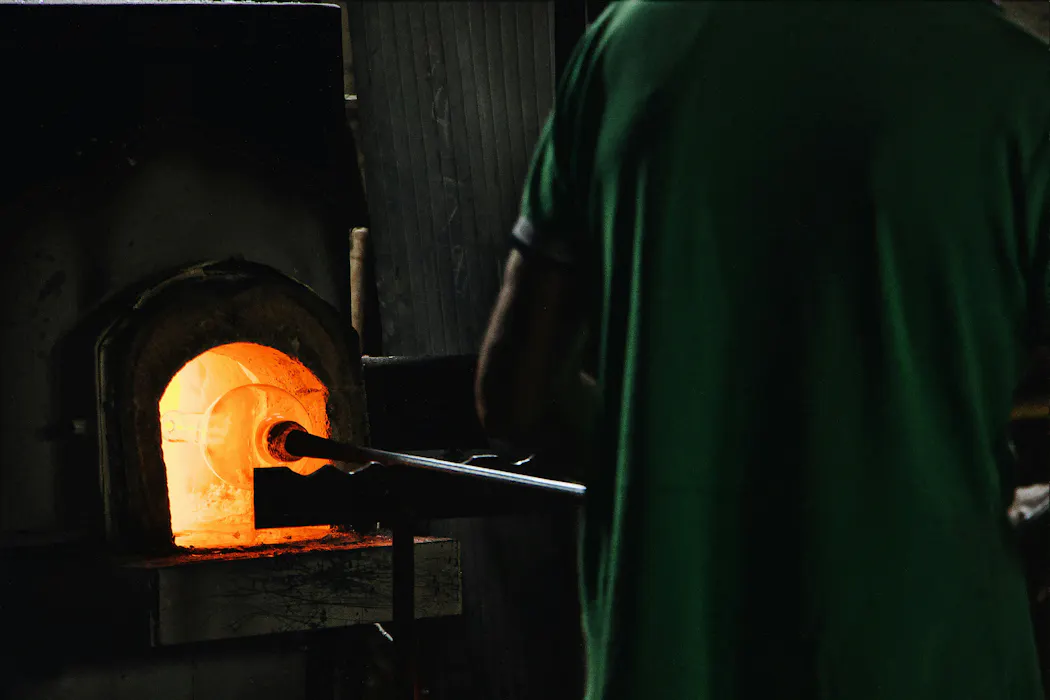
Normal view

How the invention of glassblowing changed everyday life in ancient Rome

We see glass objects every day, and often don’t think much about them. Mass-produced glass has become so cheap we barely think about the things it allows us to do.

In fact, glassblowing has a fascinating history dating back to the late first century BCE.

Roman experimentation with recycling glass permanently changed everyday life, facilitating a vast expansion of trade and economic activity.

And the way glassblowing was done during the Roman era is still very similar to the way we do it today.

The old ways

Of course, glass was invented long before glassblowing.

The earliest glass beads were made in Ancient Mesopotamia in the second half of the third millennium BCE (around 4,500–4,000 years ago).

The first closed glass vessels followed about a thousand years later (around 1500–1400 BCE) in Mesopotamia and nearby Ancient Egypt.

These early glass vessels were moulded, and the closed containers were made with a process called core-forming.

This involved sticking a plug made of animal dung, clay, mud and sand onto the end of an iron rod. Molten glass the consistency of treacle (and over 1,000°C), was poured over the plug. After it was worked, decorated, and cooled, the hardened plug had to be scraped out manually.

Glassmaking Technique: Core-Formed Glass - Getty Museum.

Later vessels were made with casting techniques (which also involved heating glass and laying it atop a mould). This also required long periods of working, and laborious grinding and polishing. Glass was only for the wealthy as this process took tens of hours to complete.

Cast glass garland bowl, late 1st century BCE, 91.1.1402. Metropolitan Museum of Art

Invention of a new technology

Glassblowing – invented towards the end of the first century BCE in the coastal Levant (in what is now Syria, Lebanon, Israel, Palestine and Jordan) – cut all this down to mere minutes.

The earliest evidence we have is from modern-day Jerusalem which, in the final quarter of the first century BCE, was ruled by Roman Jewish client kings Herod the Great and Herod Archelaus on behalf of Rome’s Emperor Augustus.

Our earliest glassblowing evidence in Jerusalem suggests furnace workers were experimenting by heating the ends of glass tubes to rework them. Scholars have suggested this was an experiment in glass recycling.

One day, someone blew into that tube and changed the industry – and history – forever. You could now make a glass container quickly and comparatively easily.

Glassworkers spread the technique as they travelled

Ancient glassblowers travelled all over the Mediterranean, and in the first century BCE, the Levant was a hotbed of glass technology and experimentation.

Some of the only named glassworkers we know from that period, such as Ennion, were Greek-speaking Syrians.

A glass cup stamped with ‘Ennion made me’, Roman, circa 1-50 CE, 17.194.225. Metropolitan Museum of Art

Glassworkers and their products soon spread to the rest of the Mediterranean, wherever the Romans were.

Glass vessels were frequently traded or gifted beyond the Roman frontier, with people as widespread as northern Scotland, Scandinavia, the Sahara and even China.

Blown glass vessels became readily available to most of society.

The Greek historian Strabo tells us (not long after the discovery of glassblowing) in Rome, a glass cup could cost as little as one copper coin.

Olive oil and wine were produced in large terracotta amphorae, which were stocked in Roman shops.

Glass containers allowed people to buy smaller quantities at a time, as they could have glass containers filled at shops and taverns.

Roman mould-blown square storage bottle, 1st-3rd century CE. Gale History Museum at Macquarie University.

And because the surface of glass is inert, it does not affect the taste of food or drink – meaning you can store things for longer periods. Most ancient pottery was unglazed (which resulted in seepage), and metals could affect taste.

Roman writers Petronius and Pliny the Elder both share a fanciful story in which the imagined discovery of an unbreakable glass is brought to Rome’s Emperor Tiberius. Tiberius has the man killed, fearing economic collapse as gold and silver would not be as useful or pretty as glass.

Like us, the Romans stored glass jars and bottles on shelves and in cupboards. We can find the vessels where they fell after the eruption of Vesuvius, in Pompeii and Herculaneum.

The easiest vessel to make in glass is a small perfume or cosmetic flask. Roman perfumes were oil and fat-based, and having an effective spoil-free container made perfumes and cosmetics more affordable.

Roman blown ribbon glass perfume bottles, 1st century CE, L to R: MU5026; MU5019; MU4976; MU5007. Gale History Museum at Macquarie University.

Glass changed the way people interacted with food and drink, as well as their personal care and hygiene. It also transformed domestic comfort, as glass windows could provide draught-free light in Roman homes and baths.

Roman art figurines and everyday objects were commonly made into the shape of animals, plants and humans (and sometimes body parts). While simple vessels were most common, Roman glass also got weird and kitschy at times, featuring things such as gladiator fight scenes or a monkey playing the pan-pipes.

Some moulds were made of stone or ceramic and lined with a thin layer of soot (usually from a lamp). This meant the hot glass bubble could be blown inside the mould, and the soot would prevent sticking.

Roman Mould-Blown Glass - Corning Museum of Glass.
Roman fish-shaped blown glass flask, MU4970. Gale History Museum at Macquarie University.

Mythological scenes and themes also featured heavily.

Some vessels featured the equivalent of live, laugh, love in the form of ancient Greek phrases such as katachaire kai euphrainou (rejoice and enjoy yourself!) or euphrainou epi toutoi eph hoi parei (delight in that at which you are present).

Flasks could be shaped like fish or fruit, such as dates and grapes. Presumably, these were the ancient equivalents of the tomato-shaped sauce container at a diner or the plastic soy sauce fish at a sushi chain.

These point to things the Romans found entertaining (and glassworkers thought sellable).

The Conversation

Thomas J. Derrick receives funding from the Gale Fund at the Faculty of Arts, Macquarie University.


Hanson’s gas policy follows the far-right playbook: attack ‘elites’ and push for drilling

Mick Tsikas/AAP, Hakim/Canva, The Conversation, CC BY

New polling this week put One Nation ahead of Labor in the primary vote for the first time, as the party’s latest policy announcements signal greater political ambition.

One Nation recently unveiled its new oil and gas policy at the Australian Energy Producers Conference in Adelaide. It promises “vastly greater returns” to an electorate “rightly unhappy” with the distribution of Australia’s natural resources.

While One Nation’s gas policy is not entirely new, the party’s growing prominence means announcements will attract greater scrutiny.

So, what is the party proposing?

Embracing government intervention

The Norway-style gas proposal is One Nation’s first substantial intervention in current tax and energy policy debates. It’s a marked shift away from the social and migration issues that have long defined the party.

Norway heavily taxes its oil and gas extraction profits. It reinvests the wealth into the world’s largest sovereign fund to spent on social initiatives.

Echoing the Trump administration’s willingness to buy into resource and technology companies, One Nation’s announcement reflects a broader embrace of economic interventionism: where a government actively modifies a free-market economy.

The announcement shows a stark differentiation between One Nation and The Liberal Party on the economy. And it comes at a time when the parties have increasingly overlapped on issues like migration.

Liberal frontbencher James Paterson attacked the policy as socialist. He described it as “borrowed from Venezuela and Hugo Chávez”.

One Nation’s policy

Despite the splashy announcement, One Nation’s gas policy was not entirely new.

Hanson has pointed to a Norway-style sovereign wealth fund as a model for gas revenue policy since at least 2017. Senator Hanson has also frequently attacked parliament for being “hostage” to multinationals resource companies operating in Australia.

In announcing the policy, Senator Hanson committed One Nation to encouraging more gas and oil exploration and production. Hanson also said taxpayers should get a “fair share” on profits from Australian resources.

Key elements of the policy include replacing the current Petroleum Resource Rent Tax, which places a 40% tax on the profits related to the extraction of petroleum, gas and condensate.

Instead, One Nation would give the government the option to take a 30% stake in future drilling projects, with profits directed into a new sovereign wealth fund.

It’s not the first time this has been suggested. Back in May 2017, Hanson proposed One Nation adopt a system of royalties paid on production, saying such a scheme would raise up to $10 billion per year.

Tapping into public grievance

One Nation’s position sets it apart from both major parties.

Labor and the Coalition hold sharply differing views on energy and Net Zero.

But the two parties share common ground on one point: neither supports increased taxation measures on the gas industry, particularly amid global uncertainty caused by the US-Israel war with Iran.

With its policy, One Nation is tapping into real public grievance. Others, such as The Australia Institute, the Greens, and Independent senator David Pocock have spent years pointing out the same basic unfairness: Australia exports vast quantities of gas, companies profit enormously, and the taxpayer gets very little in return.

But the timing of One Nation’s announcement deserves closer scrutiny. It was not made to a general audience but a gathering of energy industry heavyweights. Reports suggest the announced version was softened after consultations with industry representatives.

Pushing back at the ‘green agenda’

Far-right parties have a distinctive approach to energy policy – they simultaneously cast multinationals as “elites” who take wealth from ordinary people, while advocating for gas drilling expansion themselves.

Hanson has adopted US President Donald Trump’s slogan – “drill, baby, drill” – to spruik her party’s approach to fossil fuels. And she has called on the Labor government to push their “climate change bedwetters” to the side, and expand oil and gas exploration in the interest of energy security.

One Nation blames environmental reforms for triggering an energy crisis, which it claims has cost everyday Australians. Ending net zero is, accordingly, a “massive part” of One Nation’s gas policy, which they claim will safeguard fuel security.

Hanson has described One Nation’s policy as “partnering with the oil and gas industry, rather than treating it as the enemy”.

Internal tensions

This policy debate risks exposing potential tensions between the federal and state branches of One Nation.

Efforts by the South Australian Labor government to repeal a ten-year moratorium on fracking in the south east of the state were blocked by the newly elected One Nation MPs and Liberal Opposition.

The inconsistency between the federal party’s pledge to expand gas exploration and the state branch’s efforts to block it have created headaches for their leader. Hanson distanced herself, dismissing it as a decision for the state branch.

Heading into the next election, One Nation wants contrast with the Liberals on economic interventionism, while setting itself apart from Labor, the Greens and the independents on climate and environmental policy. It is calculated decision from a party that senses its moment.

The Conversation

Emily Foley receives funding from the Australian Research Council.

Jordan McSwiney receives funding from the Australian Research Council, NSW Government, and NSW RNA Research & Training Network.

Kurt Sengul receives funding from the Australian Research Council, NSW Government, and NSW RNA Research & Training Network

Can you really drain your lymphatic system, and should you?

Iuliia Burmistrova/Getty

Did you know your body has an inbuilt sewerage system?

It’s called the lymphatic system, and is a crucial part of how your body fights infection and disease.

Lately the lymphatic system is causing a stir online, with some social media personalities promoting “lymphatic drainage” for beauty and skin health.

So what is lymphatic drainage? And is it backed by science?

What does the lymphatic system do?

The lymphatic system is a network of tiny vessels that, like your blood vessels, branch out to most tissues in the human body.

These vessels carry lymph, a colourless fluid that contains specialised white blood cells known as lymphocytes. Lymphocytes help the body fight infection.

Unlike blood, which circulates around your body in a loop, lymph moves in one direction. It starts off as extra fluid in the tissues in your body, which is then picked up by lymphatic capillaries. From there it travels through to larger lymph vessels and nodes, before draining back into the bloodstream.

The lymphatic system has three main jobs:

  • draining excess fluid, mainly to prevent swelling
  • supporting immunity, by helping the immune system detect and respond to unwanted substances such as bacteria, viruses, parasites and cancer cells
  • absorbing fats, mainly from food, to transport them back into the body.

When something’s wrong

If the lymphatic system is not working properly, the affected body part can start to swell. This swelling is known as lymphoedema, and most commonly affects the arms or legs.

There are two main types of lymphoedema.

Primary lymphoedema occurs when the lymphatic system does not develop properly. This may be due to a genetic condition which impacts the number of lymphatic vessels you have, or their ability to pump fluid. Primary lymphoedema may be present from birth, or may develop during puberty or in adulthood.

Secondary lymphoedema occurs when the lymphatic system is damaged in some way. A common cause of secondary lymphoedema is cancer. This is because cancer treatment may involve surgically removing lymph nodes or unintentionally damaging them with radiation therapy.

Lymphoedema is a sign your lymph fluid isn’t draining properly. To keep things moving, your body pushes lymph into the tiny lymphatic capillaries near your skin. It’s similar to a traffic jam, where cars need to leave the highway to drive on backroads. However, these backroads soon become congested because they aren’t designed to handle that much traffic.

A special type of imaging known as indocyanine green lymphography can test whether your lymphatic system is congested. If your limbs show signs of persistent swelling, your GP will first assess the swelling to rule out other common causes. If they suspect lymphoedema is the cause, they can refer you to a lymphoedema specialist who may request indocyanine green lymphography to help with diagnosis and/or treatment.

People with lymphoedema may also be more vulnerable to infections because their lymphatic system isn’t working as it should. A common and potentially serious one is cellulitis, a bacterial skin infection which can leave you with red, swollen skin.


Read more: What are lymph nodes? And can a massage really improve lymphatic drainage?


What is ‘lymphatic drainage’?

The main treatment for lymphoedema is compression. This involves using medical stockings or bandaging to apply pressure to the swollen body part. This helps move excess fluid from the affected area while also softening any hard, swollen tissue.

Exercise and skincare may also help treat lymphoedema. When your muscles contract during exercise, they act like a pump and help move fluids – such as lymph – around the body. Daily skincare, which may involve washing with a pH-neutral soap and applying moisturiser, is important for keeping the skin clean and well-moisturised. It also helps prevent cracks and infections, which might make lymphoedema worse.

Some people with lymphoedema may benefit from manual lymphatic drainage. This usually involves a trained lymphoedema practitioner using specialised massage techniques that help move fluid out of congested areas. This ensures your body drains lymph fluid if, for some reason, it can’t do so properly by itself.

However, there’s little evidence that manual lymphatic drainage alone treats lymphoedema in any significant or lasting way. This is also the case with claims – mainly circulated on social media – that manual lymphatic drainage can make your skin healthier and more beautiful. The research here is even more limited, and any potential benefits are likely to be small or short-lived.

The bottom line

If your lymphatic system is healthy and you don’t have any swelling, you probably don’t need “lymphatic drainage”. To keep your lymphatic system working well, it’s best to have a balanced diet, stay hydrated and exercise regularly.

If you do notice any swelling or have concerns about your lymphatic system, speak to your GP. If you are having treatment for cancer, you should consult an accredited lymphoedema practitioner. If they recommend trying manual lymphatic drainage, it should be done by a trained lymphoedema therapist. And you should receive it alongside other evidence-based treatments such as compression, exercise and skin care.

The Conversation

Belinda Thompson receives funding from Essity and Haddenham Healthcare.

Louise Koelmeyer receives funding from Essity and Haddenham Healthcare.

Squeak up! I can’t hear you: pilot whales are shouting to hear themselves over ship noise

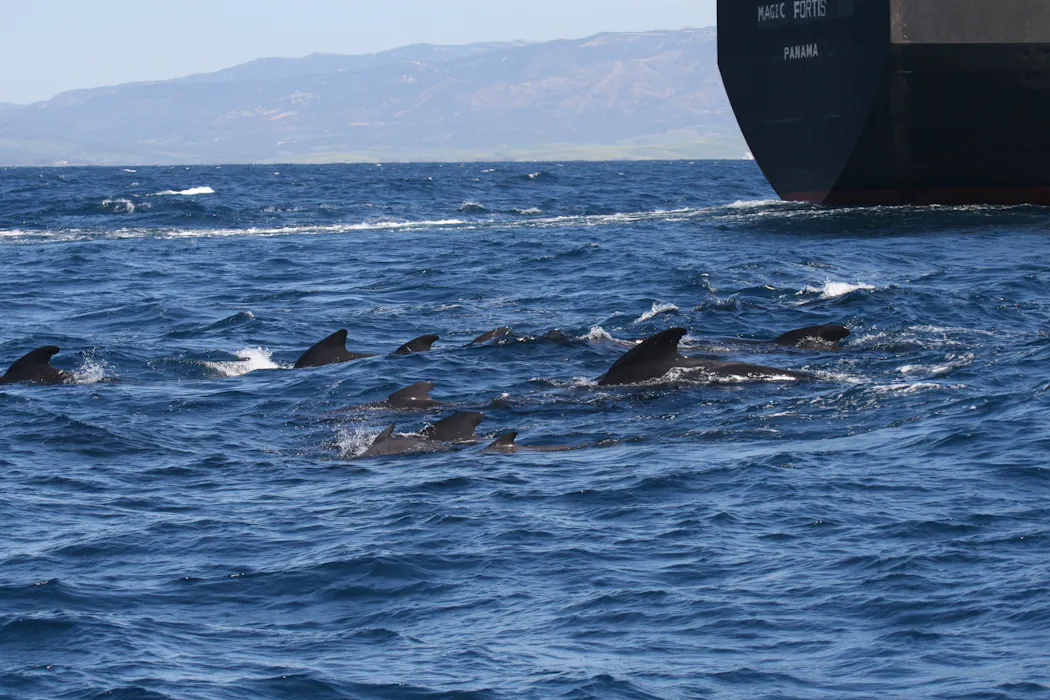
A pod of long-finned pilot whales near a cargo ship. CIRCE

In the Strait of Gibraltar – a famous marine road connecting the Mediterranean and the Atlantic – lives a critically endangered sub-population of a few hundred long-finned pilot whales (Globicephala melas).

Despite their name, these dark and blubbery marine mammals aren’t technically whales – they’re large oceanic dolphins which are believed to have a navigator or lead for each pod. Hence the “pilot” part of their name.

There are two types of pilot whales – short and long-finned. They’re generally found in deep offshore waters but can appear in coastal areas. And like other dolphins, they use high frequency sounds to talk to each other in their pods. These clicks and squeaks travel shorter distances compared with the melodic songs of humpback whales.

And as a new paper led by Milou Hegeman from Aarhus University in Denmark and published in the Journal of Experimental Biology shows, the pilot whales that live in the Strait of Gibraltar are having to shout at the upper limit of their range in order to hear each other over human noises.

What’s making all that noise?

The ocean is full of sounds.

Some of these are natural, such as the sounds from fish, seals and waves. Other sounds are produced by human activities, either deliberately (for example seismic and sonar exploration) or unintentionally (for example, the sound of moving ships or other vessels).

The ocean continues to get noisier because of human-made sound – even in isolated Arctic regions. And because of its strategic location, the Strait of Gibraltar is especially noisy with the drone of cargo ships.

Shipping noise that the pilot whales experience. CIRCE587 KB (download)

Spying on pilot whales

To investigate the communication and behaviour of the population of pilot whales in the Strait of Gibraltar, scientists used 6-metre poles to attach small tags to the creatures (kind of like an Airtag used to track your suitcase) with sterile suction cups positioned between the dorsal fin and blowhole.

Between 2012 to 2015, the steam attached tags to 23 different long-finned pilot whales who live in the region year-round.

These tags remained on pilot whales for up to 24 hours collecting sounds and tracking individual behaviour. The tags then floated to the surface where scientists could locate them using an antenna and collect the data from their diving activities.

Two black dolphins with orange recorders attached to their back, swimming in the ocean.
Two long-finned pilot whales with recorders. CIRCE

More than 84 hours of recordings were made, with 1,432 pilot whale calls extracted. The tags also recorded ship noise in the area.

The researchers found there was a scarcity of pilot whale calls during periods of shipping noise. And the volume of the calls they did make were louder by about half the increase in background noise.

This means the animals are adapting to communicate in times when it is noisy – kind of like having a conversation in a crowded place and you having to raise your voice to be heard.

A whale calling out for its group with ship noise in the background. CIRCE376 KB (download)

Other noises, other impacts

This study focuses on just one location in the ocean. But there’s increasing evidence that human-made noise is also impacting other species in other places.

For example, a 2012 study found that ship noise increases stress in right whales. Another study from 2024 found sea turtles travelling in the Galapagos were more vigilant because of increased ship noise.

But it’s not just ship noise that is impacting the animals that live in the ocean. Sonar disrupts whale diving behaviour and feeding behaviour, sometimes even potentially resulting in strandings.

Thankfully, work is being done to reduce noise pollution in the ocean – from building quieter ships to rerouting ship activity, helping ship operators drive more quietly and dialling down the noise from all human activities.

This new study is just one of many scientific contributions to learning more about our impact on our blue backyard. We can only protect what we know. And as we celebrate the 100th birthday of Sir David Attenborough, it’s worth remembering one of his many pieces of wisdom: “If we save the sea, we save our world”.

Part of this involves being more aware of sound in our sea. Because sometimes, it’s not always the visible impacts such as plastic pollution that need our attention. It might also be the impacts we can only hear.

The Conversation

Vanessa Pirotta does not work for, consult, own shares in or receive funding from any company or organisation that would benefit from this article, and has disclosed no relevant affiliations beyond their academic appointment.

People are using AI to communicate without disclosing it. Is this morally wrong?

Imagine you have used a generative artificial intelligence (AI) tool such as ChatGPT to tidy up notes you took while in a meeting. Your colleague comments on how clear they are. You don’t disclose it was the AI that made the notes clear and not you.

Now consider a different scenario. You are at your mother’s funeral. Her best friend of many years delivers a heartfelt eulogy, wishing her well in the afterlife. But later you discover her friend did not actually write the eulogy in any way – AI did.

The undisclosed use of generative AI in these two scenarios is deceptive. But is it morally wrong?

It’s worth considering this philosophical question in detail, given the rapid uptake of generative AI and the fact research has found people may be strongly incentivised to not disclose their use of generative AI because it may impact their relationships.

This is because people take generative AI outputs, generally, to be less valuable, and regard those who use the technology as less competent and authentic.

Distinguishing different kinds of deception

Roughly speaking, if you’re engaging in a “deceptive act”, you’re trying to get someone to believe something you know is false. However, deception can come in different varieties.

Philosopher John Danaher provides a useful framework to distinguish between three forms of deception by AI or robots. This framework is useful because, just as robots might convincingly mimic human behaviours, generative AI technologies are allowing humans to do the same.

Some deceptions involve lying or misrepresenting the external world, such as telling someone you saw a horse in the street, even though you didn’t. Danaher calls these “external state” deceptions.

Other deceptions involve lying or misrepresenting facts about ourselves, such as making someone believe you’re an accomplished artist, even though the artwork you showed them was generated by AI. Danaher calls these “superficial state” deceptions.

We can also deceive others into believing we lack thoughts, feelings or competencies we actually possess, such as pretending to not understand a language we speak in order to eavesdrop. Danaher calls these “hidden state” deceptions.

So, when is deception immoral?

To go back to the first example, by not disclosing you used AI to tidy up meeting notes, you’ve allowed your colleague to believe you have the capacity to do the work, which might be true. However, you also allowed your colleague to believe that you demonstrated that capacity by doing the work, which is false. This would fall into the category of an “external state deception”.

While this deception is morally objectionable, it’s arguably ethically permissible. Trivial deceptions like this happen all the time – and surely we aren’t obligated to always disclose everything about what we do and why we do it.

For example, we don’t blink an eye at undisclosed use of spell-checking software because, in most situations, being a good speller isn’t important. But triviality depends on context. If someone used spell-checking software at a spelling bee, we might be less forgiving.

The scenario about the funeral speech is similar to the first scenario, but less trivial. Your belief over your mother’s friend’s superficial state – that they wish her well – may or may not be false. However, your belief over the external state of affairs – that the eulogy is a demonstration of those well-wishes – is certainly false.

This is more morally problematic. When we claim an AI-generated output as our own – and particularly one that aims to reflect something about ourselves – we signal to others that we not only endorse the output, but that we have authored it. In this case it matters to us that the friend is the source of the eulogy – and not AI. The external state deception is deceptive in a non-trival way.

We imply the output was directly caused by our thoughts, feelings or competencies. When we don’t disclose our use of AI, we deprive others of the kinds of information needed to form true beliefs about how the world is and how others are. This is wrong if people deserve to have such information.

However, the eulogy example can still show how not disclosing our use of AI can – all things considered – sometimes be permissible. Perhaps, for example, the friend was so wracked with grief, that having AI write the eulogy on their behalf was the only way for them to get the speech written in time for the funeral. So they endorsed the generated output as their own.

In such cases, not disclosing the use of AI may be permissible, even though still a morally objectionable kind of deception. This is because, like triviality in the first scenario, other reasons might sufficiently outweigh the wrongness of non-disclosure.

Using AI more ethically

So, how can people use generative AI more ethically?

If we are to avoid immorally deceiving others, we ought to disclose our use of it in non-trivial cases.

What makes undisclosed AI use non-trivial is malleable and context-dependent. It changes in response to social norms couched within particular social practices.

Being open about AI use gives others the opportunity to form more accurate beliefs about what we are communicating – and the internal states our communication demonstrates.

The Conversation

Siavosh Sahebi is supported by an Australian Government Research Training Program scholarship.

Thomas Montefiore receives funding from the Australian Government through the Australian Research Council.

Low-dose Zoladex won’t be available in Australia from November. What might that mean for you?

Tom Werner/Getty

The drug goserelin – commonly known as Zoladex – has been a quietly crucial medicine in Australia for decades.

This prescription medicine is used to suppress sex hormones, and is a key medication for the treatment of prostate cancer, endometriosis and some breast cancers.

However, the international pharmaceutical company AstraZeneca has announced it will remove low-dose Zoladex from Australia’s Pharmaceutical Benefits Scheme (PBS) and pharmacy shelves from November. This has many patients and clinicians worried this will impact patients’ treatment and overall health.

So what is this drug, and why is it being pulled from the Australian market?

And if you currently take it, should you be worried?

What is Zoladex?

Zoladex is a synthetic hormone that affects how the pituitary gland functions. Specifically, it works to stop the production of testosterone in men, and oestrogen in women.

Given it helps reduce hormone levels, Zoladex is an effective way to treat medical conditions that are caused, or exacerbated, by sex hormones.

This includes prostate cancers, which account for 30% of all cancer diagnoses among Australian men. Prostate cancers need testosterone to grow, so reducing testosterone levels in men is one way to stop cancerous tumours from developing. This type of treatment is known as androgen deprivation therapy.

Zoladex can also be used to treat conditions that affect women. Certain breast cancers – known as ER+ cancers – require oestrogen to grow. So by limiting production of this hormone, Zoladex can help slow the growth of these cancers, particularly in pre-menopausal women. Oestrogen also contributes to pain and inflammation in women who have endometriosis, so reducing oestrogen levels can help patients manage these symptoms.

Two Zoladex medications are currently listed on the Australian Register of Therapeutic Goods. This includes a low-dose form (3.6 milligram) and a high-dose form (10.8mg). Both contain identical ingredients and are administered through a small implant injected under the skin.

While the low-dose product needs to be administered once a month, the higher-dose formulation only needs to be delivered once every three months.

Why is it being taken off Australian shelves?

AstraZeneca – the company that produces Zoladex – has decided to pull its low-dose medication from the Australian market for “commercial reasons”.

The company has stated these are unrelated to the drug’s safety or efficacy, but has not explained what the exact reasons are.

However, one possible factor could be a difference in demand for low-dose Zoladex in Australia versus overseas. In 2025, there were nearly 100,000 scripts for the medication across the country. But for a company such as AstraZeneca, it may be more profitable to go from producing two products to one, particularly in the Australian market which makes up just 2.1% of the total global demand for medicines.

However, other factors may also have contributed to AstraZeneca’s latest decision. It may be looking to cut costs, or free up manufacturing capacity to start producing a new medicine or increase supply of an existing medicine.

I take Zoladex now. What are my options after November?

AstraZeneca will not remove low-dose Zoladex from the Australian market until November 1 2026. It says this is to give clinicians and their patients enough time to transition to new medicines or make other treatment arrangements.

However, Australians will still be able to access the higher-dose form of Zoladex. For some patients, it may be suitable to switch to this form of the drug. To make this a more affordable option for patients, AstraZeneca is reportedly applying for high-dose Zoladex to be listed on the PBS.

Regarding cancer treatment, doctors are not limited to one specific drug. So if higher-dose Zoladex is not suitable, an oncologist could recommend a patient use a different drug or combination of medicines.

For women with breast cancer, they have access to more than 90 different chemotherapy treatment plans. Only three of those 90 plans require Zoladex. However, only some of these plans can be used to treat ER+ breast cancers. Similarly, more than 20 different medicine combinations can be used to treat prostate cancer, and only one of these includes Zoladex. So a doctor may be able to select an alternative treatment that still meets their patient’s specific needs.

And for women with endometriosis, alternative hormone treatments – for instance contraceptives and progestogen tablets – may be a suitable replacement for Zoladex.

But if you currently take Zoladex and are worried about losing access to the low-dose form, speak to your doctor or local pharmacist.

The Conversation

Nial Wheate in the past has received funding from the ACT Cancer Council, Tenovus Scotland, Medical Research Scotland, Scottish Crucible, and the Scottish Universities Life Sciences Alliance. He is a Chartered Chemist and fellow of the Royal Australian Chemical Institute. Nial is the chief scientific officer of Vaihea Skincare LLC, a director of medical device company SetDose Pty Ltd and was previously a Standards Australia panel member for sunscreen agents. He is a member of the Expert Panel for the Haleon Pain Management Institute. Nial regularly consults to industry on issues to do with medicine risk assessments and medicines manufacturing, design and testing. Nial is often called as a expert witness in sports tribunals involving adverse analytical findings for elite athletes.

Seahorses and shark fins are illegally trafficked. An AI tool could help stop this crime

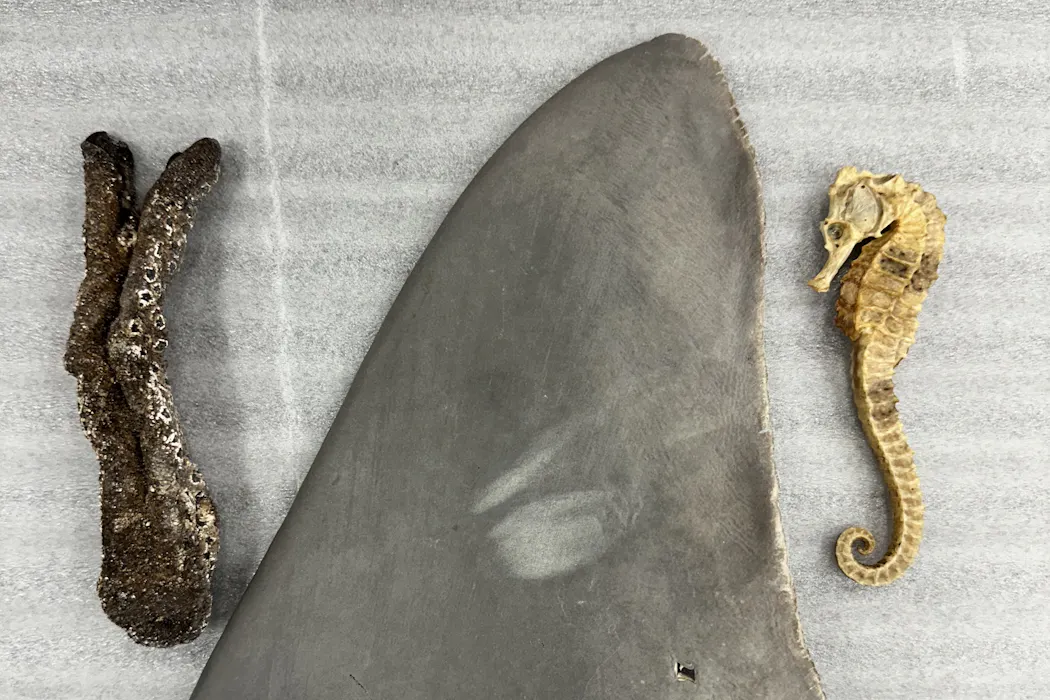
Marine wildlife samples used to create marine detection algorithms. Samples provided by the Australian Museum. Dr Vanessa Pirotta

Shark fins on a plane, seahorses in your bag and sea cucumbers in the post – these are just a few examples of illegal marine wildlife trafficking.

This crime can be hard to detect. But in a new study, published in the journal Frontiers in Ocean Sustainability, we show how artificial intelligence (AI) can be harnessed as a complimentary detection tool to help stop marine wildlife trafficking at international airports and mail facilities.

A global crime

The cross-border trade in live animals, animal parts or products is a global crime, facilitating the flow of billions of illicit dollars each year. It’s known to converge with other criminal activity, including the trafficking in drugs, arms and humans.

The United Nations Office on Drugs and Crime identifies five sources of demand for wildlife trafficking: food, medicine, pets and ornamental plants, specialist collection and adornment.

In some cases, such as pet prestige, people are motivated both by the desire to have a pet and the perceived status it brings to own an exotic animal.

People traffic marine animals too

Wildlife trafficking affects around 4,000 species. Many of the more well-known examples involve land-based animals – ivory from elephant tusks, horns from rhinos and scales from pangolins – the world’s most trafficked mammal.

Closer to home, we also see native Australian reptiles and birds, sometimes shoved in tins, put in socks and packaged up live to be sent overseas.

Marine creatures, unfortunately, are targeted too. This can include live animals such as fish in people’s bags, or dried marine life such as the rise of the seahorse trade and demand for shark fin.

We have small pockets of knowledge of this activity. But the reality is we don’t fully understand how widespread it is.

AI to detect marine wildlife trade

Currently, the best means of detecting illegally trafficked wildlife is humans. And then there are our four-legged friends: biosecurity dogs.

Recently, Australia has also been working to develop the use of AI as a potential means of detecting land-based wildlife in illegal wildlife movements – building on existing detection pathways using 3D X-ray machines fitted with algorithms.

For our latest study, we built on these efforts by developing world-first marine wildlife algorithms. We taught computers to look for shark fins, seahorses and sea cucumbers.

Eight fins illuminated in blue light.
Shark fins scanned under 3D X-ray. Vanessa Pirotta

We did this by collecting a total of 68 samples of dead marine animals, which we scanned in a 3D X-ray machine to create a library of images. We then used this image library to develop algorithms to enable computers to search for what we taught it to look for – in this case, shark fins, seahorses and sea cucumbers.

Samples were scanned alone and then in more complicated scenarios to reflect how people actually traffic marine life. This means if a bag or mail item is hiding a shark fin, seahorse or sea cucumber, the algorithm will be able to flag this to an operator, prompting them to inspect the item.

Out of a total of 298 scans and a training data set derived from these samples, our algorithm had success rates of 95%, 95% and 85% for shark fins, seahorses and sea cucumbers, respectively.

Humans and biosecurity dogs still needed alongside AI

While technology fitted with computer algorithms may help people inspecting luggage or mail, we still need people to verify what computers see. Sometimes the algorithms get it wrong and may miss items.

Despite this, the broader implications of having AI as a second set of eyes searching for trafficked marine life will aid in identifying key trade routes to potentially stop this activity. The next step is relying on implementation of these algorithms at the front lines.

Like computer algorithms and AI, the more we learn, the better we get at detecting and potentially stopping this harmful crime.

The Conversation

Vanessa Pirotta received funding from Rapiscan Systems for this research.

Justine O'Brien receives funding from the San Diego Zoo and Wildlife Alliance; NSW Department of Climate Change, Energy, the Environment and Water; the Australian Research Council; Institute of Museum and Library Services; Great Barrier Reef Foundation; and the Taronga Foundation.

Phoebe Meagher receives funding from San Diego Zoo and Wildlife Alliance and the Taronga Foundation.

Zara Bending serves as a Resident Expert for the Jane Goodall Institute Global and is a Distinguished Research Fellow at the Macquarie University Environmental Law Research Centre.

People are using AI to communicate without disclosing it. Is this morally wrong?

Imagine you have used a generative artificial intelligence (AI) tool such as ChatGPT to tidy up notes you took while in a meeting. Your colleague comments on how clear they are. You don’t disclose it was the AI that made the notes clear and not you.

Now consider a different scenario. You are at your mother’s funeral. Her best friend of many years delivers a heartfelt eulogy, wishing her well in the afterlife. But later you discover her friend did not actually write the eulogy in any way – AI did.

The undisclosed use of generative AI in these two scenarios is deceptive. But is it morally wrong?

It’s worth considering this philosophical question in detail, given the rapid uptake of generative AI and the fact research has found people may be strongly incentivised to not disclose their use of generative AI because it may impact their relationships.

This is because people take generative AI outputs, generally, to be less valuable, and regard those who use the technology as less competent and authentic.

Distinguishing different kinds of deception

Roughly speaking, if you’re engaging in a “deceptive act”, you’re trying to get someone to believe something you know is false. However, deception can come in different varieties.

Philosopher John Danaher provides a useful framework to distinguish between three forms of deception by AI or robots. This framework is useful because, just as robots might convincingly mimic human behaviours, generative AI technologies are allowing humans to do the same.

Some deceptions involve lying or misrepresenting the external world, such as telling someone you saw a horse in the street, even though you didn’t. Danaher calls these “external state” deceptions.

Other deceptions involve lying or misrepresenting facts about ourselves, such as making someone believe you’re an accomplished artist, even though the artwork you showed them was generated by AI. Danaher calls these “superficial state” deceptions.

We can also deceive others into believing we lack thoughts, feelings or competencies we actually possess, such as pretending to not understand a language we speak in order to eavesdrop. Danaher calls these “hidden state” deceptions.

So, when is deception immoral?

To go back to the first example, by not disclosing you used AI to tidy up meeting notes, you’ve allowed your colleague to believe you have the capacity to do the work, which might be true. However, you also allowed your colleague to believe that you demonstrated that capacity by doing the work, which is false. This would fall into the category of an “external state deception”.

While this deception is morally objectionable, it’s arguably ethically permissible. Trivial deceptions like this happen all the time – and surely we aren’t obligated to always disclose everything about what we do and why we do it.

For example, we don’t blink an eye at undisclosed use of spell-checking software because, in most situations, being a good speller isn’t important. But triviality depends on context. If someone used spell-checking software at a spelling bee, we might be less forgiving.

The scenario about the funeral speech is similar to the first scenario, but less trivial. Your belief over your mother’s friend’s superficial state – that they wish her well – may or may not be false. However, your belief over the external state of affairs – that the eulogy is a demonstration of those well-wishes – is certainly false.

This is more morally problematic. When we claim an AI-generated output as our own – and particularly one that aims to reflect something about ourselves – we signal to others that we not only endorse the output, but that we have authored it. In this case it matters to us that the friend is the source of the eulogy – and not AI. The external state deception is deceptive in a non-trival way.

We imply the output was directly caused by our thoughts, feelings or competencies. When we don’t disclose our use of AI, we deprive others of the kinds of information needed to form true beliefs about how the world is and how others are. This is wrong if people deserve to have such information.

However, the eulogy example can still show how not disclosing our use of AI can – all things considered – sometimes be permissible. Perhaps, for example, the friend was so wracked with grief, that having AI write the eulogy on their behalf was the only way for them to get the speech written in time for the funeral. So they endorsed the generated output as their own.

In such cases, not disclosing the use of AI may be permissible, even though still a morally objectionable kind of deception. This is because, like triviality in the first scenario, other reasons might sufficiently outweigh the wrongness of non-disclosure.

Using AI more ethically

So, how can people use generative AI more ethically?

If we are to avoid immorally deceiving others, we ought to disclose our use of it in non-trivial cases.

What makes undisclosed AI use non-trivial is malleable and context-dependent. It changes in response to social norms couched within particular social practices.

Being open about AI use gives others the opportunity to form more accurate beliefs about what we are communicating – and the internal states our communication demonstrates.

The Conversation

Siavosh Sahebi is supported by an Australian Government Research Training Program scholarship.

Thomas Montefiore receives funding from the Australian Government through the Australian Research Council.

Not A Souvenir: Tony Albert exhibit turns racist Aboriginalia into a powerful act of truth-telling

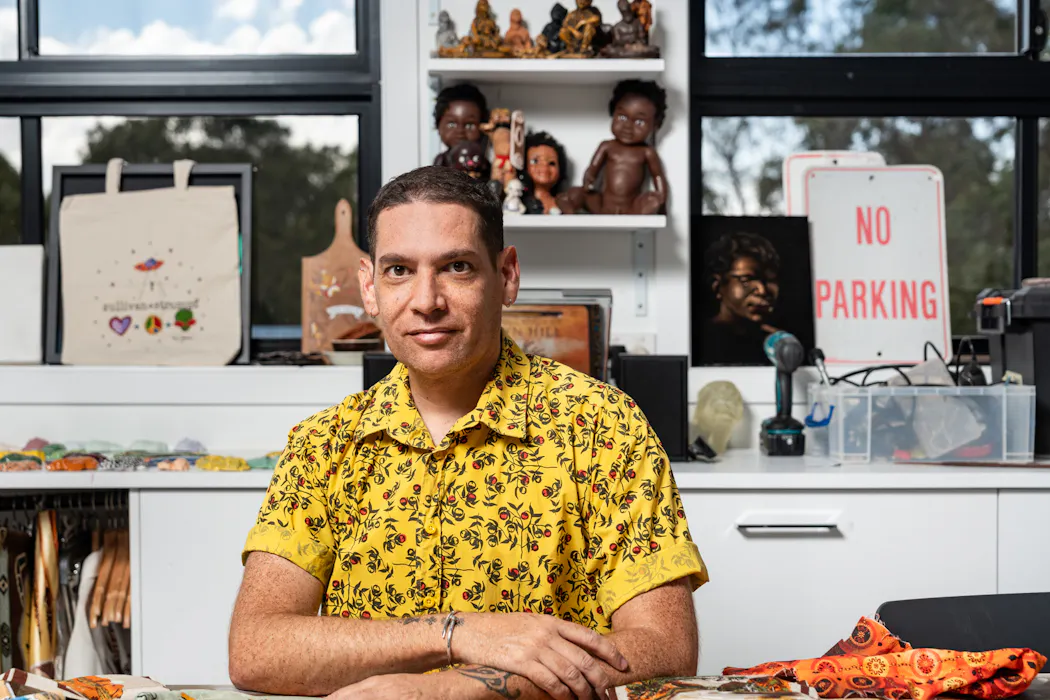
Louis Lim

Aboriginal people of my vintage grew up surrounded by Aboriginalia in the form of kitsch everyday objects, often depicting racist stereotypes that showed what Australia thought about us.

From wall hangings to tea-towels, to drink coasters and ashtrays, they were ever present. Later, when they began to be regarded as cringe-worthy, they were relegated to the op-shops frequented by a young Tony Albert.

The Girrimay, Kuku Yilanji, Yidinji artist describes his early fascination with these objects: complex, tangible reminders of racism. By incorporating them into his work, he reframes them within an immutable Blak presence — one that has informed his decades-long practice.

Tony Albert, Disconnected, 2025, synthetic, polymer paint and found objects applied to timber, courtesy and © the artist, Installation view, Tony Albert: Not a Souvenir, Museum of Contemporary Art Australia, Sydney, 2026, photograph: Ravyna Jassani.

Care and considered

When you first enter Albert’s exhibition, Not a Souvenir, showing at Sydney’s Museum of Contemporary Art, you are met with a wall of Aboriginalia reminiscent of the domestic display for which many were originally created.

Accompanying this wall is a glass display, resembling a colonial museum exhibit, that features a further assemblage of items. The sheer volume, variety, and span of time this vast assemblage represents is intentionally arresting. It’s a reminder of how diverse the public’s fascination with Aboriginalia once was.

Installation view, Tony Albert: Not a Souvenir, Museum of Contemporary Art Australia, Sydney, 2026, photograph: Ravyna Jassani.

In an earlier age, these objects reduced Aboriginal people to curios of utility and stereotype. But Albert presents them with care and consideration, treating them like an ancestor entrusting their meaning-making to Aboriginal hands.

The late Wiradjuri writer Aunty Kerry Reed-Gilbert(1956–2019) recalled how many Aboriginal people had a hand in making these objects. They were often held in our own collections, as memory pieces to be cherished, as a part of our long story.

However, Albert’s love letter to Aboriginal Kitch is interrupted in the next gallery, where the visitor encounters specific-use Aboriginalia in his 2008 work, Ash on Me, and the more recent, ASHamed (2025).

Installation view, Tony Albert: Not a Souvenir, Museum of Contemporary Art Australia, Sydney, 2026, photograph: Jessica Maurer.

These works shows ashtrays featuring the bodies and faces of Aboriginal people made to have cigarettes stubbed out on their visages. It’s a confronting shift from kitch as pristine object of souvenir, to calling out the casual violence and disregard for Aboriginal bodies.

As Aboriginal people we are often asked to explain what truth-telling looks like. Here, we see it in Albert’s use of devastating whimsy: the history of these items, their use, and Australian complicity creates an opportunity for new truths to be told.

Installation view, Tony Albert: Not a Souvenir, Museum of Contemporary Art Australia, Sydney, 2026, photograph: Jessica Maurer.

A nuanced dialogue with the past

The exhibition, like Albert’s larger body of work, is no single note. His truth-telling creates a complex dialogue between artist and visitor, often responding to events and existing works popular among the public.

Around the halfway point we see this in Conversations with Preston. This series recalls and responds to early 20th century artist Margaret Preston’s unauthorised appropriation of Aboriginal motifs across her practice.

Rather than dismissing Preston’s work, Albert recognises the beauty and tribute, while also insisting on its devastating impact. He asserts an Aboriginal hand in the re-telling.

From this gentle cadence, guests are thrust into a visceral challenge to coloniality with Albert’s series, You Wreck Me. Many encountered this work on the cover of Bronwyn Carlson and Terri Farrelly’s 2023 book, Monumental Disruptions – with both artwork and book calling for the long overdue toppling of colonial statues.

You Wreck Me shows the artist atop a wrecking ball, bound for a statue of Captain Cook. No subtle metaphor here. This is truth-telling through resistance, insistence and action.

Chance for reflection

This exhibition, curated by Albert’s long-time collaborator Bruce Johnson McLean (Wierdi), juxtaposes an astounding breadth of the artist’s works. Many of the works are seemingly disparate.

In the centre of the souvenir-laden coloniality of The Rocks, McLean reminds the visitor this is not neutral territory. Instead, Tallawoladah is a place where Aboriginal people have thrived for eons, with colonial violence being a more recent incursion.

The incongruence is reinforced through the Brothers series, which depicts Aboriginal boys with targets painted on their torsos, as direct recall of police brutality leading to the deaths of Aboriginal children.

Tony Albert, Brothers (The Prodigal Son) I, 2020, courtesy of the artist and, Sullivan+Strumpf, photograph: Aaron Anderson.

Behind these stark representations are the windows of the gallery that face Circular Quay, replete with an enormous docked cruise ship and tourists milling around.

Visitors who are invested in truth-telling may be confronted. Tourists may second-guess their purchase of a souvenir boomerang: is it authentic? – should they own it? Non-Indigenous Australian visitors may recall a part of their own colonial past. And First Nations visitors may bear witness to the way Albert’s work can hold truths while presenting a complex reality.

The exhibition concludes with an opportunity for visitors who own uncomfortable Aboriginalia to donate it to Albert to be repurposed.

As Albert explains:

It’s about taking these objects and turning them into something that celebrates our survival and our vibrancy as the world’s oldest living culture.

In refusing to allow these items to be absent in his retelling of how we continue to thrive, Albert engages in a resistance that brings visitors along, making us co-conspirators in his anti-colonial vision.

Tony Albert: Not a Souvenir is showing at the Museum of Contemporary Art Australia from May 21 to October 19.

The Conversation

Sandy O'Sullivan has received funding from the Australian Research Council.

Galloway Hoard exhibit in Sydney dives into the secrets of the Viking world

In the popular imagination, the phrase “Viking hoard” might evoke images of plunder stashed by marauding Norse pirates. Or perhaps you picture sacred objects hidden by frantic monks in the uproar of a violent raid.

The Galloway Hoard reveals the truth of the Viking expansion was less dramatic. But as the richest Viking-era hoard discovered so far in the United Kingdom and Ireland, it also exposes a more complex and intriguing past.

The hoard was buried in southwestern Scotland around 900 CE. We owe its recovery to a gold-standard cooperation between Derek McLennan, the metal detectorist who uncovered it in 2014, and the archaeologists who helped preserve it – and are now hard at work to unlock its mysteries.

Traces of a complex maritime world

The hoard, which consists of more than 100 items of mostly silver and gold, is currently on display in Sydney at the National Maritime Museum.

This is a particularly fitting venue, as it embraces the hoard as a mirror of the Vikings’ legendary seafaring culture. The exhibition greets visitors with a replica of a Viking-era boat stempost from the Isle of Eigg in Scotland’s Inner Hebrides. It reminds us of the importance of ships for this world, where voyaging the sea lanes was as important as taking the land.

Some of the hoard’s most unique and exotic items open its northern world up to the south and the east parts of the globe. In the exhibit, 3D-printed replicas allow visitors to see these items in all their original splendour.

These include an ornate silver vessel from the ancient Persian Sasanian Empire, a jar carved from Roman-era rock crystal, and Scotland’s earliest surviving fragments of silk.

Even the more “local” objects have unexpected features indicating cultural and linguistic complexity around the Viking-occupied perimeter of the Irish Sea.

Viking-era silver armbands inscribed with Old English runes, for instance, point to the persistence of the earlier language in this area despite Scandinavian incursion.

One such armband states its owner is Egbert – definitely a pre-Viking English name. Other pre-Viking English treasures include a cross, rare for having its neck-chain still attached, and seven brooches with Christian and pagan features.

This so-called “Viking hoard” then, is actually a material record of overlapping times and places that have been deliberately gathered and buried together.

But who gathered these goods together for burial, and why? What did these items mean to them? Were they venerating them, hiding them, or keeping them safe?

And did they mean for the hoard to remain undiscovered for more than a thousand years – or perhaps forever?

The mystery of hoards

These questions may never have definitive answers.

Hoards, broadly defined by British archaeologist Eleanor Ghey as buried or concealed items “kept together, perhaps gathered all at once or gradually amassed over time”, fascinate us because they’re as mysterious as they are revealing.

Ghey notes, though, that there are clues to be found in the objects themselves, and where and how they’ve been deposited. The Galloway Hoard’s 900 CE dating comes from its silver and textile items. Inscriptions on some armbands point to possible collective or even communal ownership.

One especially intriguing feature is the hoard’s two layers: a bed of gravel separates a less valuable upper deposit of silver bullion from a lower deposit containing gold and exotic goods from afar.

The upper layer might simply be a later deposit. But some speculate it’s a decoy, designed to stop finders from digging down to the more cherished goods. Perhaps we’ll know someday.

Detecting the past

The Galloway Hoard’s 2014 discovery is part of a broader explosion of similar significant finds by amateur detectorists.

In 21st-century Britain alone, detectorists have uncovered dozens of Iron Age, Roman, Pictish, Saxon, Viking and late medieval hoards. In 2009, for example, they attracted worldwide coverage after discovering the vast 7th-century Staffordshire Hoard. The public frenzy wasn’t just due to the splendour of the 4500+ objects, but to the serendipity of its discovery by an amateur.

British detectorists have shown commitment to establishing good practice. The National Council for Metal Detecting cooperates with professional archaeology bodies and promotes legal and ethical detecting.

The Galloway Hoard’s finding was a model of good practice. When he realised he’d found something significant, detectorist Derek McLennan downed his tools and contacted archaeologists, who protected the site and goods and contacted the national Treasure Trove Unit.

That said, detectorist conduct hasn’t always been so exemplary, as I discovered when researching for my forthcoming Exeter University Press book Detectorists: Feeling for the Past.

In 2015, the discovery of the Viking-era Hereford Hoard resulted in the conviction of detectorists and coin dealers for illegal finding, concealing, and black-market selling of items.

McLennan, by contrast, kept his allotted 50% of the £1.98 million (about A$3.7 million) paid by the National Museum of Scotland. This is surely a modern parable for the importance of sharing, rather than hoarding, the spoils.

Treasures of the Viking Age - The Galloway Hoard is showing at Sydney’s Australian National Maritime Museum until October 11

The Conversation

Louise D'Arcens has previously received funding from the Australian Research Council.

We found hundreds of huge ancient mass graves hidden in the Sahara desert

We have been on a years-long campaign of satellite remote sensing of the vast desert landscapes in Eastern Sudan.

This involved using satellite aerial imagery to systematically and painstakingly search for archaeological features in Atbai Desert of Eastern Sudan, a small part of the much larger Sahara.

Our team – which includes archaeologists from Macquarie University, France’s HiSoMA research unit, and the Polish Academy of Sciences – wanted to tell the story of this desert region between the Nile and the Red Sea, without having to excavate.

One mysterious archaeological feature stood out. We kept finding large, circular mass graves filled with the bones of people and animals, often carefully arranged around a key person at the centre.

Likely built around the fourth and third millennia BCE, all these “enclosure burial” monuments have a large round enclosure wall, some up to 80 metres in diameter, with humans and their cattle, sheep and goats buried inside.

Our new research, published in the journal African Archaeological Review, reveals how we found 260 previously unknown enclosure burials east of the Nile River, across almost 1,000km of desert.

Who built them?

Already known from a few excavated examples in the Egyptian and Sudanese deserts, these large circular burial monuments have long puzzled scholars.

What seemed once isolated examples emerge now as a consistent pattern. It is suggestive of a common nomadic culture stretching across a vast stretch of desert.

Most are within the borders of modern Sudan on the slopes of the Red Sea Hills. Unfortunately, satellite imagery alone cannot communicate the whole story of these enclosure burial builders.

The carbon dates and pottery from the few excavated monuments tell us these people lived roughly 4000–3000 BCE, just before Egyptians formed a territorial kingdom we know of as Pharaonic Egypt.

But these “enclosure burial” nomads had little to do with urbane and farming Egyptians.

Living in the desert and raising herds, these were Saharan desert nomads through and through.

A new elite?

Some enclosures show “secondary” burials arranged around a “primary” burial of a person at the centre – perhaps a chief or other important member of the community.

For archaeologists, this is important data for discerning class and hierarchy in prehistoric societies.

The question of when Saharan nomads became less egalitarian has plagued archaeologists for decades, but most agree it was around this time of the fourth millennium BCE that a distinctive “elite” class emerged.

This is still a far cry from the sort of huge divisions between ruler and ruled as seen in societies such as Egypt, with its pharaohs and farmers. However, it ushers in the first traces of inequality.

Animals held in high esteem

Cattle seem very important to these prehistoric nomads (a theory also supported by ancient local rock art in the area).

Burying themselves alongside their herd, these nomads show they held their animals in esteem.

Thousands of years later, local nomads chose to reuse these now “ancient” enclosures for their burial plots – sometimes almost 4,000 years after they were first built.

In other words, the prehistoric nomads created cemetery spaces that lasted for millennia.

What happened to these people?

No one can say for sure.

The few dates we have for these monuments cluster between 4000–3000 BCE, nearing the end of a period when the once-greener Sahara was drying, a phase scientists call the “African Humid Period”.

From north to south, the summer monsoon gradually retreated, reducing rainfall and shrinking pastures. This led nomads to abandon thirsty cattle, increase the mobility of their herds, migrate to the south or flee to the Nile.

The monuments are overwhelmingly located near what were then favourable watering spots; near rocky pools in valley floors, lakebeds and ephemeral rivers.

This tells us that when the monuments were being built, the desert was already quite challenging and dry.

At some point, as grass and bush made way for sand and rocks, keeping their prized cattle became unsustainable.

Having large herds of cattle in this desert, at this period, may have been a way of showing off an expensive and rare possession – a prehistoric nomad’s equivalent to having a Ferrari. This may help explain why cattle were frequently buried alongside their owners in enclosure burial monuments.

A bigger story

These enclosure burials are only one part of the greater story of human adaptation to climate change across North Africa.

From the Central Sahara, to Kenya and Arabia, keeping cattle, goats and sheep transformed societies. It changed the food they ate, the way they moved around, and community hierarchies.

It’s no coincidence communities changed how they buried their dead at the same time as they adopted herding lifestyles.

These burial enclosures tell us even scattered nomads were extremely well-organised people, and expert adapters.

Our discovery reshapes the story of the Sahara deserts and the prehistory of the Nile.

They provide a prologue for the monumentalism of the kingdoms of Egypt and Nubia, and an image of this region as more than pharaohs, pyramids and temples.

Sadly, many of these enclosure monuments are currently being destroyed or vandalised as a result of unregulated mining in the region. These unique burials have survived for millennia, but can disappear in less than a week.

Maria Gatto (Polish Academy of Sciences) was an author on our paper. We also want to acknowledge Alexander Carter, Tung Cheung, Kahn Emerson, Jessica Larkin, Stuart Hamilton and Ethan Simpson from Macquarie University for their contribution. We are also grateful to the National Corporation of Antiquities and Museums (Sudan).

The Conversation

Julien Cooper receives funding from the Australian Research Council, (Future Fellowship, FT230100067).

Maël Crépy receives funding from the CNRS (HiSoMA) and the Ifao (NOMADES research program).

Marie Bourgeois receives funding from Ifao (NOMADES research program).

A 5.3 million-year-old whale graveyard has been found on the floor of the Indian Ocean

When a whale dies, a very special natural phenomenon can come alive. The carcass might float at the surface for some time, attracting sharks and other predators. As it becomes weathered it may start to sink, falling through the water until it eventually settles on the seafloor where deep sea scavengers feast upon it.

The scientific record of “whale falls” is sparse and fragmentary. But a team of researchers, led by Xiaotong Peng from the Chinese Academy of Sciences, has discovered a vast and ancient whale necropolis in the Diamantina Zone in the southeastern Indian Ocean.

The site, described in a new paper published in Nature, dates back more than five million years and is one of the deepest known whale fall ecosystems in the world.

A whale-sized find in the middle of the ocean

During a special dive mission in February 2023 using a submersible called the Fendouzhe, the team of scientists discovered extensive whale skeletons and fossils partially buried in sediment on the seafloor.

Following the initial discovery, the team made 32 more dives to the seafloor over the next month, mapping the extent of the necropolis.

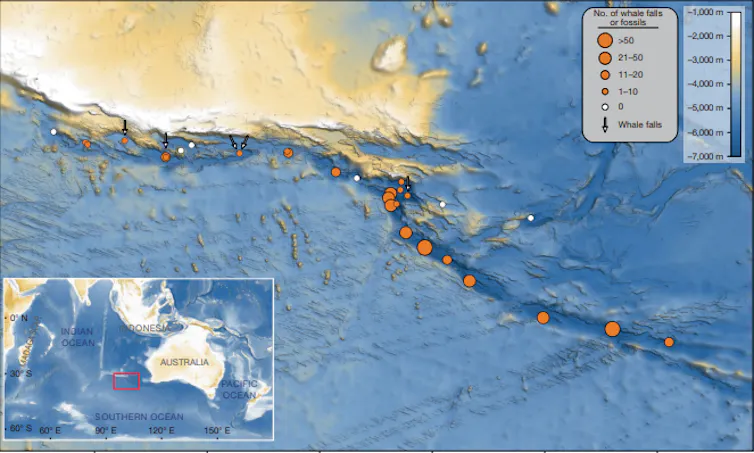
It stretched roughly 1,200 kilometres along the seafloor at depths of between 4,200 and 7,000 metres. It contained 476 whale fossils as well as five active whale falls.

A topographical map of the Indian Ocean, with orange dots representing the location of whale fossils.
Distribution and abundance of whale fossils and whale falls in the Diamantina Zone. Xiaotong Peng et al, CC BY-NC

These active whale falls were teeming with many strange-looking creatures, including jellyfish, brittle stars and bone-boring worms – many of which may be new to science, according to the researchers.

From the 43 fossils the team recovered, they identified five beaked-whale species, including the Andrews’ beaked whale (Mesoplodon bowdoini) and the strap-toothed whale (Mesoplodon layardii) which are known to inhabit the region, and one species of baleen whale – the sei whale (Balaenoptera borealis).

The largest find was a dead Antarctic minke whale, five metres in length, which the team identified from its distinct ear bone shape, as well as genetic analysis. The team also identified a new whale species – Pterocetus diamantinae – which is now extinct.

Isotopic dating, where scientists use the decay of radioactive isotopes, revealed that the oldest fossils from the site are about 5.3 million years old.

The high concentration of whale remains in the region raises the question of how exactly this graveyard was formed. The authors suggest the reason probably has to do with the V-shaped topography of the Diamantina Zone which funnels carcasses onto the seafloor, plus the fact that many deep-diving beaked whale species are known to inhabit this part of the ocean.

Three weathered skulls against a black background.
Fossil skulls of three beaked whales recovered from the seafloor of the Diamantina Zone. Global TREnD, IDSSE

A reminder of how little we know

This work deepens our our understanding of whale falls and the incredible ecosystems they support. It also deepens our understanding of beaked whales – usually offshore species which routinely dive up to 1 kilometre and hold their breath for more than an hour.

The finding of five million-year-old fossils provide an evolutionary window into the history of beaked whales from the Pliocene epoch to the present day.

This research is also a humbling reminder of how little we know of the deep sea – and how when we look for something, we may just find it, and so much more.

The Conversation

Vanessa Pirotta does not work for, consult, own shares in or receive funding from any company or organisation that would benefit from this article, and has disclosed no relevant affiliations beyond their academic appointment.

❌
Subscriptions