
❌

Normal view

A 5.3 million-year-old whale graveyard has been found on the floor of the Indian Ocean

When a whale dies, a very special natural phenomenon can come alive. The carcass might float at the surface for some time, attracting sharks and other predators. As it becomes weathered it may start to sink, falling through the water until it eventually settles on the seafloor where deep sea scavengers feast upon it.

The scientific record of β€œwhale falls” is sparse and fragmentary. But a team of researchers, led by Xiaotong Peng from the Chinese Academy of Sciences, has discovered a vast and ancient whale necropolis in the Diamantina Zone in the southeastern Indian Ocean.

The site, described in a new paper published in Nature, dates back more than five million years and is one of the deepest known whale fall ecosystems in the world.

A whale-sized find in the middle of the ocean

During a special dive mission in February 2023 using a submersible called the Fendouzhe, the team of scientists discovered extensive whale skeletons and fossils partially buried in sediment on the seafloor.

Following the initial discovery, the team made 32 more dives to the seafloor over the next month, mapping the extent of the necropolis.

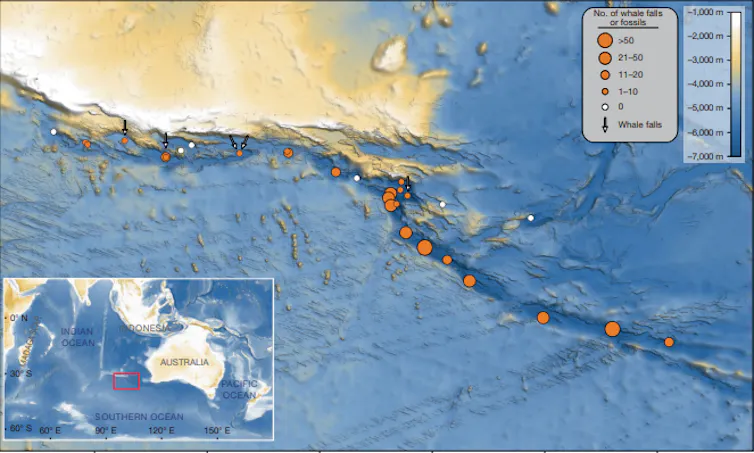
It stretched roughly 1,200 kilometres along the seafloor at depths of between 4,200 and 7,000 metres. It contained 476 whale fossils as well as five active whale falls.

A topographical map of the Indian Ocean, with orange dots representing the location of whale fossils.
Distribution and abundance of whale fossils and whale falls in the Diamantina Zone. Xiaotong Peng et al, CC BY-NC

These active whale falls were teeming with many strange-looking creatures, including jellyfish, brittle stars and bone-boring worms – many of which may be new to science, according to the researchers.

From the 43 fossils the team recovered, they identified five beaked-whale species, including the Andrews’ beaked whale (Mesoplodon bowdoini) and the strap-toothed whale (Mesoplodon layardii) which are known to inhabit the region, and one species of baleen whale – the sei whale (Balaenoptera borealis).

The largest find was a dead Antarctic minke whale, five metres in length, which the team identified from its distinct ear bone shape, as well as genetic analysis. The team also identified a new whale species – Pterocetus diamantinae – which is now extinct.

Isotopic dating, where scientists use the decay of radioactive isotopes, revealed that the oldest fossils from the site are about 5.3 million years old.

The high concentration of whale remains in the region raises the question of how exactly this graveyard was formed. The authors suggest the reason probably has to do with the V-shaped topography of the Diamantina Zone which funnels carcasses onto the seafloor, plus the fact that many deep-diving beaked whale species are known to inhabit this part of the ocean.

Three weathered skulls against a black background.
Fossil skulls of three beaked whales recovered from the seafloor of the Diamantina Zone. Global TREnD, IDSSE

A reminder of how little we know

This work deepens our our understanding of whale falls and the incredible ecosystems they support. It also deepens our understanding of beaked whales – usually offshore species which routinely dive up to 1 kilometre and hold their breath for more than an hour.

The finding of five million-year-old fossils provide an evolutionary window into the history of beaked whales from the Pliocene epoch to the present day.

This research is also a humbling reminder of how little we know of the deep sea – and how when we look for something, we may just find it, and so much more.

The Conversation

Vanessa Pirotta does not work for, consult, own shares in or receive funding from any company or organisation that would benefit from this article, and has disclosed no relevant affiliations beyond their academic appointment.
Squeak up! I can’t hear you: pilot whales are shouting to hear themselves over ship noise

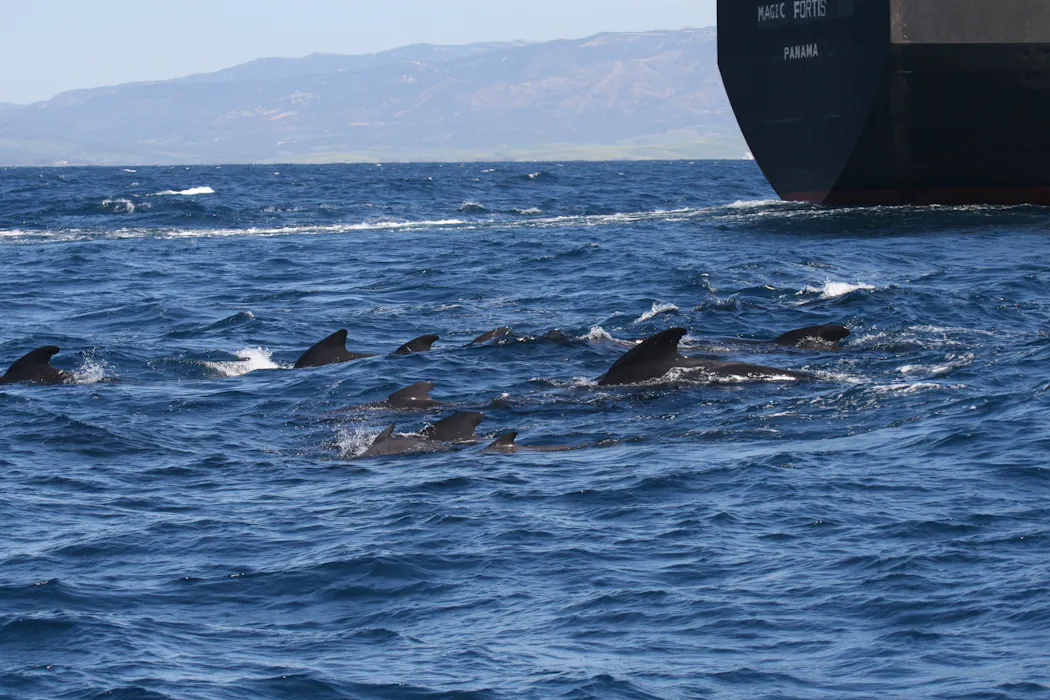
A pod of long-finned pilot whales near a cargo ship. CIRCE

In the Strait of Gibraltar – a famous marine road connecting the Mediterranean and the Atlantic – lives a critically endangered sub-population of a few hundred long-finned pilot whales (Globicephala melas).

Despite their name, these dark and blubbery marine mammals aren’t technically whales – they’re large oceanic dolphins which are believed to have a navigator or lead for each pod. Hence the β€œpilot” part of their name.

There are two types of pilot whales – short and long-finned. They’re generally found in deep offshore waters but can appear in coastal areas. And like other dolphins, they use high frequency sounds to talk to each other in their pods. These clicks and squeaks travel shorter distances compared with the melodic songs of humpback whales.

And as a new paper led by Milou Hegeman from Aarhus University in Denmark and published in the Journal of Experimental Biology shows, the pilot whales that live in the Strait of Gibraltar are having to shout at the upper limit of their range in order to hear each other over human noises.

What’s making all that noise?

The ocean is full of sounds.

Some of these are natural, such as the sounds from fish, seals and waves. Other sounds are produced by human activities, either deliberately (for example seismic and sonar exploration) or unintentionally (for example, the sound of moving ships or other vessels).

The ocean continues to get noisier because of human-made sound – even in isolated Arctic regions. And because of its strategic location, the Strait of Gibraltar is especially noisy with the drone of cargo ships.

Shipping noise that the pilot whales experience. CIRCE587 KB (download)

Spying on pilot whales

To investigate the communication and behaviour of the population of pilot whales in the Strait of Gibraltar, scientists used 6-metre poles to attach small tags to the creatures (kind of like an Airtag used to track your suitcase) with sterile suction cups positioned between the dorsal fin and blowhole.

Between 2012 to 2015, the steam attached tags to 23 different long-finned pilot whales who live in the region year-round.

These tags remained on pilot whales for up to 24 hours collecting sounds and tracking individual behaviour. The tags then floated to the surface where scientists could locate them using an antenna and collect the data from their diving activities.

Two black dolphins with orange recorders attached to their back, swimming in the ocean.
Two long-finned pilot whales with recorders. CIRCE

More than 84 hours of recordings were made, with 1,432 pilot whale calls extracted. The tags also recorded ship noise in the area.

The researchers found there was a scarcity of pilot whale calls during periods of shipping noise. And the volume of the calls they did make were louder by about half the increase in background noise.

This means the animals are adapting to communicate in times when it is noisy – kind of like having a conversation in a crowded place and you having to raise your voice to be heard.

A whale calling out for its group with ship noise in the background. CIRCE376 KB (download)

Other noises, other impacts

This study focuses on just one location in the ocean. But there’s increasing evidence that human-made noise is also impacting other species in other places.

For example, a 2012 study found that ship noise increases stress in right whales. Another study from 2024 found sea turtles travelling in the Galapagos were more vigilant because of increased ship noise.

But it’s not just ship noise that is impacting the animals that live in the ocean. Sonar disrupts whale diving behaviour and feeding behaviour, sometimes even potentially resulting in strandings.

Thankfully, work is being done to reduce noise pollution in the ocean – from building quieter ships to rerouting ship activity, helping ship operators drive more quietly and dialling down the noise from all human activities.

This new study is just one of many scientific contributions to learning more about our impact on our blue backyard. We can only protect what we know. And as we celebrate the 100th birthday of Sir David Attenborough, it’s worth remembering one of his many pieces of wisdom: β€œIf we save the sea, we save our world”.

Part of this involves being more aware of sound in our sea. Because sometimes, it’s not always the visible impacts such as plastic pollution that need our attention. It might also be the impacts we can only hear.

The Conversation

Vanessa Pirotta does not work for, consult, own shares in or receive funding from any company or organisation that would benefit from this article, and has disclosed no relevant affiliations beyond their academic appointment.
Seahorses and shark fins are illegally trafficked. An AI tool could help stop this crime

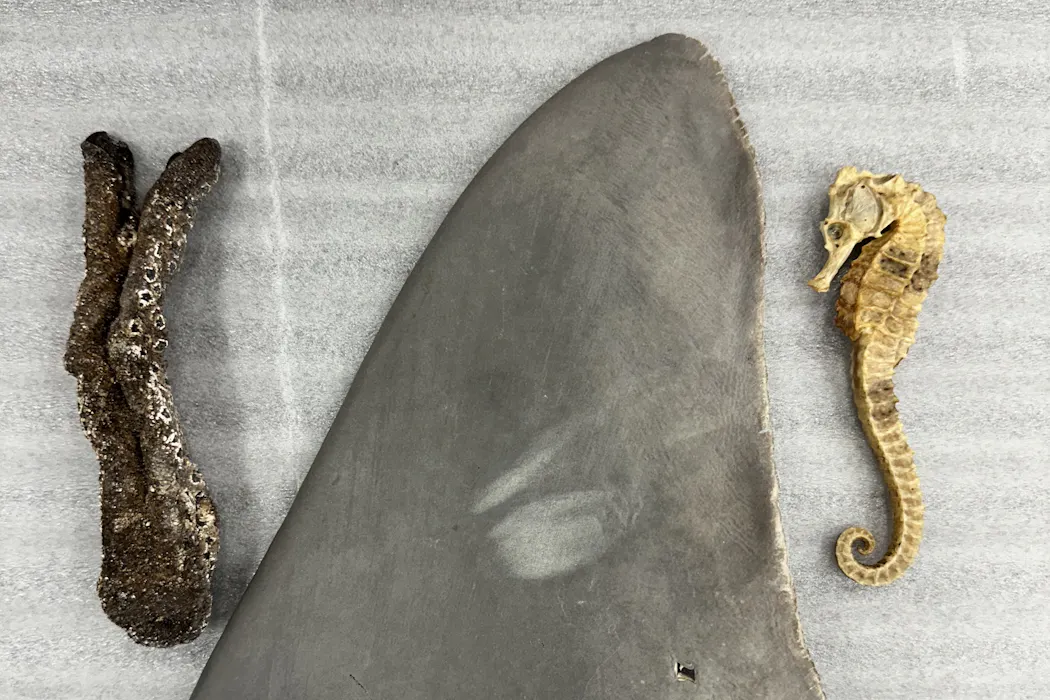
Marine wildlife samples used to create marine detection algorithms. Samples provided by the Australian Museum. Dr Vanessa Pirotta

Shark fins on a plane, seahorses in your bag and sea cucumbers in the post – these are just a few examples of illegal marine wildlife trafficking.

This crime can be hard to detect. But in a new study, published in the journal Frontiers in Ocean Sustainability, we show how artificial intelligence (AI) can be harnessed as a complimentary detection tool to help stop marine wildlife trafficking at international airports and mail facilities.

A global crime

The cross-border trade in live animals, animal parts or products is a global crime, facilitating the flow of billions of illicit dollars each year. It’s known to converge with other criminal activity, including the trafficking in drugs, arms and humans.

The United Nations Office on Drugs and Crime identifies five sources of demand for wildlife trafficking: food, medicine, pets and ornamental plants, specialist collection and adornment.

In some cases, such as pet prestige, people are motivated both by the desire to have a pet and the perceived status it brings to own an exotic animal.

People traffic marine animals too

Wildlife trafficking affects around 4,000 species. Many of the more well-known examples involve land-based animals – ivory from elephant tusks, horns from rhinos and scales from pangolins – the world’s most trafficked mammal.

Closer to home, we also see native Australian reptiles and birds, sometimes shoved in tins, put in socks and packaged up live to be sent overseas.

Marine creatures, unfortunately, are targeted too. This can include live animals such as fish in people’s bags, or dried marine life such as the rise of the seahorse trade and demand for shark fin.

We have small pockets of knowledge of this activity. But the reality is we don’t fully understand how widespread it is.

AI to detect marine wildlife trade

Currently, the best means of detecting illegally trafficked wildlife is humans. And then there are our four-legged friends: biosecurity dogs.

Recently, Australia has also been working to develop the use of AI as a potential means of detecting land-based wildlife in illegal wildlife movements – building on existing detection pathways using 3D X-ray machines fitted with algorithms.

For our latest study, we built on these efforts by developing world-first marine wildlife algorithms. We taught computers to look for shark fins, seahorses and sea cucumbers.

Eight fins illuminated in blue light.
Shark fins scanned under 3D X-ray. Vanessa Pirotta

We did this by collecting a total of 68 samples of dead marine animals, which we scanned in a 3D X-ray machine to create a library of images. We then used this image library to develop algorithms to enable computers to search for what we taught it to look for – in this case, shark fins, seahorses and sea cucumbers.

Samples were scanned alone and then in more complicated scenarios to reflect how people actually traffic marine life. This means if a bag or mail item is hiding a shark fin, seahorse or sea cucumber, the algorithm will be able to flag this to an operator, prompting them to inspect the item.

Out of a total of 298 scans and a training data set derived from these samples, our algorithm had success rates of 95%, 95% and 85% for shark fins, seahorses and sea cucumbers, respectively.

Humans and biosecurity dogs still needed alongside AI

While technology fitted with computer algorithms may help people inspecting luggage or mail, we still need people to verify what computers see. Sometimes the algorithms get it wrong and may miss items.

Despite this, the broader implications of having AI as a second set of eyes searching for trafficked marine life will aid in identifying key trade routes to potentially stop this activity. The next step is relying on implementation of these algorithms at the front lines.

Like computer algorithms and AI, the more we learn, the better we get at detecting and potentially stopping this harmful crime.

The Conversation

Vanessa Pirotta received funding from Rapiscan Systems for this research.

Justine O'Brien receives funding from the San Diego Zoo and Wildlife Alliance; NSW Department of Climate Change, Energy, the Environment and Water; the Australian Research Council; Institute of Museum and Library Services; Great Barrier Reef Foundation; and the Taronga Foundation.

Phoebe Meagher receives funding from San Diego Zoo and Wildlife Alliance and the Taronga Foundation.

Zara Bending serves as a Resident Expert for the Jane Goodall Institute Global and is a Distinguished Research Fellow at the Macquarie University Environmental Law Research Centre.

❌
Subscriptions