Normal view

TikTok’s popular microdramas shrink TV into bite-sized chunks

Actress and writer Issa Rae speaks at the Fast Company Innovation Festival in New York in 2024. Her new microdrama, 'Screen Time,' has already garnered over 100 million views. Eugene Gologursky/Getty Images for Fast Company

Some of the hottest casting calls in Hollywood right now aren’t for Netflix, Disney or HBO.

They’re for TikTok.

In January 2026, TikTok rolled out PineDrama in the United States and Brazil, an app devoted to microdramas, also known as “verticals.”

Unlike TikTok’s traditional user-generated content, PineDrama primarily features scripted series produced by studios, production companies and media partners. These are short, serialized shows meant to be watched in one-minute increments, and they often feature melodramatic tales of romance, revenge or the supernatural.

By March, TikTok was already casting for new PineDrama series, just as professionally produced microdramas such as “Love at First Bite,” “The Officer Fell For Me” and “The Return of Divorced Heiress” were attracting millions of views on the platform.

By late April, actress Issa Rae had premiered her seriesScreen Time,” a PineDrama exclusive about a double date gone awry that has already garnered over 100 million views.

At first glance, a social media app becoming a television studio might seem like a radical shift.

But in our recently published research paper, we argue that TikTok’s move into scripted storytelling is not a break from television; it is a continuation of it. In fact, TikTok’s success can be attributed, in part, to the ways it has pulled from both the business model and programming conventions of the television industry.

A business model that looks a lot like TV

Media scholars have used the term “flow” to describe how television is experienced not as an individual program, but as a continuous stream of content. Live broadcasts, scripted shows, commercials and promos blend together into a seamless viewing experience.

TikTok recreates this dynamic, but replaces network scheduling with algorithmic curation. Ads are embedded directly into the viewing experience, appearing between videos in a way that mirrors television commercial breaks.

Advertising dollars have long fueled traditional television, which sold audiences – particularly the coveted 18-to-49 demographic – to advertisers. TikTok relies on a similar advertising model, but uses user data and algorithmic recommendation systems to curate a continuous stream of personalized content and targeted ads.

TikTok’s content has also long been shaped by other norms of the television industry.

For example, even before the emergence of microdramas, creators often produced videos as part of ongoing series, a format that encourages viewers to return for updates or to see what happens after being left with a cliffhanger. This kind of serialized storytelling is central to television.

Meanwhile, genres that originated on television – talk shows, reality shows and confessional storytelling – are everywhere on TikTok. Even though these clips are only minutes long, they often rely on cliffhangers, “Part 2” reveals, emotional confessions and recurring characters to encourage repeat viewing in ways that mirror broadcast television.

The experience of using TikTok is analogous to watching TV. Users can scroll to a new video as soon as the one they’re watching no longer entertains, much like channel surfing. At the same time, users can fall into “TikTok holes,” endlessly scrolling through videos for hours in a form of binge-watching that mirrors today’s streaming culture.

Why TikTok might succeed where Quibi failed

PineDrama may sound a bit like the failed mobile streaming service Quibi.

Launched by former Disney executive Jeffrey Katzenberg, Quibi raised nearly US$2 billion to produce short-form, mobile-first video content featuring major Hollywood stars.

But despite its high-profile launch in April 2020, the platform shut down less than a year later after struggling to attract subscribers and compete in an increasingly crowded streaming market.

Like Quibi, PineDrama centers on professionally produced short-form video designed specifically for smartphone viewing. Both platforms have attempted to merge Hollywood-style storytelling with mobile-first viewing habits.

But the comparison only goes so far.

When Quibi debuted, the market was being saturated with new streaming services. Disney+, HBO Max and NBC’s Peacock had all entered the market in late 2019 or the first half of 2020. The platform also struggled because its content was locked behind a paid subscription model. Furthermore, it lacked the social sharing and algorithmic discovery mechanisms that have helped apps like TikTok thrive.

People wearing masks in a subway station walk past an advertisement featuring a young woman and the text 'quick bites, big drama.'
The rise and fall of the streaming app Quibi serves as a cautionary tale, but there’s still an appetite for microdramas. Alexi Rosenfeld/Getty Images

TikTok, on the other hand, has a much stronger track record of innovation, investment and resilience. It has survived repeated attempts to ban or restrict the app in the United States. Its parent company, ByteDance, was reportedly valued at roughly $550 billion in early 2026, giving TikTok enormous financial resources to invest in new ventures like PineDrama. And it doesn’t have to build an audience from scratch, since it can take advantage of its own massive, preexisting user base on the TikTok app. Through sponsored posts and algorithmic recommendations, the company can direct its TikTok users to PineDrama’s microdramas.

Microdrama apps such as ReelShort, DramaBox and ShortMax have already demonstrated that audiences are willing to spend time and money on this emerging form of entertainment. TikTok’s advantage lies in its ability to integrate microdramas into its preexisting social media ecosystem.

The Conversation

Jessica Maddox is affiliated with the American Influencer Council and the academic journal Creator & Influencer Studies.

Krysten Stein is affiliated with the American Influencer Council and the academic journal Creator & Influencer Studies.

‘Debate me!’ doesn’t work. Here are better ways to disagree – and maybe change minds

In a deeply divided America, what passes for 'debate' seems designed to fuel polarization, not to exchange ideas and really change minds. Brendan Smialowski/AFP via Getty Images

Spend time on social media and you will see debates with titles like “I destroy MAGA mom on vaccines” or “Conservative philosopher owns feminist student.” These popular videos focus on clip-worthy gotcha questions, one-line zingers and screaming matches edited for virality.

These “debates” would be unrecognizable to the Founding Fathers, who enshrined debate as a primary tool of legislative deliberation. Even the passionate exchanges of Abraham Lincoln and Stephen Douglas, whose 1858 “great debates” about slavery drew crowds of thousands, are tame compared with today’s vitriolic exchanges. While Lincoln and Douglas exchanged insults, played to the crowd and took a few logical leaps, they could still communicate respectfully.

Then, as now, Americans were deeply divided. But today’s wars of words seem designed to fuel intense polarization, not to change minds.

Debate is broken as a tool to inform, explore ideas and persuade an audience. It’s time to find another way.

That’s a difficult conclusion for me. As a communications professor, I believe presenting an argument, listening thoughtfully to the response and responding with a rebuttal is excellent critical thinking and public speaking practice. However, when I assign a shortened Lincoln-Douglas structure, many students ask when they get to “really” debate – meaning the ruthless online back and forth.

Research says that persuasion is possible in other ways. But the process requires understanding, perspective-taking and collaboration. People must choose communication, not competition.

A black and white illustration of around a dozen men in suits, including a standing Abraham Lincoln, on a platform amid a crowd outdoors.
The Lincoln-Douglas debates inspired a format still used today – but in such a polarized society, traditional debate rarely changes minds. Cool10191/Wikimedia Commons

Us vs. them

How did even presidential debates become so combative, so filled with personal insults, that moderators have to mute microphones to stop constant interruptions?

Political scientist Lilliana Mason says a major factor is that political affiliation has become central to Americans’ personal identity. Her 2018 book, “Uncivil Agreement,” argues that in the wake of the Civil Rights Movement, political parties started aligning less with specific policies and more with social identities, such as race, class, religion and sexual orientation.

As the parties became less diverse, both demographically and ideologically, political affiliation became an umbrella-like mega-identity that stacks different aspects of personal identities together and has created two large teams: conservative and liberal. In some ways, the two parties form different cultures, though no group is a monolith. There are surface differences, such as where liberals and conservatives tend to live, and deeper ones about values and beliefs. Ultimately, mega-identity creates a sense that the “other side” is a threat.

These identities contribute to a person’s sense of self and shape how they see others too. The more someone aligns with a political party’s constituent identities, the more partisan they become, and the stronger the influence of mega-identity.

When political affiliation becomes tied to self-concept, it links to a person’s deepest values: their sense of right and wrong. That’s why conversations about controversial issues frequently elicit defensiveness. Hearing conflicting ideas feels like you are being attacked, as though you need to defend yourself and your community or lose face.

Want to talk?

With tensions this high, avoiding politics in conversation is tempting – but often hard to avoid. And sidestepping tough topics could do just as much harm as tackling them, since deep conversations are important for the health of our relationships.

So, what can be done to sway someone on controversial issues? One successful method with research behind it is called deep canvassing. The technique was originally built for door-knockers advocating for ballot initiatives but can be adapted to other kinds of fraught conversations.

First, decide which topics you can really be civil about. If something feels so personal that any contrary opinion makes you throw up internal walls, it may not be the right topic for bridge building.

Next, cordially invite the other person into a conversation, building rapport without putting them on the spot. Something like, “I saw your post on Facebook about immigration and I wanted to talk with you about it. Are you up for that?” or “I’m curious about why you think that way. Care to talk about it?” The tone should be friendly and casual.

A middle-aged woman in a purple shirt stands in a garden speaking with a tall, younger man in a white collared shirt.
Try to go into the conversation with real curiosity about someone’s opinions. Koldunova_Anna/iStock via Getty Images Plus

If they accept, gauge where they are on the topic. Canvassers start by asking a person on a 1-10 scale where they stand on an issue and why. This allows the person to articulate their position and gives them time to process how they feel and why.

Often, the initial statements and opinions they’ll share are inflammatory ones they’ve heard elsewhere, including politicians’ talking points and media sound bites. It can be tempting to start building a counterargument or to interrupt.

Don’t. Stay open and let them talk. Remember, these issues might touch on their sense of identity and can easily trigger defensiveness, so saying, “Well, actually …” could shut down the conversation.

Sharing stories

As the conversation deepens, the goal is to move past talking points into storytelling. Journalist Mónica Guzmán, in her 2022 book “I Never Thought of It That Way,” suggests questions like, “What shaped your views on this?” or “Do you know someone who…” or “What experiences have you had that make you think this way?”

Listen for connection points, such as shared values, emotions and experiences. In a conversation about voting rights, fairness could be a shared value, no matter where you stand on a given policy. Talking about gun control? Safety could be a starting point. Canvassers link that underlying value to a story or experience of theirs that shows the other side of the issue.

For example:

“I hear what you’re saying about wanting everyone to have an ID to vote. I can see we agree on wanting elections to be fair. However, I remember when REAL ID came out, I had to go to one county to get a copy of my first marriage license, another to get a copy of my divorce decree, and then dig out my new marriage license and all the other required documents. If I couldn’t take time off, or if I didn’t have reliable transportation, I might have just given up.”

Exchanging stories can go around defensive walls and open people up to conversation, making us more open-minded and curious about each other – a moment of humanization.

“I worry that this proposal could make it hard for everyone to have a voice, and that feels unfair to me. I’m curious, do you think there might be a better way to prevent fraud and make sure the process is accessible?”

Notice the lack of sources and statistics? Not focusing on data can drive a traditional debater crazy. But someone’s political stance can actually change how they interpret raw data, a process called motivated numeracy. Statistics that contradict a strongly held belief are often discarded as “fake news.”

The conversation usually ends with the canvasser asking the other person whether their rating on the issue has moved at all. If it took 21 hours for Lincoln and Douglas to talk through their issues, it is unrealistic to assume one short conversation will make a dramatic difference. But civil experiences with someone who holds a different opinion can stick with the person long after the conversation ends.

I think debate, with its competitive point scoring, no longer serves us, but techniques drawn from deep canvassing can build bridges. Perhaps with patience and practice, conversations like these can build empathy, promote compromise and begin to disassemble the walls dividing us.

The Conversation

Lisa Pavia-Higel is a trained Braver Angels volunteer facilitator, though she is not currently active in the organization. Last fall, she helped co-facilitate a People's Supper event as a volunteer. She has also undergone one training session in deep canvassing from PROMO, a St. Louis-based LGBTQIA organization, and occasionally gives her time to the organization.

Victorians called burnout ‘overwork’ – and they cured it by holidaying in France

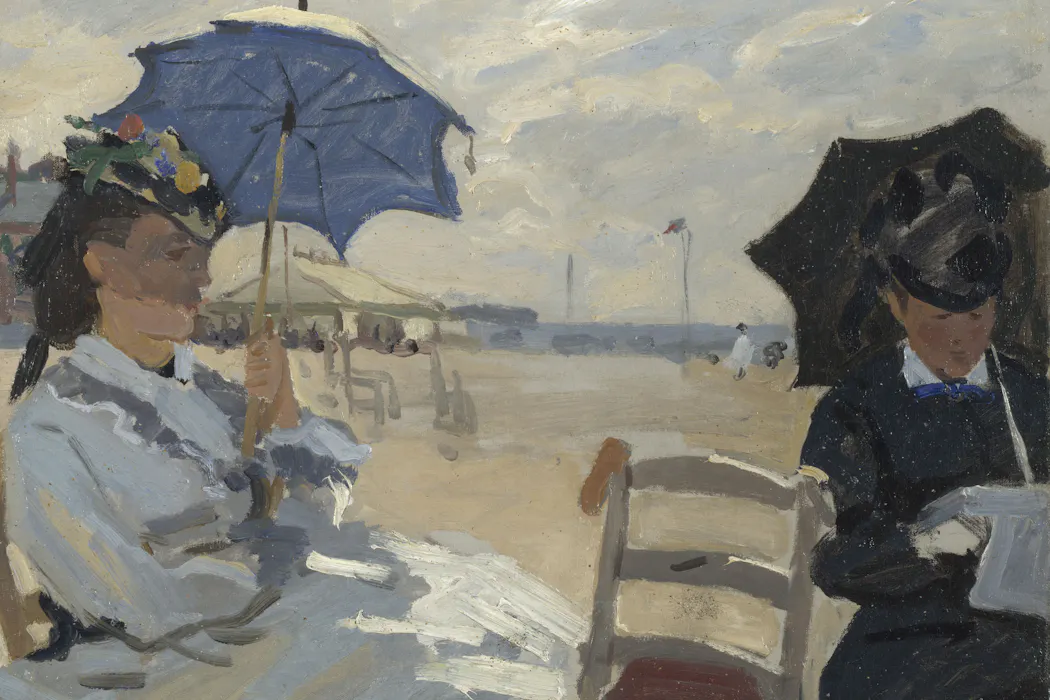
The Beach at Trouville by Claude Monet (1870). The National Gallery, London

Burnout feels like a thoroughly modern concept – one borne from our age of global digital communication and long office hours. But the Victorians also had an idea of burnout, one they termed “overwork”.

The Victorian doctor, C.H.F. Routh, for example, published On Overwork and Premature Mental Decay: Its Treatment, which ran to four editions between 1873 and 1888. Although the language differs, the underlying concerns are similar. Victorian overwork was a new development in their era of empire and industrialisation, with its railways and telegraphs which enabled rapid global communication and an ever-quickening speed of life.

The Victorians were undoubtedly followers of what the philosopher Thomas Carlyle described as the “Gospel of Work”. But they were also acutely aware of the health problems which could come from devotion to this new religion.

In America, neurologist George Beard had introduced the concept of neurasthenia, a condition linked to the overstrain of nerves. But in Britain, overwork was viewed as altogether more manly – and indeed almost a badge of pride.

As now, with our concepts of executive burnout, overwork was very much associated with mental activity and the professional classes. It therefore excluded the overburdened working classes from consideration. Doctors were a particular cause for concern.

Routh cites the case of Dr Golding Bird, a successful physician, who advised him to ease off in his work. He told him to take an annual six weeks holiday: “otherwise you will find yourself, at my age, a prosperous practitioner, but a dying old man”. Bird was still practising, but died a few weeks later at the age of 39.

Travel for health

For those suffering from overwork and other forms of illness or malaise, the primary prescription (for the professional classes) was travel to a health resort, preferably in Europe.

In 1870 the Scottish publisher William Chambers printed Wintering at Menton, an account of his own breakdown of health from overwork, following his time as Lord Provost of Edinburgh and his subsequent recovery. He writes in amazement of the beauties of the landscape in this spot on the French Riviera, its blue skies and caressing climate, and asks his contemporaries to reconsider their lives. Too many were dropping into their graves, having “succumbed in the feverish, and we might almost say, insane, battle of life. Too long and too diligently have they stuck to their professional pursuits.”

Menton became the favoured spot for the British to recuperate from overwork and other forms of breakdown of health. This was due in large part to the publication by Dr James Henry Bennet of a series of works, including Menton and the Riviera as a Winter Climate (1861), and the numerous editions of Winter and Spring on the Shores of the Mediterranean (1865-75).

The latter offered a guide to health travel, sampling all the resorts around the Mediterranean coast, but concluded that Menton offered the best climate and conditions for recovery.

Illustration of the coast in Menton
An illustration of Menton from Bennet, Winter and Spring on the Shores of the Mediterranean. Gutenberg

The reasons for the extraordinary influence of Bennet’s work can be traced to his narrative of his own recovery, which formed a preface to all his books:

Five and twenty years devoted to a laborious profession and the harassing cares which pursue a hard-worked London physician, broke down vital powers. In 1859 I became consumptive, and strove in vain to arrest the progress of the disease.

Believing himself to be dying, Bennet headed for the Riviera. But finding himself under the “genial sky” of Menton, and “freed from the labours and anxieties of former life”, he found to his great surprise that his health improved. He decided to spend winter there every year, and set up a practice. Menton, as a consequence, grew from a small village to a major health resort, complete with its own English quarter.

The medical climatology revolution

Bennet was a leading figure in the development of what was termed “medical climatology”. This was the belief that many conditions (including consumption, or tuberculosis), could actually be cured, or at least arrested, by moving to a resort with the right climate.

In part this movement was in response to the choking smog of industrial cities. “Diseases of the chest”, as they were known, inevitably fared better amid the pure air and blue skies of the Riviera in winter.

Bennet’s form of treatment was viewed as almost revolutionary at the time. Invalids were to escape the hot, close confines of an English sickroom and stride out into the hills, absorbing the rays of the sun and the pure air, while feasting their senses on the wonders of nature around them. No medicine required.

It was also a prescription for the elderly, or infirm. They could be driven out each day to a different, sheltered and sunny spot: “The range of observation is thus increased without fatigue, the glorious scenery of the district is seen and enjoyed in its ever-varying phases, and the mind is refreshed by change.” It is an inspiriting vision of what might be possible in late-life care today.

For those suffering from overwork, Bennet recommended a minimum of three full winters spent in the resort. This was a far cry from the short stays in spas in the 18th century, or our own quick “wellness” breaks.

What he offered was a concept of “legitimate idleness”, where the hardworking professional could lead a “quiet, contemplative life”, basking in the sun “like an ‘invalided’ lizard on his wall”.

Queen Victoria brought her son Leopold, a haemophiliac, to “beloved and beautiful Mentone” and writers and artists, from Robert Louis Stevenson and Aubrey Beardsley to Katherine Mansfield, flocked to the resort. They left extraordinary records of the pleasures and pains of their times in medical exile.

My own book, In Quest of a Cure: Literary and Medical Cultures of the Health Resort, explores many of these lives – in Menton, Davos and elsewhere – and the changing patterns of treatment. For cases of overwork, and other conditions, time was of the essence: in place of the hurry and worry and snatched time of Victorian city life, time was to be extended, as invalids relaxed into a state of “legitimate idleness” amid the healing powers of nature.

This article features references to books that have been included for editorial reasons, and may contain links to bookshop.org. If you click on one of the links and go on to buy something, The Conversation UK may earn a commission.

The Conversation

Sally Shuttleworth's research for this article was funded by an Advanced Investigator Grant, 'Diseases of Modern Life: Nineteenth-Century Perspectives' from the European Research Council (Seventh Framework, grant number 340121).

Galloway Hoard exhibit in Sydney dives into the secrets of the Viking world

In the popular imagination, the phrase “Viking hoard” might evoke images of plunder stashed by marauding Norse pirates. Or perhaps you picture sacred objects hidden by frantic monks in the uproar of a violent raid.

The Galloway Hoard reveals the truth of the Viking expansion was less dramatic. But as the richest Viking-era hoard discovered so far in the United Kingdom and Ireland, it also exposes a more complex and intriguing past.

The hoard was buried in southwestern Scotland around 900 CE. We owe its recovery to a gold-standard cooperation between Derek McLennan, the metal detectorist who uncovered it in 2014, and the archaeologists who helped preserve it – and are now hard at work to unlock its mysteries.

Traces of a complex maritime world

The hoard, which consists of more than 100 items of mostly silver and gold, is currently on display in Sydney at the National Maritime Museum.

This is a particularly fitting venue, as it embraces the hoard as a mirror of the Vikings’ legendary seafaring culture. The exhibition greets visitors with a replica of a Viking-era boat stempost from the Isle of Eigg in Scotland’s Inner Hebrides. It reminds us of the importance of ships for this world, where voyaging the sea lanes was as important as taking the land.

Some of the hoard’s most unique and exotic items open its northern world up to the south and the east parts of the globe. In the exhibit, 3D-printed replicas allow visitors to see these items in all their original splendour.

These include an ornate silver vessel from the ancient Persian Sasanian Empire, a jar carved from Roman-era rock crystal, and Scotland’s earliest surviving fragments of silk.

Even the more “local” objects have unexpected features indicating cultural and linguistic complexity around the Viking-occupied perimeter of the Irish Sea.

Viking-era silver armbands inscribed with Old English runes, for instance, point to the persistence of the earlier language in this area despite Scandinavian incursion.

One such armband states its owner is Egbert – definitely a pre-Viking English name. Other pre-Viking English treasures include a cross, rare for having its neck-chain still attached, and seven brooches with Christian and pagan features.

This so-called “Viking hoard” then, is actually a material record of overlapping times and places that have been deliberately gathered and buried together.

But who gathered these goods together for burial, and why? What did these items mean to them? Were they venerating them, hiding them, or keeping them safe?

And did they mean for the hoard to remain undiscovered for more than a thousand years – or perhaps forever?

The mystery of hoards

These questions may never have definitive answers.

Hoards, broadly defined by British archaeologist Eleanor Ghey as buried or concealed items “kept together, perhaps gathered all at once or gradually amassed over time”, fascinate us because they’re as mysterious as they are revealing.

Ghey notes, though, that there are clues to be found in the objects themselves, and where and how they’ve been deposited. The Galloway Hoard’s 900 CE dating comes from its silver and textile items. Inscriptions on some armbands point to possible collective or even communal ownership.

One especially intriguing feature is the hoard’s two layers: a bed of gravel separates a less valuable upper deposit of silver bullion from a lower deposit containing gold and exotic goods from afar.

The upper layer might simply be a later deposit. But some speculate it’s a decoy, designed to stop finders from digging down to the more cherished goods. Perhaps we’ll know someday.

Detecting the past

The Galloway Hoard’s 2014 discovery is part of a broader explosion of similar significant finds by amateur detectorists.

In 21st-century Britain alone, detectorists have uncovered dozens of Iron Age, Roman, Pictish, Saxon, Viking and late medieval hoards. In 2009, for example, they attracted worldwide coverage after discovering the vast 7th-century Staffordshire Hoard. The public frenzy wasn’t just due to the splendour of the 4500+ objects, but to the serendipity of its discovery by an amateur.

British detectorists have shown commitment to establishing good practice. The National Council for Metal Detecting cooperates with professional archaeology bodies and promotes legal and ethical detecting.

The Galloway Hoard’s finding was a model of good practice. When he realised he’d found something significant, detectorist Derek McLennan downed his tools and contacted archaeologists, who protected the site and goods and contacted the national Treasure Trove Unit.

That said, detectorist conduct hasn’t always been so exemplary, as I discovered when researching for my forthcoming Exeter University Press book Detectorists: Feeling for the Past.

In 2015, the discovery of the Viking-era Hereford Hoard resulted in the conviction of detectorists and coin dealers for illegal finding, concealing, and black-market selling of items.

McLennan, by contrast, kept his allotted 50% of the £1.98 million (about A$3.7 million) paid by the National Museum of Scotland. This is surely a modern parable for the importance of sharing, rather than hoarding, the spoils.

Treasures of the Viking Age - The Galloway Hoard is showing at Sydney’s Australian National Maritime Museum until October 11

The Conversation

Louise D'Arcens has previously received funding from the Australian Research Council.

❌
Subscriptions