Normal view

We need a new anti-corruption commissioner. Here’s how to pick the right one

The abrupt resignation of the National Anti-Corruption Commissioner Paul Brereton is a pivotal moment for the federal watchdog. For years, questions over the commissioner’s leadership arising from concerns about his ability to manage conflicts of interest had undermined public confidence and trust in a key Australian integrity institution.

The government has committed to a “merit-based process” to appoint the next commissioner.

But can we trust the government to do that and rebuild trust in our national anti-corruption commission? Research finds governments often abuse their power to appoint, fund and oversee integrity agencies in order to avoid serious oversight.

How do we avoid this abuse and safeguard the independence of our integrity agencies? A new report from the Centre for Public Integrity outlines three key ways to ensure these agencies are truly independent.

These reforms should guide the appointment of a new national anti-corruption commissioner.

Fundamental tensions

To do their job, integrity agencies must be independent from the government. This means they must be able to investigate and criticise governments and public officials without fear of political retaliation.

But in practice there are a few problems with this idea.

Unlike the courts and parliament, these agencies are not protected in the Constitution. Instead, they are often created by the government through an act of parliament.

This creates a foundational tension: integrity agencies are designed by government, to hold the government to account.

The government has a vested interest in these institutions being weak. Governments have been accused of establishing weak watchdogs, or deliberately “clipping the wings” of these bodies by amending laws.

There are also operational tensions. Governments can weaken integrity agencies in more subtle ways.

One way is through political appointments. In Australia, we have seen such politicisation, for instance, in appointments to the former Administrative Appeals Tribunal, ultimately leading to its abolition.

Or they might be in the form of cutting funding. This happened most recently in the current budget, with a funding cut in real terms to the Australian National Audit Office. The office had previously said that with its current funding levels, it would not be able to meet its responsibilities for performance audits.

On budget day, the joint parliamentary committee on public accounts and audit expressed its ongoing concern about the operational capability of the office given its financial position.

A new report released by the Centre for Public Integrity outlines a number of ways the independence of these agencies must be protected across three key pillars: appointments, funding and oversight.

You can’t choose your own watchdog

Our analysis shows that across the country, there is significant variation in how heads of integrity agencies are appointed. Many governments exercise broad and opaque discretion over who leads the core integrity agencies.

This creates obvious risks. If governments can appoint agency heads through opaque processes, there may be concerns — justified or not — about whether those leaders are suitably qualified or truly independent.

The controversy surrounding Brereton illustrates the stakes involved. Questions about conflicts of interest under his leadership have fuelled broader concerns about the lack of a transparent, merit-based appointment process for the role.

Our report recommends legally requiring open advertising of senior integrity positions, independent selection panels and greater parliamentary involvement in appointments.

There’s no need to wait. The government could implement such a process in the upcoming NACC appointment, instead of relying on vague platitudes of a “merit-based process”.

This proposal is similar to one that has been successfully adopted elsewhere, including for the reformed Administrative Review Tribunal.

We also recommend longer but non-renewable terms for agency heads to alleviate any pressure leaders may feel in seeking reappointment.

Handing over the purse strings

The second problem then is funding. Most Australian integrity agencies rely on governments to decide how much money they receive each year.

In practice, this means the government can place pressure on agencies by limiting their resources. Underfunded integrity agencies cannot properly investigate corruption, scrutinise spending or carry out oversight work.

Our report argues integrity agencies should have stronger protections around funding, again, drawing on models that have been successfully developed elsewhere, particularly in the ACT for their “Officers of Parliament”.

Our proposal includes separate parliamentary processes and independent funding panels that can publicly recommend appropriate funding levels. Governments would still make final budget decisions, but there would be greater transparency when they made decisions that cut agency funding.


Read more: Australia’s anti-corruption commissioner has a trust problem. He needs to change course to fix it


Genuinely independent oversight

Finally, independence does not mean integrity agencies should operate without accountability. These agencies exercise significant powers. Some can compel evidence, conduct hearings and make findings that seriously affect reputations and careers.

So oversight is essential – but that oversight must be independent. Oversight systems for integrity agencies are often poorly designed. In many jurisdictions, for instance, parliamentary oversight committees are dominated by government members.

A better system would involve parliamentary committees not dominated by government MPs, alongside independent inspectors for agencies exercising coercive powers.

The importance of such roles is underscored by the work of the NACC Inspector, in receiving and investigating complaints about the commission’s decision not to investigate Robodebt referrals.


Read more: NACC belatedly to investigate whether six Robodebt referrals engaged in ‘corrupt conduct’


Is real independence possible?

Australia has invested heavily in creating a set of core integrity agencies. Even if reluctantly, every jurisdiction across the country now has an anti-corruption agency, auditor-general and ombudsman office.

The next challenge is ensuring those institutions are sufficiently independent to do their job. Across the country, there are good designs that alleviate the operational pressures these agencies face. Adopting these designs will help secure better and more transparent funding, appointment, and oversight of core integrity agencies.

These more independent integrity agencies can in turn help safeguard the health of our democracy.

The Conversation

Gabrielle Appleby works as the Research Director for the Centre for Public Integrity. She has received funding from the Australian Research Council.

William Partlett is a Stephen Charles Fellow at the Centre for Public Integrity.
National wants to scrap sexual offender character references. Should NZ go further?

Lakeview Images/Getty Images

Stopping judges from considering “good character” references when sentencing sexual offenders – as New Zealand’s National Party has pledged to if re-elected – may sound like a niche legal reform.

But it targets a real and longstanding issue in the country’s criminal justice system – and one that has drawn renewed public attention and debate over recent months.

In the courts, character references are typically used to show a defendant has no prior history of similar offending. Lawyers may point to the absence of previous convictions and present supportive letters describing the assault as out of character.

Such evidence can be introduced by defendants convicted of – or pleading guilty to – sexual offending in a bid to reduce their sentence, alongside other mitigating discounts that judges can apply under the Sentencing Act.

National argues that its proposed reform, which comes alongside a separate petition and campaign, would lead to tougher sentences and stop offenders benefiting from their personal reputation or social standing.

Some defence lawyers, however, have argued judges already treat such evidence cautiously in serious sexual offending cases, and warn that removing it entirely could undermine the principle that courts should consider all relevant circumstances at sentencing.

In any case, the move would represent a meaningful change. But the discussion also raises wider questions about New Zealand’s sentencing framework itself – particularly when it comes to how much discretion judges are presently given.

The problems with ‘good character’ references

As Justice Minister Paul Goldsmith noted when announcing the move last month, good character references are often used to argue the offending was “the exception, not the rule”.

In sexual violence cases, this can involve employers, relatives or community figures portraying the defendant as an otherwise respectable person who made a one-off mistake.

Rape cases, particularly, illustrate the flaws in this type of reasoning. Presenting evidence of a defendant’s good character can reinforce the myth that there is a meaningful distinction between a “real rapist” and someone who has merely committed rape.

This framing also risks minimising the seriousness of sexual violence and obscuring the reality that most rapes are committed by someone known to the victim, often in private places and with little or no physical force.

Another problem is that this evidence can be deeply retraumatising for victims, who may have to watch the sentencing judge consider – and sometimes even credit – claims that the assault was less serious, or rather something more akin to a misunderstanding.

If the policy choice is between continuing to treat prior “good character” as mitigation in sexual violence cases, or scrapping it, the latter would arguably appear the sensible call.

But abolishing this single mitigating factor from the Sentencing Act – at least as it applies to sexual offences – still leaves many other issues within the legislation to address.

The case for wider reform

In another development last month, an advisory group was established to bring lived experience and leadership expertise into government decision-making around family and sexual violence prevention.

While this marks an important step, overseas experience suggests New Zealand could go much further in reforming its sentencing system.

Countries including the United States, the United Kingdom, Canada and many Australian states, for instance, use sentencing commissions to develop formal sentencing guidelines.

These bodies draw on expertise from criminology, psychology, statistics and criminal law to analyse research and sentencing data, then produce guidance on how different offences and offenders should be sentenced.

The resulting guidelines help to eliminate disparities across offences, offenders, judges, and geographic regions, while also ensuring transparency in sentencing policy. They also tend to rely more on evidence and risk-based assessment than on broad and often ambiguous factors gradually developed through court decisions.

By contrast, two-decade-old Sentencing Act appears antiquated.

Aggravating and mitigating factors referenced within the legislation are often intuitive, vague and morally framed, rather than being clearly defined or grounded in evidence.

Importantly, they also provide little meaningful guidance for how judges should apply them consistently across cases involving different levels of harm, premeditation or remorse on the part of the offender.

Leaving sentencing judges with such a high level of unguided discretion risks allowing implicit biases – which all people possess – to influence sentencing decisions.

The result is that subjective assessments about who seems dangerous, remorseful or respectable can end up driving sentencing decisions, rather than being based on consistent, evidence-based assessments of harm, proportionality and risk to public safety.

Removing “good character” mitigation in sexual violence cases may therefore be worthwhile. But if New Zealand wants a better sentencing system, much broader reform is required.

The Conversation

Carrie Leonetti does not work for, consult, own shares in or receive funding from any company or organisation that would benefit from this article, and has disclosed no relevant affiliations beyond their academic appointment.

James Comey’s Instagram seashell post sits in a murky legal zone between protected political speech and criminal threat

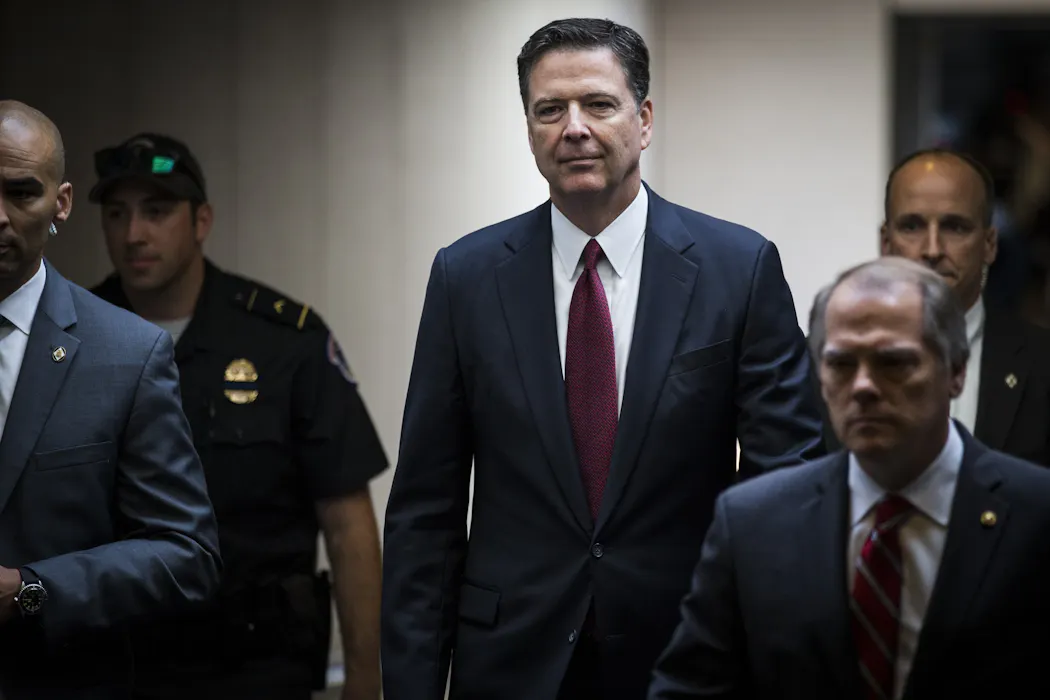
Did James Comey, former FBI director, 'knowingly and willfully' threaten, kidnap or 'inflict bodily injury upon the President of the United States'? Samuel Corum/Anadolu Agency/Getty Images

In the case of United States v. James Brien Comey Jr., the U.S. president’s security is pitted against the bedrock right to free speech enjoyed by Americans.

Two federal charges have been lodged against former FBI Director James Comey and are based on his Instagram post that depicted seashells spelling out “86 47.”

Comey’s post was interpreted by the U.S. Department of Justice as a threat to harm President Donald Trump. The indictment, obtained by the DOJ, alleges Comey violated two federal laws: 18 U.S.C. § 871, which makes it a crime to “knowingly and willfully” threaten, kidnap or “inflict bodily injury upon the President of the United States,” and 18 U.S.C. § 875, which criminalizes “communication containing any threat to kidnap any person or any threat to injure the person of another.”

Comey’s argument against the charges is likely to be twofold: (1) He lacked the requisite intent that the prosecutor needs to prove his case, and (2) even if he had the intent required by the statute, his speech is protected by the First Amendment. U.S. District Judge Louise Flanagan set Oct. 21 as the Comey case trial date.

I’m a scholar of constitutional and criminal law as well as the First Amendment. The charges against Comey exist in a legal gray area that includes the First Amendment and a series of court decisions over five decades that have gone back and forth over what dangers constitute speech that can be punished.

Three men standing in front of a curtain, flags and some official seals while one speaks at a lectern.
Ellis Boyle, U.S. attorney for the Eastern District of North Carolina, is flanked by acting Attorney General Todd Blanche, left, and FBI Director Kash Patel at a press conference on April 28, 2026, concerning charges against James Comey. Tasos Katopodis/Getty Images

Parsing the charges

In criminal law, there are generally two parts to most crimes – the criminal act and the criminal intent. The criminal act is referred to as the “actus reus.” The criminal intent is known as the “mens rea.”

Some crimes also require a particular result. For instance, murder requires a death of a person. A defendant can neither be charged with nor convicted of murder unless and until the victim dies. If the victim doesn’t die, then at most the defendant can be convicted of only attempted murder.

The criminal charges alleged in Comey’s case don’t require a result, however. The president need not be kidnapped or injured for someone to be charged with violating either of them.

But the prosecutor must still prove the criminal intent and the criminal act for both charges to stick in Comey’s case. In my view, the Justice Department will have a difficult time proving the mens rea against him.

Comey has consistently maintained that he didn’t know “86 47” implied violence against the president.

Meaning and purpose

Comey has stated he came across the shells that spelled out “86 47” while walking on a beach in North Carolina, took a picture and posted it on Instagram.

The term “86” is commonly used to mean “to throw out” or “to get rid of” in American slang. According to Merriam-Webster, the term “comes from 1930s soda-counter slang meaning that an item was sold out.”

Comey later removed the image from Instagram and posted a statement that read, “I posted earlier a picture of some shells I saw today on a beach walk, which I assumed were a political message. I didn’t realize some folks associate those numbers with violence. It never occurred to me but I oppose violence of any kind so I took the post down.”

Even though Comey has insisted that he thought it was a silly picture of shells arranged in a clever way to express a political viewpoint, the Trump administration argues that Comey not only knew the meaning of “86 47” but that he purposefully threatened the president.

What’s plausible?

The first crime charged in the indictment, 18 U.S.C. §871, requires the defendant to have “knowingly and willfully” threatened to kidnap or inflict bodily injury upon the president. This is the statute’s mens rea; the defendant must have known that he was threatening the president of the United States.

Comey’s statements suggest that he didn’t know the threatening nature of his Instagram post. Thus, he cannot be convicted of “knowingly” threatening the president if he didn’t know its meaning.

To convict Comey, the prosecutor must prove that he did, in fact, know the meaning of “86 47” when he posted it.

Comey’s career as a federal prosecutor and his tenure as the FBI director may work against him here. In my view, it’s more than plausible that Comey encountered the threatening version of the term “86” in his career. It’s also more than plausible that the term appears in documents, records and court filings that Comey has drafted and signed over his career, all of which could be used against him at trial.

But even if the Justice Department can prove Comey did, in fact, know the threatening nature of “86 47,” its case against him is not a slam dunk.

And that’s because of the First Amendment.

Testing what’s protected speech

A balding man stands in front of a soldier who is wearing a helmet.
A draft protester was convicted after declaring in 1966, ‘If they ever make me carry a rifle, the first man I want to get in my sights is L.B.J.’ His conviction was overturned by the Supreme Court. Yoichi Okamoto/PhotoQuest/Getty Images

As a constitutional law scholar, I’d expect Comey to argue that his Instagram post was protected speech.

Even though the laws charged in Comey’s case are generally valid and constitutional, criminal defendants can always argue that otherwise valid and constitutional laws are unconstitutional as applied to them and their particular case. Comey is likely to argue this in his defense, but it won’t be as straightforward as one might think.

The First Amendment is not absolute – not all speech and expression is protected by the Constitution.

In Chaplinsky v. New Hampshire from 1942, Justice Frank Murphy wrote that it’s “well understood that the right to free speech is not absolute at all times and under all circumstances.”

In 1969, the U.S. Supreme Court held in Watts v. United States that while “true threats” are not protected by the First Amendment, political hyperbole remains protected speech. The Supreme Court defines true threats as statements where the speaker means to communicate a serious expression of intent to commit an act of unlawful violence against a particular individual or group of individuals, but the speaker need not actually intend to carry out the threat.

Watts v. United States involved a threat against the sitting president of the United States, Lyndon B. Johnson. In that case, Robert Watts expressed his strong opposition to the military draft at a public rally, saying, “If they ever make me carry a rifle, the first man I want to get in my sights is L.B.J.” He was subsequently charged and convicted under the same statute, 18 U.S.C. § 871, used in Comey’s case.

The Supreme Court reversed the conviction, ultimately agreeing with Watts, who had maintained that his statement was “a kind of very crude offensive method of stating a political opposition to the President.”

As the court explained, quoting an earlier decision on press freedom, “For we must interpret the language Congress chose ‘against the background of a profound national commitment to the principle that debate on public issues should be uninhibited, robust, and wideopen, and that it may well include vehement, caustic, and sometimes unpleasantly sharp attacks on government and public officials.’”

Since Watts, countless defendants have faced similar charges for threatening the president. Many have been convicted.

In the 1970s, Eugene Hart was convicted of threatening the president after his brother reported Hart’s plan to assassinate President Richard Nixon. An appellate court affirmed his conviction, concluding that Hart’s verbal threat coupled with his detailed assassination plan couldn’t have been “uttered in jest or in the nature of a hyperbole.”

In the 1980s, David Hoffman was convicted of threatening President Ronald Reagan when he mailed a letter to the White House stating, “Ronnie, Listen Chump! Resign or You’ll Get Your Brains Blown Out.” And in 1999, Donald Adams was convicted of threatening the president when he approached the White House gates telling Secret Service officers, “I want to kill the president.”

But in those cases and others, the defendants took concrete steps that demonstrated their sincerity and conscious awareness of the threatening nature of their speech. In my estimation, both are absent in Comey’s case.

The Conversation

Wayne Unger does not work for, consult, own shares in or receive funding from any company or organization that would benefit from this article, and has disclosed no relevant affiliations beyond their academic appointment.

Supreme Court preserves access to mifepristone via telehealth – at least for now

Mifepristone is one of two drugs typically used in medication abortions. Carl Lokko/iStock via Getty Images Plus

The U.S. Supreme Court has decided that patients can continue to get mifepristone, one of the two drugs used for medication abortion, via telehealth and by mail. At least for now.

A lower court had temporarily blocked this access nationwide in early May 2026. The case now returns to that lower court, although it may well make it back to the Supreme Court in the future.

Since 2023, almost two-thirds of abortions in the United States have involved mifepristone, and since late 2024 one-quarter of all abortions occur through abortion pills provided via telehealth.

As scholars who study laws affecting reproductive health, we believe the outcome of this case will have an enormous impact on access to abortion care across the country.

In states with abortion bans, telehealth prescriptions have allowed women to get abortions anyway. But the case is also significant to those in states without abortion bans, especially women with low incomes and disabilities or who live in rural areas, where reproductive services are extremely limited.

How did the case get to this point?

The case began in October 2025, when Louisiana argued that the Biden administration’s allowance of telehealth abortions was for “avowedly political reasons.” The state asserted that the U.S. Food and Drug Administration had insufficient evidence to remove the requirement that the drug be dispensed in person, which had been in place from 2000 through 2021.

The state also argued that mailing mifepristone violated an 1873 federal law known as the Comstock Act. This law, which makes it a crime to mail or ship any “lewd, lascivious, indecent, filthy or vile article” and anything that “is advertised or described in a manner … for producing abortion,” has rarely been enforced.

The lower court thought Louisiana would likely win, but it decided to keep the FDA regulations in place while the case made its way through the courts. On May 1, 2026, however, the appellate court suspended the FDA regulation allowing mifepristone to be prescribed via telehealth.

As a result, mifepristone could no longer be mailed or prescribed via telehealth, nationwide. Three days later, on May 4, after the manufacturers of mifepristone appealed, the Supreme Court put the 5th U.S. Circuit Court of Appeals’ decision on hold for a week to give it more time to consider the legal issues. On May 11, it extended the stay for a few more days.

What does the SCOTUS decision mean for mifepristone access?

On May 14, the Supreme Court decided to leave the FDA’s regulation in effect, so mifepristone remains available for prescription via telehealth. Justices Samuel Alito and Clarence Thomas dissented, with Alito accusing the court of “perpetrat[ing] a scheme to undermine” the court’s decision in the 2022 Dobbs ruling that overturned the constitutional right to an abortion and allowed states to ban it. Thomas added his view that the Comstock Act makes it a criminal offense to mail mifepristone.

The case now returns to the 5th Circuit, which has signaled how it is likely to rule on this question. Namely, that it believes the FDA has exceeded its authority in allowing the drug to be prescribed via telehealth. Once the case has been resolved in the lower courts, it could end up before the Supreme Court again. If the court decides to strike down the rule, or if the FDA rescinds it, then women in all states would no longer be able to get the pills by mail, not just in the 13 total-ban states.

The court’s May 14 decision extends the pause on a lower court ruling, preserving mail-order access to mifepristone for now.

Why has mifepristone become so contested?

In 2000, the FDA approved mifepristone specifically to end pregnancies. In combination with telehealth, it allows for abortion to occur outside of a doctor’s office. Accordingly, anti-abortion groups have attempted to discredit mifepristone’s safety and effectiveness for decades, even though mifepristone has been shown to be as safe as ibuprofen and safer than Viagra.

Mifepristone first became available in France in 1998. In 2000, the FDA approved mifepristone in the U.S. after evaluating rigorous studies that showed it to be safe and effective.

Initially, the FDA required the drug to be prescribed and taken at a doctor’s office. But after further review of research on the drug’s safety under the Biden administration, the agency changed some of the prescribing regulations, making it easier to access the drug.

One change made permanent in 2023 was to allow mifepristone to be prescribed via telehealth and mailed. That is the regulation at issue in the Louisiana case.

But after the 2022 Dobbs ruling, mifepristone became even more of a target. Anti-abortion groups realized that people could effectively evade abortion bans by receiving abortion pills through the mail. After Dobbs, in fact, the number of abortions increased, and by June 2025 telehealth abortions had increased fivefold, with more than half of them occurring in abortion-ban states.

The attempts to challenge mifepristone first reached the Supreme Court in 2024, when anti-abortion physicians and groups challenged the FDA’s approval of mifepristone and changes in its prescribing regulations that made it easier to access the pill.

The Supreme Court ultimately dismissed the case on the grounds that the challengers did not have legal standing to bring the claim. Legal standing requires the parties to show they suffered concrete harms or injuries.

Since then several states, including Louisiana, have brought lawsuits with the same kinds of challenges to the FDA’s authority. The Louisiana case is the first to reach the Supreme Court. It is also the first state to reclassify mifepristone as a dangerous controlled substance.

Is this likely to happen with the other abortion pill?

The legal challenges so far have been only to mifepristone, one of the two pills used for medication abortion.

Unlike mifepristone, which is approved only for abortion, misoprostol was approved in 1988 for a different purpose: to treat gastric ulcers.

Misoprostol is prescribed for abortion “off-label,” which means it is an unapproved use of an FDA-approved drug that a healthcare provider determined is medically appropriate for their patient.

In fact, 1 in 5 prescriptions is for off-label use of a drug.

While some studies suggest that using misoprostol alone for an abortion is slightly less effective than taking both pills together, many researchers express confidence in the misoprostol-only option.

And the court’s ruling does not affect access to “Plan B,” a pill that prevents pregnancy and thus is used as birth control, not to induce an abortion.

The Supreme Court’s action is certainly not the end of the story. Challenges to abortion pills will continue, particularly because the leaders of many states believe the availability of these pills prevents them from enforcing their abortion bans.

The Conversation

The authors do not work for, consult, own shares in or receive funding from any company or organization that would benefit from this article, and have disclosed no relevant affiliations beyond their academic appointment.

What Jefferson and Madison would have thought about ‘rededicating’ the US to God

Many of the thousands of letters between the two founders attest to their deep commitment to religious freedom. AlexanderZam/iStock via Getty Images Plus

Thousands of Americans prayed on the National Mall on May 17, 2026, during “Rededicate 250”: a day-long rally to “come together in prayer and worship ahead of the nation’s 250th birthday,” as organizers described it. U.S. House Speaker Mike Johnson, one of many Republican politicians and conservative Christian leaders to speak, led a prayer to “rededicate the United States of America as one nation under God.”

Planned by Freedom 250, a public-private partnership, the rally prompted criticism that it blurred the lines separating church and state. According to the Pew Research Center, 73% of adults agree that religion should be kept separate from government policies, and only 19% of Americans say the United States should stop enforcing that principle.

But figures allied with the Trump administration have challenged the premise that the U.S. government should be – or was meant to be – separate from religion. In 2023, Johnson remarked that “The separation of church and state is a misnomer … it comes from a phrase that was in a letter that Jefferson wrote. It’s not in the Constitution. And what he was explaining is they did not want the government to encroach upon the church – not that they didn’t want principles of faith to have influence on our public life.”

As a scholar of American legal and religious history, I have written extensively about the development of religious freedom in the U.S., and the origins of the separation of church and state.

Two of the Founding Fathers shaped American views on these topics more than any other: Thomas Jefferson and James Madison. Yet their views have also become lightning rods for controversy as the “wall” between church and state comes under scrutiny.

My 2024 book, “The Grand Collaboration,” seeks to answer several questions: What was Jefferson’s and Madison’s understanding of religious freedom? And why were they so deeply committed to that principle?

Bedrock of law – in Virgina and beyond

Jefferson wrote the Virginia Bill for Religious Freedom in 1777, the most comprehensive declaration of religious freedom at the time. The bill guaranteed freedom of conscience, protected religious assemblies from government oversight, prohibited government funding of religious institutions and boldly declared that religious opinions were outside the authority of civil officials.

An obelisk-shaped grave sits in a grassy area with trees.
Thomas Jefferson asked that his gravesite commemorate three of his accomplishments, including writing Virginia’s statute for religious freedom. Christopher Hollis/Wikimedia Commons

Several years later, Madison guided these ideals into law. His “Memorial and Remonstrance Against Religious Assessments,” a protest against a proposal to support Christian teachers with tax money, affirmed the values of church-state separation and religious equality. He helped defeat the proposal – and set the stage for Virginia to adopt Jefferson’s bill.

As president, Jefferson went on to pen a letter to a Baptist association in Connecticut where he immortalized the phrase “a wall of separation between church and state.”

The Bill of Rights contains two clauses about religion, both in the First Amendment: that “Congress shall make no law respecting an establishment of religion, or prohibiting the free exercise thereof.”

What qualifies as “establishment of religion,” however, is open to debate.

In 1947, the U.S. Supreme Court embraced church-state separation as the guiding principle for interpreting the religion clauses, relying extensively on the two Virginians’ writings and actions. As Justice Hugo Black wrote, “In the words of Jefferson, the clause against establishment of religion by law was intended to erect ‘a wall of separation between Church and State.’”

The duo’s documents served as the authority for the legal principle of church-state separation, and for more than five decades, their bona fides remained unquestioned in the law.

Shift at SCOTUS

Criticism of church-state separation intensified in the 1980s. As the religious right grew into a political force, commentators argued that the concept was anti-religious and did not represent the prevailing views about church and state during the founders’ time.

In recent decades, such arguments have attracted politicians and jurists, including members of the Supreme Court. Justice Clarence Thomas has written that the court’s earlier separationist interpretations of the Constitution “sometimes bordered on religious hostility.” Legal scholar Philip Hamburger has declared that “the constitutional authority for separation is without historical foundation” and “should at best be viewed with suspicion.”

Several recent Supreme Court decisions have rejected a separationist approach to church-state matters. For example, the conservative majority has allowed taxpayer dollars to be used at religious schools, the display of religious symbols on government property, and religious expression by public school employees.

In a 2022 dissent, Justice Sonia Sotomayor bemoaned that the court has turned the separation of church and state from a “constitutional commitment” to a “constitutional violation.”

The justices’ earlier reliance on Jefferson and Madison has borne the brunt of criticism that their views on church-state matters did not represent their peers, or that neither man was in favor of separation as he has been portrayed.

Exchange of ideas

To better understand Jefferson’s and Madison’s beliefs, I examined many of the 2,300 letters between the two on “Founders Online,” a National Archives website. I also looked at correspondence with other acquaintances.

Both founders had deistic leanings, meaning they believed in a supreme being, but thought science and reason were the best paths to understanding religion. They were only nominally observant Christians, but more protected from religious intolerance than other “dissenters” due to their high social standing and affiliation with the Anglican Church.

A formal portrait of a man staring at the viewer, with white hair, a white shirt with a high neck, and a black jacket.
Thomas Jefferson’s official presidential portrait, painted around 1800 by Rembrandt Peale. White House History via Wikimedia Commons

All the more striking, then, that they worked throughout their lives to advance religious freedom.

Religious matters were never far from their minds. For instance, in Madison and Jefferson’s exchanges discussing the need for a bill of rights, freedom of conscience was invariably at the top of the list. Both were convinced that government should avoid supporting religion, even if no particular religion was given preference. They also insisted that people should have broad religious freedoms.

These views were clearly on the vanguard, but other religious rationalists and religious dissenters also advocated a comprehensive understanding of religious freedom.

Both men were committed to advancing religious freedom because they saw it as deeply entwined with freedom of inquiry and conscience. “Reason and free enquiry are the only effectual agents against error,” Jefferson wrote in 1784. Allowing people to investigate ideas freely “will support the true religion,” because “Truth can stand by itself.”

Similarly, Madison declared “the freedom of conscience to be a natural and absolute right.”

In their view, free inquiry was the fount of other rights. Religious freedom, for example, was a subset of freedom of conscience. And a healthy separation of church and state was key to ensuring those freedoms.

‘A pillar of support’

The letters reveal the extent to which Jefferson and Madison complemented and reinforced each other’s attitudes toward church and state. They also reveal the close intellectual and emotional affection that each man held for the other, and how much each man valued the other’s support.

A portrait of a man with white hair, a white shirt with a high neck, and a black jacket.
A portrait of James Madison by Chester Harding, painted around 1829, a few years before his death. Daderot/National Portrait Gallery via Wikimedia Commons

In their final exchanges before Jefferson’s death on July 4, 1826, he implored Madison, “To myself, you have been a pillar of support thro’ life. Take care of me when dead, and be assured that I shall leave with you my last affections.”

Madison responded with similar affection: “You cannot look back to the long period of our private friendship & political harmony, with more affecting recollections than I do.”

Jefferson’s and Madison’s half-century of collaboration on behalf of religious freedom and equality is an important chapter in the nation’s founding history. I believe its legacy should be remembered and celebrated, not discarded.

This is an updated version of an article originally published on June 25, 2024.

The Conversation

Steven K. Green does not work for, consult, own shares in or receive funding from any company or organization that would benefit from this article, and has disclosed no relevant affiliations beyond their academic appointment.

How a proposed green card application policy change would disrupt lives by assuming legal immigrants are evading the law

A draft policy from the Trump administration would make this card much harder to get. Stefano Spicca/Getty Images

More than half a million people rely every year on the ability to apply from within the United States for a green card, the government-issued ID that allows an immigrant to legally live and work in the country long term.

But in May 2026 the federal government issued a policy memorandum – essentially, a draft change to current policy – that could upend this process and deny immigrants the ability to apply for a green card while in the U.S. Instead, they would have to return to their home country to do it.

To see why this matters, picture a British woman, let’s call her Lucy, who comes to the U.S. on a student visa to earn her Ph.D. at Ohio State University. During her studies, she falls in love with Mike, an American engineer, and they marry. Under long-standing practice, Lucy could apply for her green card right in Ohio without uprooting her life.

The new policy memorandum, however, could force families like hers to make wrenching choices, sending one member of a couple out of the country with no guarantee they would be allowed back in.

As law professors who study the legal procedures relating to citizenship and immigration, we see this shift as a significant departure from how the system has worked for decades.

Congress built what’s called “adjustment of status” – the shift from one immigration status to another – into the immigration legal framework as a pathway to permanent residency. A policy memo cannot cut off that avenue.

Instead, what is being proposed by the Trump administration would require congressional action or agency rule-making that follows the proper procedural steps. The hundreds of thousands of people every year who have been clearing the legal requirements of adjustment of status cannot have their rights cut off arbitrarily.

Separation, disruption

Approximately 54%, or 608,260, of the 1.17 million new lawful permanent residents in fiscal year 2023 received a green card from within the United States.

But now, the draft policy emphasizes that those who entered the United States as nonimmigrants – such as people on student visas, who stated that they would be leaving the country once their education was finished – “are generally expected to pursue an immigrant visa and admission from outside the United States if they wish to reside permanently in this country.”

Silhouette of hand of passenger while using mobile phone during waiting in airport terminal.
Under proposed rules, a person in the U.S. who wants to apply for a green card would have to leave the country to do so. Chalabala/Getty Images

Applying from within the United States, as Lucy sought to do in the hypothetical example above, would be seen by officials as a negative element – a strike against granting the green card – that would need to be balanced out by what officials deem extraordinary counterevidence, such as sufficient family ties, hardship or length of residence in the United States, for the applicant to succeed.

The memo deems application from within the U.S. a red flag, calling such an application an “attempt to avoid the ordinary consular immigrant visa process,” implying that the immigrant hid their intention to immigrate when they obtained the nonimmigrant visa.

If the memo becomes implemented as official policy, individuals like Lucy would be expected to return to their country – in her case, the U.K. – to apply for a green card.

This could take a substantial amount of time. She would thus need to interrupt her studies, which her university may or may not allow for her to complete the degree. Her husband, Mike, would get the choice of being geographically separated from his spouse indefinitely or disrupting his own career in Ohio, with his employer potentially not letting him return to the job. The family would face even more disruption if Lucy and Mike had children.

Unsupported implications

Even if the process to get a green card goes smoothly, it can easily take over a year from applying to receiving the status symbolized by the card.

Spending over a year in the home country while waiting for the application to be resolved is a massive disruption for any individual or family. The policy memorandum justifies this by stating that seeking a green card from inside the United States is founded on applicants’ desire to evade the normal immigrant visa process, “usually accompanied by their violation of our immigration laws.”

In other words, the U.S. Citizenship and Immigration Services believes that certain people applying for green cards from inside the country – the ones who came here saying their time in the U.S. was limited – are trying to cheat the system.

The agency, however, provides no support in the policy memorandum for its claim that most individuals who seek a shift from a temporary status to a permanent one have done anything illegal.

To the contrary, the document acknowledges that such an adjustment of status already can be used only by individuals who have been either inspected and admitted or inspected and paroled, both lawful processes. And it gives no evidence for the accusation that most such individuals have done anything illegal since.

The memo also implies that all applicants for green cards who were previous holders of nonimmigrant visas – such as students and tourists, but also performing artists, athletes coming to compete, diplomats and their staff – should expect greater scrutiny in the future. It treats the move from nonimmigrant to immigrant status as highly unusual. That’s despite the fact that over half a million people a year have routinely benefited from such transitions.

A substantial number of those applicants would now be treated with greater suspicion about their original intentions. They would likely also need to take on tremendous burdens, including spending months or even years separated from a spouse or children while waiting abroad; interrupting or abandoning a degree, a job, or a career; and gambling on whether they’ll be allowed back into the U.S. at all, since consular processing abroad carries the risk of a denial with no easy appeal.

The top of a press release from the U.S. Citizenship and Immigration Services.
The press release from the U.S. Citizenship and Immigration Services announcing the change in policy regarding green cards. U.S. Citizenship and Immigration Services

Legal change or intimidation?

The largest group already in the U.S. that may avoid having to leave the country to apply for green cards is those who came to the U.S. on temporary work visas. But even they will likely face a tougher process to get a green card, and they may also face longer processing times than in the past.

Many questions have been raised about the legality of this new policy, including if it were to end up changing how pending applications are treated. Some analysts say that Congress did not intend to make the shift to immigrant status “extraordinary” and rare, as the memo claims.

Commentators – including ones who used to work at the Department of Homeland Security – have stated that, as with other announcements during the second Trump administration, the real goal may be to discourage immigration rather than effecting direct policy changes.

One immigration attorney wrote, “These policies send a clear anti-immigrant message intended to intimidate and drive undocumented immigrants to self-deport.” Another immigration lawyer called the memo legally “bonkers” and its text an “incoherent word salad.”

A number of immigration law firms are encouraging people to continue applying for adjustment of status as they had been. They are also cautioning applicants to “ensure, however, that their social media activity does not include any actions or statements that could be deemed problematic by the U.S. government.”

If the administration’s goal was to put immigrants on pins and needles, that has likely already been accomplished.

The Conversation

The authors do not work for, consult, own shares in or receive funding from any company or organization that would benefit from this article, and have disclosed no relevant affiliations beyond their academic appointment.

When you don’t have the facts, argue the law: How Trump’s EPA is limiting its own ability to protect public health far into the future

The Trump administration is trying to tie the hands of future administrations when it comes to regulating pollution, including greenhouse gas emissions. Chris Sattlberger/Tetra Images via Getty Images

As the Trump administration moves to weaken America’s air pollution rules, it is deploying new legal interpretations that are intended to tie the hands of future administrations for years to come.

In practice, the changes limit the Environmental Protection Agency’s authority under the Clean Air Act. The result allows EPA officials to ignore science, data and the adverse effects their decisions will have on public health and the environment.

But the new interpretations are also designed to apply not just to the rule in which they are first set forth but into the future.

If affirmed by the U.S. Supreme Court in inevitable legal challenges, these interpretations could make it harder for future administrations to restore the public health protections that the Trump administration eliminates. They could also make it difficult to update rules to respond to new information about health risks.

Typically, moves to weaken pollution regulations through novel legal interpretations would have a good chance of being overturned in court. But the EPA’s new interpretations are strategically designed to appeal to the current U.S. Supreme Court’s view of federal agencies’ authority, especially in light of the court’s 2024 ruling in Loper Bright v. Raimondo. In that case, the court overturned what’s known as the Chevron doctrine. A 1984 Supreme Court ruling had established that courts should defer to executive agencies’ legal interpretations of their governing statutes when the text of the law was ambiguous or left gaps. That deference no longer applies.

As a former EPA appointee who helped write and review dozens of regulations under the Clean Air Act during the Obama and Biden administrations, I find these efforts to prevent the EPA from doing its job of protecting public health and the environment to be alarming. Here are two examples of how the new interpretations are playing out.

Blocking future climate regulations

In February 2026, the EPA rescinded its 2009 endangerment finding, a determination under the Clean Air Act that carbon dioxide and five other greenhouse gases “may reasonably be anticipated to endanger public health or welfare” because they contribute to climate change.

The endangerment finding was the scientific and legal basis for EPA rules requiring automakers, power plants and oil and gas operations to cut their greenhouse gas emissions. Erasing it would make it easier for the Trump administration to eliminate greenhouse gas regulations.

Rather than try to challenge the science of climate change, which would be difficult given the growing mountain of evidence, the Trump EPA relied on legal arguments that were intended to dispense forever with the EPA’s ability to regulate greenhouse gas pollutants under the Clean Air Act.

Two men walk toward a podium. One of them, Zeldin, is grinning. The promotional sign reads 'Largest Deregulation in History
President Donald Trump and U.S. Environmental Protection Agency Administrator Lee Zeldin arrive for a White House event to announce a rollback of the 2009 Endangerment Finding on Feb. 12, 2026. Anna Moneymaker/Getty Images

Among the administration’s numerous arguments, two stand out:

First, the Trump EPA says the Clean Air Act should be read to limit the EPA’s authority to regulate air pollution only if its harm to the public is “through local or regional exposure.”

That would mean contributions from U.S. sources to global air pollution, no matter how demonstrable or how much they endanger Americans, are not covered by the Clean Air Act.

Second, the Trump EPA says that reducing greenhouse gas emissions from motor vehicles and engines would be “futile.” It points to global climate modeling that suggest these reductions would not meaningfully reduce the harm to public health and welfare.

What that argument fails to mention is that actions by people around the world to reduce emissions across different sectors add up. Motor vehicle emissions are the No. 1 contributor of U.S. emissions. If this sector is too small to regulate, then nothing is big enough.

Each of these interpretations is contrary to positions that the EPA took in the original endangerment finding, which the D.C. Circuit Court of Appeals upheld in 2012.

Allowing more toxic air pollutants

A second example involves the EPA’s proposal on March 17, 2026, to weaken pollution restrictions on businesses that sterilize medical equipment using ethylene oxide, a known carcinogen.

In that proposal, the EPA is also changing a legal interpretation in a way that would constrain the agency’s ability to protect human health into the future, this time from emissions of toxic air pollutants.

The Clean Air Act, under Section 112, establishes a methodical program for the EPA to regulate industries that emit significant quantities of air pollutants that can cause cancer, birth defects, genetic mutations or neurological harm, or harm reproductive health.

The EPA reviews how facilities control their emissions and sets standards that require all facilities to meet what the best-controlled sources are doing. But Section 112 has an important provision called “residual risk” review: Eight years after the EPA sets the first technology-based standards, it must determine whether the public health risk posed by emissions from the facilities after controls are added is acceptable.

In 2024, the EPA updated its hazardous air pollution rule for facilities that use ethylene oxide to sterilize medical equipment sensitive to steam heat, such as devices containing plastic, rubber or electronic components. Because recent research showed that ethylene oxide posed a much higher risk of cancer than previously thought, the EPA also updated its 2006 residual risk finding and required additional safeguards.

The Trump EPA is now arguing that the agency can assess residual risk only once, even if more recent information shows that the health risk is unacceptably high.

By constraining its own authority, the EPA is withholding standards that would protect thousands of people from a higher risk of cancer. It is also creating a legal precedent that will justify weakening other standards. Those include standards for chemical manufacturing facilities that the Biden EPA updated in 2024 through residual risk review.

That precedent would also prohibit the EPA in the future from taking into account new information about the health effects of any regulated hazardous air pollutant from any type of industry the EPA regulates under Section 112 of the Clean Air Act, including petroleum refineries, chemical manufacturing and paper mills.

Arguing the law

These rules are just two examples of the administration’s “if you don’t have the facts, argue the law” approach.

If the administration’s strategy works, the American public may be living, and dying, with the consequences of these industry-friendly regulations for years to come.

The Conversation

Janet McCabe is a volunteer with the Environmental Protection Network and has held several appointed positions at the United States Environmental Protection Agency. Consistent with the Indiana University Statement of Policy on Institutional Neutrality, the comments contained in this communication are solely my views and are not intended to be construed, and shall not be construed, as the views of Indiana University or comments made on behalf of or by Indiana University.

Women have the right to health care in prison. This should extend to freezing their eggs

Aleksandr Zubkov/Getty Images

In recent weeks, a female prisoner in Queensland lost her fight to have her eggs frozen while incarcerated.

Rachel Smith is currently serving a ten-year sentence for drug trafficking. She will be between 39 and 41 years of age when she is released. Smith’s fertility will decline significantly while imprisoned.

Smith was 33 when she first applied to freeze her eggs and was prepared to fund the treatment herself. She applied to Queensland Corrective Services, the Brisbane Supreme Court and the Court of Appeal. Each application failed.

By denying her access to egg freezing, the state may have denied her the chance to have a child. This goes beyond the intended scope of criminal punishment, and should be reviewed.

Your rights depend on which state you live in

Queensland prisoners are prohibited from accessing assisted reproductive technology under the Corrective Services Act 2006.

In Smith’s case, the court ruled that the processes of extracting and freezing eggs was a form of assisted reproductive technology and therefore fell within that prohibition.

The court also justified the ban on grounds of consistency. It applied a blanket ban to ensure prisoners were treated equally and avoid correctional authorities having to make judgements about which prisoners should be permitted to have children.

The outcome may have been different had Smith been imprisoned in a different jurisdiction. In Victoria, for example, access to assisted reproductive technology is a recognised human right.

In 2010, the Supreme Court of Victoria ruled that a prisoner was entitled to access assisted reproductive technology, specifically IVF, recognising it as a legitimate medical treatment and a human right necessary for the preservation of health.

In 2024, another Victorian prisoner was granted the same right.

The welfare of children

There may be legitimate concerns about the welfare of children born to incarcerated parents. This may justify restricting access to assisted reproductive technology for prisoners, which could result in pregnancy while serving time.

The state, however, has not acted consistently on these concerns. Women have been incarcerated while pregnant, and children have been born and raised in custody.


Read more: Babies and toddlers are living with their mums in prison. We need to look after them better


But these concerns don’t apply to Smith’s case. Egg freezing does not result in pregnancy. It doesn’t result in a child being born or raised in custody. It’s a procedure that preserves the opportunity to have a baby after release.

Whatever concerns one might have about prisoners reproducing while incarcerated, none of them apply to egg freezing.

Sex discrimination

The consequences of denying access to egg freezing don’t end on release. Once someone has served their time, they’re entitled to reintegrate into society with most of their freedoms and rights restored. Whatever limits incarceration places on reproductive freedoms, those limits are presumably intended to end upon release.

However, for some, this will not be the case.

Women’s fertility declines with age. By age 30, women have around a 20% chance of falling pregnant each month. This chance drops to less than 5% by the age of 40. A woman incarcerated during her reproductive years may lose the ability to conceive before she is released.

While age also affects men’s fertility, it doesn’t typically lead to infertility. A male prisoner denied access to assisted reproductive technology will probably still be able to father children after his release.

The same denial to female prisoners is much more likely to permanently prevent them from having a biological child. A rule that produces categorically different consequences by sex warrants serious scrutiny.

The purposes of criminal punishment

While incarcerated, people lose fundamental liberties and rights, including freedom of movement, privacy and the ability to make many decisions about their daily lives.

Reproductive freedoms could be argued to fall within this category. Denying access to assisted reproductive technology for incarcerated people might reasonably be understood as consistent with the restrictions of prison life.

But there is a crucial difference between restrictions that apply within prison and harms that persist beyond it.

Some might even endorse the negative effects on prisoners’ reproductive prospects as part of the punishment itself.

The problem with this view is that, in Australia, criminal incarceration serves recognised purposes: punishment, deterrence, rehabilitation and community protection. Retribution is not on that list.

Even if we think it is right that prisoners suffer for their crimes, not all punishments are equal. Those with permanent bodily consequences have been abandoned. We no longer brand, mutilate or forcibly sterilise prisoners.

No Australian court has prescribed the loss of a person’s reproductive capacity as a legitimate sentencing objective. Nor should they accept policies that make this the default outcome.


Read more: What are prisons for? Answering that is the starting point for reform


The Conversation

Molly Johnston has received research funding and/or in-kind research support from Monash IVF, Public Fertility Care, Fertility Society of Australia and New Zealand, and Ferring Pharmaceuticals.

Julian Koplin has received research funding from Ferring Pharmaceuticals.

Neera Bhatia receives funding from the Australian Research Council.

Why a US ‘freeloading’ claim has put the heat on NZ’s independent foreign policy

If there’s one area of New Zealand foreign policy that demands delicate diplomatic language from elected officials, it is the country’s nuclear-free status.

So when Defence Minister Chris Penk suggested it “would be helpful” to have a conversation about the difference between nuclear weapons and nuclear propulsion, the response was swift.

Opposition parties questioned whether the government was planning a review of the relevant legislation, forcing Prime Minister Christopher Luxon to confirm there would be no change to the policy.

Unfortunately, the issue may not be that easy to avoid in the near future.

Penk was speaking at a security forum in Singapore and responding to a reporter’s query about what Australia’s acquisition of nuclear-powered submarines might mean for nuclear-free New Zealand.

That’s a fair question, given Australia is New Zealand’s only formal ally, and closer military relations between the two countries are central to the government’s Defence Capability Plan.

The AUKUS factor

Penk’s comments were also timed unfortunately, coming a day after United States Secretary of War Pete Hegseth suggested New Zealand was “freeloading” as an ally, and defence spending at 2% of gross domestic product (GDP) was “not enough”.

This tacit pressure comes at a time when global military expenditure has accelerated rapidly, wars and conflicts are expanding, and fears grow about a new arms race.

Hegseth is pushing for partner nations to “reach a level where 3.5% of national spending goes towards their own military”.

That reflects the recent commitment by NATO countries to invest 5% of GDP annually on defence and security by 2035 (with 3.5% on core military requirements).

New Zealand and Australia are not members, but both have partnership agreements with NATO. Australia currently spends 2.2% of its GDP on the military, and is aiming for 3% by 2033.

New Zealand aims to hit the 2% target in 2032, which would bring spending broadly in line with peacetime military budgets over the past century. Whether that will be enough, however, is a key question – especially as advances in military technology gather pace.

For example, AUKUS partners are about to begin cooperating on the first “Pillar II” initiative, the development of autonomous undersea drone systems. New Zealand is still officially weighing up Pillar II membership, although many of the practical steps required seem to be already underway, and the price of entry to this club will be expensive.

Even outside AUKUS, New Zealand faces a steep bill to replace its ageing navy frigates. While these vessels could supplement Australia’s purchase of 11 new frigates and create efficiencies in the process, it would still stretch spending well beyond the 2% of GDP target.

Undermining nuclear-free law

There’s a wider perspective needed, too. Hegseth’s criticisms must be seen in the context of his administration’s undermining of the international rules-based order central to New Zealand foreign policy.

Any suggestion by a cabinet minister – however vaguely phrased or subsequently rejected by the prime minister – that part of the nuclear free policy might be on the negotiating table becomes doubly sensitive.

The Nuclear Free Zone, Disarmament, and Arms Control Act prohibits the acquisition, testing or stationing of nuclear weapons in New Zealand. It also bans “entry into the internal waters […] by any ship whose propulsion is wholly or partly dependent on nuclear power”.

That means foreign vessels retain freedom of navigation rights, in accordance with international law, for peaceful transit through New Zealand’s territorial waters – but they can’t land.

Chipping away at part of the comprehensive anti-nuclear policy would undermine the overall purpose of the law:

to promote and encourage an active and effective contribution by New Zealand to the essential process of disarmament and international arms control.

New Zealand’s commitment to increase military spending should therefore be matched by support for initiatives that seek to reboot arms control, reduce the risk of wars being triggered accidentally and to regulate military use of artificial intelligence.

As even the major nuclear powers concede, any future war between them cannot be won. For a small power such as New Zealand, working to prevent such a catastrophe is the more important objective.

The Conversation

Alexander Gillespie does not work for, consult, own shares in or receive funding from any company or organisation that would benefit from this article, and has disclosed no relevant affiliations beyond their academic appointment.

Victoria is attempting political donation reform again. How do the new laws stack up?

Since April 15, Victoria has been operating without meaningful political finance laws. As the days have passed, candidates have received unregulated political donations that would once have exceeded donation caps. Foreign and anonymous donations have been allowed.

For the first time in years, Victorians have had no reliable way of knowing who is funding political campaigns.

That vacuum is a serious threat to the integrity of Victoria’s democratic system. The unregulated and undisclosed flow of money into politics raises concerns about corruption, undue influence, and the creation of an unfair playing field between the political candidates who have access to wealth, and those who do not.

So it’s a welcome development this week that the Allan government appears to have finally secured a pathway to restoring some key political finance safeguards.

Just as importantly as the short-term fix, secured through the political negotiations with the cross-bench, the proposed legislation also includes a comprehensive independent post-election review of Victoria’s political finance framework.

The wild west for political donations

The current predicament began with the collapse of the previous laws, held in April to be unconstitutional by the High Court. The court found the laws fell foul of the Constitution’s implied freedom of political communication because of the preferential treatment of bodies known as “nominated entities”.

Nominated entities were organisations associated with the major political parties that could receive unregulated donations separately from those parties.

Following the High Court’s decision, the state government appeared to have been caught flat-footed. The weeks of urgent political negotiation that followed had, until now, failed to produce a replacement.


Read more: High Court takes an axe to Victoria’s political donations laws - and it will make federal MPs nervous


What’s in the new laws?

The bill that has finally been introduced into parliament restores some essential guardrails.

It reintroduces the previous 21-day disclosure obligations for donations over $1,250. There are again prohibitions on donations from foreign and anonymous donors.

The bill reinstates donation caps, but at a higher level than the previous $4,970. It is effectively $10,000 for the upcoming 2026 election. After that, it will be set at $7,500.

In an attempt to offset the advantage of incumbents, this is doubled for “new entrants”.

The bill also restores public funding. Administrative funding has been increased, with parties receiving $300,000 for the first MP elected, $100,00 for the second MP, and $55,000 for the 3rd to 45th MP.

Victoria appears to have learnt at least the immediate lesson, because the new bill removes the nominated entity arrangements that lay at the heart of the High Court’s decision. It also includes provisions requiring the major parties to pay back donations received from nominated entities.

That key elements of the regulatory vacuum have been filled – and particularly the disclosure scheme – should be welcomed.

But it’s not perfect

However, the rushed and politically driven nature of the process that has led to this bill, which allocates significant new public funding to political parties and restricts political activity, makes the legislation more of an emergency repair job than a comprehensive redesign.

Indeed, several weaknesses from the previous regime remain. Notably, the legislation still does not provide for expenditure caps, which are essential for a level playing field.

It does not resolve longstanding ambiguity about the treatment of fundraising events. It continues to allow wealthy people to spend large amounts financing their own political participation.

It doesn’t address the exceptions carved out for affiliation fees from associated entities, including organisations such as unions, think tanks and businesses. These are payments made by organisations to political parties to maintain formal relationships, such as participation and representation rights.

And on policy development funding, the bill retains distinctions between political parties and independents that raise concerns about unfair treatment.

It also introduces some new features that raise questions. There is a new provision allowing for wealthy individuals and entities to spend unrestricted amounts for the benefit of others.

There are concerns the significant expanding of public funding for administrative expenses that benefit political parties creates a potentially unconstitutional preferential treatment.

There is a newly introduced ability to set disclosure thresholds and donation caps into the future through regulation, and without full parliamentary review. The application of donation caps and bans to transactions that have already occurred raises concerns about fairness, legal certainty, and whether the rules can actually be implemented in practice.

A path forward

Political finance regulation is inherently difficult to get right. It requires elected representatives to make decisions about rules that affect their own electoral interests.

The Centre for Public Integrity has long argued that a holistic political finance framework should incorporate evidence-informed donation and expenditure caps, robust disclosure requirements and fair public funding arrangements.

However, donation and spending caps and public funding at the right level takes time. It requires looking holistically, informed by evidence about the cost of running campaigns, at a range of issues. These include how disclosure requirements, donations and spending caps, and public funding work together.

For instance, before South Australia introduced its landmark “donations ban”, the state government engaged an expert panel to inquire into these matters.

Previously, too, Victoria has recognised these challenges through independent review processes that have produced important evidence and recommendations. Some of these were relied on in the High Court challenge.

The bill’s current review clause requires a three-person expert panel to be created after the November 2026 election to examine the operation of the new laws. It says the panel cannot be dominated by politicians. It would be required to consult with stakeholders and the public, and to consider options for a comprehensive and enduring political finance framework for Victoria.

In the meantime, the Victorian government has managed to plug the worst of the gaping hole left by the High Court’s decision. Most importantly, it has restored disclosure requirements.

Other aspects of its short-term solution are questionable. But encouragingly, the government has also committed to the kind of robust independent review that longer-term reform requires.

Correction: in the table above, a zero was missing from the administrative expenditure figure in the new bill, this has now been added.

The Conversation

Gabrielle Appleby works as the Research Director for the Centre for Public Integrity. She has received funding from The Australian Research Council.

Joo-Cheong Tham has received funding from the Australian Research Council, the Australian Council of Trade Unions, European Trade Union Institute, International IDEA, the New South Wales Electoral Commission, the New South Wales Independent Commission Against Corruption and the Victorian Electoral Commission. He is a Director of the Centre for Public Integrity; Expert Network Member of Climate Integrity; a Fellow of the Academy of Social Sciences in Australia; and the Victorian Division Assistant Secretary (Academic Staff) of the National Tertiary Education Union.

The US Constitution and laws do not protect oil companies from being sued over the harm they cause to the climate

Across the U.S., people are calling for companies to pay for the damage they have done to the environment. Alex Kent/AFP via Getty Images

In recent years, at least two dozen local and state governments have sued petroleum companies to recover the billions in costs they have incurred responding to and rebuilding after flooding, storms and wildfires – all of which have been worsened by changes to the climate resulting from burning fossil fuels.

Most of these lawsuits, often filed in state courts, make a simple claim: Fossil fuel companies knew for decades that their products were harmful but concealed that fact to protect their profits. The lawsuits ask judges to order companies that have profited from the extraction and sale of fossil fuels to pay for the costs their products have imposed on the taxpaying public.

Recently, the U.S. Supreme Court agreed to hear one of these cases, Suncor Energy v. Boulder County, in the term beginning in October 2026. In their appeal to the Supreme Court, the oil companies are asking the nation’s highest court to block state courts from even considering holding the companies liable for climate-related damages.

The effort to block liability is part of a decades-long strategy by the conservative legal movement to limit victims’ ability to seek reimbursement for damage caused by corporate irresponsibility. In fact, this type of orchestrated campaign to abuse corporate power goes back well over a century in U.S. environmental legal history.

As professors with decades of experience analyzing environmental law, we believe this effort misreads the U.S. Constitution, misunderstands judicial precedent and misrepresents the role of courts in a federal system.

An aerial view of a neighborhood with muddy water filling streets and yards.
In a lawsuit, Boulder County, Colo., claims petroleum companies’ actions contributed to the climate change that exacerbated heavy rains and flooding. The lawsuit also alleges that the companies knew their products were dangerous to the environment, and sold them anyway. Matt Jonas/Digital First Media/Boulder Daily Camera via Getty Images

Foreign relations and national security justifications

One type of argument companies are using to try to limit their liability involves the federal government’s authority to conduct foreign affairs and protect national security. Federal courts have long applied a “customary policy of deference to the President” in matters of foreign affairs because the Constitution gives the president powers to enter treaties, appoint ambassadors, and the like.

Some prominent conservative legal scholars have tried to extend this concept by claiming that allowing lawsuits seeking compensation for climate-related damages to proceed would penalize multinational corporations doing business in the United States. They say such cases would interfere with the federal government’s ability to conduct the nation’s foreign affairs.

The Office of the Solicitor General – the government’s top litigation attorney – is making that argument to the Supreme Court in the Suncor case. It claims that by lodging authority over the nation’s foreign affairs in the federal government, the Constitution limits local governments’ ability to sue multinational corporations. Some legal academics support this claim by relying on a 2015 Supreme Court decision that states the nation must “speak with one voice” on foreign affairs.

But that case concerned the president’s narrow power to formally recognize foreign governments, which differs from corporate liability in state court for harms occurring in the U.S. As scholars at the Transnational Litigation Blog have noted, elimination of state law based on the federal government’s power to determine the nation’s foreign affairs is a “controversial and mostly moribund” doctrine. Applying it to suits in which defendants caused harm within the state is a stretch.

More troubling, the argument could prevent any lawsuit against energy, asbestos, pharmaceutical, or other multinational corporations. Unsurprisingly, both the Colorado and Hawaii Supreme Courts have rejected this reasoning. The Colorado court stated that Boulder’s suit involves areas of traditional state responsibility. It denied that Boulder was “seeking to implement foreign policy” or that its claims “intrude(d) on any power over foreign policy … reserved to the federal government.”

The Trump administration and its energy company allies have also tried to invoke national security as a a reason to dismiss these suits. The administration and the companies claim that forcing oil companies to defend these suits would reduce production of needed energy supplies. But that claim is completely unsubstantiated.

A fire truck drives by a burned-out home.
Wildfires like the one in Fourmile Canyon, Colo., in 2010, have been made more likely and worse by greenhouse gas emissions, which increase air temperatures and dry out vegetation. AP Photo/Jae C. Hong

Clean Air Act preemption

The oil companies also argue that the federal Clean Air Act preempts local claims in state courts like those made by Boulder County.

Many local claims are based on longstanding doctrines that allow court-ordered remedies for infringements like “nuisance,” which involve interfering with the public’s interest in health, safety, and welfare or enjoyment of private property.

In 2011, the Supreme Court found that the Clean Air Act blocks federal claims that air pollution is a nuisance. But it left open whether the act would also prevent similar state law cases. Numerous other Supreme Court decisions have declared that courts should presume that federal laws do not block claims in areas of traditional state authority. Since the nation’s founding, state courts have had jurisdiction over cases, like Suncor, that deal with liability for damage caused by a defendant’s wrongdoing.

In fact, the Clean Air Act includes a provision that explicitly preserves rights and remedies created and administered by state courts. Rather than seeking to regulate pollution, lawsuits like Suncor claim that the oil industry knew for decades that its product was dangerous but concealed that fact to protect its profits. The Clean Air Act does not regulate corporate fraud or deception, and no federal statute has ever preempted state law deception claims.

Even if the Supreme Court were to find that liability for fraudulent marketing is functionally equivalent to regulating emissions, that should not block state-level lawsuits. In 1984, the Supreme Court found that even the Atomic Energy Act – which comprehensively regulates management of nuclear materials and facilities, a matter of recognized federal concern – did not prevent state lawsuits to recover damages caused by a company with a federal license to operate a nuclear plant. The court stated it was “inconceivable that Congress intended to leave victims” without a remedy.

The same logic applies in these climate-damage cases. The Clean Air Act provides no compensation to communities that bear wildfire, flood, and infrastructure costs due to climate change. Preventing local governments from suing would leave local governments and the constituents they represent with no way to seek compensation for harms they have suffered. As the Supreme Court said in 2005, “If Congress had wanted to deprive injured parties of a long available form of compensation, it surely would have expressed that intent more clearly.” It did not do so in the Clean Air Act.

More generally, federal environmental laws protect wide-ranging public interests by regulating future behavior. State court damage claims seek to compensate specific victims for past harms. In building the modern environmental regulatory framework, Congress undeniably assumed that longstanding state laws that impose civil liability for irresponsible behavior would continue to be available to compensate those harmed by such actions.

People stand on a road that has been eroded by water, which still runs nearby.
Climate-related natural disasters have caused billions of dollars in damage in the U.S. alone. Marc Piscotty/Getty Images

A back-up plan

The energy industry and its political allies are already planning for the possibility that the Supreme Court will reject their pleas for immunity. U.S. Rep. Harriet Hageman, a Wyoming Republican, and Sen. Ted Cruz, a Republican from Texas, have introduced legislation that would block any lawsuits in state or federal courts based on state laws requiring energy businesses to pay for climate-related damage.

The bills are in the early stages in Congress. However, they are also based on the flawed idea that the federal government’s power over national security and foreign affairs bars the rights of local communities and individuals to seek redress for harms they have experienced.

Conservative legal scholars and practitioners have long sought to shield irresponsible corporations from answering for the harms they cause.

We believe people and communities who have suffered harm from companies deserve their day in court. Claiming that the Constitution requires local taxpayers to endure these harms without a chance to prove their case is not a defense of national security. It is a defense of corporate impunity.

The Conversation

The authors do not work for, consult, own shares in or receive funding from any company or organization that would benefit from this article, and have disclosed no relevant affiliations beyond their academic appointment.

Why Pennsylvania’s low-income residents are feeling the squeeze as gas prices rise

Pennsylvania consistently ranks among states with the highest gas prices. eyecrave productions/iStock via Getty Images Plus

When gas prices rise, not everyone feels the pain equally. For low-income and rural Pennsylvanians, a trip to the gas station can mean choosing between a full tank and groceries. Many factors, such as crude oil costs, distribution and marketing, and to some extent Pennsylvania gas taxes all add up to keep Pennsylvania’s gas prices higher than average.

Pittsburgh gas prices are among the highest in Pennsylvania due to higher urban demand, refinery maintenance issues in the Midwest and supply shortages.

Currently, the average gas price in the U.S. is $4.50. In Pennsylvania, the average is $4.66, and in Pittsburgh it’s $4.91.

To understand why, and what – if anything – can be done about high gas prices, The Conversation U.S. spoke with Hannah Wiseman, an energy and environmental law scholar whose work focuses on how regulation is designed. She explains who gets hit hardest by high gas prices and why relief is so hard to come by.

How do rising gas prices hit low-income Pennsylvanians differently than middle- or upper-income residents?

Low-income people typically have a limited monthly budget, with fewer or no savings to draw from. Each essential expense is a portion of an individual’s or family’s fixed budget, and when an essential expense rises, it eats up more of this fixed budget. For the costs of fuel and electricity, this is called the “energy burden” – the percentage of someone’s income that goes to energy costs. The higher the cost of energy, the more this impacts people’s ability to pay for other essential goods, such as food, medicine and medical care.

Pennsylvania consistently ranks among states with the highest gas prices. What regional conditions make Pennsylvania expensive?

Like any other good, the cost of gas is influenced by the cost of the raw product from which gasoline is refined, crude oil, the costs of operating the facilities that transport and distribute gas, and the amount of retail competition.

As the U.S. Energy Information Administration explains, distance from supply – refineries, ports and pipelines – usually means higher prices. This type of infrastructure is scarcer in the mid-Atlantic region, including Pennsylvania. And some rural areas have fewer gas stations, which can result in less retail competition.

Gasoline prices tend to be lowest in Gulf Coast states, such as Texas, with a current average of $4.01, and Louisiana, with a current average of $3.99, where there are many crude oil refineries and oil pipelines.

A landscape scene featuring two silos and farmland.
Due to lack of public transit, rural Pennsylvania residents rely on their personal vehicles to get to work. aimintang/E+ collection via Getty

How does the lack of reliable public transit in rural areas deepen the inequality issue?

Rural areas tend to have less public transportation – making personal vehicles essential – and people have to drive to their jobs to make ends meet. So when gas prices go up, rural residents often have no option but to fill up their tank at a high cost and potentially forgo other essentials.

Rural populations also have a substantial percentage of individuals defined as the “working poor.” These are low-income individuals for whom getting to work is essential. They are already saddled with high energy burdens, which rise with higher gas prices, and they live in rural areas with few affordable options for getting to work.

Are there existing state or federal programs that help low-income residents offset fuel costs?

Low-income support tends to come from states. Most government programs support home heating costs and utility bill payments for low-income residents; programs are more limited for gasoline. In California during the 2022 spike in gasoline prices the state sent checks to low-income families. Currently, Pennsylvania has no formal legislation in place to assist low-income families with gasoline costs.

Most electric-vehicle owners can no longer rely on the $7,500 federal tax credit for owning one. UCG/Universal Images Group via Getty Images

Electric vehicles remain out of reach for many low-income families. Does the green energy transition risk widening the equity gap?

Many U.S. residents cannot buy electric vehicles, largely because of tariffs on the import of affordable electric vehicles from countries such as China.

Additionally, the H.R. 1 Act erased the $7,500 tax credit for buying electric vehicles. This limited access to EVs widens the gap – wealthier families with electric vehicles can plug in their vehicles and avoid high gas prices, while lower-income individuals lack this option.

What can be done about high gas prices for low-income Pennsylvanians?

Pausing gasoline taxes, which is currently being debated by Pennsylvania state legislators, can reduce prices, but it also lowers revenues needed for public programs.

Direct rebates from the state to low-income individuals offer more value. However, Pennsylvania lawmakers are not presently considering direct rebates.

Read more of our stories about Pittsburgh and Pennsylvania.

The Conversation

Hannah Wiseman is a member of the Center for Progressive Reform. Her research on renewable resources, carbon sequestration, hydrogen, and energy/land use connections has received funding from the Sloan Foundation, Arnold Ventures, the Center for Rural Pennsylvania, the U.S. Department of Energy, and the National Science Foundation.

❌
Subscriptions