

Normal view

Brushing your teeth in hospital could reduce the chance of catching pneumonia

South_agency/Getty Images

You go to hospital for treatment and to get better. But sometimes, you get something much less welcome: an infection.

Pneumonia, an infection of the lungs, is one of the most common and deadly infections people develop in hospital. Around 50,000 patients contract pneumonia in Australian hospitals every year. Around 1,900 of them die from it.

It’s rarely monitored and rarely reported. And to date, few studies have looked at how it can be prevented.

But our new trial, published today in The Lancet Infectious Diseases, shows a surprisingly simple action can make a major difference: brushing patients’ teeth.

We found this can reduce the chance of getting this type of pneumonia, called non-ventilator hospital-acquired pneumonia, by 60%.

What is this type of pneumonia?

Non-ventilator hospital-acquired pneumonia occurs in patients who aren’t on a ventilator, usually outside of intensive care settings.

Patients are infected when bacteria from the mouth or throat are breathed into the lungs.

Patients who develop this type of pneumonia stay in hospital between ten and 48 days longer, and are around eight times more likely to die during their admission.

A simple intervention made a big difference

We studied 8,870 patients across three Australian hospitals to see whether improving oral care – which included tooth-brushing – could reduce this type of pneumonia.

Usually, when patients go to hospital, they don’t pack a toothbrush – especially in emergencies.

In busy hospital wards, oral care isn’t always given the attention it needs, nor are oral care products always readily available. Patients don’t always get reminders to brush their teeth and many patients need help with their oral care.

The intervention in our study was deliberately simple. We:

  • gave patients in hospital a toothbrush and toothpaste in a bag when they were admitted

  • educated patients and hospital staff about the importance of tooth-brushing. The toothbrush also had a written prompt on it – “Brush away pneumonia”

  • assisted patients who needed help with tooth-brushing

  • audited how oral care was being delivered and gave feedback to hospital wards.

We introduced the intervention into one ward at a time over 12 months at each hospital. This gradual roll-out is known as a stepped-wedge cluster randomised trial. It can test new health interventions when it’s too difficult to randomise individuals without revealing who is receiving the intervention and who isn’t.

We found that this relatively simple intervention increased the proportion of people who cleaned their teeth from 16% to 62%.

This increasing oral care led to a 60% reduction in the risk of acquiring pneumonia, from the equivalent of eight infections per month on a typical ward of 30 patients, to less than four infections per month.

This is the largest trial of its kind and the first completed across multiple hospitals.

Why does brushing teeth help?

The mouth is home to billions of bacteria. Oral hygiene often deteriorates when people are unwell, sedated, immobile, or taking certain medications.

When this happens, bacteria build up on the teeth, gums and tongue. If these bacteria are breathed in – even in tiny amounts – they can cause pneumonia.

Daily tooth-brushing reduces this bacteria. It’s a simple mechanical action with a powerful protective effect.

Yet in busy hospitals, oral care is often overlooked. Patients may not know just how important oral care is. Staff are often busy with competing priorities and oral care can be de-prioritised. There is also a general lack of understanding about the importance of oral care.

Patients can help protect themselves

One of the most important messages from our research is patients aren’t powerless. While health-care staff such as nurses play a crucial role, patients who are able to brush their own teeth can meaningfully reduce their own risk.

If you or a loved one is admitted to hospital, you can:

  • bring your own toothbrush and toothpaste
  • brush your teeth twice a day if you’re able
  • ask staff for help if you can’t
  • remind staff if oral care has been missed.

These small actions can reduce the risk of a serious, life-threatening infection.

What happens next?

Pneumonia is costly – in lives, hospital days and the financial cost of care. But because non-ventilator hospital-acquired pneumonia isn’t routinely reported, it’s often invisible.

Our research challenges the assumption that hospital-acquired pneumonia is an unavoidable complication when you go to hospital.

It also highlights the need for hospitals to monitor non-ventilator hospital-acquired infections, in the same way they monitor falls, pressure injuries and other preventable harms.

Finally, our study strengthens the case for including oral care in national infection-prevention guidelines and nursing practice.

Oral care isn’t glamorous, expensive or technologically advanced – but it works. Sometimes, the simplest interventions are the most powerful.

The Conversation

Brett Mitchell receives funding from the Medical Research Future Fund which helped fund the reported study. Brett also receives funding from the National Health and Medical Research Council through an Investigator grant. He is affiliated with Avondale University and the Hunter Medical Research Institute. Brett is Editor-in-Chief of Infection, Disease and Health.

Allen Cheng receives funding from the National Health and Medical Research Council and the Australian Government for research studies and surveillance systems. He is a member of the Infection Prevention and Control Advisory Committee for the Australian Commission for Safety and Quality in Healthcare - the views expressed in this article may not reflect the views of the committee.

Nicole White receives funding from the Medical Research Future Fund which helped fund the reported study. She is a member of the Statistical Society of Australia and holds editorial roles with the Infection, Disease and Health journal and Significance magazine.

Philip Russo is an NHMRC Early Career Research Fellow at Monash University and Director of Nursing Research at Cabrini Health.

Peta Ellen Tehan does not work for, consult, own shares in or receive funding from any company or organisation that would benefit from this article, and has disclosed no relevant affiliations beyond their academic appointment.

AI is replacing humans in responding to some surveys – but simulated opinions are not the same as public opinion

Surveys and polls help societies understand what people think about issues in politics, health, education and much more. But fewer people these days tend to respond, so pollsters have to reach out more widely, which raises cost considerably. One survey provider prices a 10 minute survey of 1,000 people in the tens of thousands of dollars.

Could AI models stand in for hundreds or thousands of people, emulating the range of answers humans would provide? This practice, known as synthetic surveys or silicon sampling, is already happening, and it’s far less expensive. But are the results trustworthy?

I am a machine learning researcher. I study large language models and their uses in medicine and science. These systems change constantly as companies update them. Different prompts, settings and model versions can produce very different answers to questions. That trait can make models difficult to use reliably in social science research, but it can help simulate replies of many humans, what researchers call “synthetic respondents.”

To create 10,000 answers from ChatGPT, for example, a pollster would prompt the model with some basic respondent demographics and context, such as “You are a young college-going urban voter with conservative political views. Respond to the following questions.” Researchers can change the demographic settings to elicit many different responses from ChatGPT for the same query.

The model also has its own internal randomness, so it naturally generates different replies to the same question asked repeatedly. In this way, researchers can combine prompting and randomness to create 10,000 different synthetic responses.

Simulations are not opinions

Pollsters have long used statistical models to generalize results from a finite number of replies. And analysts can reach different conclusions from the same survey data. Studies of synthetic respondents suggest they may be even more sensitive than people to small changes in prompts or settings, producing sharply different results.

But the use of synthetic respondents raises a deeper issue. Surveys are not just prediction tools. They are measurement tools meant to capture what people actually think. A thermometer measures your temperature directly. You would not trust one that estimated your temperature by consulting an AI model instead.

Two young women volunteers talking with a smiling young woman
Researchers who poll AI systems instead of people are not measuring public opinion, they are only simulating it. Jose Carlos Cerdeno Martinez via Getty Images

Large language models and other AI tools inherit biases and blind spots from the data they train on. For example, AI can oversimplify or distort opinions from groups of people who are underrepresented online. Traditional polling also has biases, but many biases in modern AI systems are hidden from public view inside closed proprietary models. To make matters worse, pollsters may present results from synthetic respondents to the public as if they came from surveys of people.

These shortcomings can erode trust in polls and survey research. They also raise an interesting paradox. Synthetic data, created by computers or simulations, is widely used in modern AI. It helps train AI systems for medicine, finance, robotics, self-driving cars and other disciplines. So why do synthetic survey responses seem more problematic?

The key difference is that synthetic data is checked against reality. A self-driving car may train on synthetic images and videos of different road conditions, but an automaker would never deploy the car on public roads without extensive real-world testing. If synthetic data hurts performance, engineers can correct, retrain or replace the system.

Researchers may treat synthetic survey responses as public opinion itself, but the system is not measuring public opinion. It is running a simulation of public opinion based on data it was trained on. If the simulated opinions distort reality, researchers may not realize it until flawed conclusions have already shaped public policy, business decisions or scientific research.

More efficient design and analysis

Nevertheless, there are ways AI can help survey research without weakening the measurement of public opinion. AI tools can help survey researchers write clearer questions by simplifying wording, reducing ambiguity and eliminating repetition. They can help avoid unnecessary questions, making it easier for people to respond. These tools can also adapt surveys across languages.

Once a survey is done, AI can help researchers organize large volumes of open-ended responses, summarize recurring themes and handle incomplete surveys more efficiently than human analysts. Some researchers are exploring hybrid approaches that combine smaller human surveys with AI-assisted analysis.

Decision makers use surveys and polls to listen to and understand the voices of people affected by their decisions. Replacing human respondents with synthetic respondents risks weakening that connection. At the same time, falling response rates and rising costs are real survey challenges.

I’m confident that further research can find ways to use AI transparently and effectively, in a scientifically defensible way, without replacing people.

The Conversation

Ambuj Tewari receives funding from NSF and NIH.

We ran 100,000 computer simulations of the World Cup. And the winner will be …

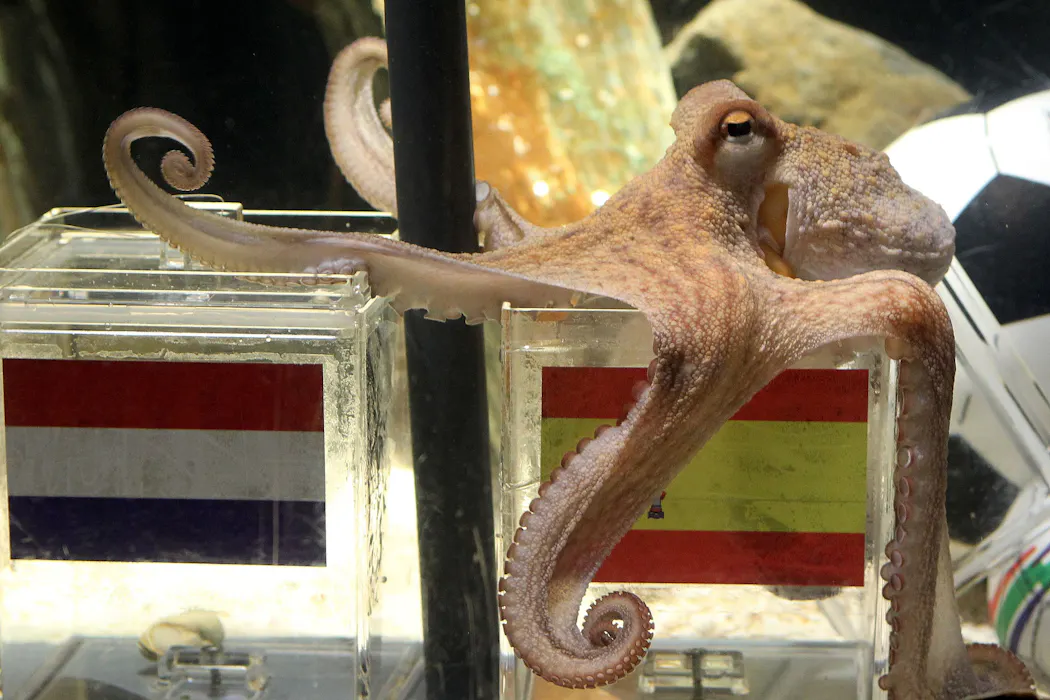
Paul the Octopus opted for Spain against the Netherlands in 2010. But how do his predictive skills compare to machine learning? Roland Weihrauch/DPA/AFP via Getty Images

In times past, when we wanted to know which team would win the World Cup, we had to turn to seers with crystal balls, use divination via tea leaves, or hope for Paul the Octopus to tell us what would happen.

But modern data science can provide a better alternative. As part of a team of statisticians, I helped train a machine learning algorithm to predict the most likely course of the tournament.

Probabilistic forecasts and loaded dice

The algorithm we built proceeds in two steps.

In the first, sophisticated statistical models and expert insight from bookmakers and transfer markets are combined to determine the strengths of all teams and their players. In the second step, a machine learning algorithm decides how to best combine the strength estimates with other information about the teams.

This produced a probabilistic forecast for each possible match in the tournament. It can be thought of as a pair of loaded dice: Instead of having the numbers 1 to 6 with equal probabilities, these loaded dice have different probabilities for the number of goals for either team.

For example, according to our forecast, Mexico has a die rolling 1.9 goals on average in the opening match, whereas opponent South Africa has an average of only 0.7. But this does not mean that Mexico will surely win. Rather, a win for Mexico is the most likely outcome with 65% probability. A draw is less likely (21%), and a win for South Africa is the least likely outcome (14%).

‘Vuelve a casa, el fútbol vuelve a casa!’

Using different pairs of loaded dice, the result of each match in the World Cup can be simulated. We took into account the official tournament draw and all FIFA rules, including the possibility of overtime and penalty shootouts. We ran the simulation 100,000 times to determine the tournament’s most likely course.

The results show that Spain is the favorite for the title with a winning probability of 14.5%, closely followed by England and France, each at 12.4%, and Germany at 11.2%.

Due to the expanded tournament – this World Cup has 48 teams and five rounds in the knockout stage – this group of favorites is tightly packed. Portugal and Argentina also have good chances to win the title, at 8.9% and 8.2%, respectively.

For its part, the United States has a good chance of reaching the Round of 32: 78%. This is the highest in their group, which has three other teams. In the knockout stage, however, when every match is do or die, the probabilities of the U.S. team “surviving” go down relatively quickly. The probability for a home victory in the final at MetLife Stadium in New Jersey on July 19 is 1%.

A deeper peek into the engine room

Our machine learning algorithm and subsequent simulations are fueled by data, expert knowledge and statistical models.

First, all national matches over the past eight years are the basis for a “retrospective” estimate of the teams’ strengths. Second, a “prospective” strength estimate is obtained from quoted odds of various international bookmakers, reflecting their expert opinions about the upcoming tournament.

Third, ratings of the individual players are produced based on their contributions to goals at the club and national levels. And finally, the current quality and future potential of the players is reflected in their expected market values. These are available from the Transfermarkt website that uses a wisdom-of-the crowd approach to estimate the unknown real-market values.

These four variables are combined with a broad range of further relevant inputs reflecting the current states of the different teams and the countries they come from. This includes team-specific details, such as their FIFA rank and the number of players in the semifinals of this year’s Champions League. We also factored in country-specific socioeconomic factors, such as GDP per capita.

To determine if and how these features are relevant for the actual results in a World Cup, a machine learning algorithm was used.

Here, a so-called random forest is trained, consisting of lots of decision trees capturing slightly different subsets of the data. The algorithm has been trained on all matches played at the major soccer tournaments since World Cup 2006. It thus links a team’s strength, market value and other factors to the number of goals scored in matches at World Cups. This is the information that loads the dice for our simulations.

Find out more

This is not the first time that our team comprising Andreas Groll and Rouven Michels and colleagues at TU Dortmund University in Germany, Lars Magnus Hvattum at Norway’s Molde University College, Gunther Schauberger at TU Munich and I have collaborated to forecast a World Cup.

In the 2019 Women’s World Cup we correctly predicted the U.S. as the winner. In the 2023 Women’s World Cup and the 2022 men’s World Cup, the winners – Spain and Argentina, respectively – were not our favorites, although we did predict them to be serious contenders.

The bottom line is forecasts are about probabilities. Our program will not predict the winner with 100% certainty – but it might do better than an eight-limbed mollusk.

The Conversation

Achim Zeileis does not work for, consult, own shares in or receive funding from any company or organization that would benefit from this article, and has disclosed no relevant affiliations beyond their academic appointment.
❌
Subscriptions