Normal view

Silicon Valley’s AI ‘tokenmaxxing’ obsession has a big problem – and philosophers saw it coming

Some time earlier this year, an employee at tech giant Meta built a system to track how much each staff member was using artificial intelligence (AI).

Named “Claudeonomics” after the Claude chatbot, the system created a leaderboard ranked by the number of tokens each user was exchanging with AI models, with leaders given titles such as “Token Legend”. (Tokens are tiny chunks of text, each around four characters long, that language models use for processing.)

Meta is not alone in its fascination with “tokenmaxxing”: AI labs OpenAI and Anthropic, e-commerce company Shopify, and tech investment firm Sequoia capital are all reportedly monitoring AI usage and rewarding heavy users, some of whom burn billions of tokens in a week.

Reducing a person’s performance to a single metric can be appealing for management in large corporations. But the choice of what to measure isn’t a neutral one – and if we’re not careful, it can start to rewrite our vision of what we actually value.

The score keeps the score

One of the more full-throated advocates of tokenmaxxing is Jensen Huang, chief executive of chipmaker Nvidia, who envisions a future in which tech employees negotiate high token budgets and consume tokens at rates commensurate with their salaries. Around 80% of those tokens are currently processed via Nvidia’s chips, so Huang’s enthusiasm makes sense.

But is token consumption a helpful metric for those of us who do not profit directly from AI processing volume?

In a recent book, The Score, philosopher C. Thi Nguyen analyses the rise of metrics throughout modern society and offers some helpful insights.

As Nguyen emphasises, what we measure shapes our goals. We develop metrics as tools of convenience; they standardise our measurement of values so we can compare large numbers of otherwise disparate things.

This standardisation comes at the expense of variation and distinctiveness, Nguyen argues. In business, it can make workers seem interchangeable.

Determining which employees in a large organisation are consuming the most tokens in a week is fairly straightforward. But it tells us nothing about the quality or impact of their work.

Bad metrics, bad results

In the past, questionable metrics have contributed to dramatically bad outcomes.

Prior to the 2008 global financial crisis, for example, many financial institutions had sophisticated systems of measures designed to incentivise selling as many loans as possible, as quickly as possible. Perhaps unsurprisingly, many of those loans turned out to be far riskier than anyone realised.

Nguyen emphasises that these types of metrics can tempt us into thinking they are unavoidable. But one of the central lessons of moral philosophy is that we ought to pause at moments like these and ask a couple of basic questions: what is a good life, and what values are actually worth chasing?

Huang and others usually don’t present tokenmaxxing as an answer to these question. But that’s how it functions. What is worth devoting your professional and creative energy to? Simple: grinding through tokens.

A new vision of the good life?

Silicon Valley has, of late, produced a striking number of manifestos and quasi-constitutions.

Consider Anthropic’s Claude’s Constitution, published in January 2026, which sets out the company’s aspirations for its model’s values and speech. Or look at venture capitalist Marc Andreessen’s Techno-Optimist Manifesto, which makes the case for ambitiously accelerating technological advancements in the service of promoting human flourishing.

Some of the most influential texts in the history of moral and political philosophy take this form. Thomas Jefferson wrote one – the US Declaration of Independence. Karl Marx and Friedrich Engels wrote another – The Communist Manifesto.

One way to view these Silicon Valley proclamations, and trends like tokenmaxxing, is as repackaging familiar commonplaces of corporate life – recasting mission statements and key performance indicators in a loftier register. But another is to see them as attempts to do something far more ambitious: sketch the outlines of a new and far-reaching vision of the good life.

On that view, the metrics used to measure progress against the vision matter. Tokenmaxxing, for example, is already creeping beyond the bounds of the tech industry – one report from the Wharton School at the University of Pennsylvania suggests many organisations are prioritising staff AI usage and spending as metrics.

Metrics can be useful – if we’re careful

Metrics do have their place in an ordered and complex society. There are many instances in which we might happily defer to the scores produced by simple metrics, trading nuance for convenience. Aggregate ratings on product or restaurant review sites, for example, can simplify our decision-making, even if they aren’t tailored to our specific preferences.

The problem is what Nguyen calls “value capture” – when we uncritically allow external metrics to determine our own goals and behaviour. Resisting this process involves questioning what is being measured and reframing it.

Instead of counting tokens, for example, we might use an equivalent metric such as energy consumption. Energymaxxing might sound more like conspicuous wastage, rather than improved performance.

Counting tokens is one measure of AI activity, which is itself intended as a measure of productivity, which in turn leaves aside the question of what is being produced. Not only is tokenmaxxing a dubious metric in itself, but it may also distort our vision of what matters.

The Conversation

Victoria Lorrimar receives funding from the John Templeton Foundation.

Tim Smartt does not work for, consult, own shares in or receive funding from any company or organisation that would benefit from this article, and has disclosed no relevant affiliations beyond their academic appointment.
Politicians have long misunderstood the ‘working class’. The rise of the far right shows how mistaken they have been

Class has always mattered, and now social democratic parties that sprung from a working class — including the Australian Labor Party – are finding out why.

Over many years, and in many countries, a growing view among political actors and within political science was that class was losing its punch. The line was something like this. The working class once voted for labour parties. The middle class voted conservative. But over many years) that difference between how the classes voted got smaller and smaller. In some places it disappeared.

The “decline of class” narrative suited the leaders of labour and social democratic parties.

They could safely adopt market-based neoliberal policies, with a human touch added, in the knowledge their base wouldn’t desert them. But their base was changing. It was becoming more middle class, more individualistic, more awake to the benefits of market solutions to complex problems.

Now, those politicians are shocked by the rise of far-right political parties that now claim to represent the working class. In Australia, One Nation is close to matching Labor — in some polls, it is already ahead.

In the United Kingdom, Reform is leading in all the polls, while the governing Labour party is below 20%. In Germany, the neo-nazi AfD is presently leading in all opinion polls, while the Social Democrats are below 14%.

In the United States, the Republican Party has gone full Trump, on an agenda with aspects that look eerily reminiscent of prewar Germany. In France, the National Rally candidate is ahead in all opinion polls for the next presidential election.

‘Blue collar’ is not the same as ‘working class’

In many countries, the labour and social democratic parties are mere shadows of their former selves.

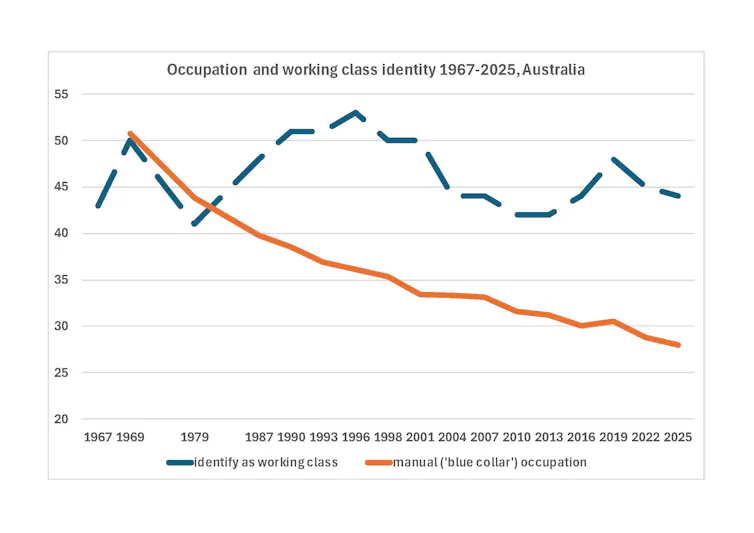
Perhaps the labour parties mistook the decline in “blue-collar” (manual) jobs for the decline of the working class. In Australia, the blue-collar share of jobs fell from 44% in 1979 to 28% in 2025. It’s fallen in the UK, the US and elsewhere.

Union membership, once a mostly “blue-collar” phenomenon, declined in most industrialised countries. It fell from an average of 30% of employees across the OECD in 1985 to 19% in 2005 and 15% in 2023. The fall was even greater in Australia.

But these changes did not reflect how likely people were to identify as working class.

In Australia, national attitude and election surveys give us a good idea of trends in people’s views. Between 1979 and 2007, the proportion of respondents in a standard national survey defining themselves as working class or lower class temporarily grew from 40%, to the low 50s in the 1980s and ‘90s, then back to 44% by 2007. In 2025, after a bit more movement, it was still 44% working class.

A chart with two lines, showing (in red) a gradual decline in blue collar occupations and *b) a variable but relatively flat proportion of peoploe identifying as working class.
Occupation x working class identity. Australian Election Study and Australian Bureau of Statistics, CC BY

A British survey in 1983 found 58% of people claimed to be working class. By 2005, those identifying as working class had barely fallen to 57%. In 2023, still 53% of people identified as working class.

In the US, where the phrase “working class” appeared absent from public discourse for decades until Trump, a differently worded question showed that in 1976, 51% of Americans thought of themselves as either working class or lower class. In 2006, the same survey showed 52% identifying as either working class or lower class. Within this period, numbers had fluctuated from year to year — but always between 48% and 55% expressed working or lower class identity.

A Gallup poll added “upper-middle class” to the options, and the proportion claiming working or lower class status was only 39% in 2006. In 2024, that number was 43%.

In Canada, the proportion identifying as working or lower class was 36% in 1980 and still 36% in 1995. In 2017, a different poll found 37% identified as working class.

In short, while “blue-collar” jobs have sharply declined almost everywhere, the experience of “working class” has been relatively stable, within some fluctuating bounds. Differences in class identity between countries seem more notable than differences over time, perhaps due to how questions are asked or how different cultures interpret them.

This is not to say that giving a “working class” response to a forced-choice survey question is the same as a deeply thought position on class. But if people no longer thought of themselves as working class, you would expect to see some pretty big changes over time in answers to these questions.

How the working class was left behind

Sure, jobs changed, a lot. But there has never been much middle-class glamour in the “white collar” jobs at the checkout counter, behind the hamburger hotplate or in the call-centre factory.

Class relations didn’t weaken. In fact, inequality worsened in many countries. Neoliberal policies, including those adopted by social democratic parties, made the rich much richer, but they slowed the growth in the wellbeing of the majority of people, and left the working class behind.

The proportion that thought big business had too much power, and income and wealth should be redistributed, became larger.

Unions lost ground not because their ideas became unpopular with workers. It simply became much harder for unions to recruit and retain members in the face of increasingly hostile employers, governments and laws.

Working class voters didn’t have solutions to hand. But nor were they offered any by social democratic parties that barely spoke their language. Now the door has been opened to far-right parties, presenting alternatives that appeal to some facing those class problems.

There’s life in class voting yet, just not in the way we thought of it.

The Conversation

Over the years David Peetz has received funding for research from the Australian Research Council, various unions and employers, the Fair Work Commission, state and national governments of both political flavours in Australia and overseas, the International Labour Organisation and the Organisation for Economic Cooperation and Development. He is presently employed by the Centre for Future Work.

Is baby talk bad? Why ‘parentese’ actually helps babies learn language

Emphasizing the sounds of certain words to young children can help them retain language, not confuse them about speaking properly. MoMo Productions/DigitalVision via Getty Images

Many parents have heard the warning: Don’t use baby talk with babies and toddlers. Instead, caregivers are often encouraged to speak properly and use adultlike language, out of concern that simplified speech could confuse children or delay language development.

But my research, which I highlighted in in my new book, “Beyond Words,” suggests the opposite is true. The sing-song voice many adults instinctively use with infants, sometimes called “baby talk” but more accurately known as “parentese” or infant-directed speech, actually helps children learn language.

Far from confusing babies, exaggerating phrases like “Loooook at the doggie!” capture their attention, help them detect patterns in speech and strengthen social bonding.

And the funny mistakes children make along the way, such as saying “goed,” instead of “went,” or “mouses” instead of “mice,” are not signs that children are learning language incorrectly. They are evidence that children are actively working out the rules of language for themselves.

A man holds his hands away from his face and leans over a small baby lying on a bed and smiles.
Speaking ‘parentese’ to a child doesn’t involve nonsense words. BjelicaS/E+ via Getty Images

What parentese really is

When many people think of baby talk, they imagine nonsense phrases like “goo goo ga ga” or made-up words like “num nums.” But that’s not what linguists and developmental psychologists mean by parentese.

Parentese uses real words and grammatically correct sentences, but with exaggerated intonation, a higher pitch, stretched-out vowels and a slower rhythm. Think of the way a caregiver might naturally say: “Hi, baaaaby! Are you huuungry?”

There is little evidence that occasional playful nonsense words harm children’s language development. But studies suggest that parentese in particular helps babies pay attention to speech, recognize patterns and engage socially.

Adults across cultures tend to speak this way to infants instinctively. Even people who swear they never use baby talk often slip into it around babies.

Researchers have found that infants actually prefer listening to parentese over regular adult speech. The exaggerated sounds and slower pacing make language easier to process. Babies are better able to pick out individual sounds, notice word boundaries and recognize patterns. In other words, parentese helps tune babies into language.

It also strengthens emotional connection. Language learning does not happen in isolation. Babies learn through warm, responsive interaction with caregivers during feeding, play, bath time and everyday routines.

Interestingly, humans are not the only ones who respond to this style of communication. Studies have even shown that cats react more positively when people use a baby-talk voice with them.

Babies are not passive learners

Children do not learn language simply by copying adults word for word. They actively test hypotheses about how language works. That is why toddlers make predictable and surprisingly logical mistakes.

One common example is overgeneralization. A child learns that people form the past tense of many verbs by adding “-ed,” so they produce forms like “goed,” “eated” or “comed.”

These are not random errors. In fact, they show that the child has understood a grammatical rule and is trying to apply it consistently. The problem is simply that English is full of irregular exceptions. The same thing happens with plurals. Children may say “foots” instead of “feet” or “mouses” instead of “mice.” Again, the logic behind these errors is sound.

Linguists sometimes say that children are little scientists, constantly testing patterns and revising their understanding as they receive more input from the world around them.

Why toddlers call everything a ‘dog’

Young children also make predictable mistakes with meaning.

A toddler might learn the word “dog” and then use it for every four-legged animal they encounter. Linguists call this overextension. On the flip side, some children use words too narrowly. A child may use “dog” only for the family pet and not recognize that other dogs belong in the same category. Linguists call this tendency underextension.

These mistakes reveal how children organize and categorize the world around them. They are gradually mapping words onto objects, people and experiences.

Pronouns are another tricky area. Small children often confuse “me” and “you” because these words constantly shift depending on who is speaking. If a parent says, “I’ll pick you up,” the child hears themselves called “you.” But when they try to repeat the sentence, they may not yet understand that the labels switch from speaker to speaker.

This is why toddlers sometimes say things that sound unintentionally cute or confusing. But beneath the confusion is a sophisticated learning process.

Even the Cookie Monster gets it wrong

Children’s speech errors are so recognizable that they often appear in popular culture. Sesame Street’s character Cookie Monster famously says things like “Me want cookie,” while Elmo often refers to himself in the third person: “Elmo wants this.” These speech patterns mirror real stages of child language development. Young children commonly confuse pronouns or refer to themselves by name before mastering forms like “I,” “me” and “mine.”

Despite occasional complaints from adults, there is no evidence that hearing this kind of speech harms children’s language development. If anything, it reflects the natural experimentation children go through.

A Cookie Monster puppet stands near a black tarp with its mouth open and holds a cookie.
The Cookie Monster saying ‘Me want cookie’ won’t teach babies and young kids to speak incorrectly. Brian Killian/WireImage via Getty Images

‘Pasketti’ and ‘wabbit’

Pronunciation develops gradually too. Young children often simplify difficult sounds and groups of consonants. “Spaghetti” becomes “pasketti,” “rabbit” becomes “wabbit” and “yellow” may come out as “lellow.”

Speech-language specialists call these simplifications phonological processes. They are a normal part of development because some sounds are physically harder to produce than others. Sounds such as r, th, sh and ch tend to develop later because they require more precise control of the tongue and mouth.

Most children naturally outgrow these pronunciation patterns as their speech matures. However, persistent difficulties can sometimes signal a speech or language disorder, which may require professional support.

A graphic image shows a young child's head with various colorful thought bubbles inside.
Children don’t learn language by copying adults word for word. They learn through interaction, experimentation and repetition. DrAfter123/DigitalVision Vectors via Getty Images

Mistakes are part of learning

Parents are often under enormous pressure to do everything right, including helping their children learn to speak a language. But children do not learn language by avoiding mistakes. They learn through interaction, experimentation and repetition.

Parentese helps babies focus on speech and engage socially. The funny mistakes toddlers make reveal that they are actively piecing together the complex system of language and are often signs of normal development. Language acquisition is messy, creative and remarkably sophisticated.

Speaking in an exaggerated sing-song voice to a baby is not something parents and caregivers need to feel embarrassed about.

Far from harming language acquisition, it may help lay the foundation for it.

The Conversation

Karen Stollznow does not work for, consult, own shares in or receive funding from any company or organization that would benefit from this article, and has disclosed no relevant affiliations beyond their academic appointment.

What ‘biodegradable’ packaging really means – and 3 key questions to ask about it

John Cameron / Unsplash

“Biodegradable” has become one of the most reassuring words in modern packaging. It appears on coffee cups, shopping bags and food containers, implying a promise: this product is better for the environment because nature will eventually take care of it.

However, biodegradability is not a simple yes-or-no property. It exists in shades, which we can measure.

Biodegradation is a complex process. Microbes and molecules present in an environment such as soil attack a material and digest it, much like what happens to food in our gut.

A material is typically defined as biodegradable if it is digested “well” by the environment in which it is placed. The more mass the material loses during digestion, and the more carbon dioxide it produces, the more biodegradable it is.

Different environments digest materials in different ways. Temperature, sunlight, oxygen, moisture and microbial diversity all influence how quickly materials degrade.

Even the most rigorous testing cannot fully capture the complexity of the real world – but it can help guide our choices.

Biodegradability is relative

In the lab we can simulate environments such as landfill, home compost bins and industrial compost facilities. If we understand in which settings a material breaks down better, we can tell the consumer how to best dispose of it and prevent pollution and other issues.

A material that decomposes quickly in an industrial composting facility may persist for years in the ocean or landfill.

Industrial composting systems maintain elevated temperatures, controlled aeration and consistent moisture. Hot, moist and oxygen-rich conditions generally aid biodegradation but they are not easy to come by in a backyard compost bin.

Home compost systems are typically cooler and more variable. The result: a material certified for industrial composting may not break down effectively at home.

Take polylactic acid (PLA), a biodegradable material generally considered to be a greener alternative to common plastics (like PET). PLA can biodegrade effectively in an industrial composting system. With temperatures above 60°C and controlled moisture, oxygen and microbial activity, microbes can convert PLA into carbon dioxide, water and biomass in just a few days.

Outside these conditions, the story changes. If PLA ends up in landfill, decomposition can be slow because oxygen is limited. In rivers or marine environments, it may persist for years and act as a raft for “alien” species. In your compost bin or worm farm it might disappear in a few months.

Time for standards

There are many ways to measure biodegradability. One common series of tests, OECD 301 assesses “ready biodegradability” in different environments as a material’s ability to biodegrade around 60% within 28 days under controlled conditions.

Industrially compostable materials are tested under very specific conditions. Standards such as EN 13432, used in Europe, assess whether packaging can successfully break down in industrial composting facilities.

To meet the standard, at least 90% of the material must biodegrade into carbon dioxide, water and biomass within six months. These tests typically involve elevated temperatures, controlled aeration, and moisture.

Most biodegradable plastic materials do not disappear cleanly. Instead, they fragment into progressively smaller particles before fully breaking down. During this period, the fragments will continue interacting with organisms and ecosystems.

Compost bins too can get indigestion

Biodegradability standards are helpful for consumers and waste regulators. Nevertheless, they are limited. They often do not test how much of any given material a specific disposal system can sustain at any one time.

This is an important parameter to take into account. Take food waste. When large quantities of food lie in landfill without oxygen, they generate methane, a greenhouse gas far more potent than carbon dioxide over short timescales.

Other biodegradable materials are no different and can throw out the balance of an ecosystem such as your compost bin, if added in excessive quantities.

Introducing certain materials to a compost bin might also cause certain microbes to thrive and others to suffer, sometimes with unintended consequences, such as making your compost bin smell bad.

In the future, biodegradability tests will likely be paired with ecotoxicity assessments, to help us understand whether a material breaks down safely and without generating harmful byproducts or microbial imbalances.

What can we do?

Few of us have an industrial composting facility nearby to take care of biodegradable materials. Industrially compostable products such as coffee cups often end up sent to landfill alongside conventional waste.

This does not mean individuals are powerless or that biodegradable materials are inherently bad.

You can start by checking local council guidance and choosing products certified for the systems available in your area, or your compost bin.

Ask yourself:

  • is this product home compostable or only industrially compostable?

  • is there infrastructure locally that can process it?

  • has it been independently certified?

As for industrially compostable coffee cups, check that you can return cups to participating cafes. They should not be placed in standard recycling bins or food and organics bins as they are considered contaminants. If unsure, place them in a bin destined for landfill.

Ultimately, the most sustainable option remains a reusable washable cup.

These may seem like small actions but they help push packaging design and waste systems toward greater transparency and accountability.

Moving beyond simple labels

As consumers, we want to make educated choices about their purchases and how they can be disposed of.

For now, we have simple labels. In the future, we will hopefully have more complete information about how materials degrade in industrial composting facilities, home compost bins, soil, freshwater, sea water and landfill sites.

Biodegradable materials offer clear advantages over highly persistent materials, but the term “biodegradable” should not be mistaken for environmentally harmless.

Let’s just remember that a biodegradable material released in the wrong place, at the wrong scale, or under the wrong conditions may behave not very differently from a non-biodegradable material.

Understanding the shades of biodegradability moves the conversation beyond simplistic labels. Nature can break many things down, eventually. The more important question is whether it can do so without getting indigestion.

The Conversation

Alessandra Sutti has received research funding from the Australian Research Council, the Marine Bioproducts Cooperative Research Centre, the Innovative Manufacturing Cooperative Research Centre and by companies participating in associated projects such as the ARC Research Hub for Functional and Sustainable Fibres and the ARC Training Centre in Sustainable Material and Responsible Technologies for Packaging (SMaRT-Pack), as well as from industry partners associated with these grants, such as HeiQ Pty Ltd, Xefco Pty Ltd, C. Sea Solutions Pty Ltd (trading as ULUU) and Simba Global Pty/Ltd. Alessandra is a paid member of the HeiQ Innovation Advisory Board, is a member of the American Chemical Society and serves as a volunteer member on Standards Australia ME-009 Committee (Microplastics). She collaborates closely with The GLOBE Program (through GLOBE Italy), The University of California Berkeley and San Francisco State University, co-developing microplastics monitoring protocols and is involved in environmental education programmes.

Martin Zaki does not work for, consult, own shares in or receive funding from any company or organisation that would benefit from this article, and has disclosed no relevant affiliations beyond their academic appointment.

Where did language come from? Nobody really knows, but the theories are fascinating

Sriharu Kapu/Unsplash

Humans are the only species known to use fully symbolic language: a system capable of expressing abstract ideas, imaginary worlds and endless combinations of meaning. But how did we get there?

The origins of language have fascinated philosophers, scientists and storytellers for thousands of years. Despite all our advances in linguistics, archaeology and cognitive science, we still don’t know exactly how language began.

That uncertainty hasn’t stopped people from trying to solve the mystery. In fact, some of the earliest theories of language’s origins are among the strangest and most entertaining ideas in the history of science.

Bow wow, ding-dong

In the 19th century, scholars proposed a flurry of curious theories to explain how speech first emerged. Many of these theories were given playful nicknames by the German philologist Max Müller, who intended them partly as satire. Yet the theories were genuine attempts to tackle one of humanity’s biggest questions.

German philologist Max Müller gave playful nicknames to competing theories of language’s origins. Public domain, via Wikimedia Commons

The most famous is probably the Bow-Wow Theory. This suggested language began through imitation of natural sounds. Early humans, according to this theory, copied the noises around them: animal cries, splashing water, thunderclaps and birdsong. Words such as “buzz”, “hiss”, “bang” and “splash” seem to support the idea because they sound like what they describe.

But there is a problem. Different languages hear the same sounds differently. English dogs go “woof” or “bow-wow”, but in Turkish they go “hev-hev”, while Indonesian dogs go “guk-guk”. Even animal noises, it turns out, are filtered through culture and language.

And onomatopoeic words (words that imitate sounds) make up only a tiny fraction of our vocabularies. Most words sound nothing like their meanings. For instance, there is nothing inherently tree-like about the word “tree”.

That brings us to the Ding-Dong Theory, which argued that sounds and meanings are naturally connected in some deeper, almost mystical way.

Some words do seem to fit their meanings uncannily well. “Mini”, “teeny” and “itsy-bitsy” feel small and delicate. “Lump”, “rump” and “plump” sound heavier and rounder.

Modern linguists call this sound symbolism. One famous experiment asked participants to match two nonsense words, “bouba” and “kiki”, to two shapes: one rounded and one jagged. Most people matched “bouba” with the soft shape and “kiki” with the sharp one.

The effect is real, but it is limited. Most language still appears to be arbitrary, which means there is no natural reason why a particular sound should mean a particular thing.

Pooh-pooh, la-la, ye-he-ho

Other theories focused less on imitation and more on emotion and social interaction.

The Pooh-Pooh Theory proposed that speech began with instinctive emotional cries such as “ouch”, “oh” or perhaps less publishable exclamations uttered after stubbing a toe. According to this idea, language evolved from spontaneous vocal reactions to pain, surprise, fear or joy.

Again, though, there are complications. Interjections vary widely across languages. English speakers say “ouch”. Greeks say “aou”. Czechs might exclaim “ach”. Emotional sounds are not nearly as universal as they seem.

Then there is the wonderfully named Yo-He-Ho Theory, which suggested language emerged from rhythmic chants used during collective labour, like sailors chanting “yo-heave-ho” while hauling ropes, or workers singing together to coordinate physical effort.

The theory may sound quaint, but modern researchers do think rhythm, cooperation and social bonding played important roles in human evolution. Language is, after all, deeply social.

Charles Darwin speculated that speech evolved from musical expression. Herbert Rose Barraud, Public domain, via Wikimedia Commons

Another proposal, the La-La Theory, linked language to music. Charles Darwin entertained the possibility that speech evolved from musical calls used in courtship and emotional expression. Before humans spoke, perhaps we sang?

Some modern theories echo this idea. One hypothesis suggests that, as early humans began walking upright, parents increasingly needed to soothe babies from a distance. Sing-song vocalisations, cooing and proto “baby talk” may have helped strengthen emotional bonds and eventually paved the way for speech.

Gestures, symbols and brains

Today, most scientists think no single theory fully explains language origins. Instead, language probably emerged gradually through a combination of gestures, vocalisations, facial expressions, social cooperation and increasing cognitive complexity.

Some researchers argue that language began with gestures before shifting to speech. Others believe language evolved as a tool for social bonding, allowing larger groups of humans to cooperate and share information. Still others see language as tied to the evolution of symbolic thought itself: our ability to imagine, plan, remember and communicate abstract ideas.

Biology is also a factor. Humans have developed unusually precise control over the tongue, lips and vocal tract. We have evolved specialised brain regions linked to language processing.

But anatomy alone cannot explain language. Parrots can mimic speech sounds. Many animals communicate. None, however, appear to possess grammar and symbolism on the human scale. And, frustratingly, early language leaves no evidence behind. Spoken words don’t fossilise.

That lack of evidence is one reason the topic became so controversial that, in 1866, the Société de Linguistique de Paris banned discussions about language origins altogether, dismissing the field as hopelessly speculative.

Saraswati, Hindu goddess of knowledge and speech – Raja Ravi Varma (1894) Public domain, via Wikimedia Commons

Of course, theories about language origins also appear in religion and mythology. In Greek mythology, the messenger god Hermes was associated with language and communication. In the Hindu tradition, the goddess of knowledge and speech Saraswati bestowed Sanskrit upon humanity. In the Judeo-Christian tradition, language was a gift from God, who enabled Adam to name the animals in the Garden of Eden.

These stories reflect something deeply human: our urge to explain where language came from, because language itself feels almost magical. Every theory of language origins captures a small piece of the puzzle. Imitation, emotion, rhythm, music, gesture, cooperation and symbolic thought probably all played some role.

But none can provide a complete answer. The truth is that language evolved so long ago, and likely so gradually, that we will never pinpoint a single moment when it began, unless someone invents a time machine.

The birth of language will probably remain one of humanity’s greatest unsolved mysteries. Still, the theories themselves tell us something important. Humans are always trying to explain what makes us human. And language may be the most human thing of all.

The Conversation

Karen Stollznow does not work for, consult, own shares in or receive funding from any company or organisation that would benefit from this article, and has disclosed no relevant affiliations beyond their academic appointment.

Conspiracy theories: do 300,000 Kiwis really believe Canada is building an army of mutant super-raccoons?

Enn Li Photography/Getty Images

Four percent of Americans – roughly 12 million people – believe that “lizard people” secretly control the Earth. At least, that was the finding of an infamous 2013 public opinion survey.

Do so many people really believe such outlandish claims? Or do results like these partly reflect people giving silly answers or deliberately skewing surveys for fun?

US psychiatrist Alexander Scott believes the latter plays a significant role.

Using the survey as an example, he coined the term “the Lizardman constant” to describe the idea that a certain amount of noise and trolling will always exist in surveys about unusual beliefs.

As Scott warned: “Any possible source of noise – jokesters, cognitive biases, or deliberate misbehaviour – can easily overwhelm the signal.”

As researchers who study uncommon beliefs such as conspiracy theories, we wanted to investigate how this kind of cheeky trolling can muddy the waters.

Trolls and true believers

Building on earlier Australian research, we surveyed New Zealanders to test how common dishonest or joking responses were in conspiracy theory surveys.

We did this in two ways. First, we directly asked people a yes/no question at the end of the survey:

“Did you respond insincerely at any earlier point in this survey? In other words, did you give any responses that were actually just joking, trolling, or otherwise not indicating what you really think?”

Second, we included in the survey a “conspiracy theory” so ridiculous we could assume most, if not all, people who said they believed it were taking the mickey.

We asked them if they believed:

The Canadian Armed Forces have been secretly developing an elite army of genetically engineered, super intelligent, giant raccoons to invade nearby countries.

In our representative online sample of 810 New Zealanders, 8.3% of respondents confessed to being insincere in the survey.

Another 7.2% said they thought the Canadian raccoon army theory was probably or definitely true. That proportion – similar to findings from Australia – would equate to more than 300,000 adult New Zealanders.

To complicate things slightly, there was some overlap between those admitting to insincere answers and those claiming to believe the raccoon conspiracy. Combined, 13.3% of respondents fell into one or both groups – roughly one in eight people not appearing to take the survey seriously.

Importantly, these respondents were also much more likely to endorse other conspiracy theories, inflating estimates of how widespread those beliefs really are.

For instance, 6.5% of the full sample endorsed the claim that governments around the world are covering up the fact that 5G mobile networks spread coronavirus.

But once we removed the insincere responders, that figure dropped by more than half to 2.7%.

Across 13 different conspiracy theories, the estimated proportion of believers fell substantially once those respondents were excluded.


Another interesting insight from our study was that people endorsing contradictory conspiracy theories were much more likely to show signs of responding insincerely.

Previous studies have found some people appear to believe conspiracy theories that directly contradict each other. In our survey, for example, some participants agreed both that COVID-19 is a myth and that governments are covering up the fact that 5G networks spread the virus.

But nearly three-quarters of those respondents also showed signs of joking or dishonest answers.

This suggests genuinely believing contradictory conspiracy theories may be less common than previously thought.

Not every conspiracy believer is joking

Our findings add further weight to the idea that surveys may overestimate how many people truly believe some conspiracy theories – thanks, in part, to trolls.

But does that mean all conspiracy theory research is bunk?

Fortunately not. Most research in this area is not focused on counting conspiracy believers, but on understanding why people hold these beliefs and what effects they can have.

We tested several well-established findings from earlier conspiracy theory research to see whether they still held up once insincere respondents were removed from the data.

For example, previous studies have found that people who endorse conspiracy theories are more likely to see the world as a dangerous and threatening place.

We found the same pattern. In fact, removing insincere respondents made little difference to the broader relationships identified in earlier research.

Nevertheless, we recommend that future surveys include ways to gauge whether respondents are answering sincerely and account for this in the analysis. At the very least, researchers should acknowledge that trolls and joking responses can distort their results.

While our research suggests some people are taking the mickey in surveys, it also shows a significant minority genuinely appear to believe some of these claims.

In some cases – such as believing authorities are covering up the fact that the Earth is flat – this may be relatively harmless. But other conspiracy beliefs can lead to real-world harm.

Good-quality research is essential for understanding how sincere believers end up down these rabbit holes, and how those beliefs influence real-world behaviour.

Research into why people embrace conspiracy theories – and the real-world consequences of those beliefs – remains important.

But when surveys suggest millions may believe in lizard overlords or genetically engineered raccoon armies, it is also worth remembering the “Lizardman constant”: some respondents may simply be having us on.


The authors acknowledge the contributions of Rob Ross, Mathew Ling and Stephen Hill to this article.


The Conversation

John Kerr is supported by a Royal Society Te Apārangi Mana Tūānuku Research Leader Fellowship.

This research was supported by the Marsden Fund Council from Government funding, managed by Royal Society Te Apārangi.

Mathew Marques does not work for, consult, own shares in or receive funding from any company or organisation that would benefit from this article, and has disclosed no relevant affiliations beyond their academic appointment.

Good news for renewables: southern Australia’s offshore winds will stay strong even as the climate changes

by-studio/Getty

If you’ve ever stood on a Victorian beach and felt the wind from the Southern Ocean, you’ll know this is not a gentle force. Whipped up across thousands of kilometres of cold ocean, these winds are relentless and powerful.

More than that – they’re one of Australia’s most valuable untapped sources of energy. Australia has many windfarms, but all of them have been built on land.

The stronger, more reliable winds blowing over oceans now turn truly enormous turbines in nations from Denmark to China. Offshore wind would work particularly well in Victoria. The state government wants large windfarms built out at sea to replace the remaining coal plants.

But will these strong winds keep blowing as reliably under climate change? Our recent research is reassuring. Despite small drops in wind strength, the winds will remain strong and reliable over the next 30-50 years.

What’s so good about offshore wind?

Offshore wind farms produce power more reliably than onshore wind or solar. They can produce a great deal of power and require minimal land. This is why offshore wind has been seen as a good fit for Australia.

Coupled with big batteries and transmission lines, offshore wind could contribute significantly to the energy transition.

Victoria has most at stake. For decades it has relied on brown coal and gas. But its gas supplies are depleting fast and ageing coal plants in the Gippsland region will not be replaced with more coal. Instead, the state wants to tap Gippsland’s offshore wind resources, which rank among the world’s best.

Despite the interest, the offshore wind sector has been slow to start. Political and economic headwinds have led some projects to be cancelled. But the sector looks set to finally begin in August, when Victoria will host the nation’s first offshore auction with a goal of securing 2 gigawatts of capacity.

Victoria is not alone. Offshore wind zones have been declared along Australia’s entire southern and western coastline, including Victoria, South Australia, Tasmania and parts of New South Wales and Western Australia.

wind farm in background, blurry, and choppy ocean waves, dark blue ocean in foreground.
To date, Australia’s wind farms are all on land – but that could be about to change. John White Photos/Getty

Will the winds stay strong?

As the climate changes, wind patterns are likely to change too.

The powerful westerly winds of the Southern Ocean are forecast to be gradually pushed closer to Antarctica. Wind speeds across southern mainland Australia could drop by up to 5% by the end of the century.

If wind speeds drop too much, it could pose a problem for offshore wind. Weaker winds would mean less electricity can be generated, potentially making projects less viable and slowing the energy transition.

An offshore windfarm commissioned today will operate for 25–30 years. That means it will still be operating mid-century, when climate change is likely to have intensified.

To find out what climate change will mean for offshore wind, we worked with climate scientists and offshore wind researchers to simulate winds 30-50 years from now using seven high-resolution regional climate models.

We projected future wind speeds at the ocean surface and offshore wind energy production across Australia’s existing offshore wind zones under two scenarios – ambitious climate action limiting global warming to around 1.8°C and continued fossil fuel dependence driving warming to roughly 3.6°C by 2100.

We validated our projections against the best available records of historical wind speeds, which date back several decades. This is because it’s not just about whether wind speeds change, but whether they will change more than the natural variability offshore wind farms can already cope with.

What we found was broadly reassuring. Yes, the winds are likely to weaken over the next 30 to 50 years. But the changes are minor, falling 0.1% to 2.6% on average. That’s within the bounds of natural variability. Unlike projections of future rainfall or temperature, our findings hold across both emissions scenarios. This suggests offshore winds will remain strong and reliable overall.

While reassuring, one area is likely to see a larger drop. Under the high emissions scenario, wind speeds are likely to fall up to 20% over winter in Western Australia’s offshore wind zones near Bunbury.

Good news for offshore wind?

It’s good news that average wind speeds across Australia’s offshore wind zones are not likely to change significantly.

Our research is not the whole story, however. We didn’t model whether extreme winds or strong swell conditions will become more likely. These events can stop windfarms from operating, damage infrastructure and shorten the window of time when turbines can be installed and maintained.

To give offshore wind developers full certainty, it will be important to study what climate change will do to these extreme events.

The Conversation

Shiaohuey Chow receives funding from the Australian Research Council.

Alberto Meucci and Guisela Grossmann-Matheson do not work for, consult, own shares in or receive funding from any company or organisation that would benefit from this article, and have disclosed no relevant affiliations beyond their academic appointment.

Men film themselves sexually abusing sedated women and share it with other men online. Why?

Erik Mclean/Pexels, The Conversation, CC BY-SA

The world watched on in horror in 2024 as Dominque Pelicot and 50 other men were tried in a French court for repeatedly drugging and raping Gisele Pelicot over almost a decade. All of them were found guilty.

While such horrific abuse can feel far away and rare, it’s more widespread than many realise. There are private online communities with thousands of members all over the world, including in Australia, trading in video and photos of sedated women being abused.

A recent investigation by CNN revealed there are thousands-strong groups on messaging app Telegram who share tactics and videos assaulting and raping their girlfriends and wives.

In April, France launched an investigation into the website Pelicot used to recruit dozens of strangers to rape his wife. During the trial, police uncovered 20,000 videos and photos of his wife’s abuse, recorded by Pelicot himself.

So why do men do it, and how can we stop it?

Global, organised abuse

While the CNN report and Pelicot’s case shocked the world, these cases are not unique, with private pages and group chats being uncovered in Australia, Canada, Ireland, the United Kingdom, Germany, Italy, Spain, China, and Poland.

These reports show how widespread this issue is, underscoring that these are not isolated episodes. They are organised crimes committed by dedicated communities that support such violence, hosted on platforms that provide the essential infrastructure.

One report from the New York Times reported China-based group chats with as many as 100,000 members. A study of Telegram networks across Italy and Spain showed groups with nearly 25,000 users.

The Telegram group CNN reported on had more than 1,000 members with some videos posted in the group amassing over 50,000 views.

The groups identified in these stories and reports are part of a broader digital ecosystem often referred to as the manosphere, an online network of group chats, influencers and communities that perpetuate misogynistic ideas.


Read more: From violence to sexism, the manosphere is doing real-world harm


Why are people doing this?

As the CNN report puts it “while the platforms vary, inside such groups, video is king”. The more perverse, humiliating and risky the visual material, the higher the engagement and the greater the reward.

Telegram, like other platforms, provides financial incentives for engagement. Members can earn points through their activity and earn a place on leader boards. Telegram has its own internal crypto system, which members can spend through affiliate links.

Research from Australia shows men who non-consensually share images and videos online are motivated by more than revenge. What these men crave is the chance to prove their manliness to other men.

While research on perpetrators of online violence is still emerging, those who study the cultures of these online groups observe that a kind of homosocial bonding is created when share their abuse with one another. As feminist philosopher Marilyn Frye put it:

from women they want devotion, service and sex. Heterosexual male culture is homoerotic; it is man-loving.

While the men in these groups are sharing images and videos of women, commenting on women’s bodies, degrading women and objectifying women, it is men who are at the centre of the exchange. They seek the validation and praise of other men. One way this is achieved is by getting comments and likes on their videos.

Another popular form of bonding is the solicitation of comments from other members. One study described how users requested descriptions of what others would do, such as “describe how you would rape this bitch”.

Others commission sexualised deepfakes – realistic but fake sexually explicit images – using nudify apps and other artificial intelligence (AI) platforms.

In these groups, the practices and the language are meant to degrade women, to reduce them to raw material, objects to be consumed to satiate men’s desire, and to reinforce the bonds between men. Misogyny is the “social glue” that holds these communities together.

What can we do about it?

Traditional approaches and responses to gender-based violence still tend to individualise the problem, focusing on single perpetrators. What this approach fails to do is address the social, structural and technological enablers of this abuse.

Take the Telegram platform: why has this become the safe haven for perpetrators?

Telegram has specific design affordances that both enable and amplify image-based sexual abuse.

Groups can have up to 200,000 members. End-to-end data encryption allows for anonymity, and its content moderation regulations are weak. Telegram allows users to share visual and audio material (including large files). And perhaps most importantly, it has interactive features: likes, comments and disappearing messages.

All of these features collide to create the perfect storm for perpetrators. They are large, private, largely unregulated and allow them to anonymously share non-consensual sexual material.

There are efforts to stop this abuse, with emerging legislation such as the Take It Down Law in the United States that came into effect in May, and regulatory bodies such as the eSafety Commissioner in Australia, that aim to tackle the creation of image-based sexual abuse (including using sexualised deepfakes).

While these laws are aimed at individual perpetrators, the Pelicot case in France prompted the arrest of the creators of the website Dominique used to recruit others to assault his wife. In 2024, Telegram’s founder was arrested and charged in France for allowing illicit behaviour on the platform, including the distribution of child sexual abuse material. The case is still before the courts.

These arrests represent a welcome shift in how we tackle this issue by holding tech executives, not just their companies, responsible for providing the infrastructure that allows this abusive and degrading behaviour to proliferate and thrive.

The author would like to acknowledge Siân Human from the Australian Research Council Centre of Excellence for the Elimination of Violence Against Women for her insights and support during the process of writing this piece.

The Conversation

Emma Quilty receives funding from the Australian Research Council and eSafety.

Why Nairobi Africa-France summit bears the hallmarks of Macron and Ruto priorities

The 2026 Africa-France summit in Nairobi on May 11-12 is the first to be held in an African country that is not a former French colony. It is also the first to be held since the dramatic collapse of relations between France and a number of west African countries – notably Mali, Burkina Faso and Niger.

The 2026 summit can be understood as the latest example of President Emmanuel Macron’s new Africa doctrine, which he laid out in Burkina Faso in 2017. The doctrine’s three notable messages were:

  • an apology for colonial wrongs

  • a neoliberal small-business approach to assistance programmes

  • the French resolve to develop new alliances outside French Africa.

In keeping with the new doctrine, the French president hesitantly apologised in 2021 for some aspects of French colonial policy in Algeria. These include the torture and assassination of the Algerian nationalist hero Ali Boumendjel.

But mostly, Macron has looked to strengthen the position of Paris as old alliances were becoming weaker.


Read more: France in Africa: why Macron’s policies increased distrust and anger


He has consciously invested time and effort beyond French west Africa. The official visit to Guinea-Bissau, a former Portuguese colony, is a case in point.

Right after his election in 2017, France’s development aid agency (AFD) and the Tony Elumelu Foundation signed an agreement in Nigeria to empower a new generation of business leaders. Tony Elumelu Foundation is a Lagos-based non-profit that promotes youth entrepreneurship across Africa.

Macron then promoted entrepreneurship during the New France-Africa Summit in 2021. He sought to inspire the youth of Africa to innovate and set up businesses.

This year’s conference is held under the banner: “Africa Forward: Partnerships between Africa and France for innovation and growth”. The business start-up vibe is no coincidence.

Kenya has also stressed the groundbreaking nature of the meeting for its focus on Africa as a major partner for Europe. Europe is looking for new allies in the midst of a war in Ukraine; and the US is unreliable, with Donald Trump imposing tariffs and questioning the North Atlantic Treaty Organisation.

As a historian of global north-global south relations, I see the meeting less as groundbreaking, and more as a continuation of an older, mutually beneficial relationship between Kenya and France.

Kenya hopes its relationship with France will elevate its influence across Africa, allowing it to rival the diplomatic weight of South Africa, which hosted the G20 summit in November 2025.

By transcending the classic divide between French and British Africa, Nairobi can present itself as a continental leader and as a diplomacy city.

History of the relationship between France and Kenya

The economic and diplomatic relationship goes back to the 1960s and 1970s. Back in September 1970 France sent a little-known legal expert called Jaques Mollet to advise the Kenyan Ministry of Industry and Commerce on the newly-formed East African Community.

France also sought cooperation with institutions of the East African Community such as the East African Development Bank. By becoming a close partner of a newly established regional economic bloc in Africa, in which Nairobi played a pivotal role, the French Ministry of Foreign Affairs sought to weaken the British influence of Africa while strengthening its own position within the European Economic Community, now the EU.

Paris somewhat cynically justified its meddling as a way to strengthen continental unity since a French and a British sphere of influence in Africa would lead to unnecessary internal competition between the Commonwealth countries in Africa and Françafrique.

Kenya sought to strengthen its trade relations with France and the EEC in the 1960s. This was partly an attempt to become more independent of the Commonwealth. When negotiating with the EEC in 1963, an east African delegation that included Kenya’s Minister of Labour Tom Mboya stressed that maintaining the East African Common Market was key – not the Commonwealth.

Ruto and Macron’s shared understanding

The similarities between Kenya’s President William Ruto and Macron further strengthen this historical bond between Kenya and France. They share the same diplomatic goals. They are both focusing on climate change funding and security, and they share a preference for neoliberal privatisation as a mode for governance at home and abroad.

Ruto’s election campaign in 2022 touted the “hustler nation” – a focus on enabling small businesses. Macron has acted as a businessman-diplomat abroad, pushing small businesses as a solution for underdevelopment.

It’s no accident therefore that the 2026 summit will host a business forum and talks will focus on the potential benefits of artificial intelligence. AI, climate initiatives and weapons manufacturing, as well as the small-business ventures that have emerged through these priorities, are areas of cooperation and investment between African countries and the former colonial powers. Politicians like to flaunt this.

Part of the reason is that these are yet unproven ventures with no long history of unequal exchange between the two sides. They are natural common ground for two sides seeking a renewed relationship that is less burdened by the dark history of colonial oppression.

Yet France and Kenya’s agreement about the need to address security, climate change and artificial intelligence obscures the fact that both countries often find themselves on opposing sides of these issues.

As the Russian invasion of Ukraine in 2022 has shown, African and European leaders do not necessarily share the same analysis of the global security situation. European countries assumed they would get complete support from African countries but only 28 out of 54 African countries voted in favour of a United Nations resolution that condemned the Russian invasion of Ukraine. Kenya abstained.

On issues like climate change and artificial intelligence, France and Kenya again agree on the broad principle that these issues require urgent action, but disagree on the form the action should take.

For instance, climate change has hit Kenya hard. Extended droughts require genuine climate action. At the same time, France and the EU have been talking about loosening climate regulations to address the energy crisis caused by the US war on Iran. This includes easing emission regulations for cars.

The same problem presents itself in relation to the AI economy, which is being championed by France. It is cheap labourers in Kenya that have been doing much of the legwork to keep AI applications going. Large language models and other applications need to be trained and monitored by humans and they are often trained in Kenya’s so-called “AI sweat shops”. Kenyans are doing much of the data labelling and content moderation AI work.

Long term relationship?

In essence, the summit illustrates how climate finance, security and AI are being used to bolster commercial interests in both Africa and France, a strategic attempt to redefine a relationship long shadowed by colonialism.

However, the future of this entrepreneur-led approach remains uncertain. Its success hinges on whether France and Kenya can ensure that the wealth generated by these emerging sectors is distributed broadly, or if it will merely enrich a small circle of tech elites.

The Conversation

Frank Gerits does not work for, consult, own shares in or receive funding from any company or organisation that would benefit from this article, and has disclosed no relevant affiliations beyond their academic appointment.
Australian teens impacted by the social media ban are getting less news: new research

Stefania Pelfini la Waziya/Getty

In the months leading up to the implementation of Australia’s social media ban in December 2025, there was much discussion about the possible negative consequences.

Among these were concerns that teenagers would consume less news. As most young adults use social media for news and many rely on it, this was a real risk.

So months on, has this come to pass? In our newly-published research, we found the more young people are impacted by the ban, the more likely they are to report they are getting less news and having less opportunity to discuss news and the issues that matter to them.

Our research

In February we surveyed 1,027 young people aged 10 to 17, just two months after the legislation took effect.

As part of a longitudinal survey that has examined young Australians’ news engagement since 2017, we asked young people questions about the ban’s impact on their social media use and their news engagement.

First, we investigated if the ban had affected young people’s social media use by asking them if their engagement with each banned platform had changed at all, and if so, whether the change was a complete stop or if they just used it less.

We found 61% of under-16s who had previously been using banned platforms reported little or no change in their social media use. For the majority of young people surveyed, the ban was ineffectual.

In fact, only one in four (26%) reported their social media use had been affected.

Next, we asked young people if the ban had affected their engagement with news.

For those whose social media use was significantly disrupted, the result was stark: 51% reported getting less news as a direct result of the ban.

This finding is a significant concern because it suggests that as the ban becomes more “successful”, with a greater number of young people being removed from platforms, their news engagement will fall in parallel.


Read more: ‘Make the platforms safer’: what young people really think about the social media ban


The impact on civic involvement

A 2025 report from the Australian Curriculum, Assessment and Reporting Authority, based on testing of year 6 and year 10 students, finds school students’ civics knowledge is the lowest it has been since testing began 20 years ago. This is despite most young people believing it’s important to take action in the community on issues that matter to them.

Our findings show that when young people are impacted by the social media ban they lose access to news about issues they care about. They are also talking less about news and finding fewer opportunities to share their views or take other forms of action.

Our previous research shows news engagement makes young people feel knowledgeable and more capable of responding to issues.

A large body of research also shows news interest and engagement is closely associated with civic engagement. The more engaged people are with news, the more likely they are to become involved in community and social issues.

Social news or no news

It’s unlikely that being cut off from news on social media will lead young people back to traditional news sources.

Most young Australians say they don’t feel represented or heard by traditional news organisations. They also feel the news mainstream outlets create isn’t accessible to young people and doesn’t focus on the issues that matter most to them.

In our survey, 75% said news organisations have no idea what their lives are actually like, and 71% said they find it difficult to find news relevant to people their age.

Our earlier research also shows Australian news organisations rarely include young people in news stories. When they are included, they are seen but not heard.


Read more: On an average day, only 1% of Australian news stories quoted a young person. No wonder so few trust the media


For instance, young people are shown in news stories in photographs and video footage ten times more than their voices are heard or they are quoted in stories.

In addition, another study of news has shown that when young people are included in breaking news events, they are often stereotyped as being lazy, dangerous and entitled.

These findings demonstrate some of the reasons young people have likely turned to social media for news in recent years.

So what should we do?

It’s likely that over time, more young people will be cut off from social media as loopholes in the ban are ironed out. This emphasises the need to find ways to encourage young people to engage with other news sources in productive and meaningful ways.

A key concern is trust. We need to educate young people about the importance of news to democratic process, providing them with insights into how high quality journalism is produced and supporting them to make informed decisions about who and what to trust online.

This can happen as part of media literacy education but this requires investments in high quality curriculum resources and teacher training.

In Australia, we are in the fortunate position that we already recognise the need for media literacy in the Australian curriculum. High quality news literacy resources are being produced by the ABC through programs such as BTN (Behind The News), and other organisations such as Squiz Kids.

At the same time, to develop trust, mainstream news organisations need to do a much better job of representing young people in fair and inclusive ways so they feel seen and heard.

Finally, it’s important to recognise that amid all of these changes to young people’s technology access, our research shows family is the first and most trusted source of news for young people. We need to help parents understand the important role they play in helping their kids navigate the news.

The Conversation

Michael Dezuanni receives funding from the Australian Research Council and ABC Education. He is the current Chair of the Australian Media Literacy Alliance.

Tanya Notley currently receives funding from the Australian Research Council and ABC Education. She is a board member of the Australian Media Literacy Alliance.

Simon Chambers does not work for, consult, own shares in or receive funding from any company or organisation that would benefit from this article, and has disclosed no relevant affiliations beyond their academic appointment.

Health authorities are racing to contain Ebola in the DRC and Uganda. Here’s what’s making it so challenging

The Democratic Republic of Congo (DRC) is grappling with a rising Ebola epidemic, with almost 600 cases detected so far and more than 130 deaths.

Ebola is a rare virus that initially causes a fever, fatigue, muscle pain, then vomiting and diarrhoea. It can then progress to the hemorrhagic stage, with internal bleeding – which presents as blood in vomit and faeces – as well as bleeding as from parts of the body including the nose, gums, vagina and needle punctures.

Ebola primarily spreads through contact with bodily fluids such as blood, faeces and vomit. It can be contracted from contaminated surfaces or contact with bodies of those who have died, but can also spread by other routes including without contact.

This current outbreak, caused by the rare Bundibugyo strain, was first confirmed as Ebola on May 15. It was already estimated to have 246 cases at the time of this confirmation.

As surveillance efforts stepped up, it became clear the outbreak was more than double that size, with spread to Uganda.

So what are health authorities doing to get the virus under control and why is it such a challenge?

And what can health authorities in Africa, as well as the rest of the world, learn from previous outbreaks?

How did so many people get sick so quickly?

Ebola has a long incubation period of two to three weeks or longer. This means the number of infected people has likely been growing since at least March or April.

Our epidemic early warning system, Epiwatch, saw signals of unknown illness in the DRC on April 13, with reports of hemorrhagic fever noted even earlier on March 13.

The delay in diagnosing Ebola may have been due to initial testing targeting the more common Zaire strain of Ebola. Tests must be specific to Bundibugyo.

The DRC is also experiencing other serious outbreaks including mpox and measles, as well as malnutrition and chronic malaria.

These underlying factors can make epidemics more severe and harder to detect.


Read more: WHO has declared mpox a global health emergency. What happens next?


How big did previous outbreaks get?

The worst Ebola epidemic in history was over 28,000 cases in the 2014 West African epidemic. More than 11,000 people died from this Zaire strain, as vaccines were not yet available at the peak of the epidemic.

In the DRC, the last epidemic of 64 cases was in late 2025. The largest epidemic in the DRC was in 2018-2019 with more than 3,000 cases. These were both the Zaire strain.

There have only been two other Bundibugyo outbreaks. The first, in 2007 with 149 cases, was in the Bundibugyo District of western Uganda, near the DRC border. The second, in 2012, was in the DRC, with 57 cases. The current Bundibugyo epidemic is already the largest in history.

While Bundibugyo is not as lethal as the Zaire strain, it can kill 30–50% of infected people. The fatality rate in this epidemic appears close to 30%, with 139 deaths reported from almost 600 cases.

Unlike the Zaire strain, for which there are treatments and vaccines, there are no approved drugs or vaccines for the Bundibugyo strain.

However, the World Health Organization has sponsored clinical trials of a monoclonal antibody and the antiviral remdesivir, a drug which is also used for COVID.

We may see higher fatality rates unless non-pharmaceutical measures ramp up.

How can it be stopped?

The epidemic can be stopped by coordinated surveillance and containment. This is by identifying cases, isolating them so they cannot infect others, tracing their contacts and quarantining them.

In 2014, these measures alone controlled the Ebola epidemic at a time when no treatments or vaccines were available. This means health system capacity is the key to epidemic control.

There were not enough beds for Ebola patients in the 2014 epidemic, so health authorities built tent hospitals to help bring the epidemic under control. This could be considered if hospitals are overwhelmed.

The DRC has limited capacity to diagnose Ebola, so it’s important to scale up surveillance and testing. A clinical case definition (such as “fever and bleeding means a probable case”) can be used if testing is not available.

Simple surveillance systems – such as open-source intelligence, where community chatter and local news reports can provide signals of epidemics – can help. So can providing incentives for communities to report suspected cases.

It’s also essential to communicate and work with communities and community leaders from the ground up. In the 2014 epidemic, locals murdered eight Ebola workers who provided health education, showing how important trust and community relationships are.

Health workers, close contacts and funeral attendants need extra precautions

Ebola is predominantly spread by contact with blood and bodily fluids. Those most at risk are close contacts of patients with Ebola, health workers and people attending funerals, which often involves touching the body.

At least four health workers have been infected, including one American missionary doctor.

Given the high fatality rate, health workers should be provided the highest level of personal protection.


Read more: How are nurses becoming infected with Ebola?


What can other countries do?

Ebola is a concern for all of us, because travel can result in infections occurring in any country. During the 2014 West African epidemic, cases also occurred outside the main affected countries, the largest number in Nigeria.

Failure to initially diagnose a case in Texas resulted in four other people becoming infected, including health workers.

Whether facing hantavirus or Ebola, emergency departments need tools to improve their awareness of and ability to prevent hospital outbreaks.

Busy staff in emergency triage may send someone with a fever back to the waiting room for hours, not realising they have travelled recently and may have a serious infectious disease. In South Korea, a person with the deadly Middle Eastern Respiratory Syndrome (MERS) virus was in the emergency department for many hours, and a huge outbreak resulted.

One useful tool for hospitals is a decision-support system used during triage that prompts staff to ask for a patient’s travel history and provides data on disease outbreaks in the country of travel. This means patients with deadly infections may be isolated before they can infect others.

Another concern is that if the outbreak becomes much larger, there may be survivors who still harbour the virus for many months or longer after recovery. They could continue to infect others after this epidemic is over if they come into contact with bodily fluids such as semen, amniotic fluid or breast milk, as well as fluids from the placenta or eye.

The WHO declaring a public health emergency of international concern helps, as it activates a range of additional measures and resources for outbreak control.


Read more: Ebola survivors struggle to return to normal lives: what I found out in Sierra Leone and Liberia


The Conversation

C Raina MacIntyre is the founder of EPIWATCH Global Pty Ltd which tracks global epidemics. She receives funding from NHMRC Investigator Grant 2016907 and NHMRC Centre for Research Excellence GNT2006595.

Ashley Quigley, Mohana Priya Kunasekaran, and Noor Jahan Begum Bari do not work for, consult, own shares in or receive funding from any company or organisation that would benefit from this article, and have disclosed no relevant affiliations beyond their academic appointment.

Australia now has access to Anthropic’s Claude Mythos. It may improve cyber safety – but not for everyone

Google DeepMind

Artificial intelligence (AI) giant Anthropic has expanded access to a highly advanced model deemed too dangerous for public release, including Australia in the select handful of users.

The large language model, known as Claude Mythos, is now being rolled out to an additional 150 organisations across 15 countries, including the Australian government and several local businesses, as part of Project Glasswing.

In an era where large-scale AI launches are happening on a day-by-day basis, this limited, gradual release may seem particularly surprising. But Mythos is not like most other AI systems. Instead it’s an automated tool for assessing software to find critical bugs and vulnerabilities.

This managed release is deliberate, as the discovery of vulnerabilities in computer systems is useful for those who want to defend them and those who want to hack them.

However, the real nature of the impact of AI systems on cybersecurity is significantly more complex.

Finding hundreds of severe vulnerabilities

Under initial testing, Mythos has been able to identify multiple new high-risk vulnerabilities. Left unfixed, such flaws allow attackers to easily steal data or induce system crashes.

While these reports are promising, the raw data needs context. Of the 23,000 vulnerabilities flagged by Mythos, only 6,200 were estimated as high-risk by Mythos. However AI isn’t perfect, as human experts could only validate two in every three of these vulnerabilities as high-risk. Even still, the nature and severity of identified vulnerabilities has led developers to say that with Mythos “defenders finally have a chance to win, decisively”.

And winning this battle is extremely valuable.

Over the last few years, Australians have repeatedly been the victims of costly cybersecurity incidents, including Optus, Medibank Private, the Melbourne International Film Festival, and Canvas.

This barrage of attacks likely explain why the Australian Signals Directorate welcomed Australia’s inclusion in Anthropic’s Project Glasswing. While this AI-driven security offers huge potential benefits, the government so far has been tight-lipped on the specifics of how Mythos will actually be used.

Dangerous in the wrong hands

While discovering vulnerabilities is useful, defenders need to be able to respond to them. This is problematic when tools like Mythos produce large numbers of false reports, which have the potential to overwhelm unprepared cybersecurity teams.

More concerningly, while access to Mythos is currently tightly controlled, it will not be long until similar tools are available to help support hackers.

And it’s not just the vulnerabilities that AI can discover that pose risks.

AI systems more broadly are incredibly vulnerable to being tricked or exploited, with highly damaging consequences.

Just this week, hackers used Meta’s AI powered chatbot to gain access to high-profile Instagram accounts, including Barack Obama’s. They did so by tricking AI chatbots into changing account details. And, even after Instagram announced it fixed the issue, within hours there were reports of further accounts being compromised.

A similar attack known as Echoleak last year revealed how tying Microsoft Copilot to email accounts could introduce significant risks. This was made possible by sending emails to accounts monitored by Copilot’s AI. These emails tricked the AI into leaking large amounts of private and confidential information, without the email ever needing to be opened by a human. No longer do we live in a world where hackers need to convince users to click a malicious link, if they can instead convince the AI that reads emails to act dangerously.

Both Echoleak and the Instagram hacks underscore the risks we face as more and more organisations tie their critical functions to AI systems that are difficult to audit, and easy to exploit – even by just being persuasive.

A new balance point

All of this suggests the current cybersecurity landscape might be shifting to a new balance point, where defenders and hackers race to develop and exploit powerful AI tools.

Tools like Mythos aren’t a silver bullet. While they provide defenders with an additional set of eyes on where to look, it still will require expertise to work out what is real, and what isn’t.

But the advent of the AI era has already fundamentally changed the risks associated with poor cybersecurity practices. Every day a user or service provider delays a software update on one of their devices is a day where a vulnerability can be exploited.

For cybersecurity teams, ensuring compliance is already a difficult enough process that will only get worse when the speed of vulnerability discovery increases.

While they are high value targets for hackers, large organisations will likely remain safe, as they will have the resources to access and deploy tools like Mythos. But smaller, less resourced companies will likely not have the capacity to access these tools – or to react to the upcoming tsunami of cybersecurity updates.

And if they fall behind on these updates, these smaller companies will likely find themselves at far more risk than they ever have been before.

The cybersecurity divide between those with and without resources will only grow. Bridging this gap is not just an IT challenge – it’s a public safety concern that will affect us all.

The Conversation

Andrew Cullen does not work for, consult, own shares in or receive funding from any company or organisation that would benefit from this article, and has disclosed no relevant affiliations beyond their academic appointment.

❌
Subscriptions