
Normal view

Interest rates look set to hold, after inflation and fuel costs fell in April. But it’s unlikely to last

Inflation actually fell in Australia last month, thanks to temporary government fuel discounts that saw fuel prices come down by 7% from their record peaks in March.

New Australian Bureau of Statistics figures show the monthly consumer price index (CPI) rose 4.2% in the 12 months to April 2026 – down from 4.6% in March and lower than market expectations.

However, the underlying picture was less reassuring.

The closely watched “trimmed mean” measure rose to 3.4%, up from 3.3% a month earlier. (The trimmed mean is the average rate of inflation after “trimming” away the items with the largest price rises or falls, leaving the weighted average of the middle 70% of items.)


Australia’s latest inflation figures will give the Reserve Bank a reason to hold interest rates steady at its June 15-16 meeting, but not a reason to relax about inflation.

With fuel prices still much higher than before the Middle East war began, the risks of further spikes in inflation and more rate rises this year have not gone away.

How fuel discounts helped cool inflation

When oil prices surged following the war in Iran, which began on February 28, the immediate effect was obvious: petrol became more expensive, soaring nearly 33% higher in March.

The new ABS data showed fuel prices actually fell 7% in April. On April 1, the federal government dropped its fuel excise by around 32 cents per litre from April 1, as well as cutting road user charges for heavy vehicles.

Both of those discounts are set to end on July 1. The government is yet to decide whether to extend them.

But central banks worry less about the initial jump in fuel prices than about how higher transport and energy costs are feeding into many other prices across the economy.

Spreading oil price shocks

According to the new data, the largest contributors to annual inflation were housing, up 6.3%, transport, up 6.6%, and food and non-alcoholic beverages, up 2.8%.

These are essential parts of household budgets, which helps explain why inflation still feels acute for many families even as the headline rate has eased.

At the same time, the rise in trimmed mean inflation to 3.4% suggests price pressures are not limited to a few volatile items in the basket of goods used to measure inflation in Australia.


Read more: What exactly is inflation, and are interest rates the only option for dealing with it?


In a speech last week, Reserve Bank Assistant Governor Sarah Hunter warned this was exactly the risk policymakers were monitoring.

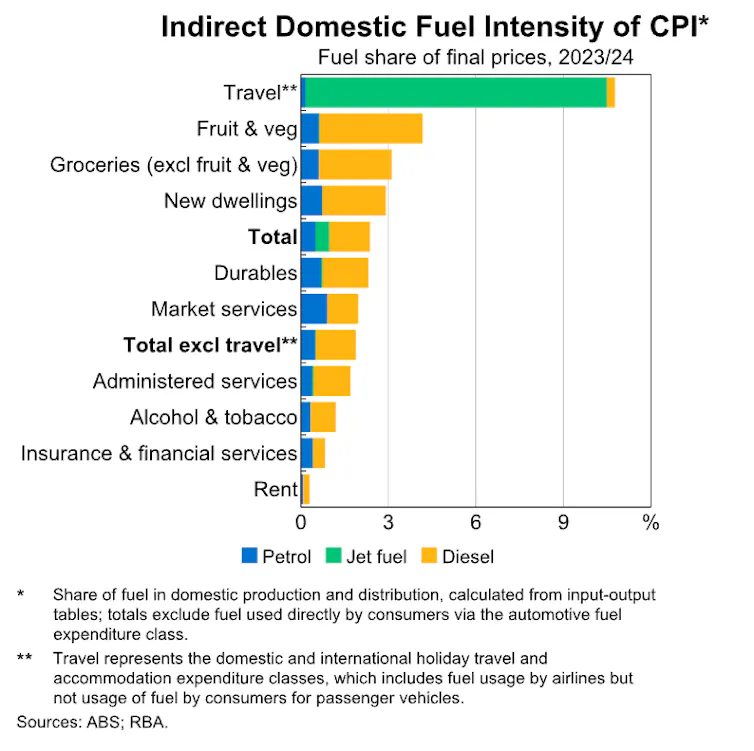
Hunter noted fuel accounts for around 2–2.5% of the cost of producing and distributing other goods and services in the CPI basket. Travel, transport and postal services, grocery items (particularly fruit and vegetables) and new home construction are all especially exposed, as Hunter highlighted with this chart.

The parts of Australia's economy most exposed to oil prices, led by travel, grocery items like fruit and vegetuables and new home construction.
The parts of Australia’s economy most exposed to oil prices, according to the Reserve Bank. RBA, May 2026

Oil also affects inflation indirectly through global supply chains of fertilisers, plastics and other industrial inputs. So higher oil prices can eventually feed into the prices of imported goods that are not obviously energy-related.

A likely interest rate hold – for now

Last month, Reserve Bank of Australia (RBA) Governor Michele Bullock warned more interest rate hikes may be on the way to fight inflation and get it back to the bank’s target of between 2–3%.

April’s softer-than-expected headline inflation number of 4.2% will reduce the case for another immediate rate rise at the bank’s June 15-16 meeting.

However, the rise in underlying inflation to 3.4% means Bullock is unlikely to sound relaxed after that meeting. Its concerns about “second-round effects” from higher oil prices have not gone away.

The Reserve Bank now faces a difficult balancing act. Higher oil prices reduce household purchasing power and slow growth. But if businesses pass rising costs through more broadly, inflation may stay above its 2–3% target for longer. That is the classic “stagflation” dilemma central banks fear.

In its May statement on monetary policy, the Reserve Bank revised up its inflation forecasts, saying it expected headline inflation to peak at 4.8%, while underlying inflation is projected to reach 3.8%. That suggests policymakers expect the oil shock to have a more persistent effect over coming quarters.

The Reserve Bank has already increased rates three times this year, lifting the cash rate from 3.6% to 4.35%.


There are now signs the economy is softening, giving the bank’s board more reason for pause.

The latest labour force data showed the unemployment rate rose to 4.5% in April, its highest level since December 2021. This is happening as households are under pressure from high interest rates, weak real income growth and elevated living costs.

Together, these figures strengthen the case for the Reserve Bank to keep rates on hold in June. But the rise in trimmed mean inflation means the Bank is still likely to emphasise caution, rather than signal Australia’s inflation problem has passed.

Looking ahead

The next few months will be critical. If global energy markets stabilise and supply disruptions ease, some inflation pressure could fade relatively quickly. That would give the Reserve Bank more confidence that inflation is moving back towards 2–3%.

But if oil prices remain elevated, or if businesses keep passing higher transport, freight and import costs through to consumers, the inflation problem could become more persistent.

The Reserve Bank is particularly alert to the possibility that repeated global inflation shocks – first the COVID pandemic, then supply chain disruptions, and now oil prices – may gradually change how businesses and households think about inflation itself.

That is why the Reserve Bank’s focus is shifting from the direct impact of higher petrol prices to the broader behavioural response across the economy.

Today’s data was therefore reassuring, but only up to a point. The headline number was better than expected. The underlying number was not.

That’s why the Reserve Bank will be cautious about declaring victory too early.

The Conversation

Stella Huangfu does not work for, consult, own shares in or receive funding from any company or organisation that would benefit from this article, and has disclosed no relevant affiliations beyond their academic appointment.

Finland is Europe’s most digitalised country – but older people are still left behind

MAYA Lab/Shutterstock

Around the world, countries are moving towards a more digital way of life. Governments have promoted digitalisation of public services to improve efficiency, cut costs and meet modern demands for speedy responses. Yet this push for the digital has caught some people by surprise. Many older adults now feel they face another hurdle in living an independent life.

Across Europe, digitalisation of services is rapidly changing older people’s lives. The post-pandemic movement of booking appointments, vaccines and basic services online accelerated things. Banks and insurance companies now operate mainly online, with in-person options getting rarer by the day in many countries.

Our recent study focuses on Finland, the most digitalised country in Europe. Finland’s first national strategy report on digitalisation was back in 1995. This laid the groundwork for online public services, well before initial steps in the UK and other countries, and when using email was not even an everyday experience.

Finland’s ombudsman for older people estimated recently that the country has between 500,000 and 600,000 residents over the age of 65 who lack digital skills, or don’t have enough skills for independent digital tasks, even if they would otherwise be able to cope independently in their day-to-day lives. This is about 40%-45% out of a total population of about 1.3 million in that age group. However, across political divisions, digitalisation continues to be seen as a self-evident good.

Our study involved talking with over 40 older people in Finland, and analysing over 40 policy documents as part of a larger European study.

Many of our research participants in their late 60s, 70s and 80s had a hard time keeping up with technological and software development. With the erosion of person-to-person contact, daily situations involving medical or financial issues meant dealing with chatbots or, after a long wait, with people who could not answer their questions. As one of our participants put it:

It is very difficult to get hold of someone at a bank, for example. Even if I just want to ask something, I have to hold indefinitely, and if I then get hold of a person in the end, they do not know. On the phone, they always say, that the answer for this or that is available digitally. But then they cannot answer questions I want an answer to.

Many of our participants were concerned about how digitalisation of services has proceeded at such a fast pace. In-person visits to banks and health centres can become very limited, even impossible. Older people are worried about not being able to talk directly with a doctor or nurse in person, or being denied contact with a human when dealing with financial matters. Information about essential health and social welfare is sometimes only available online.

Doctor typing on tablet with a Finnish flag background
Older adults have been particularly concerned about the digitalisation of medical appointments. lunopark/Shutterstock

Finland ranks highest in Europe on the EU’s Digital Economy and Society Index, which measures states’ levels of digital infrastructure and skills. Yet according to the Finnish Digital Skill Report 2023, only half of 65- to 74-year-olds have basic digital skills. Of 75- to 89-year-olds, as few as 22% have such skills, and one-third do not use internet at all.

The report also reveals that 89% of Finns help their family members in digital matters. When skills or technology are not up to date, many older people rely on someone else to access vital information or manage their finances. But not everyone has family or trusted neighbours who can help out.

Meanwhile, online fraud has taken new, more sophisticated forms, causing people to lose both assets and dignity – this is of special concern for older people. Such fears create uncertainty, and, for some, isolation. About 20% of Finnish 65-74 year-olds and about 30% of those 75 and over feel quite or very unsafe in their daily activities in the digital environment .

Debating digitalisation

Some may argue that, as some services have been digitalised from the 1990s, how long can people continue to claim they are being digitally excluded, rather than simply choosing not to use technology?

But this view ignores how digital exclusion works. Isolation, ill-health, disabilities, uneven skills, changing software constantly updating and access to devices are all part of older people’s challenges. Learning new IT skills at work is a totally different matter to coping when old, alone or without support.

There is a clear mismatch here between government policy on digitalisation of services, and the reality of people’s lives. The government does not provide digital support for older people. Many non-governmental organisations, as well as some of the larger cities such as Helsinki, do provide some digital assistance and basic training, but the national pattern is patchy at best.

The needs of older Finnish people have not been considered enough in the government’s efforts to digitise services, nor have there been sufficient impact assessments in planning and carrying out reforms. People with lower income or fewer resources, less or no digital access, fewer digital skills, fewer opportunities to learn or less support have experienced severe consequences. People with no online presence struggle to manage their day-to-day lives and may miss out socially.

Our research participants themselves suggested various possible solutions or improvements that would help them, such as maintaining continuous access to face-to-face, offline services and making digital support free and accessible.

These issues are not unique to Finland. But if even people in Europe’s most digitalised country are struggling, it’s likely to be even more acute for older adults in other countries in the coming years. As one of our participants said: “There are so many that do not really manage.” They need to be supported if we are to bring society fully into the digital age.

The Conversation

Jeff Hearn receives funding from The Research Council of Finland and JPI MYBL . He is affiliated with the British Sociological Association, and the International Sociological Association.

Charlotta Niemistö receives funding from The Research Council of Finland and JPI MYBL. She is affiliated with Åbo Akademi University.

Hanna Sjögren receives funding from The Research Council of Finland and JPI MYBL. She is affiliated with the University of Helsinki.

Australia’s economy slows as households tighten their belts, while AI investment surges

Australia’s economy grew by 0.3% in the first three months of 2026, slowing from 0.9% growth at the end of 2025, according to the latest Australian Bureau of Statistics figures.

Over the year to March, gross domestic product (GDP) rose 2.5%. But GDP per person – our total GDP, divided by our population – actually fell 0.1% in the quarter. This shows Australians were not necessarily feeling better off, despite the economy still growing overall.

The weaker-than-expected growth result is likely to reinforce the likelihood of the Reserve Bank leaving interest rates unchanged at its June meeting, after lifting rates in February, March and and May.

While inflation remains a concern, today’s figures suggest those rate rises were already beginning to weigh on household spending and economic activity.

Higher fuel prices took a toll

The Middle East war, which began on February 28, had a clear effect on Australia’s economy through higher fuel and fertiliser prices.

The Australian Bureau of Statistics (ABS) noted automotive fuel prices rose sharply towards the end of the March quarter. The federal government’s fuel discounts only started on April 1.

Households responded by spending more on essentials and cutting back elsewhere. Discretionary spending was very weak, suggesting many consumers were becoming more cautious.

Spending on electricity, gas and other fuels also rose sharply after energy rebates ended, while spending on operating vehicles increased amid concerns about petrol and diesel supplies.

Which parts of the economy grew?

The strongest part of the economy was investment.

Private investment rose strongly, led by a large jump in machinery and equipment investment. The ABS said this reflected increased business investment in data centres in New South Wales and Victoria.

That investment boom highlights one important theme: businesses are continuing to invest heavily in digital infrastructure and artificial intelligence, despite a challenging economic environment.

The GDP figures suggest Australia’s economy is becoming increasingly split in two. Sectors linked to data centres, engineering services, IT consulting and construction are expanding rapidly, while many consumer-facing industries remain under pressure.

Household consumption also grew – but the increase was concentrated in essentials, rather than discretionary spending. That is not a sign of strong consumer confidence. It suggests households were spending more because some necessary items became more expensive, or they may have been worried about supply chain shortages.


Read more: How reducing ‘just in case’ purchases can help avoid empty shelves and fuel bowsers


Which parts of the economy shrank?

Net trade was the main drag on growth.

Exports fell while imports rose. The fall in exports was driven by coal and iron ore, with bad weather disrupting port operations. Imports rose partly because of record imports of automatic data processing equipment, linked to data centre investment.

Government spending also fell, partly because energy bill relief ended. Mining saw the largest industry decline, with coal production hit by Cyclone Koji.

Consumer-facing services were weak. Retail trade, accommodation and food services, and arts and recreation all reflected subdued discretionary spending.

Watching for a per person recession

The key question is whether this is just a temporary slowdown, or the start of a more worrying loss of momentum.

The economy is still growing, but GDP per person has fallen. This happens when a country’s population is growing faster than its economy. And that matters because GDP per person is a better guide to living standards than headline GDP.

Households are also saving less, which suggests many are absorbing higher costs by dipping into their savings.

If GDP per person falls again in the June quarter, Australia would enter a per capita recession. That would not mean the whole economy is in recession, but it would mean the average Australian is going backwards.

The June quarter will therefore be important to watch. It will show more clearly how households are responding to higher fuel prices, higher interest rates and weaker confidence.

What does it mean for interest rates?

The Reserve Bank board meets on June 15–16.

Growth has slowed, GDP per person has fallen, and discretionary spending is weak. These are all signs that higher interest rates are already weighing on households and the broader economy.

At the same time, the Reserve Bank cannot ignore inflation risks. Fuel prices rose sharply late in the quarter, construction prices are still rising, and the end of energy rebates has lifted household out-of-pocket costs.

The Reserve Bank’s own forecasts suggest headline inflation is likely to peak in the June quarter.

Just after the Reserve Bank published those forecasts, Treasury released its own as part of the May federal budget. Treasury expected inflation to peak at around 5%. If the Middle East conflict ends soon, it expects inflation to fall back within the Reserve Bank’s 2–3% target band by this time next year. But if the war goes on longer, it could climb much higher.

This week’s wage rise for low-paid workers, as well as the latest inflation data and unemployment figures, will all be part of the board’s discussion.

That is why each interest rate decision is so difficult. As Reserve Bank board member Ian Harper acknowledged this week, it’s always harder to sleep the night before the board makes a rate decision:

Maybe not a sleepless night […but] you have to make a decision which, as you well know, affects every single person in this economy. And that bears on you in the middle of the night, usually about 2.30 in my case.

On balance, this GDP data strengthens the case for the Reserve Bank to hold rates in June and wait for more evidence, before deciding whether another increase is needed in August.

The Reserve Bank’s challenge is now even harder: bringing inflation back under control, without pushing an already slowing economy into a deeper downturn.


Read more: Interest rates look set to hold, after inflation and fuel costs fell in April. But it’s unlikely to last


The Conversation

Stella Huangfu does not work for, consult, own shares in or receive funding from any company or organisation that would benefit from this article, and has disclosed no relevant affiliations beyond their academic appointment.

❌
Subscriptions