
Normal view

From cloning romance authors to YouTube piracy, AI is transforming audiobooks

Miguelangel Perez/Unsplash

News on AI and audiobooks is coming thick and fast. Australia-based audiobook producer Bolinda recently announced it will create a “bespoke” AI clone of romance bestseller Barbara Cartland’s voice, in partnership with her estate. (She died in 2000.)

Two days later, Spotify announced a tool (created by synthetic voice company ElevenLabs) that will allow self-published authors to create audiobooks voiced by AI on its platform, and publish them anywhere.

Meanwhile, a recent New York Times exposé revealed AI-enabled audiobook piracy on a massive scale on YouTube, with versions appearing of everything from literary fiction to Harry Potter, business bestsellers to John Grisham. A pirated version of his latest legal thriller, The Widow, accompanied by an “AI slop” video, has over 80,000 views. Listeners called the voice “boring” and “awful”.

“If you look up any best seller, you find a free audiobook on YouTube,” said the chief executive of the United States Authors Guild. A 2025 survey found that 35% of audiobook consumers had listened to a YouTube audiobook – and that AI-narrated audiobooks now account for 23% of new releases.

Around 17% of Australian audiobook listeners have (knowingly) listened to an AI audiobook, according to my own recent survey of over 500 Australian audiobook listeners. This rate is higher among listeners with vision impairments and other disabilities, who have long used AI for accessibility reasons – and should be centred in these discussions.

How have AI voices in audiobook listening evolved? And where is it heading?

The evolution of AI voices

The large language models behind ChatGPT and Claude map the relationship between words across billions of pieces of text. Similar models map sound patterns across recorded speech to produce contemporary “AI voices”.

AI voices were originally used for accessibility. The first automated text-to-speech system was created in 1968 by a Japanese research laboratory. The first screen reader technology was developed by IBM in the early 1980s. In 1986, it introduced its first screen reader for general use on personal computers.

This text-to-speech technology was originally for vision-impaired readers, who were the first to embrace it.

But as AI voices became more convincing, concern about their impact on human-narrated audiobooks grew. In 2009, the US Authors Guild blocked implementation of the Kindle 2’s text-to-speech function, claiming it infringed their audiobook rights.

Many high profile authors argued against the decision and its impact on accessibility. “The day that artificial intelligence gives us perfect Kindle readings, we’ll have bigger fish to fry than audiobook rights,” science fiction and tech author Cory Doctorow wrote in the Guardian. He called the idea that computer narration might ever seriously rival human narration “nonsensical”.

Voice clones and pirates

Swedish Storytel, the largest streaming platform in Nordic markets, reported in 2024 that nine out of ten listeners “could not tell which narration was human” when it tested the AI-generated voices in its Voice Switcher program.

Like Spotify, Storytel uses ElevenLabs AI technology. With Voice Switcher, listeners can choose between the original human narrator, three different AI-generated voices, or an AI version of popular Swedish actor and narrator Stefan Sauk, who has licensed his voice to Storytel.

Only a handful of Barbara Cartland’s 723 novels were available as audiobooks before her estate signed an exclusive agreement with Bolinda, the leading producer of Australian audiobooks. Bolinda started by distributing accessibility materials, such as large print and talking books, in 1986, and moved to audiobooks in 1995.

Cartland’s voice clone will be used to frame the beginning and end of her audiobooks, while human narrators will continue to narrate the books themselves. Even for this limited use, Cartland fans have described the announcement as “creepy”, “haunting”, “gross” and “disappointing” on social media.

Voice clones are being put to worrying uses. Along with other “deepfakes”, this led to the UN publishing a “wake-up call” to organised fraud in March. Audiobook publishing is not immune to these deepfakes, or artificially generated imitations of real people.

Recordings of Stephen Fry reading the Harry Potter series were used to generate an illegal clone of his voice in 2023. And this year, author Shaun Rein discovered deepfakes of himself on YouTube, reading chapters of his book. “The voice clone was probably created from the author’s publicly available interviews,” wrote publishing commentator Jane Friedman.

Piracy is a problem for digital content in general – including audiobooks. YouTube addresses piracy by automatically scanning uploads to see if they match with material in their massive database of copyright content. Pirates alter or add bracketing material to try to circumvent it. Publishers told the New York Times that the program, built for music, is “less effective” with audiobooks, where “even slight changes – like shifts in speed, pitch or voice, or added background noise or music – can prevent a match”.

Audible, Spotify and Project Gutenberg

Audible, owned by Amazon, began implementing AI-voiced audiobooks in late 2023. A year later, it added a service that lets select narrators create and monetise replicas of their own voices.

The other major global player in audiobooks, Spotify, first offered AI-narrated audiobooks in 2023, the year it launched its audiobook business.

Last year, it began accepting audiobooks narrated using ElevenLabs’ AI voice technology, which lets self-publishers create an audiobook with a voice from a catalogue, or create their own voice clone. The catalogue includes trademarked clones of actors like Michael Caine. And now, self-publishers can create AI-voiced audiobooks on Spotify itself.

Commercial and pirate audiobooks sit alongside projects like public domain repository Project Gutenberg’s free catalogue of 5,000 AI-narrated audiobooks of out-of-copyright books, created by Microsoft and MIT. It was named one of the best inventions of 2023 by TIME magazine.

The future of audiobooks

Voice actors are concerned about the erosion of skilled jobs and the use of cloning technologies to infringe on their vocal rights. Unions and advocacy groups are actively campaigning for tighter regulatory controls. And authors and publishers want action on YouTube piracy.

These issues are intensified by the important ethical and environmental questions raised by AI use. Legislators, technology companies and major commercial players have a responsibility to ensure AI narration technologies are made and used transparently and ethically.

But there is no one way to read a book. Only a fraction of books published will ever be available as human-narrated audiobooks, due to the significant time and expense of making them. And for many readers – those with vision impairments or some forms of neurodivergence, for instance – audiobooks are an essential resource.

Human performance offers a gold standard listening experience: expressive, immersive and authentic. But AI narration has a growing role in the audiobook’s future.

The Conversation

Millicent Weber received funding for this research from Australian Research Council Discovery Early Career Research Award DE240100466, 'Audiobooks and Digital Book Culture'.
Amanda Lohrey’s UFO novel captures the uncertainties of reason, doubt and belief

Danie Franco/Unsplash

Amanda Lohrey’s Capture plays out as a sequence of conversations in strange rooms.

The centre of the novel is the consulting room of psychiatrist James Mather, lately stripped of all its therapeutic paintings and suggestive curios to a state of clinical blankness. There is also the apartment where the psychiatrist and his former lover regard each other from “two enormous couches in the centre of the room”. And there are the rooms of a shiatsu sensei, cavernous and empty, except for a “big glass aquarium of shimmering fish”.

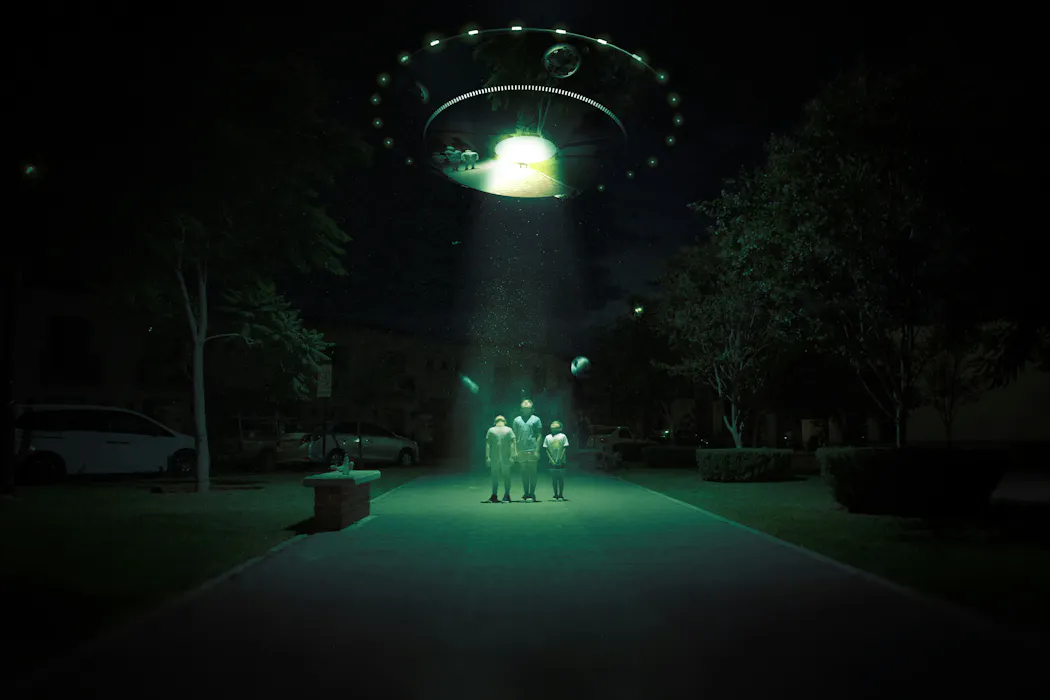
Shadowing all these rooms, in this novel of the ordinary and the divine, are the dream-interiors of UFOs. James is studying people who claim to have been abducted by aliens, and Capture is partly composed of his interviews with them. “I wake up in this weird room, this weird shiny room,” says Mary, a beautician.

But it feels like every room in Lohrey’s novel is a weird shiny room, where humans are studied with curiosity and partial incomprehension.


Review: Capture – Amanda Lohrey (Text Publishing)


Lohrey was raised as a Catholic in postwar working-class Hobart. Though she fled the faith as a teenager, her fiction has always been concerned with the personal and political dimensions of belief.

Her later career works – including the multi-award-winning The Labyrinth (2021) and The Conversion (2023) – all focus on myth, dreams and the limits of rationality. In these novels, a lonely and adrift protagonist takes on a quixotic project in the hope of giving their life a meaning and a shape.

In Capture, Lohrey sketches James as a quietly self-doubting rationalist. Though he deals in symbols and narratives, he puts himself in the science camp. He does not read fiction because it “mostly lacks substance”. He keeps himself free from the “weeds of superstition”.

His assistant, Lucy Cheng, is one of “you people in the humanities”: a historian with a doctorate on 19th-century medicine, who has a “healthy scepticism of the DSM” and an awareness of psychology’s history of oppression. “What, at any given moment,” Lucy asks, “is credible science?”

To his colleagues, James is a man “radiating complacency”, yet his glassy demeanour is already faintly rippled with uncertainty. “We make it up as we go along,” he replies to Lucy’s question. “Unless we are adhering to a rigidly prescribed set of doctrines, how else could it be?”

James wields his doubt as a professional virtue, but it also affects him in a more gnawingly existential way. After a long career, he is approaching retirement with a sense of incompleteness. Having broken his back coming off a motorbike in his twenties, the arthritic pain in his spine keeps returning him to a body he would prefer to transcend.

So he takes up the alien capture research on a whim, as a last hurrah and a grand distraction. “By immersing myself in another reality I might disengage my mind from its prison of flesh and bone,” he thinks, “for in my worst moments, pain threatened to unhinge my sense of self.”

What he expects is an enjoyably diverting cavalcade of Roswell truthers and hillbillies: “in my preparatory reading,” he says, “I have gained the impression that captives belonged to a lower socio-economic category, the kind of people prone to paranoid fears, and dreams so vivid they cannot be distinguished from reality.”


Read more: Intellectual fearlessness, politics and the spiritual impulse: the remarkable career of Amanda Lohrey


Everyday epiphanies

There is something here of the liberal political imagination in the age of Trump, which too readily blames the rise of a post-truth world on poor people who are easily tricked.

At first, the psychiatrist seems confident in his ability to explain away the experiences of his subjects. He concludes that his first case, Anthony, may be suffering “unconscious grief at the prospect of having no heirs,” which has “induced a psychotic episode”.

James’s favoured technique is to get patients talking on their pet topic, watching how they light up and how they construct their narratives. He encourages the beautician Mary to detail the art of eyelash extensions, while he savours “the accuracy, indeed a kind of eloquence, with which she describes her technique.”

He does the same to everyone. He encourages his assistant Lucy’s young son to monologue about Transformers, and his grown-up son to rhapsodise about bread baking. “I am content to listen as he describes his art,” he says.

This is how the psychiatrist understands other humans, but these are also moments when he finds humans to be at their most obsessive, arcane and alien. Rituals and icons – the “everyday epiphany” of a fresh loaf of bread, or the plastic gods of a small child – belong to a realm of shamanic experience James cannot fully comprehend. “My psyche is stripped bare of consoling ritual,” he says, “and what remains is the pain in my spine.”

Amanda Lohrey. Text Publishing

The emotional core of the novel is a scene in which James contemplates the evening rituals and icons of his wife. He recalls “watching Deborah prepare for bed, an unvarying ritual of small observances, never rushed”. In her absence, her presence is felt as a “constellation of intimate traces”.

On the bureau opposite the bed, Deborah keeps a framed photograph from 1870 that she discovered during her archival research. It shows a bargemaster’s wife and baby aboard a canal boat. The boat’s confined living space is decorated like a shrine.

Every night before turning out her lamp my wife glances at this icon. On many nights it’s the last thing she sees. Why? It is so unlike Deborah to romanticise the past. My instinct tells me that these late-night glances are a rite of mourning, but for what? Could it be that some infant, some lost or unborn child, lives aboard the boat of my wife’s dreams?

James considers showing the photograph to his assistant Lucy, to see what another woman might make of it, but he thinks better of it: “It is not, after all, my shrine.”

Alien otherness

His wife and her household gods are a dark canal James cannot fathom. So he is unsettled when he interviews Bernard, a draughtsman with the city planning authority, who claims to have experienced a religious awakening in his close encounter with a UFO, and who mourns every day for his absent alien gods.

In a pair of wonderfully freewheeling scenes, James takes his incomprehension to a folklorist and to a theologian. The latter suggests that this is “just one of the many symptoms of the god-shaped hole in our culture […] We’ve been deprived of metaphysical hope so we take it where we can find it.”

The confidence James took into the project is already evaporating. His subjects are sober and middle class; their stories, though extraordinary, are “linear, consistent and rational”. Every one of his theories seems inadequate.

This leaves him to contemplate the ultimate horror: that these experiences cannot be adequately captured by the language of psychiatry as delusions or symptoms, projections or wish fulfilments. What if these things actually happened? What if the gods are real?

“I have arrived in a cul-de-sac of unknowing,” he says. “I no longer believe that I can account for and interpret the reality of others.”

When Flick, the folklorist and James’s ex-lover, tries to talk him out of his newfound doubts about doubt, the psychiatrist resorts to the language used by alien abductees themselves. Only those who witnessed the interviews in his consulting room, he says, can really understand:

Her logic is impeccable but rankles with me. You were not in the room, I want to say. You were not in the room. In the room there’s an electricity, a vibration; it’s a different order of experience. Outside the room, it’s all words. And after all her theories are applied, in my mind there remains a surplus of meaning.

And so it comes back to a conversation in a room: to the psychiatrist’s art, which is also the novelist’s art, of reading the vibrations: probing, diagnosing and interpreting the alien otherness of human consciousness. What if, Lohrey asks, the textures of everyday life – with all of its attachments and private obsessions – are too much for the psychiatrist or the novelist to capture?

The Conversation

Robbie Moore does not work for, consult, own shares in or receive funding from any company or organisation that would benefit from this article, and has disclosed no relevant affiliations beyond their academic appointment.

❌
Subscriptions