Concrete is everywhere, and that’s a problem. Manufacturing the essential material accounts for around eight percent of annual global carbon dioxide emissions, making it one of the single biggest contributors to the climate crisis. Researchers are investigating all types of creative solutions to the issue, often by replacing ingredients with more eco-friendly alternatives.
Recent propositions include adding coffee grounds, bacteria, and even recycled diapers into the mix.But engineers at Purd
Concrete is everywhere, and that’s a problem. Manufacturing the essential material accounts for around eight percent of annual global carbon dioxide emissions, making it one of the single biggest contributors to the climate crisis. Researchers are investigating all types of creative solutions to the issue, often by replacing ingredients with more eco-friendly alternatives.
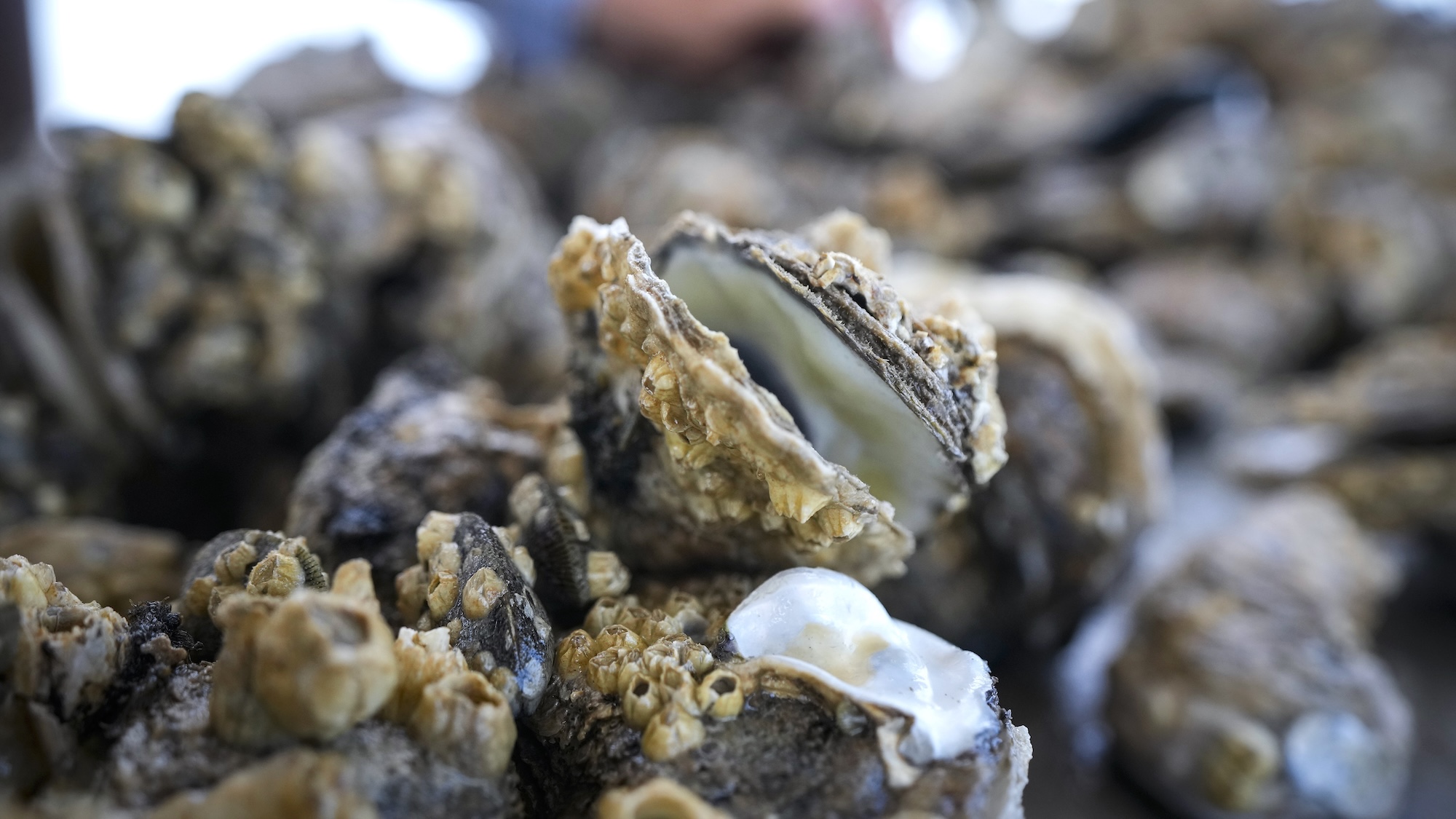
Recent propositions include adding coffee grounds, bacteria, and even recycled diapers into the mix.But engineers at Purdue University in Indiana think the answer can already be found in the natural world. According to a study recently published in the journal Chemistry of Materials, one solution may be swapping out the cement for shellfish.
“Oysters generate a natural cement. They use this material for attaching to each other when building reef structures,” chemist and study co-author Jonathan Wilker explained in a recent university profile.
Wilker has spent years examining the biological properties of oyster cement in hopes of recreating the sturdy adhesive for other applications. They have since learned that the bivalves bind together by producing the inorganic compound calcium carbonate—basically chalk. While calcium carbonate isn’t usually adhesive by itself, oysters also produce a small amount of stickier organic materials like phosphorylated proteins. This allows the shellfish to fuse together, even when saturated in water.
After breaking down the chemical composition of oyster cement, Wilker’s team recreated it in a laboratory. They then collected a bunch of limestone bathroom tiles, since their calcium carbonate is virtually identical to oyster shells. From there, they glued stacks of tiles together using their artificial, biomimetic cement. In nearly every stress test, the tiles broke before the bond itself.
Confident in their faux-oyster cement’s abilities, Wilker and colleagues finally tried combining a polymer from their creation into commercially available concrete mix. In lab tests, their oyster-inspired concrete was 10 times stronger while doubling its compressive strength. On top of all that, it also took less time to cure.
Wilker’s team plans to continue testing their patent-pending recipe. He notes that it’s not simply stronger. It’s even more eco-friendly when compared to most adhesives on the market.
“Most of the adhesives that you see at the hardware store are made of organic compounds, derived from petroleum,” he said. “There is so much more that we can learn from nature.
A senior surveyor at a government inspection unit has admitted alerting the renovation consultant ahead of site checks at Wang Fuk Court before the estate went up in flames, a public inquiry has heard.
Andy Ku (centre), a senior maintenance surveyor at the Independent Checking Unit (ICU), leaves the Wang Fuk Court independent committee hearing on May 6, 2026. Photo: James Lee/HKFP.
Victor Dawes, lead counsel to the independent committee investigating the fatal fire, questioned Andy Ku, a
A senior surveyor at a government inspection unit has admitted alerting the renovation consultant ahead of site checks at Wang Fuk Court before the estate went up in flames, a public inquiry has heard.
Andy Ku (centre), a senior maintenance surveyor at the Independent Checking Unit (ICU), leaves the Wang Fuk Court independent committee hearing on May 6, 2026. Photo: James Lee/HKFP.
Victor Dawes, lead counsel to the independent committee investigating the fatal fire, questioned Andy Ku, a senior maintenance surveyor at the Housing Bureau’s Independent Checking Unit (ICU), on Wednesday.
Dawes presented to the committee Ku’s written witness statement, in which the senior surveyor said that the ICU had “no particular role in reviewing or confirming the quality, reliability, and integrity of consultants.”
The committee earlier heard in March that one of the directors of Will Power Architects, the consultancy firm overseeing the large-scale maintenance work at the Tai Po housing estate, had not carried out his duties as a “registered inspector” (RI).
“The RI’s work, in effect, is to act as a regulator. If it’s not up to you to keep them in check, who else would it be?” Dawes asked Ku.
Ku replied that the oversight system is essentially “self-regulating” and that the ICU does not have a formal auditing system.
The committee also heard on Wednesday that for most of its inspections, the ICU had notified a Will Power employee, who was also a representative for the RI. The inspector himself was not there for most of the ICU checks.
Dawes remarked that the ICU’s inspection practice deviated from the norm with other government departments, such as the Labour Department and Buildings Department.
The lead counsel also told the hearing that the ICU had conducted a total of 10 inspections at Wang Fuk Court, of which only two were held without advance notice. One of those two inspections was an impromptu check, which Ku conducted himself after a medical appointment in the same district.
“If you didn’t have a medical appointment in Tai Po that day, there wouldn’t have been an inspection?” Dawes asked. Ku agreed.
Wang Fuk Court buildings on December 29, 2025, one month after the deadly fire. Photo: Kyle Lam/HKFP.
Dawes then showed the committee screenshots of ICU maintenance surveyor Amanda Lau’s text conversations scheduling an inspection with the RI representative, who then alerted the contractor, Prestige Construction & Engineering. Ku confirmed that Lau acted on his orders.
After the fire, the ICU began conducting inspections without advance notice, Ku said.
Dawes asked if the new arrangements meant that the ICU realised there were issues with its old system. Ku replied: “There was room for improvement.”
Scaffolding nets, foam boards
Ku was also grilled on his unit’s oversight of scaffolding nets and foam boards, which a preliminary investigation has blamed for contributing to the spread of the blaze.
The lead counsel brought up the ICU’s checks on the fire retardancy of scaffolding nets used at Wang Fuk Court.
He asked Ku why he told the Buildings Department the nets were up to standard, despite the ICU’s own test showing the nets continued to burn for more than 10 seconds before the flame was extinguished.
Ku said that upon two retrials of the same piece of netting, the net did not catch fire.
Dawes showed a fire retardancy certificate to the committee and asked Ku whether the ICU could verify the legitimacy of the certificate and whether it really corresponded to the same lot of scaffold nets.
Ku said the unit could not verify, as it relied on the contractor’s word.
Despite residents’ complaints, the senior surveyor told the hearing that he did not notice the estate’s windows were covered with foam boards during an ICU inspection in September because scaffolding nets were in the way.
The blackened exterior of an apartment block in Wang Fuk Court, Tai Po, on November 27, 2025, with what appears to be styrofoam boards attached to the windows. Photo: Kyle Lam/HKFP.
A month later, the contractor and the inspector told Ku that only three floors would have windows covered with foam boards whenever spalling works were carried out.
Ku said he did not ask to see a fire retardancy certificate for the foam boards as he believed the phased arrangement would mitigate fire risks. “There was no basis to ask for a certificate,” he said.
Dawes scrolled through about a dozen photos from the site, most of which showed windows covered with foam boards in clear view. The photos were part of a slideshow report that Ku had previously seen.
Dawes questioned how Ku could have been unaware of the foam boards, to which the government surveyor said he was “focused on the concrete works.”
Ku added that in retrospect, he “had been lied to” and that he did not follow up on the matter because there were no further complaints from residents.
Leftover Altoid tins are staple components in all types of handy, DIY projects. Once you eat the mints, the aluminum containers routinely house basic first aid kits, miniature speakers, sewing accessories, and even watercolor paints. But for the YouTuber Exercising Ingenuity, one specific use came to mind.
“Have you ever looked at a tin of Altoids and thought, ‘That looks like a tiny computer?’” he asked in a video on May 9.
Of course, whether or not you imagined the same endeavor is besid
Leftover Altoid tins are staple components in all types of handy, DIY projects. Once you eat the mints, the aluminum containers routinely house basic first aid kits, miniature speakers, sewing accessories, and even watercolor paints. But for the YouTuber Exercising Ingenuity, one specific use came to mind.
“Have you ever looked at a tin of Altoids and thought, ‘That looks like a tiny computer?’” he asked in a video on May 9.
Of course, whether or not you imagined the same endeavor is beside the point—because the creator went ahead and did it. The final result may not be the most versatile pocket computer ever designed, but it definitely is one of the most portable.
Exercising Ingenuity was particularly inspired by cyberdecks, which first rose to prominence among hackers during the 1980s. The term originated in William Gibson’s landmark 1984 science fiction novel Neuromancer, and basically boils down to a rugged standalone laptop (with a little bit of punk flare thrown in for good measure). Most actual cyberdeck projects are built with an emphasis on utility and resilience, but Exercising Ingenuity’s chief goal was to make his variant as small as possible.
The problem wasn’t finding an appropriately tiny CPU and LCD screen—a Raspberry Pi Zero and an old, two-inch display both did the trick. Instead, the more difficult challenge was cramming a mechanical keyboard into the pocket-sized tin. That required learning how to construct a diode matrix configuration typing input, then individually assembling and soldering each key on his keyboard. Although the time-lapse video makes the job look incredibly frustrating and hard on the fingers, the YouTuber swears it was a “really enjoyable part of the project.” To each their own.
Typing will remain a challenge unless you have very small fingers. Credit: YouTube
From there, it was a matter of designing a flexible 3D-printed interior frame and cramming everything into the tin. This was easier said than done, and required the hobbyist to trim down as much wiring as possible while also soldering parts like the UPS board and LCD display directly onto the Raspberry Pi. Despite literally and figuratively cutting every possible corner to make room for all of the components, the final result still required swapping out the tin’s hinges with slightly larger replacements to ensure the case could close shut.
With every hurdle cleared, it was simply a matter of booting up the contraption to give it a test run. Exercising Ingenuity says the final product worked flawlessly, and he was even able to program a small motor to run using his Altoid cyberdeck. Actually typing on the keyboard still looks like a labor of love, but the overall result remains very cool. Its inventor even made all of the designs available online for free, in case any aspiring cyberpunks are looking to recycle an old mint tin.
In The Workshop, Popular Science highlights the ingenious, delightful, and often surprising projects people build in their spare time. If you or someone you know is working on a hobbyist project that fits the bill, we’d love to hear about it—fill out this form to tell us more.
Summer is quickly approaching, which means more time for summer fun like checking out amusement parks. Millions of people go to amusement parks for the thrill of riding a favorite classic ride or a new roller coaster. And this summer, dozens of new coasters are debuting, such as Falcon’s Flight, the world’s tallest and fastest roller coaster located in Six Flags Qiddiya City in Saudi Arabia.
While roller coasters and amusement rides are generally very safe—the International Association of Am
Summer is quickly approaching, which means more time for summer fun like checking out amusement parks. Millions of people go to amusement parks for the thrill of riding a favorite classic ride or a new roller coaster. And this summer, dozens of new coasters are debuting, such as Falcon’s Flight, the world’s tallest and fastest roller coaster located in Six Flags Qiddiya City in Saudi Arabia.
While roller coasters and amusement rides are generally very safe—the International Association of Amusement Parks and Attractions (IAAPA) says that the chance of being seriously injured on a fixed-site ride in the U.S. is about 1 in 15.5 million rides taken—the risk isn’t zero. And when deadly or disabling cases make the headlines, it raises legitimate questions about how to stay safe and have fun.
“People are injured or killed on amusement rides and devices. That is a harsh reality, especially in the name of fun,” says Brian Avery, a senior lecturer and roller coaster safety expert at the University of Florida. “But generally speaking, your risk or exposure to that is low.”
Here’s what you need to know about roller coasters and amusement rides, how they are assessed for safety, and how to prepare for any trips you plan to take this summer.
Falcon’s Flight is the world’s tallest and fastest roller coaster located in Six Flags Qiddiya City in Saudi Arabia. The coaster reaches speeds of 150 mph in under five seconds. Video: That SOUND?! Falcon’s Flight Cliff Drop Testing at Six Flags Qiddiya World’s Tallest Coaster, @CoasterRaccoon
How do roller coasters work?
The first thing to know about rides and coasters is that not all rides are the same.
“Roller coasters are amusement rides, but all amusement rides are not roller coasters,” says Kathryn Woodcock, a professor of occupational and public health who studies amusement ride safety at Toronto Metropolitan University.
Roller coasters are defined as a ride with an elevated railway with sharp curves and steep inclines, but even roller coasters have tons of different subtypes based on what the tracks and support structures are made of (namely wooden or steel), how the riders are positioned, and the ride’s speed.
Beyond coasters, there’s other rides, such as: drop towers, ferris wheels, bumper cars, water rides, and more, all with their own considerations for fun and safety.
But the gist is, according to amusement park ride manufacturer Sunhong, that rides use controlled inputs like motors, hydraulics, pneumatics, or gravity to shape the acceleration, centripetal force, and changes in G-force that makes rides exciting.
Just existing on the Earth, we experience a G-force of about one G, jumping and landing is about two to four G, and the most intense rides out there, according to Sunhong, hit about six G for a moment.
“It’s pushing the envelope or it gives the illusion of [riders] being in danger while they’re experiencing an amusement ride device, but in a controlled manner,” adds Avery.
How safe are roller coasters and rides, really?
The first roller coasters were invented in the late 1800s, says theme park and roller coaster historian Richard Munch. At that time, the only safety in place was a fixed metal bar and a “do not stand up” sign, he adds. “If you followed those words, you would normally return unhurt and many times happy to ride again,” he says.
This photograph of the “Loop the Loop” roller coaster was taken at Coney Island, New York, in 1903.Image: Contributor / Getty Images / Photo 12
Roller coasters and amusement rides have changed a lot since those days—including in the 1990s when Avery says there was a “roller coaster arms race” to get faster, taller, and more attractive rides out there for thrill-seeking visitors. But safety comes at every level of a ride, from engineering and manufacturing, to installing and regulating, and of course operating.
“They’re looking at everything from the track, how the footers are sunk into the ground, the forces being exerted, the station being built, the trains that will be on it, the containment system that’s going to be used, the types of harnesses, secondary restraints,” he says. “All those are factored into their design considerations.”
Once a coaster is designed, it’s tested and inspected for months and operational guidelines, policies, and training are developed by the engineers or manufacturer.
Next comes state inspections, or at least in some states that heavily regulate amusement rides. There isn’t federal government oversight of rides, except in the case of traveling carnival rides, says Amanda Demanda, an injury lawyer based in Florida.
Regulations vary greatly. Some states, like Alabama, Mississippi, Montana, Nevada, Wyoming, and Utah, don’t have state oversight at all, so take a look at the regulations in the state that you’re visiting before heading out.
Finally, it comes down to the operators and attendants. “Attendants are the first line of defense,” says Avery. “They’re going to be the ones that are adequately trained or should be. They’re enforcing the rules. They’re going through the checkpoints.”
While some rides have computer systems that can help alert attendants to potential problems, attendants are in charge of checking restraints, conducting daily maintenance and operation inspections, and dispatch rides.
They also assess riders to make sure they are an appropriate size and weight for a ride, and if a rider has a disability, ensuring that they can maintain enough postural control to stay safe for the duration of the ride, he says.
While the news stories about amusement park incidents demonstrate the worst case scenarios, most of the injuries that occur on rides are soft tissue injuries: sprains, strains, and cuts, according to one 2013 study that looked at pediatric amusement ride-related injuries between 1990 and 2010. The study demonstrated that 70 percent of the incidents occurred in the summer months with more than 20 injuries a day between May and September.
But these injuries don’t necessarily just happen because the ride itself is unsafe—operation, rider health, and rider behavior all play a factor.
“The largest theme parks in the world have 20 million visitors per year, each of whom generally experiences multiple rides during their visit,” says Woodock. “The number of serious injuries associated with ride failure is very, very low proportionate to that.”
Serious injuries, even in people who are unsuited to the ride or acting inadvisably, are still very low, she adds.
Staying safe at the amusement park is relatively straightforward: Follow the guidelines when it comes to size and health, listen carefully to loading and safety instructions, and trust your gut. In the unlikely case that something does go wrong and you do get hurt, report it to the park and seek medical care.
If you’re one of the millions of visitors heading to an amusement park this summer, just be attentive, stay hydrated, and, of course, have fun.
In Ask Us Anything, Popular Science answers your most outlandish, mind-burning questions, from the everyday things you’ve always wondered to the bizarre things you never thought to ask. Have something you’ve always wanted to know? Ask us.
Greeshma Gadikota and her team explore how materials that might otherwise be landfilled can be transformed into products needed for solar energy and other critical technologies.
Greeshma Gadikota and her team explore how materials that might otherwise be landfilled can be transformed into products needed for solar energy and other critical technologies.
Everything is bigger in Texas, and that includes its controlled detonations. Texas A&M University recently revealed what they say is the world’s largest controlled explosion lab, where researchers can fill a nearly 500-foot metal tube with gas and ignite it in the name of science. They are calling it The Detonation Research Test Facility (DRTF). By precisely measuring what it takes to turn a simple flame into a massive, deadly detonation, researchers hope to make discoveries that could bette
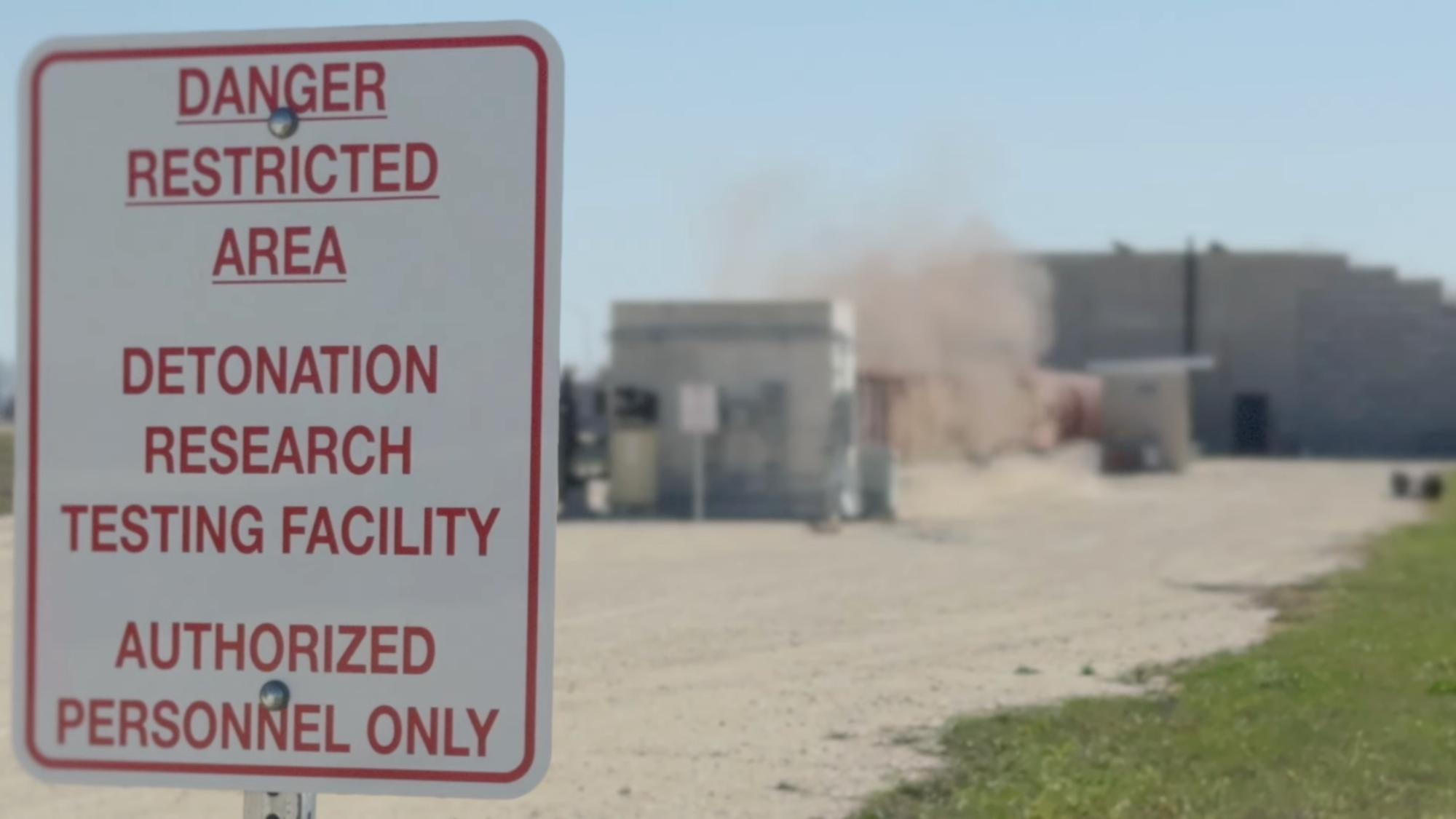
Everything is bigger in Texas, and that includes its controlled detonations. Texas A&M University recently revealed what they say is the world’s largest controlled explosion lab, where researchers can fill a nearly 500-foot metal tube with gas and ignite it in the name of science. They are calling it The Detonation Research Test Facility (DRTF). By precisely measuring what it takes to turn a simple flame into a massive, deadly detonation, researchers hope to make discoveries that could better prepare engineers to prevent gas leaks, and potentially inform ways to build explosion-resistant infrastructure. And all of that will require lots and lots of yeehaw inducing bangs.
Located in Southeast Central Texas, the detonation tunnel is about six feet in diameter and stretches nearly the length of two football fields. Its metal exterior consists of three-quarter-inch steel walls and is covered in earth to muffle the sound—or try to, at least. Inside, the tube holds various sensors that can measure the explosion as it intensifies. By containing all the power within the facility, researchers can study explosions strong enough to level entire buildings. The shockwaves that form in the tunnel can apparently reach speeds of Mach 5—or roughly 3,800 miles per hour.
“The facility enables us to observe, measure and understand one of nature’s most extreme forces in ways that haven’t been scaled before, or even been possible until now,” Texas A&M Engineering professor Dr. Elaine Oran said in a statement.
Measuring a detonation, from flame to boom
The idea for the massive detonation tunnel began as an inquiry from the coal mining industry. Industry leaders sought to scientifically determine whether natural gas trapped in a coal mine could explode and detonate. The short answer is yes. It quickly became clear, however, that a facility capable of measuring that would prove useful for a number of other explosion-related questions as well.
To measure an explosion, researchers start by sending an electrical current through a long wire leading into the chamber. Eventually, the current leads to a spark, which creates a flame, not unlike a gunslinger in a Western striking a match and watching a flame trickle its way to a stick of dynamite.
Texas A&M University’s Detonation Research Test Facility is a nearly 500-foot detonation tube more than 6 feet in diameter, built with three-quarter-inch-thick steel walls and paired with a 90-meter earth-covered muffler. Image: Texas A&M University College of Engineering.
When the flame enters the chamber, it begins a violent journey. The chamber is lined with what researchers refer to as an “obstacle course” of metal beams that generate turbulence. As the flame travels, more surface area is created, which in turn causes it to burn faster and stronger.
Eventually, all of that power creates a shockwave in front of the flame. Once the shockwave is strong enough, it pushes forward and creates a second, much larger explosion. That second, earth-shaking boom is the detonation.
Video footage of the process occurring in real time is dramatic, to say the least. Everything is quiet except for a voice in the control room counting down three, two, one. That’s followed by what sounds like a muffled gunshot as the flame enters the tube’s first segment. Visually, the tunnel’s thick metal exterior quivers and soil shakes off it as each succeeding segment ignites. That all leads up to the detonation, which is a significantly larger boom that shakes the entire facility and sends earth soaring into the air. Seconds later, amid smoky air, the soil can be heard raining back down, like an artillery scene from a war film.
And even though the facility is designed to withstand massive explosion level forces safety, it still leads some to check their heart rates.
“There’s a lot of nervousness, [and] jitters,” Texas A&M Aerospace engineering student Zachary Wideman said in a video. “Because something on this scale with this type of energy, you can’t help but be nervous.”
Though the facility’s controlled explosions will likely prove most useful for industrial safety initially, engineers involved believe its scientific findings could have broader appeal. The shockwaves it creates could prove important for future testing of hypersonic plane and space shuttle propulsion. On the more conceptual side, scientists interested in the history of the cosmos could use the tube’s controlled explosions to help build models of supernovas, which undergo a similar physical process, albeit on a much, much larger scale.
Bioluminescence is everywhere in nature, but it puts on its biggest light shows underwater. In the deepest regions of the oceans, as much as 90 percent of all living creatures may possess at least some ability to shimmer thanks to cellular chemical reactions. However, the ethereal displays aren’t limited to these deep, dark waters. The cold blue glow from bioluminescent algae like Pyrocystis lunula is occasionally visible atop waves for other organisms to see.
Still, spotting these glimmers i
Bioluminescence is everywhere in nature, but it puts on its biggest light shows underwater. In the deepest regions of the oceans, as much as 90 percent of all living creatures may possess at least some ability to shimmer thanks to cellular chemical reactions. However, the ethereal displays aren’t limited to these deep, dark waters. The cold blue glow from bioluminescent algae like Pyrocystis lunula is occasionally visible atop waves for other organisms to see.
Still, spotting these glimmers is difficult for the naked eye. P. lunula only shines for a few milliseconds at a time when agitated. However, those lights could hypothetically remain illuminated for much longer if certain chemical switches are flipped on in the algae. The possibilities would be vast—suddenly, harmless organisms could replace environmentally toxic chemicals used to produce artificial glows, and even cut back on electricity usage for lights.
“This project was a moonshot idea,” University of Colorado Boulder civil engineer Wil Srubar said in a recent profile. “I was curious if we could create a world in which we don’t use electricity but rather use biology to produce light.”
Drawing on previous research, Srubar and his colleagues assessed P. lunula’s bioluminescent response to basic and acidic compounds. They tested one acidic compound with a pH of 4 (similar to tomato juice) and a more basic compound with a pH of 10 (similar to hand soap).
Their results, published in the journal Science Advances, suggest algae could be part of a brighter, more sustainable future. In both cases, P. lunula began to shine. Acidic exposure made the algae glow brightly for up to 25 minutes, while the basic compound produced a shorter, more diffused light.
“It was a very exciting moment when we found the right chemical stimulant that allowed the light to stay on for a long time,” said engineer and study co-author Giulia Brachi. “This is the first time we have figured out how to sustain luminescence.”
The team took things even further from there. The engineers embedded the algae into various shaped objects made with naturally sourced, 3D-printed hydrogel. Because the acid and base solutions aren’t lethal to P. lunula, the organisms survived for weeks while constantly glowing. After four weeks, the acid-treated examples still retained 75 percent of their brightness.
According to the team, there are a range of uses for P. lunula. Autonomous robots and even space exploration equipment could produce battery-free light illuminated by the algae. If the algae responds to other chemicals, then it may show promise as a tool to test water quality or toxicity. What’s more, the photosynthetic algae doesn’t produce any carbon—it devours it.
“We’re storing carbon while we’re producing light, whereas conventionally, we emit carbon to light up spaces,” said Srubar. “This discovery really paves the way for engineering other living light materials and devices.”
Wind turbines are a net positive for a sustainable society, but that doesn’t mean they don’t have an environmental impact. Apart from their material requirements, those giant, spinning blades can be lethal to unsuspecting winged animals like birds and bats. Although some reports dramatically overplay wind farms’ danger to flying species, there is no denying they can unintentionally kill anywhere from two-to-six birds and four-to-seven bats per megawatt every year. That may not seem like many fat
Wind turbines are a net positive for a sustainable society, but that doesn’t mean they don’t have an environmental impact. Apart from their material requirements, those giant, spinning blades can be lethal to unsuspecting winged animals like birds and bats. Although some reports dramatically overplay wind farms’ danger to flying species, there is no denying they can unintentionally kill anywhere from two-to-six birds and four-to-seven bats per megawatt every year. That may not seem like many fatalities, but every animal counts for an endangered species.
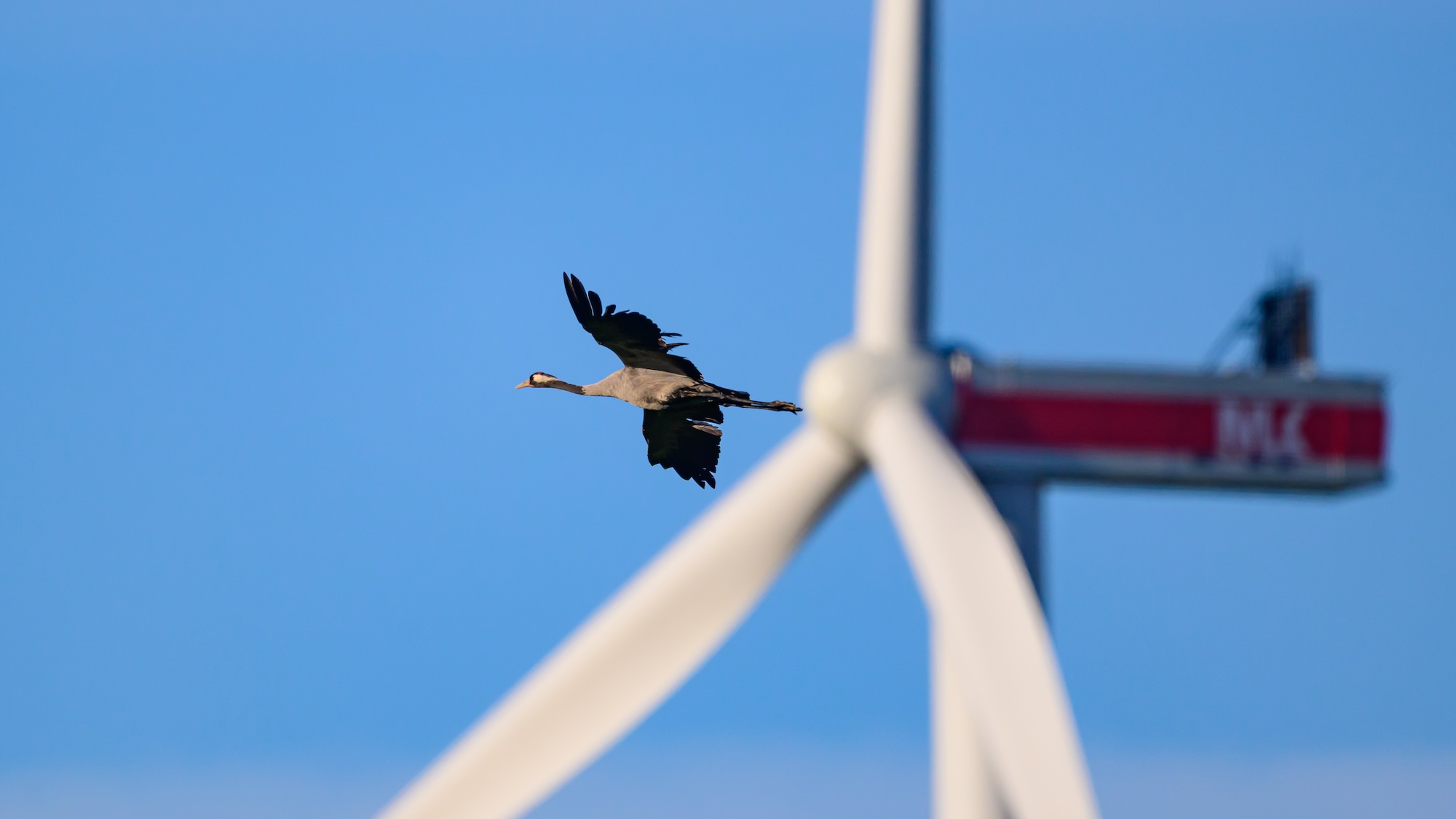
To lower these risks, engineers are devising new ways to make wind turbines more visible and avoidable. One potential solution may involve taking a cue from some of nature’s most dangerous creatures. According to a study published in the journal Behavioral Ecology, more bats and birds will steer clear of wind turbines when their blades are painted with colors similar to animals like venomous coral snakes and poison dart frogs.
A drone photograph of a wind turbine in southern Finland, digitally modified with a biologically inspired warning pattern under natural light conditions. Credit: Eric Lehtonen
“White blades, which are the most frequently used pattern around the world, turned out to be the worst option for birds,” Johanna Mappes, a University of Helsinki environmental scientist and study co-author, said in a statement. “This suggests that a relatively simple visual change could reduce bird mortality in connection with wind power.”
To test how birds respond to various turbine designs, Mappes and her colleagues placed test subjects in front of a video screen in a controlled laboratory environment. They then played clips of wind blades with multiple color palettes spinning at different speeds. These included turbines featuring classic white blades, one blade painted black, blades with red-and-white stripes, or blades with a newly designed, biomimetic red-black-yellow pattern.
“By using a touchscreen especially designed for birds, we can use games to explore their behavior and ecology by simulating real-world scenarios, without putting the birds at risk,” explained University of Exeter ecologist and study co-author George Hancock.
In nearly every trial, the birds were far more likely to approach white blades than any of the colored options. However, the test subjects were the most avoidant of the team’s novel, biomimetic striped blades.
“We’ve known for a long time that birds change how they respond to objects with warning colors, but to see such a large effect was remarkable,” Hancock added.
There is no way to completely prevent wind turbines from ever accidentally harming or killing animals. That said, the study’s authors believe a wider industry adoption of evolutionarily inspired color schemes could be an easy, cheap way to make the technology safer. They also suggest that similar approaches be developed for other human-made avian dangers like power lines and building windows.
“If the results are repeated in practical conditions in different countries and with different bird species, it could be a significant change for the entire wind power industry,” said Mappes.
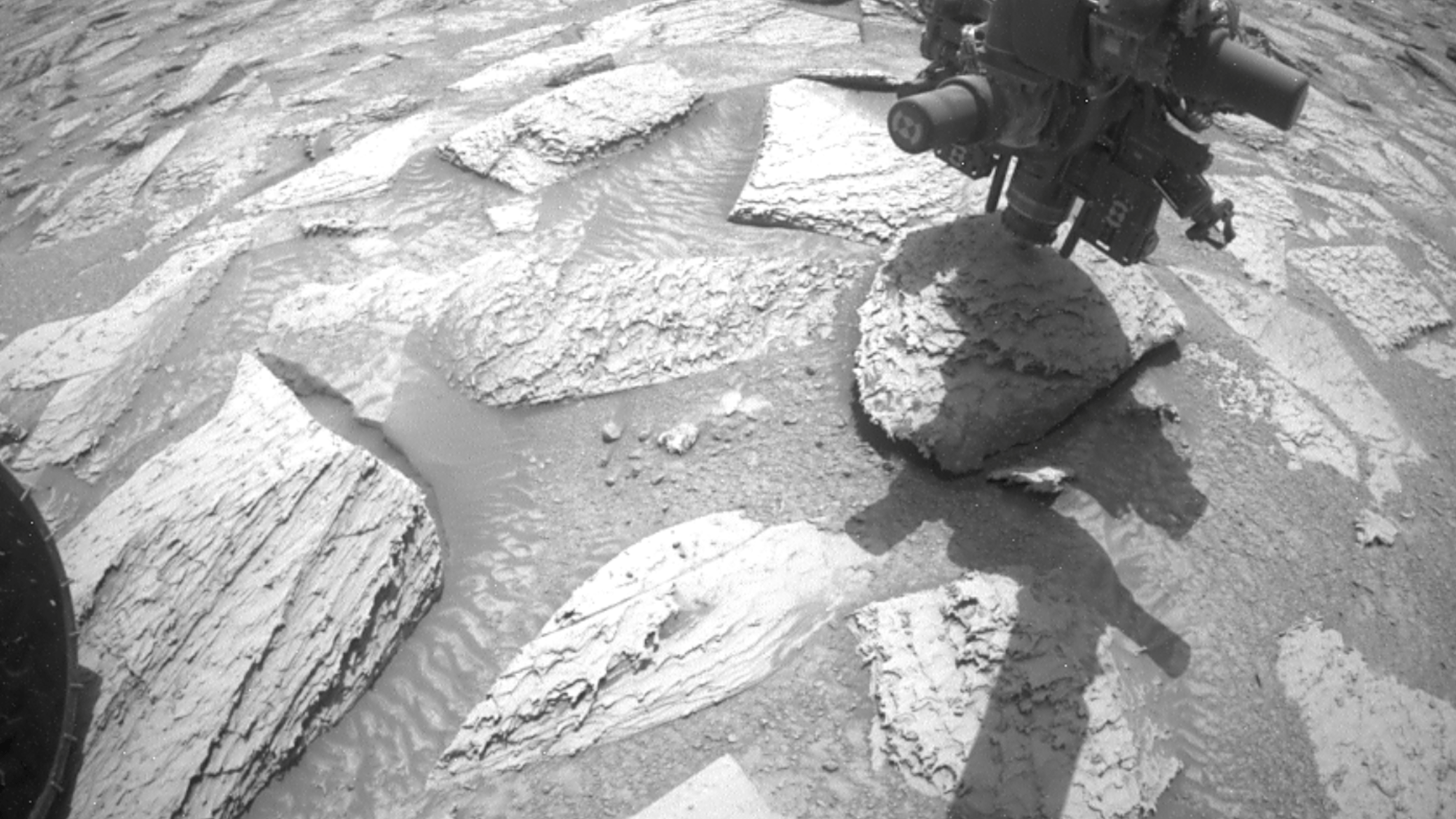
Curiosity got itself stuck between a rock and hard place last month, but NASA says there’s no reason to fret about the intrepid Mars rover. On April 25, mission engineers were remotely piloting its robotic arm’s rotary-percussive drill into a Martian rock nicknamed Atacama. It’s a relatively routine task for Curiosity, which takes the samples and then pulverizes them into a powder for future onboard chemical analysis.
But Atacama is no small stone. The hefty, 1.5-foot-wide geologic formation
Curiosity got itself stuck between a rock and hard place last month, but NASA says there’s no reason to fret about the intrepid Mars rover. On April 25, mission engineers were remotely piloting its robotic arm’s rotary-percussive drill into a Martian rock nicknamed Atacama. It’s a relatively routine task for Curiosity, which takes the samples and then pulverizes them into a powder for future onboard chemical analysis.
But Atacama is no small stone. The hefty, 1.5-foot-wide geologic formation is about six inches thick and weighs about 28.6 pounds. So NASA engineers were understandably a bit worried when Curiosity attempted to retract its arm—and subsequently lifted the entire rock off the ground.
“Drilling has fractured or separated the upper layers of rocks in the past, but a rock has never remained attached to the drill sleeve,” the agency explained in a recent rundown.
While amusing to envision, the situation was no laughing matter for NASA’s engineers. The rover’s drill would be of little more use with a giant rock indefinitely attached to it. But even if controllers could detach Atacama from the rover, the force might damage the tool or the arm itself. Without those capabilities, Curiosity’s ongoing mission would be in serious jeopardy.
Mission specialists first tried the drilling version of “turning it off and on again,” by vibrating the tool. However, Atacama remained stubbornly stuck on Curiosity…for another four days. NASA then tried a new approach by reorienting the robotic arm and instructing the drill to vibrate one more time. Atacama managed to shake off a bit of sand that time, but little else.
Two more stressful days passed before NASA gave it a third try. Engineers tilted the drill slightly further, then rotated and vibrated the tool while also spinning its drill bit. The Curiosity team anticipated it may take multiple attempts to pull off the feat.But in this case, Atacama finally gave way almost immediately. The nearly weeklong ordeal culminated with the giant rock fracturing as it landed on the Martian ground.
So far, NASA hasn’t reported any lingering damage to the vehicle, meaning the rover is likely ready to continue exploring the Red Planet. As for Atacama, it seems the Martian rock learned a valuable lesson: Don’t mess with Curiosity.
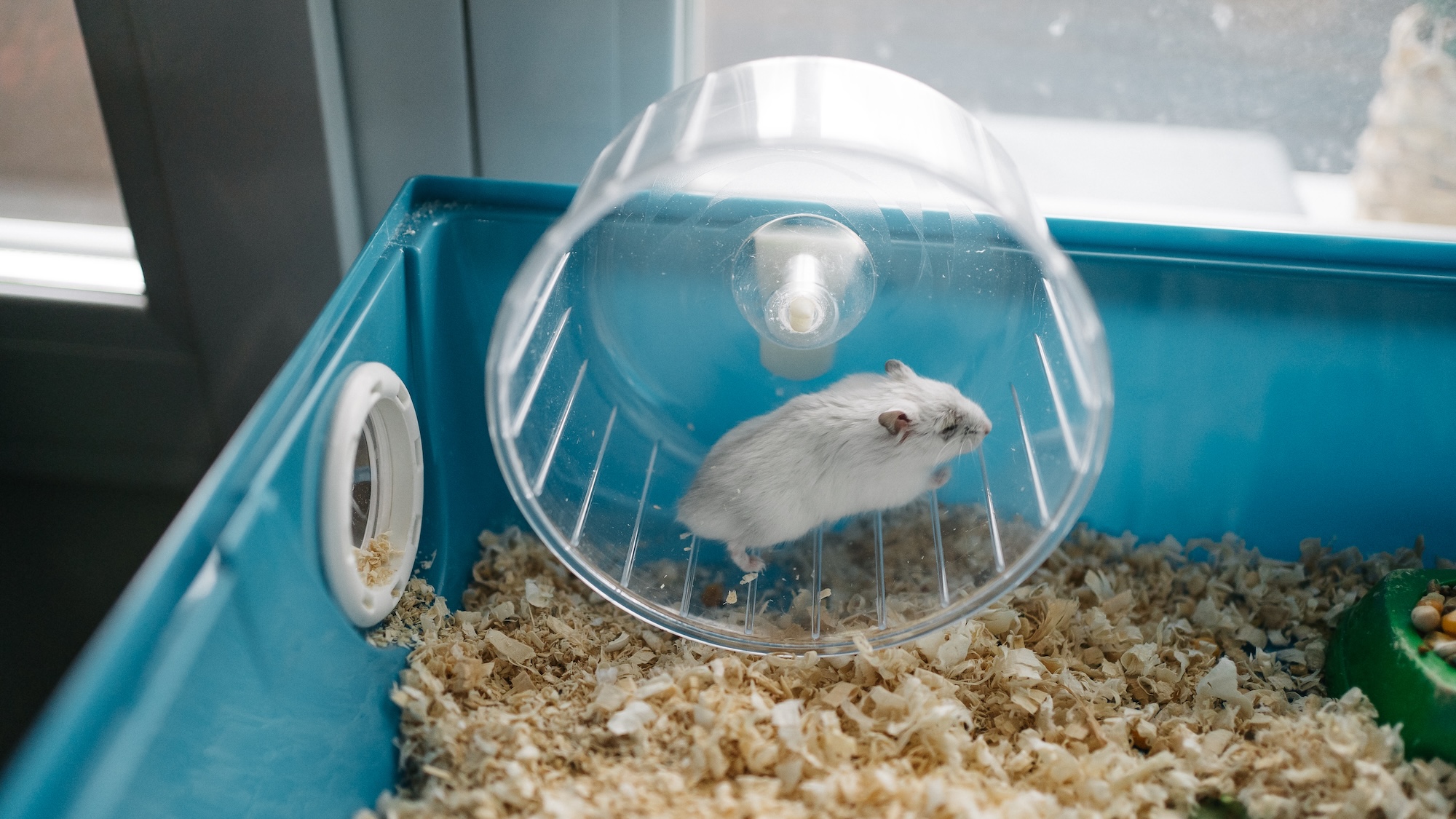
Renewable energy is the cornerstone of any sustainable society, but why limit your options to wind or solar installations? In the United States alone, over one million homes host a tiny, furry alternative power source without even realizing it. As a young YouTuber known as Flamethrower recently demonstrated, it’s time for hamsters to start pulling their weight around the house. Or, at the least, it’s time for them to start turning hamster wheels into miniature, makeshift turbines.
The idea ca
Renewable energy is the cornerstone of any sustainable society, but why limit your options to wind or solar installations? In the United States alone, over one million homes host a tiny, furry alternative power source without even realizing it. As a young YouTuber known as Flamethrower recently demonstrated, it’s time for hamsters to start pulling their weight around the house. Or, at the least, it’s time for them to start turning hamster wheels into miniature, makeshift turbines.
The idea came to Flamethrower after his brother received one of the tiny pets for his birthday. Although adorable, naturally nocturnal hamsters are often up at all hours of the night running on their little exercise accessories. While laying awake to the sound of a spinning, squeaky wheel, the amateur engineer realized how to make the best of an unexpectedly annoying situation.
“So what did I do? Exploit it for energy production, of course!” he declared in his recent video entry.
Turbines help generate most of the world’s energy, and their underlying principles are simple enough. Electricity funneled through wires to a motor will make it spin, but the reverse is also true—spin a motor, and electricity will generate through its terminals into battery storage. The fundamentals are basically the same whether a turbine spins thanks to steam, wind, or nuclear power. Or hamsters.
However, a hamster-powered turbine is not the easiest project to design. As the YouTuber explained, a 5 volt (V) DC motor hypothetically needs to spin at over 10,000 RPM to simply reach a smartphone’s standard 15 watt charging speed. Even if such a superpowered hamster existed, its speed would likely cause the motor to melt before it provided any juice to a battery—and therein lay another issue.
Batteries don’t only store energy—they are designed to provide electricity at a steady current when needed. However, a standard battery also must receive a higher voltage than it stores in order to amass any reserves.
Part of the solution came from a device known as an energy harvester module, which takes small voltages and amplifies them to an acceptable level for a battery. But the problem is that the amount of required voltage increases in direct proportion to the energy that’s being stored, meaning yet another unfeasible hurdle. The hobbyist ultimately relied on a system called maximum power point tracking (MPPT) to calculate the optimal input and output proportions for the energy harvester and a few other components.
All that potential energy is only as good as the battery that stores it, however. For this project, the YouTuber relied on lithium-ion cells salvaged from a broken electric scooter. Flamethrower hooked up his rig to the hamster wheel’s axis, then gave his brother’s pet the night to get its steps in. The next day, he attached his phone via a USB cable charging port to test the whole thing for the first time.
The initial setup worked flawlessly, although it charged at a snail’s pace. Naturally, he booted up his thermal camera nearby (who doesn’t own one?) to investigate any pain points in the system. It turns out the issue did have anything to do with the hamster wheel charger itself, but his outdated USB cable. After swapping that out with a newer replacement, phone charging sped up dramatically.
“And with that, my hamster’s life finally has a purpose,” the inventor declared.
As absurd as it appears, it’s hard to argue with such an ingenious source of free electricity. Hypothetically, the same idea could be adapted to basically anything in a house that spins mechanically, like a stationary bike. Then again, the whole point is to have the hamster do the work, not you. In any case, the YouTuber seems to be on to something here. The way Flamethrower tells it, the rodent may be more reliable than solar or wind energy.
“It’s supposed to be nocturnal but I’m starting to think it never sleeps,” he said.
In The Workshop, Popular Science highlights the ingenious, delightful, and often surprising projects people build in their spare time. If you or someone you know is working on a hobbyist project that fits the bill, we’d love to hear about it—fill out this form to tell us more.
Complex problems require creative solutions, and wildlife veterinarian Nielsen Donato is no stranger to what might seem like out-of-the-box problem solving. Last month, Donato and his team at Vets in Practice in the Philippines fixed temporary wheels onto an Aldabra giant tortoise (Aldabrachelys gigantea) that was struggling to walk.
More recently, they built a contraption to care for a four-year-old African spurred tortoise (Geochelone sulcata) that had been run over by a car not once but t
Complex problems require creative solutions, and wildlife veterinarian Nielsen Donato is no stranger to what might seem like out-of-the-box problem solving. Last month, Donato and his team at Vets in Practice in the Philippines fixed temporary wheels onto an Aldabra giant tortoise (Aldabrachelys gigantea) that was struggling to walk.
More recently, they built a contraption to care for a four-year-old African spurred tortoise (Geochelone sulcata) that had been run over by a car not once but twice. When the unfortunate reptile was first brought to the clinic, Donato—who is the clinic’s chief surgeon and exotic animal medicine specialist—wasn’t there.
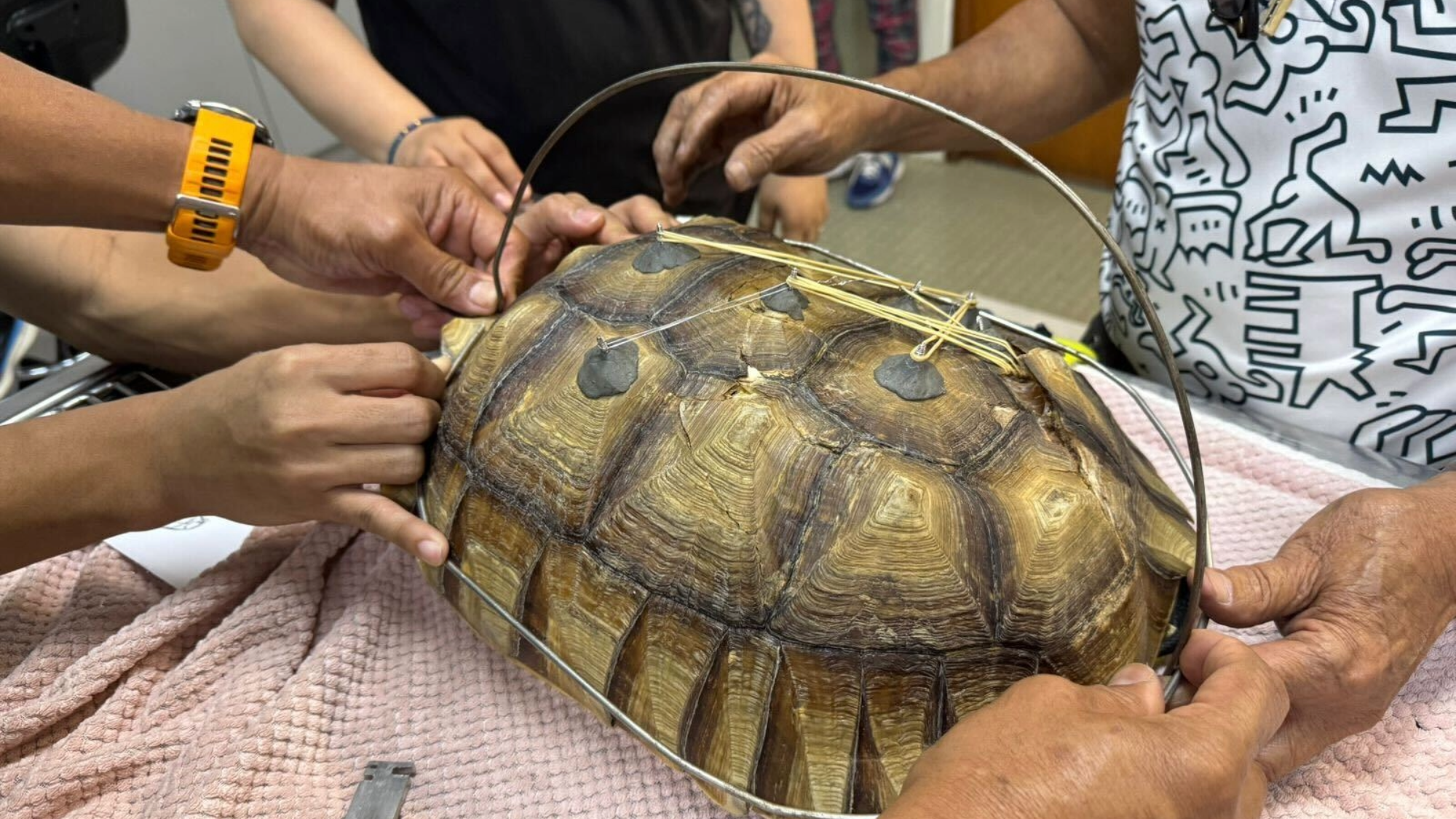
Over the phone, Donato instructed the team to keep the tortoise’s exposed soft tissue damp by rinsing the shell with saline (salt water). They also tried to stabilize the cracks, by fixing inverted screws onto various parts of the shell with epoxy putty, and then tying rubber bands around the screws.
The team sketched out their plan of action to save the tortoise’s shell. Image: Nielsen Donato.
“At this point, our main concern is to stabilize the condition of the turtle from shock, from the injury. So for the first three weeks, we made sure that there were no flies that laid eggs and turned into maggots,” Donato tells Popular Science.
They kept the tortoise hydrated, tube-fed it, kept its wound clean, basked it in the sun, and gave it antibiotics and pain medication.
The wires help keep the shell together. Image: Nielsen Donato.
“And once the tortoise, the sulcata, was more mobile and showing interest in eating on its own, we planned to repair the shell,” he says
According to Donato, the most difficult part for him was lifting the crushed parts of the shell. So he designed a frame for the shell that, with the help of wires, would pull up these shell parts. And the contraption worked.
The tortoise was hit by a car twice, but is on the road to recovery. Image: Nielsen Donato.
“When we were twisting the wire, we noticed that we were starting to align the shell and the cracks were becoming more opposed to each other,” he explains. The team sealed the cracks with dental acrylic and asked the turtle’s owner to bring it back after three weeks. By the time the tortoise was back in their clinic, the shell had become more stable. The team removed the brace, wires, screws, and putty, and sent it back home again before its next appointment.
“When it visited us lately, it started moving around more actively and the owners were not worried about its appetite because it was eating again,” Donato reports.
One thing is for certain—this tortoise went to shell and back again.
The groundbreaking experimental aircraft known as Solar Impulse 2 has met an untimely end. According to a National Transportation Safety Board report, the completely solar-powered plane crashed into the Gulf of Mexico during an autonomous test flight on May 4. While there were no injuries or fatalities, the wreck of the Solar Impulse marks an unfortunate end for one of the most impressive and inspirational planes in aviation history.
Solar Impulse was first conceptualized in 2003 by Bertrand
The groundbreaking experimental aircraft known as Solar Impulse 2 has met an untimely end. According to a National Transportation Safety Board report, the completely solar-powered plane crashed into the Gulf of Mexico during an autonomous test flight on May 4. While there were no injuries or fatalities, the wreck of the Solar Impulse marks an unfortunate end for one of the most impressive and inspirational planes in aviation history.
Solar Impulsewas first conceptualized in 2003 by Bertrand Piccard, the grandson of Swiss deep sea pioneer Auguste Piccard and the son of Jacque Piccard, the first person to reach the Mariana Trench. Piccard never intended the vehicle for commercial use, but instead envisioned it as a way to raise awareness for sustainable energy by building the first solar-powered plane capable of circumnavigating the globe. The first iteration, Solar Impulse 1, completed its inaugural test flight in 2009 followed by multiple additional trips over the next few years.
Construction on Solar Impulse 2 began in 2011. Even with a 232-foot wingspan that made it wider than a Boeing 747, the completely carbon-fiber frame ensured the plane only weighed about 5,100 lbs, making it about as heavy as a standard SUV. The 130-cubic-foot, nonpressurized cockpit included oxygen reserves and additional environmental equipment to enable a pilot to travel long distances at a maximum altitude of 39,000 feet. According to sUAS News, a total of 17,248 photovoltaic solar cells offered a peak power output of 66 kW to four electric motors and four lithium-ion batteries weighing nearly 1,400 lbs. Basic autopilot technology also allowed its sole occupant to sleep in 20 minute intervals.
Solar Impulse 2 made history in 2016 as the first fixed-wing, entirely solar-powered plane to circumnavigate the Earth. The feat was accomplished over the course of 16.5 months, with Piccard alternating piloting duties with Foundation co-founder André Borschberg and making 17 stops along the route. Solar Impulse 2 cruised at a ground speed between 31 and 62 mph, relying on the slower pace during evening portions of the trip.
In 2019, the Solar Impulse Foundation announced the sale of Solar Impulse 2 to Skydweller Aero for an undisclosed sum. The Spanish–American company’s plans were very different from the plane’s initial purpose. Instead of focusing on its solar capabilities, Skydweller hoped to pursue its military-related surveillance potentials, which included “carrying radar, electronic optics, telecommunications devices, telephone listening, and interception systems.”
After supplying numerous modifications, Solar Impulse 2 completed its first autonomous flight in Spain in 2023. The first entirely uncrewed, autonomous flight took place at Stennis International Airport near Bay St. Louis, Mississippi, the following year. At the time, Skydweller also confirmed its larger goal was to develop and supply a fleet of uncrewed, solar-powered planes capable of nonstop flight at latitudes between Miami (26°N) to Rio de Janeiro (23°S). These near-continuous operations would involve military and commercial contracts, allegedly at a much lower cost than current satellite options. The overhauled flagship aircraft reportedly crashed after losing power while flying over the Gulf of Mexico on May 4.
“We learned through social media about the crash of the Skydweller solar drone,” Piccard and Borschberg wrote in a statement provided to Popular Science. “The Solar Impulse team is saddened by the loss of an important technological flagship.”
Skydweller representatives did not respond to Popular Science at the time of writing. According to the Swiss news outlet SWI, part of Solar Impulse Foundation’s original sales contract with Skydweller stipulated the aircraft would eventually return to Switzerland for installation in the Swiss Museum of Transport in Lucerne.
“Very often when we speak of protection of the environment, it’s boring,” Piccard told Popular Science in 2013. “The first airplane [had] the technology of 2007. The second airplane [had] the technology of tomorrow.”

 Login
Login