The provincial government says its complex needs shelter in Saskatoon was designed to provide a medically supervised and secure place where police may bring individuals.
Pope Leo says in Spain that conflicts are pushing world into crisis
Leo, addressing Spanish parliament, urges help for migrants
Pope calls increased European military spending ‘troubling’
Leo urges protection of Catholic seal of confession
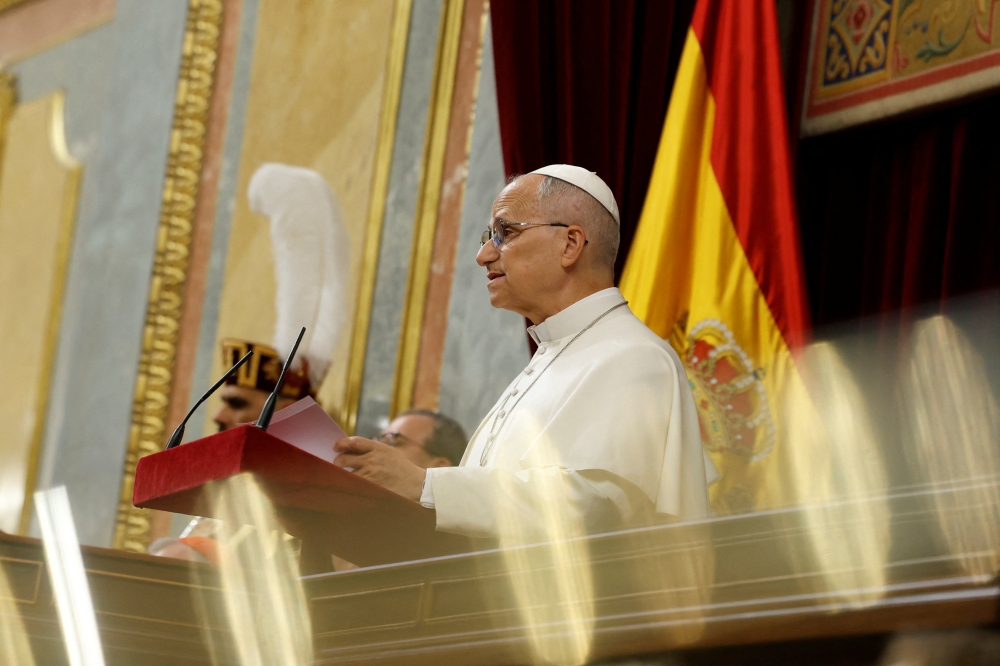
MADRID, June 8 — Pope Leo told Spain’s parliament that escalating conflict, deepening polarisation and widespread disregard for human rights had pushed the world into a profound crisis, in one of his most expansive political addresses yet today. Leo, who has adopted a more forceful tone recently against the direction of global leadership, also firmly repeated his opposition to increased European military spending, urging politicians instead to end the wars ravaging the globe and help migrants. “The world is undergoing a profound spiritual and cultural crisis, which is manifested in multiple forms of violence, polarisation, and mutual distrust,” the pope said in the address, which came hours after Israel and Iran renewed their attacks on one another in the most serious test of a two-month ceasefire.
“Weapons can impose a temporary silence; but they can never build an authentic and lasting peace,” he said.
Leo’s speech, which was delivered in Spanish and was received with a seven-minute standing ovation by lawmakers, was a rare papal address to a national legislature and the first by a pope to Spain’s parliament. It is part of a week-long visit to the country in which the pontiff has met with migrants and the homeless, and called on national leaders to stop dividing their electorates. The pope, whose Spain tour will culminate with the pontiff meeting migrants in the Canary Islands who braved dangerous Atlantic waters to enter Europe, said a lack of help for the world’s migrants was challenging “the ethical foundation of the international order”.
He said countries must look for solutions that go beyond “the mere management of flows” and should address the causes that force people to leave their countries of origin, including war, poverty and climate change.
The pope told parliament that “the moral greatness of a nation is manifested above all in its capacity to accompany, protect, and love those lives that pass through the greatest fragility”.
More than 3,000 people died in 2025 trying to reach the Canary Islands, off the western coast of Africa, often in makeshift dinghies, according to NGO Caminando Fronteras. Prime Minister Pedro Sanchez’s government has opened a mass amnesty programme, allowing an estimated 500,000 immigrants to apply for legal status.
Pope calls European rearmament ‘troubling’
Leo, who issued a fervent manifesto last month urging global governments to slow down the development of AI systems, called on Monday for “rigorous ethical vigilance” over how AI was used in warfare. He said that rising European military spending, which grew last year by the highest amount since the end of the Cold War amid pressure from US President Donald Trump, was “troubling.” Spanish Prime Minister Pedro Sanchez has refused to meet Trump’s demands for Nato member countries to increase defence spending to 5 per cent of GDP, although the expenditure has tripled since he took office in 2018, rising from around €10 billion (RM46.8 billion) to more than €34 billion. The pope last month called European rearmament a betrayal of democracy.
Leo also offered some of his most in-depth remarks yet addressing the balance in the relationship between Church and state. He urged protection of religious freedom, saying that faith “cannot be relegated to silence as though it were irrelevant to public life”.
The pope likewise defended the privacy of the Catholic seal of confession, which obliges a priest not to reveal any information given to him by penitents.
Several countries, including France, have debated whether to compel priests to report sexual abuse disclosed in confessions, following scandals that have shaken the Church internationally.
Protecting the seal, Leo said, preserves “a sacred space of inner freedom, where the believer can open his or her soul before God”. A 2023 report by Spain’s human rights ombudsman estimated hundreds of thousands of victims of clerical abuse there over decades. The Vatican has said the pope would meet with a group of victims during the visit, but has yet to offer further details. The pope did not mention abuse by Catholic clergy in his speech. — Reuters
KUALA LUMPUR, June 10 — In a moment of unexpectedly human vulnerability, a gorilla at a Japanese zoo has gone viral for appearing to suffer an existential crisis following a spat with his mate.
The footage depicts Kiyomasa, a 13-year-old male gorilla, seemingly adrift in a sea of deep contemplation following a disagreement with his mate.
Rather than returning to typical primate antics, Kiyomasa is seen perched in solitude, his posture striking a chord with viewers who described it as a classic "thinking pose", evocative of Michalangelo’s The Thinker.
Kiyomasa is no stranger to the spotlight; he is the son of the world-famous silverback Shabani, whose own imposing presence has made him a celebrity in his own right.
However, while his father is known for power, Kiyomasa has captured the internet's imagination through this rare display of perceived vulnerability and quiet reflection.
Hong Kong sweltered on Friday, with temperatures exceeding 36 degrees Celsius in the northern New Territories by mid-afternoon.
A heatwave in Hong Kong in late May 2026. Photo: Kyle Lam/HKFP.
Acting Assistant Director of the Hong Kong Observatory (HKO) Choy Chun-wing told RTHK on Friday that minimum temperatures remained at, or above, 28 degrees Celsius over the past six days – matching a record seen in mid-May 2021. The longest continuous record could be broken by the weekend.
The HKO has suggested some relief from the weeklong heatwave is in store, with rain predicted for the weekend.
“The anticyclone aloft will weaken tomorrow, while upper-air disturbances will bring showers and thunderstorms to Guangdong. An easterly airstream will affect the coast of Guangdong in the next couple of days. High temperature weather will be alleviated,” the weather service said on Friday.
Temperatures as of 2.45pm on May 29, 2026. Photo: HKO.
But it added that high temperatures may soon return. “With the easterly airstream being replaced by a southerly airstream early next week, the weather over the coastal areas will be very hot again midweek next week.”
At a Thursday press briefing, the Senior Citizen Home Safety Association’s CEO Maura Wong said that it had handled over 7,700 heat-related emergency assistance cases requiring hospitalisation last summer.
“The Association urges the elderly to take precautions against the heat during the height of summer, and carers should also take a more proactive role in looking after the elderly by providing timely care and support,” she said.
A heatwave in Hong Kong in late May 2026. Photo: Kyle Lam/HKFP.
At the same event, the HKO’s Choy warned that sea surface temperatures in the central and eastern equatorial Pacific are predicted to continue rising, with an El Niño event set to develop in the summer and autumn.
Stronger El Niño events often increase the likelihood of abnormally high temperatures across different regions. Choy warned of a high chance that this summer would be among Hong Kong’s 10 hottest on record.
A heatwave in Hong Kong in late May 2026. Photo: Kyle Lam/HKFP.
The Labour Department hoisted the amber Heat Stress at Work Warning on Friday, urging employers to conduct risk assessments for staff who work outdoors or in non-air-conditioned environments.
Employers “should take necessary preventive and control measures, including rescheduling work periods, setting up shading covers, providing ventilation and heat dissipation equipment, and reminding employees to replenish water and rest in a timely manner,” the department said in a press release.
Planet warming
The Intergovernmental Panel on Climate Change has warned that the intensity and frequency of heatwaves have continued to increase since the 1950s due to human-caused climate change. The prevalence of greenhouse gases like carbon dioxide – which trap heat in the atmosphere – raises the planet’s surface temperature, with hotter, longer heatwaves putting lives at risk.
Hong Kong has already warmed by 1.7 degrees Celsius since the Industrial Revolution, research NGO Berkeley Earth says. Heat and humidity may reach lethal levels for protracted periods by the end of the century, according to a 2023 study, making it impossible to stay outdoors in some parts of the world.
BANGKOK: Earlier this week, Thailand’s cabinet approved a 176 billion baht (S$6.89 billion) support package to help households and businesses deal with the rising cost of living amid the current energy crisis.
The conflict in the Middle East, which began on Feb 28 when the United States and Israel started bombing Iran, resulted in the closure of the Strait of Hormuz, an important chokepoint for 20% of the supply of oil and gas across the globe. Since a significant portion of this supply was bound for Asia, countries in the region have suffered disproportionately, with governments scrambling to obtain sufficient supply for domestic use amid higher prices.
Thailand’s support package is called the “Thai Help Thai Plus,” and is meant to help low-income citizens with direct financial support during this “second wave” of the worldwide energy emergency. The programme also includes a “co-payment” subsidy component where the government pays part of people’s daily purchases.
The first was the energy crisis, followed by the “crisis” of higher prices, as Thailand’s inflation rate grew to 2.9% last month, and is believed to may even reach 5%.
The country’s Deputy Prime Minister and Minister of Finance, Ekniti Nitithanprapas, said that the programme is intended to prevent public purchasing power from shrinking.
Registration for the “Thai Help Thai Plus” will be from May 25 to 29 via Krungthai Bank Public Company Limited, through the Paotang digital-wallet app.
More than 43 million people are expected to benefit from the programme. From June to September, 13.2 million holders of state welfare cards will receive 1,000 baht (S$39.20) each month for buying consumer goods in the first part of the programme, said Thailand’s Permanent Secretary for Finance, Lavaron Sangsnit.
For the co-payment portion, the government pays 60% of purchases, and citizens pay the remaining 40%, up to 200 baht (S$7.84) per day, with a monthly cap of 1,000 baht per month through the same four-month period from June to September, as the government endeavours to stimulate consumer spending. /TISG
U.S. President Donald Trump told reporters on Monday that he believes that “Cuba sees the end” and, as such, he will have “the honor of taking Cuba”.
The American leader was likely referring to an “end” of Cuba’s current communist system, which has historically been at odds with the U.S.
“I mean, whether I free it, take it. Think I can do anything I want with it. You want to know the truth”, the president added.
Trump’s comments coincided with a total collapse of the Cuban electrical grid on Monday which left millions without power. The U.S. blockade of foreign oil supplies — which has meant that no oil shipment has reached Cuba in three months — to the island has left Cubans facing chronic electricity shortages and frequent power outages.
The Cuban national energy provider — La Unión Eléctrica de Cuba — posted on X that it had restored power to several “micro systems” in the provinces and that power was gradually being restored municipality by municipality.
Responding to Trump’s predictions of Cuba’s imminent collapse, the Cuban Consul General in Italy José Luis Darias Suarez told Latin America Reports that he was unaware of Trump’s latest comments, but that “in 67 years of revolution, a United States president has never been able to do what [he] wants with Cuba.”
“On the contrary, they have implemented different measures, especially measures of economic pressure, to topple the Cuban Revolution, a revolution that remains in power because of [the] popular support … of the people who stand with the revolution, of which there are indisputably many”.
However, the current economic crisis has contributed to a growth in political opposition to the Cuban government. Protests, once a rarity in Cuba, have gradually increased in intensity and scope.
In the central city of Morón demonstrators even ransacked a local office of the ruling Cuban Communist Party (PCC) in a sign of growing discontent towards the island’s leadership.
Trump’s warnings to Cuba contrast the conciliatory tone struck by Cuban President Miguel Díaz-Canel last Friday, who revealed that the Cuban and American governments were engaged in official negotiations that sought to find “a potential solution to … bilateral differences” between the two traditional adversaries.
However, those negotiations may require Cuba to make comprehensive political changes in exchange for the United States easing its economic sanctions against the island; the New York Times and The Miami Herald report that the U.S. government sees removing Cuban President Miguel Díaz-Canel from power as a key element of any future negotiation.
The New York Times revealed that, if Cuba complied, the U.S. would then likely allow Cubans to choose their next leader, as opposed to having a U.S.-backed figure installed.
However, Trump’s most recent comments imply that a negotiated solution remains anything but guaranteed. The Trump administration’s actions in Venezuela to capture President Nicolás Maduro and their killing of Iranian supreme leader Ayatollah Khamenei serve as a reminder that the U.S. is willing to use force to remove heads of state, such as Miguel Díaz-Canel, that it perceives to be hostile.
Featured Image: Trump with military officers at MacDill Air Force Base in 2017.
Fired 60 Minutes veteran Scott Pelley hasn’t quoted poet John Masefield in any of his scathing statements since embattled CBS News chief Bari Weiss and new newsmagazine EP Nick Bilton canned him for rejecting their regime earlier this week. However, the ex-Evening News anchor sure captured the spirit of the past British Poet Laureate’s famous […]
Hong Kong has issued its first “very hot weather” warning of the year, with the city expected to endure a heatwave through Friday.
The Hong Kong Observatory (HKO) issued the warning at 7.45am on Tuesday, with the mercury expected to reach 35 degrees Celsius.
A man is running in Hong Kong ‘s public space File photo: Kyle Lam/HKFP.
The warning is triggered when the mercury is set to reach, or exceed, 33 degrees Celsius. As of around 1:30pm on Tuesday, Cheung Chau was seeing temperatures of 32.1 degrees Celsius.
The city recorded its hottest day of the year on Monday, as temperatures hit 32 degrees Celsius.
The HKO has alerted the public of the risks of heat stroke and sunburn.
The heatwave is expected to continue through to Friday, as an anticyclone aloft brings very hot weather and low pressure to the coast of Guangdong, according to the HKO.
Highs of 33 degrees Celsius are predicted between Tuesday and Friday, while the lows will range between 27 and 29 degrees.
Hong Kong may see showers during this weekend, as temperatures dip slightly to 26-30 degrees Celsius.
The Intergovernmental Panel on Climate Change has warned that the intensity and frequency of heatwaves have continued to increase since the 1950s due to human-caused climate change. The prevalence of greenhouse gases like carbon dioxide – which trap heat in the atmosphere – raises the planet’s surface temperature, with hotter, longer heatwaves putting lives at risk.
Hong Kong has already warmed by 1.7 degrees Celsius since the Industrial Revolution, research NGO Berkeley Earth says. Heat and humidity may reach lethal levels for protracted periods by the end of the century, according to a 2023 study, making it impossible to stay outdoors in some parts of the world.
In a Tuesday statement, the Centre for Health Protection of the Department of Health reminded members of the public to hydrate regularly, and to avoid strenuous exercise and prolonged activities such as hiking.
It also suggested that outdoor or manual workers should reschedule work to cooler hours as far as possible.
Nevertheless, as of Tuesday lunchtime, the Labour Department had not yet issued a heat stress warning – a three-tier warning system introduced in 2023 to help protect Hong Kong workers from heatstroke.
Outbound travel during long weekend
Hongkongers enjoyed a three-day weekend, with Monday marking Buddha’s Birthday.
People at Shenzhen Bay Port. File photo: GovHK.
According to the Immigration Department, Hong Kong residents made over 615,000 outbound journeys on Saturday, with over 557,000 travellers heading northbound to Shenzhen and other destinations in mainland China.
The figure marks a week-on-week increase of 36.7 per cent.
From Friday to Monday, Hong Kong residents made nearly 1.87 million outbound trips – a rise of 30.8 per cent compared to the same period last week.
Cuba has “absolutely no fuel oil and absolutely no diesel”, according to the country’s Energy Minister, Vicente de la O Levy.
His comments, made to state-run media on Wednesday, underline the severity of Cuba’s energy crisis, which has been intensified by a near-total U.S. blockade on fuel imports since January.
The effects of the fuel shortages were felt immediately, with widespread power outages on Wednesday night sparking protests in Havana. Though the protests soon dissipated, large sections of eastern Cuba remained in darkness on Thursday.
While Cuba has domestic reserves of natural gas and crude oil, it lacks the money to maintain or upgrade its refineries, which are necessary to convert high-viscosity crude oil into fuel oil, essential to electricity generation.
“Cuba is open to anyone that wants to sell us fuel”, Levy implored.
However, Cuba has largely been cut off from international oil imports by the U.S., which threatened to impose tariffs on any country supplying oil to Cuba and severed Venezuelan oil supplies to the Cuban state.
Despite this, Russia sent an oil tanker to help alleviate the crisis in March and China has also helped Cuba mitigate its reliance on imported fuel by helping install solar parks across the island.
Nevertheless, it is unclear if any country would be willing to provide Cuba with enough oil to sustain its national grid indefinitely. There is also no guarantee that the U.S. would allow new foreign oil imports to arrive.
The U.S. is reportedly considering sending the island a humanitarian aid package worth US$100 million to ease the effect of its own oil blockade of the island, with CIA Director John Ratcliffe visiting Havana yesterday to discuss “intelligence cooperation, economic stability, and security issues”.
Ratcliffe is likely the first CIA Director to visit the island since 1953, as the U.S. and Cuba have been staunch geopolitical adversaries since the triumph of the Cuban Revolution in 1959.
Although the two nations are involved in official diplomatic negotiations, tensions between Washington and Havana have been rising dramatically. The North American superpower has repeatedly threatened the Cuban leadership with political regime change and has ratcheted up punitive sanctions against officials and economic entities deemed to be linked to the Cuban regime.
Although the U.S. claims its measures are solely targeted at the Cuban government, the punitive measures have contributed to an economic and humanitarian crisis that is harming many ordinary Cubans, with hospitals, schools and workplaces facing shortened operating hours because of power cuts.
Critics of the Cuban regime, however, argue that the energy shortages and the humanitarian suffering in the Caribbean nation are a result of the political leadership’s authoritarianism, economic mismanagement and corruption.
A new UN study has named Hong Kong’s data centres as some of the most carbon-intensive in the world, blaming the city’s heavy dependence on a fossil-fuel-powered energy grid.
A government data centre in Cheung Sha Wan. Photo: Googlemaps.
The report, titled “Environmental Cost of AI’s Energy Use,” examined the global carbon, land and water impacts of the infrastructure powering AI, saying that by 2030, data centres could consume 945 terawatt-hours.
That is “nearly triple the combined annual electricity use of Pakistan, Bangladesh, and Nigeria, countries collectively home to more than 650 million people,” according to a UN press release.
Lamma power station. File photo: Tom Grundy/HKFP.
“Indonesia, India, and Hong Kong (SAR) are among the most carbon-intensive grids with carbon footprints 62%, 51%, and 43% higher than the global average, respectively. Poland and Mainland China rank lower with carbon intensities at 30% and 21% higher than the global average,” the UN University’s Institute for Water, Environment and Health said in a report on Wednesday.
In comparison, the carbon footprint of electricity in the US, Germany, and Italy is 18 per cent, 24 per cent, and 32 per cent below the global average, respectively.
Energy in Hong Kong is 67 per cent derived from fossil fuels, 32 per cent from nuclear and just 1 per cent from renewables, the report said.
Energy sources for countries and territories across the world. Photo: UN.
There is also a water footprint for cooling heat-intensive data centres, as well as a land footprint. “AI-related water consumption could equal the basic annual domestic needs of 1.3 billion people by the end of the decade, while its land footprint may exceed 14,500 square kilometres – roughly twice the size of the Jakarta metropolitan area,” the UN said.
However, Hong Kong was ranked among the lightest for water and land consumption, mostly because its energy mix does not rely on renewable energy sources, which require large amounts land.
The environmental cost of data centres. Photo: UN.
As a trade and logistics hub, with around 300 internet service providers, Hong Kong remains a prime location for data centres. Its telecommunication networks connect to 12 external submarine optical fibre cable systems, with more under construction, according to the city’s Digital Policy Office.
The government is building a new 110,00 square metre data facility in Sandy Ridge, 90 per cent of which will be dedicated to data centres, according to a government press release in March.
Daily AI use, not training
The UN report said that day-to-day use of AI models accounted for around 80 to 90 per cent of total energy demand, as opposed to just model training. It cited the case of ChatGPT, which was processing around 2.5 billion prompts per day, with image generation requiring a thousand times more energy than a simple text query.
“China’s DeepSeek, launched in January 2025, attracted more than 20 million daily active users within three weeks, and had about 125 million monthly active users by mid-2025,” the report said.
An aerial view of Alibaba’s Zhangbei data centre cluster in Hebei, China. Data sources: Epoch AI; Sentinel-2 false-colour imagery, February 2026. Photo UN.
According to the Digital Policy Office website, “data centre operators are all striving to enhance energy efficiency , so as to reduce their power consumption, their operating expense and also their environmental impacts.”
It cites existing policies by the Electrical and Mechanical Services Department (EMSD), which set rules for ensuring the energy efficiency of buildings and regulate the use of fresh water in cooling towers for air conditioning systems.
The EMSD’s Green Data Centres Practice Guide lays out initiatives for efficient data centre design, procurement, operations and disposal, whilst also promoting the use of assessment tools to measure environmental impacts.
Ottawa faces pressure to explain how recent climate policy rollbacks will affect emissions, as officials say modelling on the impact is still underway.

 Login
Login