A spokesperson for the agency says the passenger 'should not have boarded' the plane bound for Detroit due to U.S. entry restrictions put in place to reduce Ebola risk.
The U.S. government is requiring travelers that have been to African countries where Ebola outbreaks are occurring within the last three weeks to go through enhanced screening at Washington Dulles International Airport (IAD). The State Department issued a travel advisory on Thursday stated that all U.S.-bound American citizens and lawful permanents that have been in...
The World Health Organization’s (WHO) chief on Wednesday shot down Secretary of State Marco Rubio’s comments alleging the agency was a “little late” to identify an Ebola outbreak in the Democratic Republic of Congo. “We don’t replace the countries’ work, we only support them,” WHO chief Tedros Adhanom Ghebreyesus said in Geneva, as reported by...
GENEVA, May 20 — The deadly hantavirus and Ebola outbreaks show that while the response to declared public health crises has improved, awareness of pandemic risks still lags, a leading pandemic expert warned today.
Over six years after the World Health Organisation declared the Covid-19 pandemic, global efforts to revamp public health crisis response have improved the reaction to the hantavirus and Ebola outbreaks, said Helen Clark, a former New Zealand prime minister and the co-chair of the Independent Panel for Pandemic Preparedness and Response.
“The new international health regulations are working,” she told AFP in an interview in Geneva.
As soon as the alert was sounded last Friday over the new Ebola outbreak in the Democratic Republic of Congo, and once the world learned a few weeks ago of the rare hantavirus outbreak on the MV Hondius cruise ship in the Atlantic, “the response has gone quite well”, she said.
“Our issue is now really upstream from that,” she said, insisting that far more work needed to go into identifying risks and how “these outbreaks get away”.
“I think we need a lot more knowledge around risk-informed preparedness,” she said, urging more focus on knowing your risk and “what could crop up”, and “be ready to deal with that”.
“Those basic issues of surveillance, early detection... We’re not there yet.”
Clark said the hantavirus species behind the cruise ship outbreak that triggered a global health scare after three people died was known to be endemic in the area of Argentina where the ship departed from.
“But we’re not clear how much was known about that by ships who depart regularly from there,” she said.
Meanwhile, the outbreak of the Bundibugyo strain of Ebola believed to have killed more than 130 people in a remote province of DRC seems to have spread under the radar for weeks, with tests focused on another strain showing up negative.
“How could this have gone for four to six weeks, ... spreading while not getting the testing results that we needed to show that it was a particular variant?” Clark asked.
She called for thorough investigation of “the chain of events here, and what we can learn from it, and what it says about the capacities we need”.
‘Perfect storm’
Clark highlighted that the Ebola outbreak especially had laid bare the dire impact dramatic global aid cuts had on disease prevention efforts.
“There’s a perfect storm,” she warned, pointing to how countries had been “very suddenly expected to make up a lot of investment in the health system which previously came from donors”.
“With the best will in the world, the poorest and most fragile countries just haven’t got money sitting in the bank to do that, so things will get neglected across a range of areas.”
Clark insisted that “global solidarity remains extremely important”.
“We’re talking global public goods,” she stressed, pointing to a confirmed Ebola case in a US national and how hantavirus had “popped up in places where people (disembarked) from the ship”.
“We’re in this together, and so we have to look to ways of financing preparedness or response which reflect our shared interests.” — AFP
PUTRAJAYA, May 20 — The Health Ministry (MOH) has stepped up preparedness and monitoring measures following the World Health Organisation’s (WHO) declaration of an Ebola outbreak caused by the Bundibugyo virus as a Public Health Emergency of International Concern (PHEIC) on May 17.
The MOH said in a statement today that no Ebola cases have been reported in Malaysia so far, but preparedness measures are being further strengthened, taking into account the risk of imported cases through international travel following outbreaks in the Democratic Republic of Congo and Uganda.
“The MOH is monitoring travellers entering Malaysia from Uganda and the Democratic Republic of Congo, including those transiting through international hubs such as Dubai, Doha and Singapore. There are currently no direct flights from either country to Malaysia,” the statement said.
The ministry said monitoring and screening efforts are being intensified to support public health risk assessments and enable early preventive measures.
According to the statement, eight laboratory-confirmed cases and 246 suspected cases had been reported to the WHO as of May 16, along with 80 suspected deaths in Ituri Province in the Democratic Republic of Congo. In Uganda, two confirmed cases, including one death, were reported in Kampala, involving an individual with a travel history to the Democratic Republic of Congo.
Ebola is a serious infectious disease that can be fatal and is spread through close contact with the blood or body fluids of infected people or animals, with common symptoms including fever, headache, muscle pain, fatigue, vomiting and diarrhoea, and in some cases, bleeding.
To strengthen the country’s preparedness, the MOH said various measures are being implemented, including enhanced surveillance at all international entry points, improved early case detection, and greater readiness of healthcare facilities to isolate and manage suspected cases.
In addition, the ministry said personal protective equipment (PPE) preparedness and training for healthcare workers are being kept at an optimal level, while laboratory diagnostic capacity is being strengthened in collaboration with the Institute for Medical Research and the National Public Health Laboratory.
The Health Ministry (MOH) is also strengthening coordination and global risk monitoring with the WHO, the Malaysian Border Control and Protection Agency, airlines and other relevant agencies.
“Individuals who have travelled to affected countries are advised to seek immediate medical attention if they develop symptoms such as fever, body aches, vomiting or bleeding within 21 days of returning,” the statement said.
The ministry also urged the public to rely only on official information from MOH and WHO, and to avoid sharing unverified information that could cause public concern. — Bernama
GENEVA, May 19 — The World Health Organization chief said Tuesday he was “deeply concerned” by an Ebola outbreak in the Democratic Republic of Congo which has spilt into Uganda, believed to have killed 131 people.
WHO chief Tedros Adhanom Ghebreyesus on Sunday declared the outbreak a public health emergency of international concern (PHEIC) – the second-highest level of alert under international health regulations.
“I did not do this lightly... I’m deeply concerned about the scale and speed of the epidemic,” he told the World Health Assembly in Geneva.
He added that he would convene the agency’s emergency committee later Tuesday “to advise us on temporary recommendations”.
The DRC’s health minister said the suspected toll from the outbreak declared late last week had risen to 131 deaths and 513 cases.
Tedros said that so far, 30 cases had been confirmed to be Ebola in the DRC’s northeastern Ituri province.
“Uganda has also informed WHO of two confirmed cases in the capital of Kampala, including one death among two individuals who travelled from DRC,” he told the WHO’s annual meeting of its decision-taking body.
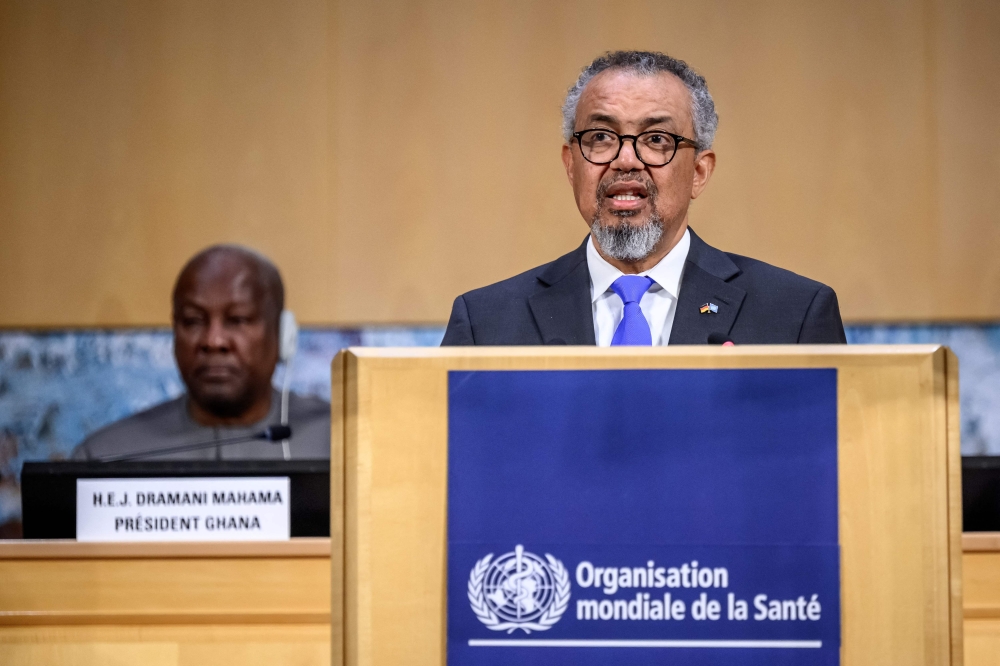
World Health Organization Director-General Tedros Adhanom Ghebreyesus delivers a speech at the opening of the 79th World Health Organization assembly in Geneva on May 18, 2026. — AFP pic
In addition, he said, there was “one US citizen confirmed positive and transferred to Germany, as reported by the US”.
The total number of confirmed and suspected cases “will change as field operations are scaling up, including strengthening surveillance, contact tracing and laboratory testing”, Tedros stressed.
There were a number of reasons to worry, he said.
He pointed out that cases had been reported in urban areas, including Kampala, as well as the Congolese city of Goma, and also that there was “significant population movement in the area”.
“The province of Ituri is highly insecure,” he said, pointing out that intensifying conflict in recent months had seen more than 100,000 people newly displaced in the region.
He also said that deaths had been reported among health workers, “indicating healthcare-associated transmission”.
Tedros highlighted that the epidemic had been shown to be caused by the Bundibugyo strain, “a species of Ebola virus, for which there are no vaccines or therapeutics”. — AFP
 Login
Login