Login
Login
The Global Impact of Losing U.S. Sea Level Science
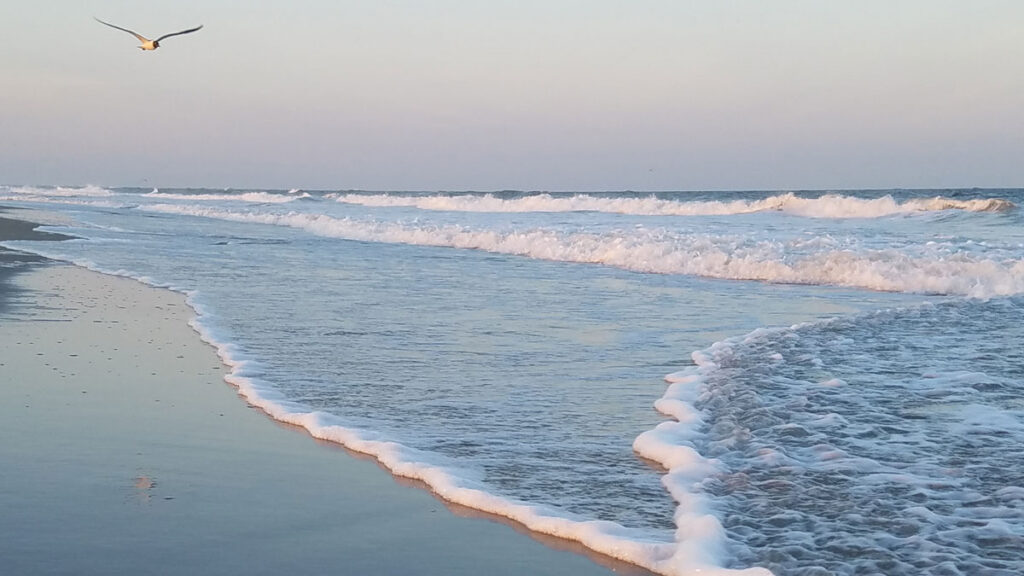
Since the beginning of the 20th century, global sea level has risen by about 20 centimeters (roughly 8 inches) [Fox-Kemper et al., 2021]. As a result, coastal and island communities around the world are experiencing more frequent high-tide flooding, worsening storm surges, and increasing damage to homes and infrastructure. In the United States, for example, human-caused sea level rise alone increased damages from 2012’s Hurricane Sandy by about $8 billion [Strauss et al., 2021].
The United States has long been a key member of the global climate research community. However, that role is now threatened.
Scientific understanding of the magnitudes and rates of sea level rise, of how they vary around the planet, and of why the ocean is rising is based on a body of rigorous research that, for decades, has tracked past and present sea levels and projected future rise.
The United States has long been a key member of the global climate research community, including in producing the wealth of sea level research that has informed countries, states, and communities of what lies ahead for their shorelines. However, that role is now threatened by the Trump administration’s attacks on the country’s scientific research enterprise broadly and on climate research especially.
Analysis of the evolution of sea level rise projection science [Garner et al., 2018] underscores both the country’s prominent past role in the field and how the ongoing attacks may undermine progress in our understanding of sea level change. It also points to the urgency of acting across multiple fronts to preserve scientific knowledge and prevent further harm to the capacity to measure and project how much and how fast rising seas will affect global coastlines.
Four Decades of Advancing Sea Level Science
By the late 1970s, scientists around the world had begun to recognize the growing threat that climate change posed to the Greenland and Antarctic ice sheets and the danger their melting presented to coastal regions [Mercer, 1978]. The first global mean sea level (GMSL) projections were published in 1982 [Gornitz et al., 1982], and the first planning-oriented sea level scenarios were published just a few years later [e.g., National Research Council, 1987].
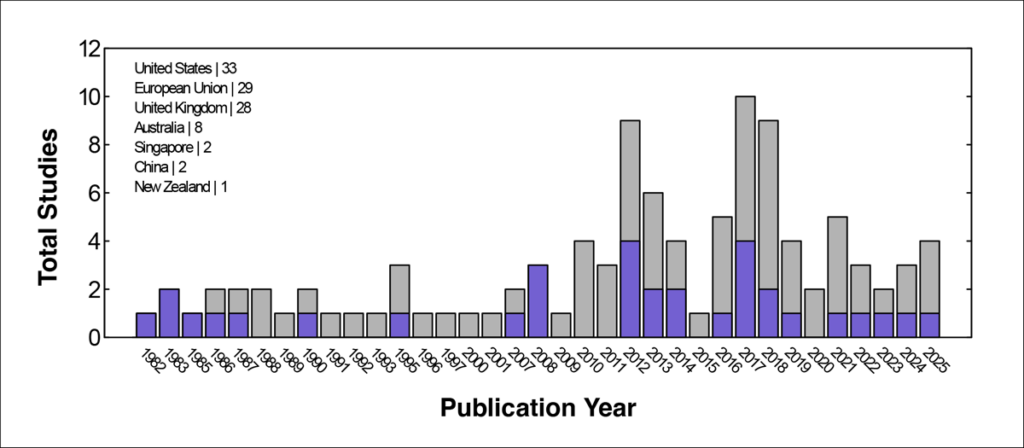
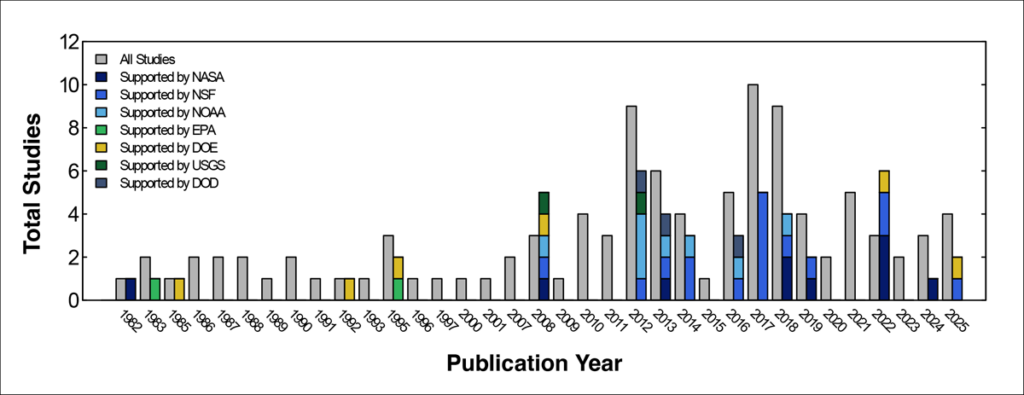
Since 1982, 103 studies have produced GMSL projections [Garner et al., 2018]. About one third of the studies (33 in total), including the first five, were published by teams led by scientists at U.S. institutions (Figure 1). Thirty-three studies (some, but not all, of which were also led by U.S.-based scientists) have also benefited from U.S. federal funding, sometimes from multiple agencies (Figure 2), including the National Science Foundation (NSF; 16 studies), NASA (10 studies), NOAA (8 studies), the U.S. Department of Energy (DOE; 6 studies), the U.S. Department of Defense (3 studies), the U.S. Geological Survey (2 studies), and the EPA (2 studies).
U.S. scientists have further played critical roles in developing GMSL projections for Intergovernmental Panel on Climate Change (IPCC) assessments. For example, chapters producing sea level projections for the IPCC Fifth Assessment Report [Church et al., 2013], the IPCC Special Report on the Ocean and Cryosphere in a Changing Climate [Oppenheimer et al., 2019], and the IPCC Sixth Assessment Report (AR6) [Fox-Kemper et al., 2021] were all coled by U.S.-based scientists.
Meanwhile, U.S. funding has been essential to the IPCC, constituting more than 25% of the nearly $207 million invested globally in the organization from 1989 to 2024 [IPCC, 2025]. NASA also played a key role in making IPCC AR6 sea level projections more accessible and usable through the NASA/IPCC Sea Level Projection Tool [Kopp et al., 2023; Fox-Kemper et al., 2021; Garner et al., 2021], which supports local assessments of sea level change around the world and has about 400,000 users annually.
U.S. institutions have been vital in developing, hosting, and maintaining critical sea level datasets.
Beyond direct contributions of U.S. scientists and federal funding to the global scientific community’s sea level projection research, U.S. institutions have been vital in developing, hosting, and maintaining critical sea level datasets. For example, the University of Hawai‘i Sea Level Center is a crucial part of the Global Sea Level Observing System, operating a network of more than 90 tide gauge stations and supporting global real-time oceanographic operations and long-term climate studies. NASA satellite missions, including TOPEX/Poseidon and the Gravity Recovery and Climate Experiment (GRACE and GRACE-FO), have been instrumental in helping to measure changes in GMSL and ice sheets, providing new ways to assess the accuracy of global sea level projections [Törnqvist et al., 2025]. And the Sea Level Research Group at the University of Colorado has consistently processed such datasets, providing critical data access for the broader research community.
Pushed to a Precipice
Since January 2025, climate and sea level science in the United States has come under an unprecedented attack. Scientists have seen congressionally approved research funding revoked or frozen. Agencies like NASA, NOAA, and NSF have been stripped of physical resources, talented scientific experts, and independent advisory and governing boards. The Trump administration, in its fiscal year (FY) 2026 budget, sought debilitating funding cuts for federal scientific agencies, including proposed budget reductions of 24% for NASA, 27% for NOAA, 57% for NSF, and 55% for EPA. Although the scale of these cuts was reduced in the enacted FY2026 budget, the administration is pushing for similarly steep cuts in its FY2027 budget request.
In May 2025, NASA’s Goddard Institute for Space Studies, which produced the first global sea level projections [Gornitz et al., 1982], was evicted from its 49-year home, and efforts to undermine the institute have continued into 2026. Since December, the administration has advanced plans to dismantle the National Center for Atmospheric Research, which developed and maintains a host of climate datasets and resources, including the Community Earth System Model that is widely used to help generate GMSL projections. And in January 2026, the government announced it would withdraw from more than 60 international bodies, including the IPCC, as part of a broader move to pull back from international scientific cooperation.
Efforts to apply climate science in U.S. policy have been hindered not only by political polarization and proposed funding cuts but also by deliberate suppression of data and research.
Efforts to apply climate science in U.S. policy have been hindered not only by political polarization and proposed funding cuts but also by deliberate suppression of data and research. Broadly, the current U.S. administration has removed more than 2,000 datasets from federal platforms, and more specifically, it has systematically scrubbed climate-related content from agency websites. Such erasures disrupt public access to critical information and undermine scientific transparency.
Furthermore, the DOE published a report that without conducting any statistical analysis, denied the scientific evidence for sea level acceleration. It similarly claimed, without any analysis of the numerous sea level projection studies documented here, that sea level is “rising at a lower rate than predicted.” The EPA went further, falsely claiming that “aggregate sea level rise has been minimal.” In fact, the most recent IPCC sea level projections are in good agreement with observations [Törnqvist et al., 2025; Dessler and Kopp, 2025].
The U.S. scientific community now stands at a precipice. Efforts to dismantle federal scientific agencies and diminish research are eroding the United States’ foundational contributions to our knowledge of global change and sea level rise.
The Path to Preserving Critical Science
As we plummet toward a loss of data, expertise, and innovation, we face a future that would not only further damage the United States’ reputation for scientific excellence and transparency but also cripple the global sea level research community at a time when the risks from sea level rise are rapidly increasing [Fox-Kemper et al., 2021].
While some U.S.-based sea level scientists could move to countries more committed to climate science, there are not enough positions in the world nor enough mobility for the vast majority to relocate. Grassroots archiving efforts have helped preserve some critical datasets, but this is a temporary and often insufficient stopgap. An urgent need remains for resilient and transparent scientific infrastructure, so that U.S. taxpayer–funded research findings and datasets are, and remain, publicly accessible.
Historically, federally funded scientific initiatives have enjoyed strong support across the political spectrum in the United States.
Historically, federally funded scientific initiatives have enjoyed strong support across the political spectrum in the United States. However, the unprecedented hostility facing science in the country today has revealed that new institutional safeguards and legal protections to prevent political interference are critically needed.
Expanding collaborations between U.S. universities and private foundations and donors provides one potential route to providing some protection and improving long-term stability for sea level science data and initiatives. Climate Central’s Surging Seas project offers one model to emulate. However, philanthropic efforts are far from sufficient to preserve the U.S. scientific enterprise.
Another avenue to protect federally funded science from political pressure is through bipartisan legislation. Bills such as the Scientific Integrity Act (which aims to ensure that scientific findings are not influenced or altered by political pressure) and the Protect America’s Workforce Act (which aims to restore collective bargaining rights for unionized federal employees) represent such opportunities.
Yet the effectiveness of such legislative efforts hinges on the critical caveat that the people holding authority in government recognize and abide by enacted legislation. Under an executive who does not abide by the rule of law, such legislative efforts, even if they are passed successfully, will offer little actual protection. The path to preserving U.S. climate and sea level science, therefore, cannot be separated from the path to restoring the rule of law within the U.S. government.
Progressing on this front requires the scientific community to advocate for its priorities more vocally and to build coalitions that include both academics and the stakeholders who benefit from scientific climate projections. It also requires making use of tools and levers that many scientists are unaccustomed to, such as the court system. AGU and other institutions have modeled this approach over the past year, joining legal efforts to protect federal workers, for example, and speaking up against the dismantling of valued science agencies.
Restoring the rule of law also requires electoral organizing to reestablish Congress as an independent and coequal branch of government that wields, rather than abdicates, lawful oversight of administration officials and federal agencies.
Scientific understanding of sea level processes and projections of future changes inform local, national, and international decisionmaking and provide a pathway to resilience against the risks of rising coastal waters. Safeguarding the long-standing leadership, integrity, and continuity of U.S. climate and sea level science is both a national and global imperative—one that many scientists are already stepping up to support. Now we need the rest of the scientific community—and its allies in academia, philanthropy, industry, and the public—to join in.
Acknowledgments
The authors thank Amy Appollina and Jessica Slotter for their assistance in curating a database of global sea level rise projections.
References
Church, J. A., et al. (2013), Sea level change, in Climate Change 2013: The Physical Science Basis. Contribution of Working Group I to the Fifth Assessment Report of the Intergovernmental Panel on Climate Change, edited by T. F. Stocker et al., pp. 1,137–1,216, Cambridge Univ. Press, Cambridge, U.K., https://doi.org/10.1017/CBO9781107415324.026.
Dessler, A., and R. E. Kopp (2025), Climate experts’ review of the DOE Climate Working Group Report, ESS Open Archive, https://doi.org/10.22541/ESSOAR.175745244.41950365/V2.
Fox-Kemper, B., et al. (2021), Ocean, cryosphere and sea level change, in Climate Change 2021: The Physical Science Basis. Contribution of Working Group I to the Sixth Assessment Report of the Intergovernmental Panel on Climate Change, edited by V. Masson-Delmotte et al., pp. 1,211–1,362, Cambridge Univ. Press, Cambridge, U.K., https://doi.org/10.1017/9781009157896.011.
Garner, A. J., et al. (2018), Evolution of 21st century sea level rise projections, Earth’s Future, 6, 1,603–1,615, https://doi.org/10.1029/2018EF000991.
Garner, G. G., et al. (2021), IPCC AR6 Sea Level Projection Tool, NASA Sea Level Change Portal, sealevel.nasa.gov/data_tools/17.
Gornitz, V., S. Lebedeff, and J. Hansen (1982), Global sea level trend in the past century, Science, 215(4540), 1,611–1,614, https://doi.org/10.1126/science.215.4540.1611.
Intergovernmental Panel on Climate Change (IPCC) (2025), IPCC Trust Fund Programme and Budget, IPCC-LXII/Doc. 2, rev. 1, IPCC Secr., Geneva, Switzerland, apps.ipcc.ch/eventmanager/documents/88/180220250655-Doc.%202,%20Rev.1%20-%20IPCC%20Programme%20and%20Budget.pdf.
Kopp, R. E., et al. (2023), The Framework for Assessing Changes To Sea-level (FACTS) v1.0: A platform for characterizing parametric and structural uncertainty in future global, relative, and extreme sea-level change, Geosci. Model Dev., 16, 7,461–7,489, https://doi.org/10.5194/gmd-16-7461-2023.
Mercer, J. (1978), West Antarctic ice sheet and CO2 greenhouse effect: A threat of disaster, Nature, 271, 321–325, https://doi.org/10.1038/271321a0.
National Research Council (1987), Responding to Changes in Sea Level: Engineering Implications, Natl. Acad. Press, Washington, D.C.
Oppenheimer, M., et al. (2019), Sea level rise and implications for low-lying islands, coasts and communities, in IPCC Special Report on the Ocean and Cryosphere in a Changing Climate, edited by H.-O. Pörtner et al., pp. 321–445, Cambridge Univ. Press, Cambridge, U.K., https://doi.org/10.1017/9781009157964.006.
Strauss, B. H., et al. (2021), Economic damages from Hurricane Sandy attributable to sea level rise caused by anthropogenic climate change, Nat. Commun., 12, 2720, https://doi.org/10.1038/s41467-021-22838-1.
Törnqvist, T. E., et al. (2025), Evaluating IPCC projections of global sea-level change from the pre-satellite era, Earth’s Future, 13, e2025EF006533, https://doi.org/10.1029/2025EF006533.
Author Information
Andra J. Garner (garnera@rowan.edu), Department of Environmental Science, Rowan University, Glassboro, N.J.; Robert E. Kopp, Department of Earth and Planetary Sciences and Rutgers Climate and Energy Institute, Rutgers University, New Brunswick, N.J.; Gregory G. Garner, Glassboro, N.J.; Aimée B. A. Slangen, Department of Estuarine and Delta Systems, Royal Netherlands Institute for Sea Research, Yerseke; and Benjamin P. Horton, School of Energy and Environment, City University of Hong Kong