Normal view

  • ✇Eos
  • NSF Eliminates Geoscience Postdocs Emily Gardner
    Research & Developments is a blog for brief updates that provide context for the flurry of news regarding law and policy changes that impact science and scientists today. The National Science Foundation (NSF) has eliminated its postdoctoral fellowship funding for Earth scientists. On the NSF website, the opportunity is listed as “archived.” This first came to the attention of Eos this week, although a Redditor had posted about the opportunity being archived as far back as March.
     

NSF Eliminates Geoscience Postdocs

14 May 2026 at 19:14
A row of microscopes sit on a lab bench.

Research & Developments is a blog for brief updates that provide context for the flurry of news regarding law and policy changes that impact science and scientists today.

The National Science Foundation (NSF) has eliminated its postdoctoral fellowship funding for Earth scientists.

On the NSF website, the opportunity is listed as “archived.” This first came to the attention of Eos this week, although a Redditor had posted about the opportunity being archived as far back as March.

“What do you do when the most powerful people in the country just decide that your field shouldn’t exist anymore?” asked one Earth scientist on Bluesky.

“So, what are we doing now that we’re just not going to have new grants in GEO?” asked another.

According to the last program solicitation, posted in October 2024, the program generally awarded about $2.78 million each year, funding 8 to 10 postdoctoral fellowships. Proposals could be related to any of the disciplines within the scope of NSF’s Division of Earth Sciences (EAR), part of the NSF Directorate for Geosciences (NSF GEO).

The NSF announced an “organizational realignment” in December 2025. As part of the agencywide reorganization, GEO gained new leadership in February 2026. Joydip Kundu, the new NSF GEO Directorate Head, first joined NSF GEO in July 2025 as the agency’s deputy assistance director, coming from the NSF Directorate for Computer and Information Science and Engineering. He previously worked for the White House Office of Management and Budget (under President Obama) and the University of Maryland. Like Kundu, NSF’s new deputy directorate heads also came from within the agency.

When contacted about the archived opportunity, an NSF spokesperson confirmed to Eos that “The EAR postdoc fellowship solicitation has been archived and will not have a competition this fall. NSF regularly evaluates its portfolio of funding opportunities and will continue to explore funding opportunities for early career geoscientists.”

NSF continues to offer fellowship opportunities to postdoctoral researchers in the fields of engineering, entrepreneurial research, mathematics and physical sciences. Fellowships to postdocs in biology are available only if they involve the use of artificial intelligence.

—Emily Gardner (@emfurd.bsky.social), Associate Editor

These updates are made possible through information from the scientific community. Do you have a story about how changes in law or policy are affecting scientists or research? Send us a tip at eos@agu.org.

A photo of a hand holding a copy of an issue of Eos appears in a circle over a field of blue along with the Eos logo and the following text: Support Eos’s mission to broadly share science news and research. Below the text is a darker blue button that reads “donate today.”
Text © 2026. AGU. CC BY-NC-ND 3.0
Except where otherwise noted, images are subject to copyright. Any reuse without express permission from the copyright owner is prohibited.
  • ✇Eos
  • Astronomers Find 10,000 Potential New Exoplanets Kimberly M. S. Cartier
    Research & Developments is a blog for brief updates that provide context for the flurry of news that impacts science and scientists today. To date, astronomers have confirmed the existence of just under 6,300 exoplanets. New research could more than double that number, adding a potential 10,000 new planets in one fell swoop. Yes, that’s right. A 1 with 4 zeros. The T16 project has announced the discovery of 10,091 exoplanet candidates observed by NASA’s Transiting Exoplanet Sur
     

Astronomers Find 10,000 Potential New Exoplanets

13 May 2026 at 14:45
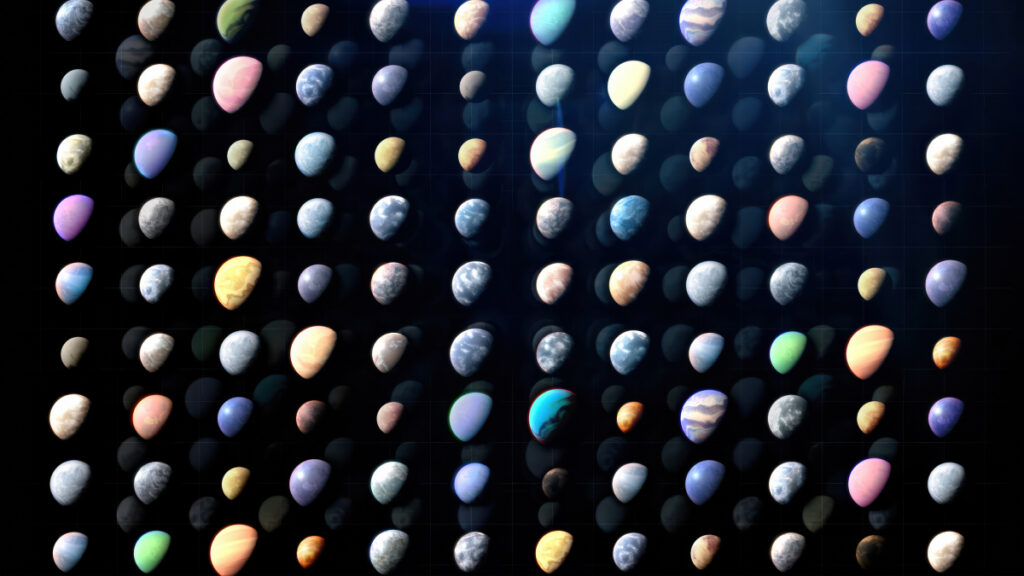
An artist’s illustration of an array of exoplanets with a 9 by 12 grid of colorful planets in a gibbous phase. A second grid of shadowed planets sits behind it.

Research & Developments is a blog for brief updates that provide context for the flurry of news that impacts science and scientists today.

To date, astronomers have confirmed the existence of just under 6,300 exoplanets. New research could more than double that number, adding a potential 10,000 new planets in one fell swoop.

Yes, that’s right. A 1 with 4 zeros.

The T16 project has announced the discovery of 10,091 exoplanet candidates observed by NASA’s Transiting Exoplanet Survey Satellite (TESS). Since 2018, the all-sky survey has been monitoring more than 200,000 nearby stars using the transit method, which detects the faint dip in a star’s light when a planet crosses in front of it. Astronomers typically require 3 dips to be sure that what they’re seeing is actually a planet and not a one-off event such as an asteroid or comet in that distant star system.

The T16 project analyzed the light curves of more than 54 million stars observed during the first year of the TESS mission. The project’s analysis technique allowed it to search for planets around stars up to 16 times fainter than TESS typically searches, drastically increasing the field of discovery.

That’s more than were detected in the entirety of NASA’s Kepler mission and its follow-on K2.

Their pipeline detected 11,554 planet candidates. Of those, 1,052 of those had been detected previously and 411 only had one transit—not enough to confirm a planet.

That leaves 10,091 potential new planets. That’s more than were detected in the entirety of NASA’s Kepler mission and its follow-on K2 and more than double the existing planet candidates from TESS that await confirmation. These discoveries will be published in the Astrophysical Journal Supplement.

All of the new planet candidates orbit their stars quickly, with orbital periods between 12 hours and 27 days. Although most of the stars that TESS observes are smaller and cooler than the Sun, those close orbits likely mean that most of those planets are far too hot to be habitable.

 
Learn More

•  Read the paper: The T16 Planet Hunt
•  More context from The Bad Astronomer
 

The T16 project team confirmed the planet-hood of one of their candidates not using the transit method, but a different method that measures the gravitational tug a planet exerts on its host star. That planet, TIC 183374187, is hot and slightly larger than Jupiter.

The remaining 10,090 newly discovered planet candidates require additional verification to determine whether they truly are planets or not. But given the rigor of the team’s analysis and the requirement of at least 3 transits to even make this list, it’s likely that most of the new discoveries are indeed planets.

“Astronomers are a bit conservative when it comes to claims like this, and want to be sure they pass a bunch of tests to make sure everything was done correctly and these planets actually exist,” astronomer Phil Plait wrote in his Bad Astronomy Newsletter. “Having said that, the process the astronomers went through looks legit to me, and I would bet the majority of these new candidates are real. That’s amazing.”

—Kimberly M. S. Cartier (@astrokimcartier.bsky.social), Staff Writer

These updates are made possible through information from the scientific community. Do you have a story about science or scientists? Send us a tip at eos@agu.org.

A photo of a hand holding a copy of an issue of Eos appears in a circle over a field of blue along with the Eos logo and the following text: Support Eos’s mission to broadly share science news and research. Below the text is a darker blue button that reads “donate today.”
Text © 2026. AGU. CC BY-NC-ND 3.0
Except where otherwise noted, images are subject to copyright. Any reuse without express permission from the copyright owner is prohibited.
  • ✇Eos
  • Sand Demand Outpaces Sustainable Extraction Kimberly M. S. Cartier
    Research & Developments is a blog for brief updates that provide context for the flurry of news that impacts science and scientists today. Sand is the most exploited solid natural resource on Earth. It has been integrated into how we build homes, roads, buildings, and bridges as well as how we protect coastal infrastructure from rising seas. Sand underpins nearly every aspect of modern infrastructure and economics, plays crucial roles in supporting ecosystem biodiversity, and literal
     

Sand Demand Outpaces Sustainable Extraction

12 May 2026 at 13:48
Colorful boats filled sit side by side on a sandy bank, each with a line of trucks waiting to fill it with more extracted sand.

Research & Developments is a blog for brief updates that provide context for the flurry of news that impacts science and scientists today.

Sand is the most exploited solid natural resource on Earth. It has been integrated into how we build homes, roads, buildings, and bridges as well as how we protect coastal infrastructure from rising seas. Sand underpins nearly every aspect of modern infrastructure and economics, plays crucial roles in supporting ecosystem biodiversity, and literally shores up rivers and coasts.

A new report from the United Nations Environment Programme (UNEP) found that we are using 50 billion metric tons (50 trillion kilograms) of sand per year. As global development and industrialization expand, demand for sand in the building sector is expected to rise 45% by the year 2060, outpacing current efforts to sustainably harvest it. The report’s authors urge countries to establish sand as a strategic national asset and develop policies for sustainable extraction.

“Sand is sometimes referred as the unrecognized hero of development, but its essential role in sustaining the natural services on which we depend is even more overlooked,” Pascal Peduzzi, director of the UNEP Global Resource Information Database Geneva, said in a press release about the report. “Sand is our first line of defence against sea level rise, storm surges, and salination of coastal aquifers—all hazards exacerbated by climate change.”

Sand Wanted: Dead or Alive

Dead sand, or sand that has been extracted from its natural environment, is a key component in building materials like concrete and asphalt. Communities around the world use sand in water filtration systems, providing clean water for drinking and agricultural use. And although a transition to clean energy sources is necessary to curb the effects of climate change, many of those sources also depend on sand: solar panels require glass made from high-purity silica sand, and wind turbines, hydroelectric dams, and nuclear power plants all require concrete.

A copse of mangroves grows on a sandy shore. Dozens of iguanas lounge on the sand.
Mangroves, one of the most important coastal trees, can grow in sand. Credit: Diego Parra

Sand also plays a critical role in natural ecosystems. It is home to a wide array of critters from crabs, sharks, and turtles to microorganisms like bacteria and fungi. It supports the growth of corals, mangroves, and seagrasses that in turn support even more marine creatures. It is a key component of healthy soil and aids in surface drainage. It guides river evolution and acts as flood buffer and storm barrier. It also provides local economic benefits via tourism.

These are among the values of sand when it is left alone and unused, called “alive” sand. The UN report notes that these benefits are typically of greater value over time than if sand is dredged and used. But because these benefits are hard to see, they are often overlooked when nations calculate the value of their sand resources.

A Sustainable Sand Future

Despite sand’s importance whether dead or alive, the report notes that few countries have established sand as a strategic national asset or have developed strategies for sustainable extraction. At the current pace, humans are extracting sand from the natural environment at a faster pace than it is being replenished by geologic processes.

 
Related

•  Read the Report: Sand and Sustainability: An Essential Resource for Nature and Development
•  Track Global Sand Dredging: Marine Sand Watch
•  Dig Into the Details: Grains of Sand: Too Much and Never Enough
 

What’s more, the UNEP’s Marine Sand Watch tool shows that about half of sand dredging companies are operating within marine protected areas, accounting for about 15% of the volume of dredged sand. This practice, the report notes, is potentially trading in sand’s long-term benefits for short-term gains.

The UN report recommends a few actions to protect the long-term availability of sand as a natural resource, including:

  • Recognizing sand as strategic national asset, establishing national inventories, and creating long-term regional planning groups that consider sand as an essential resource for resilience;
  • Establishing circularity and recycling of building materials, especially in areas of conflict and natural disasters;
  • Strengthening environmental protection practices, and codifying international frameworks to strengthen accountability along the supply chain, including increased transparency about extraction; and
  • Integrating sand-related biodiversity and social risks into financial decisionmaking and governance.

“Over-reliance on short-term economic metrics risks obscuring, and further impacting, the geological and ecological processes that take centuries to form and may not be restored once critical thresholds are crossed,” the report states. “What is hardest to measure may be precisely what sustains both nature and human societies over the long term. The challenge ahead is not only to manage extraction, but to recognise and balance the full spectrum of sand’s values.”

—Kimberly M. S. Cartier (@astrokimcartier.bsky.social), Staff Writer

These updates are made possible through information from the scientific community. Do you have a story about science or scientists? Send us a tip at eos@agu.org.

A photo of a hand holding a copy of an issue of Eos appears in a circle over a field of blue along with the Eos logo and the following text: Support Eos’s mission to broadly share science news and research. Below the text is a darker blue button that reads “donate today.”
Text © 2026. AGU. CC BY-NC-ND 3.0
Except where otherwise noted, images are subject to copyright. Any reuse without express permission from the copyright owner is prohibited.
  • ✇Eos
  • 2026 Has Already Broken Climate Records. El Niño Could Break More. Grace van Deelen
    Research & Developments is a blog for brief updates that provide context for the flurry of news that impacts science and scientists today. As the midpoint of the year approaches, several climate records have already been broken. Arctic winter sea ice extent reached a record low. Several countries saw record-breaking winter heat waves. And more than 150 million hectares have already burned globally in wildfires.  The increasingly likely emergence of an El Niño this summer will like
     

2026 Has Already Broken Climate Records. El Niño Could Break More.

12 May 2026 at 04:02
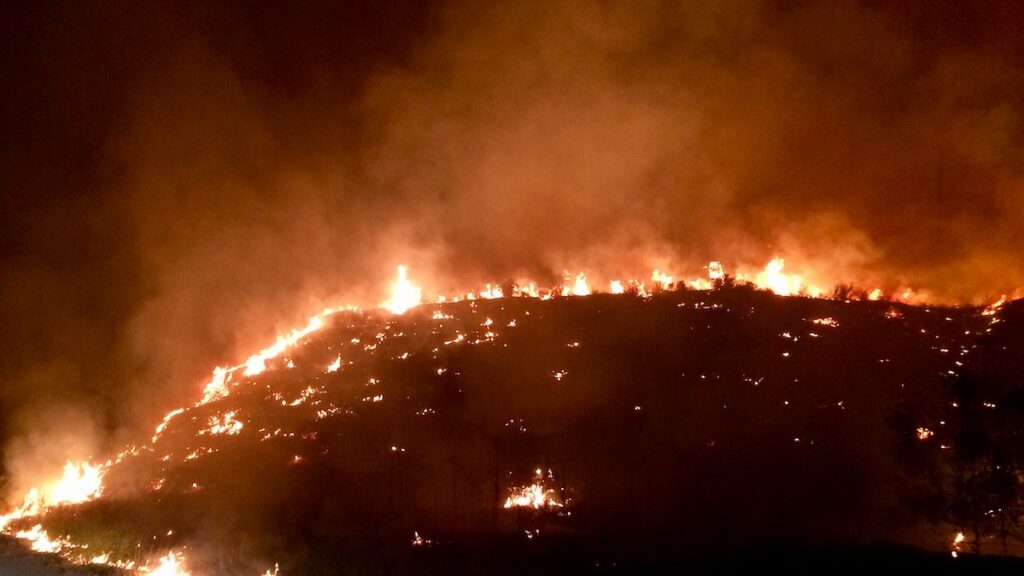
A wildfire on a hillside burns at night.

Research & Developments is a blog for brief updates that provide context for the flurry of news that impacts science and scientists today.

As the midpoint of the year approaches, several climate records have already been broken. Arctic winter sea ice extent reached a record low. Several countries saw record-breaking winter heat waves. And more than 150 million hectares have already burned globally in wildfires. 

The increasingly likely emergence of an El Niño this summer will likely continue the year’s record-breaking weather trends and could lead to “an unprecedented year of global fire,” according to a statement from World Weather Attribution, a climate research collaboration. 

“In modern human history, we’ve never experienced a strong or very strong El Niño event amid pre-existing conditions that were this warm globally.”

NOAA’s Climate Prediction Center predicts there is a 61% chance of El Niño—a natural climate pattern that involves warming waters in the Pacific Ocean—emerging by July 2026 and persisting through the end of the year. El Niño typically temporarily boosts global temperatures. 

At a press briefing on 11 May hosted by World Weather Attribution, climate scientists outlined the potential risks of this emerging El Niño against the backdrop of human-caused climate change, including intensifying wildfire seasons, extreme heat waves, and worsening droughts.

In the press briefing, Frederike Otto, a climate scientist at World Weather Attribution and Imperial College London, emphasized that climate change will likely play a larger role in the rest of this year’s extreme weather events than El Niño will, pointing to more than 100 analyses done by World Weather Attribution that have controlled for the effects of the El Niño Southern Oscillation (ENSO), the broader climate phenomenon that produces El Niño and its sister condition, La Niña. 

 
Related

•  Read About the 2024 El Niño: Record-Breaking Temperatures Likely as El Niño Persists
 

“We find that human-induced climate change has a much greater influence on the likelihood and intensity of extreme weather events than ENSO,” she said. 

Still, El Niño could push average global temperatures to extremes. The effects of El Niño will “be amplified considerably by the now nearly 1.5°C [(2.7°F)] of global warming experienced as of 2026,” Daniel Swain, a climate scientist at the University of California, Los Angeles and the California Institute for Water Resources, said in a statement. “In modern human history, we’ve never experienced a strong or very strong El Niño event amid pre-existing conditions that were this warm globally.”

The global fire season has “got off to a very fast start,” particularly in the African savanna, Southeast Asia, and northeastern China, Theodore Keeping, who studies extreme weather and wildfires at Imperial College London and World Weather Attribution, said in the briefing. Though El Niño may have mixed effects on the U.S. wildfire season, much of the U.S. is expected to face elevated wildfire risk, and a strong El Niño could worsen wildfires elsewhere in the world, particularly in the Amazon rainforest and Australia, Keeping said. 

More than 150 million hectares have burned in wildfires so far this year. Credit: Our World in Data, CC BY

“This rapid start [to the wildfire season], in combination with the forecast El Niño, means that we’re looking at a particularly severe year materializing,” Keeping said. “The likelihood of harmful, extreme fires potentially could be the highest we’ve seen in recent history.”

—Grace van Deelen (@gvd.bsky.social), Staff Writer

These updates are made possible through information from the scientific community. Do you have a story about science or scientists? Send us a tip at eos@agu.org.

A photo of a hand holding a copy of an issue of Eos appears in a circle over a field of blue along with the Eos logo and the following text: Support Eos’s mission to broadly share science news and research. Below the text is a darker blue button that reads “donate today.”
Text © 2026. AGU. CC BY-NC-ND 3.0
Except where otherwise noted, images are subject to copyright. Any reuse without express permission from the copyright owner is prohibited.
  • ✇Eos
  • Number of Scientific Publications from EPA Authors Has Dropped During Trump Administration Grace van Deelen
    Research & Developments is a blog for brief updates that provide context for the flurry of news regarding law and policy changes that impact science and scientists today. The number of peer-reviewed scientific studies authored by scientists at the EPA has declined since the beginning of Donald Trump’s second administration, according to a new analysis. The analysis was published by Public Employees for Environmental Responsibility (PEER), a nonprofit organization that advocates fo
     

Number of Scientific Publications from EPA Authors Has Dropped During Trump Administration

5 May 2026 at 19:39
Silhouettes of people in lavender and periwinkle stand, some overlapping, on a aubergine-colored background. Overlying the image at the bottom is the text “R&D Research and Developments.”

Research & Developments is a blog for brief updates that provide context for the flurry of news regarding law and policy changes that impact science and scientists today.

The number of peer-reviewed scientific studies authored by scientists at the EPA has declined since the beginning of Donald Trump’s second administration, according to a new analysis.

The analysis was published by Public Employees for Environmental Responsibility (PEER), a nonprofit organization that advocates for public employees in the natural resource and environmental professions. The report tracks the number of peer-reviewed scientific studies authored by EPA scientists since 1977. 

According to PEER’s analysis, 61 peer-reviewed publications by EPA scientists have been published so far this year, putting the agency on track to publish 183 articles by the end of 2026. That would be 67% of the number of articles published the previous year and 54% of the number of articles published in 2024.

“These numbers represent a diminution of scientific contributions from the fewer, remaining EPA scientists,” Kyla Bennett, a science policy director at PEER and a former EPA attorney, said in a statement. “The net result is that the scientific contribution of EPA to a greater understanding of what affects human health and the environment will be diminished.”

chart visualization
The number of peer-reviewed publications authored by EPA scientists in 2026 will be just over half of the number published in 2024, if current publication rates continue. As of 5 May, 2026, EPA authors have published 61 peer-reviewed articles for the year. Credit: PEER, Grace van Deelen

Peer-reviewed publications can take years to review and publish, meaning the work for a publication may have occurred during a previous administration. But the decline in publications may indicate a shift away from long-term basic research at the agency, according to PEER. 

Since Trump took office, hundreds of scientists have been terminated from the EPA or have chosen to resign, and scientists working within at least one of its research office have been told to pause efforts to publish research, representing “millions of dollars of research, potentially, that’s now being stopped,” one EPA employee told The Washington Post anonymously.

In February, the EPA took final steps to eliminate the Office of Research and Development, the arm of the agency responsible for conducting research. In its place, Administrator Lee Zeldin announced that a new office, called the Office of Applied Science and Environmental Solutions, would be formed but would not operate as a separate division. 

Six EPA scientists who signed an open letter expressing frustration about changes to the agency, including the elimination of the Office of Research and Development, were terminated and have filed claims with the federal government arguing that their terminations were illegal retaliation.

—Grace van Deelen (@gvd.bsky.social), Staff Writer

These updates are made possible through information from the scientific community. Do you have a story about how changes in law or policy are affecting scientists or research? Send us a tip at eos@agu.org.
A photo of a hand holding a copy of an issue of Eos appears in a circle over a field of blue along with the Eos logo and the following text: Support Eos’s mission to broadly share science news and research. Below the text is a darker blue button that reads “donate today.”
Text © 2026. AGU. CC BY-NC-ND 3.0
Except where otherwise noted, images are subject to copyright. Any reuse without express permission from the copyright owner is prohibited.
  • ✇Eos
  • New USGS Tool Fills in the Gaps on U.S. Water Supply Emily Dieckman
    Research & Developments is a blog for brief updates that provide context for the flurry of news that impacts science and scientists today. In the contiguous United States, crop irrigation, municipal water supplies, and thermoelectric power generation use more than 224 billion gallons of fresh water every day. Conducting water research or making decisions about water use, until now, often required referencing datasets across various agencies. The U.S. Geological Survey (USGS) National
     

New USGS Tool Fills in the Gaps on U.S. Water Supply

29 April 2026 at 16:27
A bridge crosses a river beneath a relatively short waterfall. A city skyline is on the other side of the river.

Research & Developments is a blog for brief updates that provide context for the flurry of news that impacts science and scientists today.

In the contiguous United States, crop irrigation, municipal water supplies, and thermoelectric power generation use more than 224 billion gallons of fresh water every day. Conducting water research or making decisions about water use, until now, often required referencing datasets across various agencies. The U.S. Geological Survey (USGS) National Water Availability Assessment Data Companion (NWDC), announced this week, aims to streamline this process. In part, the tool is designed to help decisionmakers better understand the balance between how high demand and limited supply affect water availability in their communities.

“While the United States has abundant water nationally, regional imbalances between supply and demand may create water challenges affecting millions of Americans,” said lead scientist Shirley Leung in a USGS press release. “What once required significant resources and time can now be done in minutes, giving communities of all sizes the same foundation for water planning.”

The lower 48 states are home to about 80,000 sub-watersheds, from those in the arid southwest to the Great Lakes Basin, where about 84% of North America’s surface fresh water is located. According to the USGS, the NWDC is the first tool that integrates information about water availability in individual watersheds at a national scale.

The tool is designed to complement Water Data for the Nation (WDFN), another USGS product that consolidates observational data from the agency’s thousands of local monitoring stations gathering data on streams, lakes, reservoirs, precipitation, water quality, and groundwater. The new tool uses modeling to fill in spatial and temporal gaps between the observations made at these stations.

Water managers, researchers, agricultural experts, and others can use the NWDC to compare watershed conditions, identify seasonal patterns in water use, or to create data visualizations of statewide water use, for example. Though the tool currently covers only the contiguous United States, it will soon be extended to Alaska, Hawaii, and Puerto Rico, according to the USGS.

David Tarboton, a professor of civil engineering at the Utah Water Research Laboratory, said he was “intrigued” by the new tool, and is interested in examining the data its model produces. 

While Tarboton was disappointed that the tool’s most recent available data are from 2020, “having a sort of integrated, wall-to-wall dataset that’s consistently produced is very valuable,” he said. He works, in part, in the areas of hydroinformatics and data sharing, and noted that the modern methods the agency is using to share the data could be useful in developing automated tools.

—Emily Gardner (@emfurd.bsky.social), Associate Editor

These updates are made possible through information from the scientific community. Do you have a story about science or scientists? Send us a tip at eos@agu.org.

A photo of a hand holding a copy of an issue of Eos appears in a circle over a field of blue along with the Eos logo and the following text: Support Eos’s mission to broadly share science news and research. Below the text is a darker blue button that reads “donate today.”
Text © 2026. AGU. CC BY-NC-ND 3.0
Except where otherwise noted, images are subject to copyright. Any reuse without express permission from the copyright owner is prohibited.
  • ✇Eos
  • Trump Terminates Entire National Science Board Grace van Deelen
    Research & Developments is a blog for brief updates that provide context for the flurry of news regarding law and policy changes that impact science and scientists today. The Trump Administration has terminated the positions of every member of an independent board meant to govern the National Science Foundation (NSF). The National Science Board directs and approves large funding decisions for NSF’s approximately $9 billion basic science research budget. It is meant to function ind
     

Trump Terminates Entire National Science Board

27 April 2026 at 14:44
Silhouettes of people in lavender and periwinkle stand, some overlapping, on a aubergine-colored background. Overlying the image at the bottom is the text “R&D Research and Developments.”

Research & Developments is a blog for brief updates that provide context for the flurry of news regarding law and policy changes that impact science and scientists today.

The Trump Administration has terminated the positions of every member of an independent board meant to govern the National Science Foundation (NSF).

The National Science Board directs and approves large funding decisions for NSF’s approximately $9 billion basic science research budget. It is meant to function independently from the federal administration to keep science funding insulated from political pressure and budget cycles.

“I have watched the systematic dismantling of the scientific advisory infrastructure of this government with growing alarm, and the National Science Board is simply the latest casualty.”

In a 24 April notice from the Presidential Personnel Office, all the scientists serving on the board were informed their positions had been eliminated. The emails dismissing board members provided no reason for the termination.

“I am deeply disappointed, though I cannot say I am entirely surprised,” Willie E. May, one of the terminated board members and vice president of research and economic development at Morgan State University in Maryland, told The New York Times

“I have watched the systematic dismantling of the scientific advisory infrastructure of this government with growing alarm, and the National Science Board is simply the latest casualty,” he said. 

Ranking member of the House Committee on Science, Space, and Technology Zoe Lofgren (D-CA) called the terminations “the latest stupid move made by a president who continues to harm science and American innovation.”  

The terminations come after a year that shocked higher education and research budgets. Last year, NSF granted 51% less funding to scientists than the 2015-2024 average and terminated hundreds of active grants. Last May, the Trump administration proposed cutting $5 billion from NSF’s budget, though the proposal was rejected. The president’s budget request for fiscal year 2027 once again proposes to reduce the foundation’s budget by more than half. In a February 2026 meeting of the National Science Board, NSF leadership said the foundation was seeking to reduce grant solicitations.

The Trump administration has also restructured scientific advisory groups elsewhere in the federal government, eliminating 152 federal advisory committees at science agencies, merging all of the Department of Energy’s advisory committees into one and dismantling the Environmental Protection Agency’s research office.

“Without a functional National Science Board in the near term, the agency is left without the guidance and oversight of independent experts, and the public is left without information on how NSF is carrying out its mission,” Gretchen Goldman, president and CEO of the Union of Concerned Scientists, wrote in a blog post about the terminations. 

—Grace van Deelen (@gvd.bsky.social), Staff Writer

These updates are made possible through information from the scientific community. Do you have a story about how changes in law or policy are affecting scientists or research? Send us a tip at eos@agu.org.

A photo of a hand holding a copy of an issue of Eos appears in a circle over a field of blue along with the Eos logo and the following text: Support Eos’s mission to broadly share science news and research. Below the text is a darker blue button that reads “donate today.”
Text © 2026. AGU. CC BY-NC-ND 3.0
Except where otherwise noted, images are subject to copyright. Any reuse without express permission from the copyright owner is prohibited.
  • ✇Eos
  • Temperatures in Nearly All Major U.S. Cities Have Warmed Since First Earth Day Grace van Deelen
    Research & Developments is a blog for brief updates that provide context for the flurry of news that impacts science and scientists today. After more than half a century of Earth Days, one planetary challenge—climate change—threatens our planet more than ever. In 1970, the year Sen. Gaylord Nelson (D-Wisc.) organized the first Earth Day events, the annual average concentration of carbon dioxide in the atmosphere was 326 parts per million. In 2025, it was 31% higher, at 427 parts p
     

Temperatures in Nearly All Major U.S. Cities Have Warmed Since First Earth Day

22 April 2026 at 18:37
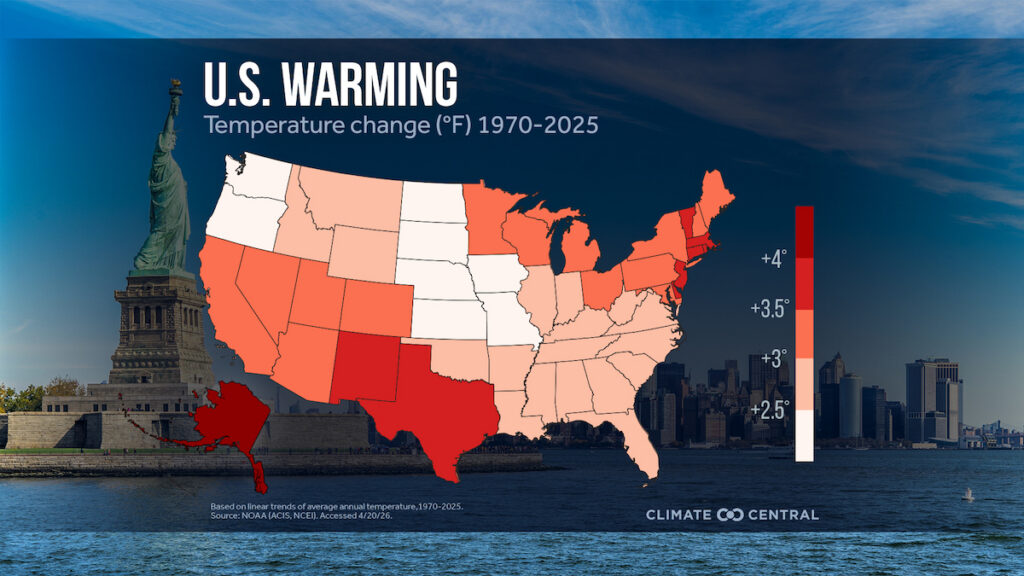
A map of the United States shows which states have warmed the most since 1970. Alaska, New Jersey, New Mexico, Delaware, Massachusetts, and Vermont are the six fastest-warming states.

Research & Developments is a blog for brief updates that provide context for the flurry of news that impacts science and scientists today.

After more than half a century of Earth Days, one planetary challenge—climate change—threatens our planet more than ever.

In 1970, the year Sen. Gaylord Nelson (D-Wisc.) organized the first Earth Day events, the annual average concentration of carbon dioxide in the atmosphere was 326 parts per million. In 2025, it was 31% higher, at 427 parts per million. 

“It may sound small, but it’s reshaping daily life.”

Changes in average annual temperatures in U.S. cities and states show the powerful effects of this increase in heat-trapping carbon dioxide. A new analysis, published today by climate research and communications nonprofit Climate Central, found that since 1970, all 50 states and 99% of major U.S. cities have warmed, with an average city-level increase of 1.6°C (2.9°F).

“It may sound small, but it’s reshaping daily life,” Shel Winkley, a meteorologist at Climate Central, said in a video released alongside the report. 

On average, the 49 U.S. states analyzed in the report have warmed by 1.7°C (3.0°F) since 1970. The six states that have warmed the fastest since the first Earth Day are Alaska with a 2.4°C (4.4°F) increase, New Jersey and New Mexico with a 2.1°C (3.7°F) increase, and Delaware, Massachusetts, and Vermont with a 2°C (3.6°F). Trends for Hawaii, which were analyzed separately and not included in the national average, also showed statewide warming.

In 2025, the United States was on average 1.4°C (2.6°F) warmer than the 20th century average. The Paris Agreement, a legally binding global treaty, sets a goal to limit warming to 1.5°C (2.7°F) above preindustrial levels, though some scientists expect that the world has already entered the period of time during which this limit will be breached.

A graph shows how much Reno, Nevada, and the United States have warmed since 1970. Reno has warmed 7.9 degrees Fahrenheit, Nevada has warmed 3 degrees, and the United States has warmed 2.9 degrees.
Warming is occurring much faster in some cities than in their respective states, or than the United States as a whole. Check out your city’s data in the Climate Central report. Credit: Climate Central, CC BY 4.0

Warming trends in the United States are most pronounced in the Southwest, where cities have warmed an average of 1.9°C (3.5°F) since 1970. And in some cases, cities are warming much faster than whole states. Three of the five cities that have warmed the fastest since 1970 are in the Southwest: Reno, Nev., with an increase of 4.4°C (7.9°F), Las Vegas, with an increase of 3.3°C (6.0°F), and El Paso, Texas, with an increase of 3.3°C (5.9°F). 

The effects are evident at the national, state, and local levels. Temperatures have warmed in 240 of the 242 cities analyzed by Climate Central. Harrisonburg, VA and Monterey, CA were the only two cities analyzed that have not warmed since 1970.

The report highlights some good Earth Day news, however, and points out that solar and wind power generation is at an all-time high in the United States, accounting for 19% of the electricity generated in the country in 2025 despite those industries facing recent headwinds from the federal administration. 

“Every fraction of a degree [of warming] that we prevent does matter, for our health, for our communities, and for the world that we’re passing on to the next generations,” Winkley said. 

—Grace van Deelen (@gvd.bsky.social), Staff Writer

These updates are made possible through information from the scientific community. Do you have a story about science or scientists? Send us a tip at eos@agu.org.

A photo of a hand holding a copy of an issue of Eos appears in a circle over a field of blue along with the Eos logo and the following text: Support Eos’s mission to broadly share science news and research. Below the text is a darker blue button that reads “donate today.”
Text © 2026. AGU. CC BY-NC-ND 3.0
Except where otherwise noted, images are subject to copyright. Any reuse without express permission from the copyright owner is prohibited.
❌
Subscriptions