Normal view

Announcing the Inaugural AGU Advances Early Career Editorial Fellows

Photo of aurora over a body of water with mountains in the background.
Editors’ Vox is a blog from AGU’s Publications Department.

AGU Advances is excited to announce the journal’s inaugural Early Career Editorial Board! The editors of AGU Advances have selected three early career researchers to join the Early Career Editorial Fellow program:

Huilin Huang

University of Virginia

Yihe Huang

University of Michigan

Danielle Monteverde Potocek

Spark Climate Solutions

They will serve as Associate Editors from January 2026 to December 2027, under the leadership of the mentoring editors: David Schimel (Jet Propulsion Laboratory), Thorsten Becker (The University of Texas at Austin, Jackson School of Geoscience), and Eric Davidson (University of Maryland Center for Environmental Science), respectively. AGU Advances is excited to join AGU journals GeoHealth and JGR: Biogeosciences (Xenopoulos, M. A., and T. H. Nguyen, 2024) in launching an Early Career Editorial Fellow program and grateful to our exceptional Early Career Fellows for volunteering their time in service of scientific publishing. This mentorship program, designed to offer a hands-on approach for researchers interested in editorial roles, will support the next generation of researchers and journal editors and lead to stronger futures for our journals and scientific community.

The Early Career Fellows will work one-on-one with a current AGU Advances Editor.

The Early Career Fellows will work one-on-one with a current AGU Advances Editor to learn about the steps of the editorial process, the ethics of reviewing, and what goes into making a decision on a manuscript. They will also learn about the more challenging elements of the editorial process, such as securing reviewers, addressing conflicting reviews, addressing author and/or reviewer concerns.

As the scientific world, and the world at large, change and shift, so too does the world of academic publishing and the needs of future researchers. By working with these Early Career Fellows, we will gain invaluable insight on how to keep our publications at the forefront for the Earth and space sciences.

Below, we asked the Early Career Fellows about their research interests and what they are excited about as they step into this new role (responses edited for length and clarity):

What is your current role and area of research?

Danie: “My areas of research include: biogeochemistry, geobiology, climate science, and global environmental change. “

Huilin: “My area of research is land-atmosphere interaction especially biosphere-atmosphere interaction and climate modeling.”

Yihe: “My group studies the physical mechanisms of earthquakes and faulting processes using both observational methods (e.g., seismic data analysis) and numerical tools (e.g., earthquake rupture simulation). We’re particularly interested in how fluid, fault zone structure, and fault geometry can affect the nucleation, propagation and arrest of earthquakes and how earthquakes contribute to the strain budget and structural evolution of fault zones and plate boundaries. We also have a broad interest in developing physical tools for seismic hazard mitigation and bridging earthquake science and engineering applications.”

Do you have prior experience as a journal editor?

Danie: “This is my first experience in an editorial role.”

Huilin: “I am currently working as the associate editor of Geophysical Research Letters.”

Yihe: “Yes, I’ve been an Associate Editor for JGR: Solid Earth since 2020, and I’ve been an editor for Earth, Planets and Space since last year.”

What interested you in joining the AGU Advances editorial board?

Danie: “I was eager to learn more about the publishing process from the editorial perspective, engage with fellow editors, and contribute to supporting the scientific community. I was also particularly drawn to the structure of the Early Career Board, which offers the opportunity to be mentored by a senior editor and develop editorial expertise before handling manuscripts independently. “

Huilin: “I am drawn to AGU Advances because it prioritizes high-impact studies that fundamentally shift our understanding.”

Yihe: “I’m interested in getting a broader perspective about how an editorial board works, especially for a cross-disciplinary high-impact journal like AGU Advances.”

What would you like to see next from AGU Advances or the AGU journals as a whole?

Danie: “AGU Advances already has a strong focus and track record of publishing research with global relevance and impact. I am excited to support this mission and would also like to see continued expansion of the author base to include more diverse geographies (particularly Asia and Global South) as well as a broader range of career stages.

I would also welcome AGU journals to continue their outreach and engagement with the community that balances traditional hypothesis-driven research with action-oriented perspectives addressing urgent scientific and societal challenges especially considering the rapidly shifting landscape of scientific research.”

Huilin: “I am particularly interested in seeing the conversation toward the use of new technolog[ies] (like AI/ML or new satellite, new models) to advanc[ing] process-level understanding.”

Yihe: “I would like to see editors’ perspectives on how AGU Advances distinguishes itself from other high-impact journals. I would also like to learn how we can advertise and communicate the advantages of publishing in AGU Advances through different avenues.”


We are so appreciative of our volunteer Editors, David Schimel, Thorsten Becker, and Eric Davidson, who will be mentoring our new Early Career Fellows. Here, we asked them what they are looking forward to most about the program:

What outcomes for AGU Advances do you hope to see from the Early Career Board?

Dave: “ECRs provide a fresh view and are often much closer to the methods and science in papers we receive. An ECR and a Board editor have a great combination, experience, perspective and familiarity up close with the work and the community.”

Eric: “The associate editors become interested in being full editors and are well prepared. At a minimum, they have an experience that makes them better authors and reviewers because of the perspective they’ve gained as associate editors. 

Why did you decide to become a mentoring editor?

Editing scientific papers can be a true joy of learning and discovery.

Thorsten Becker

Thorsten: “We value a diversity of perspectives and background when assessing contributions during initial and formal review, and it will be terrific to benefit from Yihe’s expertise. Editing scientific papers can be a true joy of learning and discovery, and we think this position will be a great pathway to take on a larger role in this community process while having a somewhat reduced workload and being able to participate in an exchange about best practices and a mentoring system that can hopefully facilitate sharing best practices and insights gained from prolonged work in an editorial role.”

Dave: “Oh, man, when I started as a peer reviewer and then a guest editor, followed by being a member of a board, each step was sink or swim!  I am happy to share a few lessons learned but also expect to learn a lot from my ECR’s view from the cutting edge.  I think we’ll have fun learning from each other.”

What advice would you give to early career researchers interested in becoming journal editors?

Seeing publishing from the other side is really important for maturing scientists!

David Schimel

Dave: “Being an editor is an amazing way to broader your knowledge and network, but being an editor is serious work, is a paper going to advance science, or, with appropriate guidance could it advance science?  Does it build on the literature or ignore relevant work?  Accepting/rejecting papers has huge career impact on authors but we have to keep in mind we review papers to advance science, not to play career games, while recognizing publications have become very much about careers with all manner of distorted and perverse incentives. Seeing publishing from the other side is really important for maturing scientists!  Also, you learn that ten extra minutes to explain a decision to an author can change a life!  I’ve learned a HUGE amount from the peer reviewers and editors of my own papers!”

Eric: “Accept invitations to review manuscripts. Let an editor or EiC know of your interest. Make sure you have the time to do this.”

 —Allison Schuette (aschuette@agu.org, 0009-0007-1055-0937), Program Coordinator, AGU Publications; Alberto Montanari (0000-0001-7428-0410), Editor-in-Chief, AGU Advances; Huilin Huang (0000-0002-7328-6738), Early Career Fellow, AGU Advances; Yihe Huang (0000-0001-5270-9378), Early Career Fellow, AGU Advances; Danielle Monteverde Potocek (0000-0002-0198-8220), Early Career Fellow, AGU Advances; Thorsten Becker (0000-0002-5656-4564), Editor, AGU Advances; Eric Davidson (0000-0002-8525-8697), Editor, AGU Advances; David Schimel (0000-0003-3473-8065), Editor, AGU Advances; Kristina Vrouwenvelder (0000-0002-5862-2502), Assistant Director, AGU Publications; and Sarah Dedej (0000-0003-3952-4250), Assistant Director, AGU Publications
Citation: Schuette, A., A. Montanari, H. Huang, Y. Huang, D. Monteverde Potocek, T. Becker, E. Davidson, D. Schimel, K. Vrouwenvelder, and S. Dedej (2026), Announcing the inaugural AGU Advances Early Career Editorial Fellows, Eos, 107, https://doi.org/10.1029/2026EO265018. Published on 5 May 2026.
This article does not represent the opinion of AGU, Eos, or any of its affiliates. It is solely the opinion of the author(s).
Text © 2026. The authors. CC BY-NC-ND 3.0
Except where otherwise noted, images are subject to copyright. Any reuse without express permission from the copyright owner is prohibited.
  • ✇Eos
  • The Editorial Board Marks the Latest Chapter in AGU Books Dara Liling · Estella Atekwana · Xianzhe Jia and Jim O’Connor
    Editors’ Vox is a blog from AGU’s Publications Department. The AGU Books Editorial Board comprises researchers spanning the breath of the Earth and space sciences. From diverse perspectives comes an interdisciplinary catalog of monographs and textbooks—and collaborations between scientists whose paths might not cross otherwise. In honor of the 70th anniversary of the AGU Books Program, we interviewed three members who have served on the Books Board since its founding in 2020: Estella Atek
     

The Editorial Board Marks the Latest Chapter in AGU Books

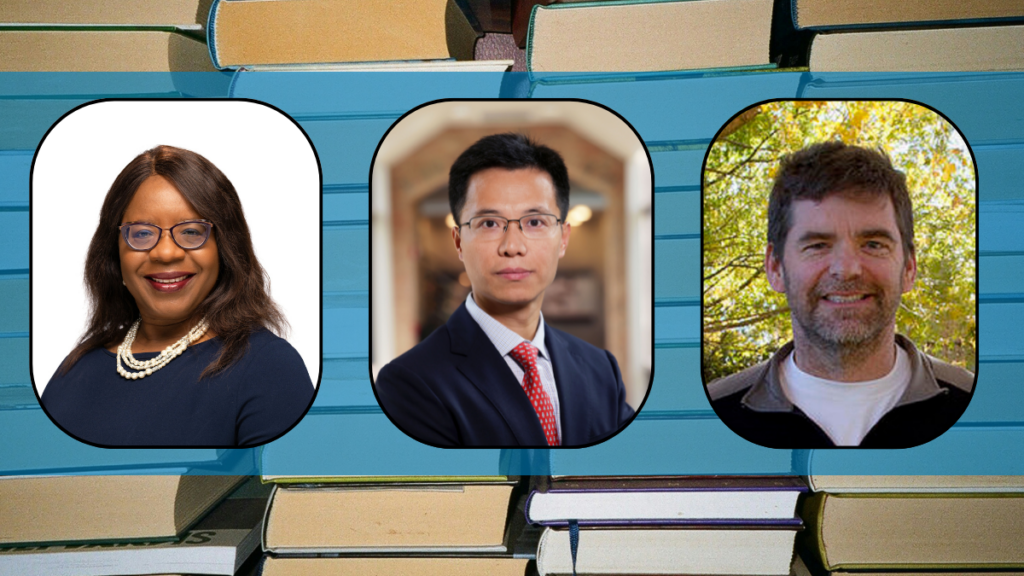
Photos of 3 members of the AGU Books Editorial Board.
Editors’ Vox is a blog from AGU’s Publications Department.

The AGU Books Editorial Board comprises researchers spanning the breath of the Earth and space sciences. From diverse perspectives comes an interdisciplinary catalog of monographs and textbooks—and collaborations between scientists whose paths might not cross otherwise.

In honor of the 70th anniversary of the AGU Books Program, we interviewed three members who have served on the Books Board since its founding in 2020: Estella Atekwana is a near-surface geophysicist and serves as a dean and professor at the University of California Davis; Xianzhe Jia is a space physicist and professor at the University of Michigan; Jim O’Connor is a research geologist with the United States Geological Survey. We asked these Editorial Board members about their favorite projects and why books remain important within the scientific literature  which is dominated by journals.

What is a memory or project that stands out from your AGU Books Editorial Board experience?

Supporting Congo Basin Hydrology, Climate, and Biogeochemistry pushed Board member Jim O’Connor to engage with new topics and geographic areas of study.

JOC: Two items stand out for me. One is one of the first books that I handled, Congo Basin Hydrology, Climate, and Biogeochemistry: A Foundation for the Future. This book was so far outside my zone (topically and spatially) yet so gratifying to be a small part of. It was really a very different book, discussing much classic hydrology but also touching on resource management and politics in an area where those topics are complicated. It was so interesting. And it was published in both English and French.

The other memory sticking with me is our early discussions on what AGU books could and should be about. The discussions were so wide-ranging (including children’s books!), and they really forced me out of what was probably a pretty narrow lane. I suppose such discussions might be expected when you put together a diverse group of scientists and give them a chance to explore what AGU books could be.

Board member Estella Atekwana saw Salt in the Earth Sciences progress from a proposal through multiple iterations and finally to a published book.

EA: One project that stands out is serving as the Subject Editor for the two-volume set Salt in the Earth Sciences: Evaporite Rocks and Salt Deposition and Salt in the Earth Sciences: Basin Analysis and Salt Tectonics by Webster Mohriak. It was a pleasure to work with Dr. Mohriak, who was thoughtful, responsive, and deeply engaged with the review process. I also developed a tremendous appreciation for the reviewers, who took the time to read the full volume carefully, sometimes through multiple iterations, and provide detailed and constructive feedback. Seeing the book move from proposal to publication was deeply rewarding. It reminded me how much care, expertise, and collaboration go into producing a high-quality scholarly book.

XJ: One project that stands out for me is a book that’s still in production. It is about exoplanets, focused on how stellar-driven space environments interact with (exo)planetary magnetic fields and atmospheres and, ultimately, shape habitability. What’s made it memorable is that the book sits right at the boundary between communities that don’t always share the same language—space physics, planetary science, and exoplanets. I’m excited for it to become a resource that helps readers move back and forth between exoplanets and our solar system with a shared comparative framework.

What is your favorite thing about serving on the AGU Books Editorial Board?

EA: When I was first asked to serve as on the AGU Books Editorial Board, I approached the role with some skepticism. I wondered why early- and mid-career faculty or scientists would choose to write books when the academic reward system often emphasizes journal articles, citation counts, and publications in high-impact journals. However, serving on the Board has changed my perspective. I have enjoyed reviewing book proposals, encouraging leaders in the field to consider writing books, and working with an editorial team that provides thoughtful support every step of the way.

My favorite thing about serving on the AGU Books Editorial Board is getting to help shape syntheses—not just what’s new, but what the community collectively understands.

Xianzhe Jia

XJ: My favorite thing about serving on the AGU Books Editorial Board is getting to help shape syntheses—not just what’s new, but what the community collectively understands. This role gives me the opportunity to work with Volume Editors and authors to turn a set of strong contributions into a coherent, usable resource, and to do that in a way that brings different subfields into the same conversation.

JOC: I suppose my favorite thing has been similar to that of being a journal editor. One is forced to confront a much wider scientific arena than that framed by one’s particular scientific discipline. Every AGU book I’ve worked with has had some element of “new and cool” that came with it.

Why are books important for Earth and space science communities? 

XJ: Scientific fields advance by connecting pieces that are often studied separately—stars and their activity, planets and their atmospheres and magnetospheres—and those connections are hard to establish from individual papers alone. A good book synthesizes what we know across those interfaces, makes assumptions and terminology explicit, and highlights where knowledge gaps exist. That’s valuable both for training new scientists and for enabling collaboration; books help researchers from different disciplines meet on common ground, especially when we’re trying to interpret sparse data and compare very different environments.

JOC: I believe that in many instances books enable better stories. The length and format freedom, particularly in relation to journal articles, allows for longer and more fully developed narratives. And I believe good storytelling is essential for communicating science. My personal experience is that books I have been a part of have much wider and long-lasting reach to a wider public than most journal articles. Though this may be changing (or already changed) in the social media age.

In many fields, a well-written book becomes the go-to reference for generations of students, researchers, and practitioners.

Estella Atekwana

EA: Books are important because they provide a trusted, comprehensive place to access knowledge on a particular topic. In many fields, a well-written book becomes the go-to reference for generations of students, researchers, and practitioners. I am reminded of the book Geodynamics by Donald Turcotte and Gerald Schubert, which was foundational to my own studies as a Ph.D. student and has remained an essential text in the field through subsequent editions. It was a special delight when I came to UC Davis to meet Professor Donald Turcotte, then Professor Emeritus in Earth and Planetary Sciences, the author of a book that had been so fundamental to my intellectual development. That experience reinforced for me the lasting impact books can have. They synthesize knowledge, broaden access, and help sustain a global scientific community.

—Dara Liling (dliling@agu.org; 0009-0005-6828-2811), American Geophysical Union, USA; Estella Atekwana (0000-0003-1424-4068), University of California Davis, USA; Xianzhe Jia (0000-0002-8685-1484), University of Michigan, USA; and Jim O’Connor (0000-0002-7928-5883), United States Geological Survey, USA

Citation: Liling, D., E. Atekwana, X. Jia, and J. O’Connor (2026), The Editorial Board marks the latest chapter in AGU Books, Eos, 107, https://doi.org/10.1029/2026EO265023. Published on 1 June 2026.
This article does not represent the opinion of AGU, Eos, or any of its affiliates. It is solely the opinion of the author(s).
Text © 2026. The authors. CC BY-NC-ND 3.0
Except where otherwise noted, images are subject to copyright. Any reuse without express permission from the copyright owner is prohibited.

  • ✇Eos
  • NSF Eliminates Geoscience Postdocs Emily Gardner
    Research & Developments is a blog for brief updates that provide context for the flurry of news regarding law and policy changes that impact science and scientists today. The National Science Foundation (NSF) has eliminated its postdoctoral fellowship funding for Earth scientists. On the NSF website, the opportunity is listed as “archived.” This first came to the attention of Eos this week, although a Redditor had posted about the opportunity being archived as far back as March.
     

NSF Eliminates Geoscience Postdocs

14 May 2026 at 19:14
A row of microscopes sit on a lab bench.

Research & Developments is a blog for brief updates that provide context for the flurry of news regarding law and policy changes that impact science and scientists today.

The National Science Foundation (NSF) has eliminated its postdoctoral fellowship funding for Earth scientists.

On the NSF website, the opportunity is listed as “archived.” This first came to the attention of Eos this week, although a Redditor had posted about the opportunity being archived as far back as March.

“What do you do when the most powerful people in the country just decide that your field shouldn’t exist anymore?” asked one Earth scientist on Bluesky.

“So, what are we doing now that we’re just not going to have new grants in GEO?” asked another.

According to the last program solicitation, posted in October 2024, the program generally awarded about $2.78 million each year, funding 8 to 10 postdoctoral fellowships. Proposals could be related to any of the disciplines within the scope of NSF’s Division of Earth Sciences (EAR), part of the NSF Directorate for Geosciences (NSF GEO).

The NSF announced an “organizational realignment” in December 2025. As part of the agencywide reorganization, GEO gained new leadership in February 2026. Joydip Kundu, the new NSF GEO Directorate Head, first joined NSF GEO in July 2025 as the agency’s deputy assistance director, coming from the NSF Directorate for Computer and Information Science and Engineering. He previously worked for the White House Office of Management and Budget (under President Obama) and the University of Maryland. Like Kundu, NSF’s new deputy directorate heads also came from within the agency.

When contacted about the archived opportunity, an NSF spokesperson confirmed to Eos that “The EAR postdoc fellowship solicitation has been archived and will not have a competition this fall. NSF regularly evaluates its portfolio of funding opportunities and will continue to explore funding opportunities for early career geoscientists.”

NSF continues to offer fellowship opportunities to postdoctoral researchers in the fields of engineering, entrepreneurial research, mathematics and physical sciences. Fellowships to postdocs in biology are available only if they involve the use of artificial intelligence.

—Emily Gardner (@emfurd.bsky.social), Associate Editor

These updates are made possible through information from the scientific community. Do you have a story about how changes in law or policy are affecting scientists or research? Send us a tip at eos@agu.org.

A photo of a hand holding a copy of an issue of Eos appears in a circle over a field of blue along with the Eos logo and the following text: Support Eos’s mission to broadly share science news and research. Below the text is a darker blue button that reads “donate today.”
Text © 2026. AGU. CC BY-NC-ND 3.0
Except where otherwise noted, images are subject to copyright. Any reuse without express permission from the copyright owner is prohibited.
  • ✇Eos
  • Germany to Return Contested Dinosaur Fossil to Brazil Sofia Moutinho
    For many years a source of irritation, a fossil of the Brazilian spinosaurid Irritator challengeri is now bringing some joy to paleontologists in its homeland. Following a successful public campaign for restitution, the piece is returning to Brazil from the collection of Germany’s State Museum of Natural History Stuttgart (SMNS), where it has been kept for the past 30 years—a situation that Brazilian paleontologists and lawmakers deemed illegal. Representatives of both countries made the
     

Germany to Return Contested Dinosaur Fossil to Brazil

22 May 2026 at 11:18
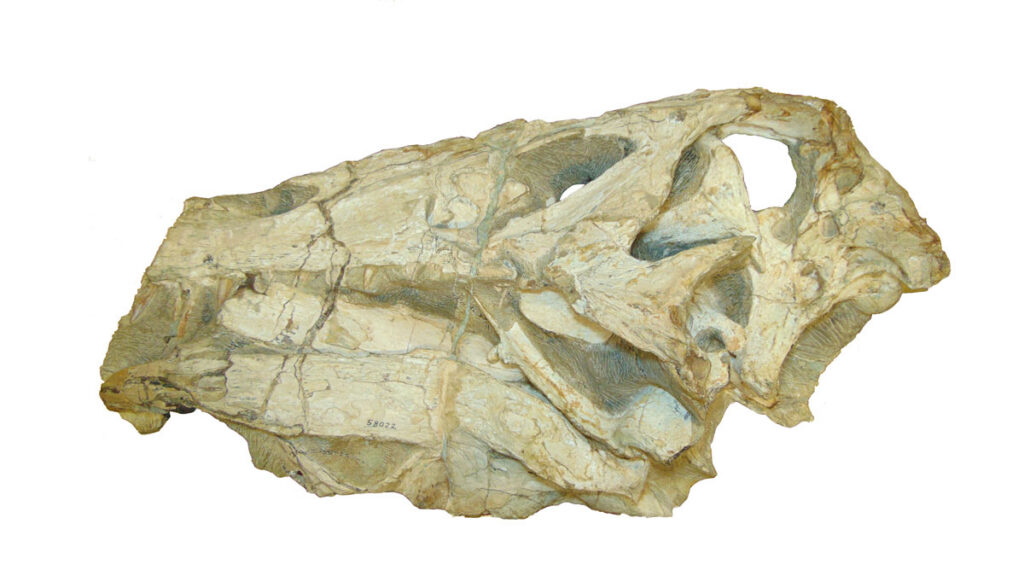
Fossil of the skull of the dinosaur Irritator challengeri

For many years a source of irritation, a fossil of the Brazilian spinosaurid Irritator challengeri is now bringing some joy to paleontologists in its homeland.

Following a successful public campaign for restitution, the piece is returning to Brazil from the collection of Germany’s State Museum of Natural History Stuttgart (SMNS), where it has been kept for the past 30 years—a situation that Brazilian paleontologists and lawmakers deemed illegal.

Representatives of both countries made the announcement last month during Brazilian President Luiz Inácio Lula da Silva’s visit to Germany. In a joint statement, they announced the German museum’s “willingness” to “hand over” the fossil to Brazil and start a new, more transparent era of international collaboration.

“It is a very expected and cherished move because it represents a huge scientific and social victory for the Global South and for Brazil.”

“Finally, the Irritator will be back to its original place,” said paleontologist Allysson Pontes Pinheiro, director of the Plácido Cidade Nuvens Paleontology Museum.

The museum, located in northeastern Brazil where the fossil was discovered in the 1990s, will host the Irritator when it returns to Brazil. “It is a very expected and cherished move because it represents a huge scientific and social victory for the Global South and for Brazil,” Pinheiro said, highlighting that the return will allow local scientists and the population to have access to a heritage that would be difficult and expensive to access abroad.

The Irritator challengeri fossil is one of many that have been illegally obtained from South America by researchers from the Global North. Considered the most complete spinosaurid skull ever described, the 110-million-year-old specimen was taken from the Araripe Basin in northeastern Brazil and described in 1995 by British paleontologist David Martill and his German colleague Eberhard “Dino” Frey. Martill and Frey worked on at least one other fossil smuggled from Brazil to Germany, an Ubirajara jubatus specimen, which was repatriated in 2023 and is currently housed at Plácido Cidade Nuvens.

Martill and Frey named the newly discovered species in reference to their irritation upon learning that the skull had been manipulated by fossil dealers to get a better price. Little did the researchers know that the fossil would irritate many other scientists, especially those from the animal’s homeland.

Revisiting a Fossil with “Problematic Status”

In 2023, triggered by the publication of a paper that acknowledged the fossil’s “problematic status,” paleontologists in South America published an open letter to the Ministry of Science, Research and Arts of Baden-Württemberg State demanding its return. The document received about 300 signatures from scientists and lawyers and was followed by a viral social media campaign involving influencers and a more recent public petition on Change.org that gathered more than 34,000 signatures.

“This campaign showed us that it is worth continuing to fight for our fossils.”

The restitution request is based on Brazilian legislation passed in 1942 that determined that fossils found in the country are the state’s property and cannot be traded or exported without explicit authorization. In addition, a more recent Brazilian ordinance (dating to 1990) mandates that any holotype (a fossil used to describe a new species, such as the contested Irritator specimen) must remain in the country. Regardless, SMNS maintained the fossil had been legally purchased from a private dealer in Germany in 1991.

“We are very happy the Brazilian law is now being respected,” said Aline Ghilardi, a paleontologist at the Federal University of Rio Grande do Norte who was at the forefront of the repatriation campaign. “This campaign showed us that it is worth continuing to fight for our fossils.”

At the time of publication, SMNS had not responded to requests for comment.

A Long Process of Decolonization

But Ghilardi is not entirely satisfied. She didn’t like the wording of the announcement, which used the expression “hand over” rather than return, repatriate, or restitute.

“The statement was a missed opportunity to demonstrate the German government’s willingness to decide in favor of a restitution process,” she explained. “It seems there is resistance to making these restitutions as actual restitutions. It appears as if it is theirs by right and that they will hand over the fossil to Brazil as part of scientific cooperation.”

Ghilardi expressed that she will believe the repatriation will actually happen only when a specific return date is announced. (As of publication, it has not.) She also hopes that the Irritator case is not an isolated incident, but part of an ongoing trend of restitutions intended to break the pattern of neocolonialism in science.

A 2025 study published by Ghilardi and colleagues in the journal Palaeontologia Electronica showed that of nearly 500 invertebrate species described from fossils found in the Araripe Basin—one of Brazil’s richest and most threatened regions of geodiversity—about half have holotypes stored in institutions across Europe, Asia, and North America, violating Brazilian law.

Most of these smuggled fossils are hosted in Germany. “Some foreign colleagues complained about our campaign, saying that it looked like we were persecuting Germany,” Ghilardi said. “But that is not the case. It is just the numbers.”

It is possible, she noted, that other countries hold even more specimens that were not described in the scientific literature and therefore could not be counted.

The same study also found that more than 200 species were described in publications that did not include any Brazilian scientists as coauthors, despite Brazilian legislation requiring foreign research on Brazilian fossil material to be conducted in partnership with local institutions.

Wave of Repatriation

Paleontologist Serjoscha Evers at the Universität Freiburg, who authored the 2023 study on the Irritator fossil, wrote in an email to Eos that he welcomed the news of the dinosaur’s return.

However, he also wondered whether the decision is just “a diplomatic favor that resulted from the public pressure, or foreshadowing a broader wave of repatriations based on a legal conclusion that the fossils are unlawfully in German custody.”

Paleontologists involved in the Irritator restitution efforts said that since the campaign began, they have been receiving emails from museums and institutions worldwide seeking information on the procedures for returning fossils to Brazil.

Reconstruction of the Irritator challenger dinosaur.
Germany recently said it would “hand over” the Irritator challengeri fossil to Brazil. This illustration suggests what the dinosaur would have looked like before it was a fossil, about 110 million years ago. Credit: PaleoGeekSquared/Wikimedia Commons, CC BY-SA 4.0

The Plácido Cidade Nuvens Paleontology Museum, the final destination of the Irritator, has received several restitutions itself, including 45 fossils originally collected from the Araripe Basin and previously held by the University of Zurich in Switzerland, the fossil of a crustacean that was in the possession of the Universidad Nacional del Nordeste in Argentina, and a fish fossil seized in Italy.

According to Pinheiro, the museum’s director, paleontologists and the Brazilian government have listed at least 90 Brazilian holotypes still held in Germany. And the Brazilian Ministry of Foreign Affairs confirmed to Eos that it is currently negotiating the return of nine fossils held in undisclosed countries.

“We have been talking with colleagues from the museums where these materials are hosted, and they seem very favorable to returning them,” Pinheiro observed. “It is a huge advancement and a great change of behavior from important museums that have been holding heritage from the Global South.”

—Sofia Moutinho (@sofiamoutinho.bsky.social), Science Writer

Citation: Moutinho, S. (2026), Germany to return contested dinosaur fossil to Brazil, Eos, 107, https://doi.org/10.1029/2026EO260167. Published on 22 May 2026.
Text © 2026. The authors. CC BY-NC-ND 3.0
Except where otherwise noted, images are subject to copyright. Any reuse without express permission from the copyright owner is prohibited.
  • ✇Eos
  • Artists and Scientists Partner to Bring Atmospheric Data to Life Emily Gardner
    “I’ve just always felt like art and science are flip sides of the same coin.” Scientists use tools ranging from models to microscopes to make sense of the world around them. Some might say artists do the same thing using tools such as paintbrushes and musical instruments. “I’ve just always felt like art and science are flip sides of the same coin, with maybe different outcomes or different processes, but they’re both just getting at the truth of the world,” said Sara Bouchard, a sound art
     

Artists and Scientists Partner to Bring Atmospheric Data to Life

3 June 2026 at 12:47
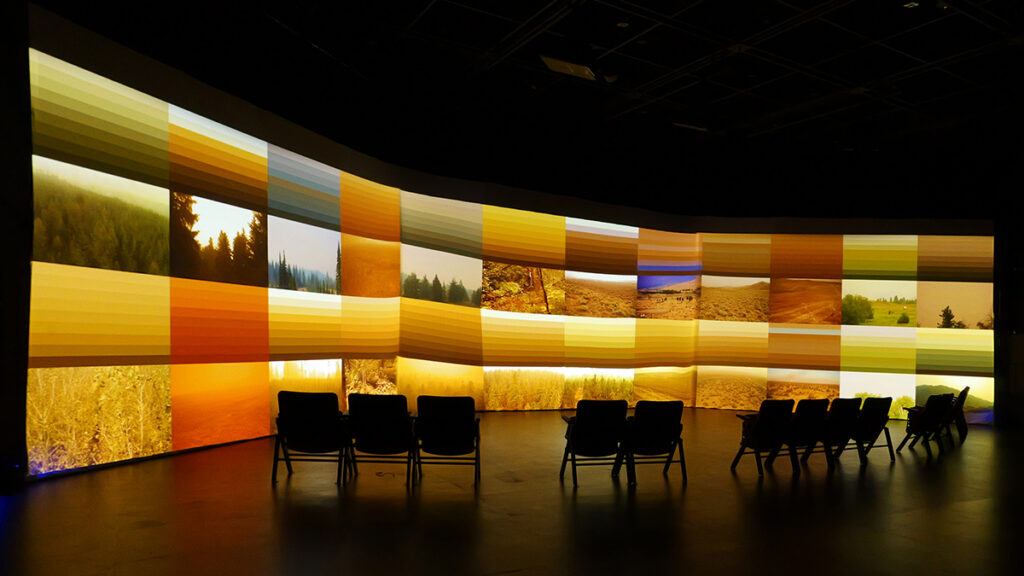
A row of 12 chairs, lined up in a dark room, is silhouetted against three screens showing orange-hued images. Some are just gradients of color, and others display landscapes.

“I’ve just always felt like art and science are flip sides of the same coin.”

Scientists use tools ranging from models to microscopes to make sense of the world around them. Some might say artists do the same thing using tools such as paintbrushes and musical instruments.

“I’ve just always felt like art and science are flip sides of the same coin, with maybe different outcomes or different processes, but they’re both just getting at the truth of the world,” said Sara Bouchard, a sound artist and composer and adjunct faculty member in the Department of Kinetic Imaging at Virginia Commonwealth University’s (VCU) School of Art.

A recent National Science Foundation–funded collaboration between scientists and artists brought this principle to life.

In fluxART, artists partnered with scientists from FLUXNET, an international network of researchers using eddy covariance techniques to measure how gases move between ecosystems and the atmosphere.

Researchers and artists collaborated on art projects based on data collected at FLUXNET towers. A view from the top of one such tower near Sisters, Ore., is seen here. Credit: Alexander Irving

The scientist-artist pairs worked together in yearlong residencies and produced art pieces—ranging from music compositions and video installations to ceramic works and paintings—that they presented at the Patricia Valian Reser Center for the Creative Arts in Corvalis, Ore., in early 2026.

“Part of the framing of the residency was around flux as this metaphor for connection and belonging and relationships.”

“The metaphor that people use to describe what this science network measures, or does, is that it’s monitoring the breath of the biosphere,” said Maoya Bassiouni, an environmental scientist at the University of California, Berkeley, who directed and developed the residency. “Those fluxes are sort of this giving and receiving between the land and the atmosphere, and it’s exactly what the scientists are doing in the community. So, part of the framing of the residency was around flux as this metaphor for connection and belonging and relationships.”

Bassiouni, who also created artworks in the residency, presented a lecture about the series alongside two other fluxART artists in late May at the National Center for Atmospheric Research’s (NCAR) Mesa Lab in Boulder, Colo.

An installation at NCAR’s Mesa Lab Library featuring all four fluxART projects also opened on 27 May and will be on display through the end of 2026.

En Masse

Bouchard, the sound artist, was paired with Chris Gough, a biogeochemist who serves as the executive director of the Rice Rivers Center at VCU.

Gough studies how factors such as climate and disturbances affect ecosystems, particularly forests and wetlands. Bouchard learned more about Gough’s work by spending a year in his lab.

Virginia Commonwealth University’s Rice Rivers Center Marsh, an AmeriFlux site whose data were used in this project, is located along the James River, seen here. Credit: Megan May Photography

The result was a composition for choir and percussion called En Masse, which explores the connections between communities and ecosystems in a time of climate crisis. The piece’s five movements represent the movement of carbon through the environment: “Air,” “Wood,” “Soil,” “Fire,” and “Breath.”

In addition to vocals and instruments, the composition features birdsong, recordings from a compost pile, sonified data from Gough’s lab, and spoken words gathered from real people sharing their climate anxieties. An excerpt from the “Fire” movement reads,

Future! / Heavy weight on my ribcage / dusty, fragmented
Fire! / Clenched jaw, copper taste in my mouth / stark, shifted
Fire! / I worry about my kids / desperate, unbreathable
Fire! / and their future / squeezed, extreme
Future! Fire! Fire! Fire!

Both Bouchard and Gough said they were moved by the piece as it was performed in Corvalis and by seeing the mix of artists and scientists who attended, many traveling from other states.

“I was struck by how engaged both the scientific and artistic communities were,” Gough said. “We walked out, and it was a full room of people. It was energizing, and I think it felt meaningful in a way that stepping up on a conference stage to deliver the traditional convention talk [isn’t].”

September: Orange

In another pairing, video artist Julia Oldham partnered with Christopher Still, a plant ecophysiologist at Oregon State University.

The partnership started with Oldham visiting a 175-foot-tall (53-meter-tall) FLUXNET tower near Sisters, Ore., that Still and his team monitor.

Video artist Julia Oldham visited a FLUXNET tower near Sisters, Ore., with scientist Christopher Still in preparation for creating an art piece based on data gathered at the tower. Credit: Alex Irving

At the top of the tower, a PhenoCam takes photos of the surrounding Deschutes National Forest every half hour. Still uses data from these images to examine how the greenness of the canopy changes over time because such changes can provide information about fluxes in carbon, water, and energy.

“I learned more about what Chris uses the PhenoCam for and got superexcited about the fact that Chris is using color data to understand forests,” Oldham said. “I thought that that was a really beautiful point of overlap for us as a scientist and an artist, to think about color and forests and what we can learn from color as a scientific tool.”

The pair created two pieces. 18//Flux shows how the colors and light from one PhenoCam site changed from 4 a.m. to 9 p.m. throughout the year for 13 years. Each frame is divided into 13 strips, with each strip representing 1 hour of the monitoring period.

The two had conversations throughout the duration of the project about the growing role of wildfires in the area. In fact, one of the FLUXNET towers they were using in the project burned down.

Their conversations led to September: Orange, a three-channel video showing footage from 24 different PhenoCams in the northwestern United States and Canada. When all of the landscapes are the same shade, the video briefly pauses. In September, when wildfires sweep through Cascadia, orange becomes the dominant color. The piece is accompanied by field recordings from Oregon forests and sonified canopy greenness data.

“I think the installation was a wild success, and I had a lot of people tell me how much they enjoyed it and appreciated it,” Still said. “Most people don’t respond to a 2D graph of data…whereas I think almost everyone responds to images, and photographs are really meaningful to people. So I think that is a really brilliant way to draw people into the science.”

—Emily Gardner (@emfurd.bsky.social), Associate Editor

Citation: Gardner, E. (2026), Artists and scientists partner to bring atmospheric data to life, Eos, 107, https://doi.org/10.1029/2026EO260178. Published on 3 June 2026.
Text © 2026. The authors. CC BY-NC-ND 3.0
Except where otherwise noted, images are subject to copyright. Any reuse without express permission from the copyright owner is prohibited.
❌
Subscriptions