
Reading view

Academic questions Singapore’s rush towards AI amid growing fears over jobs and inequality
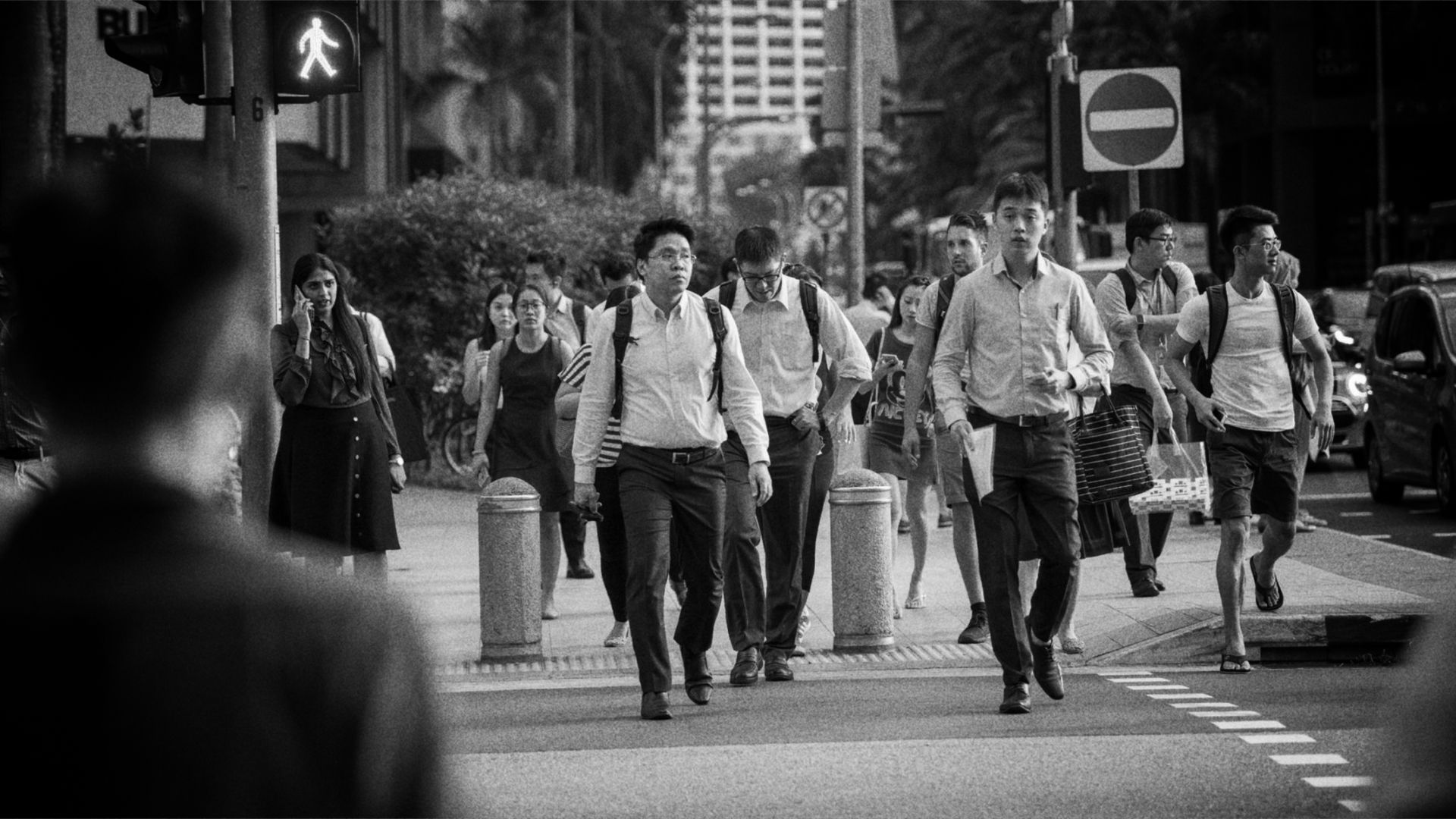
SINGAPORE: As Singapore accelerates its embrace of artificial intelligence, concerns are growing over the technology’s impact on jobs, education, inequality and the environment, with academic Walid J Abdullah calling for a deeper national conversation about the costs of rapid AI adoption.

In a lengthy Facebook post published against the backdrop of major companies pursuing aggressive AI strategies, Dr Walid questioned whether society is moving too quickly to integrate artificial intelligence into everyday life without fully considering its long-term consequences.

His remarks come amid heightened public discussion surrounding AI-driven restructuring exercises at major corporations, including Meta and Standard Chartered, as firms increasingly turn to automation and AI tools to streamline operations and cut costs.

Even members of the Government appear to have been bitten by the AI bug. Earlier this week, Singapore Foreign Minister Vivian Balakrishnan revealed that he had personally built a customised AI-powered diplomatic assistant to help manage the demands of global diplomacy.

Dr Balakrishnan argued that Singapore’s opportunity lies not necessarily in building frontier AI models, but in deploying AI effectively across society, and said that something needs to be understood in order to be governed.

While acknowledging that artificial intelligence has genuine benefits and may contribute to medical and technological advances, Prof Walid argued that enthusiasm for AI should not crowd out serious discussion about its drawbacks.

“AI definitely can help with some tasks and has reportedly been useful in medical advances,” he wrote on Facebook, “But that does not mean we should not have a serious discussion about the drawbacks.”

One of his primary concerns centred on education, particularly the growing emphasis on technological tools in classrooms. Prof Walid argued that good teaching ultimately depends on human qualities that AI cannot replicate, including emotional connection and the creation of safe spaces for thought and discussion.

“For me, a good teacher should: 1. Explain concepts clearly; 2. Simplify difficult ideas; 3. Create a safe space for thought and discussion in class and 4. Develop human/emotional connection with students,” he wrote.

While technology may assist with explaining concepts and simplifying ideas, he argued that the social and emotional aspects of teaching cannot be outsourced to machines.

He also questioned whether generative AI tools are genuinely improving students’ cognitive abilities, saying he had yet to observe evidence that students are thinking or writing better since the rise of GenAI.

“GenAI can enhance learning, if used properly,” he wrote, “But the question that needs to be asked is not whether GenAI can enhance learning. The question is: on the balance of probabilities, would teenagers and 19-23 year olds use GenAI properly such that it would enhance learning?”

Prof Walid also raised concerns about inequality and job displacement, referencing recent controversy surrounding comments by Standard Chartered’s chief executive on replacing “lower value humans” with automation, remarks that were publicly criticised by former president Halimah Yacob.

He argued that AI-driven automation appears to conflict with longstanding economic justifications centred on preserving employment.

“We cannot do away with oil, because of jobs. We have to get more foreigners in, because of jobs. We have to invest in countries with questionable human rights records, because of jobs,” he wrote, “But somehow, we don’t have to think about jobs when embracing AI?”

He questioned whether widespread AI adoption could deepen existing social and economic divides by concentrating power and wealth among companies and individuals able to benefit most from automation.

Prof Walid also pointed to the massive energy demands associated with AI infrastructure, particularly data centres, and questioned whether sustainability commitments are being sidelined in the rush to expand AI capabilities.

“All of the talk by big tech about saving the environment is likely down the drain now,” he wrote, referring to the environmental costs of powering AI systems and managing the resulting electronic waste.

“What is the long term impact on the environment? Or have we decided collectively that we are abandoning sustainability targets?”

Beyond economics and sustainability, the academic argued that technology itself is never politically or morally neutral. He urged the public to scrutinise not only the tools being built, but also the values and intentions of the executives leading major technology companies.

“Technology has never been neutral,” he wrote, warning about the growing concentration of power among tech firms and the potential consequences of allowing their platforms and systems to become deeply embedded in society without sufficient public debate.

He said Singapore should openly discuss the moral and practical implications of AI adoption before introducing even more AI-focused initiatives and training programmes.

Noting that concerns about AI are not isolated to Singapore, he urged, “At least, let’s have a conversation about this, before we introduce yet another AI tool into the list of Skillsfuture courses.”

This article (Academic questions Singapore’s rush towards AI amid growing fears over jobs and inequality) first appeared on The Independent Singapore News.

  •  

ADP Report: Only 15% Singapore workers feel safe from job cuts despite rising AI adoption; also ranked as among world’s least confident about job security

SINGAPORE: Singapore workers are showing up to work, putting in extra hours, and even adopting artificial intelligence (AI), yet many still don’t feel secure about their future.

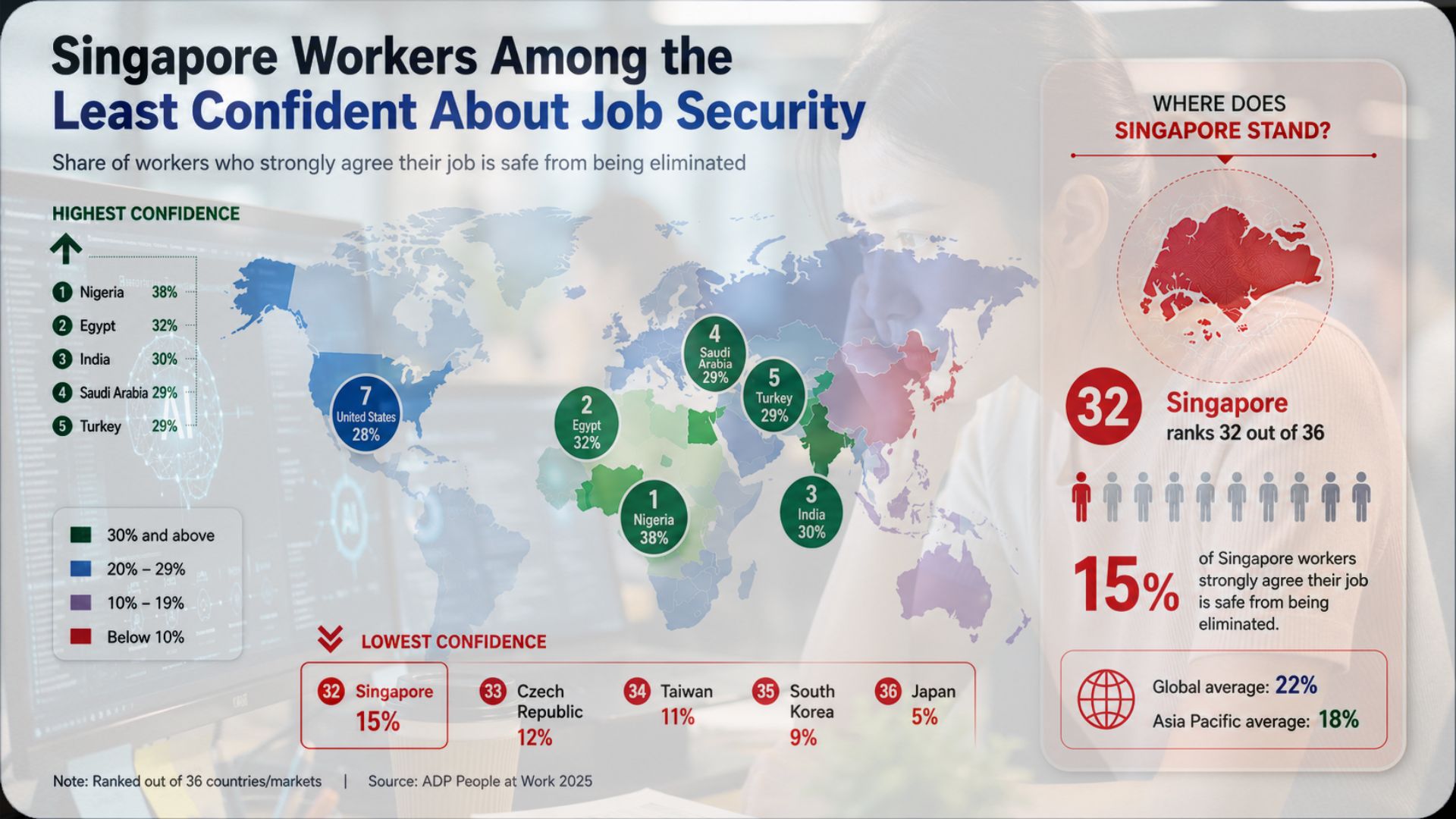
A new People at Work report by ADP Research, cited by Vulcan Post (May 21), shows that only 15% of workers in Singapore strongly believe their jobs are safe from elimination. This placed Singapore among the lowest-ranked markets globally for job security confidence.

Out of 36 markets surveyed, only four scored lower than Singapore. Across the Asia-Pacific (APAC) region, the average was slightly higher, at 18%, while the global average was 22%. Unemployment remains relatively low worldwide, yet confidence doesn’t appear to be following.

Infographic showing global rankings of worker confidence in job security, with Singapore placed 32nd out of 36 markets at 15%, alongside visual comparisons to global and Asia-Pacific averages for 2026
People at Work Report/ADP Research
Infographic: Singapore ranks among the lowest globally for worker confidence in job security in 2026

Workers are now worried about relevance, not just employment

According to Jessica Zhang, Senior Vice President for Asia-Pacific at ADP, workers are thinking beyond whether they have a pay cheque today. Her point was that many employees are now asking a different question: Will my job still matter a few years from now?

Concerns now go beyond being centred on layoffs or economic downturns as workers watch automation, AI adoption, changing business needs and how fast and easily skills can become outdated.

Zhang said employers need to do more than reassure staff. Companies should explain how jobs are changing, what that means in practical terms and continue investing in training so employees can stay useful and adaptable while supporting business performance.

Working more doesn’t always mean feeling safer

The report also found that many workers in Singapore are putting in unpaid hours. About 45% said they worked over five unpaid hours each week. Among them, 35% reported clocking between six and 15 unpaid hours weekly, while another 10% said they exceeded 16 hours.

The figure for six to 15 unpaid hours was above the Asia-Pacific (APAC) average. There is an uncomfortable contrast in these numbers. Longer hours are usually seen as a sign of commitment or ambition, yet they don’t appear to translate into greater job security.

Though it doesn’t mean hard work has no value, it still suggests workers increasingly see staying employed and staying relevant as two separate challenges.

AI is arriving, but engagement isn’t rising with it just yet

Singapore also recorded fairly high levels of generative AI use. Around 23% of workers said they used AI almost every day, while only 8% said they had never tried it. Yet employee engagement remained muted.

Fully engaged workers made up just 12% of Singapore’s workforce in both 2024 and 2025, below the regional average of 15%, a combination is worth paying attention to, as more tools don’t automatically create more confidence. Technology may improve speed and output, but workers still want clarity about where they fit in.

The deeper concern may be certainty in employment

ADP Research surveyed more than 39,000 adult workers across 36 markets between July and August 2025, including over 13,000 respondents from APAC.

For Singapore, the findings point to something further than job cuts. Many workers still have jobs, but what appears to be fading is confidence that today’s job will still look familiar tomorrow.

The practical answer is neither panic nor endless overtime. Workers can keep building skills. Employers can communicate earlier. Because when people understand where work is heading, uncertainty tends to shrink.

This article (ADP Report: Only 15% Singapore workers feel safe from job cuts despite rising AI adoption; also ranked as among world’s least confident about job security) first appeared on The Independent Singapore News.

  •  

Singapore job hiring drops across most sectors despite AI-driven manufacturing demand; employment outlook weakens in the coming months

SINGAPORE: Singapore’s job market has taken a sharp turn. After ending 2025 on a stronger footing than many expected, businesses are now showing far less appetite to hire.

New survey data from the Economic Development Board (EDB) and Singapore Department of Statistics (DOS), reported by Vulcan Post, points to weaker business sentiment over the next six months and softer hiring plans across much of the economy.

When hiring slows there, the effects spread beyond office towers and into everyday spending, household planning, and career decisions.

Manufacturing finds support while other sectors lose steam

The outlook isn’t equally weak across every sector. Manufacturing seems to be holding up better than expected, supported by demand linked to artificial intelligence (AI), especially in semiconductor-related activity. According to the report, this strength has helped cushion weaker performance elsewhere in manufacturing.

Still, that support comes with limits. The article noted that gains are uneven and concentrated in select areas rather than broad-based growth, meaning stronger demand in one corner of the economy doesn’t automatically create opportunities across the board.

Services face the bigger hiring slowdown

Earlier in the year, most industries still expected to expand hiring after a stronger-than-expected 2025, but this optimism has now faded.

The latest business outlook shows that only recreation and personal services expect higher hiring activity. Several sectors that are usually seen as dependable employers are turning more cautious. Finance, viewed as a stable source of professional jobs, is also expected to face pressure rather than expansion.

Retail trade recorded one of the steepest changes in sentiment. Expectations moved from net positive territory earlier in the year into negative ground, making it one of the sectors facing the strongest pullback.

Longer job search periods and tougher competition for openings

Hiring sentiment doesn’t equal actual job losses, but it does act as an early signal. Companies usually reduce expansion plans before making larger workforce decisions. When uncertainty rises and costs increase, employers tend to delay recruitment and become more selective.

For Singaporeans planning a job switch, returning to work, or entering the market, this could mean longer search periods and tougher competition for openings.

At the same time, hiring slowdowns don’t hit every skill group equally. Areas linked to technology, automation and specialised industrial work may continue to see demand even as hiring cools.

Businesses are choosing caution in hiring for now

In summary, many employers seem to be waiting for greater stability before making hiring commitments.

Singapore has navigated difficult periods before and recovered faster than expected, but for now, the mood has changed from expansion to caution.

When hiring weakens, workers who keep skills current, stay flexible and expand their options usually give themselves the best chance of riding out slower cycles.


Read related: Meta terminates 8,000 jobs globally, while Singapore staff receive their termination e-mails at 4 AM, as the company moves on with its new AI-focused teams

This article (Singapore job hiring drops across most sectors despite AI-driven manufacturing demand; employment outlook weakens in the coming months) first appeared on The Independent Singapore News.
  •  

Singaporeans push back after David Neo says ‘protecting every job’ would be a ‘disservice’

SINGAPORE: Yet another newly minted People’s Action Party (PAP) minister has found himself at the centre of online criticism after comments he made about jobs and employment sparked accusations that he is out of touch with the realities faced by ordinary Singaporean workers.

The latest minister to draw fire is Acting Minister for Culture, Community and Youth David Neo, who recently said that it would be a “disservice” to protect every job as Singapore navigates the impact of artificial intelligence and rapid technological change.

Mr Neo, who also serves as co-chair of the Government’s Economic Strategy Review (ESR) committee on human capital, made the remarks in an interview with CNA while discussing how Singapore should respond to technological disruptions and the changing nature of work.

According to Mr Neo, Singapore cannot afford to slow the adoption of AI simply to preserve existing jobs, as doing so would weaken the country’s competitiveness and risk driving businesses elsewhere.

“We want to protect every worker, but we don’t want to do that through protecting every job,” he said, “If we were to just protect jobs in the short term, we’ll be doing our workers a disservice in the long term. Because if we are not competitive, then (businesses) will move out of Singapore.”

Mr Neo added that countries that fail to adapt could lose industries and investments to more competitive economies. Instead of preserving jobs indefinitely, he argued that Singapore should focus on helping workers reskill and upskill while strengthening support for career transitions.

The acting minister also outlined his view of what constitutes a good job.

“A good job is not just a job that offers a good paycheck,” he said, “A good job should be one that offers good dignity, stability, as well as social mobility.”

The ESR has therefore emphasised expanding the range of quality jobs available across the economy for workers at different stages of their careers, he added.

“Ultimately, that’s going to be what provides good jobs, not just today but tomorrow for all our workers.”

However, the comments were met with a wave of criticism online, with many Singaporeans questioning whether Mr Neo is in a position to understand the anxieties faced by workers worried about layoffs and unemployment.

Much of the criticism centred on Mr Neo’s career history.

Mr Neo enlisted in the Singapore Armed Forces (SAF) at the age of 19 and spent his entire professional career in the military before entering politics. During his military career, he held several senior appointments and obtained degrees from the Massachusetts Institute of Technology and Stanford University under Government scholarship.

In 2022, he was appointed Chief of Army and promoted to the rank of Major-General.

In March 2025, he resigned from the SAF. Days later, he was spotted at a PAP walkabout in Tampines GRC alongside Minister for Social and Family Development Masagos Zulkifli. He was subsequently introduced as a PAP candidate for the 2025 General Election and entered Parliament as part of Mr Masagos’ team.

As a minister, Mr Neo is now part of a political leadership that receives some of the highest salaries among elected office holders globally.

For many critics, this background makes his comments on job insecurity difficult to accept.

One netizen wrote: “A paper general will never understand the pain of losing a job because he has never had to live through it himself.

“Every morning, unemployed Singaporeans wake up to the same harsh reality: no job, no certainty, and no clear answers. They face the stress of supporting their families, paying their bills, and wondering when their next opportunity will come.

“While some people discuss unemployment as a statistic or policy issue, those affected are living it every single day. Until you have experienced that struggle firsthand, it is difficult to truly appreciate the fear, frustration, and helplessness that many job seekers endure.”

Another commenter sarcastically suggested that ministers should volunteer for token salaries if they believed pay was not the most important aspect of work, saying, “Volunteer at $1 paycheck lah. Since they are already millionaires or multi-millionaires, serve the country with your passion loh… Just do it.”

Others compared Mr Neo’s remarks to previous controversies involving ministers commenting on issues that critics felt they lacked personal experience with.

“First was a Minister who does not live in an HDB advising about small spaces, then another minister not married to advise on fertility and family planning measures, a minister with no medical knowledge as health minister, and now this bozo of a clown to talk about protecting jobs.

“We really have incompetent ministers who are not even on the ground level to take charge of our livelihoods. All of them are living in castles in the air to understand the plight of common folks.”

Several netizens also focused on the contrast between ministerial salaries and Mr Neo’s remarks about good jobs being about more than pay.

One commenter said: “So long as the people feel that the appointment holders are paid too high and not helpful (contributing), whatever they said would not be well taken.

“In this case, the Minister with a very good paycheck advises Singaporeans that good jobs are about more than a good paycheck.

“The government has to win over the Singaporeans first. Come down to our level first. Leadership by example that they are willing to work with lower paychecks.”

Another netizen remarked that Mr Neo appeared to be describing his own career when defining a good job.

“He’s just describing himself having a good job, on top of a good paycheck. His job offer dignity, stability (won’t be sack unless you decide to resign), and social mobility (will be moved to be some CEO of some company in the event they decide to leave or lose an election)…”

Others were more blunt in their criticism.

“What kind of stupid statement is that, especially when our ministers are all overpaid?” one commenter said, while another netizen said, “David Neo’s job protection plan: protect my job, not yours.”

One netizen quipped sarcastically, “He wakes up every morning because his job is protected.”

Another commenter suggested that public office holders should experience the same competitive pressures faced by workers: “Maybe we need to replace our MPs, Ministers and judges with AI. Then they will know what real competition is.”

This article (Singaporeans push back after David Neo says ‘protecting every job’ would be a ‘disservice’) first appeared on The Independent Singapore News.

  •  
❌