Reading view

100 ships redirected amid naval blockade of Iran ports, Strait of Hormuz: Centcom

U.S. Central Command (Centcom) said Saturday it has redirected more than 100 commercial vessels as part of the ongoing naval blockade of Iranian ports in the Strait of Hormuz, calling the move a “milestone” as tensions persist in the region. Since the blockade began in April at President Trump‘s direction, more than 15,000 U.S. troops...

  •  

Three months in, is Trump losing the Iran war?

Malay Mail

  • Doubts grow whether Trump can translate tactical military successes into geopolitical win
  • Iran’s leverage over strait, unchecked nuclear ambitions undercut Trump’s war narrative
  • Pressure on Trump grows as war objectives remain unmet

WASHINGTON, May 23 — US President Donald Trump may have won just about every battle against Iran, but three months after attacking the Islamic Republic he now faces a bigger question: Is he losing the war?

With Iran’s grip on the Strait of Hormuz, its resistance to nuclear concessions and its theocratic government largely intact, doubts are growing that Trump can translate the US military’s tactical successes into an outcome he can frame convincingly as a geopolitical win.

His repeated claims of complete victory ring hollow, some analysts say, as the two sides teeter between uncertain diplomacy and his on-again-off-again threats to resume strikes, which would be sure to draw Iranian retaliation across the region.

Trump is now at risk of seeing the US and its Gulf Arab allies emerge from the conflict worse off while Iran, though battered militarily and economically, could end up with greater leverage, having shown it can throttle one-fifth of the world’s oil and gas supplies.

The crisis is not yet over, and some experts leave open the possibility Trump might still find a face-saving way out if negotiations break in his favour.

But others predict a grim post-war outlook for Trump.

“We’re three months in, and it’s looking like a war that was designed to be a short-term romp for Trump is turning into a long-term strategic failure,” said Aaron David Miller, a former Middle East negotiator for Republican and Democratic administrations.

For Trump, that matters, especially given his famous sensitivity to being perceived as a loser, an insult he has often lobbed at opponents. In the Iran crisis, he finds himself commander-in-chief of the world’s mightiest military pitted against a second-tier power seemingly convinced it has the upper hand.

And this predicament could make Trump, who has yet to define a clear endgame, more likely to resist any compromise that looks like a retreat from his maximalist positions or a repetition of the 2015 Obama-era nuclear deal with Iran that he scrapped in his first term, analysts say.

White House spokeswoman Olivia Wales said the US has “met or surpassed all of our military objectives in “Operation Epic Fury”.”

“President Trump holds all the cards and wisely keeps all options on the table,” she added.

Pressure and frustration

Trump campaigned for a second term promising no unnecessary military interventions but has brought the US into an entanglement that could do lasting damage to his foreign policy record and credibility abroad.

The continuing standoff comes as he faces domestic pressure over high US gasoline prices and low approval ratings after he embarked on the unpopular war ahead of November’s midterm elections. His Republican Party is struggling to maintain control of Congress.

As a result, more than six weeks into a ceasefire, some analysts believe Trump faces a stark choice: to accept a potentially flawed deal as an off-ramp or escalate militarily and risk an even longer crisis. Among his options if diplomacy collapses, they say, would be to launch a round of sharp but limited strikes, frame it as a final victory and move on.

Another possibility, analysts say, is that Trump could attempt to shift focus to Cuba, as he has suggested, in hopes of changing the subject and trying to score a potentially easier win.

If so, he might end up misjudging the challenges posed by Havana, much as some Trump aides privately acknowledge that he mistakenly thought the Iran operation would resemble the January 3 raid that captured Venezuela’s president and led to his replacement.

Even so, Trump is not without his defenders.

Alexander Gray, a former senior adviser in Trump’s first term and now chief executive officer of the American Global Strategies consultancy, rejected the notion that the president’s Iran campaign was on the ropes.

He said that the heavy blow to Iranian military capabilities was in itself a “strategic success,” that the war had drawn Gulf states closer to the US and away from China, and that the fate of Iran’s nuclear program was still to be determined.

There are signs, however, of Trump’s frustration with his inability to control the narrative. He has torn into his critics and accused the news media of “treason.”

The conflict has lasted twice the maximum six-week timeframe that Trump laid out when he joined with Israel in starting the war on February 28. Since then, though his MAGA political base has stood by him on the war, cracks have appeared in his once almost unanimous backing from Republican lawmakers.

At the outset, waves of airstrikes quickly degraded Iran’s ballistic missile stockpile, sank much of its navy and killed many top leaders.

But Tehran responded by blocking the strait, which sent energy prices soaring, and attacking Israel and Gulf neighbors. Trump then ordered a blockade of Iran’s ports but that has also failed to bend Tehran to his will.

Iran’s leaders have matched Trump’s triumphalist claims with their own propaganda depicting his campaign as a “crushing defeat,” though it is clear that Iranian officials have overstated their own military prowess.

Shifting goals still unachieved

Trump had said his objectives in going to war were to close off Iran’s path to a nuclear weapon, end its ability to threaten the region and US interests and make it easier for Iranians to overthrow their rulers.

There is no sign that his often-shifting goals have been achieved, and many analysts say it is unlikely that they will be.

Jonathan Panikoff, a former deputy national intelligence officer for the Middle East, said that while Iran has taken devastating hits, its rulers consider it a success simply to have survived the US assault and learned how much control they can exert over Gulf shipping.

“What they discovered is they can exercise that leverage and with few consequences for them,” said Panikoff, now at the Atlantic Council think tank, adding that Iran appeared confident it could tolerate more economic pain than Trump and outlast him.

Trump’s main stated war aim — Iran’s denuclearisation — also remains unfulfilled, and Tehran has shown little willingness to significantly rein in its program.

A stockpile of highly enriched uranium is believed to remain buried following US and Israeli airstrikes last June and could be recovered and further processed to bomb grade. Iran says it wants the US to recognise its right to enrich uranium for what it says are peaceful purposes.

Further complicating matters, Iran’s supreme leader has issued a directive that the country’s near-weapons-grade uranium cannot be sent abroad, two senior Iranian officials told Reuters.

Some analysts have suggested that the war could make Iran more, not less, likely to ramp up efforts to develop a nuclear weapon to shield itself like nuclear-armed North Korea.

Another of Trump’s declared goals — forcing Iran to halt support for armed proxy groups — also remains unmet.

Adding to Trump’s challenges, he is now dealing with new Iranian leaders considered even more hardline than their slain predecessors. Post-war, they are widely expected still to have enough remaining missiles and drones to pose a continued danger to their neighbors.

He is also facing fallout with further erosion of relations with traditional European allies, which have mostly refused his calls for assistance in a war they were not consulted about.

China and Russia, meanwhile, have drawn lessons about the US military’s shortcomings against asymmetric Iranian tactics and how some of its weapons supplies have become depleted, analysts said.

Robert Kagan, a senior fellow at the Brookings Institution think tank, has argued that the outcome will be even more of a decisive setback to US standing than its humiliating withdrawals from much longer, bloodier conflicts in Vietnam and Afghanistan because those countries “were far from the main theaters of global competition.”

“There will be no return to the status quo ante, no ultimate American triumph that will undo or overcome the harm done,” he wrote in a recent commentary entitled “Checkmate in Iran” on the Atlantic magazine’s website. — Reuters

 

  •  

Why China might react badly to any call between Trump and Taiwan’s president

Malay Mail

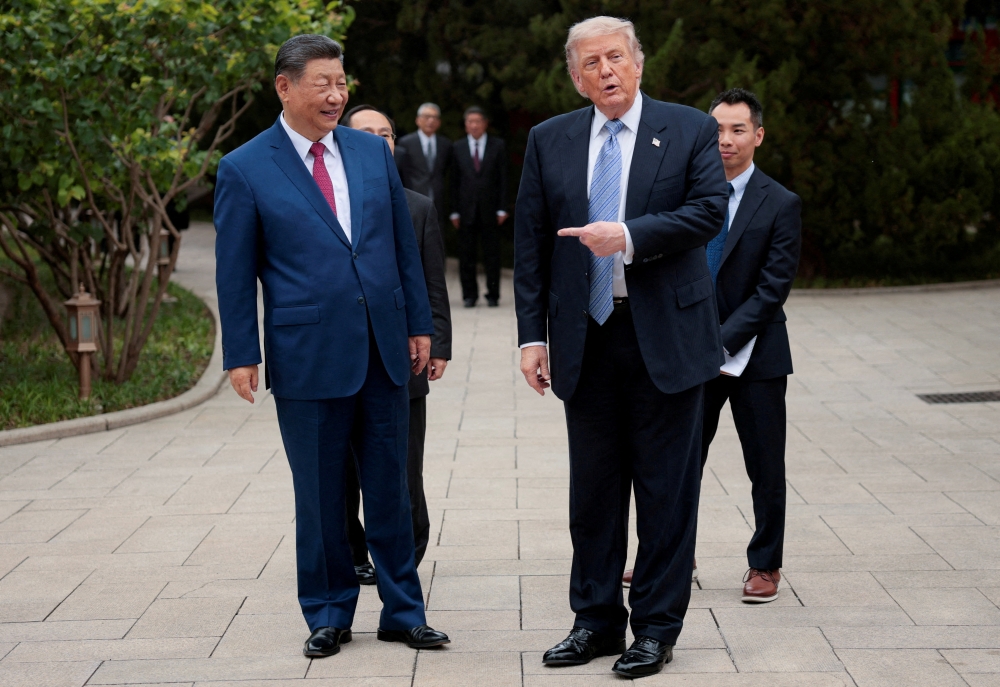
BEIJING, May 23 — US President Donald Trump said on Wednesday he would speak with Taiwan’s President Lai Ching-te, an unprecedented move for a US leader that could roil US relations with China and ‌maybe prompt more Chinese war games around the island.

It was the second time in a week Trump had said he intended to speak to Lai, dispelling initial speculation that his first mention of it after meeting Chinese President Xi Jinping last week was a verbal slip. Taiwan said it would be happy ‌for Lai and Trump to speak, though no details on when this might happen have been confirmed by either Washington or Taipei.

China’s foreign ministry, referring to the possibility of a Trump-Lai call, said on Thursday the United States should “handle the Taiwan issue with extreme caution and stop sending wrong signals to the separatist forces of Taiwan independence”.

Here is why such a call could infuriate Beijing.

What is China’s position on Taiwan? 

China calls Taiwan its single most important and sensitive issue as it concerns Chinese sovereignty and territorial integrity not to be questioned or interfered with by outsiders.

Beijing views Taiwan as an unresolved matter from the Chinese civil war, which saw the defeated Republic of China government flee to the island in 1949 after losing to Mao Zedong’s communists, who founded the People’s Republic.

Beijing calls Taiwan a Chinese province with no right to claim to be a country and has never renounced the use of force to bring it under ‌its control, though says it would prefer “peaceful reunification”.

China says Taiwan is its “core of core interests” and a red line that cannot ⁠be crossed, routinely criticising any high-level engagements between foreign leaders and Taipei ⁠as an interference in China’s internal affairs.

Neither the Chinese nor Taiwanese governments officially recognise the other ⁠and China refuses to refer to Lai ⁠as “president”.

How has China reacted to ⁠past us engagement with Taiwan?

China launched major war games around Taiwan in 2022 shortly after the Taipei visit of then US House Speaker Nancy Pelosi, and has held several other rounds of war games also in reaction to US engagements with Taiwan. China’s last major war games near ⁠the island were in late December. Earlier that month, the Trump administration approved an US$11 billion arms sales package to Taiwan, its largest ever.

What is Taiwan’s position? 

Taiwan is a thriving democracy whose government strongly rejects Beijing’s sovereignty claims. Taiwan says it is an independent country called the Republic of China, which remains the island’s formal name, and has a right to engage with the rest of the world and choose its own leaders.

Lai has repeatedly offered talks with China, but been rebuffed. Beijing calls him a “separatist”.

What is the US view?

The US ⁠severed official ties with Taipei in favour of Beijing in 1979 but is bound by the Taiwan Relations Act to provide the island with the means to defend itself. The US officially takes no position on Taiwan’s sovereignty under Washington’s “One China” ⁠policy.

In 2022, the State Department also added wording on the Six Assurances, referring to six Reagan-era security assurances given to Taiwan, which the United ⁠States declassified in ⁠2020.

Among the assurances made in 1982, but never previously formally made public, are statements that the US has not set a date for ending arms sales to Taiwan, nor agreed to prior consultation with Beijing on such sales, or to revise the Taiwan Relations Act that underpins US policy towards the island.

China ‌has repeatedly demanded that the US end arms sales to Taiwan.

What happened the last time Trump engaged directly with Taiwan?

In late 2016, President-elect Trump held a 10-minute call with then President Tsai Ing-wen. China reacted relatively mildly, issuing a diplomatic complaint and blaming Taiwan for engaging in a “petty action”. — Reuters


  •  

Nearly half of older women in Japan prefer AI over humans for personal advice, survey finds

Malay Mail

TOKYO, May 23 — A recent survey in Japan found that almost half of elderly women living in the country prefer artificial intelligence (AI) over humans for advice on interpersonal conflict, a higher percentage than any other age demographic, where consulting a human remains the favoured choice, Kyodo News reported.

According to the Japan Institute for Promotion of Digital Economy and Community survey, conducted online in mid-January, when asked whether they would prefer to consult a human or AI about relationship issues, 47.8 per cent of female respondents in their 60s and 70s chose AI, which is more than the 37.3 per cent who preferred humans.

This is compared to the overall tally of all respondents, in which 45.8 per cent said they would choose humans and 36.5 per cent said they would choose AI when seeking unbiased and objective advice on interpersonal problems. The remaining 17.7 per cent said they did not know or did not want to pick either option.

Among male respondents in their 60s and 70s, 57.0 per cent preferred to consult a human, while 25.2 per cent chose AI.

Atsushi Nakagomi, an associate professor at Chiba University who studies the intersection of AI and human health, said he was surprised that it was elderly women who were more likely to prefer AI.

He added, “AI makes people feel more comfortable about opening up, as they might feel free to seek advice without worrying about how their comments will be perceived.”

The online survey received valid responses from 1,449 people aged 18 to 79 residing in Japan. — Bernama-Kyodo

  •  

Climate change’s worst-case scenario is officially canceled

Solar farm

You’ve probably never heard of the term “RCP 8.5” — the highest-emission scenario used by climate scientists to project the planet’s future. But if you’ve read about climate change, you’ve seen the numbers and nightmarish outcomes it produced: 4°C of warming by 2100, sometimes 5°C, sea level rising multiple feet, parts of the planet too hot for humans.

Those numbers shaped a decade and a half of climate journalism, including a lot of my own when I covered climate change at Time magazine. I didn’t always know — and didn’t always communicate — that the scenario behind the most apocalyptic, attention-getting findings was largely an attempt to imagine how bad things could get, not a true forecast. But I wasn’t alone. RCP 8.5 was a frequent background presence in climate journalism.

Last month, though, the scientists who built that scenario formally retired it. In a paper published in Geoscientific Model Development, Detlef van Vuuren and more than 40 co-authors eliminated RCP 8.5 from the scenarios that will feed into the Intergovernmental Panel on Climate Change’s (IPCC) Seventh Assessment Report, which is due in 2029. Based on falling clean-energy costs, climate policy, and recent emissions trends, the highest-emissions pathway had become, in their words, “implausible.”

I can understand if your eyes began glazing over as soon as you read “seventh assessment report,” but this shift represents real progress and hope. It means that the apocalyptic climate change future that we’ve been describing for 15 years is officially no longer on the table. Instead, a merely bad climate future — about 2.8°C by 2100 — is now the central scientific estimate. Given how hopeless our climate future has appeared at times, that really does qualify as good news.  

Counting to 8.5

Climate models can’t tell you the future on their own, because how much the planet will warm depends in large part on what humans do. So scientists build scenarios: structured guesses about how the next century might unfold under different assumptions about energy use, growth, and climate policy.

Four such scenarios were introduced in 2011 as the standard set for the IPCC, the international body of scientists that periodically takes stock of global climate research and translates it into reports for governments worldwide. Three of the four were called “mitigation” pathways — futures where the world worked to reduce greenhouse gas emissions. One, the infamous and now obsolete RCP 8.5, was the “no-policy” baseline, a future with continued fossil fuel expansion, coal use roughly five times higher by 2100, and a global population pushing 12 billion. Think of it like Dickens’s Ghost of Christmas Future, a vision of just how bad things could get if we did nothing to change our ways. 

And just like any dystopia, RCP 8.5 guaranteed attention. Between 2011 and 2020, more than 2,000 climate impact studies used RCP 8.5 as their default future. Almost every dramatic projection of crop failure, mass displacement, killing heat, and coastline retreat that any general reader ever encountered in climate change coverage depended on it.

All of those projections were plausible enough under the numbers set by RCP 8.5, but by the mid-2010s, researchers, journalists, and even official government reports were routinely calling the scenario “business as usual,” a phrase that transformed a stress test into something that sounded like a forecast. It wasn’t, and it was never meant to be. Somewhere along the way, though, that distinction got lost.

How the worst case got walked back

The world that RCP 8.5 assumed will never arrive. Global coal use isn’t on a path to quintuple; consumption has largely plateaued after decades of growth. Instead of the global population ballooning to 12 billion people, the UN’s current median forecast projects about 10.2 billion by 2100, with other reputable forecasts putting the number even lower. (All things being equal, fewer people means less emissions.)  

At the same time, the clean energy transition moved faster than almost anyone in 2011 anticipated. The cost of solar power has fallen by about 85 percent since the RCPs were published, and annual global investment in the energy transition is now over $2 trillion. Actual global emissions have tracked far more closely to what you’d expect from a world trying to reduce them than from one doing nothing at all. By 2026, Climate Action Tracker estimated that current policies put the world on course for about 2.6 degrees of warming by 2100 — still serious, but a long way from 4 or 5.

Was RCP 8.5 ever realistic? One camp of experts, led by climate scientist Zeke Hausfather and energy modeler Glen Peters, argues that RCP 8.5 was plausible in 2011, but was taken off the table by genuine policy and technology progress. The other camp, led by Roger Pielke Jr., argues that the rate of global decarbonization has been roughly linear for decades. That would mean we didn’t actively avoid RCP 8.5; it was just never realistic to begin with. Both camps agree on what counts, though: RCP 8.5 should be gone, and the planet is still on track to warm between 2.5° and 3° by 2100. 

RCP 8.5 was as much a climate journalism story as it was a climate science one. In 2017, the writer David Wallace-Wells published “The Uninhabitable Earth” in New York magazine. It was probably the most widely read piece of climate journalism of the last decade, and it was built almost entirely on RCP 8.5 projections. 

Wallace-Wells revised his view in 2022, though there has been relatively little coverage of this year’s retirement of RCP 8.5. And researchers need to catch up: Pielke Jr. estimated that as late as early 2026, 30 new RCP 8.5 studies were coming out each day on average, generating more grist for the climate ultra-doom narrative. We’ll see whether last month’s announcement finally puts it to rest.

The future is in our hands 

But even if we’ve averted doom, there is a lot of work to do to secure a safer future.

The new “medium” climate pathway — the one that reflects current policies — estimates 2.8°C of warming on average by 2100, with the likely range running from 2.1°C to 3.7°C. That would still mean drastic declines in coral reefs and accelerated species extinction, worsening water scarcity, and further sea level rise. And while we’ve taken the worst of the worst-case scenarios off the table, we’ve run out of time to keep warming below 1.5°C, and 2°C — the upper limit that the 2015 Paris Accords sought to prevent. 

And as with anything to do with climate change, this scientific shift was quickly politicized. The day before Hausfather and his co-authors published their analysis of RCP 8.5’s retirement, President Donald Trump posted on Truth Social: “GOOD RIDDANCE!”, and described the change as proof that climate science was “WRONG! WRONG! WRONG!.” Not surprisingly, Trump is the one who is wrong here, as Carbon Brief explained in detail, but his mistake shows how easy it is to take the wrong lesson from the end of RCP 8.5. We shouldn’t fall for it.

The entire point of climate scenarios like RCP 8.5 was that there was no one certain future for climate change — only multiple possible futures. Whether or not RCP 8.5 was ever possible, the enormous advances in clean energy over the past 15 years are what made its retirement certain. Now we have new futures before us, waiting for what we do next.  

A version of this story originally appeared in the Good News newsletter. Sign up here!

  •  

‘Invisible damage’: Report on violence against animals in Colombia conflict

Bogotá, Colombia – On April 20, the Special Jurisdiction for Peace (JEP) – Colombia’s transitional justice mechanism – released a report on the violence suffered by animals in the context of the armed conflict. 

The JEP’s report, conducted in partnership with the University of Essex, found that an animal is killed or injured every 30 minutes due to the armed conflict.

Animal rights activists say the release represents a step forward in publicizing the often invisibilized violence inflicted upon animals in war.

The report was developed through the construction of a database using 237 national, regional, and local media outlets, and 600 X accounts belonging to social and environmental organizations, as well as State entities and multilateral organizations.

Based on the information collected, they made an individual categorization referring to domestic animals, and a collective one referring to species, that is, wild animals. In this context, 100,252 domestic animals faced violence and 44 species are at imminent risk of extinction as a result of the armed conflict.

Thirty-two percent of the recorded cases involving animals were directly linked to military actions, including armed confrontations, ambushes, and attacks. The impacts were not distributed evenly across the territory; there are regions where armed conflict, illegal economies, and environmental richness converge, intensifying the harm. For example, Antioquia is the department with the highest concentration of species threatened by the conflict.

“We realized that most cases involved incidents such as accidents with landmines, anti-personnel mines, ambushes against the public security forces, harassment of the public security forces, and armed confrontations. These were some of the situations in which animals were killed or injured. They were also affected by forced displacement,” Laura Ojeda, a researcher on the JEP’s Investigation and Prosecution Unit who contributed to the report, explained. 

Forced abandonment was one of the most documented forms of harm identified in the report, largely because it was closely tied to the victimization of caregivers within the dynamics of the conflict. 27% of the recorded cases — corresponding to approximately 900,000 animals — involved forced abandonment.

The report also identified nine ways in which animals were used throughout the armed conflict: as means of transportation; as devices to detonate explosive artifacts; as instruments to inflict pain and suffering – torture –; as sentinels for rapid alerts; as surveillance tools; in practices of bioterrorism involving zoonotic diseases; as propaganda tools; as amulets or part of esoteric rituals; and as a means to intimidate communities and extort payments from business owners and farmers.

Visibilizing animal suffering

The report comes as part of the JEP’s efforts to recognize the environment within its processes of justice, truth, and reparation. This release, the third in a series of three, is the first to focus on the specific forms of violence suffered by animals. 

“It is part of a strategy to recognize all forms of life that have been victims of the armed conflict in Colombia,” Ojeda told Latin America Reports.

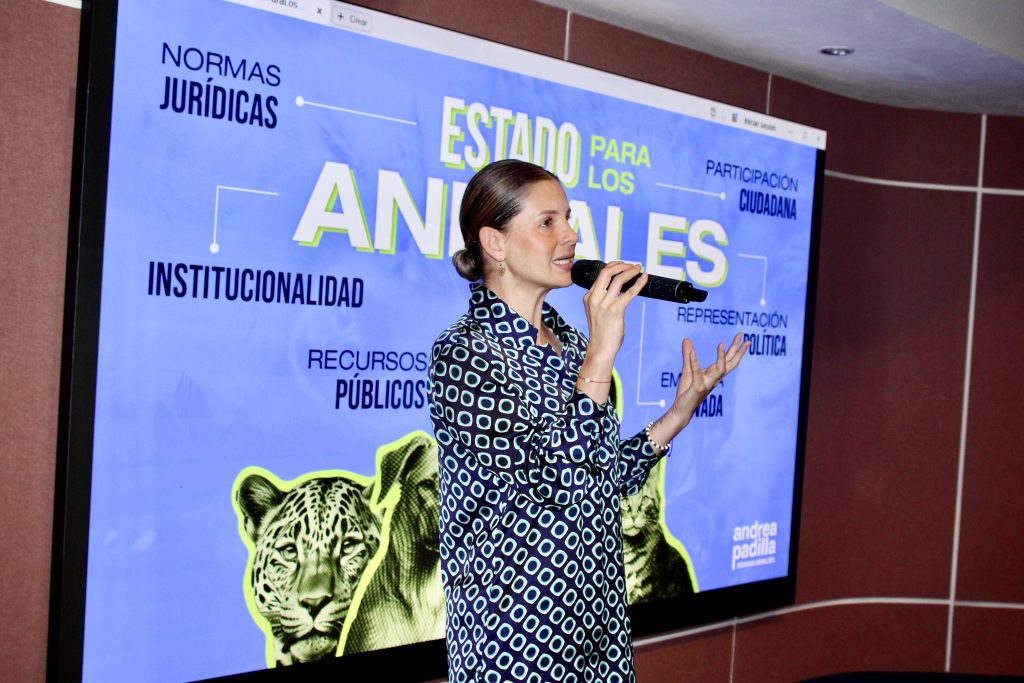
For Senator Andrea Padilla of the Green Alliance (Alianza Verde) party, the report represents a major step forward for animal rights. 

She notes that harm to animals is usually addressed as a collateral issue, as damage to property under a framework of harm to human assets.

“Animals have always been excluded from any moral consideration, from any legal consideration, even from news coverage,” the senator told Latin America Reports.

Senator Andrea Padilla delivers a speech on animal rights. Image credit: @andreanimalidad via X

The team behind the report faced the challenge of shifting the narrative away from the legal framework which refers to animals only as part of the natural environment.

Instead, it adopted a “differential” approach from natural sciences, in collaboration with La Enredadera & co, a scientific outreach collective.

For Luis Carlos Posso, anthropologist and member of the collective, the report represents an exception to the “unavoidable anthropocentrism permeating the law.”

Senator Padilla highlighted the animal rights implications:  “I believe it is only fair that sentient beings capable of emotions, affection, and social, moral, and emotional lives are also considered as affected by the conflict.”

Padilla added that understanding the impact of the conflict on animals deepens the appreciation of the human toll of violence.

“When we understand that there are bonds of affection there, family bonds that are abruptly broken by war, we can also see the conflict in a deeper way — that is, we can understand the deepest forms of harm being caused,” said the senator.

Animals as victims of the armed conflict

In addition to detailing the harms inflicted upon animals, the report proposes various reparative measures. These include habitat restoration, veterinary care in conflict zones, public veterinary care networks, the inclusion of animals in memory and truth processes, protection measures for at-risk species, and conservation initiatives.

However, there is still a long way to go before animals can be fully recognized as victims.

“Legally they are not things, but they are also not rights-holders. If they are not rights-holders, they cannot be recognized as victims,” explains Ojeda.

Colombian law recognizes animals as sentient beings, and laws such as the Ángel Law reflect significant progress in their rights. Currently, there is a bill advancing in congress that seeks to historically and legally recognize animals and ecosystems as victims of the internal armed conflict, prohibiting their use as instruments of war and ordering their essential reparation. This is Bill No. 012 of 2025, led by Senator Esmeralda Hernández of the Pacto Histórico party.

Senator Padilla explained that the success of the legal changes will depend on whoever is elected as the next president. 

“Undoubtedly, this report holds great value. It not only offers another perspective on the armed conflict, but also explicitly incorporates animals into the analysis of war, harm, and peace,” said Senator Padilla. She added that animals must be involved in reparations processes, insisting, “peace must include animals, or it will not be complete.”

This article originally appeared in The Bogotá Post and was re-published with permission.

Featured image description: Parrot in a tree.

Featured image credit: Piqsels.

The post ‘Invisible damage’: Report on violence against animals in Colombia conflict appeared first on Latin America Reports.

  •  

10 Scariest Horror Movie Climaxes of All Time, Ranked

Most movies go for the feel-good ending. Comedies are meant to make us laugh until the end. Dramas often see protagonists make up. Thrillers and action movies have the good guy conquer the evil villain. Horror is different. While the genre has its share of happy endings, where the final girl slays the killer or the monster is defeated, it's also the one that can get away with terrifying endings. Here, the antagonists are either victorious or the hero is so damaged that there is no true victory for them. Movies like Rosemary's Baby, Night of the Living Dead, Midsommar, and Smile knew how to scare the viewer through the very last second, but these 10 horror movies did it better than any other.

  •  

Toyota Hilux driver allegedly high on ‘mushroom vape’ crashes into pedestrian and shopfront in Kuantan

Malay Mail

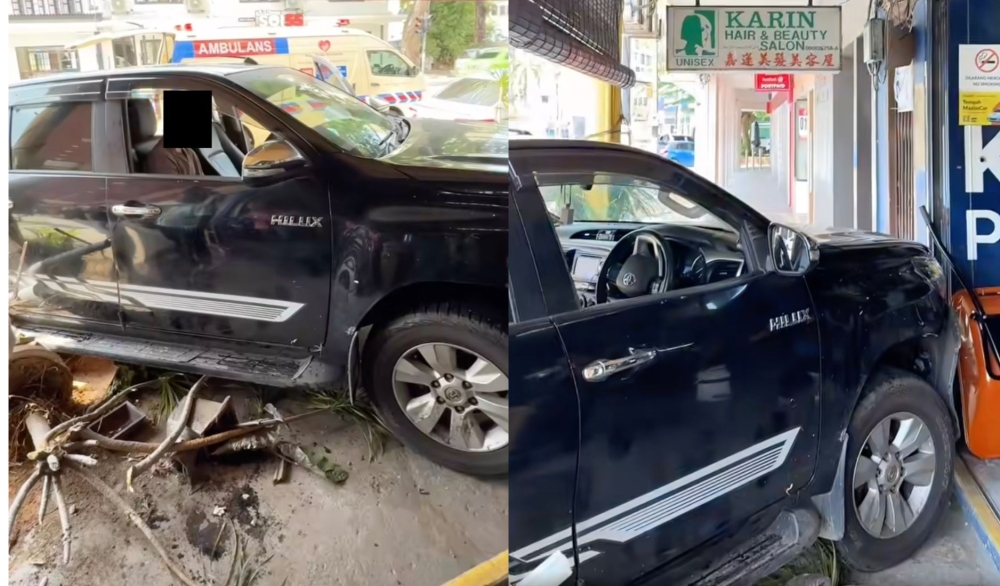
KUALA LUMPUR, May 23 — A 21-year-old driver high on a suspected “mushroom vape” ploughed into a pedestrian and smashed into a shopfront in Kuantan yesterday, police said.

The crash happened at about 11.30am along Jalan Besar, leaving a 68-year-old man with minor injuries to his left knee and right hand. He was later taken to Hospital Tengku Ampuan Afzan (HTAA) for treatment.

According to Utusan Malaysia, Kuantan police chief Assistant Commissioner Ashari Abu Samah said the suspect had been driving a Toyota Hilux from Jalan Teluk Sisek towards the city centre before losing control outside a hardware store.

“Upon arriving at the scene in front of a hardware shop, the driver is believed to have lost control of the vehicle before veering off and crashing into the pedestrian and the business premises,” he said.

Police later searched the vehicle and reportedly found a plastic bottle containing synthetic MDMA.

The suspect was taken to the Kuantan district Narcotics Criminal Investigation Division for a urine screening test, which came back negative.

“The urine screening result was negative, however the suspect was handed over to the Kuantan district police headquarters’ Narcotics Division for further action under Section 12(2) of the Dangerous Drugs Act 1952,” he reportedly said.

“Mushroom vape” typically refers to vape products containing psychoactive mushroom-derived substances or synthetic hallucinogens designed to mimic psychedelic effects.

Ashari said police believed the suspect had been driving while intoxicated from the substance, which could not be detected through standard urine tests.

  •  
❌