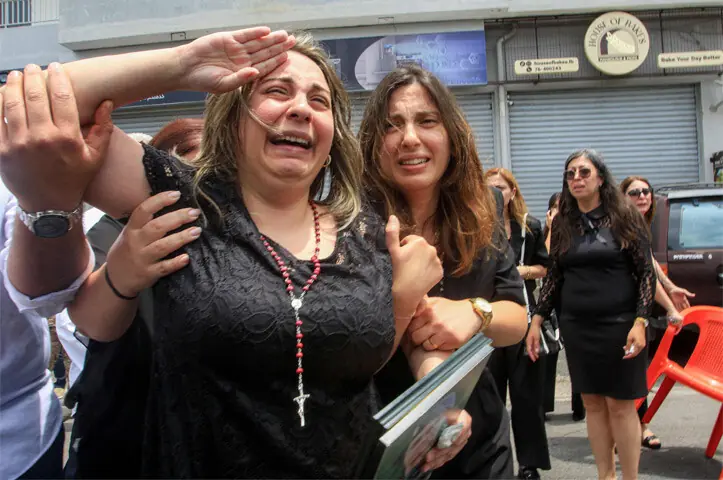
The wife of a Lebanese army captain, who was killed by Israeli bombardment, salutes as mourners carry her husband’s coffin at his home village in southern Lebanon.—AFP
• Woman, child among 12 killed in attacks on Zifta, Tyre • Beirut counts 3,491 Israeli strikes since April 17; fresh bombardment damages Unesco heritage site • Hezbollah denies contact with Trump
BEIRUT: An Israeli strike on southern Lebanon killed 12 people on Monday as Lebanese Defence Minister Michel Menassa revealed Israel has carried out nearly 3,500 air strikes since a US-brokered ceasefire took effect in April.
The Lebanese health ministry said the dawn raid on the town of Zifta in the Nabatieh district resulted in seven deaths, including a Syrian child and a woman, and wounded eight others.
Meanwhile, an Israeli strike on Tyre in southern Lebanon on Monday killed five people and wounded eight, the health ministry said, as Israel said it would continue strikes despite Iranian threats.
“An Israeli enemy raid on the city of Tyre, near the Red Cross centre, resulted in five martyrs and eight wounded, four of whom were Red Cross paramedics,” the ministry said in a statement.
The continuing violence underscores the fragility of the ceasefire that came into effect on April 17.
Nearly 3,500 Israeli attacks
During a cabinet meeting on Monday, Menassa said that between April 17 and June 7, Israel conducted 3,491 air strikes, 407 controlled demolitions and six razing operations, flattening entire villages in southernmost Lebanon.
PM Nawaf Salam said the escalation has caused additional waves of displacement. More than 1 million people have been displaced and over 3,600 killed since Hezbollah drew Lebanon into the conflict on March 2 with rocket fire at Israel to avenge the US-Israeli killing of Iran’s supreme leader.
The heavy bombardment in Tyre also damaged a Unesco World Heritage site. Ali Badawi, the culture ministry’s regional director of archaeological sites for south Lebanon, said Sunday’s bombardment had “the worst impact” on Tyre’s ancient areas since the war began. “The amount of debris and damage at the site is high,” Badawi said. “Some archaeological artefacts were damaged when rubble fell on them, as debris fell over a large area, impacting a large number of elements at the site — columns, capitals, column bases, mosaics.”
Tyre’s ruins include Roman baths, a second-century triumphal arch and a hippodrome. Lebanese Culture Minister Ghassan Salame appealed to protect the sites, charging that Israel “does not respect” the Hague Convention on the Protection of Cultural Property.
‘No contact with Trump’
Amid the ongoing conflict, a senior Hezbollah official denied statements from US President Donald Trump suggesting the two sides had communicated.
Senior Hezbollah official Mahmud Qomati said in written remarks that “there has been no direct contact between President Trump and Hezbollah officials”.
Trump told reporters last Wednesday that “we actually spoke with Hezbollah for the first time, ever,” and later claimed he had a “very good call” with the group through highly placed representatives.
LONDON: The England and Wales Cricket Board (ECB) announced on Monday captain Ben Stokes and team-mate Gus Atkinson are being investigated for breaking team rules in a nightclub incident after the first Test against New Zealand.
It is the latest controversy concerning the England team following a tour of Australia where the side was confronted with allegations of a drinking culture during a 4-1 Ashes series loss concluded in January.
“The ECB is currently investigating a breach of team protocols following the conclusion of the first Men’s Test against New Zealand,” the governing body said.
“Ben Stokes and Gus Atkinson were present at a nightclub in the early hours of Monday morning when an incident took place.
“We are currently seeking further information, and an announcement regarding the squad for the second Test will be made in due course.
“The Cricket Regulator has been informed and we will provide a further update when possible.”
Before the Ashes, white-ball captain Harry Brook was punched by a nightclub bouncer in Wellington on the eve of a One-day International against New Zealand. As a result, England imposed a midnight curfew on all players and staff. The BBC, however, reported the curfew was still in place despite the first Test being over, and the investigation relates to more than a breach of the curfew.
England thrashed New Zealand by 115 runs before lunch on Sunday to go 1-0 up in a three-match series as they enjoyed a comprehensive victory in their first Test match since their humiliating Ashes defeat The second Test, across London at the Oval, starts on June 17.
THREE parallel events now underway or recently held carry the potential in varying measure to reset India’s destiny, in all likelihood for the better. From a bird’s eye view, the field looks set for a change. The fact that Germany lost the election for the first time in 40 years for a non-permanent member’s seat at the UN Security Council offers stark lessons for the Modi government to ponder.
Germany turned Palestine averse and cosied up to Israel, much like Narendra Modi’s India, with Chancellor Friedrich Merz in the saddle. The UN defeat is being linked to Merz’s embrace of Benjamin Netanyahu. British Prime Minister Keir Starmer’s future is also under a cloud, his ties with the Zionist lobby being a key factor. Ergo: Israel’s chums are being globally isolated.
India’s proximity to Israel was nudged by right-wing ideologues to counter Russian prime minister Yevgeny Primakov’s 1998 doctrine to form the Russia-India-China group as a stabilising force in a post-USSR Global South. The Western countermeasures included America’s ‘pivot to the east’, dragging India into the Quad. But when the RIC went on to become BRICS, a ‘West Asian Quad’ was conceived including India, Israel, the UAE and the US. The faint outlines of the outcome of the Iran war are threatening to end India’s entanglement with both Quads. And the German debacle at the UN is the writing on the wall.
Potentially, also crucial for the country’s future is the internet-spawned Cockroach Janta Party, which launched its first street protests in New Delhi over the weekend. The party minted into an untested force after a senior judge insulted unemployed youth as cockroaches. The ‘cockroaches’ have given a tart reply to the judiciary, but they’re also demanding the resignation of Modi’s education minister, hitherto an unthinkable prospect.
The third albeit widely underplayed event is the fractious INDIA opposition group seeking to get its act together. Twenty-three parties, including Mamata Banerjee’s Trinamool Congress were holding a make-or-break meeting on Monday (June 8) under the Congress party’s stewardship. All three events have the heft to cause tremors in the Modi establishment. Some say the jolt could be more rattling to him than he experienced in 12 years of unbridled power.
Questions have surfaced over the Cockroach lot with insinuations that the cluster of motivated urban youth is supported by the Hindutva order to vent the steam gathering from months of a crippling economic crisis, not all of which is linked to the Iran war. There is also the issue of an overtly corrupt administration keeling over with criminal incompetence amid lacerating acts of omission and commission.
Hundreds of thousands of school-leaving students and admission-seeking medical college aspirants have been grievously harmed by leaked papers and erring tabulation mechanisms. The Cockroach party has sought probity in judiciary, education and the nexus between business and the media, but its critics have sought to portray the group as left oriented with some of them belonging to this or that communist party.
Another suggestion is that they are an extension of the Aam Aadmi Party, a ploy to shift the focus from the improving chances of opposition unity. It’s a fact that AAP came out of the India Against Corruption campaign of 2011 in which the RSS played a backroom role to successfully undermine the Manmohan Singh government.
There’s no need to spread fear of those such as the Cockroach party before they do something wrong.
While the AAP’s birth pangs indeed created the grounds for the coronation of Narendra Modi as prime minister in May 2014, it is equally a fact that AAP was applauded the following year as the sheet anchor that stalled the BJP juggernaut in Delhi. Before this, the Modi wave had easily evicted Congress governments in Maharashtra and Haryana polls. And there was no AAP in Maharashtra to blame the defeat on, although in Haryana it did cut some votes.
The AAP subsequently propagated a soft temple-hopping Hindutva, in which Arvind Kejriwal scrupulously avoided standing with Muslims when they were under attack from the BJP and the police in 2020. But if he or the Cockroach group can yet consciously or unwittingly help stall the rightward, obscurantist drift the Modi government has set India on, it would make Deng Xiaoping’s spirit burst into a smile. “It doesn’t matter whether a cat is white or black, as long as it catches mice.” Deng’s dictum applies to anybody who would rescue India from its current trauma. And there’s no need to spread fear of those such as the Cockroach party before they do something wrong.
But let’s not get too swayed also by the shouts of youth power or the roar of something called Gen Z. As far as one could see, it was the youth that demolished the Babri Masjid with their raw sinews. It’s the youth that goes about lynching and harassing innocent citizens in the name of religion. Of course, on the other side, it’s the youth that’s languishing in Modi’s prisons, if they are not out on strictly monitored bail terms, for fighting for a just and equal society in a democratic system that doesn’t discriminate between citizens. Think Umar Khalid.
There’s a youth component in almost every political party. The mighty US is split between youthful Zionists and their youthful adversaries. When I looked up Gen Z on a search engine, an option pointed to Gen Ziaul Haq! I think the idea of Gen Z or Gen Alpha etc is conjured to obscure the reality of universal class struggle, and in India’s of its defining caste identity.
A few donning cockroach masks at the Delhi rally were seen carrying portraits of Bhimrao Ambedkar thereby putting Dalit politics at the centre. But again, hasn’t everyone used Ambedkar’s portraits to lure support? Finally, while Deng’s point is priceless, a useful caution in T.S. Elliott’s line says: “Youth is cruel and has no remorse. It smiles at situations which it cannot see.” A fair point to ponder.
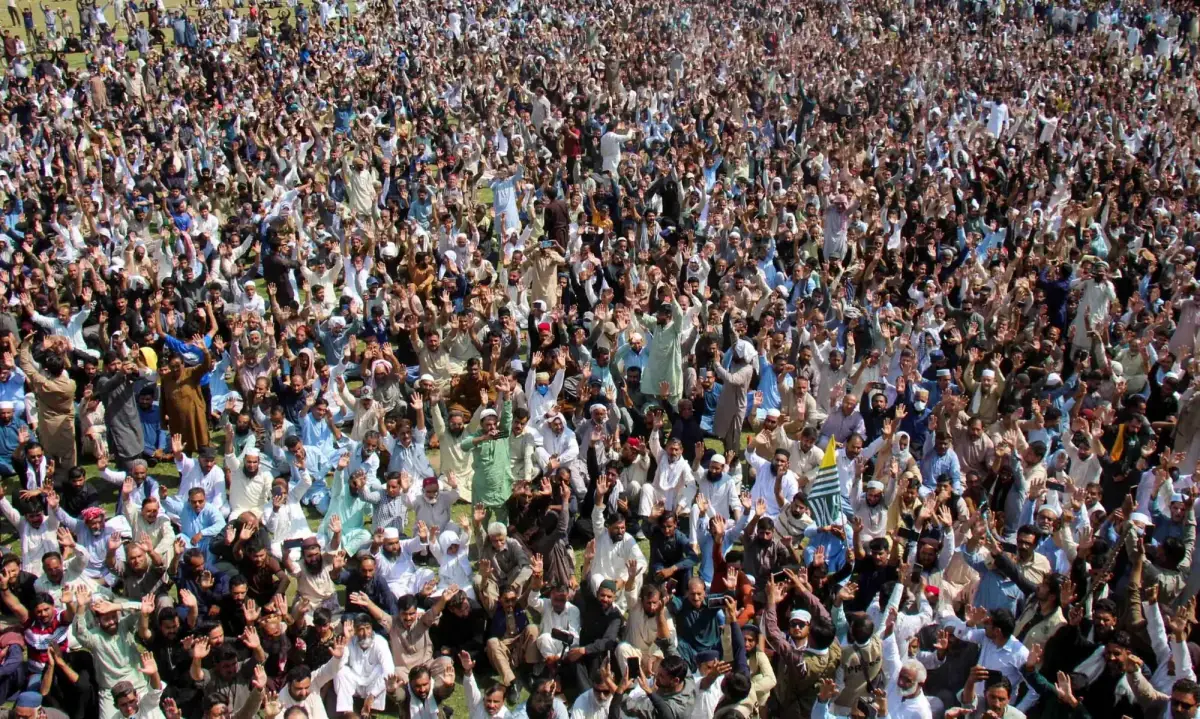
MATTERS have worsened in the stand-off between the Azad Kashmir government and the Joint Awami Action Committee, which has recently been proscribed by the regional administration. The situation started deteriorating after a trader affiliated with the JAAC was reportedly shot in an altercation with law-enforcers on Saturday. The following day protesters and LEAs clashed outside a Rawalakot hospital where the victim’s body was brought, resulting in the deaths of at least four policemen and seven protesters.
This unfortunate series of events echoes similar confrontations between the AJK government and JAAC over the past few years, where dialogue over protesters’ demands has alternated with deadly violence. The region is particularly on edge as the JAAC has called for a major strike today. With the proscription of the group and the deaths in clashes with the administration, emotions are high all round and better sense is required across the board to prevent the situation from deteriorating further.
At the core of the dilemma is the JAAC’s call for abolition of refugee seats for those who left India-occupied Kashmir and settled in AJK. Indeed, the AJK government’s banning of the JAAC has not helped matters, and has only raised the temperature. To prevent further confrontation, the AJK government should reconsider the ban, though investigations are required into the killing of the policemen and the deaths of the protesters.
This paper has argued that bans targeting popular movements are undemocratic, and have, throughout history, failed to suppress dissenting voices. At the other end, the JAAC, too, should take a less hard-line position. While the group had earlier called for civic and governance reforms, it is now demanding constitutional changes, such as the abolition of refugee seats.
These delicate constitutional matters must be decided in the House, after thorough debate by all sides. In fact, as the AJK Supreme Court has said in its opinion on a reference sent to it by the region’s president regarding the refugee seats, constitutional changes can only be achieved “by an assembly possessed of the full democratic mandate of the people, after deliberation” and cannot be “wrested from a government under duress”.
Therefore, both sides need to de-escalate. The authorities should reconsider the JAAC ban, while JAAC supporters must keep all protest peaceful, and take their demand for constitutional change to the AJK legislature.
QUETTA: Police are investigating the motive behind the acid attack on a doctor from Civil Hospital Quetta, whose attacker was killed as he tried to flee, officials said on Monday.
Dr Mahnoor Nasir, who hails from Duki, was attacked while on duty on Saturday. The provincial government immediately shifted her to Aga Khan University Hospital in Karachi for specialised care.
After registering a case against the accused, Humayun Shah, investigators are now questioning hospital employees and close acquaintances of the attacker to determine the real cause.
“We are investigating the tragic incident, keeping in view all aspects to trace out the people who could be behind this episode,” a senior police officer said.
Balochistan’s chief minister visited the hospital on Sunday night to check on Nasir’s health, assuring full cooperation for her recovery.
On Monday, Balochistan Governor Jaffar Khan Mandokhail telephoned Nasir’s father, Habibullah Khan Nasir, to offer arrangements for specialised treatment and plastic surgery abroad. Mandokhail emphasised that the provincial government is bearing all expenses related to her recovery from day one.
“The entire nation is proud of a brave daughter like Dr Mahnoor, and the people of Balochistan stand with her in this hour of difficulty,” Mandokhail said. He added that the government is utilising all available resources to ensure the safety and dignity of doctors and paramedical staff.
Meanwhile, the Young Doctors Association continued its strike across all government hospitals in Quetta, boycotting outpatient and other departments. The doctors have established a protest camp on the hospital premises, making speeches criticising health officials and demanding enhanced workplace security.
ISLAMABAD: A local court on Monday reissued non-bailable arrest warrants for Khyber Pakhtunkhwa Chief Minister Sohail Afridi over his continued failure to appear in a case registered under the Prevention of Electronic Crimes Act (Peca).
Senior Civil Judge Muhammad Abbas Shah directed the authorities concerned to arrest CM Afridi and produce him before the court. The order was passed after the chief minister failed to appear despite being summoned for the hearing.
The case was registered by the National Cyber Crime Investigation Agency (NCCIA), formerly known as the cybercrime wing of the FIA, over allegations of content deemed misleading against state institutions.
Expressing displeasure over the repeated absence of the accused, the court reissued the non-bailable warrants and adjourned further proceedings until June 18.
Physical remand
In a separate case, the same court handed vlogger Sohrab Barkat over to the NCCIA on a four-day physical remand.
The investigating agency produced the accused before the court and sought his physical custody for interrogation. After hearing the request, Judge Abbas Shah approved the four-day remand.
According to the agency, a case has been registered against Mr Barkat under relevant cybercrime laws. Investigators alleged that he uploaded a YouTube video related to the Joint Action Committee, which led to the registration of the case.
• Think tank seeks relief for salaried class
• Stresses social spending should boost productivity, not just expenditure
ISLAMABAD: Financial experts on Monday urged policymakers to broaden the tax base, increase funding for climate change and social protection, focus on job creation, and provide relief to the salaried class.
Speaking at a pre-budget session, organised by the Sustainable Development Policy Institute (SDPI), they noted that the country’s fiscal framework remains heavily focused on managing recurring crises rather than reducing the underlying vulnerabilities that continue to deepen poverty, inequality and climate risks.
Amid the government’s efforts to unveil the federal budget for 2026-27, they called for a decisive shift in fiscal priorities, urging policymakers to move beyond short-term stabilisation measures and place human development, climate resilience and productive investment at the centre of economic planning.
SDPI Deputy Executive Director (Policy) Dr Shafqat Munir Ahmad stressed the need to protect and increase allocations for education, health, nutrition and social protection, while significantly expanding investments in climate adaptation and disaster preparedness.
The country cannot continue financing recovery after every flood, drought and heatwave while underinvesting in prevention, preparedness, anticipatory action and human development,” he said, adding that the budget should be judged not only by fiscal numbers but also by its ability to reduce poverty, strengthen resilience and safeguard development gains.
Dr Shafqat also called for greater public investment in employment-generating sectors, particularly agriculture, small and medium enterprises (SMEs) and emerging green economic opportunities. Social spending, he said, should be viewed as an investment in national productivity and economic competitiveness rather than a fiscal burden.
On taxation, SDPI Deputy Executive Director (Research) Dr Sajid Amin Javed warned against increasing the burden on salaried and documented taxpayers.
He noted that a large share of direct taxes continues to come from formally employed individuals while significant segments of the economy remain outside the tax net.
Dr Javed suggested that budgetary reforms should focus on broadening the tax base and improving productivity rather than relying on revenue measures that disproportionately affect middle-income households.
He also supported ongoing tariff rationalisation efforts, arguing that reducing tariff distortions could improve industrial competitiveness, attract investment and support export-led growth. “Pakistan needs structural reforms instead of annual revenue-driven adjustments,” he maintained, stressing that excessive reliance on indirect taxation ultimately weakens purchasing power and constrains economic activity.
SDPI Research Fellow Dr Khalid Waleed argued that the budget should serve as a roadmap for economic transformation rather than a mechanism for balancing accounts.
“A budget is not meant to be a calculator with a flag on it; it is meant to be a development strategy expressed in rupees,” he said.
Dr Waleed urged policymakers to ensure that fiscal decisions support job creation, productive investment and human capital development. While welcoming climate budget tagging, he cautioned that the exercise should not become a procedural requirement divorced from actual spending decisions.
“Climate budget tagging must be inclusive, not just a box-ticking activity,” he said, calling for climate risks to be integrated into fiscal planning, development spending and public investment decisions.
He advocated stronger incentives for renewable energy and warned against policy inconsistencies that could discourage investment in the clean energy sector.
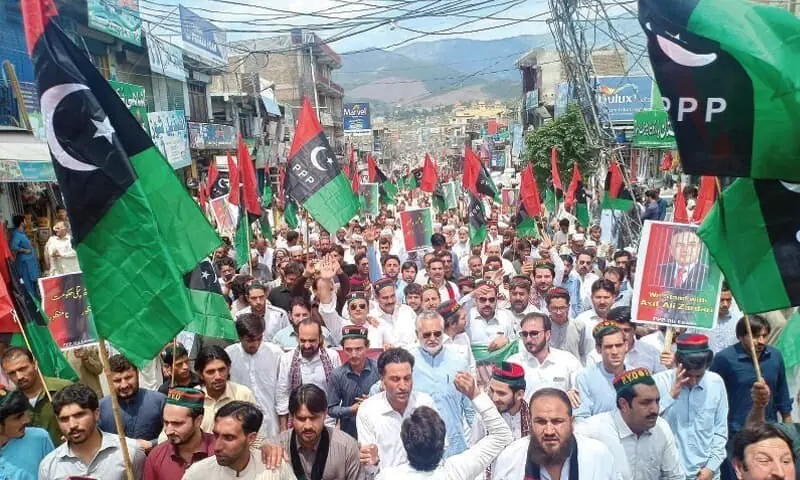
GILGIT: The PPP is all set to form a government in Gilgit-Baltistan after it gained 11 out of 24 seats in the Gilgit-Baltistan Legislative Assembly, according to unofficial results (Forms-47) of the June 7 elections.
As per Forms-47 issued by returning officers from 24 constituencies, the PPP bagged 11 seats, with the PML-N trailing with six seats. The candidates backed by the PTI won two seats, and its ally MWM was victorious in one seat. The independent candidates secured four seats.
In a post on X in the early hours of Monday, Bilawal Bhutto-Zardari declared victory, saying the PPP had become the “single largest party” in the region.
“The Pakistan Peoples Party is emerging as the single largest party and we will be attempting to form government. I am grateful to the people for their trust and congratulations to Jiyalas on their victory,” said Bhutto-Zardari, whose party had alleged rigging during the polling.
Recount ordered
On Monday, the Election Commission of Gilgit-Baltistan ordered a recount in two constituencies and re-polling in a few polling stations in GBA-16, Diamer.
The recount order came after independent candidate Safdar Ali Shirazi and PPP candidate Nazir Ahmed Advocate formally requested a recount of votes in GBA-20 (Ghizer-II), alleging irregularities during the counting process.
Acting on the request, the returning officer ordered a recount, which is scheduled to take place today. The commission also ordered a recount in GBA-3, Gilgit.
The Election Commission also ordered a re-poll at three polling stations in GBA-16 (Diamer-II).
Victorious candidates
PPP regional president Amjad Hussain won from GBA-1 (Gilgit), while former chief minister Hafiz Hafeezur Rehman of PML-N won from GBA-2 (Gilgit). PTI-backed independent Sohail Abbas won from GBA-3 (Gilgit).
In Hunza, PTI-backed independent Naik Nam Karim won from GBA-6. In Nagar, Muhammad Ali Akhtar of PPP won from GBA-4 and Zulfiqar Ali Murad of PPP won from GBA-5.
In Skardu, Syed Tauqeer Mehdi of PPP won from GBA-7, Fida Muhammad Nashad of PPP from GBA-9, Nasir Ali Khan of PPP from GBA-10, and Mohammad Kazim Mesum of MWM from GBA-8.
In Kharmang district, Iqbal Hassan of PPP won from GBA-11. In Shigar district, Imran Nadeem of PPP won from GBA-12. In Astore district, Rana Farman Ali and Rana Muhammad Farooq won from GBA-13 and GBA-14, respectively.
In Diamer, Kifayatur Rehman of PML-N won from GBA-18, independent candidate Dilpazir Khan won from GBA-15, Ataullah of PPP from GBA-16, and Mohammad Naseem of PPP from GBA-17. In Ghizer, Syed Jalal of PPP won from GBA-19, Abdul Jahan of PML-N won from GBA-20, and independent candidate Aman Ali won from GBA-21 (Yasin).

 Login
Login