The Hong Kong government could raise civil servants’ salaries by up to 4.12 per cent this year and plans to introduce a revamped appraisal system for its employees in October, a minister has said.
Hong Kong’s government headquarters. Photo: Kyle Lam/HKFP.
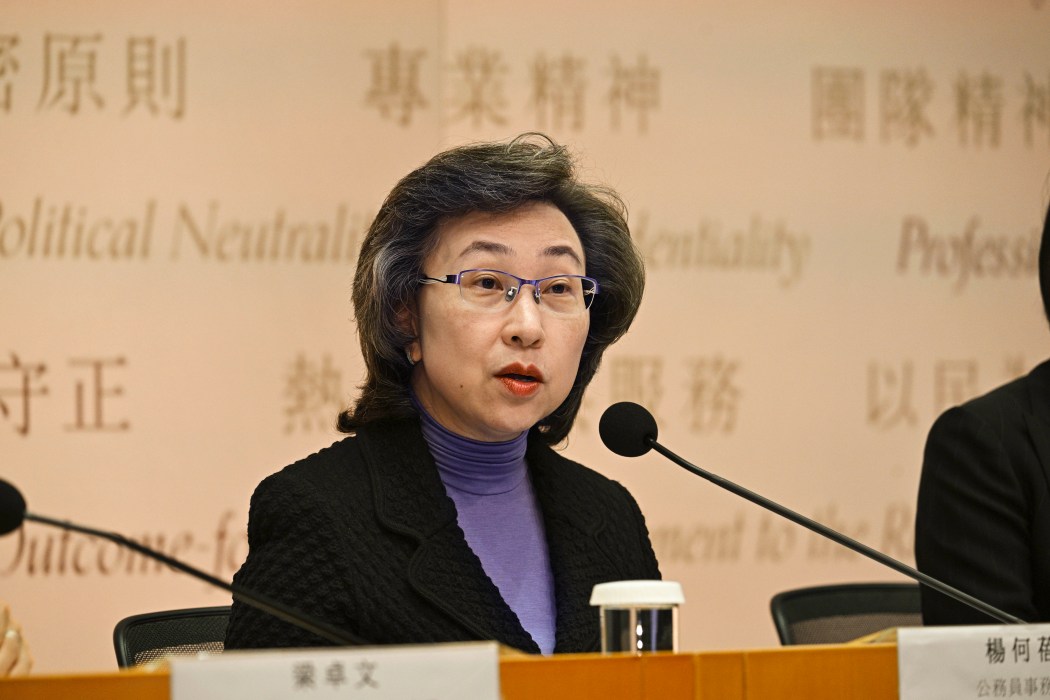
Secretary for Civil Service Ingrid Yeung said on Thursday that the tentative results of the 2026 Pay Trend Survey suggested a 4.12 per cent pay rise for senior civil servants, 2.64 per cent for middle-tier employees, and 1.17 per cent for junior staff.
The suggestions are based on findings from a survey of around 155,000 employees from 104 private companies conducted between April 2025 and April 2026. The survey’s results will be one of six factors considered by the Executive Council, the city’s top decision-making body, for a pay adjustment, Yeung said.
The other factors include “civil servants’ demand for salary adjustment and their morale,” Yeung said, adding: “I will meet with their representatives next week on these matters.”
The government resumed the pay trend survey this year following a salary freeze in 2025 amid a three-year fiscal deficit that strained public finances.
Financial Secretary Paul Chan estimated in his annual budget speech in February that the government could see a HK$2.9 billion surplus in the 2025-26 fiscal year.
Asked on Thursday whether a pay rise for civil servants would lead to a backlash in the wake of the deadly Tai Po fire, Yeung said the “vast majority” of government employees “are professional, efficient, and committed.”
Secretary for the Civil Service Ingrid Yeung speaks to reporters. File photo: GovHK.
“For the few underperforming civil servants, I believe the best way is to handle them through established mechanisms,” she said.
Yeung also said that under the revised appraisal system, civil servants’ performance assessments would be curved, and the bottom five to 10 per cent of staff may not receive a pay rise.
Department heads, especially those leading smaller teams or highly professional workers, may make a case to the Civil Service Bureau if they find the performance of all their staff members to be satisfactory, she added.
She promised that authorities would review the new mechanism to ensure fairness in the appraisal.
The Hong Kong government has launched a public consultation on proposed amendments to the city’s fire safety law, six months after the deadly blaze at Wang Fuk Court housing estate in Tai Po.
Wang Fuk Court on May 4, 2026. Photo: Kyle Lam/HKFP.
According to a government statement on Tuesday, the one-month consultation aims to enhance “public safety, regulatory coherence, enforcement effectiveness and accountability,” as well as to respond to public expectations for improved fire safety following the deadly blaze in November.
The proposed amendments will cover the Fire Services Ordinance and three subsidiary pieces of legislation on fire safety equipment in buildings, the professionals who oversee them, and the Fire Services Department’s powers to abate fire hazards, a Security Bureau spokesperson said.
“We will also take this opportunity to appropriately enhance the enforcement powers of the Fire Services Department (FSD) in specific areas and combat illicit fuelling activities, among others,” the spokesperson added.
Tuesday marked six months since the fire broke out at Wang Fuk Court on November 26.
The blaze, which killed 168 people and displaced thousands of residents, exposed shortcomings in the FSD’s role in overseeing fire safety during major renovation works at densely populated housing estates, with officials pledging reforms at a public inquiry into the tragedy.
The entrance to the City Gallery in Central, the venue of a public inquiry into the deadly Wang Fuk Court fire, on March 26, 2026. Photo: Kyle Lam/HKFP.
Tuesday’s proposals were made by the government’s Task Force on Strengthening Fire Safety Governance, established after the fire and chaired by Secretary for Security Chris Tang.
Members of the public may submit their views on the proposals by email or regular mail until June 25.
According to the statement, the government hopes to finalise the proposals and table a bill in the Legislative Council later this year.
Hong Kong’s Education Bureau (EDB) has apologised for mistakenly sending the Primary One allocation results via SMS one day early, urging parents to ignore the message.
A primary school in Wong Tai Sin. File photo: Kyle Lam/HKFP.
The EDB said on Tuesday that an “operational error” in setting up a system-controlled text-messaging function led to the sending of the Primary One results via SMS on Tuesday morning, instead of Wednesday morning.
It said it had sent a clarification SMS to parents, telling them to ignore the previous message and await the formal results, which will be released at 7.30am on Wednesday.
The SMS text messages sent on Tuesday morning appeared to contain erroneous information. Some parents told local media that they received messages showing the wrong year and, in some cases, incorrect school choices.
An EDB spokesperson said the prematurely sent message would not affect the results of the Primary One central allocation.
“After a full-scale review by the technical teams, it is confirmed that the system has not been subject to any cyberattack or hacking, and the core database remains integral and complete,” the spokesperson said in a Chinese-language statement.
“This incident is totally unrelated to information security and cybersecurity,” the spokesperson added.
Education Bureau. Photo: GovHK.
Two hotlines – 2832 7700 and 2832 7740 – have been set up for answering parents’ enquiries, the bureau said, urging parents not to contact the schools based on Tuesday’s SMS.
The EDB said it had formed a crisis response team to review the incident, including whether the system or any personnel were at fault.
This year’s Primary One central allocation has a high satisfaction rate of 93.6 per cent, the bureau said last week.
A total of 16,345 children took part this year, with a little more than 14,000 allocated to schools within their first three choices, according to the EDB.
The Hong Kong government has proposed allocating up to 180 “reserve units” of transitional housing to tenants evicted due to the “shoebox” flat reform.
United Court, a transitional housing project at Tung Tau, Yuen Long. File photo: GovHK.
Victor Tai, undersecretary for housing, said on Monday that the reserve units would only be provided under “very exceptional circumstances,” such as tenants evicted by landlords of subdivided flats and those in urgent need of housing.
The reserve units will only come from transitional housing projects in urban or “extended urban” areas, such as Tung Chung, Sha Tin and Tseung Kwan O, according to a policy briefing submitted by the Housing Bureau to the Legislative Council’s (LegCo) panel on housing.
Speaking at the panel, Tai said the units would only be reserved for three months. If the units were not allocated to anyone, they would become available again for other transitional housing applicants.
“Our aim is to have some reserve units in urban and extended urban areas ready for providing immediate support,” Tai said in Cantonese.
Elaine Chik, a lawmaker from the Democratic Alliance for the Betterment and Progress of Hong Kong (DAB), raised concern that the 180 reserve units may fail to meet demand.
In response, Tai said many current tenants of subdivided units were themselves applicants for public or transitional housing, and that the amount of reserve units should be enough for those in urgent need of temporary shelter.
A subdivided unit in Jordan run by Rent to Rent Innovation, on February 14, 2025. File photo: Kyle Lam/HKFP.
According to the briefing paper, those who wish to move into the reserve units must undergo a review by one of the six government-appointed District Service Teams “to verify their imminent housing needs.”
Another Housing Bureau team will review the applications before allocating the units for a three-month tenancy.
The policy is expected to come into force next month.
Hong Kong passed the Basic Housing Units Ordinance in September, mandating landlords of subdivided units to meet government-set living standards. These include a floor space of at least 86 square feet, a ceiling height of 2.3 metres, as well as windows and an individual toilet.
10 people have sustained minor injuries after a truck collided with a double-decker KMB bus on a downhill stretch in Kwun Tong.
A KMB bus and a light-goods truck collide in Sau Mau Ping on May 12, 2026. Photo: Christine Fong, via Facebook.
Police said they received a report of the crash on Po Lam Road, Sau Mau Ping, at about 6.20am on Tuesday. The collision involved a light goods vehicle and a Route 600 KMB bus, which travels between Kwun Tong and Central.
The truck overturned following the crash, while the KMB bus struck a traffic light pole before coming to a halt, police said.
Eight bus passengers and both drivers were reportedly mildly injured and were sent to United Christian Hospital for treatment.
Dashcam footage circulating online appeared to show the truck violating traffic signals by making a right turn towards Po Tat Shopping Centre on Po Lam Road, as the KMB bus was travelling downhill.
Images from the scene showed the truck lying on its side, while the windscreen of the KMB bus was shattered. Traffic in the area was disrupted following the incident, according to RTHK.
In an emailed reply to HKFP’s enquiry, KMB said on Wednesday that an investigation showed its bus was crossing the intersection on a green light, while the truck ran a red light by turning right from the opposite lane.
The bus operator said it would cooperate with the police.
A Hong Kong court has ordered the forfeiture of more than HK$670,000 in “terrorist property” from three persons involved in a thwarted bomb plot during the 2019 protests.
The High Court. File photo: Kyle Lam/HKFP.
In a written judgment on Thursday, High Court Judge Judianna Barnes ruled that Wong Chun-keung and Ng Chi-hung were “terrorists” and Lau Pui-ying was a “terrorist associate” under the United Nations (Anti-Terrorism Measures) Ordinance.
Barnes said a total sum of HK$674,860 in the defendants’ accounts and in cash, which was liable to be seized under the ordinance, was “intended to be used to finance or otherwise assist the commission of ‘terrorist acts.’”
In November 2024, Ng was sentenced to almost 24 years in jail for masterminding the foiled bomb plot, which aimed to kill police officers at a demonstration on December 8, 2019, amid the large-scale protests and unrest that year.
Wong, who led a radical group known as “Dragon Slayers,” was sentenced to 13 and a half years in prison. Both defendants pleaded guilty, with Wong testifying for the prosecution in exchange for leniency in sentencing.
Lau was among seven defendants who stood trial by jury. In August 2024, the nine-member jury found her and five others not guilty. Only one defendant was convicted by the jury and was sentenced to 10 years and 10 months behind bars.
Despite her acquittal, authorities submitted “numerous Telegram messages” that showed Lau “actively administered, together with [Wong], crowd-funding exercise in securing funds” for Dragon Slayers and the bomb plot, according to the judgment on Thursday.
A rally is held in Hong Kong Island on December 8, 2019, to mark International Human Rights Day. File photo: May James/HKFP.
Between November 6 and December 9, 2019, Lau’s three accounts received net deposits of more than HK$1 million while she was earning a salary of less than HK$3,000, the government submitted.
Barnes said the evidence “overwhelmingly supported” the government’s application to forfeit the sum.
Roughly HK$536,000 was kept in Lau’s three accounts, according to the judgment, while the remainder, around HK$138,000, consisted of deposits in Wong and Ng’s bank accounts, as well as cash.
Wong and Ng did not oppose the application while Lau was absent throughout the proceedings, including court notices and a hearing regarding the government’s application.
The anti-terrorism ordinance, enacted in 2002, was invoked for the first time to prosecute the group.
The defendants were accused of planning a bomb attack during a rally marking International Human Rights Day, plotting to place two bombs along the rally’s marching route to kill police officers.
A defence lawyer for a Tiananmen vigil activist has urged a Hong Kong court not to “pay lip service” to human rights protections, arguing that calls to “end one-party rule” in China should be considered legitimate political expressions.
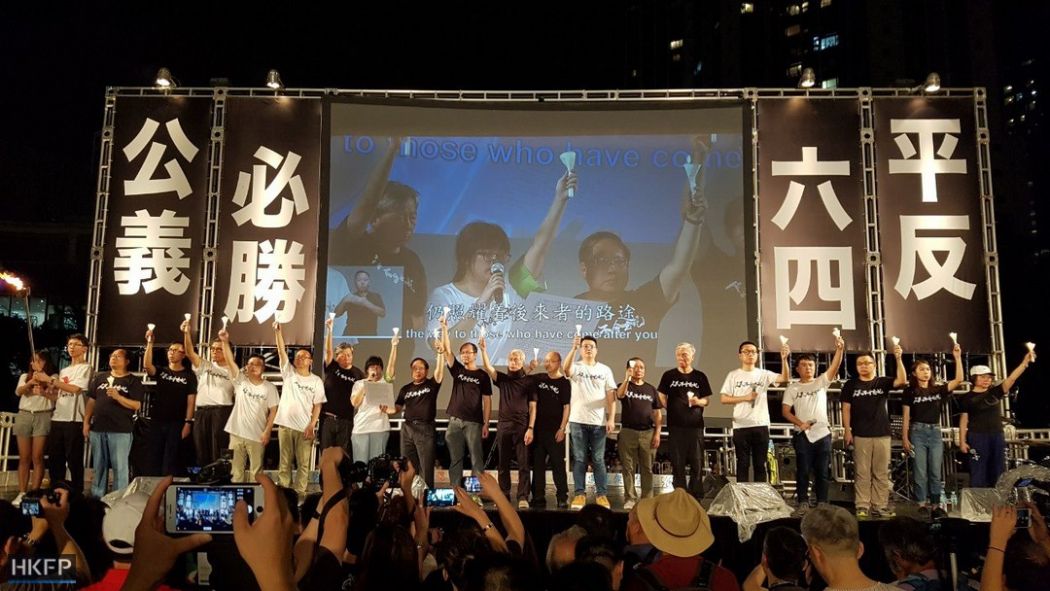
Alliance leaders (from left) Lee Cheuk-yan, Chow Hang-tung, and Albert Ho appear on the giant screen at Hong Kong’s annual Tiananmen crackdown vigil on June 4, 2019. File photo: Todd R. Darling/HKFP.
Barrister Erik Shum, representing Lee Cheuk-yan, spoke before a three-judge panel on Monday as closing arguments began in the national security trial of Lee and Chow Hang-tung. Both are former leaders of the now-defunct Hong Kong Alliance in Support of Patriotic Democratic Movements of China.
The pair and the Alliance are facing a charge of “inciting subversion,” an offence under the Beijing-imposed national security law, over the group’s calls to end one-party rule in China during decades of candlelight vigils commemorating the 1989 Tiananmen crackdown. The offence carries a maximum penalty of 10 years behind bars.
The calls to end one-party rule – one of the group’s five tenets that also included the democratisation of China since its founding in 1989 – were demanding a change in the country’s political system rather than targeting any specific political party, Shum said.
Shum told the court on Monday that prosecutors had failed to present evidence that the Alliance sought to incite the public to revolt against the ruling Chinese Communist Party (CCP).
The Alliance had never proposed an “action plan” to mobilise supporters to topple the CCP, he added.
“In the past 30 years, there has been no evidence showing that any person acted under the Alliance’s specific instruction,” Shum said in Cantonese.
Civilian political criticism
Prosecutors have argued that there are no “lawful means” to end CCP rule after a 2018 constitutional amendment stipulates that the party’s leadership is the “defining feature” of China’s socialist system.
Shum argued on Monday that prosecutors presented a “tautological theory.”
“We ask: How exactly did the Alliance incite others to overthrow the CCP? And my submission is that the prosecution has always reverted to the claim that ending CCP rule is illegal,” Shum said.
From left: Lee Cheuk-yan, Albert Ho, Chow Hang-tung. Photos: HKFP.
Shum urged the court to draw a boundary for what is considered an acceptable political expression and what is not.
“The court must not pay lip service to human rights protections,” he said.
Judge Alex Lee, one of the three national security judges presiding over the trial, asked Shum to elaborate on how higher courts interpreted illegal means in the landmark “Hong Kong 47” case, in which 45 pro-democracy campaigners were found guilty of subversion.
Shum argued that the case revolved around the group’s plan to indiscriminately veto the government budget once they were elected as lawmakers, which was ruled a breach of duty and an abuse of power.
The Alliance, however, was not exercising any power, and its calls should be considered civilian political criticism, Shum said.
“On this side of the spectrum is dissatisfaction with the status quo. Is that not allowed to be said?” he said.
‘Freedom is not absolute’
Also delivering closing arguments on Monday, lead prosecutor Ned Lai said the Alliance’s calls should be interpreted as toppling China’s “fundamental system” and the country’s central political bodies.
Lai argued the Alliance’s calls had exceeded the legitimate boundary of freedom of expression as the defendants intended to stoke hatred against Beijing.
“We say that their behaviour had crossed the line,” he said in Cantonese. “Freedom is not absolute.”
A Correctional Service Department vehicle arrives at the West Kowloon Law Courts Building on January 22, 2026. Photo: Kyle Lam/HKFP.
The prosecutor also said the defendants’ advocacy for democratisation was irrelevant to the case as their calls amounted to a breach of the law.
Judge Lee appeared skeptical of Lai’s submission, saying that the court may have to consider whether the defendants “genuinely believed” that their behaviour was lawful.
Chow, a barrister representing herself in the trial, is set to deliver her closing arguments on Tuesday.
For decades, the Alliance organised vigils at Victoria Park to commemorate the 1989 Tiananmen crackdown in Beijing, when hundreds, perhaps thousands, were killed as troops dispersed pro-democracy demonstrators in and around Tiananmen Square.
The Alliance disbanded in 2021 after authorities banned the vigil for two years, citing Covid-19 restrictions, and arrested its leadership on national security allegations. Chow and Lee have been behind bars since September 2021.
A third defendant, former lawmaker Albert Ho, was excused from attending the rest of the proceedings after pleading guilty when the trial opened in January.
The Hong Kong Economic Journal (HKEJ) reported on Monday, citing unnamed sources, that the government viewed a cap of 10,000 as a “reasonable starting point,” as the figure would not excessively affect taxi drivers’ income or exceed road capacity.
Authorities believe that Uber’s suggestion of 30,000 permits is too ambitious, while the taxi trade’s proposal of 3,600 would fail to meet public travel demands, the report said.
In a submission to the Legislative Council (LegCo) Panel on Transport on Monday, the government did not specify a final number of permits but noted public opinion favoured a range of 10,000 to 15,000 permits.
A government consultancy report conducted between November 2024 and January 2025 estimated that ride-hailing services facilitate about 114,000 trips in Hong Kong on an average day.
Meanwhile, the number of active ride-hailing drivers was believed to be fewer than 30,000, as many work part-time, the government said.
The government said public opinion remained divided. According to its submission document, some advocate a higher cap because ride-hailing vehicles far outnumber traditional taxis in some major cities around the world.
However, others believe that Hong Kong’s situation is “unique” and that the number of permits should not exceed the city’s current taxi fleet of about 18,000.
Taxis in Wan Chai. Photo: Kyle Lam/HKFP.
In a submission on Tuesday, Uber said it had more than 30,000 active ride-hailing drivers on its platform over the past year, arguing that the proposed 10,000 or 15,000 caps would not meet demands.
Uber estimated that, if the number of permits were capped at 15,000, four in 10 ride requests could go unfulfilled during rush hours, while waiting times might double, and fares could increase by 70 per cent.
The ride-hailing platform urged the government to issue enough permits to ensure a “flexible” service and to protect existing drivers’ livelihoods.
Authorities are expected to introduce the final cap by the end of June and begin enforcing the regulatory framework in the fourth quarter of this year.
In October, LegCo passed a bill to introduce a licensing regime as part of a regulatory framework for ride-hailing services in Hong Kong.
Under the framework, ride-hailing platform operators will be required to obtain a licence, while drivers will also need to acquire a permit for themselves and their vehicles to provide ride-hailing services.

 Login
Login