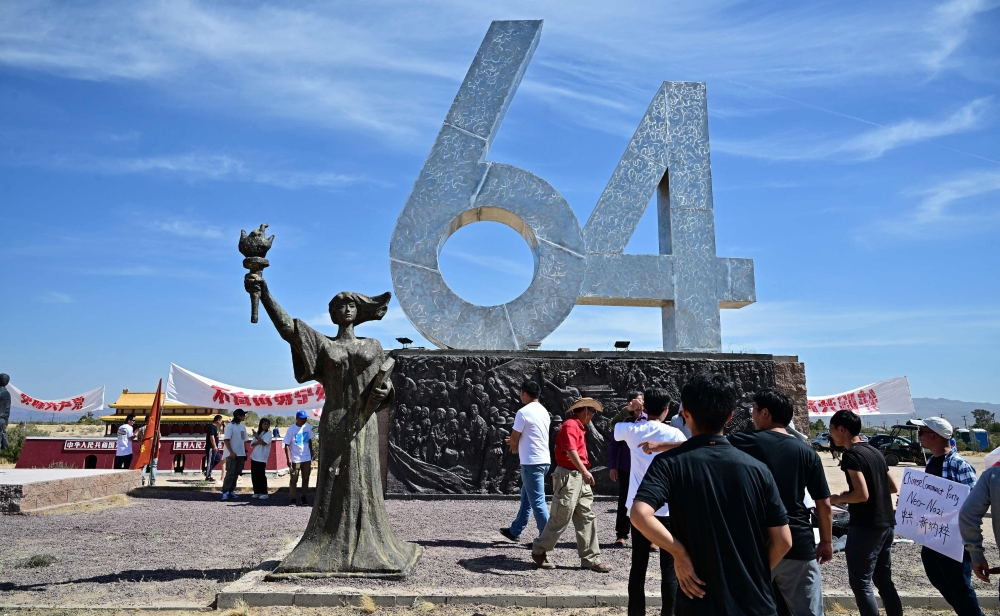
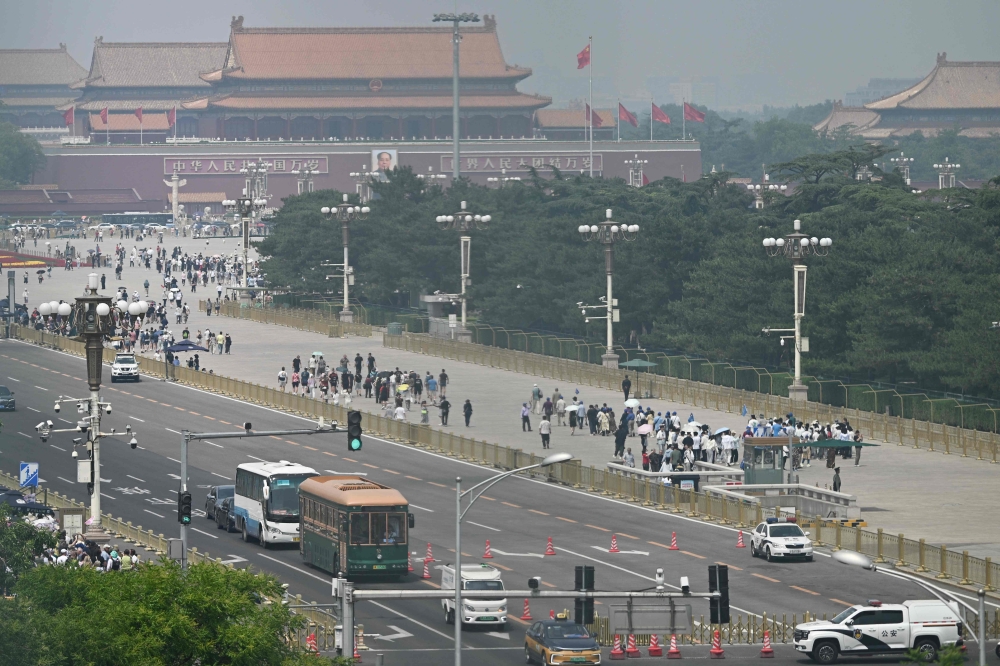
A Hong Kong Tiananmen vigil activist standing in a national security trial has urged the court to safeguard the “dignity and bottom line of the law,” as she warned judges not to become “accomplices” in an alleged government crackdown on free speech.
The candlelight vigil commemorating the 1989 Tiananmen crackdown in Beijing, in 2018. File photo: Kris Cheng/HKFP.
Chow Hang-tung, a former leader of the now-defunct Hong Kong Alliance in Support of Patriotic Democratic Movements of China, sai
A Hong Kong Tiananmen vigil activist standing in a national security trial has urged the court to safeguard the “dignity and bottom line of the law,” as she warned judges not to become “accomplices” in an alleged government crackdown on free speech.
The candlelight vigil commemorating the 1989 Tiananmen crackdown in Beijing, in 2018. File photo: Kris Cheng/HKFP.
Chow Hang-tung, a former leader of the now-defunct Hong Kong Alliance in Support of Patriotic Democratic Movements of China, said that authorities have been “reshaping” the city’s long-held values by prosecuting activists who advocate for democracy in China.
Her statement to the court was made on Tuesday as the prosecution and the defence completed their closing arguments. The three-judge panel said they hope to deliver a verdict in “mid or late July.”
Chow is representing herself in the trial, in which she faces a charge of inciting subversion under the Beijing-imposed national security law alongside the Alliance and Lee Cheuk-yan, another former leader of the group. The offence carries a maximum penalty of 10 years behind bars.
Prosecutors accuse the Alliance of inciting others to topple the ruling Chinese Communist Party (CCP) through its calls to “end one-party rule” in China, a key tenet of the group since its founding in 1989 after the Tiananmen crackdown in Beijing.
Delivering closing arguments on Tuesday, Chow said the crux of the case was whether the law protects the “perpetual rule” of the CCP or the rights of people to advocate democracy.
“Ending one-party rule means putting an end to the status quo, in which those in power are not bound by the law,” she said in Cantonese.
‘Unheard of’
Prosecutors previously argued that the Alliance’s calls breached China’s constitution, after a 2018 amendment stipulated that the CCP’s leadership is the “defining feature” of the country’s “fundamental” socialist system.
Chow argued on Tuesday that the CCP’s leadership is merely “symbolic” under China’s constitution, as the text has not demarcated the party’s power and function.
A Correctional Service Department vehicle arrives at the West Kowloon Law Courts Building on January 22, 2026. Photo: Kyle Lam/HKFP.
“King Charles III is also the leader of his country, but he has no real power,” she said, drawing an analogy to the UK’s constitutional monarchy.
Instead, it is a reality that the CCP is in power, she said. The Alliance’s advocacy aimed at creating “favourable conditions” for the country’s democratisation, not toppling the regime, she added.
She argued it was “unheard of” that a government would accuse its citizens of breaching the constitution.
“Any document that can be called a constitution in the world is to restrict the operation of power, not ordinary people,” she said.
Citing the trial of former South Korean president Chun Doo-hwan, who was responsible for the country’s bloody crackdown of the Gwangju uprising in 1980, Chow said it was those who sought to concentrate power that were ruled to have breached the constitution.
‘Accomplice’
She also dismissed the prosecution’s claim that the only “reasonable and natural effect” of the Alliance’s calls was an incitement of others. Her group was merely making political criticism and had not called for action, she said.
She argued that the charge against her demonstrated the government’s “paranoia” and its attempt to silence those making unfavourable opinions, adding that the defendants wholly believed in their advocacy.
If the court found the defendants guilty, that would prohibit the political freedom that the city has long championed, she said.
From left: Lee Cheuk-yan, Albert Ho, Chow Hang-tung. Photos: HKFP.
“If the court cannot rigorously draw a line for what is the reasonable and natural effect [of political speech], it will easily become an accomplice in the authorities’ crime,” she said. “What is on trial is actually the law itself.”
Senior counsel Priscilia Lam, representing the Alliance, argued the prosecution had not been able to present evidence of the group’s alleged incitement to subversion.
“What did the Alliance do to incite people to subvert state power?” Lam said in Cantonese. “I have heard nothing on this after sitting here for so long.”
For decades, the Alliance organised vigils at Victoria Park to commemorate the 1989 Tiananmen crackdown in Beijing, when hundreds, perhaps thousands, were killed as troops dispersed pro-democracy demonstrators in and around Tiananmen Square.
The Alliance disbanded in 2021 after authorities banned the vigil for two years, citing Covid-19 restrictions, and arrested its leadership on national security allegations. Chow and Lee have been behind bars since September 2021.
Another defendant, former lawmaker Albert Ho, pleaded guilty when the trial opened in January.
HONG KONG, May 19 — A Tiananmen activist told a Hong Kong court Tuesday that she “totally embraced” actions the prosecution deemed crimes, as closing arguments in her national security trial entered their second day.Chow Hang-tung, 41, is standing trial for “incitement to subversion” along with her former colleague Lee Cheuk-yan, 69. They face years behind bars if convicted.The pair were leaders of the now-defunct Hong Kong Alliance, a group that used to organise
HONG KONG, May 19 — A Tiananmen activist told a Hong Kong court Tuesday that she “totally embraced” actions the prosecution deemed crimes, as closing arguments in her national security trial entered their second day.
Chow Hang-tung, 41, is standing trial for “incitement to subversion” along with her former colleague Lee Cheuk-yan, 69. They face years behind bars if convicted.
The pair were leaders of the now-defunct Hong Kong Alliance, a group that used to organise candlelight vigils to mark China’s deadly 1989 crackdown on demonstrators in Beijing’s Tiananmen Square.
Beijing imposed a national security law on the financial hub in 2020, and the Alliance’s leaders were charged the following year and have been behind bars since.
Chow, a Cambridge-educated barrister who is representing herself, smiled widely at supporters in the gallery as she entered the courtroom.
Standing in front of a three-judge panel, she said it was a “weird” criminal case because the defendants did not dispute the facts.
“The defendants fully embraced the actions that the prosecution alleged to be crimes,” Chow told the court, adding that their efforts were an expression of their beliefs.
“What is really at dispute is what the law suppresses and what it protects,” she said.
Chow Hang-tung, barrister and a leader of the Hong Kong Alliance in Support of Patriotic Democratic Movements of China, poses during a photo session in Hong Kong on March 21, 2021. — AFP pic
‘End one-party rule’
In their closing arguments on Monday, prosecutors accused Chow and Lee of “endangering national security in the name of human rights”, adding that freedom of speech and association are “not absolute rights”.
They said the Alliance had repeatedly called to “end one-party rule” in China, which they said amounted to overthrowing or undermining the political system established by the Chinese constitution.
Chow said the group’s stance of “end one-party rule” means “to put an end to a state of unrestrained power”.
She told the court the Chinese constitution “exists to restrain those in power, not to restrain ordinary people”.
“The constitution itself is a tool... to put an end to various forms of autocracy,” she said, adding that the prosecution’s allegations that the group incited people to contravene the constitution were “completely absurd”.
Lee’s lawyer said Monday the court must not pay “lip service” to human rights, adding that the right to criticise state organs is protected by China’s constitution.
Lee, who sat quietly in the dock on Tuesday’s hearing, had previously denied that “end one-party rule” means overthrowing the Chinese Communist Party’s leadership.
He hoped the party would reform to grant Chinese citizens “the civic rights and happiness they deserved”, Lee told the court in March.
Hong Kong newspapers from June 5, 1989, reporting the Tiananmen Square China uprising, are pictured during a press preview of the Tiananmen June 4th Memorial permanent exhibition which opens June 2 in Manhattan, in New York City June 1, 2023. — Reuters pic
‘Vague, arbitrary’
Lee and Chow face a maximum penalty of 10 years imprisonment.
A third defendant, 74-year-old former lawmaker Albert Ho, pleaded guilty in January.
Rights groups have slammed the trial.
Amnesty International’s deputy regional director Sarah Brooks said in a statement on Monday that “the prosecution’s case relies on vague, overly broad and arbitrary definitions of ‘subversion’”, and called for the charges to be dropped.
Urania Chiu, a law lecturer researching Hong Kong at Oxford Brookes University, told AFP the verdict could have wider consequences.
“If the prosecution’s broad and circular understanding of the offence is accepted (by the court), legitimate critiques of Chinese government policies... however minor, will easily be criminalised”, she said. — AFP
A defence lawyer for a Tiananmen vigil activist has urged a Hong Kong court not to “pay lip service” to human rights protections, arguing that calls to “end one-party rule” in China should be considered legitimate political expressions.
Alliance leaders (from left) Lee Cheuk-yan, Chow Hang-tung, and Albert Ho appear on the giant screen at Hong Kong’s annual Tiananmen crackdown vigil on June 4, 2019. File photo: Todd R. Darling/HKFP.
Barrister Erik Shum, representing Lee Cheuk-yan, spoke b
A defence lawyer for a Tiananmen vigil activist has urged a Hong Kong court not to “pay lip service” to human rights protections, arguing that calls to “end one-party rule” in China should be considered legitimate political expressions.
Alliance leaders (from left) Lee Cheuk-yan, Chow Hang-tung, and Albert Ho appear on the giant screen at Hong Kong’s annual Tiananmen crackdown vigil on June 4, 2019. File photo: Todd R. Darling/HKFP.
Barrister Erik Shum, representing Lee Cheuk-yan, spoke before a three-judge panel on Monday as closing arguments began in the national security trial of Lee and Chow Hang-tung. Both are former leaders of the now-defunct Hong Kong Alliance in Support of Patriotic Democratic Movements of China.
The pair and the Alliance are facing a charge of “inciting subversion,” an offence under the Beijing-imposed national security law, over the group’s calls to end one-party rule in China during decades of candlelight vigils commemorating the 1989 Tiananmen crackdown. The offence carries a maximum penalty of 10 years behind bars.
The calls to end one-party rule – one of the group’s five tenets that also included the democratisation of China since its founding in 1989 – were demanding a change in the country’s political system rather than targeting any specific political party, Shum said.
Shum told the court on Monday that prosecutors had failed to present evidence that the Alliance sought to incite the public to revolt against the ruling Chinese Communist Party (CCP).
The Alliance had never proposed an “action plan” to mobilise supporters to topple the CCP, he added.
“In the past 30 years, there has been no evidence showing that any person acted under the Alliance’s specific instruction,” Shum said in Cantonese.
Civilian political criticism
Prosecutors have argued that there are no “lawful means” to end CCP rule after a 2018 constitutional amendment stipulates that the party’s leadership is the “defining feature” of China’s socialist system.
Shum argued on Monday that prosecutors presented a “tautological theory.”
“We ask: How exactly did the Alliance incite others to overthrow the CCP? And my submission is that the prosecution has always reverted to the claim that ending CCP rule is illegal,” Shum said.
From left: Lee Cheuk-yan, Albert Ho, Chow Hang-tung. Photos: HKFP.
Shum urged the court to draw a boundary for what is considered an acceptable political expression and what is not.
“The court must not pay lip service to human rights protections,” he said.
Judge Alex Lee, one of the three national security judges presiding over the trial, asked Shum to elaborate on how higher courts interpreted illegal means in the landmark “Hong Kong 47” case, in which 45 pro-democracy campaigners were found guilty of subversion.
Shum argued that the case revolved around the group’s plan to indiscriminately veto the government budget once they were elected as lawmakers, which was ruled a breach of duty and an abuse of power.
The Alliance, however, was not exercising any power, and its calls should be considered civilian political criticism, Shum said.
“On this side of the spectrum is dissatisfaction with the status quo. Is that not allowed to be said?” he said.
‘Freedom is not absolute’
Also delivering closing arguments on Monday, lead prosecutor Ned Lai said the Alliance’s calls should be interpreted as toppling China’s “fundamental system” and the country’s central political bodies.
Lai argued the Alliance’s calls had exceeded the legitimate boundary of freedom of expression as the defendants intended to stoke hatred against Beijing.
“We say that their behaviour had crossed the line,” he said in Cantonese. “Freedom is not absolute.”
A Correctional Service Department vehicle arrives at the West Kowloon Law Courts Building on January 22, 2026. Photo: Kyle Lam/HKFP.
The prosecutor also said the defendants’ advocacy for democratisation was irrelevant to the case as their calls amounted to a breach of the law.
Judge Lee appeared skeptical of Lai’s submission, saying that the court may have to consider whether the defendants “genuinely believed” that their behaviour was lawful.
Chow, a barrister representing herself in the trial, is set to deliver her closing arguments on Tuesday.
For decades, the Alliance organised vigils at Victoria Park to commemorate the 1989 Tiananmen crackdown in Beijing, when hundreds, perhaps thousands, were killed as troops dispersed pro-democracy demonstrators in and around Tiananmen Square.
The Alliance disbanded in 2021 after authorities banned the vigil for two years, citing Covid-19 restrictions, and arrested its leadership on national security allegations. Chow and Lee have been behind bars since September 2021.
A third defendant, former lawmaker Albert Ho, was excused from attending the rest of the proceedings after pleading guilty when the trial opened in January.
HONG KONG, May 18 — A Hong Kong court is expected to begin hearing closing arguments in the case of two democracy activists facing national security charges today, as the trial enters its final stages.Lee Cheuk-yan, 69, and Chow Hang-tung, 41, who organised candlelight vigils to mark Beijing’s deadly crackdown on demonstrators in Tiananmen Square in 1989, are standing trial for “incitement to subversion”, which carries a maximum penalty of 10 years in jail.The tr
HONG KONG, May 18 — A Hong Kong court is expected to begin hearing closing arguments in the case of two democracy activists facing national security charges today, as the trial enters its final stages.
Lee Cheuk-yan, 69, and Chow Hang-tung, 41, who organised candlelight vigils to mark Beijing’s deadly crackdown on demonstrators in Tiananmen Square in 1989, are standing trial for “incitement to subversion”, which carries a maximum penalty of 10 years in jail.
The trial has been condemned by Amnesty International and Human Rights Watch as an attempt at “rewriting history”.
Lee and Chow, leaders of the now-defunct Hong Kong Alliance, were charged in 2021 and have been behind bars since then.
The trial, which began in January, took place over 22 days.
Dozens of clips were played in court, showing the defendants speaking at vigils, protests and press interviews over the years.
Hong Kong authorities say that the national security law has no retroactive effect, but it is common for prosecutors to cite pre-2020 material as evidence in such cases.
The Alliance was founded in May 1989 amidst calls in Hong Kong to support the democratic movement led by students and workers in Beijing.
The group’s key tenets included “building a democratic China” and “ending one-party rule”.
For more than three decades thereafter, the group organised candlelit vigils in the semi-autonomous city and subsequently became the driving force seeking redress on behalf of those who died in the crackdown.
Prosecutors said the Alliance had repeatedly called for the “end of one-party rule” in China, which they said amounted to subverting state power.
Lee, a veteran labour activist and a witness to the 1989 crackdown, told the court he felt no enmity towards the Communist Party and hoped it would reform.
Chow, a barrister who is representing herself, told the court that the Alliance’s position of “ending one-party rule” meant calling for a democratic transition in China.
‘An absurd trial’
Hong Kong used to be the only place in China where people could publicly mourn Beijing’s deadly crackdown on pro-democracy demonstrators in Tiananmen Square on June 4, 1989.
But Beijing imposed a national security law on the former British colony in 2020 following huge and sometimes violent pro-democracy protests the year before.
In September 2021, Hong Kong authorities arrested Alliance leaders and raided its museum, which exhibited preserved items from the Tiananmen crackdown.
Earlier this month, Chow wrote in a letter to a group of families of victims of the crackdown that “this is an absurd trial where the plaintiff has become the defendant”, referring to the Alliance’s decades of activism calling for justice for the families.
“But the trial is, ultimately, a public process that can examine facts and record testimony and evidence,” she added.
A third defendant in the case, 74-year-old Albert Ho, a former lawmaker, pleaded guilty in January. — AFP
Hong Kong introduced new national security rules in March that empower police to demand that national security suspects surrender passwords to their devices. Meanwhile, an independent bookshop owner and his employees were arrested for allegedly selling seditious books.
A sign reads “Closed for one day due to an unexpected incident. Apologies for the inconvenience,” at Book Punch in Sham Shui Po on Tuesday, March 24, 2026. Photo: Kyle Lam/HKFP.
The national security trial of two Tiananmen
Hong Kong introduced new national security rules in March that empower police to demand that national security suspects surrender passwords to their devices. Meanwhile, an independent bookshop owner and his employees were arrested for allegedly selling seditious books.
A sign reads “Closed for one day due to an unexpected incident. Apologies for the inconvenience,” at Book Punch in Sham Shui Po on Tuesday, March 24, 2026. Photo: Kyle Lam/HKFP.
The national security trial of two Tiananmen vigil activists continued, and the city’s largest teachers’ union officially dissolved.
Under the new rules, gazetted on March 23, police can require people under national security investigation to provide passwords or help decrypt their electronic devices.
Failure to do so can be punished by up to one year behind bars and a HK$100,000 fine. Providing a false or misleading statement is punishable by up to three years’ imprisonment and a fine of HK$500,000.
Social media apps on a smartphone. Photo: dole777/Unsplash.
The new rules also empowered customs officers to freeze or confiscate assets relating to national security crimes or to forfeit “articles that have seditious intention.”
Such powers were previously restricted to the secretary for justice, the secretary for security, and the police force.
In an attempt to quell public concerns, security chief Chris Tang described claims that police could stop people on the street and demand their phone passwords as “false and misleading.”
Tang said in the Legislative Council (LegCo) on March 26 that with the new requirements in place, there was public concern that police would randomly demand that citizens on the street hand over mobile phone passwords.
Secretary for Security Chris Tang. File photo: Kyle Lam/HKFP.
The minister said that police must apply for a court warrant providing “national security reasons” before requesting people suspected of endangering national security to hand over mobile phone passwords.
China summons top US diplomat
Beijing summoned the top US diplomat in Hong Kong after the US Consulate General issued an alert over a new rule in the financial hub empowering police to demand that national security suspects surrender their passwords.
US Consul General Julie Eadeh (centre) at her welcoming reception. Photo: US Consulate General in Hong Kong and Macau, via Facebook.
In a statement on February 28, Beijing’s foreign ministry office in Hong Kong said it had summoned Julie Eadeh, the US consul general in Hong Kong, for “solemn representations.”
The statement said the move was in response to the “so-called ‘security alert’” issued by the US Consulate General on February 26, days after the Hong Kong government introduced the new national security rule.
Bookshop owner, staff arrested
In late March, Hong Kong independent bookseller Pong Yat-ming and three of his staff members were reportedly arrested on suspicion of selling seditious titles, including a biography of jailed media tycoon Jimmy Lai.
Local media reported on March 24 that national security police arrested one man and three women for allegedly “knowingly selling a publication that has a seditious intention,” an offence under Hong Kong’s homegrown security law, the Safeguarding National Security Ordinance, known locally as Article 23.
A seven-seater vehicle in Sham Shui Po, outside a building where independent bookstore Book Punch is located, on March 24, 2026. Moments before the photo was taken, a woman was seen being escorted from the bookstore by people who appeared to be wearing police lanyards into the vehicle. Photo: Kyle Lam/HKFP.
Citing anonymous sources, the reports said police also raided Book Punch – Pong’s Sham Shui Po bookstore – and seized allegedly seditious publications, including Lai’s 2024 biography – The Troublemaker: How Jimmy Lai Became a Billionaire, Hong Kong’s Greatest Dissident, and China’s Most Feared Critic.
The high-profile national security trial of Tiananmen vigil activists – barrister Chow Hang-tung and unionist Lee Cheuk-yan – continued in March.
The former leaders of the now-disbanded Hong Kong Alliance in Support of Patriotic Democratic Movements of China are standing trial for “inciting subversion,” which carries a maximum penalty of 10 years in jail. The third defendant, solicitor Albert Ho, pleaded guilty when the trial opened in January.
The case revolves around the Alliance’s key slogan calling for “an end to one-party rule” in China, which prosecutors allege amounts to a breach of China’s constitution and incitement to subversion.
On March 5, a panel of three national security judges ruled to bar a Taiwanese academic from testifying as the evidence he planned to give was deemed “irrelevant” to the case. Chow had initially applied to have Ho Ming-sho, a sociology professor at National Taiwan University, testify in the trial.
The Tiananmen vigil in Victoria Park on June 4, 2018. Albert Ho (second from left), Chow Hang-tung (third from left), and Lee Cheuk-yan (third from right) are photographed on stage. File photo: Kris Cheng/HKFP.
Lee’s barrister, Erik Shum, argued that prosecutors had misinterpreted the Chinese constitution and erred in saying that there are no “lawful means” to call for an end to the Chinese Communist Party’s (CCP) rule. The lawyer also told the court that calling for an end to the CCP’s rule does not mean “overthrowing” its government and state organs.
Chow, who represents herself, said the prosecution had adopted a broad reading of the Chinese constitution and had erred in alleging that she had directly breached it. The Alliance’s slogans fell within a Chinese citizen’s legitimate demand for choosing the country’s leadership, she also told the court.
However, the court ruled on March 13 that the prosecution established a prima facie case against Chow, Lee, and the Alliance, and the trial would go on.
Taking the stand on March 17, Lee denied that his demand for an end to one-party rule in China amounted to a call to overthrow the CCP. “I have no enmity in my heart, only love. Based on my love for the people, I hoped the Communist Party would reform, to let people have the rights and happiness they deserve,” he said the following day.
Activists Lee Cheuk-yan (sixth from right), Chow Hang-tung (fifth from right) and Albert Ho (fourth from right) at the Tiananmen vigil in Victoria Park on June 4, 2018. Photo: Catherine Lai/HKFP.
Later, on March 20, Chow told the court that the Tiananmen vigils had “always promoted love and responsibility” rather than “hatred and despair.”
She also said writings published by the Alliance were not meant to be subversive, but to expose Hongkongers to democratic movements in mainland China. Her articles were intended to “tell stories” about Chinese activists facing oppression, including the late dissident Liu Xiaobo and his widow Liu Xia, she added.
On March 25, she played a video of the 2018 vigil in the courtroom, as well as a clip of Di Mengqi, a member of the Tiananmen Mothers, recounting the death of her son during the 1989 crackdown. “The most important session of the vigils was the speeches by the Tiananmen Mothers. They are the most directly affected parties and victims of the crackdown,” she said.
Chow called three defence witnesses to testify in court. Former Alliance volunteer Choi Shuk-fong, 66, said she witnessed the Tiananmen crackdown when she was working as a journalist for Sing Tao Daily.
Former journalist and Tiananmen Square crackdown eyewitness Choi Shuk-fong (right) exits the West Kowloon Law Courts on March 30, 2026. Photo: James Lee/HKFP.
However, the judges barred a photo of injured, bloodied protesters at Tiananmen Square, which was taken by Choi, from being shown in court. “At the moment, I don’t see how this can help the court,” Judge Alex Lee said. Instead, Judge Johnny Chan verbally described the image.
A second defence witness, former vigil attendee Shum Lai-fong, 69, told the court she believed the Alliance’s call for an end to one-party rule was not directed at any specific party.
Kwan Chun-pong, 54, a former standing committee member and volunteer of the Alliance, also testified as a defence witness for Chow. Judge Lee instructed Chow to ask Kwan only questions about matters from 2018 onwards.
Activist Kwan Chun-pong leaves the West Kowloon Law Courts Building on March 31, 2026. Photo: Hillary Leung/HKFP.
At one point, the judge reprimanded Chow when she referred to the crackdown as the “June 4 massacre.” “If you use phrases like this, I will need to consider whether to allow you to continue asking questions,” he said, correcting the term to “June 4 incident.”
Judge Lee adjourned the case to May 18 for the prosecution and the defence to present their closing submissions.
Appeals in Apple Daily case
Pro-democracy media tycoon Jimmy Lai decided not to appeal against his national security conviction and jail term, his lawyer said on March 6, nearly one month after the sentencing of the Apple Daily founder. The lawyer did not elaborate on the reason for not appealing.
Lai, 78, was sentenced to 20 years behind bars on February 9 – the longest jail term handed down so far under the Beijing-imposed national security law.
Two of his eight co-defendants filed an appeal against their 10-year sentences.
Fung Wai-kong, former editorial writer and editor-in-chief of Apple Daily’s English news section, and Lam Man-chung, former executive editor-in-chief at the tabloid, filed their appeals on March 2 and March 10, respectively, according to local media and High Court documents.
Fung Wai-kong. Photo: Internet.
Eight co-defendants – including Fung, Lam and four other former Apple Daily executives – pleaded guilty and were sentenced to up to 10 years in prison alongside Lai.
The Registry of Trade Unions gazetted on March 27 that the HKPTU – the city’s largest teachers’ union – was dissolved, marking the end of the group’s half-century of history.
Hong Kong Professional Teachers’ Union. File photo: Candice Chau/HKFP.
Once a prominent force in Hong Kong’s civil society and democratic movement, the 53-year-old union had over 95,000 members before its dissolution, representing 90 per cent of the profession.
The Hong Kong Arts Centre (HKAC) revived an Asian film competition in early March after a 17-month hiatus, adding new terms requiring participants to ensure their work complies with the city’s national security legislation.
The HKAC’s Incubator for Film and Visual Media in Asia (ifva) Awards opened for applications on March 1.
According to the awards’ rules and regulations, “entrants must acknowledge and agree [that] the submitted entry… does not violate any provisions of the National Security Law, including these pertaining to secession, subversion, terrorist activities, and collusion with foreign entities.”
Prosecution and arrests figures
As of April 1, a total of 394 people have been arrested for “cases involving suspected acts or activities that endanger national security” since Beijing’s national security law came into effect, according to the Security Bureau. That figure includes those arrested under Article 23 and for other offences.
Of the 208 people and five companies that have so far been charged, 180 people and four companies have been convicted or are awaiting sentencing.
In total, 100 people and four companies have been charged under Beijing’s national security law, with 79 persons and three companies convicted. Thirteen people have been charged under Article 23, 10 of whom have been convicted.

 Login
Login