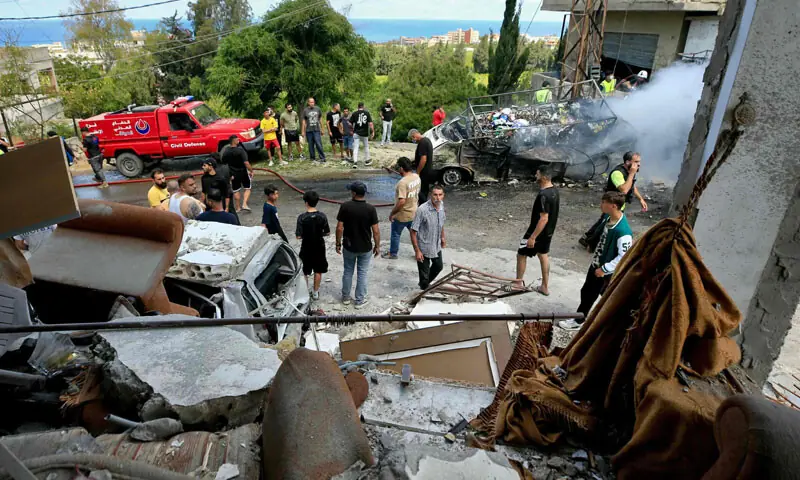
BEIRUT: An Israeli strike on a military vehicle in southern Lebanon killed three soldiers, the Lebanese military said on Saturday, laying bare Israel’s continued aggression just days after the countries discussed a conditional truce during talks in the United States.
Israel has launched an invasion into Lebanon, claiming it seeks to root out Hezbollah, which engaged in the wider Middle East war by launching retaliatory missiles against Israeli forces in response to US-Israeli strikes that killed Iran’s supreme leader.
Meanwhile, Lebanon has vowed that it will disarm Hezbollah over time, but has also denounced Israel’s invasion, accusing it of employing scorched-earth tactics to drive civilians out of southern towns and villages.
In the latest incident, the Lebanese army said two officers and a soldier were killed in a strike on a military vehicle on the road between Khardali and Nabatieh.
Tehran rejects claims it is using Lebanon as ‘bargaining chip’, urges Beirut to focus on ‘real foe’
Hezbollah dubbed the attack a “heinous crime”. It criticised the Lebanese government for exposing its own country to further bloodshed through its “complete surrender to the enemy’s demands in Washington”.
A conditional truce announced this week in Washington requires Hezbollah to stop firing and withdraw from near the Israeli border, and would see Lebanon’s army deploy to new “pilot zones” in the area, where it will exercise exclusive control. But Hezbollah has rejected the agreement, demanding a Israeli troops withdrawal.
The Lebanese army said that “the continuation of the deliberate and repeated brutal Israeli aggression … is aimed at thwarting all efforts to reach a solution”.
Lebanese President Joseph Aoun also denounced the latest attack, calling it a “flagrant violation of Lebanese sovereignty … despite Lebanon’s efforts in the Washington negotiations to put an end to the continued Israeli aggression that goes unchecked”.
On Saturday, Israel renewed evacuation orders for five villages in Lebanon’s south and east, telling residents to move north of the Zahrani River. Its military conducted several strikes across South Lebanon, according to Lebanese state media.
Iranian Foreign Minister Abbas Araghchi on Saturday rejected Aoun’s remarks that Lebanon was a bargaining chip for Tehran.
“Had Lebanon been a bargaining chip for Iran, we’d have a deal long ago,” Araghchi posted on X. “Based on Mr Aoun’s comments, one would think it’s Iran that has occupied 1/5 of Lebanon, displaced 1/4 of Lebanese and bombing his country on daily basis… Save Lebanon from your real foe, Mr. President,” Araghchi added.
• Iran launches fresh missile, drone attacks on Kuwait, Bahrain • Kuwait says new attack ‘dangerous escalation’; Bahrain denounces ‘blatant aggression’ • Falling debris causes ‘material damage’ in Kuwait • Centcom says four attack drones downed near Hormuz; Iranian coastal radar sites also hit • Trump says Iran has ‘22pc’ of missiles left • US okays sale of $2bn in anti-drone weapons to Kuwait
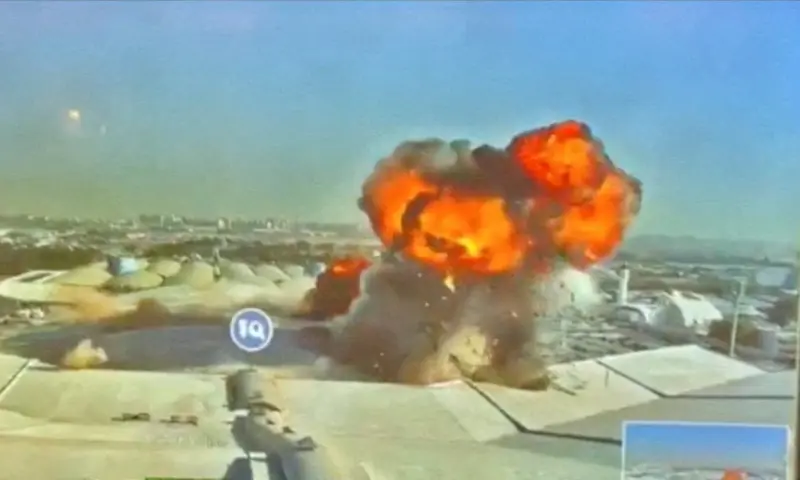
KUWAIT CITY: Iran launched fresh missile and drone attacks on Bahrain and Kuwait early on Saturday, while the United States said it struck Iranian coastal radar sites after intercepting missiles and drones aimed at Gulf allies and the Strait of Hormuz, further straining a fragile ceasefire.
Bahrain and Kuwait intercepted seven Iranian missiles, while Bahrain also destroyed several drones, officials said. It was the second attack on both Gulf states since Wednesday.
Iran’s Revolutionary Guards said they had targeted “enemy bases” with missiles after the US military said it struck radar sites in Iran and downed drones headed towards the strategic Strait of Hormuz.
Bahrain, home to the headquarters of the US Fifth Fleet, denounced the attacks against its territory and neighbouring Kuwait as “blatant aggression” and “a flagrant violation of the sovereignty of both countries”.
In Bahrain’s capital Manama, an AFP journalist reported hearing three explosions, while the interior ministry said air raid sirens had sounded across the country.
Later, Bahrain’s military said its air defences had “successfully intercepted and destroyed three missiles and several drones”.
Kuwait also condemned the attacks, calling them a “direct threat” to the lives of citizens and residents and a “dangerous escalation” at a time when the international community was making efforts to stop combat operations.
In Kuwait, an AFP journalist reported hearing repeated blasts near the country’s international airport, which had been struck on Wednesday in an attack blamed on Iran that killed one person.
“We woke up to a huge explosion. The explosions were very loud,” Reem, an Egyptian mother of two, said, referring to the Saturday attacks. “My children were terrified, and I couldn’t calm them down,” she said.
Kuwait’s military said it had “engaged seven hostile ballistic missiles” in Kuwaiti airspace. It added that some interceptions over residential areas caused falling debris, resulting in material damage but no casualties.
In the hours after the barrages, Kuwait’s aviation authority announced the resumption of air traffic, saying 11 Kuwait Airways and Jazeera Airways flights had been diverted during an airspace closure caused by the Iranian attack.
Qatar, Egypt and Jordan joined Bahrain and Kuwait in condemning the attacks, calling them violations of sovereignty and international law.
In a statement, the Qatari Ministry of Foreign Affairs called for de-escalation and stressed the necessity of sparing the region the consequences of “unjustified attacks”.
Egypt also strongly condemned the “heinous Iranian attack that targeted Kuwait and Bahrain”, terming them a flagrant violation of the sovereignty of the two countries and “a dangerous escalation that threatens the security and stability” of the entire region.
The Jordanian foreign ministry said in a statement that the attacks constitute a blatant breach of international law and the United Nations Charter.
US strikes Iranian sites
US Central Command said six of the seven ballistic missiles fired towards Kuwait and Bahrain were downed, while the seventh “did not reach its intended target”.
Centcom also said US forces downed four one-way attack drones before they could threaten maritime traffic near the Strait of Hormuz.
US forces then struck Iranian coastal radar sites to prevent further attacks. No US personnel were harmed, Centcom said.
Iran’s foreign ministry condemned the US attack on coastal radar installations in the Gulf, calling it a “flagrant” violation of the ceasefire in place since April.
It described the strikes as an attack “on the national sovereignty and territorial integrity of the Islamic republic” and denounced Washington’s “hostile and provocative behaviour”.
Trump says Iran still has missiles
US President Donald Trump claimed Iran still had “21, 22 per cent” of its missiles left after Tehran fired dozens across the region.
“They still have capacity. They have some missiles, they have some drones. I would say, percentage-wise, maybe 21, 22pc of their missiles,” Trump told NBC News.
The estimate is higher than the 18pc he gave in May. Trump has often claimed to have completely destroyed Iran’s war-fighting capacity.
Weeks of complex talks marked by threats and flare-ups of violence have failed to secure a deal to end the war. However, Trump said Iran had “got no choice” except to reach an agreement.
“They’re strong, they’re proud, there are things they never thought they’d be doing that they’re going to have to do,” he said.
Meanwhile, the United States also announced its approval of a $1.98 billion arms sale to Kuwait, one of the Gulf countries hit by Iranian strikes during the Middle East war.
In a statement, the US State Department said it would allow purchases of counter-drone technology from defence company Anduril, which was founded by a supporter of President Trump.
“This proposed sale will support the foreign policy and national security objectives of the United States by improving the security of a major non-Nato ally that has been an important force for political stability and economic progress in the Middle East,” the statement said.
NEW DELHI: Pakistan has decided not to send its team for the Asian Senior Fencing Championships to be held in New Delhi from June 19 despite the local organisers sending an invite to the neighbouring country to take part in the continental event, Press Trust of India (PTI) news agency reported on Thursday.
India is hosting the championships for the first time. Fencers from more than 30 countries across Asia and Oceania will be seen in action. Nearly 100 delegates and technical officials will oversee the event.
“We sent an invite to Pakistan, as well as Afghanistan, to participate in the championships but they chose not to send their fencers. The deadline for sending entries is long over and we are now in the process of procuring visas for the athletes and officials,” the Fencing Association of India (FAI) secretary general Rajeev Mehta told PTI.
Last month, the Indian Sports Ministry had reiterated that the blanket ban on bilateral sporting ties with Pakistan that was imposed last year will remain in force, but the athletes from across the border will not be stopped from coming here for multilateral events.
Despite that, Pakistan has chosen not to send the entries of their fencers.
The wife of a Lebanese army captain, who was killed by Israeli bombardment, salutes as mourners carry her husband’s coffin at his home village in southern Lebanon.—AFP
• Woman, child among 12 killed in attacks on Zifta, Tyre • Beirut counts 3,491 Israeli strikes since April 17; fresh bombardment damages Unesco heritage site • Hezbollah denies contact with Trump
BEIRUT: An Israeli strike on southern Lebanon killed 12 people on Monday as Lebanese Defence Minister Michel Menassa revealed Israel has carried out nearly 3,500 air strikes since a US-brokered ceasefire took effect in April.
The Lebanese health ministry said the dawn raid on the town of Zifta in the Nabatieh district resulted in seven deaths, including a Syrian child and a woman, and wounded eight others.
Meanwhile, an Israeli strike on Tyre in southern Lebanon on Monday killed five people and wounded eight, the health ministry said, as Israel said it would continue strikes despite Iranian threats.
“An Israeli enemy raid on the city of Tyre, near the Red Cross centre, resulted in five martyrs and eight wounded, four of whom were Red Cross paramedics,” the ministry said in a statement.
The continuing violence underscores the fragility of the ceasefire that came into effect on April 17.
Nearly 3,500 Israeli attacks
During a cabinet meeting on Monday, Menassa said that between April 17 and June 7, Israel conducted 3,491 air strikes, 407 controlled demolitions and six razing operations, flattening entire villages in southernmost Lebanon.
PM Nawaf Salam said the escalation has caused additional waves of displacement. More than 1 million people have been displaced and over 3,600 killed since Hezbollah drew Lebanon into the conflict on March 2 with rocket fire at Israel to avenge the US-Israeli killing of Iran’s supreme leader.
The heavy bombardment in Tyre also damaged a Unesco World Heritage site. Ali Badawi, the culture ministry’s regional director of archaeological sites for south Lebanon, said Sunday’s bombardment had “the worst impact” on Tyre’s ancient areas since the war began. “The amount of debris and damage at the site is high,” Badawi said. “Some archaeological artefacts were damaged when rubble fell on them, as debris fell over a large area, impacting a large number of elements at the site — columns, capitals, column bases, mosaics.”
Tyre’s ruins include Roman baths, a second-century triumphal arch and a hippodrome. Lebanese Culture Minister Ghassan Salame appealed to protect the sites, charging that Israel “does not respect” the Hague Convention on the Protection of Cultural Property.
‘No contact with Trump’
Amid the ongoing conflict, a senior Hezbollah official denied statements from US President Donald Trump suggesting the two sides had communicated.
Senior Hezbollah official Mahmud Qomati said in written remarks that “there has been no direct contact between President Trump and Hezbollah officials”.
Trump told reporters last Wednesday that “we actually spoke with Hezbollah for the first time, ever,” and later claimed he had a “very good call” with the group through highly placed representatives.
• Pentagon chief says Trump is ‘patient’, wants to make a ‘great deal’ to ensure Iran doesn’t have nukes • US military fires on Gambia-flagged ship ‘violating Iran blockade’ • War secretary asserts Iran under pressure to open Strait of Hormuz with or without deal • Iran asks vessels traversing vital waterway to comply with its regulations • Hegseth lauds PM Shehbaz, CDF Munir for role in US-Iran peace talks, says ‘true friendship’ developing with Islamabad
SINGAPORE: As negotiators from Washington and Tehran worked to bridge major differences blocking an agreement to end the weeks-long war, Defence Secretary Pete Hegseth on Saturday warned that the US was ready to restart attacks on Iran if a deal was not reached.
“Our ability to recommence if necessary…we are more than capable,” Mr Hegseth said while speaking at the Shangri-La Dialogue in Singapore. “Our stockpiles are more than suited for that, both there and around the globe, so we’re in a very good place,” he claimed.
The Pentagon chief said President Donald Trump was “patient” and wants to make a “great deal” that ensures Iran does not get a nuclear weapon.
“Those goalposts haven’t shifted at all,” he said, referring to the US demand that Iran abandon any nuclear ambitions it has, which Tehran says is for civilian purposes. “We think we’re in a good place to make that deal,” he said, while also warning that the Pentagon was “postured even stronger today than we were on Day One”. “The talks have been productive,” Mr Hegseth further said.
At the Singapore dialogue, he also assured his Asian allies, saying that the US had not turned its back on the Asia-Pacific region despite being engaged in conflict with Iran. “We can do two things at one time. We’re super-charging our defence industrial base so that we’re building 2X, 3X, 4X the munitions very soon to ensure that all of our (operations) plans are properly funded throughout the world,” he said.
Meanwhile, US Central Command claimed to have disabled a Gambia-flagged cargo vessel, M/V Lian Star, attempting to sail to an Iranian port by launching a missile into its engine room. “A US aircraft disabled the vessel by firing a Hellfire missile into the ship’s engine room after Lian Star’s crew failed to comply. The ship is no longer transiting to Iran,” Centcom said on X.
The statement did not mention if there were any injuries aboard the Lian Star following the strike.
The war launched by the US and Israel on Feb 28 has killed thousands of people in Iran and Lebanon, and caused global economic pain by pushing up energy prices due to Iran’s effective closure of the Strait of Hormuz.
A White House official said that US President Donald Trump would only make a peace deal with Iran if it met all his conditions. “The Situation Room meeting has concluded and lasted approximately two hours. President Trump will only make a deal that is good for America and satisfies his red lines,” the White House official told AFP on condition of anonymity. “Iran can never possess a nuclear weapon.”
However, Mohsen Rezaei, a military adviser to Iran’s supreme leader, said that US President Donald Trump was “betraying diplomacy for the third time” by continuing “naval blockade and adopting increasingly excessive demands in negotiations”. In a post on social media platform X, Mr Rezaei said the US president also “demonstrated that he is not genuinely interested in negotiations and is pursuing other objectives”.
US-Pakistan ties
The Pentagon chief also praised Pakistan for its role in facilitating the peace talks. He said Washington and Islamabad are developing a “true friendship”, praising Prime Minister Shehbaz Sharif and CDF and COAS Field Marshal Asim Munir for their role in the US-Iran peace negotiations.
Responding to a question at the Shangri-La Dialogue in Singapore, he said, “I mentioned India here, but I very easily could have mentioned Pakistan and the role that the field marshal and the prime minister are playing in peace negotiations. I think an unexpected development and a true friendship [is] developing there, which I think is important.”
Mr Hegseth also reiterated the US and Pakistan’s stance of President Donald Trump brokering a ceasefire between Pakistan and India during the May 2025 conflict.
“I think both sides are going to see understandable threats coming from the other, maybe some of which we see differently, and countries are going to want to develop ICBM threats,” he said, clarifying that Washington was not “pointing a finger” at either country right now or terming either of them a threat to the US.
Strait of Hormuz
The Strait of Hormuz blockade, which has become a sticking point in the peace negotiations, was also addressed by the defence secretary. He said various countries were “putting pressure on Iran” to reopen the Strait of Hormuz once a peace deal was agreed on, or even if it was not.
Responding to a media query in Singapore, he said that Hormuz would be “an open strait, a toll-free strait that the entire world could use”. The secretary asserted that the US-imposed blockade of Iranian ports was “ironclad” and had “put the real pressure on Iran”. “They want to say that they control the strait, but we do, and everything behind the scenes shows that we are in control when it comes to that,” he added.
Qatar, meanwhile, rejected proposals for permanent transit fees in the Strait of Hormuz, warning that such measures would ultimately drive up costs for consumers worldwide, Al Jazeera reported. Speaking at the Shangri-La Dialogue security forum in Singapore, Qatar’s Deputy Prime Minister Sheikh Saoud says Doha and its Gulf partners oppose any long-term toll system for ships passing through the strategic waterway.
Iran’s Khatam al-Anbiya Central Headquarters, however, reasserted Tehran’s control over the Strait of Hormuz, warning commercial and military vessels to comply with regulations governing passage.
“All ships, commercial vessels, and tankers are only required to travel through the designated routes and obtain permission from the Islamic Revolutionary Guard Corps Navy. Any violation of these regulations will seriously jeopardise the security of their traffic,” it added in a statement reported in the Iranian media.

 Login
Login