
Reading view

Daniel Sackheim Traverses Los Angeles’ Noir Side in ‘The City Unseen’

Daniel Sackheim Traverses Los Angeles’ Noir Side in ‘The City Unseen’

When we think of Los Angeles, we often picture seemingly endless sunny skies, postmodern downtown skyscrapers, Hollywood, and beachy enclaves like Venice. But there’s also a mysterious, lurking side of Los Angeles popularized by legendary gangsters like Mickey Cohen and the hardboiled novels of Raymond Chandler, published between the 1930s and 1950s.

For Emmy award-winning director and photographer Daniel Sackheim, this gritty, shadowy underbelly lends itself to a series of bold black-and-white photos that highlight the noir valence of this iconic hub. His forthcoming book, The City Unseen, leans into L.A.’s dualities, focusing on historic buildings, trains, and individuals walking through urban spaces.

a black-and-white photograph by Daniel Sackheim in a noir style of a man looking at a diorama of elphants
“900 EXPOSITION BLVD”

Often silhouetted in patches of sunlight, Sackheim’s dramatically cinematic effects of deep shadows and crisp highlights suggest a kind of timelessness. Even the daytime shots feel eerily as if they could be shot during a full moon or amid uncanny artificial light. In a city that is both contemporary and steeped in history, “Sackheim’s journey through these urban spaces is a testament to the paradox of the night, where stillness and trepidation walk hand in hand,” says a statement.

Sackheim is curating an exhibition alongside photographer Julia Dean for Ren Gallery, which is slated to open in May. The City Unseen is scheduled for release on May 12. Find your copy from Hat & Beard Press, and see more of Sackheim’s work on Instagram.

a black-and-white photograph by Daniel Sackheim in a noir style of a figure walking next to a large building amid deep shadows, with a silhouetted pigeon flying above
“LOWER GRAND AVENUE”
a black-and-white photograph by Daniel Sackheim in a noir style of a man eating at a Japanese food counter
“OMOIDE YOKOCHO”
a spread from Daniel Sackheim's book 'The City Unseen'
a black-and-white photograph by Daniel Sackheim in a noir style of Randy's Donuts in Los Angeles
“936 WEST FLORANCE AVE”
a black-and-white photograph by Daniel Sackheim in a noir style of a figure walking next to a large building amid deep shadows
“SOUTH BROADWAY AT 1ST ST”
a black-and-white photograph by Daniel Sackheim in a noir style of a cook working in a train car
“12601 VENTURA BLVD”
a spread from Daniel Sackheim's book 'The City Unseen'
a black-and-white photograph by Daniel Sackheim in a noir style of a man walking down a rainy street below a theater marquis
“842 SOUTH BROADWAY”
the cover of Daniel Sackheim's photography book, 'The City Unseen'

Do stories and artists like this matter to you? Become a Colossal Member today and support independent arts publishing for as little as $7 per month. The article Daniel Sackheim Traverses Los Angeles’ Noir Side in ‘The City Unseen’ appeared first on Colossal.

  •  

Want to Predict Wildfire Severity? Look to the State of Vegetation

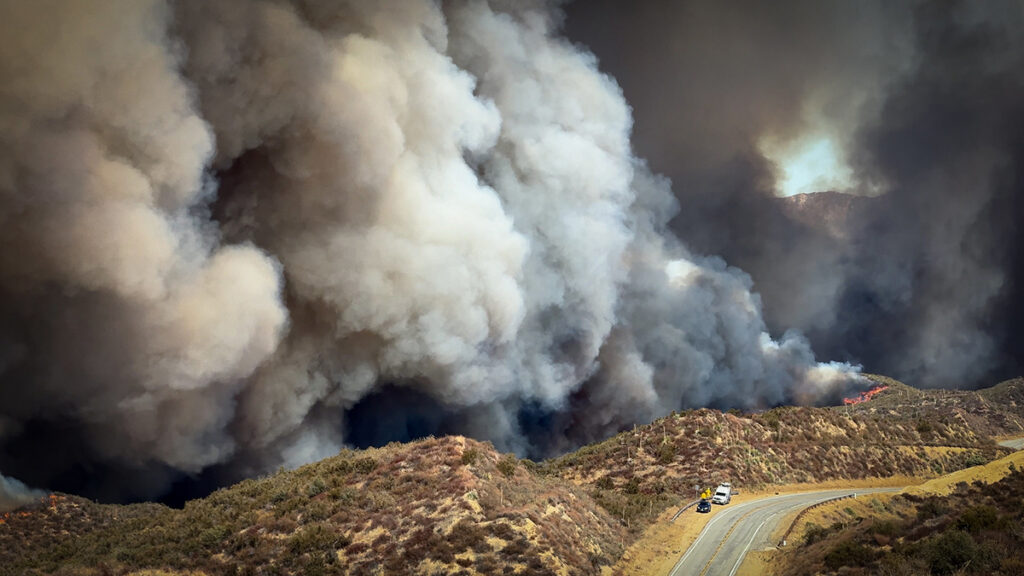
Large plumes of smoke rise from a hillside. Two vehicles on a roadside are dwarfed by the smoke cloud.
Source: AGU Advances

Urbanization, climate change, and fire suppression practices are contributing to increased wildfire risk at the densely populated wildland-urban interface. These factors make fires more unpredictable and harder to manage. In January 2025, this was made devastatingly clear in Los Angeles, when massive wildfires engulfed entire hillsides and canyons, destroying neighborhoods and damaging surrounding ecosystems.

The Mediterranean climate region of California, which stretches up most of the state’s coastline, is a naturally fire-prone landscape because its dry conditions support vegetation growth and also allow for fire to spread easily. As wildfires become more intense, better modeling and understanding of their drivers is crucial in efforts to predict risk.

Ward-Baranyay et al. looked at three of the January 2025 Los Angeles wildfires by analyzing preburn conditions, such as fuel characteristics, topography (including elevation and slope), and wind speed. Satellite observations gathered from the Ecosystem Spaceborne Thermal Radiometer Experiment on Space Station (ECOSTRESS) and the Earth Surface Mineral Dust Source Investigation (EMIT)—precursors to a recently announced NASA mission, the Explorer for Artemis Geology Lunar and Earth (EAGLE)—provided detailed information about the vegetation’s condition before the fires began. The researchers then built a random forest regression model to predict burn severity based on these conditions, ultimately demonstrating that prefire fuel conditions were a key driver of the destructive wildfires’ immediate effects on wildlands.

The model used in the study was able to accurately capture about 60% of the patterns in burn severity. It was most accurate for the Palisades and Hughes fires, but less accurate for the Eaton Fire. This discrepancy could be because the area burned by the Eaton Fire was more topographically variable, meaning its burn severity drivers may not have been fully captured by the model, the researchers suggest. Vegetation type was also a strong performance indicator: Terrain with shrub or scrub cover, the dominant vegetation type, offered the most accurate predictions for burn severity. The burn patterns of forests and other landscape types were less accurately captured.

Fuel conditions emerged as the dominant driver of burn severity, more so than topography or weather. In particular, how abundant, wet, dry, or stressed vegetation is can hint at how severe future fires may be. Tracking and monitoring these fuel conditions, researchers suggest, may be a way to monitor wildfire hazard in California and other fire-prone regions. (AGU Advances, https://doi.org/10.1029/2025AV002179, 2026)

—Rebecca Owen (@beccapox.bsky.social), Science Writer

A photo of a telescope array appears in a circle over a field of blue along with the Eos logo and the following text: Support Eos’s mission to broadly share science news and research. Below the text is a darker blue button that reads “donate today.”
Citation: Owen, R. (2026), Want to predict wildfire severity? Look to the state of vegetation, Eos, 107, https://doi.org/10.1029/2026EO260130. Published on 4 May 2026.
Text © 2026. AGU. CC BY-NC-ND 3.0
Except where otherwise noted, images are subject to copyright. Any reuse without express permission from the copyright owner is prohibited.
  •  

‘Our Neighbors, the Peacocks’ Paints a Portrait of an Unusual Convergence of Populations

‘Our Neighbors, the Peacocks’ Paints a Portrait of an Unusual Convergence of Populations

When we think of “invasive species,” perhaps zebra mussels or kudzu vine spring to mind. Both have flourished in their non-native environments and continue to threaten other native organisms. Invasive species aren’t inherently bad—they’re just trying to survive—but by definition, they’re likely to disrupt local ecosystems and even cause billions of dollars worth of damage each year. So, what does one California city have to say about its burgeoning population of… peacocks?

Introduced by a businessman and land baron named Elias Lucky Baldwin more than a century ago, the avian population has long called the area home. Over the years, though, as the originally open area filled with homes and commercial strips, efforts by local residents end up at odds, as some would like to protect the birds and others would prefer to see them sent away altogether. In a short film titled “Our Neighbors, the Peacocks,” filmmaker Callie Barlow traces the unusual history of peafowl in Los Angeles County through the eyes of some of its current residents.

Arcadia, California, sits in the San Gabriel Valley about 45 minutes from downtown Los Angeles. Dozens of peacocks, which are carefully watched over by some and detested by others, meander through residents’ yards, traipse around on rooftops, peck at cars, call from trees, and of course, display their beautiful feathers—especially during mating season.

In her short documentary, Barlow invites locals to share their love—or loathing—for the vibrant birds as she highlights how Arcadia’s history of protecting the birds has perhaps led to something of an overpopulation problem. Nearby neighborhoods participate in relocation programs, while Arcadia’s birds are protected, and opinions about how to deal with growing numbers land all along the spectrum.

“‘Our Neighbors, the Peacocks’ resists the urge to resolve the tension it so clearly lays out,” says Jason Sondhi, who selected the film for Short of the Week. “Instead, it leans into a modest but resonant idea articulated by its director that living alongside these animals might require ‘putting aside your own discomforts to find a deeper meaning in nature.'”

See the film on YouTube.

a still from a short film showing peacocks walking through a suburban front yard
a still from a short film showing a woman seated in her living room, surrounding by eclectic decor and wearing peacock-feather leggings
a still from a short film showing a peacock with its feathers on full display

Do stories and artists like this matter to you? Become a Colossal Member today and support independent arts publishing for as little as $7 per month. The article ‘Our Neighbors, the Peacocks’ Paints a Portrait of an Unusual Convergence of Populations appeared first on Colossal.

  •  
❌