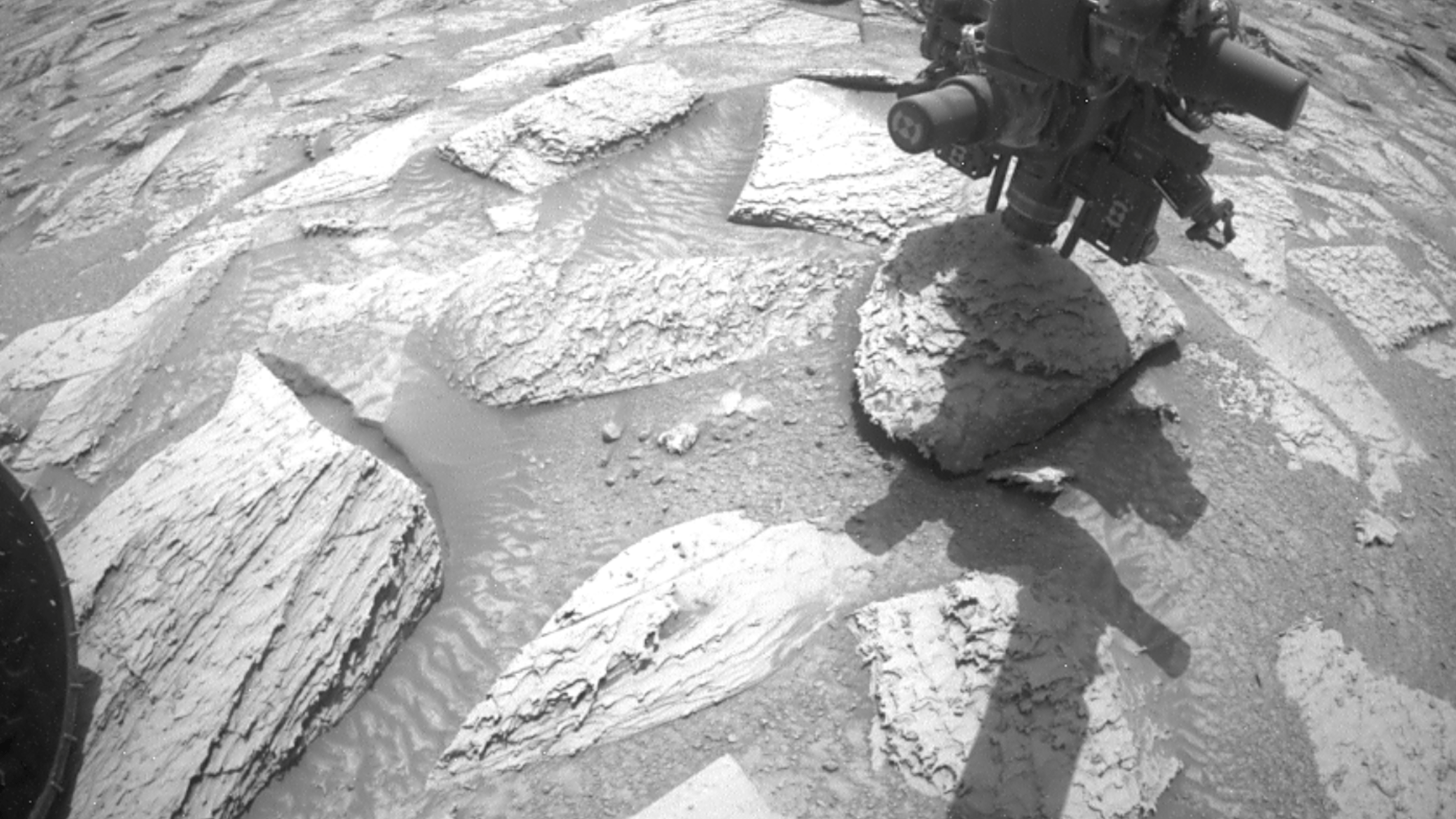
Curiosity got itself stuck between a rock and hard place last month, but NASA says there’s no reason to fret about the intrepid Mars rover. On April 25, mission engineers were remotely piloting its robotic arm’s rotary-percussive drill into a Martian rock nicknamed Atacama. It’s a relatively routine task for Curiosity, which takes the samples and then pulverizes them into a powder for future onboard chemical analysis.
But Atacama is no small stone. The hefty, 1.5-foot-wide geologic formation is about six inches thick and weighs about 28.6 pounds. So NASA engineers were understandably a bit worried when Curiosity attempted to retract its arm—and subsequently lifted the entire rock off the ground.
“Drilling has fractured or separated the upper layers of rocks in the past, but a rock has never remained attached to the drill sleeve,” the agency explained in a recent rundown.
While amusing to envision, the situation was no laughing matter for NASA’s engineers. The rover’s drill would be of little more use with a giant rock indefinitely attached to it. But even if controllers could detach Atacama from the rover, the force might damage the tool or the arm itself. Without those capabilities, Curiosity’s ongoing mission would be in serious jeopardy.
Mission specialists first tried the drilling version of “turning it off and on again,” by vibrating the tool. However, Atacama remained stubbornly stuck on Curiosity…for another four days. NASA then tried a new approach by reorienting the robotic arm and instructing the drill to vibrate one more time. Atacama managed to shake off a bit of sand that time, but little else.
Two more stressful days passed before NASA gave it a third try. Engineers tilted the drill slightly further, then rotated and vibrated the tool while also spinning its drill bit. The Curiosity team anticipated it may take multiple attempts to pull off the feat.But in this case, Atacama finally gave way almost immediately. The nearly weeklong ordeal culminated with the giant rock fracturing as it landed on the Martian ground.
So far, NASA hasn’t reported any lingering damage to the vehicle, meaning the rover is likely ready to continue exploring the Red Planet. As for Atacama, it seems the Martian rock learned a valuable lesson: Don’t mess with Curiosity.
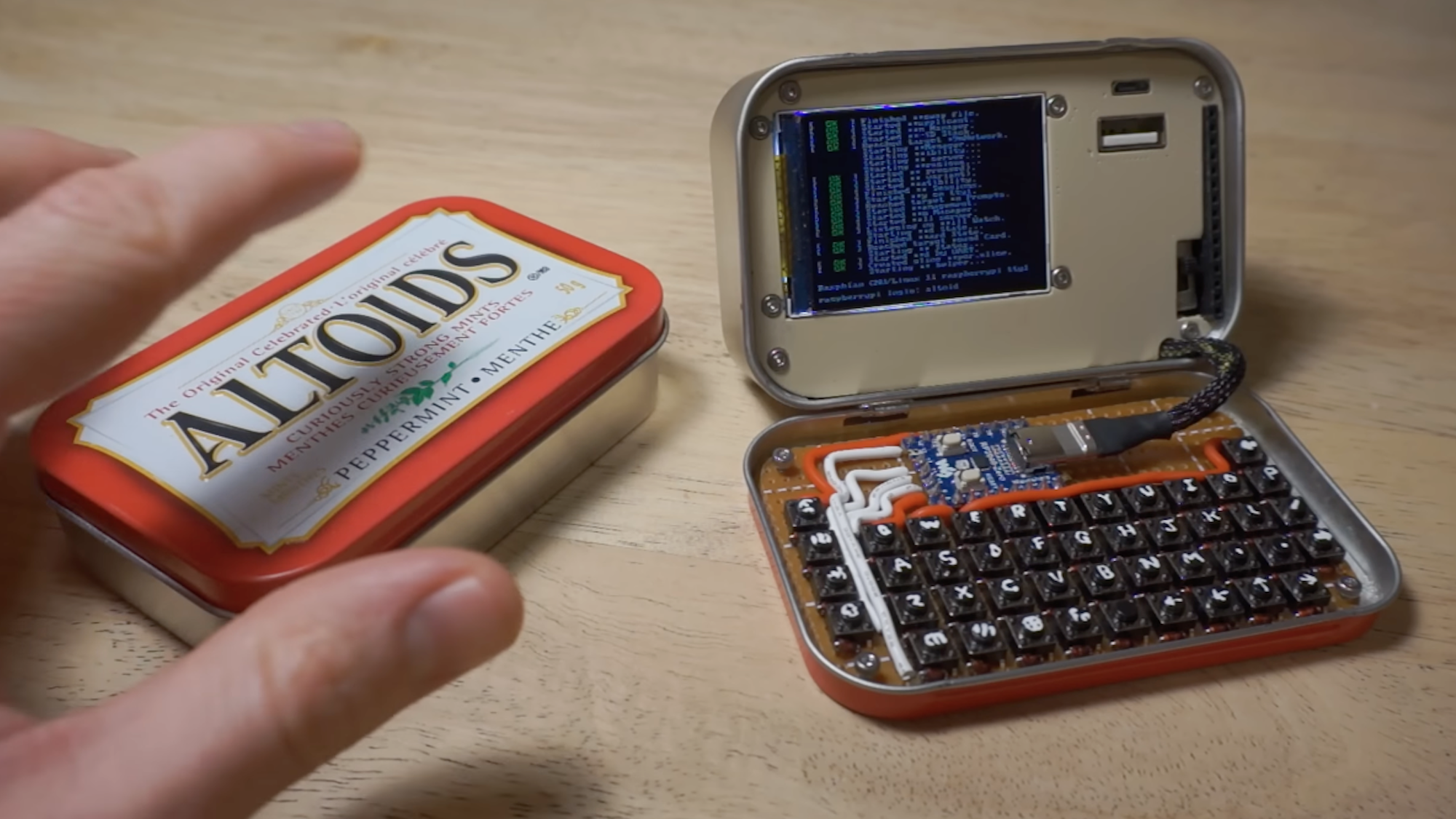
Leftover Altoid tins are staple components in all types of handy, DIY projects. Once you eat the mints, the aluminum containers routinely house basic first aid kits, miniature speakers, sewing accessories, and even watercolor paints. But for the YouTuber Exercising Ingenuity, one specific use came to mind.
“Have you ever looked at a tin of Altoids and thought, ‘That looks like a tiny computer?’” he asked in a video on May 9.
Of course, whether or not you imagined the same endeavor is beside the point—because the creator went ahead and did it. The final result may not be the most versatile pocket computer ever designed, but it definitely is one of the most portable.
Exercising Ingenuity was particularly inspired by cyberdecks, which first rose to prominence among hackers during the 1980s. The term originated in William Gibson’s landmark 1984 science fiction novel Neuromancer, and basically boils down to a rugged standalone laptop (with a little bit of punk flare thrown in for good measure). Most actual cyberdeck projects are built with an emphasis on utility and resilience, but Exercising Ingenuity’s chief goal was to make his variant as small as possible.
The problem wasn’t finding an appropriately tiny CPU and LCD screen—a Raspberry Pi Zero and an old, two-inch display both did the trick. Instead, the more difficult challenge was cramming a mechanical keyboard into the pocket-sized tin. That required learning how to construct a diode matrix configuration typing input, then individually assembling and soldering each key on his keyboard. Although the time-lapse video makes the job look incredibly frustrating and hard on the fingers, the YouTuber swears it was a “really enjoyable part of the project.” To each their own.
Typing will remain a challenge unless you have very small fingers. Credit: YouTube
From there, it was a matter of designing a flexible 3D-printed interior frame and cramming everything into the tin. This was easier said than done, and required the hobbyist to trim down as much wiring as possible while also soldering parts like the UPS board and LCD display directly onto the Raspberry Pi. Despite literally and figuratively cutting every possible corner to make room for all of the components, the final result still required swapping out the tin’s hinges with slightly larger replacements to ensure the case could close shut.
With every hurdle cleared, it was simply a matter of booting up the contraption to give it a test run. Exercising Ingenuity says the final product worked flawlessly, and he was even able to program a small motor to run using his Altoid cyberdeck. Actually typing on the keyboard still looks like a labor of love, but the overall result remains very cool. Its inventor even made all of the designs available online for free, in case any aspiring cyberpunks are looking to recycle an old mint tin.
In The Workshop, Popular Science highlights the ingenious, delightful, and often surprising projects people build in their spare time. If you or someone you know is working on a hobbyist project that fits the bill, we’d love to hear about it—fill out this form to tell us more.
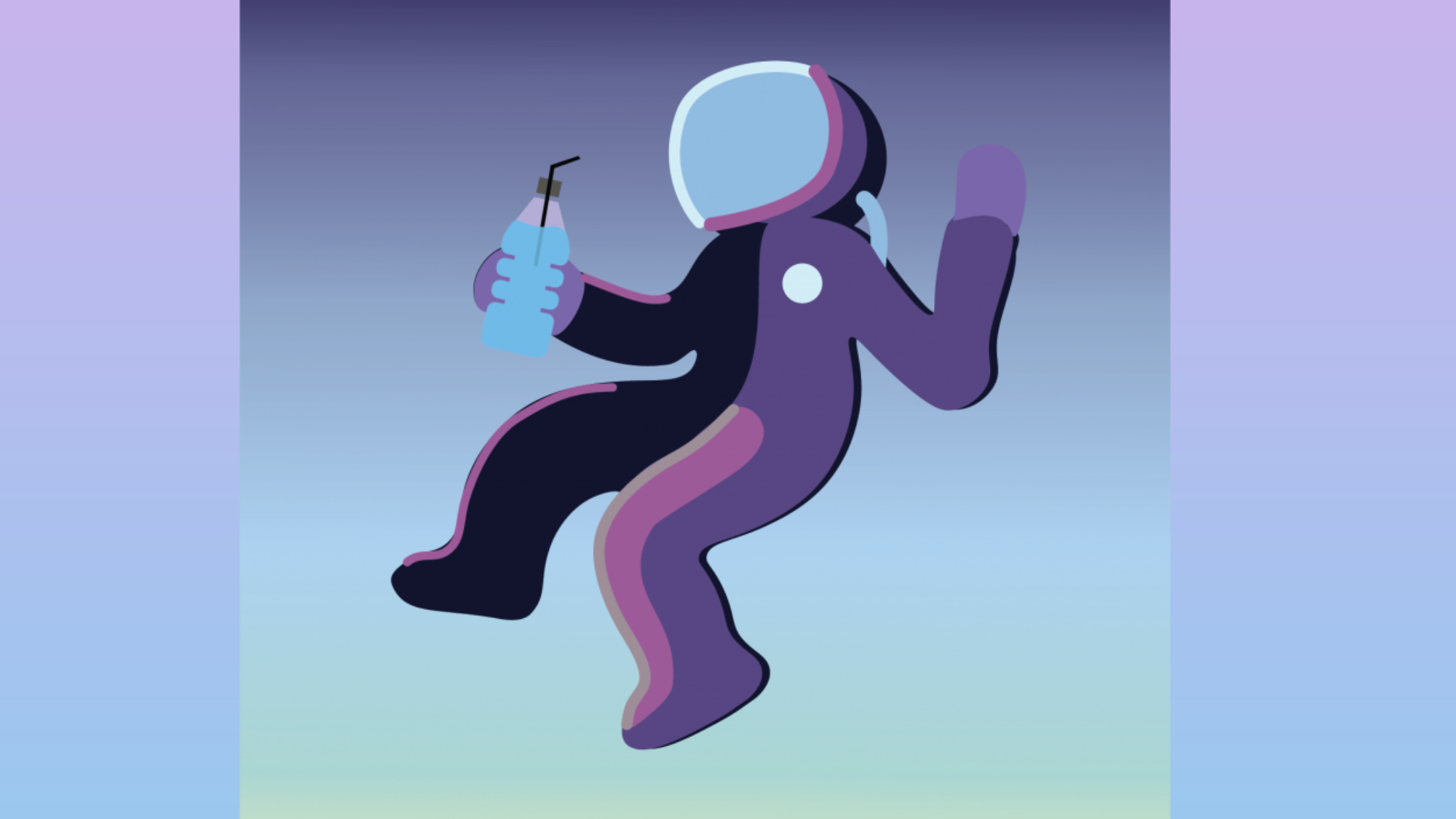
Space is undeniably incredible—but the food options up there, not so much. Though cosmic cuisine has come a long way from the days of sucking liver and beef paste out of a tube in the 1960s, the options on the intergalactic menu are still limited. And with astronauts preparing to spend longer periods in zero gravity following the recent Artemis II mission, there’s never been a greater need for a wider variety of shelf-stable options to break up the dietary monotony. The team behind a new study published in the journal ACS Food Science & Technology have found a partial solution: a customizable fortified beverage made from nanoemulsions.
The roughly soda can-sized drink comes in various flavors and sweetness levels that astronauts can choose from. It is also enriched with omega-3 fatty acids, which are largely absent from astronauts’ normal daily diet. The emulsions are possible both on Earth and in zero gravity, which means astronauts could pick and choose which drink they want at a moment’s notice and based on their preferences or cravings. By sipping on these drinks, astronauts can break up the monotony, while simultaneously protecting their bodies against the hazards of space.
The only catch: the current version has a flat-soda consistency and a slightly sweet, fishy flavor, which isn’t exactly a crowd-pleaser. But after spending roughly three years getting to Mars, any way to shake things up (fishy or not) probably has its upside.
Spicing up space food
Many astronauts understandably get pretty tired of their rotating menu of slightly gooey and bland food. It can be so monotonous that many may fail to fulfil their daily calorie goals. Some astronauts even experience what researchers call space anorexia. Not getting proper nutrition poses risks anywhere, but it’s doubly so in space where higher reaction levels and muscle mass loss from microgravity take a toll. The longer an astronaut spends in space, the more these issues get amplified.
Currently, space agencies address the microgravity issue by having their astronauts engage in high resistance exercises to keep their muscles from atrophying. But that only goes so far. The chemist working on the new beverage wanted to see if they could find a way to subtly add nutrients into an astronaut’s diet that could help mitigate space’s harmful effects. They chose to focus on omega 3 fatty acids because past research has shown they may help in bolstering protection against space radiation and reportedly increase bone formation rate.
This graphic breaks down how aromas, fruit acids and bioactives interact with each other during the emulsion process. Image: ACS Food Science & Technology.
Space drink: floral, sugary, and a hint of fish oil
To actually get those nutrients into an astronaut’s body, the team turned to a concept already well established here on Earth: the fortified drink. A fortified drink is essentially any beverage with nutrients added that weren’t originally present. The practice dates back at least to the 1920s in the United States, when vitamin D was added to milk to help combat rickets. Today, nutrients such as vitamins, minerals, or fatty acids are commonly added to a variety of consumer drinks, from orange juice and energy drinks to plant-based milks.
In this case, the team used a process that combines water-soluble ingredients like sugar with omega-3 fatty acids, which are oil-soluble. The ingredients are then blended into a stable mixture to create the beverage.
After tinkering with a variety of sugars, fats, acids, and flavorings, they settled on six drink recipes with two sweetness levels (medium or high) and three flavor profiles reminiscent of rose, orange blossom, and floral citrus. Each serving is 11 fluid ounces, roughly the same size as a standard soda, and provides up to one-third of an astronaut’s recommended daily omega-3 fatty acid intake.
Though this study focused on omega-3s specifically, there’s not really anything stopping future versions from swapping in whatever nutrient an astronaut needs most. The overarching idea is that astronauts could pick their preferred flavor profile, sweetness level, and possibly even their nutrients on the fly, right there in the moment. Think of it as a much more limited, slightly fish-forward version of Coca-Cola’s option-abounding Freestyle fountain machine.
The emulsion drink isn’t quite ready for space missions yet. The researchers want to do more testing to improve the taste. It’s also not entirely clear how prolonged time spent hurling through space could impact beverage’s shelf life. And even when those kinks are worked out, the drink’s creators make clear it isn’t intended to come across as some wonder concoction. Instead, in a statement, paper co-author Volker Hessel called the fortified drinks “one small piece in the big puzzle of human space exploration.”
A senior surveyor at a government inspection unit has admitted alerting the renovation consultant ahead of site checks at Wang Fuk Court before the estate went up in flames, a public inquiry has heard.
Andy Ku (centre), a senior maintenance surveyor at the Independent Checking Unit (ICU), leaves the Wang Fuk Court independent committee hearing on May 6, 2026. Photo: James Lee/HKFP.
Victor Dawes, lead counsel to the independent committee investigating the fatal fire, questioned Andy Ku, a senior maintenance surveyor at the Housing Bureau’s Independent Checking Unit (ICU), on Wednesday.
Dawes presented to the committee Ku’s written witness statement, in which the senior surveyor said that the ICU had “no particular role in reviewing or confirming the quality, reliability, and integrity of consultants.”
The committee earlier heard in March that one of the directors of Will Power Architects, the consultancy firm overseeing the large-scale maintenance work at the Tai Po housing estate, had not carried out his duties as a “registered inspector” (RI).
“The RI’s work, in effect, is to act as a regulator. If it’s not up to you to keep them in check, who else would it be?” Dawes asked Ku.
Ku replied that the oversight system is essentially “self-regulating” and that the ICU does not have a formal auditing system.
The committee also heard on Wednesday that for most of its inspections, the ICU had notified a Will Power employee, who was also a representative for the RI. The inspector himself was not there for most of the ICU checks.
Dawes remarked that the ICU’s inspection practice deviated from the norm with other government departments, such as the Labour Department and Buildings Department.
The lead counsel also told the hearing that the ICU had conducted a total of 10 inspections at Wang Fuk Court, of which only two were held without advance notice. One of those two inspections was an impromptu check, which Ku conducted himself after a medical appointment in the same district.
“If you didn’t have a medical appointment in Tai Po that day, there wouldn’t have been an inspection?” Dawes asked. Ku agreed.
Wang Fuk Court buildings on December 29, 2025, one month after the deadly fire. Photo: Kyle Lam/HKFP.
Dawes then showed the committee screenshots of ICU maintenance surveyor Amanda Lau’s text conversations scheduling an inspection with the RI representative, who then alerted the contractor, Prestige Construction & Engineering. Ku confirmed that Lau acted on his orders.
After the fire, the ICU began conducting inspections without advance notice, Ku said.
Dawes asked if the new arrangements meant that the ICU realised there were issues with its old system. Ku replied: “There was room for improvement.”
Scaffolding nets, foam boards
Ku was also grilled on his unit’s oversight of scaffolding nets and foam boards, which a preliminary investigation has blamed for contributing to the spread of the blaze.
The lead counsel brought up the ICU’s checks on the fire retardancy of scaffolding nets used at Wang Fuk Court.
He asked Ku why he told the Buildings Department the nets were up to standard, despite the ICU’s own test showing the nets continued to burn for more than 10 seconds before the flame was extinguished.
Ku said that upon two retrials of the same piece of netting, the net did not catch fire.
Dawes showed a fire retardancy certificate to the committee and asked Ku whether the ICU could verify the legitimacy of the certificate and whether it really corresponded to the same lot of scaffold nets.
Ku said the unit could not verify, as it relied on the contractor’s word.
Despite residents’ complaints, the senior surveyor told the hearing that he did not notice the estate’s windows were covered with foam boards during an ICU inspection in September because scaffolding nets were in the way.
The blackened exterior of an apartment block in Wang Fuk Court, Tai Po, on November 27, 2025, with what appears to be styrofoam boards attached to the windows. Photo: Kyle Lam/HKFP.
A month later, the contractor and the inspector told Ku that only three floors would have windows covered with foam boards whenever spalling works were carried out.
Ku said he did not ask to see a fire retardancy certificate for the foam boards as he believed the phased arrangement would mitigate fire risks. “There was no basis to ask for a certificate,” he said.
Dawes scrolled through about a dozen photos from the site, most of which showed windows covered with foam boards in clear view. The photos were part of a slideshow report that Ku had previously seen.
Dawes questioned how Ku could have been unaware of the foam boards, to which the government surveyor said he was “focused on the concrete works.”
Ku added that in retrospect, he “had been lied to” and that he did not follow up on the matter because there were no further complaints from residents.
The groundbreaking experimental aircraft known as Solar Impulse 2 has met an untimely end. According to a National Transportation Safety Board report, the completely solar-powered plane crashed into the Gulf of Mexico during an autonomous test flight on May 4. While there were no injuries or fatalities, the wreck of the Solar Impulse marks an unfortunate end for one of the most impressive and inspirational planes in aviation history.
Solar Impulsewas first conceptualized in 2003 by Bertrand Piccard, the grandson of Swiss deep sea pioneer Auguste Piccard and the son of Jacque Piccard, the first person to reach the Mariana Trench. Piccard never intended the vehicle for commercial use, but instead envisioned it as a way to raise awareness for sustainable energy by building the first solar-powered plane capable of circumnavigating the globe. The first iteration, Solar Impulse 1, completed its inaugural test flight in 2009 followed by multiple additional trips over the next few years.
Construction on Solar Impulse 2 began in 2011. Even with a 232-foot wingspan that made it wider than a Boeing 747, the completely carbon-fiber frame ensured the plane only weighed about 5,100 lbs, making it about as heavy as a standard SUV. The 130-cubic-foot, nonpressurized cockpit included oxygen reserves and additional environmental equipment to enable a pilot to travel long distances at a maximum altitude of 39,000 feet. According to sUAS News, a total of 17,248 photovoltaic solar cells offered a peak power output of 66 kW to four electric motors and four lithium-ion batteries weighing nearly 1,400 lbs. Basic autopilot technology also allowed its sole occupant to sleep in 20 minute intervals.
Solar Impulse 2 made history in 2016 as the first fixed-wing, entirely solar-powered plane to circumnavigate the Earth. The feat was accomplished over the course of 16.5 months, with Piccard alternating piloting duties with Foundation co-founder André Borschberg and making 17 stops along the route. Solar Impulse 2 cruised at a ground speed between 31 and 62 mph, relying on the slower pace during evening portions of the trip.
In 2019, the Solar Impulse Foundation announced the sale of Solar Impulse 2 to Skydweller Aero for an undisclosed sum. The Spanish–American company’s plans were very different from the plane’s initial purpose. Instead of focusing on its solar capabilities, Skydweller hoped to pursue its military-related surveillance potentials, which included “carrying radar, electronic optics, telecommunications devices, telephone listening, and interception systems.”
After supplying numerous modifications, Solar Impulse 2 completed its first autonomous flight in Spain in 2023. The first entirely uncrewed, autonomous flight took place at Stennis International Airport near Bay St. Louis, Mississippi, the following year. At the time, Skydweller also confirmed its larger goal was to develop and supply a fleet of uncrewed, solar-powered planes capable of nonstop flight at latitudes between Miami (26°N) to Rio de Janeiro (23°S). These near-continuous operations would involve military and commercial contracts, allegedly at a much lower cost than current satellite options. The overhauled flagship aircraft reportedly crashed after losing power while flying over the Gulf of Mexico on May 4.
“We learned through social media about the crash of the Skydweller solar drone,” Piccard and Borschberg wrote in a statement provided to Popular Science. “The Solar Impulse team is saddened by the loss of an important technological flagship.”
Skydweller representatives did not respond to Popular Science at the time of writing. According to the Swiss news outlet SWI, part of Solar Impulse Foundation’s original sales contract with Skydweller stipulated the aircraft would eventually return to Switzerland for installation in the Swiss Museum of Transport in Lucerne.
“Very often when we speak of protection of the environment, it’s boring,” Piccard told Popular Science in 2013. “The first airplane [had] the technology of 2007. The second airplane [had] the technology of tomorrow.”
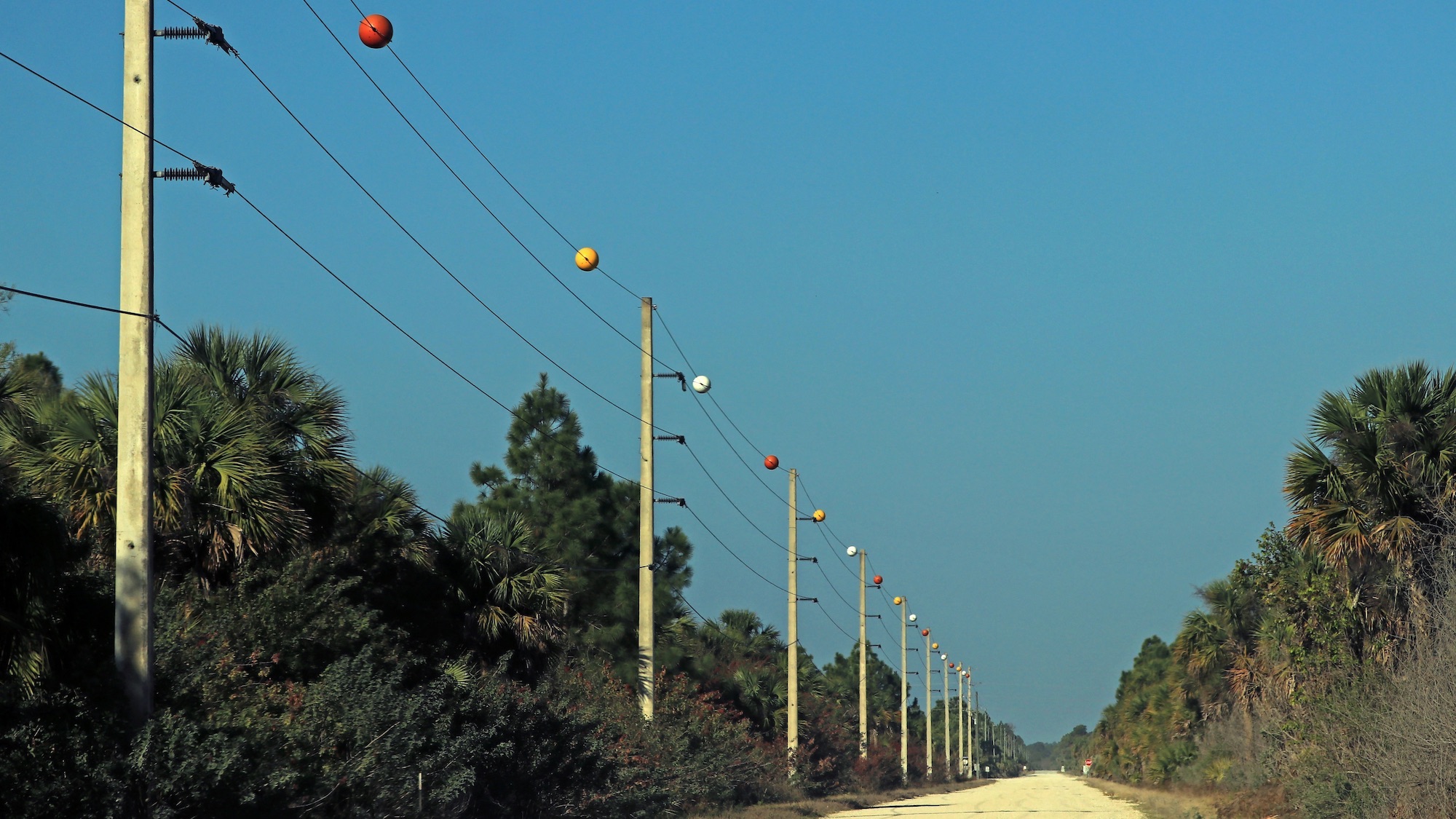
What are those orange balls on some power lines? – Maggie, age 8, West Chester, Pennsylvania
Have you ever looked up while driving on a highway and spotted those big orange balls hanging on power lines? They look a bit like giant toy beads strung along the electric wires.
What in the world are those overgrown basketballs doing up there?
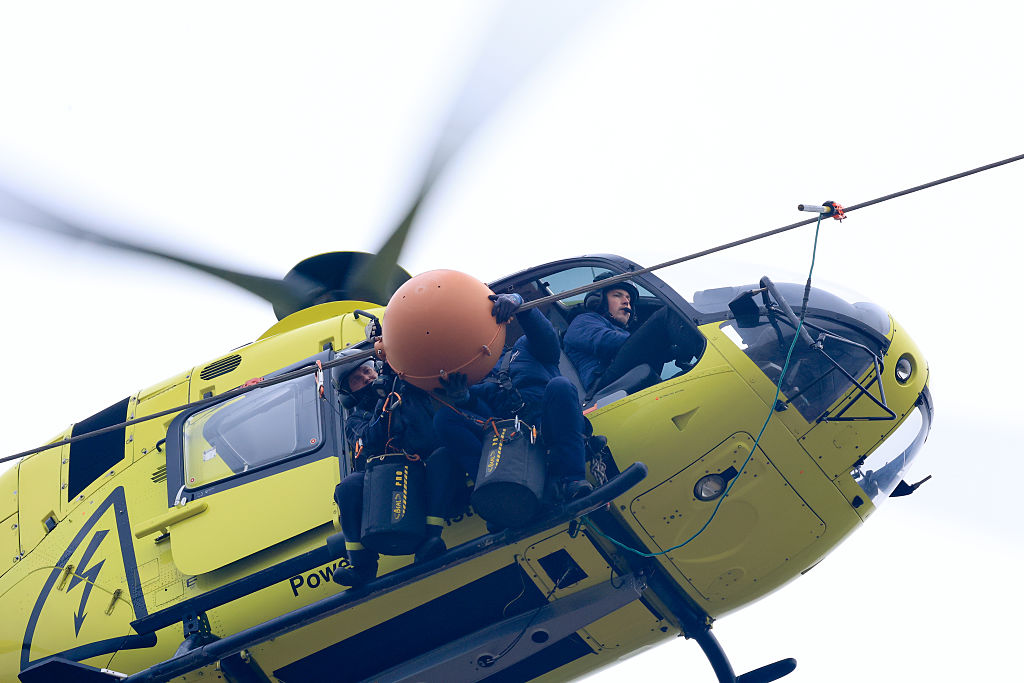
Those big orange balls don’t help with electricity flow or improve the efficiency of the power lines, but they do have a very important job. Officially called aviation marker balls or spherical markers, they’re there to help pilots see power lines so airplanes and helicopters don’t crash into them. They’re like bright warning signs in the sky, protecting pilots, passengers and people on the ground below.
Big round warning signs in the sky
Power lines can be very hard to see from an airplane or helicopter, especially when pilots are flying low. Thin metal wires can visually blend into the background of nature.
The orange balls help the lines stand out. You can think of them as being like reflective tape on a bike – just a little something simple that helps people notice a danger before it’s too late.
Orange isn’t a random choice. This vibrant color is very visible to the human eye and especially stands out against the more muted colors of nature – blue sky, green trees or gray clouds. Sometimes the balls are red or white, or even striped, but orange is the most common because it works well in most lighting conditions.
Aviation safety rules in many countries explain which colors should be used so pilots can quickly recognize hazards. Organizations like the U.S. Federal Aviation Administration publish guidelines you can check out about marking obstacles near flight paths.
These balls may look like slightly oversized ping-pong balls from your perspective on the ground. But most are actually much bigger, about the size of a large beach ball, roughly 2 to 3 feet (0.6 to 1 meter) across. Each one can weigh 10 to 25 pounds (4.5 to 11 kilograms), about as heavy as a large backpack full of books.
They’re usually made from strong plastic or fiberglass, similar to materials used in boats or playground equipment. That way, they can survive years of sun, rain, snow, wind – and even the occasional bird landing on them.
Even though they sit on wires that carry huge amounts of electricity, the balls themselves are not energized. They’re made of insulating materials, so electricity does not flow through them.
The wires are strung between sturdy metal towers or wooden poles that are very tall to keep dangerous high-voltage electric wires high up in the sky, far away from people on the ground. This design makes it safe to walk, play and drive underneath them. Some transmission towers, especially for very high-voltage lines, can be as tall as a 15-story building.
If you look closely at big transmission lines, you’ll often see three thick wires, sometimes with an additional thinner one on top that’s called a shield wire. Because the shield wire sits higher, lightning is more likely to hit it first, protecting the other wires from a strong blast of electricity that can damage equipment or cause power outages. The shield wire is connected to the ground, so a lightning strike’s electricity can flow safely down the tower and into the earth.
The three main wires work together to carry electricity in a steady rhythm. By sharing the job among three wires instead of one, the system can move more energy with less waste, making it more efficient.
Installing the aviation marker balls is a job for specially trained crews, often working from helicopters. The power line usually stays turned on while the work is being done, so safety rules and careful planning are critical. The ball comes in two halves that clamp around the wire and bolt together tightly.
Once installed, these balls can last 10 to 15 years, depending on weather and conditions. They don’t need much maintenance, but utilities inspect them from time to time to make sure they haven’t cracked or faded too much.
Not every transmission line needs the markers. Usually only places where aircraft are more likely to fly low – such as near rivers, valleys, airports or helicopter routes – will use these brightly colored balls. Most neighborhood power lines are too low to need markers.
Next time you spot those bright orange dots in the sky, you’ll know: They’re not electrical equipment, and their color isn’t random. They’re simple, clever tools helping keep our busy world a little safer.
Hello, curious kids! Do you have a question you’d like an expert to answer? Ask an adult to send your question to CuriousKidsUS@theconversation.com. Please tell us your name, age and the city where you live.
And since curiosity has no age limit – adults, let us know what you’re wondering, too. We won’t be able to answer every question, but we will do our best.
For a few select evenings in the late spring and early summer, sunlight aligns with Manhattan’s grid. The city’s bustling streets are washed with golden light as the sun sets, while tourists and locals alike flood the streets to snap that perfect picture. This event is nicknamed Manhattanhenge and it will begin on May 28 and continue through July 12.
However, you don’t need to live in the Big Apple to see a “henge” like Manhattanhenge. They actually pop up in a few places and a website called Hengefinder can help you find the closest henge.
Meet Hedgefinder
Data scientist and engineer Victoria Ritvo created the website, while software engineer John Pribyl built the accompanying app. Ritvo wrote about creating Hedgefinder in her blog, and details the three basic steps that scientists can use to find a henge. First, find the angle of the road, or its bearing relative to true north. Second, find the angle of the sun at sunset, or its azimuth. Third, find the dates when those two angles match.
While you don’t have to do any of that high-level math, you can read about how Rivoto and Pribyl made their calculations. You simply put in an address or city and can get a calculation for the closet henge near you.
“Having Hengefinder active means henges are now explorable outside of Manhattan, and I’ve been searching for them using the app,” Ritvo writes. “My favorite one so far, I haven’t actually seen. I’m intrigued by the Haarlemmertrekvaart, a canal which traces the southern edge of Westerpark in Amsterdam.”
Interestingly, much of Europe is left out of henge mania due to medieval street design. Amsterdam’s famed canals do offer an option, where sunlight can reflect off of the water. Henges may have been occurring twice a year for the past 400 years on the Haarlemmertrekvaart.
How henges work
The sun does not set in the same place every day. Its position changes along the horizon with the seasons. While the angle does not usually match the directions of a street, it will on a few days each year if the street is angled correctly.
In 1997, the term Manhattanhenge was first coined by Neil deGrasse Tyson, an astrophysicist and director of the Hayden Planetarium at New York’s American Museum of Natural History. Tyson noted that the setting sun framed by Manhattan’s building was comparable to how the sun’s rays strike the center of England’s Stonehenge on the solstice. The Neolithic humans who built the stone circle in stages between 3100 BCE and 1600 BCE intended for the light to shine that way on the solstice. But the builders of Manhattan? Not so much.
Chicagohenge in Illinois and Baltimorehenge in Maryland both occur when the sunset lines up with the grid systems in those cities around the spring and fall equinoxes in March and September. In Canada, Torontohenge occurs in February and October.
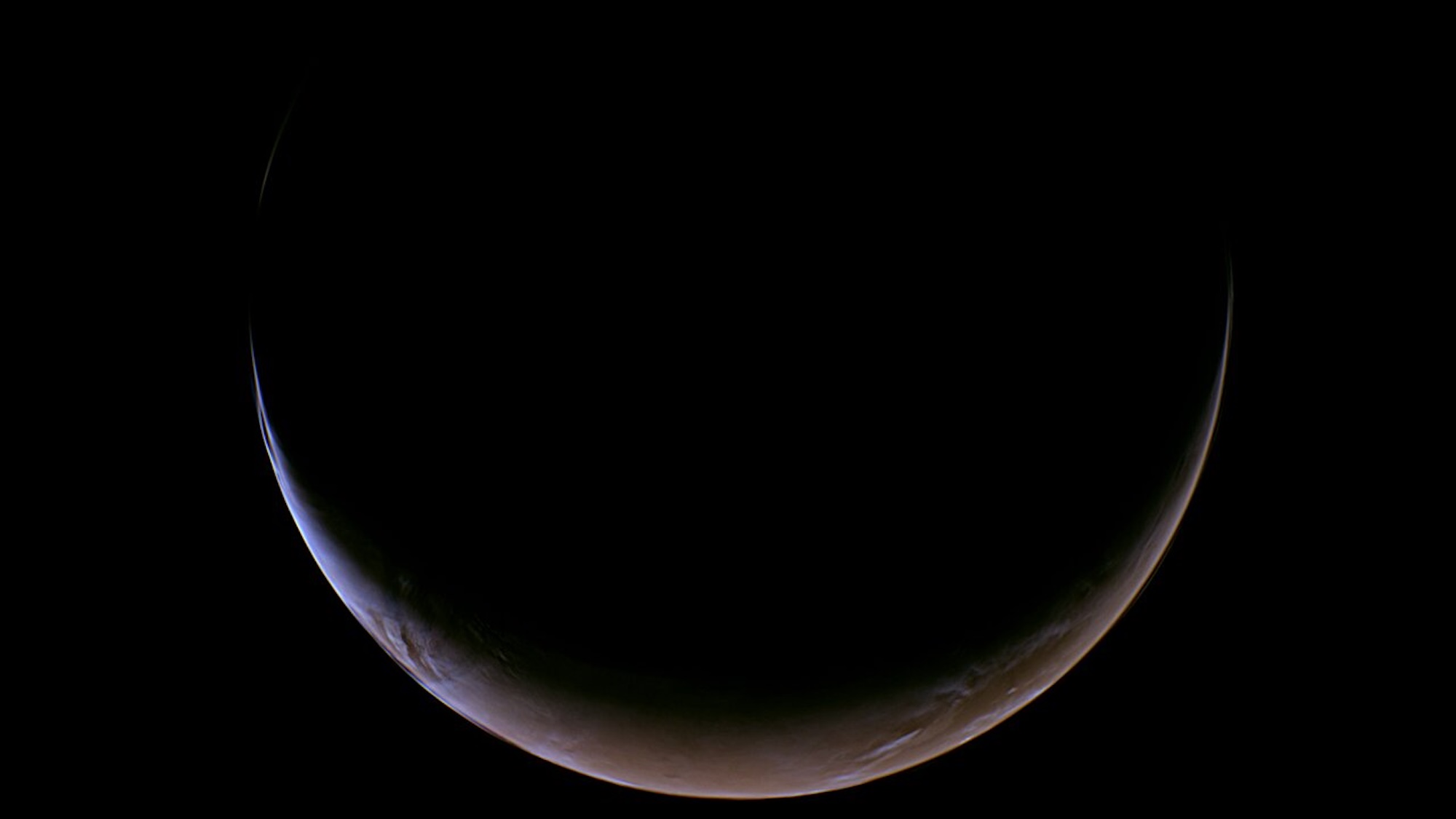
NASA’s Psyche spacecraft is currently en route to a small, metal-rich asteroid near Jupiter. However, the barely 3,600-pound probe recently required a little help from Mars to complete its lengthy 2.2-billion-mile mission. Despite its complex gravity assist earlier this month, the groundbreaking spacecraft still found time to snap some travel photos showcasing its Red Planet flyby. NASA released the latest image from Psyche’s trip on May 20, which offers a gorgeous view of Mars just hours before Earth’s neighbor temporarily eclipsed the cosmic traveller.
According to NASA, the image was taken on May 15 at about 8:03 a.m. EDT by the spacecraft’s multispectral imager instrument. The thin crescent view of Mars is due to the spacecraft’s approach at what’s known as a high phase angle. The fingernail slice of Red Planet actually looks brighter and wider than mission specialists anticipated, thanks to a large level of sunlight scattering through the dusty Martian atmosphere. Interestingly, the instrument’s original unfiltered image wouldn’t look very discernible to the human eye. Instead, scientists processed the photo into a natural-color palette using the probe’s red, blue, and green imager filter data.
Launched in October 2023, Psyche is destined for 16 Psyche, a 140-mile-wide rock that astronomers theorize may be the remnant of an ancient planetary core. Once there, the spacecraft will study its iron magnetic properties, as well as use its imagers and spectrometers to analyze the asteroid’s chemical and elemental compositions.
Thanks to the Martian gravity assist, Psyche is scheduled to reach its destination in 2029. At its closest pass, Psyche swung around the Red Planet barely 2,800 miles above the surface at a speed of around 12,333 miles per hour.
Complex problems require creative solutions, and wildlife veterinarian Nielsen Donato is no stranger to what might seem like out-of-the-box problem solving. Last month, Donato and his team at Vets in Practice in the Philippines fixed temporary wheels onto an Aldabra giant tortoise (Aldabrachelys gigantea) that was struggling to walk.
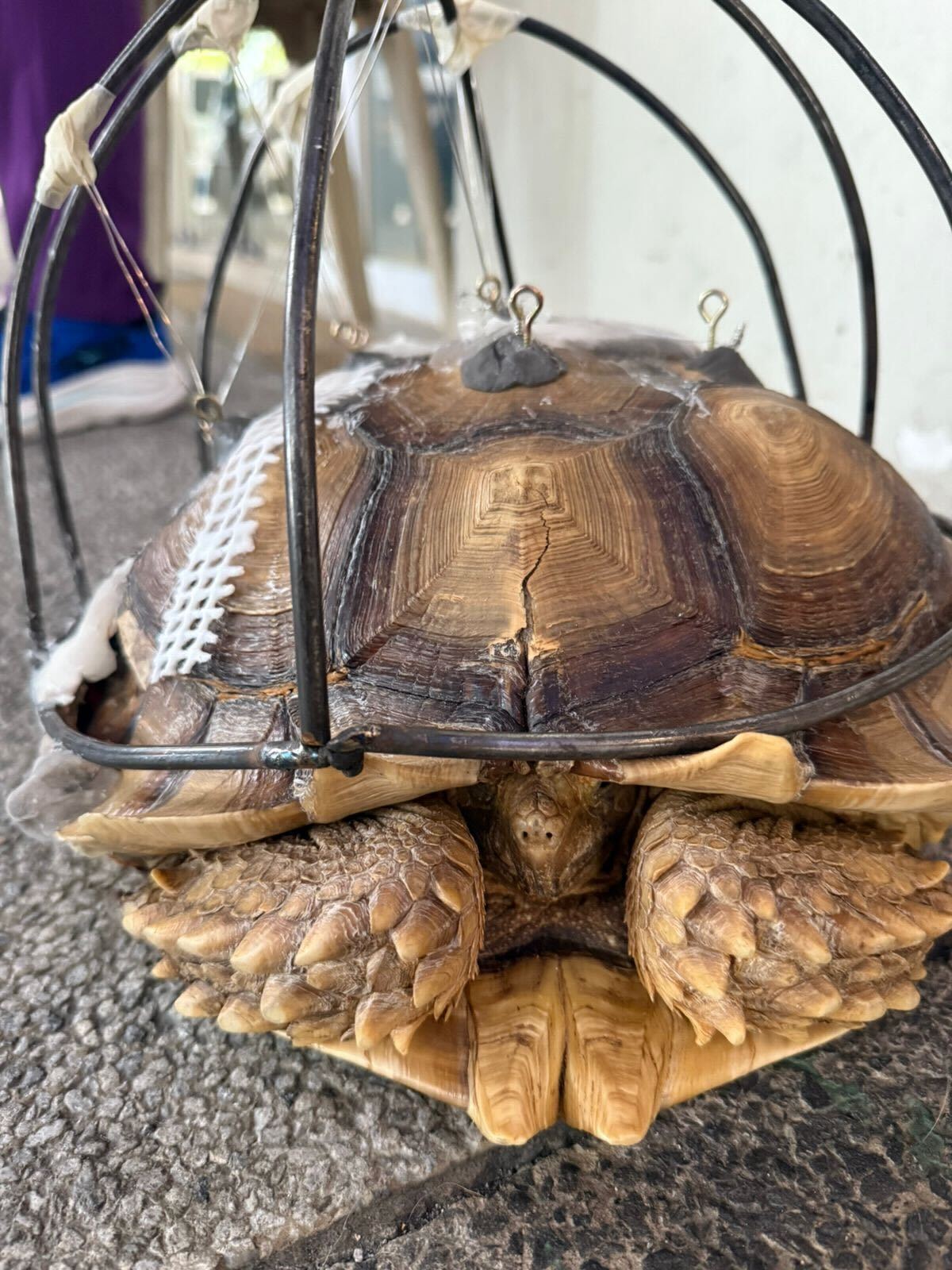
More recently, they built a contraption to care for a four-year-old African spurred tortoise (Geochelone sulcata) that had been run over by a car not once but twice. When the unfortunate reptile was first brought to the clinic, Donato—who is the clinic’s chief surgeon and exotic animal medicine specialist—wasn’t there.
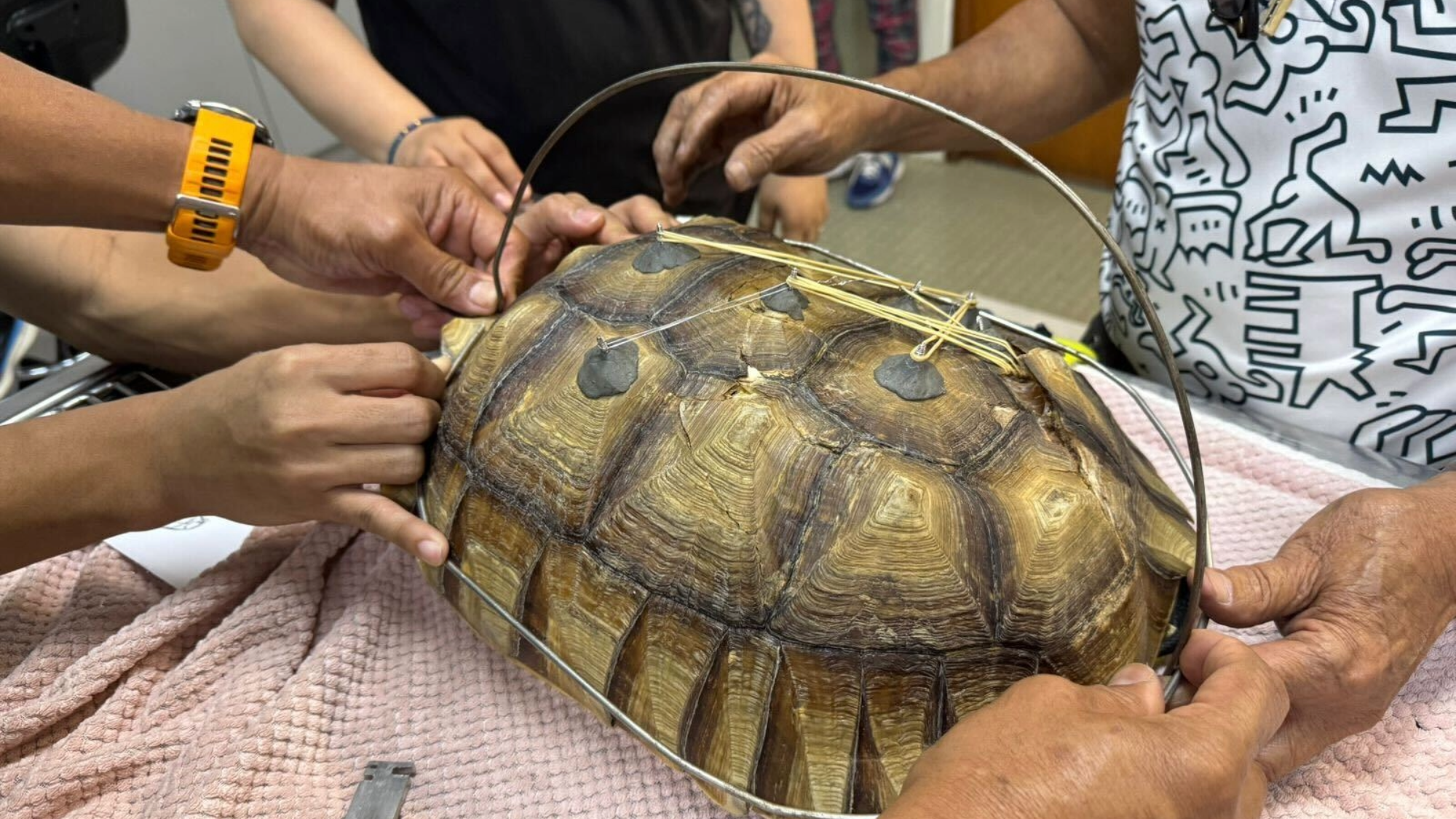
Over the phone, Donato instructed the team to keep the tortoise’s exposed soft tissue damp by rinsing the shell with saline (salt water). They also tried to stabilize the cracks, by fixing inverted screws onto various parts of the shell with epoxy putty, and then tying rubber bands around the screws.
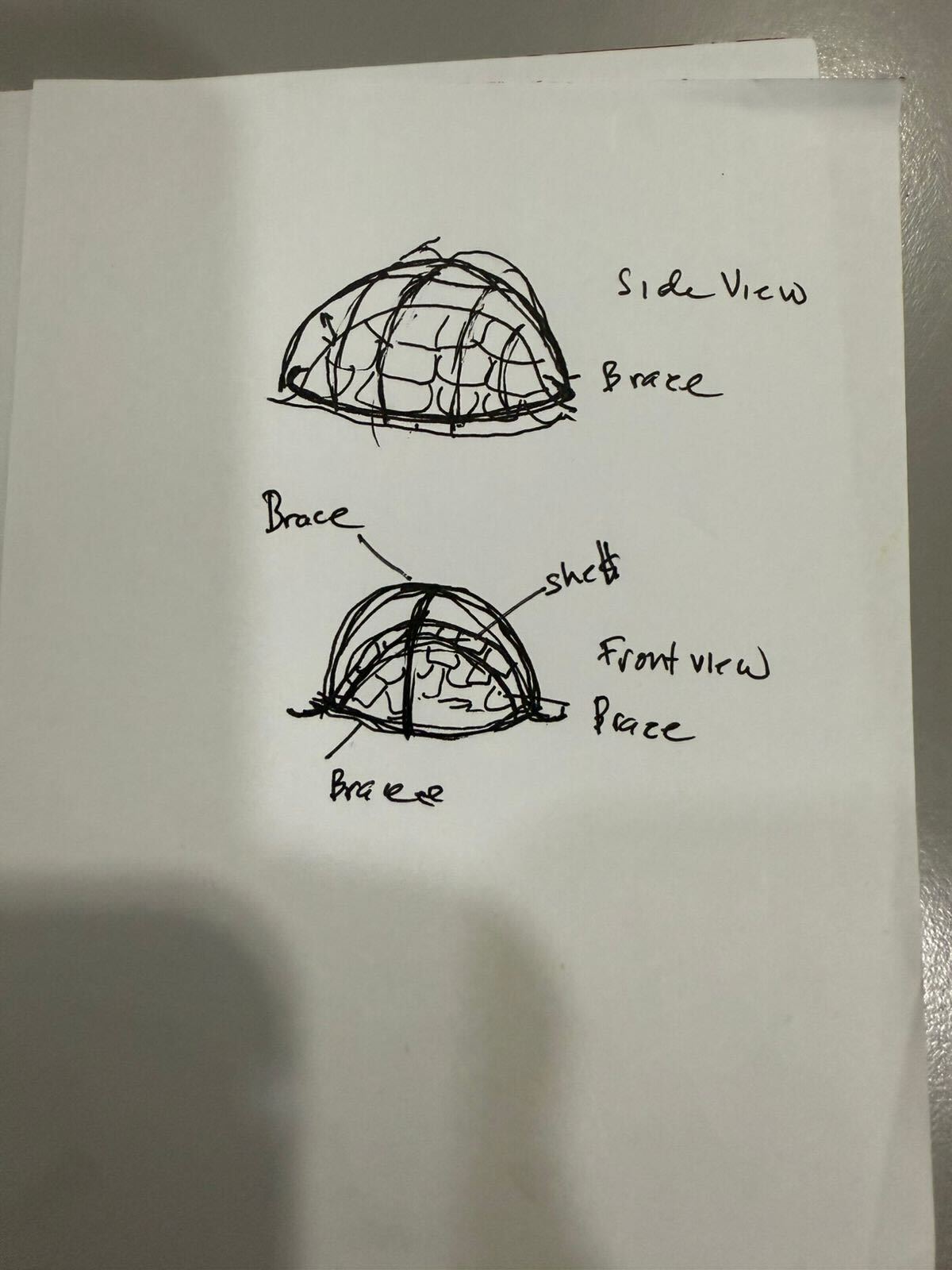
The team sketched out their plan of action to save the tortoise’s shell. Image: Nielsen Donato.
“At this point, our main concern is to stabilize the condition of the turtle from shock, from the injury. So for the first three weeks, we made sure that there were no flies that laid eggs and turned into maggots,” Donato tells Popular Science.
They kept the tortoise hydrated, tube-fed it, kept its wound clean, basked it in the sun, and gave it antibiotics and pain medication.
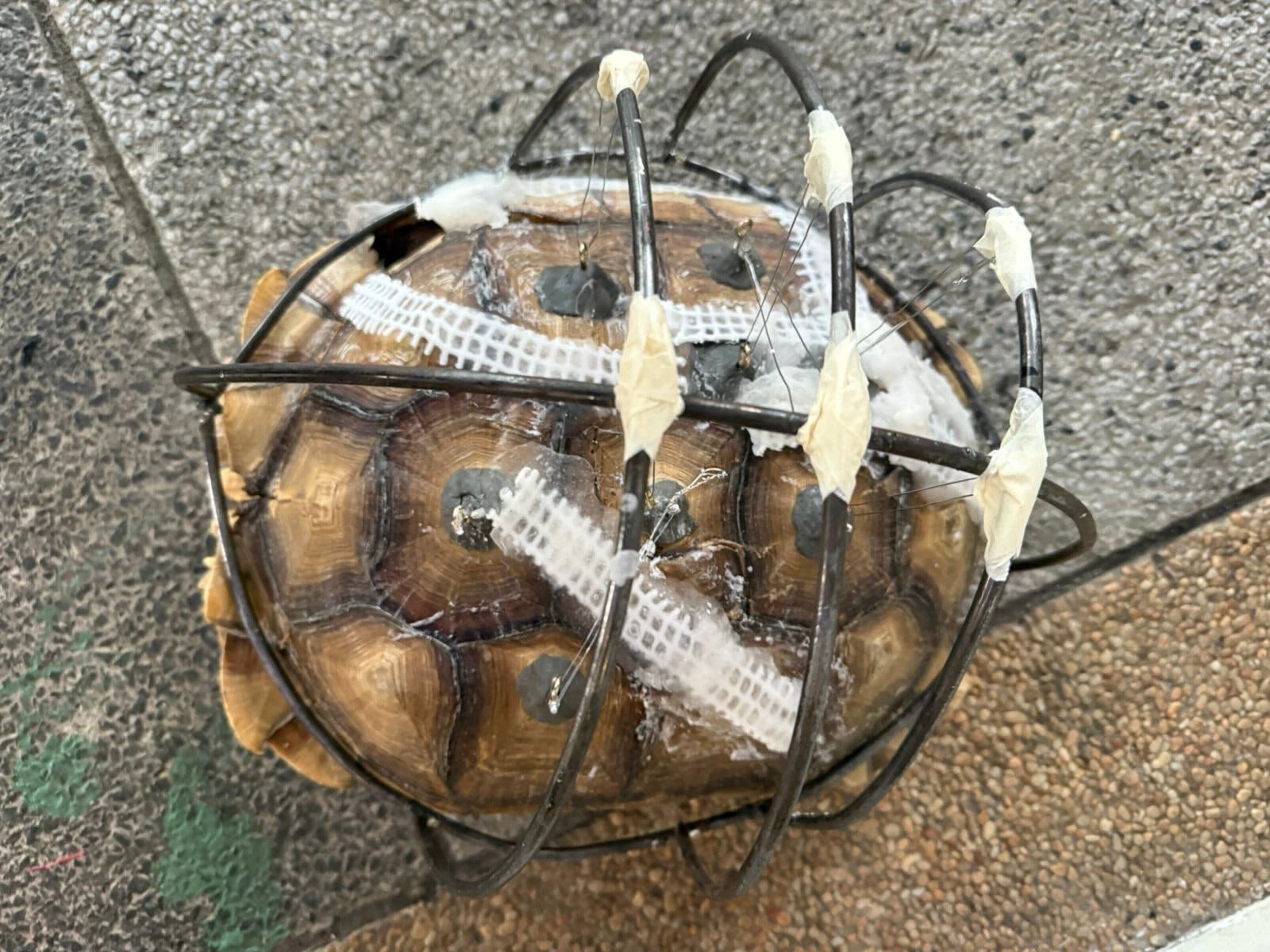
The wires help keep the shell together. Image: Nielsen Donato.
“And once the tortoise, the sulcata, was more mobile and showing interest in eating on its own, we planned to repair the shell,” he says
According to Donato, the most difficult part for him was lifting the crushed parts of the shell. So he designed a frame for the shell that, with the help of wires, would pull up these shell parts. And the contraption worked.
The tortoise was hit by a car twice, but is on the road to recovery. Image: Nielsen Donato.
“When we were twisting the wire, we noticed that we were starting to align the shell and the cracks were becoming more opposed to each other,” he explains. The team sealed the cracks with dental acrylic and asked the turtle’s owner to bring it back after three weeks. By the time the tortoise was back in their clinic, the shell had become more stable. The team removed the brace, wires, screws, and putty, and sent it back home again before its next appointment.
“When it visited us lately, it started moving around more actively and the owners were not worried about its appetite because it was eating again,” Donato reports.
One thing is for certain—this tortoise went to shell and back again.
There are over 283 million cars cruising the United States, and over 90 percent of them are still guzzling gas. Apart from the obvious environmental problems, fuel prices also continue to skyrocket thanks to the ongoing war in Iran. The average price for gas is currently around 33 percent higher than it was before the crisis, and there is little sign that those numbers are going down anytime soon.
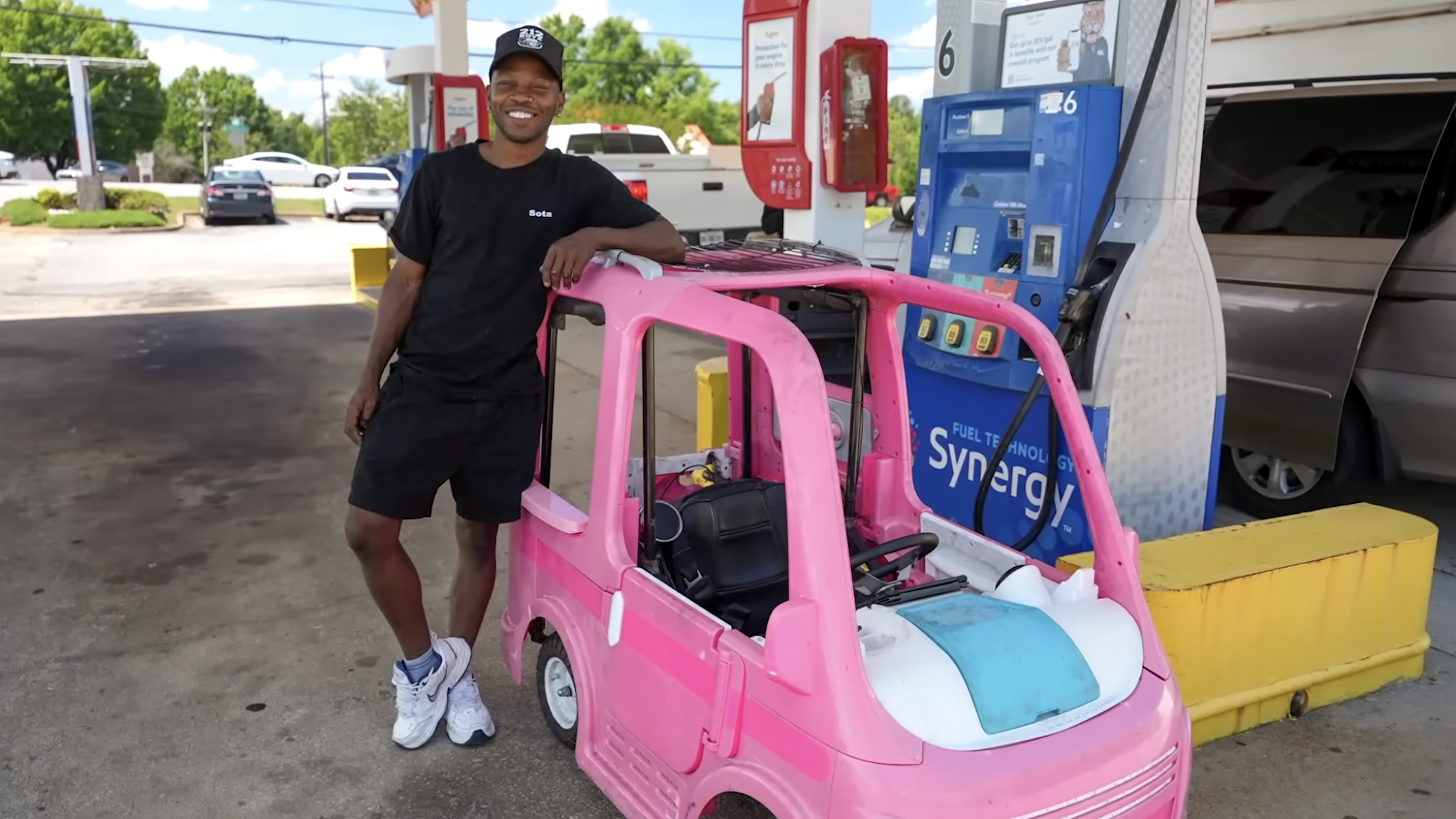
The strain is forcing many drives to reconsider how they get around—and they’re getting creative with it. In Georgia, a 30-year-old handyman is showing everyone how to properly adapt to uncertain times. According to a recent Reuters profile, Mali Hightower has retrofitted a discarded, bright pink Power Wheels Barbie Dream Camper with a two-gallon, one-piston engine for his shorter commuting needs.
“I drive this when I can,” Hightower said on May 19.
To get it going, a driver simply pulls the rip cord that’s attached to the former power washer engine. At less than four-feet-tall, the Dream Camper may not be the most comfortable ride for a full-grown adult,but it’s definitely cheaper. Hightower likely still prefers driving his 1996 Mercedes-Benz convertible, but with a full tank costing him around $90 right now, he’s more than willing to use his Power Wheels alternative for errands like grocery runs.
While somewhat surreal to see at a gas pump, the DIY solution underscores a more important issue: the need for more people to divest from fossil fuel rides in favor of public transportation and electric vehicles (EVs). Unfortunately, that’s easier said than done for many people. The U.S. is dramatically underfunded when it comes to options like commuter bus routes and trains, while EVs are still out of many people’s price ranges. The Dream Barbie Camper may be one-of-a-kind right now, but there’s a good chance that similar, intentionally constructed alternatives are on the way. At least those will be able to comfortably fit the driver.
To effectively travel on Mars, rovers need to deal with a lot of sand. German engineers have created a new kind of ground rover that uses swimming motions to push through sand that may otherwise cause the wheels to get stuck. Its inspiration: the African sandfish (Scincus scincus), a lizard known for burrowing into the Sahara Desert and literally swimming through its sand like a fish. It’s one of the animal kingdom’s strangest methods of propulsion, but it may help shape the future of Mars exploration.
A video of the rover, released this week by the University of Würzburg, shows a mini-fridge-sized, silver rover making its way through a sandy, Martian-mimicking test floor. Rather than rolling forward, each of its four wheels cuts through the sand in what looks like a figure-eight motion. The rover pushes on several yards and then cuts a corner and returns to where it started.
“The wheels mimic the animal’s [sandfish’s]characteristic interaction with the ground, generating both longitudinal and lateral forces,” University of Würzburg researcher Amenosis Lopez said in a statement. “The rover leaves sinusoidal tracks in the sand.”
The sandfish: nature’s cute solution to slippery sand
Though most people likely associate space rovers with round wheels or tracks reminiscent of those on WALL-E, neither design is ideal for dealing with Mars’s uniquely harsh and sandy environment. Sand is unique because it’s a material with both solid and liquid-like qualities. On top of sand’s mixed texture, rovers roaming on the Red Planet have to deal with steep slopes and uneven terrain, where varying levels of slipperiness can cause imbalance. Patches of softer sand are also a nightmare for wheels, making the prospect of a rover getting stuck never far from mind
But nature figured out a solution to this issue millions of years ago, and it’s called the sandfish. Contrary to its name, the Sahara Desert native is a lizard in the skink family. Above ground, the sandfish uses its tiny legs to scrabble around much the same as any lizard. Things get more interesting when it burrows down into the sand. X-ray imaging shows the sandfish propelling itself forward under the sand, using a powerful waving motion to generate thrust and overcome drag. The result looks like an animal swimming through the sand, remarkably similarly to how a fish would oscillate its body to move through water
Engineers at Georgia Tech took those observations and used them to create their own sandfish robot in 2011. Testing with their robots showed that the little lizard’s oddly wedged shaped head may also help it generate lift forces and more easily swim through sand.
Sink or swim: new rover did both
Researchers working on the sandfish-inspired robot said it outperformed a wheeled version when navigating through a sandy test track. Where the round wheels would wobble and weave, the oscillating wheels stayed relatively stable. That’s not to say the new approach worked right out of the gate. Early models of the design were reportedly so heavy that the rover literally sank into the sand. The team went back to the drawing board and made a second version, this time increasing each wheel’s width and reducing overall mass
It’s unlikely these oddball new wheels will become the main chassis system for NASA rovers, at least not in the immediate future. More work still needs to be done to increase their overall controllability and account for slippage that can occur in complicated, real-world environments. There are also the added variables of accounting for scientific instruments and other cargo a rover might have to carry.
More than anything, the wheel design is a testament to the sandfish’s innate ingenuity and evolutionary gifts. Many scientists only recently began to truly appreciate these traits and what other technology they could inspire.

 Login
Login