Wonder Studios’ Beyond the Loop uses Hal Watmough’s The Trials to show how AI short films are moving beyond prompt demos into a test of craft, ownership and IP
Wonder Studios’ Beyond the Loop uses Hal Watmough’s The Trials to show how AI short films are moving beyond prompt demos into a test of craft, ownership and IP
Suno, an AI music generation platform, pocketed $400 million in its latest funding round, which the company says values the company at $5.4 billion. The funding round, announced Wednesday, was led by Bond Capital, with IVP, Forerunner, Union Square Ventures, Alkeon Capital Management and Quiet joining the mix. Previous investors who joined the Series D funding […]
Suno, an AI music generation platform, pocketed $400 million in its latest funding round, which the company says values the company at $5.4 billion. The funding round, announced Wednesday, was led by Bond Capital, with IVP, Forerunner, Union Square Ventures, Alkeon Capital Management and Quiet joining the mix. Previous investors who joined the Series D funding […]
Manuel Gual posted a photo:
Route 66 Dreams: Classic Cars Across the American Desert
Description
A cinematic visual journey through the mythic atmosphere of Route 66, featuring vintage cars, abandoned gas stations, neon motels, desert highways, red rock landscapes, and golden sunset light. The series blends classic Americana, road trip nostalgia, open-road freedom, and a slightly surreal retro mood, evoking the timeless romance of travel across the American Southwest.
These images were g
Route 66 Dreams: Classic Cars Across the American Desert
Description
A cinematic visual journey through the mythic atmosphere of Route 66, featuring vintage cars, abandoned gas stations, neon motels, desert highways, red rock landscapes, and golden sunset light. The series blends classic Americana, road trip nostalgia, open-road freedom, and a slightly surreal retro mood, evoking the timeless romance of travel across the American Southwest.
These images were generated by Artificial Intelligence.
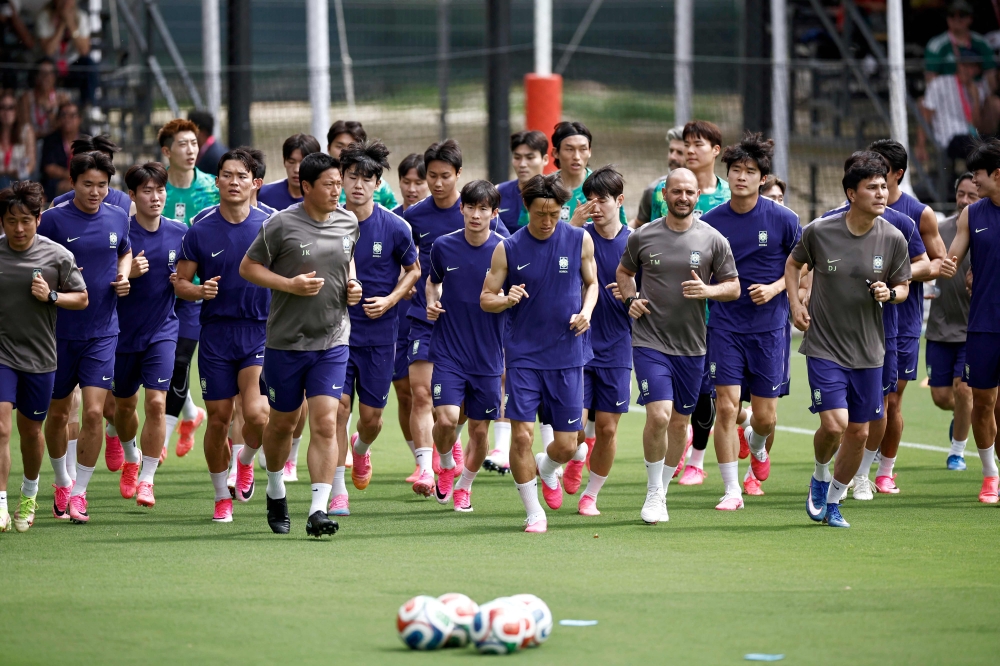
SEOUL, June 8 — South Korean goalkeeper Kim Seung-gyu missed the birth of his daughter this month due to his World Cup preparations, but the 35-year-old says he is determined to compensate for his absence with performances on the pitch.Kim, who is set for his fourth World Cup appearance, acknowledged the emotional cost of being away from his family.“I am really sorry that I couldn’t be with my wife for the birth, and I want to bring home good results from here
SEOUL, June 8 — South Korean goalkeeper Kim Seung-gyu missed the birth of his daughter this month due to his World Cup preparations, but the 35-year-old says he is determined to compensate for his absence with performances on the pitch.
Kim, who is set for his fourth World Cup appearance, acknowledged the emotional cost of being away from his family.
“I am really sorry that I couldn’t be with my wife for the birth, and I want to bring home good results from here as my presents,” he told reporters on Sunday before a training session at Chivas Verde Valle in Zapopan, near Guadalajara in Mexico. With more than 80 caps for South Korea, the experienced FC Tokyo goalkeeper faces competition for the starting spot from Jo Hyeon-woo.
The tournament also carries a sense of finality for Kim, who suggested this campaign may mark the end of his World Cup journey. Despite that, his enthusiasm has not dimmed.
“I’ve played at every World Cup thinking it could be my last. Given my age now, this one really does feel like my final one,” he said.
“I am just as excited about my fourth World Cup as I was about my first one. The first match will set the tone for the rest of the tournament, and so there will be some pressure. I will try to stay calm and just do what I can do.”
South Korea have been drawn in Group A with co-hosts Mexico, the Czech Republic and South Africa. They begin their campaign against the Czechs in Guadalajara on June 11. — Reuters
By Dominique A. Harroch and Richard D. Harroch The words of successful entrepreneurs carry extraordinary weight. They've walked the path of innovation, faced countless challenges, and emerged as leaders who shape our global economy. This collection brings you the most recent and widely-cited quotes from 25 of today's most influential living entrepreneurs, offering wisdom to fuel your own journey toward success.1. "If I were a student today, irrespective of whether it's for math or science or che
The words of successful entrepreneurs carry extraordinary weight. They've walked the path of innovation, faced countless challenges, and emerged as leaders who shape our global economy. This collection brings you the most recent and widely-cited quotes from 25 of today's most influential living entrepreneurs, offering wisdom to fuel your own journey toward success.
1. "If I were a student today, irrespective of whether it's for math or science or chemistry or biology—doesn't matter what field of science I'm going into or what profession—I'm going to ask myself, 'How can I use AI to do my job better?'" —Jensen Huang, NVIDIA CEO
Context: Speaking in the "Huge Conversations" show, Huang emphasized the critical importance of learning to work with AI tools early in one's career. As the leader of the company powering the AI revolution, his advice reflects the reality that AI literacy will be essential for future success.
2. "There is the possibility in the next three to five years that one of these techniques would get enough true logical Qubits to solve some very tough problems." —Bill Gates, Microsoft Co-founder
Context: Gates offered an optimistic timeline for quantum computing breakthrough during a Yahoo Finance interview, demonstrating his continued forward-thinking approach to transformative technologies even decades after founding Microsoft.
3. "If you want to be autonomous, start your own company." —Brian Chesky, Airbnb CEO
Context: Chesky challenged conventional management wisdom about employee autonomy, advocating for his "founder mode" approach to leadership that emphasizes being deeply involved in company details while empowering teams.
4. "Our bet is sort of that in the next year probably...maybe half the development is going to be done by AI, as opposed to people, and then that will just kind of increase from there." —Mark Zuckerberg, Meta CEO
Context: At LlamaCon in April 2025, Zuckerberg shared Meta's aggressive timeline for AI-powered development, illustrating how even software creation itself is being revolutionized by artificial intelligence.
5. "Let your joy be in your journey—not in some distant goal." —Tim Cook, Apple CEO
Context: Cook's philosophy emphasizes the importance of finding fulfillment in the process of building and creating, rather than fixating solely on end results. This mindset has helped Apple maintain its culture of excellence while pursuing ambitious innovations.
6. "For me, it matters that we drive technology as an equalizing force, as an enabler for everyone around the world." —Sundar Pichai, Google/Alphabet CEO
Context: Pichai's vision for technology's role in society reflects Google's mission to organize the world's information and make it universally accessible, emphasizing technology's potential to level playing fields globally.
7. "The cloud is still in its early stages, and we're going to see decades of growth ahead of us." —Andy Jassy, Amazon CEO
Context: Jassy continues to champion cloud computing's transformative potential, drawing from his experience building AWS from the ground up into one of the world's most valuable business divisions.
8. "Stone Age. Bronze Age. Iron Age. We define entire epics of humanity by the technology they use." —Reed Hastings, Netflix Co-founder
Context: Hastings' perspective on technological eras reflects his understanding of how fundamental shifts in technology reshape entire civilizations—insight that guided Netflix's transformation from DVD-by-mail to streaming giant.
9. "The future of work is not about replacing humans with technology, but about augmenting human capabilities with technology." —Marc Benioff, Salesforce CEO
Context: Benioff's vision for AI and automation emphasizes enhancement rather than replacement, reflecting Salesforce's approach to building tools that empower rather than eliminate human workers.
10. "I'd say maybe 20%, 30% of the code that is inside of our repos today and some of our projects are probably all written by software." —Satya Nadella, Microsoft CEO
Context: Speaking at Meta's LlamaCon in April 2025, Nadella revealed how deeply AI has penetrated Microsoft's development processes, showcasing the practical transformation happening in tech companies today.
11. "The key is not to predict the future, but to be prepared for it." —Daniel Ek, Spotify CEO
Context: Ek's approach to innovation emphasizes adaptability over prediction, a strategy that has helped Spotify navigate the complex music industry and expand globally.
12. "Infrastructure is about removing friction. The best infrastructure is invisible." —Patrick Collison, Stripe CEO
Context: Collison's philosophy on building payment systems reflects Stripe's approach to creating seamless financial infrastructure that enables rather than complicates business operations.
13. "The biggest opportunities often come disguised as impossible problems." —Drew Houston, Dropbox CEO
Context: Houston's perspective on problem-solving reflects the entrepreneurial mindset that turned file synchronization challenges into a multi-billion-dollar business opportunity.
14. "Culture is not about what you say, it's about what you do repeatedly." —Dara Khosrowshahi, Uber CEO
Context: Khosrowshahi's focus on cultural transformation has been central to Uber's evolution from a controversial startup to a more mature public company focused on sustainable growth.
15. "The most important thing is to try and inspire people so that they can be great at whatever they want to do." —Susan Wojcicki, Former YouTube CEO
Context: Wojcicki's leadership philosophy emphasizes empowerment and inspiration, principles that guided YouTube's growth into the world's largest video platform.
16. "Starting a company is like jumping off a cliff and assembling a plane on the way down." —Reid Hoffman, LinkedIn Co-founder
Context: Hoffman's vivid metaphor captures the essence of entrepreneurship—taking bold action despite uncertainty and building solutions while navigating challenges in real-time.
17. "Make every detail perfect and limit the number of details to perfect." —Jack Dorsey, Former Twitter CEO
Context: Dorsey's design philosophy emphasizes the power of simplicity and focus, principles that have guided his approach to building both Twitter and Square.
18. "We think, mistakenly, that success is the result of the amount of time we put in at work, instead of the quality of time we put in." —Arianna Huffington, Thrive Global CEO
Context: Huffington's advocacy for well-being and work-life balance challenges traditional notions of entrepreneurial success, promoting sustainable approaches to achievement.
19. "I truly believe that we have to change the way we think about how we treat people, how we love people, and how we lift people up." —Whitney Wolfe Herd, Bumble Founder
Context: Wolfe Herd's philosophy extends beyond business to social impact, reflecting Bumble's mission to create healthier relationship dynamics both in dating and professional networking.
20. "The best way to predict the future is to build it, one customer at a time." —Tony Xu, DoorDash CEO
Context: Xu's customer-centric approach has driven DoorDash's growth from a Stanford dorm room idea to the leading food delivery platform in the United States.
21. "Data is the new oil, but insights are the new gold." —Ryan Smith, Qualtrics CEO
Context: Smith's perspective on data analytics emphasizes that raw information is less valuable than the actionable insights derived from it—a principle at the heart of Qualtrics' experience management platform.
22. "The whole world should be able to design. We want to democratize design and make it accessible to everyone." —Melanie Perkins, Canva CEO
Context: Perkins' vision has driven Canva's mission to simplify graphic design, making professional-quality design tools accessible to millions of non-designers worldwide.
23. "The best software is the software that helps people do things they couldn't do before." —Stewart Butterfield, Slack Co-founder
Context: Butterfield's philosophy on product development emphasizes enablement and empowerment, principles that transformed workplace communication through Slack's intuitive design.
24. "The most successful entrepreneurs are the ones who can turn their personal pain points into solutions for millions of people." —Julia Hartz, Eventbrite Co-founder
Context: Hartz's insight reflects the entrepreneurial journey of identifying universal problems through personal experience and building scalable solutions that benefit entire markets.
25. "Transportation is not just about getting from point A to point B; it's about connecting communities and creating opportunities." —Logan Green, Lyft Co-founder
Context: Green's broader vision for mobility extends beyond ride-sharing to urban planning and social equity, reflecting Lyft's mission to improve how people move through their cities.
Key Themes from Today's Entrepreneurial Leaders
These quotes reveal several powerful themes that define successful entrepreneurship today:
1. AI as the Great Equalizer: Leaders like Huang, Nadella, and Pichai emphasize that artificial intelligence is not just a tool but a fundamental shift that will determine competitive advantage across all industries.
2. Purpose Over Profit: Many of today's most successful entrepreneurs, from Chesky to Wolfe Herd, emphasize that meaning and mission drive sustainable success more than pure financial motivation.
3. Continuous Learning: Whether it's Gates exploring quantum computing or Huang advocating for AI tutors, top entrepreneurs never stop learning and adapting to new technologies and market realities.
4. Quality Over Quantity: From Dorsey's focus on perfecting fewer details to Huffington's emphasis on quality time over total hours, effective leaders prioritize depth over breadth.
These thoughts from today's most successful entrepreneurs offer more than inspiration—they provide a roadmap for navigating an increasingly complex and rapidly changing business landscape. Their wisdom reminds us that success is not just about having great ideas, but about executing them with purpose, resilience, and an unwavering commitment to continuous growth.
As you build your own entrepreneurial journey, let these insights guide your decisions, inspire your vision, and remind you that today's impossible dreams often become tomorrow's inevitable realities. The future belongs to those who are bold enough to embrace change, wise enough to learn from both success and failure, and passionate enough to pursue purpose over profit.
"The biggest risk is not taking any risk," as Zuckerberg reminds us. In a world of unprecedented change and opportunity, these entrepreneurial voices light the path forward for the next generation of innovators and leaders.
Dominique A. Harroch is the Chief of Staff at AllBusiness.com. She has been the Chief of Staff or Operations Leader for multiple companies where she leveraged her extensive experience in operations management, strategic planning, and team leadership to drive organizational success. With a background that spans over two decades in operations leadership, event planning at her own start-up and marketing at various financial and retail companies. Dominique is known for her ability to optimize processes, manage complex projects and lead high-performing teams. She holds a BA in English and Psychology from U.C. Berkeley and an MBA from the University of San Francisco. She can be reached via LinkedIn.
Richard D. Harroch is a Senior Advisor to CEOs, management teams, and Boards of Directors. He is an expert on M&A, venture capital, startups, and business contracts. He was the Managing Director and Global Head of M&A at VantagePoint Capital Partners, a venture capital fund in the San Francisco area. His focus is on internet, digital media, AI and technology companies. He was the founder of several Internet companies. His articles have appeared online in Forbes, Fortune, TIME, MSN, Yahoo, Fox Business and AllBusiness.com. Richard is the author of several books on startups and entrepreneurship as well as the co-author of Poker for Dummies and a Wall Street Journal-bestselling book on small business. He is the co-author of a 1,500-page book published by Bloomberg on mergers and acquisitions of privately held companies. He was also a corporate and M&A partner at the international law firm of Orrick, Herrington & Sutcliffe. He has been involved in over 200 M&A transactions and 250 startup financings. He can be reached through LinkedIn.
“I have a passion for product design; most of the motifs I draw are related to consumer products,” says Shohei Ochiai. The Tokyo-based artist studied at Tama Art University, where he graduated about a decade ago, and is an admirer of the designs of consumer product company Braun, Memphis Group founder Ettore Sottsass, and famed […]
The post SHOHEI Ochiai Flattens consumer products into Surrealistic Childlike paintings first appeared on Hi-Fructose Magazine.
“I have a passion for product design; most of the motifs I draw are related to consumer products,” says Shohei Ochiai. The Tokyo-based artist studied at Tama Art University, where he graduated about a decade ago, and is an admirer of the designs of consumer product company Braun, Memphis Group founder Ettore Sottsass, and famed […]
A lot of expensive movies are large. So one thing has to be clear before we get started: Epic cinema is not just scale. An epic has to make human feeling look small against history without making it meaningless. That is the trick.
A lot of expensive movies are large. So one thing has to be clear before we get started: Epic cinema is not just scale. An epic has to make human feeling look small against history without making it meaningless. That is the trick.
Stock markets continue to perform strongly despite the mounting risks. Neither the war in the Middle East, nor the resurgence of inflationary pressures, nor fears of an economic slowdown have managed to slow down the equity market. However, beneath this apparent strength there lies an increasingly evident fragility: the growing concentration of the market. The bulk of the gains rests on an increasingly limited number of stocks, and the trend is particularly evident in the U.S. According to Goldm
Stock markets continue to perform strongly despite the mounting risks. Neither the war in the Middle East, nor the resurgence of inflationary pressures, nor fears of an economic slowdown have managed to slow down the equity market. However, beneath this apparent strength there lies an increasingly evident fragility: the growing concentration of the market. The bulk of the gains rests on an increasingly limited number of stocks, and the trend is particularly evident in the U.S. According to Goldman Sachs, 85% of the S&P 500’s gains so far in 2026 (10%) come from technology. Excluding the sector, the advance drops to 3%.
The 28th Shanghai International Film Festival has unveiled the competition lineup for its Golden Goblet Awards, spanning five categories across fiction, documentary, animation, and short film. The festival runs June 12-21. The main competition features 12 titles drawn from 15 countries and territories, all of them world premieres. Among the contenders are Indonesia’s “My Own […]
The 28th Shanghai International Film Festival has unveiled the competition lineup for its Golden Goblet Awards, spanning five categories across fiction, documentary, animation, and short film. The festival runs June 12-21. The main competition features 12 titles drawn from 15 countries and territories, all of them world premieres. Among the contenders are Indonesia’s “My Own […]
The world-famous Tribeca Film Festival starts next week and will feature a "live action" feature-length film entirely AI-generated, a world's first.
[Read More]
New York Times publisher A.G. Sulzberger warned that AI companies were making choices that could lead to “a great deal of unnecessary harm” to the news business and the public’s access to reliable sources, in a speech delivered during the World News Media Congress in France on Monday. Companies leading the development of generative-AI systems — including […]
New York Times publisher A.G. Sulzberger warned that AI companies were making choices that could lead to “a great deal of unnecessary harm” to the news business and the public’s access to reliable sources, in a speech delivered during the World News Media Congress in France on Monday. Companies leading the development of generative-AI systems — including […]
Two out of three journalists say the working environment in Hong Kong has changed “for the worse” in the past year, according to the latest survey by the Foreign Correspondents’ Club.
Journalists outside Wan Chai’s District Court, on August 29, 2024. Photo: Kyle Lam/HKFP.
The 2026 FCC Press Freedom Survey, which received 78 responses from members, found that “67 per cent of respondents said the working environment for them as a journalist had changed for the worse in the last 12 months.”
Two out of three journalists say the working environment in Hong Kong has changed “for the worse” in the past year, according to the latest survey by the Foreign Correspondents’ Club.
Journalists outside Wan Chai’s District Court, on August 29, 2024. Photo: Kyle Lam/HKFP.
The 2026 FCC Press Freedom Survey, which received 78 responses from members, found that “67 per cent of respondents said the working environment for them as a journalist had changed for the worse in the last 12 months.”
The FCC pointed out that the survey “happened to take place” after Apple Daily founder Jimmy Lai was convicted and sentenced to jail, as well as Beijing’s national security office in Hong Kong, the Office for Safeguarding National Security (OSNS), summoned representatives of several major foreign media outlets, shortly following the deadly Wang Fuk Court fire.
At the meeting, the OSNS warned that some media organisations had spread false information and smeared the government in reports on the massive blaze at the housing estate in Tai Po, which killed 168 people and displaced thousands of residents.
‘Watershed moment’
One respondent said that the warning by the OSNS to foreign journalists “should be seen as a watershed moment here in Hong Kong. It has created an increased chilling effect.”
About a quarter of respondents said they experienced minor or significant interference in their work, with most describing incidents while covering the Tai Po fire. One journalist said they were told to leave when they were “speaking to survivors in a corner, disturbing no one.”
A resident in Wang Sun House, Wang Fuk Court, on April 20, 2026. Photo: Kyle Lam/HKFP.
Another respondent said that the 20-year sentence handed down to Lai “only further chills the local reporting environment.”
More than 50 per cent said sources had become less willing to be quoted during the same period, the survey found.
One respondent was quoted as saying that “the scope of what is ‘acceptable’ in terms of who can be quoted” has narrowed each year.
“It has reached the point where non-political voices who question policy-making or have reservations about certain aspects of it will get cut or reduced significantly by editors,” the respondent added.
Fewer respondents had a clear sense of what subjects are sensitive in the most recent survey, down from 78 per cent last year to 65 per cent this year, with one respondent saying the Beijing-imposed national security law “is still rather fluid and capricious.”
Half of the respondents said they were “slightly concerned” about arrest or prosecution in relation to their work as journalists, while 41 said they were not. The remaining 9 per cent said they were very concerned.
The Foreign Correspondents’ Club, Hong Kong. Photo: Kelly Ho/HKFP.
A third of respondents said their organisations had downsized in Hong Kong. Among them, a third cited the political and legal environment as well as corporate cost-cutting.
But 17 per cent of respondents said their organisations had increased staff in the city, with 40 per cent of them citing “the growing importance of Hong Kong” and increased investment.
“Press freedom remains engrained in Hong Kong law, but as is apparent from the results of our survey, the sentiment for working journalists in the city has been in flux,” said FCC President Morgan Davis.
“The FCC supports journalists’ fundamental right to conduct their work freely and without fear of intimidation or harassment,” the club said in its statement.
“We will continue to safeguard press freedom in the city, via engagement with the journalism community and relevant stakeholders, in order to make sure that Hong Kong remains an international hub for media, business and finance.”

 Login
Login