Thousands attend CLC convention in Winnipeg. Comments by the leaders of the CLC, USW, PSAC, and UFCW plus NDP federal leader Avi Lewis. The LabourStart Report about union events. And Larry Rousseau singing “It’s a Wonderful World.”
RadioLabour is the international labour movement’s radio service. It reports on labour union events around the world with a focus on unions in the developing world. It partners with rabble to provide coverage of news of interest to Canadian workers.
The post CLC sets
Thousands attend CLC convention in Winnipeg. Comments by the leaders of the CLC, USW, PSAC, and UFCW plus NDP federal leader Avi Lewis. The LabourStart Report about union events. And Larry Rousseau singing “It’s a Wonderful World.”
RadioLabour is the international labour movement’s radio service. It reports on labour union events around the world with a focus on unions in the developing world. It partners with rabble to provide coverage of news of interest to Canadian workers.
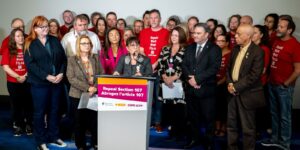
The fight to repeal section 107 from the Canadian Labour Code has progressed after the House of Commons had the second reading of the bill aimed at abolishing it.
Leaders from the NDP and Canada’s union movement have rallied around the bill, framing the repeal of section 107 as key to defending the right to strike. At the same time, smaller labour organizations are working to reclaim the political strike as a tool the labour movement can wield to assert workers’ rights.
Bill C-247 was t
The fight to repeal section 107 from the Canadian Labour Code has progressed after the House of Commons had the second reading of the bill aimed at abolishing it.
Leaders from the NDP and Canada’s union movement have rallied around the bill, framing the repeal of section 107 as key to defending the right to strike. At the same time, smaller labour organizations are working to reclaim the political strike as a tool the labour movement can wield to assert workers’ rights.
Bill C-247 was tabled in October and highlights how section 107 of the labour code has been used in the last two years to tilt the scales during collective bargaining. Section 107 gives the labour minister the power to do things that “seem likely to maintain or secure industrial peace” when they deem it expedient.
Section 107 has been invoked eight times in the last two years and has ended legal strikes being held by rail workers, flight attendants and postal workers.
“Every single time that a government oversteps and uses 107 or any other legislation to send workers back to work, they are undermining the work that happens at the [bargaining] table,” said Siobhan Vipond, vice president of the Canadian Labour Congress. “Let us be clear, every single time that 107 has been used by this government, it has been used in favor of the employer.”
NDP leader, Avi Lewis, expressed support for repealing section 107 in hopes it will balance the power at the bargaining table.
“No worker wants to give up their own wages to go on a picket line,” Lewis said, “but when you’re talking about bargaining in Canada, in a cost of living crisis, where people cannot afford groceries, cannot afford rent and mortgages, being paid a fair wage is our only hope for workers in Canada of getting out of this cost of living emergency, and it’s only the right to strike that balances the scales in labor negotiations, so that employers can’t just do what they want.”
For organizers like Emile Lacombe, who has been organizing with the Alliance Ouvrière (Worker’s Alliance) since 2024, this effort to amend the labour code is positive. But the ongoing attack on the right to strike signals a need to build more labour militancy.
“What we’re seeing right now is that the government is taking advantage of the fact that we’re disorganized, that we’re used to taking the legal route,” Lacombe said in an interview with rabble.ca. “The thing is that they have the upper hand on that department, because they can change laws, the bosses can hire better lawyers than us.”
Lacombe joined a panel at a conference held by the International League of People’s Struggles last week where he discussed the importance of reclaiming the political strike, a strike that happens not just to secure a fair deal but also to assert broader political or social demands.
Representing the Workers Alliance Emile spoke alongside speakers with the Immigrant Workers Centre, the International Migrants Alliance, Migrante Canada and the 1919 Workers Collective. All groups agreed that labour should build towards the political strike.
Lacombe highlighted that the history of the political strike is strong in Canada. Workers used the strike to fight against government austerity in 2015 and to stand up for the environment in 2019. Now, in a time where the NDP and unions are fighting to protect the right to strike, Lacombe said these large mobilizations of workers may be exactly what’s needed to demonstrate that workers’ hard fought wins cannot just be taken away. “If we want the right to strike, we need to prove it in action and to show it by defying back to work orders,” Lacombe said. “That’s the only way that we can ensure that we have this right.”

 Login
Login