Bogotá, Colombia – Bolivia’s government ordered Colombia’s ambassador to leave the country just days after Colombian President Gustavo Petro expressed support for ongoing anti-government protests.
“The Bolivian government has decided to request that the Ambassador of the Republic of Colombia accredited to the country conclude her diplomatic duties in Bolivian territory,” read a statement on Wednesday morning by Bolivia’s Ministry of Foreign Relations.
The ministry expressed its disapprov
Bogotá, Colombia – Bolivia’s government ordered Colombia’s ambassador to leave the country just days after Colombian President Gustavo Petro expressed support for ongoing anti-government protests.
“The Bolivian government has decided to request that the Ambassador of the Republic of Colombia accredited to the country conclude her diplomatic duties in Bolivian territory,” read a statement on Wednesday morning by Bolivia’s Ministry of Foreign Relations.
The ministry expressed its disapproval of Colombia’s involvement in its domestic affairs amid mounting anti-government protests.
“Bolivia considers it essential that any external assessment or statement regarding the country’s internal situation be made with responsibility, diplomatic prudence, and full respect for… institutions,” continued the statement.
While the government did not explicitly mention Petro, the measure came just days after the Colombian president weighed in on the protest movement, describing it as a “popular insurrection” in an X post last Sunday.
In recent weeks, miners, teachers, farmers and Indigenous groups have been calling for President Rodrigo Paz to resign over economic hardships, including soaring inflation and the suspension of fuel subsidies.
Bolivia’s foreign ministry responded to Petro the same day, saying his words, “do not reflect the relation of friendship, respect and cooperation between the peoples of Bolivia and Colombia.”
Petro, whose term ends in August, did not backtrack following the Ambassador’s dismissal.
“If they expel the ambassador simply for proposing dialogue and mediation, it means we’re sliding toward extremism that could lead to a very difficult situation for the Bolivian people,” the president told Caracol radio today.
Despite the spat, Bolivia’s foreign ministry said diplomatic channels remained open and the expulsion did not count as a full-scale rupture in relations.
The government added that it had granted Ambassador Elizabeth García Carrillo “the appropriate period of time in accordance with current international standards” to leave the country.
Featured image description: President Gustavo Petro (L) and President Rodrigo Paz (R). I
Buenos Aires, Argentina – José Roberto Acosta, a former senior official in President Gustavo Petro’s government and current ambassador to Argentina, assessed Colombia’s next presidential election, in which the first progressive government in the country’s history will be tested this Sunday, May 31.
“Colombia is a protagonist, for better or worse,” said Acosta, describing the country as “the navel of the Americas” because of its strategic geopolitical position.
Acosta served as director of Publi
Buenos Aires, Argentina – José Roberto Acosta, a former senior official in President Gustavo Petro’s government and current ambassador to Argentina, assessed Colombia’s next presidential election, in which the first progressive government in the country’s history will be tested this Sunday, May 31.
“Colombia is a protagonist, for better or worse,” said Acosta, describing the country as “the navel of the Americas” because of its strategic geopolitical position.
Acosta served as director of Public Credit under Petro, one of the most sensitive positions inside Colombia’s economic team, before being appointed ambassador in August 2025 as part of a broader cabinet reshuffle. His arrival in Buenos Aires came after a diplomatic crisis triggered by public clashes between Petro and Argentine libertarian president Javier Milei.
In an exclusive interview with Argentina Reports at the Colombian Embassy, Acosta described Colombian politics as a “sancocho,” a traditional Colombian stew, where multiple forms of violence continue to overlap within what he defined as a strong institutional framework.
“In Colombia, assassinations are undoubtedly a political tool,” he added in general terms, so as to abide by internal restrictions discouraging government officials from commenting directly on the race. He referred to the atmosphere surrounding the campaign that revives memories of the intense political violence of the 1990s, notably the attack against senator and presidential hopeful Miguel Uribe Turbay.
Acosta described Colombia as a country where “multiple forms of violence coexist simultaneously,” with conflicts tied to “drug trafficking, armed groups, illegal mining and political extremism” overlapping within the electoral environment. At the same time, he argued that Colombia remains “institutionally very strong,” pointing to the country’s 1991 Constitution and the fact that President Petro, who built his political career after being part of the guerrilla movement, reached power through democratic elections.
Asked about the possibility of continuity for Petro’s political movement, Acosta mentioned Senator Iván Cepeda, the chosen candidate to succeed Petro in leading the ruling Historic Pact party.
“The possibility of continuity is enormous,” he said.
With less than a week until Colombia’s presidential election, the latest Invamer poll shows Cepeda leading the first-round field with 44.6% of voting intention. His closest rival, an outsider and right-wing opposition candidate Abelardo de la Espriella, follows at 31.6%, while conservative Senator Paloma Valencia, candidate of the traditional right-wing Uribista movement, sits third at 14.0%.
Regarding the current administration, Acosta also defended Petro’s controversial “Total Peace” strategy despite criticism surrounding the security situation in several regions of the country.
“We are always optimistic about peace,” he said. “The priority continues to be saving lives.”
On drug trafficking, one of the central pillars of Washington’s renewed regional security agenda under Donald Trump, Acosta described the ‘war on drugs’ as “a lost war” requiring international coordination rather than unilateral responses.
“As Colombians, we saw bombs, trucks and buses loaded with explosives erase entire buildings and kill many people,” he said.
Asked about the figure of “narcoterrorism,” which has a regional dimension, he responded: “Anyone may frame it as they find convenient, but in the end the result is the same: we don’t want to see that violence again in our country.”
Ambassador José Roberto Acosta at the Colombian Embassy in Argentina. Credit: Cecilia Degl’Innocenti
The Wall Street trader who joined Petro’s government
Acosta’s profile remains unusual within Latin American diplomacy, where outsiders and traders have increasingly joined conservative governments, such as in Javier Milei’s cabinet with Economy Minister Luis Caputo or Pablo Quirno in Foreign Affairs.
Instead, Acosta served under Petro, a figure close to regional progressive leaders such as Luiz Inácio Lula da Silva, Claudia Sheinbaum and Pedro Sánchez.
A lawyer, economist and former stockbroker during Wall Street’s pre-digital era, Acosta also worked as a journalist at El Espectador, participating in investigations linked to the Odebrecht corruption scandal and the oil company Pacific Rubiales.
Throughout the interview, Acosta moved naturally between political theory and market logic, frequently referencing thinkers such as Karl Marx, Michel Foucault and Jurgen Habermas to explain global power dynamics.
“I do not know another left-wing trader or banker in Colombia,” he said jokingly.
Acosta defines himself not as a Marxist but as a “Marx scholar,” arguing that reading the German philosopher helped him understand the difference between “price” and “value,” an idea he later applied in financial markets and public policy.
“While we continue to live under a capitalist structure, whoever controls capital controls many other things: media, networks, narratives,” he said.
Between Petro and Milei
President Petro’s confrontational style on social media has repeatedly generated diplomatic tensions across the region, including disputes with governments in the United States, Ecuador and Bolivia. This “X/Twitter diplomacy,” as some analysts describe it, has become a recurring feature of the foreign policy style of several presidents, including Javier Milei.
In 2025, the Argentinian president publicly referred to Petro as a “terrorist communist” in his social media, leading to the expulsion of Argentine diplomats from Bogotá before bilateral relations were gradually normalized through diplomatic channels.
Despite the ideological distance between both presidents, Acosta described the operational relationship as pragmatic.
“In practice, the relationship works beyond the political rhetoric,” he said.
The ambassador highlighted agreements involving aviation, trade and migration, including expanded air connectivity between both countries and progress in commercial procedures affecting Argentine exports.
“One does not discuss tweets or political tensions in meetings with business sectors,” he said. “The conversation immediately moves toward infrastructure, trade, coffee or export channels.”
Acosta also reaffirmed Colombia’s historical support for Argentina’s sovereignty claim over the Malvinas Islands and suggested that Colombia could eventually pursue a more active role inside Mercosur.
“I can imagine a meeting between Milei and Petro,” he said. “But I do not think it would be easy.”
Featured image description: Ambassador José Roberto Acosta at the Colombian Embassy in Argentina.
Bogotá, Colombia – Colombian President Gustavo Petro arrived in Caracas today to meet with his counterpart in Venezuela, Interim President Delcy Rodríguez.
The visit makes Petro the first world leader to visit the South American nation since the United States captured longtime strongman Nicolás Maduro in a military operation on January 3.
Petro and Rodríguez are expected to discuss bilateral issues including energy and security cooperation on their more than 1,300 mile shared border.
T
Bogotá, Colombia – Colombian President Gustavo Petro arrived in Caracas today to meet with his counterpart in Venezuela, Interim President Delcy Rodríguez.
The visit makes Petro the first world leader to visit the South American nation since the United States captured longtime strongman Nicolás Maduro in a military operation on January 3.
Petro and Rodríguez are expected to discuss bilateral issues including energy and security cooperation on their more than 1,300 mile shared border.
The Colombian president landed in Caracas on Friday afternoon with his Foreign Minister, Rosa Yolanda Villavicencio, and Defense Minister, Pedro Sánchez.
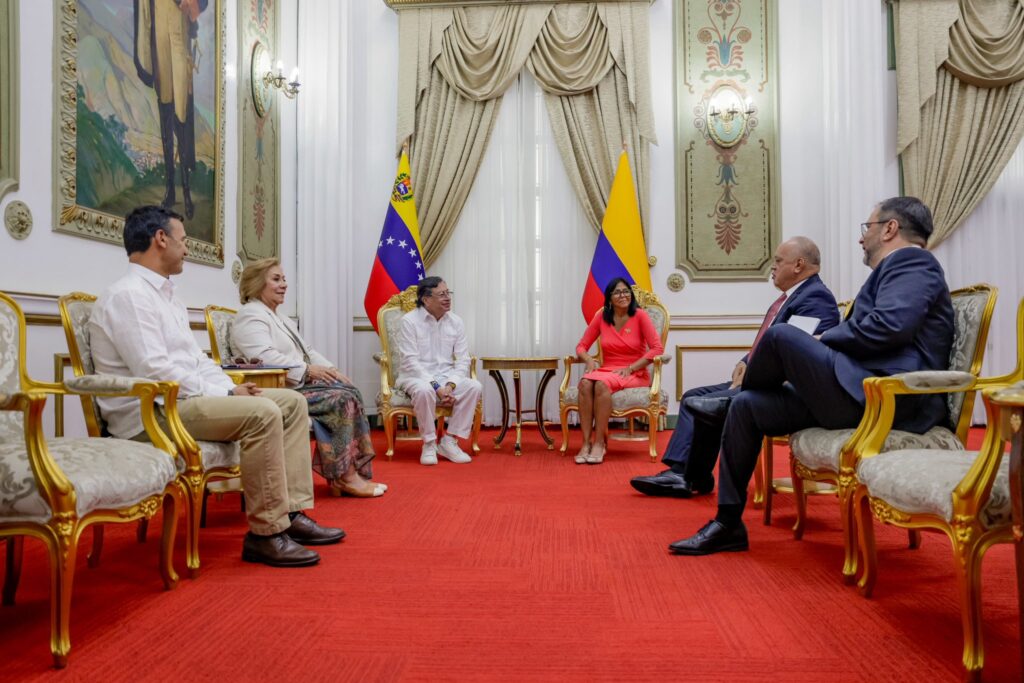
The delegation from Bogotá has been meeting with Rodríguez and her Interior Minister, Diosdado Cabello, alongside Foreign Minister Yván Gil at the Palacio de Miraflores – Venezuela’s presidential palace.
Petro and Rodríguez were flanked by top officials at their meeting. Image courtesy of @InfoPresidencia via X
Petro and Rodríguez were scheduled to meet in Cúcuta, a Colombian city bordering Venezuela, in March but the Venezuelan president cancelled at the last minute citing security concerns.
Then last Friday, the Colombian leader announced he would head to Venezuela, saying, “If Mohammed won’t come to me, I’ll go to the mountain.”
The primary purpose of the meeting is strengthening security cooperation, according to the Petro administration.
“The aim of this meeting is for both governments to make progress on a joint plan to strengthen security and intelligence in the border area,” wrote the Office of the President in a post on X today.
The sprawling frontier is a hotbed for guerrilla activity and is largely controlled by the Colombian National Liberation Army (ELN), a rebel group involved in drug trafficking and illegal mining on both sides of the border.
The ELN was known to have ties to the Maduro regime but the Venezuelan government is under pressure from the U.S. to crack down on the rebel group, which Washington considers a “terrorist organization.”
While the Petro administration maintains the importance of strengthening bilateral cooperation, the meeting has perturbed many in the Venezuelan exile community in Colombia.
“President Gustavo Petro’s visit to Venezuela, particularly his meeting with Delcy Rodríguez, raises serious concerns among Venezuelans,” Juan Carlos Viloria Doria, President of the Global Alliance for Human Rights and Vice-President of Venezuelans in Barranquilla, told Latin America Reports.
He noted that many Venezuelans do not consider Rodríguez to be a legitimate leader, describing her as “an extension of the regime led by Nicolás Maduro.”
“In this regard, such visits can be interpreted as a political endorsement or a form of international legitimization of a situation in Venezuela that still lacks adequate democratic guarantees,” maintained Viloria.
Petro and Rodríguez greet reporters. Image courtesy of @InfoPresidencia via X
There has also been pressure in Colombia for Petro to mediate the release of 16 Colombian citizens jailed in Venezuela.
The families of those detained allege the arrests were made “without a court order or evidence” and say their loved ones have faced human rights violations including torture.
While there has been an easing in repression following Maduro’s ouster, Venezuela remains an authoritarian state and rights groups continue to denounce abuses.
“The least that we Venezuelans expect is that [the meeting] be used as an opportunity to demand concrete progress on human rights and democracy,” said Viloria.
“Any dialogue or rapprochement must be aimed at improving the living conditions of the Venezuelan people and fostering a genuinely democratic transition, not at consolidating contested power structures.”
Featured image description: Colombian President Gustavo Petro and Venezuelan Interim President Delcy Rodríguez at a meeting in Caracas on April 24, 2026.
KUALA LUMPUR, June 8 — Prime Minister Datuk Seri Anwar Ibrahim departed for Tokyo today to lead the Malaysian delegation on the Madani Diplomacy mission to strengthen strategic cooperation and national energy security, as the world faces a global energy supply crisis.In a Facebook post, Anwar said that during the visit, he will hold a meeting with Japanese Prime Minister Sanae Takaichi to discuss the development of bilateral relations and to pioneer new Malaysia-
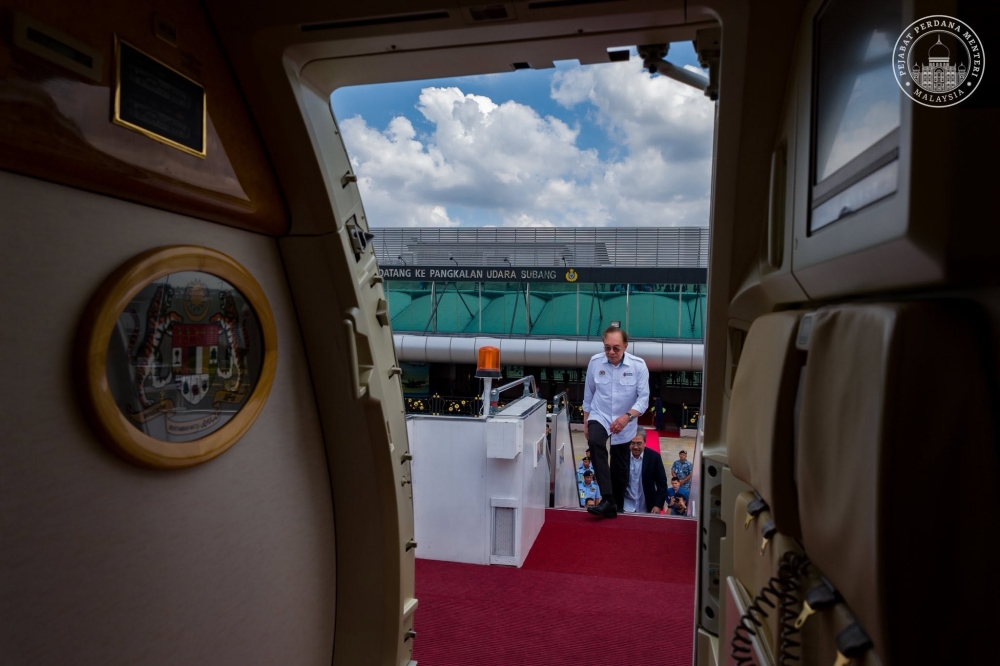
KUALA LUMPUR, June 8 — Prime Minister Datuk Seri Anwar Ibrahim departed for Tokyo today to lead the Malaysian delegation on the Madani Diplomacy mission to strengthen strategic cooperation and national energy security, as the world faces a global energy supply crisis.
In a Facebook post, Anwar said that during the visit, he will hold a meeting with Japanese Prime Minister Sanae Takaichi to discuss the development of bilateral relations and to pioneer new Malaysia-Japan cooperation, particularly in the fields of economy, investment and energy security.
The Prime Minister said that he will also deliver a keynote speech at the 31st Nikkei Forum: Future of Asia, as well as a special lecture at the University of Tokyo on the challenges and future of this region in an increasingly challenging global landscape.
“Pray that our mission runs smoothly and brings beneficial results for the people and the country,” he posted.
Yesterday, the Foreign Ministry in a statement announced that Anwar’s official visit to Japan will begin today until June 10 at the invitation of the Japanese government.
Japan continues to be one of Malaysia’s most important economic partners, ranking as the country’s fifth-largest trading partner in the world since 2024. — Bernama
Bogotá, Colombia – Bolivia’s government ordered Colombia’s ambassador to leave the country just days after Colombian President Gustavo Petro expressed support for ongoing anti-government protests.
“The Bolivian government has decided to request that the Ambassador of the Republic of Colombia accredited to the country conclude her diplomatic duties in Bolivian territory,” read a statement on Wednesday morning by Bolivia’s Ministry of Foreign Relations.
The ministry expressed its disapprov
Bogotá, Colombia – Bolivia’s government ordered Colombia’s ambassador to leave the country just days after Colombian President Gustavo Petro expressed support for ongoing anti-government protests.
“The Bolivian government has decided to request that the Ambassador of the Republic of Colombia accredited to the country conclude her diplomatic duties in Bolivian territory,” read a statement on Wednesday morning by Bolivia’s Ministry of Foreign Relations.
The ministry expressed its disapproval of Colombia’s involvement in its domestic affairs amid mounting anti-government protests.
“Bolivia considers it essential that any external assessment or statement regarding the country’s internal situation be made with responsibility, diplomatic prudence, and full respect for… institutions,” continued the statement.
While the government did not explicitly mention Petro, the measure came just days after the Colombian president weighed in on the protest movement, describing it as a “popular insurrection” in an X post last Sunday.
In recent weeks, miners, teachers, farmers and Indigenous groups have been calling for President Rodrigo Paz to resign over economic hardships, including soaring inflation and the suspension of fuel subsidies.
Bolivia’s foreign ministry responded to Petro the same day, saying his words, “do not reflect the relation of friendship, respect and cooperation between the peoples of Bolivia and Colombia.”
Petro, whose term ends in August, did not backtrack following the Ambassador’s dismissal.
“If they expel the ambassador simply for proposing dialogue and mediation, it means we’re sliding toward extremism that could lead to a very difficult situation for the Bolivian people,” the president told Caracol radio today.
Despite the spat, Bolivia’s foreign ministry said diplomatic channels remained open and the expulsion did not count as a full-scale rupture in relations.
The government added that it had granted Ambassador Elizabeth García Carrillo “the appropriate period of time in accordance with current international standards” to leave the country.
Featured image description: President Gustavo Petro (L) and President Rodrigo Paz (R). I

 Login
Login