hayksenekerimyan posted a photo:
Sometimes the smallest details carry the most charm. A single clothespin holding on to a delicate piece of fabric, framed by soft garden bokeh, captures the beauty of everyday simplicity.
Canon EOS300 with Helios-44M-4 and Kodak Vision3.
Sometimes the smallest details carry the most charm. A single clothespin holding on to a delicate piece of fabric, framed by soft garden bokeh, captures the beauty of everyday simplicity.
Canon EOS300 with Helios-44M-4 and Kodak Vision3.
ShutterNut... posted a photo:
Please be aware... ALL Photos are purely for entertainment. I am no expert. Titles are from recognition - what I was told - or a quick search. Polite comments or corrections are welcome.
Please be aware... ALL Photos are purely for entertainment. I am no expert. Titles are from recognition - what I was told - or a quick search. Polite comments or corrections are welcome.
zwedral posted a photo:
The movie itself is one of the greatest ever made however, this photo is pure luck of camera button click when the wind blast came in and displaced some azalea flowers...thank you Luck!
The movie itself is one of the greatest ever made however, this photo is pure luck of camera button click when the wind blast came in and displaced some azalea flowers...thank you Luck!
One load of laundry can release up to 1.5 million tiny plastic fibers into the water that drains out of your washing machine. Most water treatment plants can’t catch fibers that small, so they end up in rivers, lakes, and the ocean. Scientists now think laundry is responsible for about 35% of the small plastic pieces found in the sea.
That changes what “zero-waste” cleaning actually means today. The plastic detergent bottle is the obvious problem. The hidden problems, including shedding fibers,
One load of laundry can release up to 1.5 million tiny plastic fibers into the water that drains out of your washing machine. Most water treatment plants can’t catch fibers that small, so they end up in rivers, lakes, and the ocean. Scientists now think laundry is responsible for about 35% of the small plastic pieces found in the sea.
That changes what “zero-waste” cleaning actually means today. The plastic detergent bottle is the obvious problem. The hidden problems, including shedding fibers, plastic films sold as “eco-friendly,” mystery fragrance chemicals, and contaminants you’ll never see on a label, are the bigger concern. But here’s the good news: most of the simple ingredients people have used for generations still work, and a few small upgrades make the rest of your routine a lot cleaner.
Cleaning Your Home
Most chemicals in store-bought cleaners haven’t been fully tested for long-term health effects. The EPA’s Safer Choice program certifies products made without ingredients linked to cancer, hormone problems, or harm to wildlife. About 2,000 products carry the label. Almost lost in a 2025 budget cut, the program survived but with fewer staff. Words like “natural” and “green” on packaging aren’t regulated and don’t really mean anything, so look for the Safer Choice label or check the EWG Guide to Healthy Cleaning before trusting a brand.
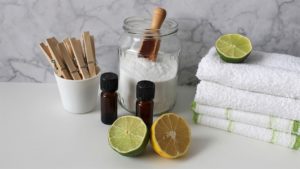
Making your own cleaners gives you control, cuts packaging, and saves money. The basic kit is short: baking soda for scrubbing, white vinegar for windows and mineral stains, lemon juice for cutting boards, 3% hydrogen peroxide (in a dark bottle) for stains and germs, and castile soap for general cleaning. A spray bottle of half vinegar, half water cleans most surfaces. Reuse jars and spray bottles instead of buying new ones.
One important update: older recipes, including earlier versions of this article, used borax as a staple ingredient. Newer research has changed that advice. Europe added borax to its list of substances of very high concern in 2010 because high doses caused reproductive problems in animals, and California lists it as a reproductive toxin under Proposition 65. Borax isn’t banned in the U.S., but the Environmental Working Group recommends skipping it in homemade cleaners. Plenty of borax-free recipes work just as well.
About killing germs: the popular advice to spray vinegar, then hydrogen peroxide, came from a 1996 study on beef tissue, not on home surfaces. Vinegar at normal household strength doesn’t reliably kill many germs, including norovirus and several drug-resistant bacteria, and it isn’t EPA-registered as a disinfectant. For everyday cleaning, vinegar is fine. When real germ-killing matters, when cleaning up after handling raw meat or during a stomach flu outbreak, use 3% hydrogen peroxide alone or an EPA-registered disinfectant.
Never mix peroxide and vinegar in the same bottle and don’t mix bleach with vinegar or any acid; the gases created when these are mixed is dangerous.
Microfibers. Synthetic fabrics like polyester, nylon, and fleece shed tiny plastic threads every time you wash them. France passed a law requiring built-in filters on all new washing machines, which took effect January 1, 2025. California passed a similar law in 2023, but the governor vetoed it. Oregon, New York, and several other states have filter bills moving through their legislatures. Until U.S. machines come with filters, you can use a microfiber-catching laundry bag like Guppyfriend or a Cora Ball, or attach an external filter from Filtrol or PlanetCare to your drain hose. These catch up to 90% of fibers.
“Plastic-free” laundry sheets and pods. Most laundry sheets use a film made from polyvinyl alcohol (PVA or PVOH), which dissolves in water. The cleaning industry says PVA breaks down completely in wastewater treatment, but a 2021 study estimated that about 75% of it passes through treatment plants intact and persists in the environment. The science is debated, but the labels aren’t: if you see polyvinyl alcohol, PVOH, or PVA on the package, the dissolving film is a synthetic plastic. Powdered detergent in cardboard, concentrated liquid in glass, or PVA-free sheet brands are alternatives that avoid this question.
A hidden carcinogen called 1,4-dioxane. This chemical isn’t added to detergent on purpose — it’s a leftover from how certain ingredients are made. Because it’s a contaminant rather than an ingredient, manufacturers don’t have to list it. Independent testing has found it in most conventional detergents. New York finalized rules in September 2024 limiting it to 1 part per million, and the EPA officially called it an unreasonable health risk in November 2024. To avoid it, skip detergents listing SLES (sodium laureth sulfate), “PEG” anything, or ingredients with “-eth-” in the name.
Skip dryer sheets. A University of Washington study found dryer vents emit more than 25 different volatile chemicals when scented detergent and dryer sheets are used together. Seven are classified as hazardous air pollutants. Wool dryer balls reduce drying time and static without coating clothes in chemicals. For scent, put a few drops of essential oil on a damp washcloth and toss it in.
Wash cold. About 90% of the energy a washing machine uses goes to heating water. Switching from warm to cold cycles saves about 3.2 kWh per load, roughly the same as running your fridge for 10 months over a year’s worth of laundry. Cold water also makes clothes last longer and shed fewer microfibers. Modern detergents are designed to clean in cold water. Replace fabric softener with half a cup of white vinegar in the rinse cycle. If you’re shopping for a new dryer, heat-pump dryers use 20–60% less energy than conventional ones.
What You Can Do Today
Wash in cold water on shorter cycles. Saves energy, money, and reduces microfiber shedding.
Use a microfiber-catching laundry bag, ball, or external filter.
Skip dryer sheets and fabric softener. Use wool dryer balls and vinegar instead.
Read ingredient lists. Avoid SLES and PEG compounds in detergent. Skip products with PVA in their dissolvable film if microplastics matter to you.
Make your own cleaners with baking soda, vinegar, peroxide, and castile soap. Skip borax.
Look for the EPA Safer Choice label on store-bought products.
Never mix bleach with vinegar or any other acid.
Support state and federal microfiber filter laws so this stops being a consumer-level problem.
40 pounds of paper towels per American per year. The United States is the world’s most committed buyer of single-use towels, by a margin no other country approaches. Americans alone consume nearly half of all paper towels produced globally, and Europeans use roughly 50 percent fewer than we do.
Paper towels, facial tissues, toilet paper, and napkins together make up a quietly enormous share of American household disposable spending and a startlingly large share of global forest pulp demand. The
40 pounds of paper towels per American per year. The United States is the world’s most committed buyer of single-use towels, by a margin no other country approaches. Americans alone consume nearly half of all paper towels produced globally, and Europeans use roughly 50 percent fewer than we do.
Paper towels, facial tissues, toilet paper, and napkins together make up a quietly enormous share of American household disposable spending and a startlingly large share of global forest pulp demand. The U.S. uses about 13 billion pounds of paper towels each year, and producing them consumes roughly 110 million trees and 130 billion gallons of water.
The financial cost lands quietly on households, in $5 four-packs and $20 jumbo packs that add up to hundreds of dollars annually. The environmental cost lands somewhere else entirely: the boreal forest of Canada.
What 13 Billion Pounds Looks Like at Home
The average American household spends meaningfully more than the headline average suggests. Statista’s 2022 data put per-consumer-unit spending on cleansing and toilet tissue, paper towels, and napkins at $114.41. Paper towel users spend closer to $200 per year on disposable towels alone, with many families spending $400 or more. Toilet paper adds another $182 per year on average per household, with that figure rising during and after the pandemic.
Add facial tissues, napkins, and the kitchen-roll runs that don’t show up in pantry inventory, and a typical American family is spending $400 to $700 a year on products designed to be used once and thrown away. Over an adult lifetime, the math compounds: roughly $10,500 on paper towels and $9,500 on tissues per person. Think about that in relation to your monthly salary the next time you shop.
The volume side is just as striking. Americans throw out roughly 3,000 tons of paper towels every single day. Used paper towels can’t be recycled because they’re contaminated with food, grease, cleaning chemicals, or simply too short-fibered after one use, so essentially all of that volume goes to landfill or incineration. EPA’s most recent breakdown shows tissue paper and towels accounting for 3.8 million tons of municipal solid waste, or about 1.3 percent of total MSW generation. While that is a small percentage of total trash, it is a large percentage of single-use, single-purpose throwaway products.
The Boreal Forest Connection
Most of the trees used to make American at-home tissue products come from the Canadian boreal forest, one of the largest intact forest ecosystems on Earth and a globally significant carbon sink. Clear-cut logging for tissue manufacturing now consumes more than one million acres of boreal forest each year, according to the Natural Resources Defense Council (NRDC).
These forests store roughly twice as much carbon per acre as tropical rainforests. Each clear-cut releases that carbon and degrades habitat for boreal caribou, billions of migratory birds, and Indigenous communities whose traditional territories overlap with logging concessions.
The NRDC has tracked the paper products supply chain for six years through its Issue with Tissue scorecard, and the 2024 edition shows real movement at the top of the rankings — and continued failure at the bottom.
Brand owner
Notable products
2024 grade
Notes
Procter & Gamble
Charmin, Bounty, Puffs
F
Sixth year
Continues to source virgin pulp from boreal forests.
Procter & Gamble
Charmin Ultra Bamboo
B
First non-F grade for any P&G tissue product.
Kimberly-Clark
Kleenex, Cottonelle, Scott
D
New deforestation and forest-degradation commitments in 2024.
Georgia-Pacific
ARIA
A+
Relaunched as 100% recycled content; top of the scorecard.
P&G’s continued reliance on virgin pulp for its flagship at-home brands matters because Charmin, Bounty, and Puffs together command a substantial share of the U.S. retail market. The grade isn’t an abstraction; it tracks the proportion of each brand’s fiber that comes from intact, climate-critical forests rather than recycled content or alternative sources like wheat straw.
Why “Tree-Free” Doesn’t Always Mean “Impact-Free”
Bamboo tissue has become the most visible alternative to virgin pulp in U.S. retail, and it is meaningfully better than virgin forest fiber on most environmental metrics. It is not, however, the most sustainable option available — recycled content is.
NRDC’s hierarchy puts 100 percent post-consumer recycled paper at the top: it requires no new fiber, diverts paper from landfills, uses about 15 gallons of water per roll, and has the lowest carbon footprint. Bamboo uses about 25 gallons of water per roll, requires more processing, and carries a real risk of being grown on land that was previously primary forest, a problem the FSC certification system is meant to address, but which still requires consumers to read labels carefully.
Recycled-content paper towels are widely available, including from Seventh Generation, Marcal, and Trader Joe’s, and they perform competitively with virgin towels for most household uses. The case for switching is straightforward: same function, lower cost over time when bought in bulk, and dramatically lower environmental impact.
What You Can Do
The interventions here are unusually high-leverage at the household level, because per-capita consumption in the U.S. is so far above the baseline of comparable countries.
Replace the highest-volume product first:
Switch out paper towels for washable cloth towels, microfiber rags, or bar mops for an estimated 80 percent of household uses. Keep a small roll of recycled-content paper towels for genuinely unpleasant tasks ( like wiping up after raw meat, pet accidents, or automotive work.
Choose 100 percent post-consumer recycled toilet paper brands when available (Seventh Generation, Marcal, Who Gives A Crap recycled line, ARIA). If recycled isn’t available, FSC-certified bamboo is a strong second choice.
Replace paper napkins with cloth. A set of 12 cotton napkins costs roughly the equivalent of two months of paper napkin spending and lasts for years.
The math on switching is more favorable than the sticker price suggests. Who Gives A Crap’s recycled toilet paper subscription runs roughly $1.03 to $1.29 per double-length roll, comparable to or below mainstream supermarket pricing per sheet. The premium framing of “eco-friendly” tissue products often reflects packaging and marketing more than per-use cost.
Push retailers and manufacturers:
The NRDC tissue scorecard is updated annually and is the single best public reference for which brands deserve which share of the market.
Retailer pressure has worked: the 2024 scorecard shows movement at Kimberly-Clark and Georgia-Pacific in direct response to consumer and shareholder advocacy.
For the cardboard tubes and outer packaging, Earth911’s recycling search tool confirms local acceptance; most curbside programs take them, but not all.
Don’t flush, rinse
A modest bidet attachment costs $30 to $80, installs without a plumber on most U.S. toilets, and reduces toilet paper consumption by an estimated 75% or more in households that use it consistently. The water cost of a bidet is roughly an eighth of a gallon per use, vastly less than the embedded water in the toilet paper it replaces.
Paper-product consumption is one of the few household waste categories where a typical American family can cut its environmental and financial footprint by half or more with relatively small behavior changes. The leverage is unusually direct.
Paper is one of the easiest materials to recycle, and Americans are still pretty good at it. We are also still throwing away tens of millions of tons of it every year.
Paper and paperboard make up roughly a quarter of municipal solid waste in the United States, it is the single largest category by weight. Eliminating paper waste entirely would take a Herculean effort for most households, but whether you want to do good, better, or best, you can cut what you use and recycle more of what you don’t
Paper is one of the easiest materials to recycle, and Americans are still pretty good at it. We are also still throwing away tens of millions of tons of it every year.
Paper and paperboard make up roughly a quarter of municipal solid waste in the United States, it is the single largest category by weight. Eliminating paper waste entirely would take a Herculean effort for most households, but whether you want to do good, better, or best, you can cut what you use and recycle more of what you don’t.
The Numbers
The U.S. Environmental Protection Agency’s last comprehensive accounting of municipal solid waste, released in 2020 with 2018 data, pegged total MSW generation at 292.4 million tons — about 4.9 pounds per person per day. Paper and paperboard accounted for 23.1% of that total, or 67.4 million tons. (EPA has not published an updated edition of the Facts and Figures report since.)
More recent data comes from the paper industry itself. The American Forest & Paper Association (AF&PA) reported that about 46 million tons of paper were recycled in the United States in 2024 — roughly 125,000 tons every day — which resulted in a paper recycling rate of 60% to 64% and a cardboard recycling rate of 69% to 74%. Both figures slipped compared to 2023, primarily because exports to Asia softened. Domestic mills, meanwhile, used 1.29 million more tons of recycled paper than the year before, and recycled fiber’s share of all fiber used at U.S. mills reached 44.4%, its highest in two decades.
AF&PA changed its methodology in 2024 to report rates as ranges rather than single numbers and to factor in recycled fiber that arrives in the country inside imported packaging. That makes year-over-year comparisons messier than they used to be, but it also makes the numbers more honest. The headline takeaway has not changed: paper is still one of the most recycled materials in the United States, and overall paper waste has been declining since around 2000 as digitization eats into print volumes.
With paper still filling roughly a quarter of our garbage cans, there is plenty of room to do better.
Good
You can take simple steps to reduce the paper you use, and curbside paper recycling remains widely available across most U.S. communities. AF&PA reports that 79% of Americans have access to community residential-curbside recycling for paper and cardboard. Recycling clean paper takes almost no effort and makes a meaningful difference.
Here is how to be good about paper waste:
Recycle paper through your curbside program. It is the simplest single thing you can do.
Recycle only clean paper. Wishcycling of food-soiled paper can contaminate an entire load.
Cancel print subscriptions you no longer read and switch to digital editions of newspapers and magazines.
Set your printer to two-sided printing by default, and reuse paper as scratch paper before recycling it.
Choose paper products made with post-consumer recycled content. Recycled-content packaging now makes up nearly half the fiber used at U.S. paper mills.
Better
If you want to do better than good — or if your community has limited curbside service — a little extra effort goes a long way. Contact your local solid waste utility to let them know you value recycling (your garbage bill should tell you whom to call). To do better, you’ll need to recycle more types of paper and start replacing single-use paper with reusable alternatives:
Use the Earth911 recycling locator to find drop-off options for paper your curbside program won’t take, such as paperback books, gable-top cartons, aseptic drink boxes, shredded paper, and more.
Compost what you can’t recycle. Dirty paper towels, disposable napkins, paper plates, and pizza boxes don’t belong in the recycling bin, but they break down well in commercial composting or a home compost bin.
Replace paper-bag lunches with a lunchbox or furoshiki wrap, which doubles as reusable gift wrap.
Digitize what you reasonably can. Use note-taking apps and electronic calendars in place of notebooks, and sign up for electronic billing and digital magazine subscriptions.
Cut the junk mail at the source. Register your mail preferences with DMAchoice, which is now operated by the Association of National Advertisers, for a small fee that covers a 10-year listing. To stop prescreened credit and insurance offers, use the credit bureaus’ OptOutPrescreen service or call 1-888-567-8688.
Best
Because paper is one of the more easily recyclable materials, paper products are often the greener choice in head-to-head comparisons with plastic. So while plastic-free is a popular goal, almost no one seriously attempts a paper-free lifestyle, and you don’t need to.
To get to zero waste, do what you can to eliminate avoidable paper and recycle the rest. If you have already worked through the Good and Better tiers, you’ll notice that food packaging accounts for most of the paper waste you have left.
Zero waste grocery shopping requires a real shift — seeking out bulk stores, carrying reusable containers, and cooking more from scratch. The payoff is a dramatic reduction in paperboard packaging.
Cutting pizza boxes and takeout containers means cooking more meals at home. The packaging savings are significant; the takeout habit is harder to break.
Rethink napkins, tissues, and paper towels. Cloth napkins are the easiest swap; handkerchiefs take more getting used to. Breaking the paper towel habit usually means buying a stack of cloth shop towels or microfiber cloths and learning to grab those instead.
Toilet paper is a tougher ask. Bidets, including affordable seat attachments, are the most effective way to cut household toilet paper use. If that’s a stretch, switching to bamboo or recycled-content toilet paper is a meaningful step down from virgin tree fiber.
What You Can Do This Week
Audit your recycling bin once. If half of what’s in there isn’t paper or cardboard, your sorting habits are leaving easy wins on the table.
Spend ten minutes registering with DMAchoice and OptOutPrescreen. Junk mail volumes drop within two to three months.
Use the Earth911 recycling search to find a drop-off for the paper categories your curbside program rejects — shredded paper and gable-top cartons are the two most commonly missed.
Replace one disposable paper product in your kitchen with a reusable alternative this month. Cloth napkins or shop towels are the lowest-friction starting points.
Editor’s note: This article was originally authored by Gemma Alexander on April 6, 2020, and was substantially updated in May 2026.

 Login
Login