CAMBRIDGE BAY (Nunavut), May 16 — Since US President Donald Trump’s barrage of threats to seize Greenland, authorities on the frozen island have been seeking help from a northern ally: Canada.A reserve unit of the Canadian armed forces called the Rangers has long maintained a year-round presence in mostly inaccessible Arctic communities. For three years, authorities in Greenland and Denmark have consulted with Canadian officials on how to set up their own versio
CAMBRIDGE BAY (Nunavut), May 16 — Since US President Donald Trump’s barrage of threats to seize Greenland, authorities on the frozen island have been seeking help from a northern ally: Canada.
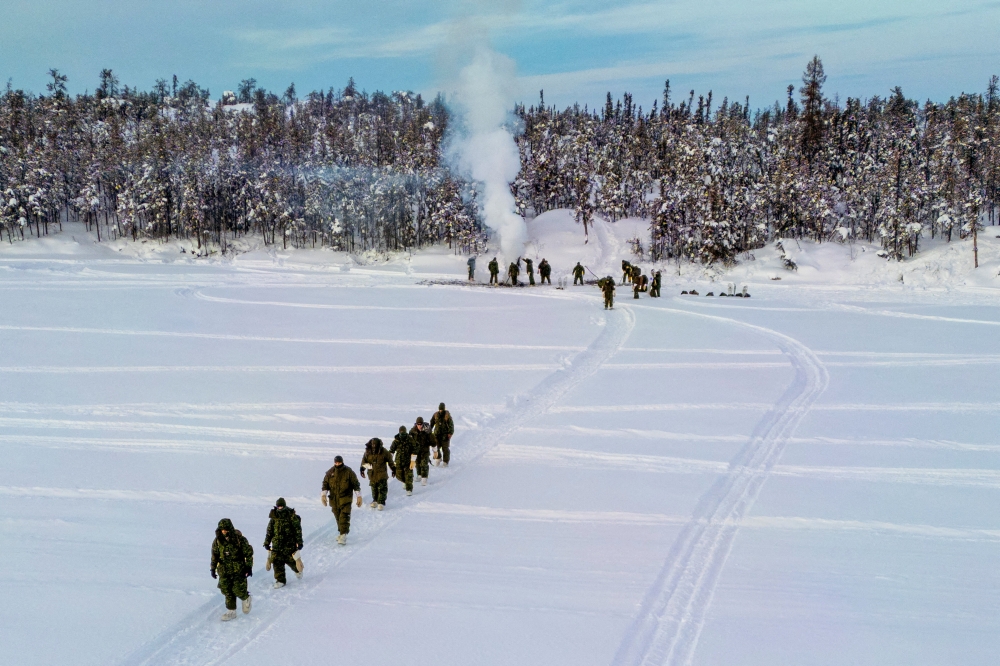
A reserve unit of the Canadian armed forces called the Rangers has long maintained a year-round presence in mostly inaccessible Arctic communities. For three years, authorities in Greenland and Denmark have consulted with Canadian officials on how to set up their own version of the Rangers - conversations that grew more urgent with Trump’s threats and growing fears of Russian hostility in the Arctic.
“The rhetoric coming out of the White House has sped up efforts to rebuff the idea that Arctic communities need the US to come in and save them,” said Whitney Lackenbauer, an honorary lieutenant-colonel Canadian Ranger involved in the talks, who spoke with Reuters during a recent 5,000-kilometer Arctic snowmobile trek by the Rangers. “The Nordic countries and Canada, we’re increasingly realizing we can come together in military and diplomatic ways to send a message that carries moral weight.” As Canada attempts to pivot away from relying on the US to protect its vast Arctic, Prime Minister Mark Carney is strengthening ties and exchanging security tips with the Nordic countries, which he describes as trusted partners. Canada’s increased defense collaboration with the Nordics is part of Carney’s effort to strengthen alliances between what he calls “middle powers” in a world where the United States is considered a less reliable partner.
The White House said Trump’s leadership has prompted allies “to recognize the need to meaningfully contribute to their own defense” and that the Arctic is a critical region for US national security and the economy.
“The administration is participating in diplomatic high-level technical talks with the governments of Greenland and Denmark to address the United States’ national security interests in Greenland,” a White House spokesperson said in an email.
Alliances are shifting in the Arctic as climate change makes it more accessible. Russia has far more military bases than any other nation there and in recent years China has started to increase its presence in the mineral-rich area, mostly in partnership with Russia. While Carney says Canada will no longer rely on any other nation to protect its own territory, he says the Arctic’s greatest threat is from Russia - and the Nordics have been boosting their own defenses since Russia invaded Ukraine.
In March, Canada and the five Nordic countries - Denmark, Finland, Iceland, Norway and Sweden - agreed to deepen their cooperation in military procurement and ramp up defense production to deal with security threats, including cyberattacks. A plan for how Greenland might adapt the Canadian Rangers is expected by the end of this year, according to government policy documents. Canadian Foreign Affairs Minister Anita Anand told Reuters she meets regularly with Nordic officials to work on collective defense and Arctic security. Canada’s partnership with the United States through NORAD, the North American Aerospace Defense Command, remains critical, she said. But Canada is focused on bolstering new alliances. That includes the opening of a Canadian consulate in Nuuk in February and an invitation to her Nordic counterparts to visit Canada’s Arctic this year.
“We have to build something new, and it has to be a world order that is built on the values that we represent,” Danish Prime Minister Mette Frederiksen told Carney during the Nordic-Canadian summit in Oslo in March. In April, Alexander Stubb became the first Finnish president to visit Canada in a dozen years and signed several agreements on Arctic cooperation. Stubb and Carney took to the ice in Ottawa for a hockey practice, and afterward Stubb said he and Carney message each other almost every day.
The two national leaders sometimes chat about hockey or baseball, Stubb told reporters, but “most of the time it’s about Nato or Ukraine or Iran.”
No more ‘free pass in the arctic’ for hostile nations
Lackenbauer, the honorary Canadian Ranger lieutenant-colonel, is also an Arctic expert at Trent University in Peterborough, Ontario. He said Canada should overhaul its approach to Arctic security just as Nordic countries did after Russian troops marched into Ukraine in 2022.
“The more we can go and help Canada’s allies in northern Europe, the more hostile nations will get the message that they do not get a free pass in the Arctic,” he said. Among the eight countries that share the Arctic, Canada’s investment in defending the territory has consistently been near the bottom, trailing Russia, the US, Norway, Sweden, Denmark and Finland, according to the Arctic Business Index, a network of far north research institutions and analysts. Along with Greenland, Canada has historically spent the least. Last year, Canada hit the Nato target of spending 2 per cent of its GDP on defense, around CA$63 billion (RM181 billion), after repeated complaints from Trump. That compared to a low point of just 1 per cent in 2014.
Neil O’Rourke, Director General at Canada’s Coast Guard for Fleet and Maritime Services, said he and a Danish defense colleague realised years ago that if either country had a serious incident in the Arctic, their first phone call should be to each other.
“Up north, we’re just across the water and it makes much more sense to share resources than to get help from down south,” O’Rourke said in an interview. He said Canada is also trying to learn more from Norway about how its maritime services handle emergency towing of vessels.
Rob Huebert, an Arctic expert at the University of Calgary, said working with the US remains critical, noting that the country produces arguably the most advanced military weaponry and that Canada’s military remains highly dependent on the US for protecting its northernmost regions.
“If we are talking about war-fighting capability, that means working with the US military,” he said. Huebert said Carney’s March trip to observe a Norwegian-led Nato exercise in Bardufoss is perhaps an indication the country’s approach is changing.
“Until very recently, Canada’s participation in Nato’s Arctic exercises in the Nordics has been very token,” he said. “But then all of a sudden because of Trump, we decide we’d better do something with the Nordics.” — Reuters
The retreat of glaciers and ice sheets is expected to have widespread impacts on communities around the world because of its effect on sea levels. Already, the global average sea level is more than 10 centimeters higher than it was just 3 decades ago; and the rate of rise is increasing, contributing to increased storm surges and flooding, lost infrastructure and community lands, and more.
Recent reports on the instability of Antarctica’s Thwaites Glacier, for example, have focused attention
The retreat of glaciers and ice sheets is expected to have widespread impacts on communities around the world because of its effect on sea levels. Already, the global average sea level is more than 10 centimeters higher than it was just 3 decades ago; and the rate of rise is increasing, contributing to increased storm surges and flooding, lost infrastructure and community lands, and more.
Recent reports on the instability of Antarctica’s Thwaites Glacier, for example, have focused attention on how accelerating ice flow can lead to ice sheet collapse and rising sea levels.
Earth’s ice sheets accumulate ice through snowfall and lose mass through a mix of surface ablation, iceberg calving, and melting at their interface with the ocean. Glacial ice flows under its own weight, and the rate at which it flows to coastal areas is a primary control on ice sheet mass loss.
Flow rates depend on how much resistance an ice sheet encounters at its interface with the ground (e.g., whether it is frozen to its substrate) and on its effective viscosity, a measure of how strongly it resists deformation. The viscosity of ice, in turn, varies based on properties including temperature, crystal size and orientation, and impurity content.
Some properties within and beneath ice sheets that affect how they flow are anisotropic, meaning they vary by direction. For example, roughness in some directions at the ice bed can facilitate ice sliding more effectively than roughness in other directions, similar to the way a properly oriented corrugated metal roof allows snow to slide off. Several forms of anisotropy within ice also affect how ice flows from land to ocean (Figure 1).
Fig. 1. Anisotropy in glaciers and ice sheets has various sources, including from ice fabric and other properties within the ice (englacial) or at the ice-bed interface. Many forms of anisotropy in glacial ice can be measured with radar. Credit: Adapted from Hills et al., 2025, https://doi.org/10.1029/2024RG000842, CC BY 4.0
Measuring anisotropic properties is key to better understanding how quickly changes at the edges of the Greenland and Antarctic ice sheets will lead to sea level rise. Recent advances in ice-penetrating radar technology and in processing radar data are revolutionizing how we observe directionally varying ice sheet properties, paving the way for projections of mass changes that account for previously neglected processes.
Crystal Fabric: Memory and Modulator of Ice Flow
Fabric, the orientation of crystals composing ice, is the best studied and arguably most important of anisotropic ice sheet properties. As ice deforms, for example, by stretching horizontally as it flows toward the coast, its millimeter-scale crystals are reoriented (Figure 1).
Fabric thus contains a memory of past flow. Simultaneously, fabric influences flow because ice crystals are about 3 orders of magnitude easier to shear in some directions than others—similar to how stacked playing cards slide easily against each other when held along their edges but resist motion when pinched top to bottom.
Over the past 20 years, radar polarimetry has matured into a quicker and easier alternative means for inferring fabric.
The potential importance of fabric on large-scale ice flow has long been recognized, but a shortage of observations has made it difficult to quantify and validate its effect in ice sheet models. Until recently, fabric could be measured only directly in ice cores or inferred through seismic soundings. These methods provide highly detailed information about how fabric develops but are expensive, logistically taxing, and provide information only about sparse point locations.
Over the past 20 years, though, radar polarimetry has matured into a quicker and easier alternative means for inferring fabric, enabling observations at the scale of entire glaciers and providing new constraints on how fabric influences ice sheet flow.
How Radar Reveals Fabric
Ice-penetrating radar instruments emit electromagnetic energy as radio frequency waves. These waves reflect off interfaces within and beneath glacial ice, including transitions in ice chemistry and the contact surface between the ice sheet and the ground or water below. The properties of the reflected waves are then measured when they return to the radar. Just as fabric leads to anisotropic ice deformation, it also introduces directional dependence in the measured electrical properties.
The speed of a radar wave through an ice crystal is approximately 1% faster if the wave is polarized across the crystal’s principal (c) axis rather than aligned with it. Though small, this difference can compound enough that it causes measurable changes in returned radar signals.
In a typical radar survey over anisotropic ice, waves with different polarizations travel at slightly different speeds (Figure 2). The times that return signals arrive back at the receiver thus vary directionally, a difference that can be identified using polarimetric radars that transmit and receive radio waves at multiple orientations.
Fig. 2. Propagation of polarized radio waves through anisotropic ice reveals structural variations with depth because waves aligned across the prevailing ice fabric (represented by the ball, in which darker shading indicates a greater concentration of c axes) travel faster than waves aligned with the fabric. The phase delay increases as the effect of the anisotropy accumulates with depth. Credit: Adapted from Hills et al., 2025, https://doi.org/10.1029/2024RG000842, CC BY 4.0
Fabric’s effect on radar signal travel times accumulates through an ice column, so it is more prominent in thicker ice with stronger horizontal fabric (i.e., the ice crystals are more consistently aligned). In such cases, differences in travel times between polarizations can be measured even by standard radars.
When fabric is weaker or ice is thinner, the offset is smaller and detectable only by systems that can identify the phases of radar returns—that is, the exact positions of the returned waves in their oscillation cycle. Even small wave speed differences from weak fabrics accumulate into measurable phase shifts between polarizations, which can be used to determine the consistency of crystal alignment and the predominant crystal orientation.
Small differences in fabric through an ice column can also change the strength, or amplitude, of returned signals. This amplitude difference offers an independent way to identify fabric orientation and its depth variation.
Polarimetric radar has been widely applied in cryospheric science in recent years largely due to the advent of low-cost systems that can measure signal phases. For example, the popular Autonomous phase-sensitive Radio Echo Sounder (ApRES) is a lightweight, ground-based system that can be used to infer ice fabric at single points down to 2 kilometers deep. In the past decade, polarimetric ApRES systems have revealed ice flow histories, including changes in flow directions, of key glaciers over the past few millennia. These measurements offer windows into how ice sheets responded to previous climate variations.
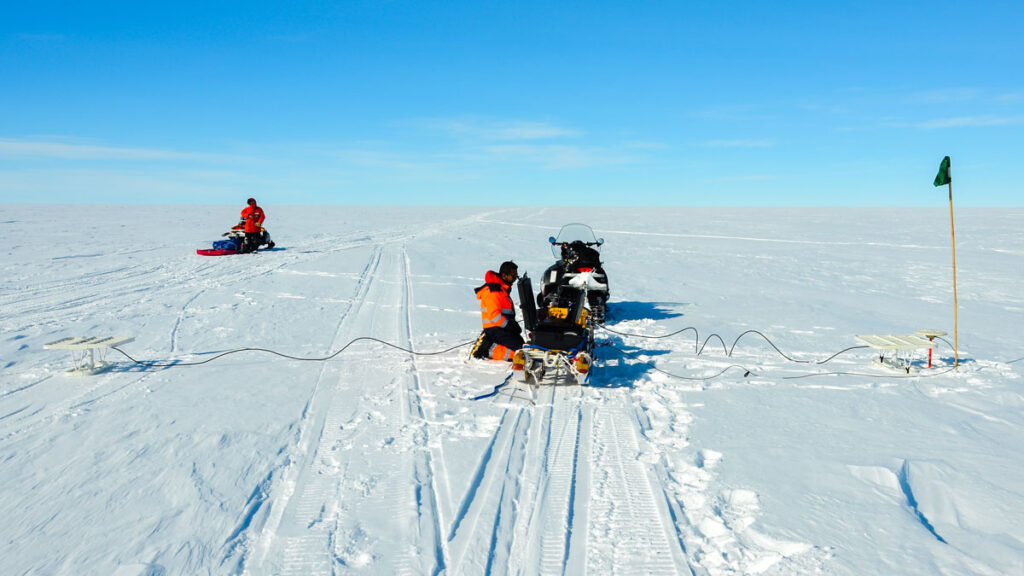
A mobile, quad-polarimetric radar is dragged by snowmobile over the surface of Müller Ice Cap on Axel Heiberg Island in Nunavut, Canada, in May 2023. Credit: David Lilien
The next generation of polarimetric radars go beyond one-point-at-a-time stationary soundings, offering full polarimetry capabilities on moving platforms. These systems may soon allow scientists to map directional ice properties at the scale of entire ice sheets.
Insights into Fast-Flowing Ice Fabric
The growing number of radar studies conducted near sites where ice cores have been collected, which allow fabric to be investigated up close, has provided validation and bolstered confidence that fabric can be inferred accurately from its effects on radar. Researchers now infer fabric from radar in more dynamic areas, such as Thwaites Glacier, Whillans Ice Stream, and the Northeast Greenland Ice Stream (NEGIS), where ice fabrics change over short spatial scales and where drilling ice cores is logistically difficult. Airborne radar surveys are particularly effective in these settings because they can efficiently map fabric variations across large, fast-moving areas.
Observations of strong fabrics in fast-flowing regions suggest that fabric is an important control on ice viscosity, although its implications for ice flow are just beginning to be explored. For example, at Rutford Ice Stream in Antarctica, ApRES data indicate that fabric causes sharp changes in viscosity in different directions with depth, a complexity not captured by current ice flow models.
A combination of airborne and ground-based radar shows that the fabric of the NEGIS varies substantially across the ice stream, which facilitates horizontal shear that allows faster and more cohesive flow in the middle of the ice stream while simultaneously stiffening this ice against along-flow stretching. These viscosity variations may alter how quickly coastal changes, such as increased melt due to climate warming, influence inland ice flow.
Scientists have studied ice sheet mass balance at glacier-mounted stations along the renowned “K-transect” near Kangerlussuaq in southwestern Greenland since the early 1990s. This image shows a view up the transect in April 2025. Polarimetric radar offers another tool with which to study ice flow here and at other locations on the ice sheets. Credit: Tamara Gerber
The emerging consensus from radar observations and recent progress in fabric modeling is that ice fabric can soften ice stream shear margins by a factor of 10. In other words, the fabric tends to develop in a way that greatly reduces the ice’s effective viscosity at lateral boundaries between fast-flowing and slower-flowing ice, which enables the ice to deform more easily at the margins. The agreement between observations and process-scale modeling highlights fabric as a major, but largely ignored, control on ice flow that may affect estimates of how ice dynamics will contribute to future sea level rise.
Beyond Fabric
Most polarimetric radar studies so far have focused on fabric, but other ice characteristics can cause directional effects too. For instance, bubbles trapped in ice have dramatically different properties than ice itself. Ice deformation can bring bubbles into alignment, such that they affect radar waves differently in different directions.
Likewise, ice at its melting point can contain liquid water along boundaries between crystals, and if those pockets of water are aligned in one direction, they can also affect radar returns. Each of these properties has important influences on ice flow, but their implications are yet to be explored.
Another source of anisotropy is the bottom boundary of the ice sheet. This interface can be rougher in some directions than others, though the roughness is typically aligned with the prevailing ice flow direction or the direction of meltwater trapped within the ice.
Polarimetric radar can measure directionally dependent properties of ice sheet bases at a finer scale than radar profiling can. Such work is leading to new insights into glacier geomorphology, interactions of ice shelf bottoms with the underlying ocean, and how ice slides over substrate surfaces. Rates and extents of sub-ice-shelf melt and basal sliding are widely recognized as key controls on the future of the ice sheets.
Expanding Horizons: Large-Scale and Planetary Applications
Radar polarimetry has already transformed our understanding of ice fabric, revealing much about how crystal alignment modulates the flow of Earth’s ice sheets and filling critical gaps between the handful of direct measurements from ice cores. As polarimetric techniques mature, their applications are expanding.
Researchers are moving from studying isolated profiles of ice fabric to mapping it across whole basins, a key shift for validating bespoke models of fabric and its effects on flow. These models are also rapidly developing to include additional physical processes (e.g., migration recrystallization) and key simplifications (e.g., reducing directionally varying viscosity to a single number) that allow them to interface more easily with—and be incorporated into—large-scale models used for projecting sea level rise.
Techniques pioneered for measuring ice on Earth may also prove useful elsewhere in the solar system.
Techniques pioneered for measuring ice on Earth may also prove useful elsewhere in the solar system. Orbital radar sounders have already probed Mars’s ice masses, and the icy shell of Jupiter’s moon Europa will soon be surveyed by single-polarization radars aboard NASA’s Europa Clipper and the European Space Agency’s Jupiter Icy Moons Explorer (JUICE). These radars might be useful for polarimetry at some locations on Europa, which could reveal past and present motion of ice features and answer fundamental questions about the moon. Whether Europa’s shell flows, for example, may be key to whether its subsurface ocean can harbor life.
As polarimetric radar systems become routine tools for glaciologists and as similar instruments begin operating on spacecraft exploring icy worlds, a technique once limited to a few isolated core sites on Earth could be poised to transform our understanding of ice across the solar system.
Author Information
David Lilien (dlilien@iu.edu), Indiana University Bloomington; T. J. Young, University of St Andrews, Fife, Scotland; Benjamin Hills, Colorado School of Mines, Golden; Tamara Gerber, Université de Lausanne, Lausanne, Switzerland; and Matthew Siegfried, Colorado School of Mines, Golden
Citation: Lilien, D., T. J. Young, B. Hills, T. Gerber, and M. Siegfried (2026), New directions in mapping ice sheet fabrics and flow, Eos, 107, https://doi.org/10.1029/2026EO260154. Published on 14 May 2026.
HBO Max’s U.S. movie chart on May 10, 2026, shows a disaster-franchise takeover, and the timing is striking because it did not happen through one title alone. A brand-new sequel entered the platform’s movie chart at #1, immediately knocking Wuthering Heights off the top spot after that film had controlled the daily movie chart from May 4 through May 9.
HBO Max’s U.S. movie chart on May 10, 2026, shows a disaster-franchise takeover, and the timing is striking because it did not happen through one title alone. A brand-new sequel entered the platform’s movie chart at #1, immediately knocking Wuthering Heights off the top spot after that film had controlled the daily movie chart from May 4 through May 9.
The police in Greenland are investigating the case of a lone man from Las Vegas who goes by Cliff. Locals said he had offered money to Greenlanders to join the United States.
The police in Greenland are investigating the case of a lone man from Las Vegas who goes by Cliff. Locals said he had offered money to Greenlanders to join the United States.
Keira Alexandra Kronvold’s daughter was taken from her after she was subjected to parental competence psychometric testsA Greenlandic woman whose newborn baby was forcibly removed by Danish authorities as a result of controversial parenting competency tests has won a landmark case in the high court ruling that their actions were illegal.Keira Alexandra Kronvold’s daughter Zammi was taken away from her when she was two hours old and placed in foster care in November 2024 after Kronvold was subjec
Keira Alexandra Kronvold’s daughter was taken from her after she was subjected to parental competence psychometric tests
A Greenlandic woman whose newborn baby was forcibly removed by Danish authorities as a result of controversial parenting competency tests has won a landmark case in the high court ruling that their actions were illegal.
Keira Alexandra Kronvold’s daughter Zammi was taken away from her when she was two hours old and placed in foster care in November 2024 after Kronvold was subjected to so-called FKU (parental competence) psychometric tests. At the time she was told that the test was to see if she was “civilised enough”.

 Login
Login