Normal view

Colombia’s super‑rich pack their bags amid the rise of the left: ‘The country is wonderful if you have one foot out the door’

24 May 2026 at 04:00

Paranoia has gripped some Colombian billionaires after four years of President Gustavo Petro’s leftist government. Arturo Ramos, 30, says the country is headed for an economic collapse. “Everyone in Latin America has gone bankrupt because of the delusion that they can spend more money than they have,” says this heir to a business empire, who prefers to remain anonymous.

Seguir leyendo

© Roveda, Gabriel (Getty Images)

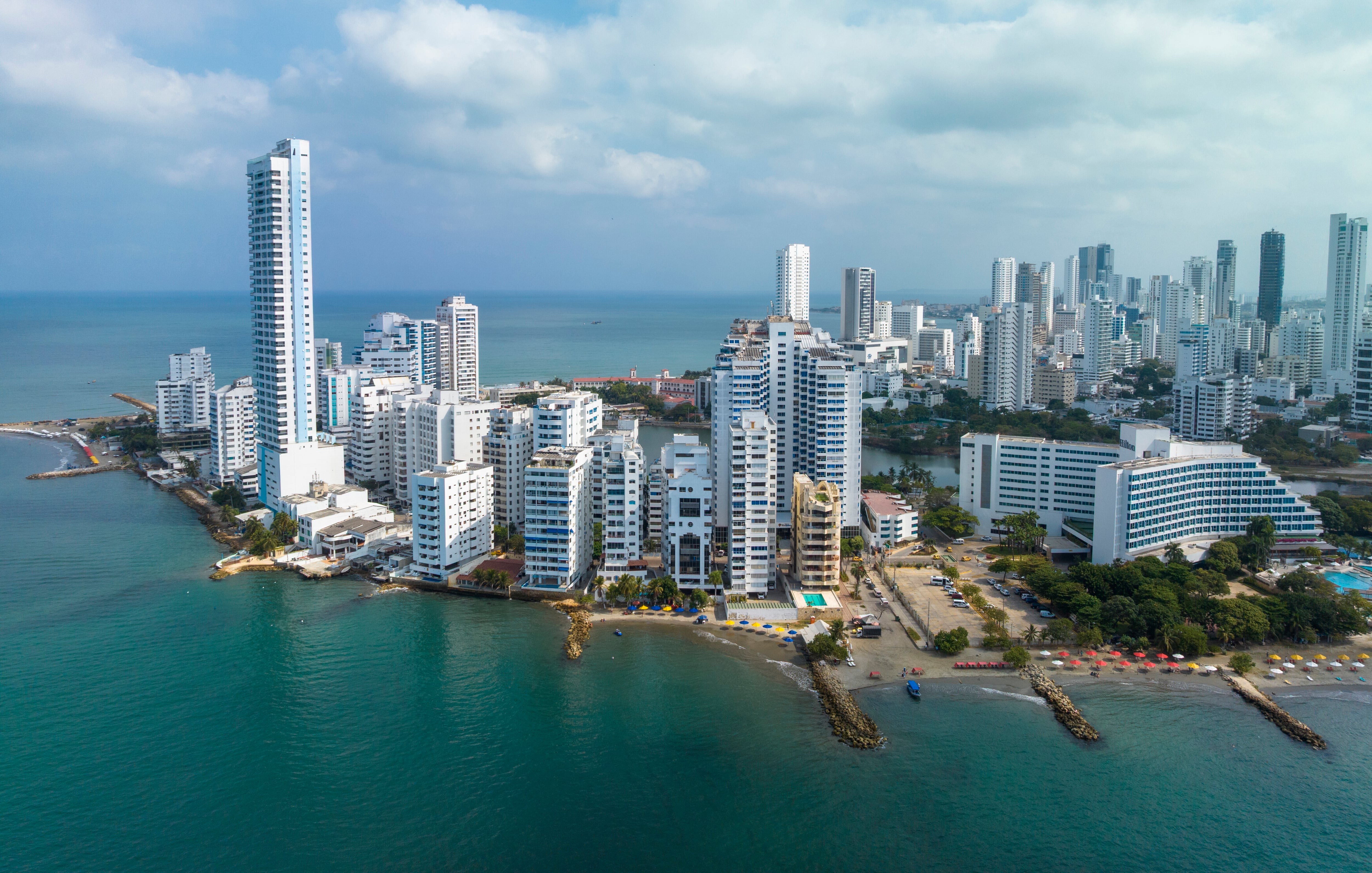
Panoramic view of skyscrapers on the coast of Cartagena, Colombia.
  • ✇El País in English
  • Colombia chooses its next president amid renewed violence Santiago Torrado
    Renewed violence — a kind that has never been fully extinguished in Colombia — marks the presidential campaign to choose Gustavo Petro’s successor. In many places, the first-round vote this Sunday will take place under crossfire. Nearly 10 years after the signing of the historic peace accord with the now-defunct FARC guerrilla organization, other armed actors threaten communities and the war still burns, albeit in a more fragmented phase. The humanitarian consequences of the armed conflict have
     

Colombia chooses its next president amid renewed violence

27 May 2026 at 12:46

Renewed violence — a kind that has never been fully extinguished in Colombia — marks the presidential campaign to choose Gustavo Petro’s successor. In many places, the first-round vote this Sunday will take place under crossfire. Nearly 10 years after the signing of the historic peace accord with the now-defunct FARC guerrilla organization, other armed actors threaten communities and the war still burns, albeit in a more fragmented phase. The humanitarian consequences of the armed conflict have reached “the most serious level of the last decade,” the International Committee of the Red Cross (ICRC) warned this month. Amid that crisis, public security has become one of the main concerns.

Seguir leyendo

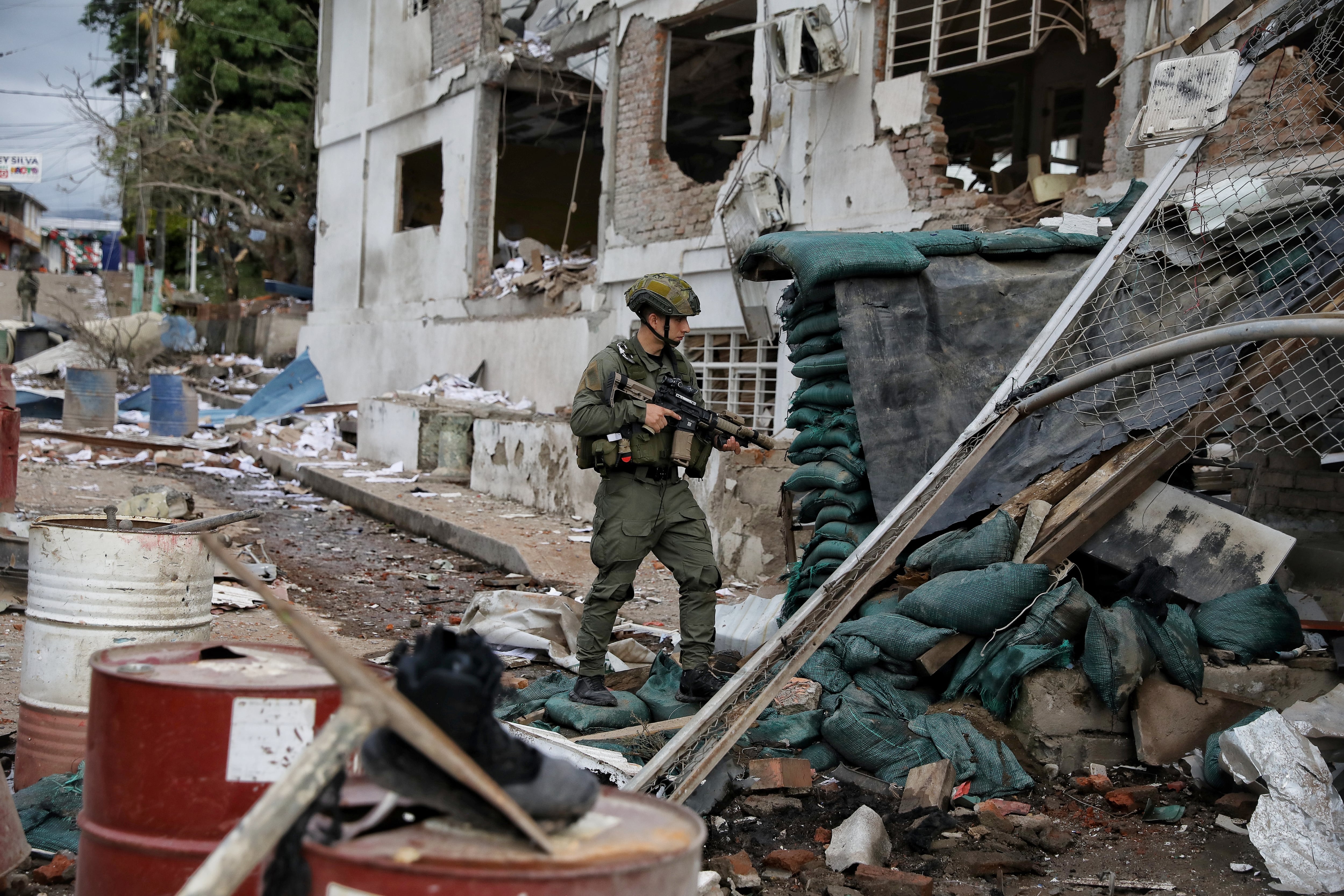
A vehicle loaded with explosives detonated by FARC dissidents on the Pan-American Highway in Cauca on April 29.

© Santiago Saldarriaga (AP Photo/Santiago Saldarriaga)

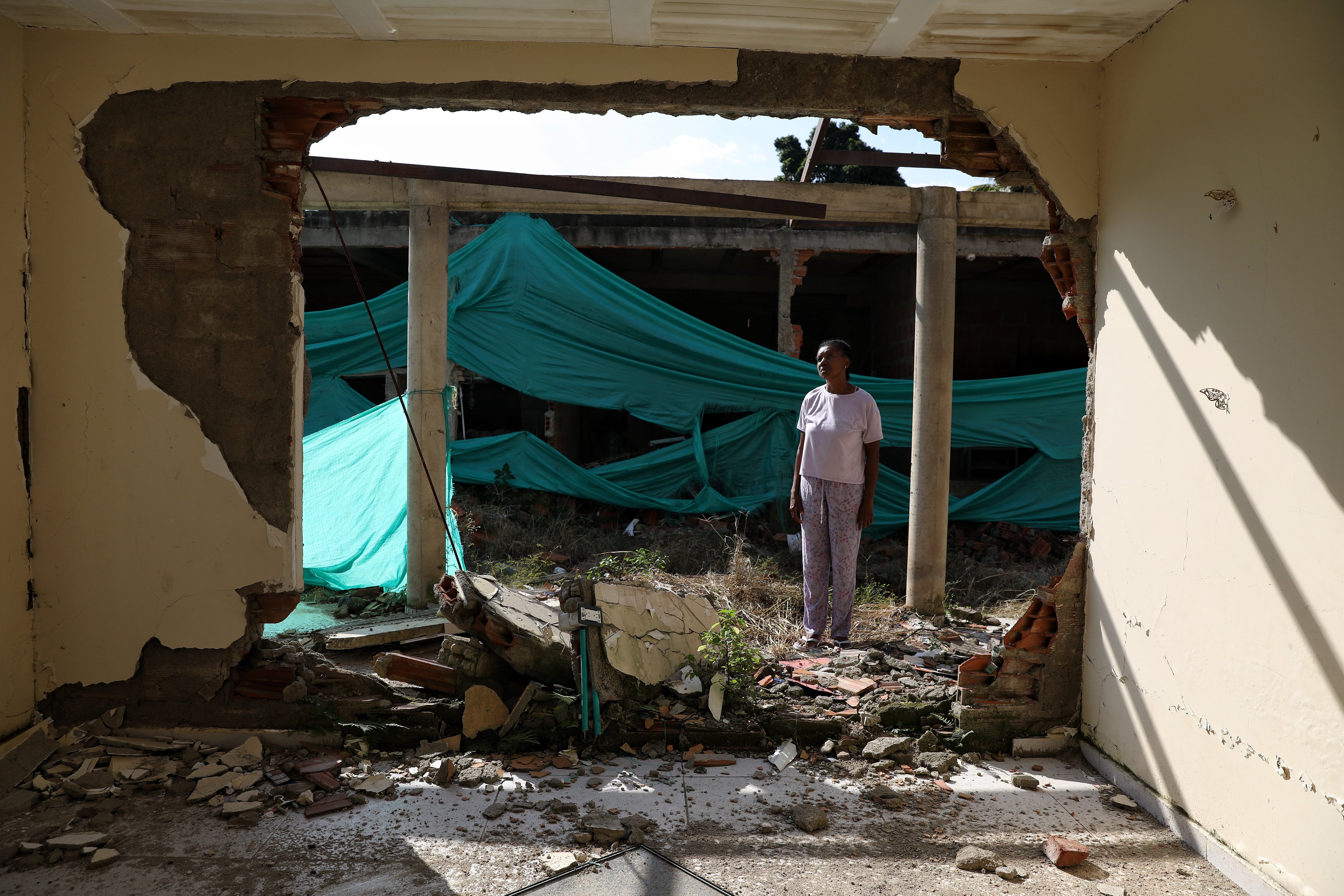
Eucaris Zamora in front of her destroyed home in Robles, May 19.
  • ✇Latin America Reports
  • Colombia presidential candidates announce running mates as race narrows Alfie Pannell
    Bogotá, Colombia – Iván Cepeda and Abelardo de la Espriella, two of the frontrunners to be the next Colombian president, have announced their choices for vice president following Sunday’s legislative elections and presidential primaries. Cepeda selected Aida Quilcué, a senator and Indigenous leader, to join him on the ticket for the left-wing Historic Pact (Pacto Historico), which won the most congressional seats on Sunday. Meanwhile, de la Espriella, a hard-right outsider, announced today th
     

Colombia presidential candidates announce running mates as race narrows

10 March 2026 at 21:21

Bogotá, Colombia – Iván Cepeda and Abelardo de la Espriella, two of the frontrunners to be the next Colombian president, have announced their choices for vice president following Sunday’s legislative elections and presidential primaries.

Cepeda selected Aida Quilcué, a senator and Indigenous leader, to join him on the ticket for the left-wing Historic Pact (Pacto Historico), which won the most congressional seats on Sunday. Meanwhile, de la Espriella, a hard-right outsider, announced today that he will run alongside ex-finance minister José Manuel Restrepo. 

But the big winner in Sunday’s primary, right-wing Paloma Valencia of the Democratic Center (Centro Democrático) party, has yet to announce her running mate amid mounting speculation.

Cepeda sticks to his guns

On Monday, Cepeda formally announced Aida Quilcué as his running mate. A leader of the Nasa Indigenous group, Quilcué has a record as a staunch defender of human rights and as an advocate for ethnic minorities in Colombia.

She was integral to the negotiation of the ethnic chapter of the 2016 peace accord with the Revolutionary Armed Forces of Colombia (FARC) and has been a key figure in Colombia’s Indigenous rights movement. 

Last month, Quilcué made national headlines when she was kidnapped in her home state of Cauca, in the Colombian Pacific, by dissidents of the FARC. 

Miguel Jaramillo Luján, a Colombian political strategist, described Cepeda’s choice of Quilcué as a “symbolic” one which entrenches his stance as an advocate of peace and human rights.

But the analyst also noted that the selection may not be the most politically savvy move: “From an electoral standpoint, I believe that this is a concentric circle and does not add much electoral power to Iván Cepeda, who I think is acting symbolically but overly prideful in this decision,” Jaramillo told Latin America Reports

De la Espriella’s establishment pick

Abelardo de la Espriella, a criminal defense attorney, has styled himself as an anti-establishment political outsider. His traditional values, tough on crime campaign has been successful so far, regularly placing him in second place in presidential polls.

Today, ‘The Tiger’, as he has styled himself, announced his running mate: José Manuel Restrepo.

Restrepo is an economist at the Rosario University in Bogotá and served as President Ivan Duque’s Minister of Finance and Public Credit from May 2021 to August 2022, running the country’s finances during the COVID-19 pandemic. Before that he was Minister of Commerce, Industry, and Tourism beginning in 2018.

“I think the selection of José Manuel Restrepo… represents an attempt to counterbalance de la Espriella, who has no experience in public office,” said Jaramillo.

While de la Espriella is an outsider, he must take on Cepeda and Valencia, both sitting senators since 2014. Restrepo burnishes the criminal lawyer’s bid by adding proven governance credentials.

When announcing his running mate on Tuesday, de la Espriella said: “My choice of vice president was not driven by political calculation… it was clear to me that a renowned academic, an outstanding economist, and a highly qualified former minister and technician will undoubtedly be the best travel companion.”

Paloma Valencia in the spotlight

On Sunday, Paloma Valencia received over 45% of votes in presidential primaries, although Cepeda and de la Espriella were both absent from the contest.

Valencia’s win, as well as her Democratic Center party’s strong showing in legislative elections – winning the second highest number of seats – bolsters her position in the presidential race, according to experts. 

“From the [primaries], it’s clear that Paloma Valencia is the right-wing’s principal candidate,” Sergio Guzmán, director at Colombia Risk Analysis, a political risk consultancy, told Latin America Reports

Before Sunday’s vote, de la Espriella had been dominating conservative polls. Now, it is unclear which conservative candidate will attract the most voters in May’s election.

Whoever emerges as the winner must face off with Cepeda and will be under pressure to  win over centrist Colombians, said Guzman.

One way to achieve this is by selecting running mates with a broader appeal.

Sunday’s primaries highlighted the widespread popularity of Juan Daniel Oviedo, who was on the same list as Valencia and won 17% of the total votes. The former director of the National Administrative Department of Statistics (DANE), Oviedo is considered center-right and notably more moderate than Valencia.

Valencia is under mounting public pressure to pick Oviedo as her running mate, according to Jaramillo, but the two differ on key issues and Oviedo has specified strict conditions for joining Valencia’s ticket.

“We openly show fundamental differences. For example, I believe in peace,” Oviedo told Colombian radio station Caracol on Monday. “You cannot take positions that do not recognize that the [2016 peace] agreement must be implemented and that it requires more than just bullets to get rid of criminals,” he added.

Valencia has staked her campaign on law and order, promising a ‘mano dura’, or ‘iron fist’, against crime and armed groups in Colombia. Her politics follow those of her party’s founder, ex-president Álvaro Uribe, who waged war on the FARC rebels from 2002 to 2010. 

Today, Valencia told Caracol that she will not compromise on this: “I am an Uribista and I have my values and principles… Neither he [Oviedo] will change nor will I change.” 

But Valencia said she remains open to running alongside Oviedo, with the two due to meet today to discuss a possible joint ticket. She is also considering four other possible running mates, according to Colombian newspaper El Tiempo, with her decision due by Friday.

Jaramillo argues the best move for Valencia is not to pick Oviedo, as he is legally bound to support her as they ran under the same list in the primaries.

He believes she should distance herself from Uribe – arguing Uribistas are more likely to back de la Espriella – and instead court the moderate vote by choosing a center-left candidate.

But Guzmán says that is unlikely: “She seems to be going in a different direction.”

Featured image description: Left to right: Iván Cepeda, Paloma Valencia, Abelardo de la Espriella.

Featured image credit: @PactoCol via X / @PalomaValenciaL via X / @ABDELAESPRIELLA via X

The post Colombia presidential candidates announce running mates as race narrows appeared first on Latin America Reports.

  • ✇Latin America Reports
  • Tensions rise as Colombia presidential run-off campaign gets underway Catherine Ellis
    Bogotá, Colombia – A challenge to a public debate, accusations about football shirts used as political symbols, and increasingly sharp exchanges on social media — campaigning for Colombia’s run-off in its presidential election is already underway just a day after Abelardo de la Espriella emerged as the surprise first-round winner. While Senator Iván Cepeda had been widely expected to come out on top and enter the second round in a stronger position, his camp was left disappointed after fallin
     

Tensions rise as Colombia presidential run-off campaign gets underway

1 June 2026 at 23:11

Bogotá, Colombia – A challenge to a public debate, accusations about football shirts used as political symbols, and increasingly sharp exchanges on social media — campaigning for Colombia’s run-off in its presidential election is already underway just a day after Abelardo de la Espriella emerged as the surprise first-round winner.

While Senator Iván Cepeda had been widely expected to come out on top and enter the second round in a stronger position, his camp was left disappointed after falling short of those expectations.

Although he still claimed nearly 41% of the tally, de la Espriella surpassed him by almost three points, coming out with 44%.

Analysts say the run off is wide open. An important factor is supporters of other candidates whose votes are up for grabs. But a decisive factor is also likely to be those who didn’t participate at all in the first round.

“Whoever manages to somehow win over the undecided voters who didn’t vote in the first round but will vote in the second, I think that’s already enough to be president,” political analyst Oscar Chala said.

With three weeks to go until the June 21 elections, the race is on to sweep up those votes, and the candidates haven’t wasted any time in trying to position themselves.

Shortly after the results, Cepeda’s camp alleged irregularities in the vote, although the candidate backtracked the next day, saying they were not significant.

He also criticised the wearing of Colombian football shirts as part of political campaigns, linking it to de la Espriella’s far right movement — and also challenged him to a public debate, something he had not previously participated in.

“Cepeda is now inviting and wanting to hold a debate when he had always avoided it. That is a sign of desperation,” Rubén Erazo, political consultant, told Latin America Reports.

Although de la Espriella accepted the debate — which will be held on Tuesday June 9 — he also called his rival a “coward” and accused his campaign of hiding behind Petro.

Despite the disappointing result for Cepeda, he gained roughly what polls had been predicting — even marginally higher. Yet analysts say he struggled to win over undecided and abstentionist voters and lacked a solid and coherent campaign.

“The failures of Cepeda’s campaign are that Cepeda is not himself the candidate. The candidate is the current president Petro,” political consultant Rubén Erazo said, referring to this election being more like a referendum on Petro’s legacy.

He said this incorporates “the good, the bad, and the ugly” of his presidency. While he expanded social programmes, other policies, such as opening ambitious negotiations with armed groups, were highly controversial. Those dissatisfied with what Petro stands for are likely to be against Cepeda.

Despite knockbacks, Erazo says this doesn’t mean it is game over for the senator and Petro ally.

“Cepeda could win as long as his team reorients his strategy, acknowledges mistakes, thinks calmly and does not focus solely on claiming fraud,” he said.

The race is still very much open — and analysts say anything could happen, and that a lot will depend on where they target their political energy.

“Cepeda is likely to move closer to the centre and Abelardo could become more radical. The strategy Abelardo will use to try to win is to radicalize his discourse because he knows that Iván Cepeda will start seeking centrist votes,” Chala said.

He believes Espriella will also target an abstentionist segment on the right, even further right than traditional right-wing establishment figures such as Paloma Valencia, who once polled above 20% but ultimately secured just under 7%.

This part of the electorate is conservative, often macho, and wants hardline security strategies and more investment in the country.

De la Espriella was the main candidate able to capitalize on this as well as anti-Petro sentiment, and is expected to continue drawing support from parts of Valencia’s former base.

“However, his discourse is very anti-establishment and he’s not seeking the support of political parties,” Chala explained.

Nevertheless, Paloma Valencia — and her mentor, former president Álvaro Uribe — have come out in support of de la Espriella. Her relevance is not yet completely diminished if she can convince those who supported her to shift to this camp.

Moreover, while Cepeda took a backseat in his own campaign and drew heavily on traditional strategies such as mass gatherings and marches, Espriella, as well as doing this, drew heavily on crafting his own image — calling himself “The Tiger”.

“Everything is exaggerated and trying to inspire: the planes, the Italian suits from when he was a lawyer, and even his image of advising controversial figures,” he said. “Even the beard, for example, is copied from Nayib Bukele. It’s the same style.”

De la Espriella is plainly anti-establishment and aligns himself with Nayib Bukele, Javier Milei and Donald Trump. That appeals to some of the electorate, and repels another part.

At this stage, both candidates are still very much in this race, with everything to play for.

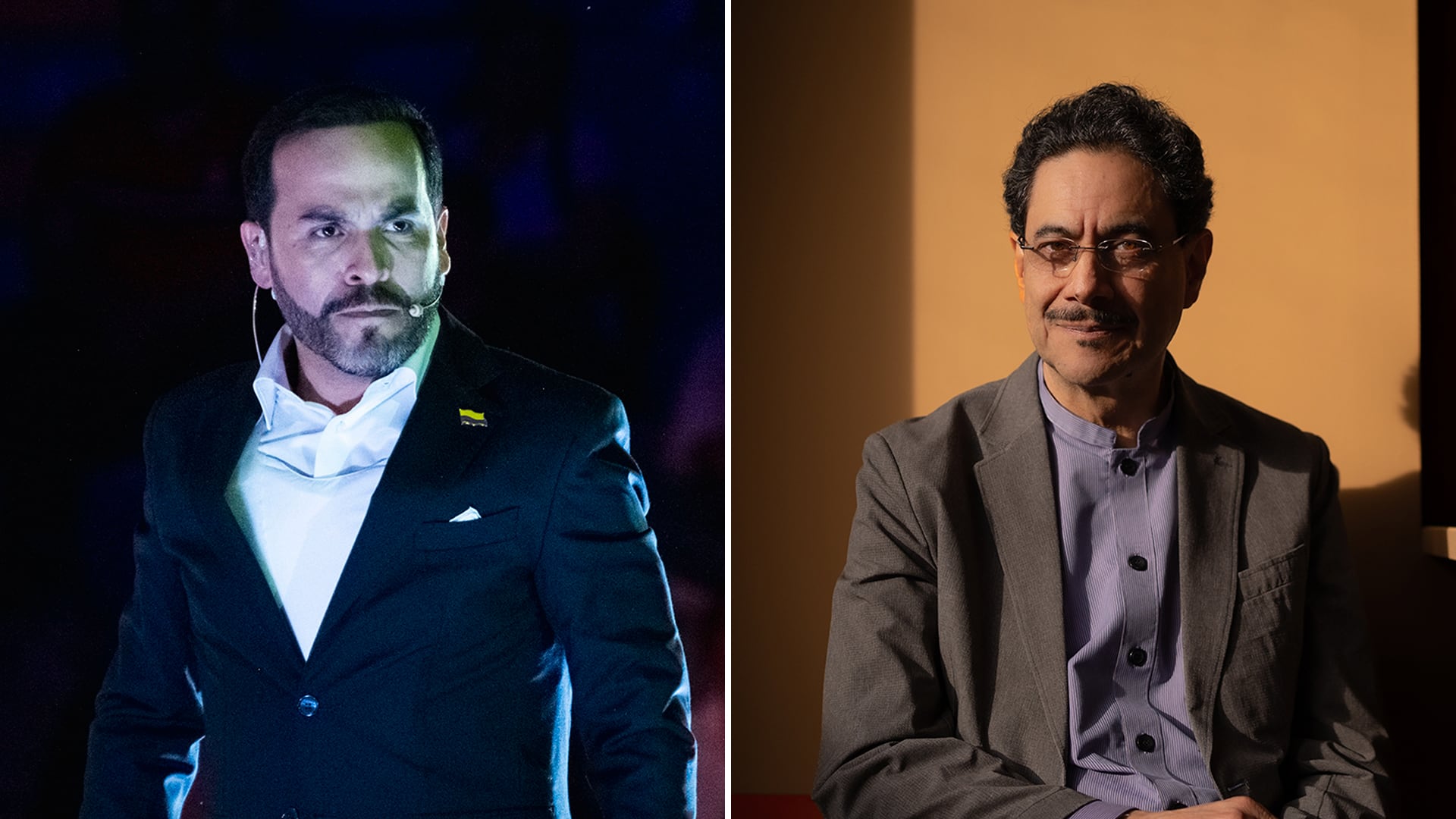
Featured image description: Iván Cepeda (Left) and Abelardo de la Espriella (Right).

Featured image credit: Respective campaigns.

The post Tensions rise as Colombia presidential run-off campaign gets underway appeared first on Latin America Reports.

Colombian presidential candidate thanks Trump for support

3 June 2026 at 19:29
Right-wing Colombian presidential candidate Abelardo De La Espriella on Wednesday thanked President Trump for his support after De La Espriella won the most votes in the initial round of elections. De La Espriella's message of thanks to the U.S. president included an AI-generated image of a bald eagle next to a tiger, with the eagle...

In Colombia, De la Espriella and Cepeda head to a runoff as Petro questions the results

1 June 2026 at 06:49

Colombia will hold a presidential runoff between two candidates who embody irreconcilable visions for the country. Abelardo de la Espriella, the ultraconservative lawyer who ran as the outsider promising to break with everything, won the first round with 43.7% of the vote, with 99% of polling stations counted. Iván Cepeda, the candidate of the governing left, received 40.9%.

Seguir leyendo

Abelardo de la Espriella arrives at his polling station in Barranquilla this Sunday, May 31.Iván Cepeda, at his polling station in south Bogotá, this Sunday, May 31.

💾

© EPV

Abelardo de la Espriella and Iván Cepeda.

Trump expresses ‘total endorsement’ of Colombia’s far-right presidential candidate Abelardo de la Espriella

3 June 2026 at 10:03

It took a while, but the endorsement that Colombia’s far-right presidential candidate Abelardo de la Espriella was most eagerly awaiting has finally arrived. U.S. President Donald Trump expressed his support for him on Tuesday via his social media platform, Truth. And he did so in the most effusive way possible: “Congratulations to Colombian presidential candidate El Tigre, Abelardo de la Espriella, a smart, strong, and tough leader, on his decisive victory in the first round of Colombia’s presidential election,” the Republican celebrated in his message.

Seguir leyendo

© AGENCIAS

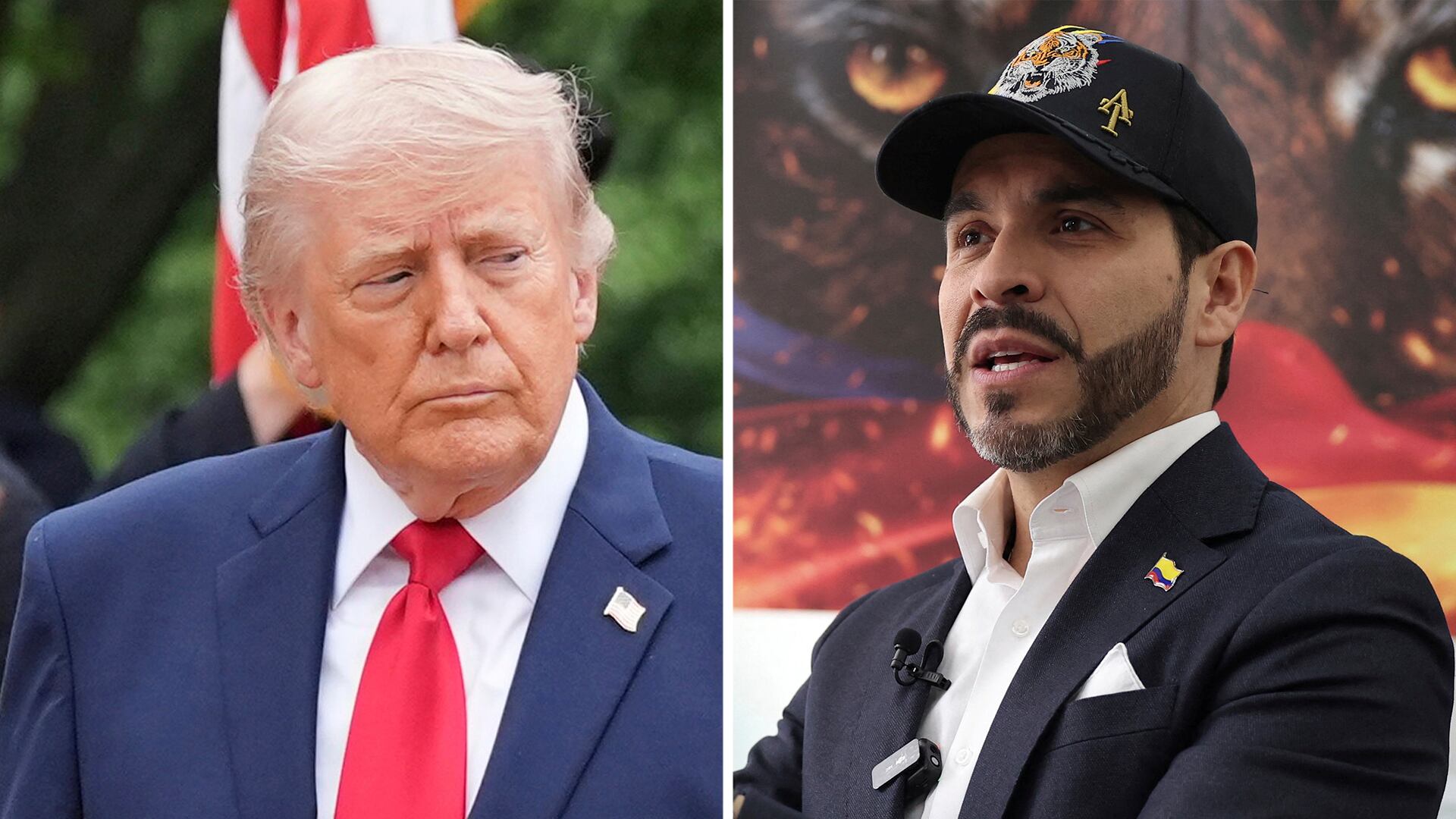
Donald Trump and Abelardo de la Espriella.
  • ✇El País in English
  • Four intractable crises facing Colombia’s next president María Martín
    In Catatumbo, a region on the border with Venezuela, women have been giving birth at home for months. It is not for lack of hospitals but because they are afraid to take the roads and get caught in the crossfire between two guerrilla groups. Babies take months to be registered, farmers fear stepping on mines, and children hide when they see drones flying overhead laden with explosives. Those who stayed do not venture out and live locked up as if during a pandemic. Those who could leave fled, and
     

Four intractable crises facing Colombia’s next president

29 May 2026 at 09:39

In Catatumbo, a region on the border with Venezuela, women have been giving birth at home for months. It is not for lack of hospitals but because they are afraid to take the roads and get caught in the crossfire between two guerrilla groups. Babies take months to be registered, farmers fear stepping on mines, and children hide when they see drones flying overhead laden with explosives. Those who stayed do not venture out and live locked up as if during a pandemic. Those who could leave fled, and the region has lost nearly 100,000 residents over the past year. “We are not part of this war, but we are in it,” a community leader told EL PAÍS, fearing he could be killed. This Sunday, Colombia holds the first round of its presidential elections. It does so with that war in the background, and with three other deep wounds that no candidate has fully explained how they intend to heal.

Seguir leyendo

© Santiago Saldarriaga (AP)

A soldier walks through an area attacked by FARC dissidents in Buenos Aires (Colombia), in 2025.

Iván Cepeda enters final stretch of presidential campaign with no money and Petro on his heels

Iván Cepeda begins his second week heading into the presidential runoff with no money and time running out. His campaign team, deployed across several regions of the country for the final push, is convinced that the race will be decided in two cities: Bogotá and Barranquilla. The ruling party candidate has renewed his bet on social media: he now appears in more personal videos with voters, painting murals and even playing soccer. And he has the math clear: he needs at least 2.5 million additional votes to overtake his opponent Abelardo de la Espriella and cross the threshold into the Casa de Nariño presidential residence.

Seguir leyendo

© Ivan Valencia (AP Photo/Ivan Valencia)

Iván Cepeda in Bogotá, June 7, 2026.
  • ✇Latin America Reports
  • Colombia president rejects preliminary election results Alfie Pannell
    Bogotá, Colombia – President Gustavo Petro rejected the results of first-round presidential elections on Sunday, alleging irregularities. Hard-right populist Abelardo de la Espriella defied pollsters’ predictions to beat the candidate representing Petro’s leftist Historic Pact party, Iván Cepeda, although neither surpassed the 50% required to win outright. “The so-called count being transmitted is not legally binding. Its data is not considered official. As president, I do not accept the r
     

Colombia president rejects preliminary election results

1 June 2026 at 01:46

Bogotá, Colombia – President Gustavo Petro rejected the results of first-round presidential elections on Sunday, alleging irregularities.

Hard-right populist Abelardo de la Espriella defied pollsters’ predictions to beat the candidate representing Petro’s leftist Historic Pact party, Iván Cepeda, although neither surpassed the 50% required to win outright.

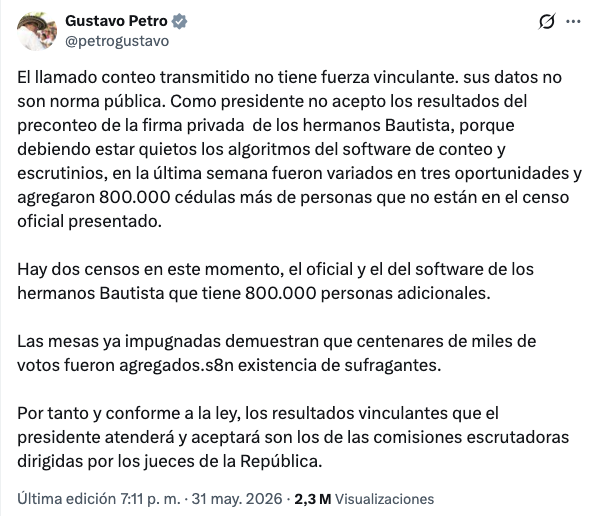
“The so-called count being transmitted is not legally binding. Its data is not considered official. As president, I do not accept the results of the preliminary count,” wrote Petro on X shortly after the election was called.

In Colombia, the “pre-conteo”, or preliminary count, is based on officials tallying the ballot sheets and entering them into an online software. But the “escrutinio”, or scrutinized results, usually take several days to be announced and are ratified by judges.

According to the Registrar’s Office, which is responsible for overseeing the voting process, the pre-count is “for informational purposes only” and has “no legal standing.”

But de la Espriella received nearly 700,000 more votes than Cepeda, a gap which is very unlikely to be closed after the scrutiny.

Delivering a speech after the results were released, Cepeda said he would not address the elections until the scrutinized count came out.

A post from President Gustavo Petro on May 31 saying he would not accept the pre-count results of Sunday’s elections.

“Only once the vote-counting committees have fully, clearly, and thoroughly clarified this matter will we comment on tonight’s results,” the senator told a crowd of supporters at the Hotel Tequendama in central Bogotá.

He also referred to historic efforts by Colombia’s traditional parties and institutions to repress the leftist movement embodied by the Historic Pact: “Our life has been a constant struggle.”

A crowd of Cepeda voters gathered nearby to watch the speech on a large screen, with some chanting the Spanish anti-fascist slogan “No Pasarán”. One pair held a sign reading “Fraud!”.

Petro has repeatedly warned that the elections may be stolen, part of a long-running dispute with Thomas Greg & Sons, a multinational company responsible for electoral logistics.

In 2022, the Historic Pact gained some 500,000 votes in legislative elections following the scrutiny.

Regardless of the final results of the election, Cepeda and de la Espriella are set to face off in a second round on June 21.

Featured image description: President Gustavo Petro at a cabinet meeting, October 22, 2025.

Featured image credit: @InfoPresidencia via X.

The post Colombia president rejects preliminary election results appeared first on Latin America Reports.

In the final stretch of Colombia’s presidential campaign, undecided voters are in high demand

Legislative election day in Bogotá, Colombia, March 8.

Just days remain until the first round of Colombia’s presidential election on May 31, and millions of citizens still haven’t decided which of the 12 candidates to vote for.

Seguir leyendo

  • ✇El País in English
  • De la Espriella’s and Cepeda’s paths to Colombia’s presidential runoff run through abstainers Juan Lewin
    Abelardo de la Espriella’s unexpected victory over Iván Cepeda on Sunday, in the first round of Colombia’s presidential election, shows that right‑wing voters are now almost entirely united behind the penal lawyer, while left‑wing voters are fully consolidated behind the senator. The 653,000‑vote margin the far-right candidate held over the senator seems small in an election where 24 million people cast a vote and more than 3 million voted for other candidates. The challenge for the runoff would
     

De la Espriella’s and Cepeda’s paths to Colombia’s presidential runoff run through abstainers

2 June 2026 at 09:35
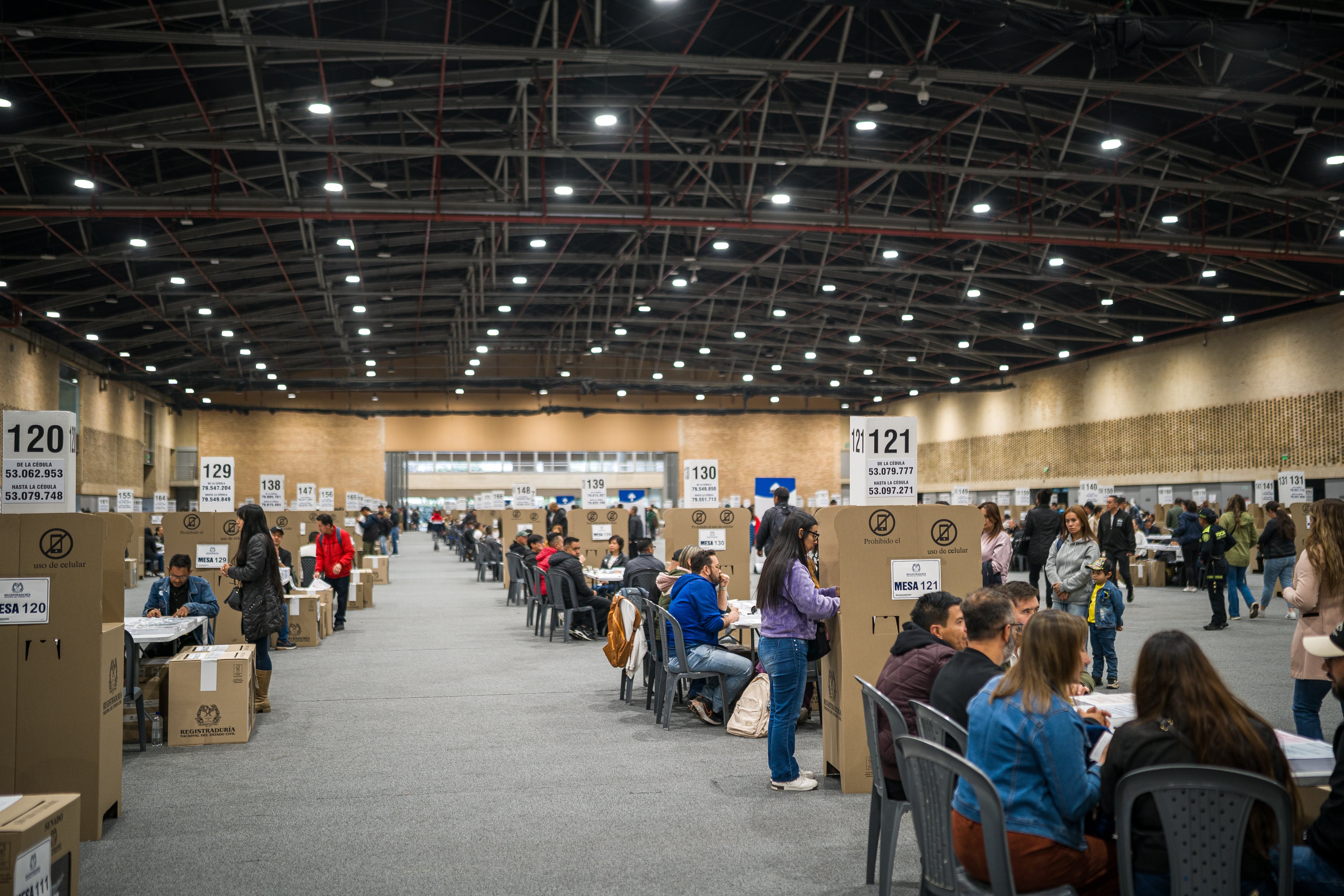
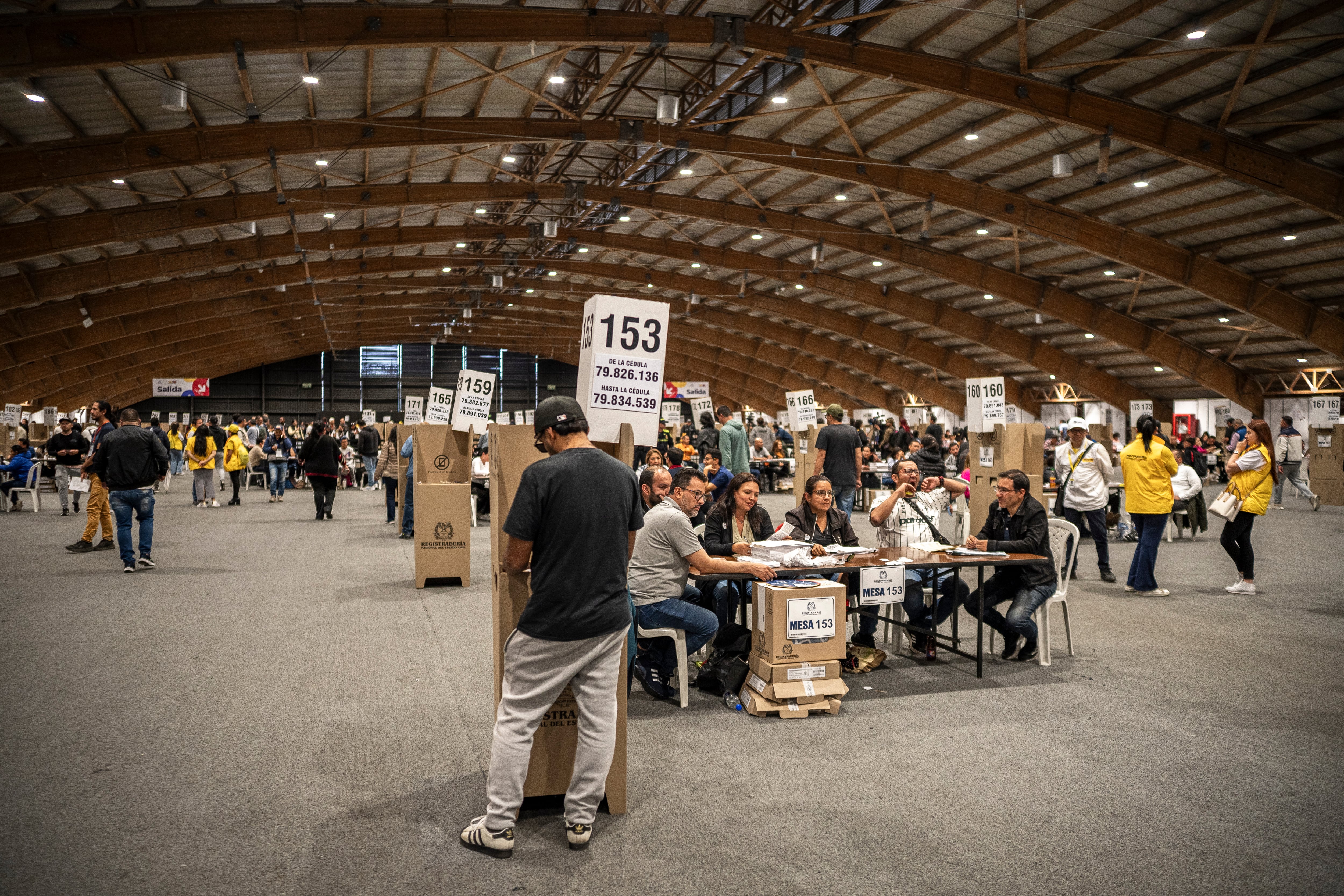
Voting stations at Corferias during election day in Bogotá this Sunday.

Abelardo de la Espriella’s unexpected victory over Iván Cepeda on Sunday, in the first round of Colombia’s presidential election, shows that right‑wing voters are now almost entirely united behind the penal lawyer, while left‑wing voters are fully consolidated behind the senator. The 653,000‑vote margin the far-right candidate held over the senator seems small in an election where 24 million people cast a vote and more than 3 million voted for other candidates. The challenge for the runoff would appear to be persuading those voters — but given the candidates’ profiles and recent history, the path necessarily also runs through the mobilization of people who did not go to the polls on Sunday.

Seguir leyendo

❌
Subscriptions