
Normal view

  • ✇SoraNews24 Japan
  • Japan’s instant ramen snack theme park features an athletic course even adults can enjoy Elliot Hale
    Sample ramen pizza, alongside other limited-edition items to pick up, or just make your own treats. Snacks in Japan come in all sorts of shapes and sizes, from ever-feuding mushrooms and bamboo shoots to make-your-own sweets, but one that I see fairly often in the hands of little children are packets of Baby Star Ramen. A popular snack made of deep-fried, crunchy, bite-sized pieces of instant noodles, Baby Star Ramen came about in 1959 when the founder of Oyatsu Company realized that the broke
     

Japan’s instant ramen snack theme park features an athletic course even adults can enjoy

23 May 2026 at 05:00

Sample ramen pizza, alongside other limited-edition items to pick up, or just make your own treats.

Snacks in Japan come in all sorts of shapes and sizes, from ever-feuding mushrooms and bamboo shoots to make-your-own sweets, but one that I see fairly often in the hands of little children are packets of Baby Star Ramen. A popular snack made of deep-fried, crunchy, bite-sized pieces of instant noodles, Baby Star Ramen came about in 1959 when the founder of Oyatsu Company realized that the broken noodle fragments left at the bottom of instant noodle production lines could actually be seasoned and packaged up as a snack by themselves.

The Oyatsu Company factory is located in Tsu, Mie, and while factory tours are currently suspended, for those who want to dive into the world of Baby Star, right next door is Oyatsu Town, a theme park offering everything from a giant athletic course to making original Baby Star Ramen, as well as limited-edition food you can only eat there, resulting in an enjoyable experience for child and adult alike.

▼ Sadly, no factory tours are currently available.

Our Japanese-language reporter Natsuno Futon visited the theme park with her kids in tow during Golden Week, one of Japan’s busiest periods for travel and day excursions, so upon arriving and noting that same-day entry was limited until after lunch, it wasn’t too unexpected. So, Natsuno’s first recommendation for any future visit is to always reserve your entry tickets in advance, particularly if you plan to go on a weekend or holiday.

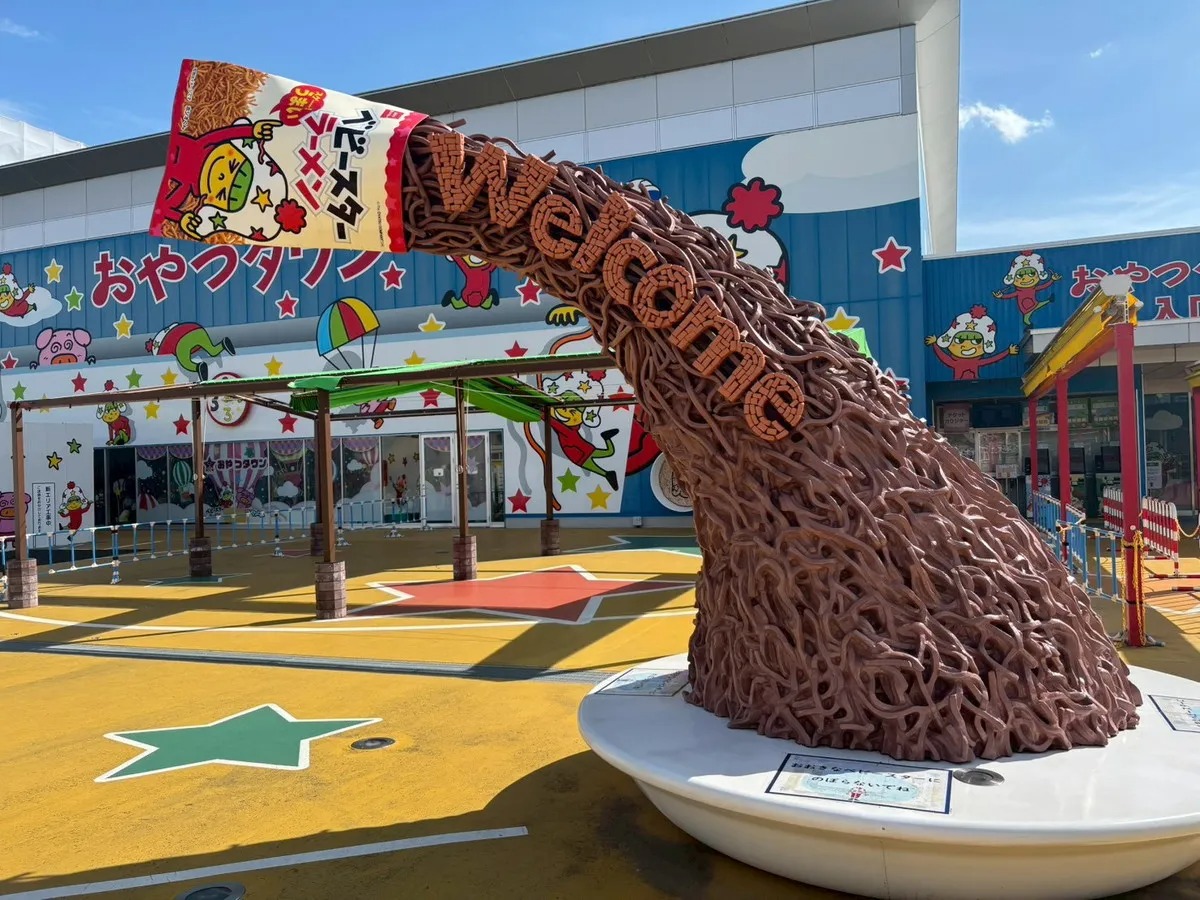
Arriving at the entrance, the first thing to welcome Natsuno and her family was a giant Baby Star photo spot, appearing as if Baby Star was flowing like a waterfall, along with a spot where you could get inside a Butamen cup, Oyatsu Company’s line of instant cup noodles, adorned with designs of Hoshio-kun, the Baby Star Ramen mascot.

Peak season entry is 2,500 yen (US$15.70) for adults, whereas it drops down to 2,200 yen during the Regular days, and 1,600 yen for the Value days.

It’s best to check the company website for absolute clarity, but the general rule seems to be Saturday through Monday is Regular, Tuesday through Friday is Value, and national holidays like Golden Week in May and Obon in August are Peak.

▼ Natsuno couldn’t help but take one last look at the factory, as she really enjoys factory tours, but it sadly wasn’t to be.

Stepping inside, Natsuno was greeted with the company’s history spread out on the floor, designed almost like a board game.

It was quite interesting to learn that the name change to Oyatsu Company was an unexpectedly recent development.

▼ Not at all spoken through the pitch-black sunglasses of denial: 1993 is still very recent.

Proceeding further inwards, a giant athletic area appears, teeming with the Golden Week crowd of people.

While as an adult, Natsuno tends to curb her childhood playfulness and instead let her children loose to gallivant through play areas, she couldn’t quite restrain herself from wanting to join in on the fun. Looking around, she could even see many adults playing there quite seriously, so she embraced her inner child and entered the play equipment.

Among them, what was particularly enjoyable was the Hoshio-kun Giant Slide, which gets quite a bit of speed.

▼ They’re even considerate enough to provide wrap-around skirts to make sliding even more speedy.

The Super Giant Butamen-kun Adventure and Giant Jungle Gym are also extremely fun.

Since you walk on the net, the stimulation to the soles of your feet is amazing, nearing the level where you might mistake it for a minor piece of health equipment.

▼ Natsuno is still a child at heart, she promises.

The most popular one, though, is the giant athletic course consisting of three whole floors, which are divided by height; the first floor is for small children, but the second and third floors offer up more of a challenge.

Natsuno ventured up to the third floor together with her children but had to retire halfway through for a very specific reason: her sweaty hands.

It’s a little difficult to see in the image below, but this is a course where you have to move forward while moving around the outside of orange bars that bulge outward.

With hands that get particularly sweaty, Natsuno could just foresee herself slipping off due to them. Yet, because she wanted to show her children an inspirational figure that takes on challenges even in the face of adversity, plus it was too frustrating to just give up, she attempted it a second time and cleared it safely. However, she later heard from her children, “since we were moving ahead of you, we couldn’t see you.” Sad though she was, she still felt a sense of accomplishment, so it wasn’t all bad.

▼ There is even a section of the park dedicated to interactive digital content that kids can have fun with.

Next, the family moved on to the experience of making Baby Star at Hoshio-kun Kitchen, where you can make your very own original Baby Star Ramen.

For an additional 1,000 yen each to the park entrance fee, the children challenged the “My Special Baby Star,” where you can choose your favorite flavor from several types, season it yourself, and then have the staff bake it for you in the oven.

Natsuno had reserved in advance, but there seemed to be sufficient availability that you could even reserve on the day itself.

After completing the ramen, you put stickers on the original container, though her children instead opted to put on only a few, saving the rest for later to add to their sticker collection albums.

The family came away from the experience with the children beaming with happiness and proud faces for their new creations.

However, being hungry, they decided to swing by Baby Star Dining, where you can savor original foods using Baby Star, such as Baby Star Katsu Curry.

Among them all, Natsuno can personally recommend the pizza, particularly the limited-time Pink Butamen Gratin Pizza, being a lot more authentic than expected.

It’s baked in a pizza oven, so you get that classic pizza base texture, and the pink coloring is added via beetroot instead of food coloring.

The appearance certainly has quite the impact, referencing Butamen and its pig mascot, but the taste has no unexpected quirks and is extremely delicious.

▼ The Ramen Pizza was also full of ingredients and highly satisfying.

Of course, you can eat freshly-fried Baby Star Ramen.

At the gift shop Oyatsu Marche, limited-edition products and character goods are lined up, with Natsuno being drawn to all of the Butamen goods. He just has such a charming presence…

Natsuno also discovered Baby Star limited to Oyatsu Town, this time purchasing the Spiny Lobster Flavor (850 yen for a pack of six), and found it to have a very strong shrimp taste, both rich and delicious.

There was also a cute, little steel suitcase-like container that you could stuff your favorite Baby Star flavors into for just 1,700 yen.

Before walking through the doors, Natsuno had assumed she would be entering a facility designed just for children, but she ended up, even as an adult, enjoying it with all her might.

In the end, from their 10:30 a.m. start, they stayed fully until the closing time at 5:00 p.m., staying more than six hours. With the addition of a new area opening in Spring 2027, there will be even more to get lost in, although prospective visitors should take note that the park will be closed from January 12, 2027, to prepare for this new opening.

Whether you visit with kids or not, it’s all but guaranteed you’ll have a great time exploring Oyatsu Town, just remember to book in advance on the weekends and holidays.

Location information
Oyatsu Town / おやつタウン
Address: Mie-ken, Tsu-shi, Mori-cho 1945-11
三重県津市森町1945-11
Open: 10:00 a.m.–3:00 p.m. (Tuesday–Friday), 10:00 a.m.–4:00 p.m. (Saturdays and Mondays), 10:00 a.m.–5:00 p.m. (Sundays) However, times can change, so check the website for up-to-date information
Closed: Irregular Days
Website

Photos ©SoraNews24

● Want to hear about SoraNews24’s latest articles as soon as they’re published? Follow us on Facebook and Twitter!
  • ✇SoraNews24 Japan
  • Let’s hike a Japanese mountain (that isn’t Mt. Fuji) – Mt. Tsukuba[Photos] Casey Baseel
    A beautiful, highly customizable hike that’s an easy day-trip from Tokyo. We’re finally in that not-too-cold, not-too-hot sweet spot of spring weather in Japan, providing a prime window for all sorts of outdoor activities. While “climb Mt. Fuji” might be the one that most quickly comes to mind for travelers in Japan, the country’s tallest mountain won’t be open to hikers until midsummer, but today we’re taking a look at a different great mountain to hike that’s doable as a day trip from Tokyo.
     

Let’s hike a Japanese mountain (that isn’t Mt. Fuji) – Mt. Tsukuba[Photos]

16 May 2026 at 05:00

A beautiful, highly customizable hike that’s an easy day-trip from Tokyo.

We’re finally in that not-too-cold, not-too-hot sweet spot of spring weather in Japan, providing a prime window for all sorts of outdoor activities. While “climb Mt. Fuji” might be the one that most quickly comes to mind for travelers in Japan, the country’s tallest mountain won’t be open to hikers until midsummer, but today we’re taking a look at a different great mountain to hike that’s doable as a day trip from Tokyo.

Mt. Tsukuba is located in the town of Tsukuba, Ibaraki Prefecture. With a height of 877 meters (2,877 feet), it offers some great views from the top, but it can also be a safe, manageable hike even if you’re not a hard-core alpinist. As proof, our Japanese-language reporter Natsuno Futon, who readily admits to not doing a whole lot of exercise these days, recently headed out to Mt. Tsukuba with her two elementary school-age daughters to hike one of its trails.

There are a number of different routes you can take to the top of Mt. Tsukuba, but today we’ll be following along on Natsuno’s trek up the Otatsuishi Trail. You can get on the trail from the Tsutsujigaoka Parking Area, which itself can be reached in about two hours from downtown Tokyo, first by taking the Tsukuba Express train from Akihabara Station to TX Tsukuba Station, and from there a series of shuttle buses to the Numata, Tsukubasan-jinja Iriguchi, and finally Tsutsujigaoka bus stops, with 45 minutes spent on the train and a total of about 50 minutes on the buses (alternatively, if you’re arriving by car, you can just drive to the Tsutsujigaoka Parking Area and pay to park in the lot).

Natsuno rolled up at around 11:40 a.m. on a holiday. The parking area is already at an altitude of about 500 meters, so you’re starting off part-way to the top.

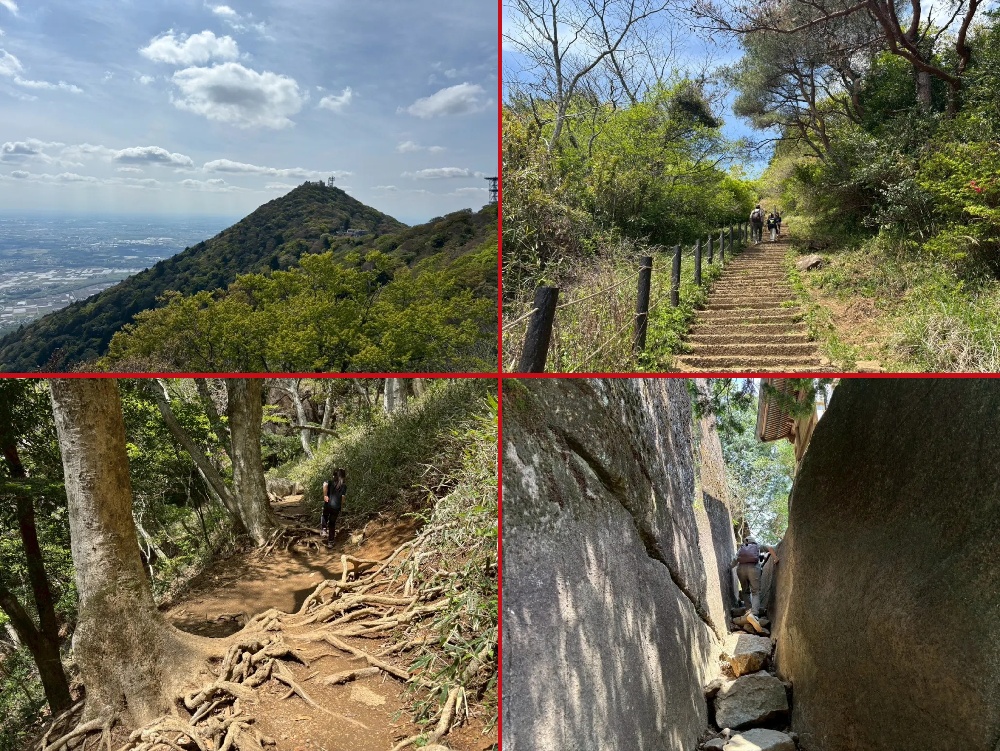
The early section of the trail is a series of paved steps, and less than five minutes after they’d started the hike, they were already being rewarded with beautiful scenery like this.

After about 15 minutes of walking, the paved steps had stopped and the course had turned into a genuine trail. Natsuno’s youngest, a first-grader, said “I’m tired” for the first time since they’d set out, so they stopped for short break, then continued on after she’d recharged.

Mt. Tsukuba has a reputation as being a beginner-friendly hike, but you’ll still want to wear proper hiking shoes and watch your step. At around 12:20, Natsuno passed through this section of trees with exposed roots stretching across the path…

…and this rocky section felt as much like an obstacle course as it did a hiking trail.

At 12:30, they reached a rest area at on overlook beside the trail. Long ago, this used to be the site of a teahouse, called the Benkei Chaya, and it’s still a place for those walking the trail to stop and rest their feet, though you’ll need to bring your own snacks or drinks to enjoy.

After a 10-minute breather and some munchies, Natsuno was on the move again.

Mt. Tsukuba has a unique shape, with essentially two peaks with a recessed plateau between them. The Nyotaisan, or “Female Peak,” is the higher of the two (877 meters versus the Nantaisan/”Male Peak’s” 871 meters), so when Natsuno’s group came to a fork in the trail, they took the path headed for the Nyotaisan.

▼ 女体山頂 = Nyotaisan peak

One of the cool things about the Otatsuishi Trail is how many different scenic spots there are along the way. For example, there’s the Benkei Nanamodori.

A narrow section of the trail where a large boulder wedged between the tops of two other creates a tunnel-like structure, this was once said to be a gateway between the world of the gods and the world of humans, and Natsuno felt a spark of adventurous excitement as they passed through it.

At 12:43, they reached a section of the trail called Takamagahara, after the “high plain of the heavens” where the sun goddess Amaterasu and other Shinto deities reside.

▼ There’s a shrine dedicated to Amaterasu here (you can see part of its roof in this photo).

10 minutes later they came upon the Kuniwari Ishi, or “Kingdom-splitting Rock,” where legend has it the gods drew lines upon the stone to determine who would have dominion over which parts of the realm.

And at 12:55, they found themselves at Debune Irebuni, “Ships Coming and Going,” a rock formation that resembles two boats passing by each other, and so a place of worship of Funadama no Kami, the patron deity of ships and sailors.

It had been an hour-plus of consistent ascents up to this point, but from here Natsuno got a slight reprieve as the trail sloped back down for a section. However, while she wasn’t having to work herself up and over rocks for a while, she still had to be mindful of her footing, since a slip here would mean a nasty tumble.

Up until now, Natsuno and her group hadn’t encountered many other people on the trail, but a posted sign said that as they got closer to the peak, things might get more crowded. From the point where they were now, it was usually only another 20 minutes or so to get to the top, but during congested times, it could take as much as four times as long.

Luckily, things that nearly so severe on this day. As the terrain got super rocky, though, almost like the mountain was giving Natsuno a final test, the slower speed at which hikers could progress did end up causing a bit of a traffic jam right before the peak.

Another part of the reason for this line, though is that people were waiting patiently to take photos at the top of the mountain, which Natsuno’s group got to at 1:24 p.m., about an hour and 40 minutes after they’d started hiking.

Taking in the breathtaking view and caressed by the cool breeze, Natsuno felt a sense of accomplishment, and her kids had managed the hike pretty well too, even if the youngest had said along the way, more than once, “I’m tired.”

Now, from here you could get back down simply by turning around and waking back the same way you came, or by taking one of the other trails to the bottom. There is, however, a third option, which is to take the ropeway gondolas that run between the peak and the Tsutsujigaoka Parking Area, and in deference to her younger daughter’s sagging energy level (and maybe her own), Natsuno made the decision to ride the ropeway back.

The ropeway station is next to a lookout area with tables and benches, where Natsuno spotted a few well-prepared groups having picnic lunches.

The view from here is amazing too, whether you’re appreciating it with the naked eye or using the coin-operated binoculars.

▼ You can also see the slightly lower Nantaisan peak from here.

The ropeway runs between 9:20 a.m. and 5 p.m., and the ride takes a little under 10 minutes.

At 2:23, Natsuno’s group was back at the Tsutsujigaoka Parking Area, where they rewarded themselves for their hike to the summit with some meat-wrapped rice balls on a stick and fried chicken cutlets.

▼ Mountain climbing is hungry work, after all.

Though Natsuno’s group took around an hour and 40 minutes to hike their way up, serious adult hikers can do the Otatsuishi Trail ascent in about 40 minutes, so walking it both ways, up and down, is still a very doable day trip. There are also longer trails that start lower on the mountain, plus one that connects the mountain’s two peaks, which are about 35 minutes apart on foot. All of that makes Mt. Tsukuba a very customizable hike, and a great way to get a taste of mountain trekking in Japan.

Related: Mt. Tsukuba official website, Mt. Tsukuba Cable Car and Ropeway official website
Photos ©SoraNews24
● Want to hear about SoraNews24’s latest articles as soon as they’re published? Follow us on Facebook and Twitter!

❌
Subscriptions