
Normal view

  • ✇Latin America Reports
  • Mexico boosts security after pyramid attack but plays down shooting risks Alfie Pannell
    Bogotá, Colombia – Mexican authorities have said they will tighten security around tourist sites following a shooting on Monday that killed a Canadian tourist and injured twelve others. The attack at the Teotihuacan pyramids by a lone gunman has renewed concerns about fan safety ahead of the 2026 World Cup Games, which will be co-hosted by Mexico.  But Mexican President Claudia Sheinbaum sought to re-assure visitors, maintaining that mass shootings are rare in the country and describing th
     

Mexico boosts security after pyramid attack but plays down shooting risks

23 April 2026 at 14:19

Bogotá, Colombia – Mexican authorities have said they will tighten security around tourist sites following a shooting on Monday that killed a Canadian tourist and injured twelve others.

The attack at the Teotihuacan pyramids by a lone gunman has renewed concerns about fan safety ahead of the 2026 World Cup Games, which will be co-hosted by Mexico. 

But Mexican President Claudia Sheinbaum sought to re-assure visitors, maintaining that mass shootings are rare in the country and describing the incident as a one-off.

“Our obligation as a government is to take the appropriate measures to ensure that a situation like this does not happen again,” said Sheinbaum on Tuesday morning.

Mexican Security Secretary Omar García Harfuch added that state security forces had been ordered to “immediately strengthen security” at tourist destinations across the country.  

The Teotihuacan pyramids are a UNESCO Heritage Site and one of Mexico’s most visited archaeological complexes.

But Sheinbaum was also careful to stress that attacks like the one on Monday are incredibly rare in Mexico: “Clearly, we all know — Mexicans know — that this is something that had not previously taken place.”

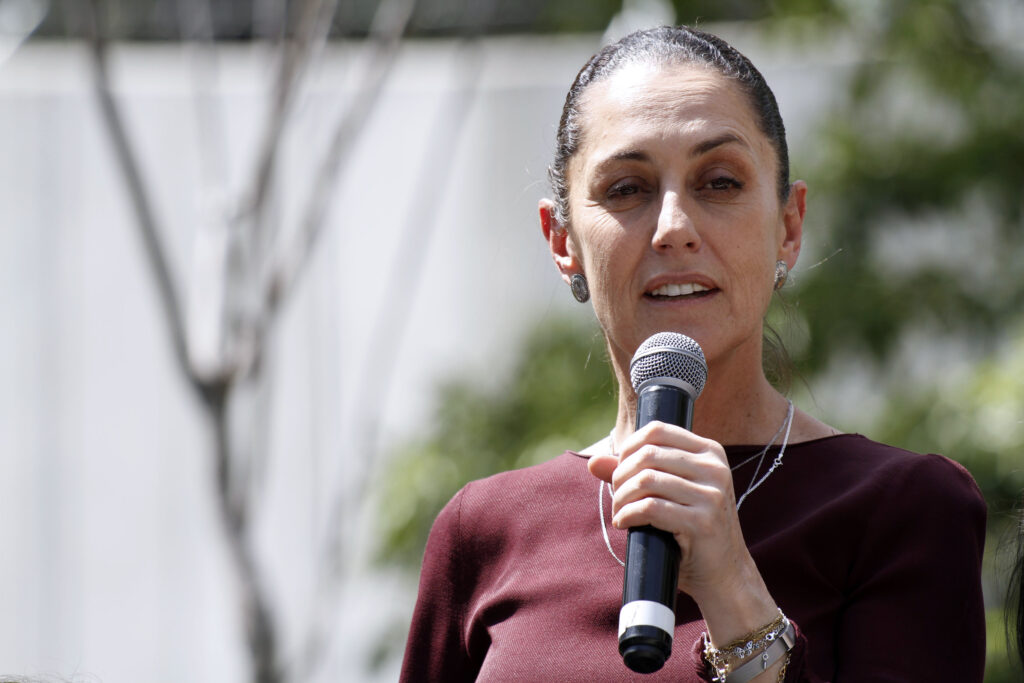
Claudia Sheinbaum pictured in 2020. Credit: Maritza Ríos / Secretaría de Cultura de la Ciudad de México

Unlike in the United States, guns are difficult to obtain legally in Mexico and mass shootings targeting members of the public are uncommon.

While Mexico has grappled for years with high homicide rates, shootings tend to happen in specific areas marked by cartel violence and rarely affect tourists.

Ideological motivations

Rather than a sign of broader security struggles, authorities maintain that Monday’s shooting was perpetrated by a ‘lone wolf’ actor driven by extremist views.

Sergio Ortiz Borbolla, head of campaigns and communications at the Global Project Against Hate and Extremism, maintained that Julio César Jasso Ramírez, 27, was a Nazi sympathizer inspired by other mass shootings. 

“Although the investigation is still ongoing, several factors point to an ideological motive,” said Ortiz.

He noted that Monday’s shooting happened on Adolf Hitler’s birthday and the anniversary of the 1999 mass shooting at Columbine High School in the U.S., which killed 14. 

The perpetrator’s social media included posts where he performed a Nazi salute and a framed AI-generated photo of him side-by-side with the Columbine shooters was found at the scene of the attack, according to authorities. 

“The incident… highlights the growing influence of extremist online communities on acts of violence, a trend that transcends national borders,” noted Ortiz. 

Mexican Attorney-General Cervantes also described “a psychopathic profile of the attacker, characterized by a tendency to imitate situations that occurred in other places, at other times, and involving other individuals – this tendency can be referred to as copycat behaviour”.

Countdown to the games

Monday’s shooting is the latest headache for the Mexican government ahead of this summer’s soccer competition. 

A wave of cartel violence in February, including in World Cup host city Guadalajara, sparked concerns about the threat posed by organized crime in the country. 

But the government has been engaged in a push to assure visitors that the country is safe, announcing plans to mobilize 100,000 security forces this summer. It also said it will deploy an additional 2,100 military vehicles, 24 aircraft, and 33 drones.

But, as Ortiz noted, the type of violence seen in Mexico this week is “not common.” 

“There is no indication that this type of attack poses a widespread risk to tourists,” he concluded.

Featured image description: The Pyramid of the Moon in Teotihuacan – one of the largest in Mesoamerica, México.

Featured image credit: Marcelosan via WIkimedia Commons

The post Mexico boosts security after pyramid attack but plays down shooting risks appeared first on Latin America Reports.
  • ✇Latin America Reports
  • Conflict-hit regions face security concerns ahead of Colombia presidential election Catherine Ellis
    Bogotá, Colombia – Human rights defenders, analysts and social leaders in Colombia have expressed concern about the humanitarian situation in conflict-affected regions ahead of the country’s presidential elections on Sunday. Although the National Liberation Army (ELN) and several dissident groups of the now-defunct FARC rebels have announced temporary ceasefires during the election period, rights groups say fears remain high over violence, mobility restrictions and intimidation in remote area
     

Conflict-hit regions face security concerns ahead of Colombia presidential election

29 May 2026 at 21:36

Bogotá, Colombia – Human rights defenders, analysts and social leaders in Colombia have expressed concern about the humanitarian situation in conflict-affected regions ahead of the country’s presidential elections on Sunday.

Although the National Liberation Army (ELN) and several dissident groups of the now-defunct FARC rebels have announced temporary ceasefires during the election period, rights groups say fears remain high over violence, mobility restrictions and intimidation in remote areas.

Lina Mejía, coordinator at the humanitarian organization Vivamos Humanos, said there were still significant risks surrounding conditions during and after the vote.

“It’s not just a question of whether armed groups will respect the elections themselves, but also whether there will be mobility restrictions, whether electoral materials will be protected from attacks after the vote, and whether communities will be free from intimidation,” she told Latin America Reports.

Humanitarian organizations say that while armed groups often refrain from directly attacking polling stations, elections can still be affected by the broader security environment in areas where armed actors exercise territorial control and over illicit economies linked to coca production, illegal mining and extortion.

According to the Electoral Observation Mission (MOE), 386 municipalities across 31 departments have been identified as having some level of electoral risk linked to violence and the presence of armed groups. 

The organization said the number of municipalities at risk had increased compared to earlier assessments and called for stronger protections during the electoral period, especially in regions like Catatumbo and the southwest of the country, including Cauca, Meta and Guaviare.

This week, at least 50 fighters were reportedly killed in Guaviare during a three-hour battle between rival FARC dissident factions. The faction led by Iván Mordisco allegedly attacked a camp belonging to the rival Calarcá group.

Both factions rejected the 2016 peace agreement that led thousands of members of the former FARC guerrilla movement to demobilize.

In Catatumbo, a region along the border with Venezuela, clashes over the past few months between the ELN and FARC dissident faction Frente 33 have kept security conditions volatile.

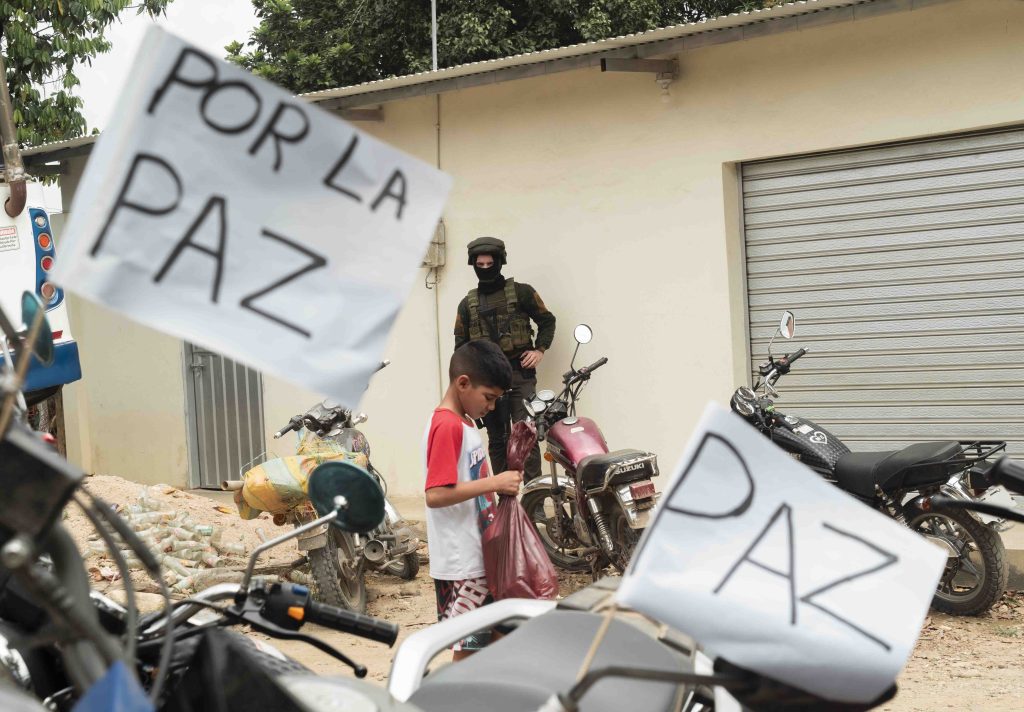
Humanitarian caravan in Catatumbo with peace signs. Credit: Lucas Molet.

Just this month, Freiman Velásquez, a social leader and member of the Association for Peasant Unity of Catatumbo (Asuncat), was assassinated in Tibú. He was killed alongside his sister and two of his bodyguards. The attack has been attributed to the ELN.

Despite the violence, Carmen Garcia, a social leader in Catatumbo, said elections can sometimes bring brief periods of calm.

“There is one positive thing in the territory: when it comes to voting, the armed actors usually respect the process,” she said.

In Catatumbo, the ELN announced a ceasefire beginning Saturday afternoon until after the elections.

But Garcia, who runs an organization rescuing young people from recruitment by armed groups, said many residents no longer trust such agreements following recent killings and security violations in the region.

“Before, the word of the ELN meant something. The word of the FARC meant something. If they said there would not be an attack, you knew there would not be one,” she told Latin America Reports. “But now people no longer truly believe in ceasefires.”

Rights groups say the violence forms part of a broader deterioration in the humanitarian situation in Colombia.

According to Vivamos Humanos, more than 350 violent incidents were recorded during the first five months of 2026.

These include homicides, mobility restrictions, and the presence of anti-personnel mines and improvised explosive devices.

“Among the main impacts are restrictions on mobility and movement, as well as homicides, and the presence of anti-personnel mines, unexploded ordnance and improvised explosive devices,” said Mejía.

Concerns have also intensified in the southern Colombian department of Caquetá. On May 12, audio messages circulated on social media by a FARC dissident group announcing an armed strike across the Caquetá and Caguán river basins, restricting river and road movement.

“We campesinos are in an extremely difficult situation. It’s so tense,” one resident of Cartagena del Chairá, Caquetá, told Latin America Reports. He and other residents were concerned that the strike might affect the ability to vote due to movement restrictions.

The resident said communities had been forced to carry identification documents issued by one armed group and threatened if they failed to do so.

While the strike ended a few days after it was announced, Colombia’s Ombudsman’s Office, the Defensoría del Pueblo, warned that the situation reflected an ongoing pattern of intimidation and territorial control by armed groups.

“This threat adds to a situation that is not new: since December 2025, communities in Putumayo, Caquetá and Amazonas have faced armed strikes and severe restrictions on movement,” the organization said in a statement published on May 15.

The Defensoría also called for “urgent measures” to guarantee the transport of electoral materials and the installation of rural polling stations in remote areas “to guarantee free and peaceful elections on May 31.”

Featured image description: Graffiti from FARC dissidents and the ELN in the city of Cucuta

Featured image credit: Lucas Molet.

The post Conflict-hit regions face security concerns ahead of Colombia presidential election appeared first on Latin America Reports.

  • ✇Hong Kong Free Press HKFP
  • China probes cross-border brokers in crackdown; Hong Kong ‘loophole’ in crosshairs AFP
    China’s market regulator announced a sweeping investigation on Friday against three major brokers running cross-border trading, as it launched a two-year crackdown on investment leaving the country. Photo: David Dennis via Flickr. China does not allow private individuals to directly invest in overseas markets, requiring them to trade assets only through approved third-party channels. However, regulations differ in the semi-autonomous city Hong Kong, and some brokers have been able to l
     

China probes cross-border brokers in crackdown; Hong Kong ‘loophole’ in crosshairs

By: AFP
23 May 2026 at 04:15
foreign exchange

China’s market regulator announced a sweeping investigation on Friday against three major brokers running cross-border trading, as it launched a two-year crackdown on investment leaving the country.

renminbi cash dollar
Photo: David Dennis via Flickr.

China does not allow private individuals to directly invest in overseas markets, requiring them to trade assets only through approved third-party channels.

However, regulations differ in the semi-autonomous city Hong Kong, and some brokers have been able to legally operate there, attracting investors from mainland China to open trading accounts in the Chinese finance hub.

Authorities have sought to regulate the loophole in recent years, and in 2022 barred private Chinese investors from opening accounts with such brokers.

The China Securities Regulatory Commission (CSRC) said on Friday it will probe and impose penalties on Hong Kong-registered brokers Futu and Longbridge, as well as New Zealand-registered Tiger Brokers.

Regulators said the brokers had conducted securities-related business in China “without obtaining the necessary approvals or licenses”, violating China’s securities law.

The CSRC said in a separate statement Friday it will join forces with seven other bodies, including the Ministry of Public Security and the People’s Bank of China, to carry out a two-year campaign targeting illegal cross-border securities activities.

The campaign aims to “completely eradicate the illegal cross-border operations of overseas securities, futures and fund management institutions”, it said.

Futu said in a filing that Chinese authorities have proposed a fine of about 1.85 billion yuan (US$271 million).

Futu “has already ceased opening accounts for applicants with mainland Chinese identities… has consistently engaged in active dialogue with regulatory authorities and complied with their rectification requirements”, it said in a statement.

flags exchange business IFC
Photo: Rhoda Kwan/HKFP.

Chinese investors accounted for about 13 percent of the firm’s total client base of 29.2 million users registered globally, it added.

UP Fintech, a US-listed brokerage firm who owns Tiger Brokers, said CSRC fined the company 308.1 million yuan and confiscated 103.1 million yuan of illegal income.

The firm “accepts the penalty with sincerity,” it added.

The two brokers’ CEOs were also fined.

Chinese authorities’ aim “is to gain full control of capital outflows, and to block any loopholes of these illegal activities”, Kelvin Lam, a China-focused economist at Pantheon Macroeconomics, told AFP.

“What China is trying to do at the moment is to make sure no overseas branches of these companies… take funds out of Chinese investors and help them to invest overseas,” Lam said.

Hong Kong cross-border brokers have operated in a regulatory grey zone until now, he said, but authorities are seeking to fully stem the flow of Chinese investment out of the country.

“Rather than worrying the fact of capital leaving China illegally, the aim of Chinese authorities is to seek full control of the situation rather than anything else,” Lam said.

Shares in Nasdaq-listed Futu tumbled more than 25 percent in Friday’s trading, with UP Fintech dropping about 20 percent.

  • ✇Hong Kong Free Press HKFP
  • US jury convicts man who ran secret Chinese ‘police station’ in New York AFP
    A US jury convicted a man on Wednesday for his role in running a clandestine Chinese “police station” in New York as part of a campaign to monitor US-based dissidents. A photograph taken in February 2022 shows Harry Lu Jianwang (third right) and Chen Jinping (second right) at a meeting of the Fuzhou Police Service Station for Overseas Chinese. Photo: US Attorney’s Office, via Screenshot. “Harry” Lu Jianwang, 64, faces up to 30 years in prison for acting as an illegal agent of the Chinese
     

US jury convicts man who ran secret Chinese ‘police station’ in New York

By: AFP
14 May 2026 at 08:29
Secret Chinese police station US featured image

A US jury convicted a man on Wednesday for his role in running a clandestine Chinese “police station” in New York as part of a campaign to monitor US-based dissidents.

A photograph taken in February 2022 shows Harry Lu Jianwang (third right) and Chen Jinping (second right) at a meeting of the Fuzhou Police Service Station for Overseas Chinese. Photo: US Attorney's Office, via Screenshot.
A photograph taken in February 2022 shows Harry Lu Jianwang (third right) and Chen Jinping (second right) at a meeting of the Fuzhou Police Service Station for Overseas Chinese. Photo: US Attorney’s Office, via Screenshot.

“Harry” Lu Jianwang, 64, faces up to 30 years in prison for acting as an illegal agent of the Chinese government in setting up and running the “overseas police station” in Manhattan’s Chinatown, the Justice Department said in a statement.

Lu and another man, Chen Jinping, were arrested in April 2023 and accused of operating the secret police station, which operated from an office building, on behalf of China’s Ministry of Public Security.

Canada and several European governments have cracked down on similar “police stations,” whose existence was first revealed by Spain-based rights group Safeguard Defenders.

They often operate with little or no indication they are there, though US officials said the Manhattan office had been visited by officials from the Chinese consulate in New York.

According to Safeguard Defenders, the stations have been involved in pressuring nationals to return home to face criminal charges.

“Lu Jianwang used a police station in New York City to target PRC (People’s Republic of China) dissidents in furtherance of the Chinese government’s political agenda,” said FBI Assistant Director in Charge James C. Barnacle Jr.

FBI agents first searched the outpost in October 2022 and found a blue banner reading “Fuzhou Police Overseas Service Station, New York, USA,” referring to a city in southeastern China.

“The New York police station was part of a global initiative by the MPS (Ministry of Public Security) to establish overseas police service stations all over the world,” the Justice Department said.

“Lu was tasked by his MPS handler with collecting information on behalf of the Chinese government, such as locating a pro-democracy advocate who had fled from China and moved to the US,” it added.

Beijing said in December last year that there was no “so-called police station.”

“China is a country governed by the rule of law and has always strictly abided by international law and respected all countries’ judicial sovereignty,” said foreign ministry spokesman Lin Jian when asked about the case at a regular news conference.

Lu’s co-defendant Chen Jinping is awaiting sentencing.

❌
Subscriptions