MAY 14 — Have you seen the number of school books kids in national schools (from as young as Standard 1) are required to bring to school?
Some of them look like they’re hauling luggage in the airport for a two-month trip in Rome. Is all this backpack-like activity helpful for the spines and backs of eight- and nine-year-olds?
Most importantly, is there some reason why e-textbooks remain like something from the far future? Have we not entered the digital age like, uh, two decades ago?
Note that at present the only government initiative on digital textbooks is DELIMa (Digital Education Learning Initiative Malaysia, see note 1). This is the Ministry of Education’s main digital learning portal (rebranded from earlier MOE Digital Learning efforts post-Frog VLE).
It provides access to hundreds of digital textbooks along with other resources like interactive modules, videos, and tools from partners such as Google, Microsoft, and Apple.
However, this platform is only a supplementary or optional resource for most primary and secondary schools. Long and short, students still need to lug their backpack-like bags to school almost every day.
More than a decade ago marketing author Seth Godin already proposed that schools produce PDF versions of textbooks, send these to kids and update them as and when necessary.
Also, with the explosion of video lessons, interactive learning websites, educational games, etc you really wonder if buying (let alone hauling) huge textbooks is absolutely necessary at all.
Tech guru Kevin Kelly even talked about the screening phenomenon in which the future will consist of accessing information, images and messages from “wherever” (phone, office walls, traffic junctions, etc.), after which they can do mash-ups, share their work, etc.
In light of the advent of such a tech-soaked society, are physical textbooks really the best we can do?
Shouldn’t the education sector be preparing our kids where the ‘book’ is no longer delimited by physical binders, where information flows (from producer to producer) rather than remain static?
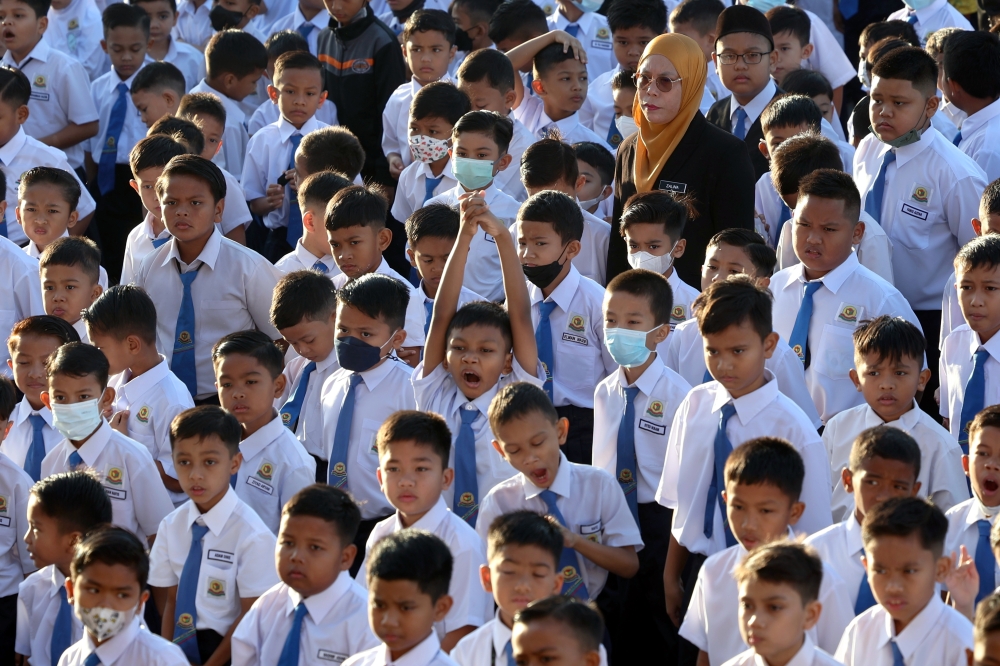
Shouldn’t the education sector be preparing our kids where the ‘book’ is no longer delimited by physical binders, where information flows (from producer to producer) rather than remain static? — Bernama pic
Isn’t the preference for physical textbooks (as opposed to e-textbooks) analogous to being stuck in an era of Encyclopædia Britannica (as opposed to Wikipedia)?
And need we even remind ourselves about the advent of AI and how that may completely transform education very, very soon?
Finally, wastage is a serious issue. Year after year, new copies (as in thousands and thousands of them) of the same books are printed then chucked aside after the final exam.
It would appear the only beneficiary of that are the book-sellers; the rest of society picks up the cost of this externality.
Quite a few private schools have already chucked aside physical textbooks. When will our public schools follow suit?
Check out DELIMa’s website at https://delima.moe-dl.edu.my/
* This is the personal opinion of the columnist.

 Login
Login