Normal view

  • ✇Cartoon Research
  • A “Short” Tribute to Mom – Part III Michael Lyons
    From UPA’s “Bringing Up Mother” (1954) “Motherhood-It’s the biggest on-the-job training program in existence today”. – Author and humorist Erma Bombeck. Indeed, this is true. And, this weekend, we get to celebrate all who have endured this lifelong “on-the-job training” for us on Mother’s Day. Continuing a tradition from 2021 and 2025, what follows are some additional classic cartoon shorts that are perfect for Mother’s Day (three of them suggested by Cartoon Research readers). Mother Hen’s Hol
     

A “Short” Tribute to Mom – Part III

8 May 2026 at 07:01

From UPA’s “Bringing Up Mother” (1954)

“Motherhood-It’s the biggest on-the-job training program in existence today”. – Author and humorist Erma Bombeck. Indeed, this is true. And, this weekend, we get to celebrate all who have endured this lifelong “on-the-job training” for us on Mother’s Day.

Continuing a tradition from 2021 and 2025, what follows are some additional classic cartoon shorts that are perfect for Mother’s Day (three of them suggested by Cartoon Research readers).

Mother Hen’s Holiday, Columbia, (1937)

Here is a classic “Color Rhapsody” from Columbia, set on Mother’s Day.

As the short opens, we meet the Mother Hen (voiced by Toby Wing) who is singing about how much she has to do and how tired she is, and we can see why – she is mom to so many little chicks, they almost overflow out of the baby carriage.

It’s soon evident why she is so overwhelmed, as, once back home, the endless number of little chicks causes chaos in the house, creating absolute destruction. However, they then spot the calendar and note that it’s Mother’s Day.

The chicks then decide to do all they can for mom, cleaning and repairing the house. They even bake a cake and feed it to their happy Mother Hen, as the short ends.

Directed by Arthur Davis, Mother Hen’s Holiday features some nice sight gags, particularly during the sequences where the chicks trash the house, all set against lovely backgrounds.

It all has a cozy, classic cartoon tone, and a nice sentiment for Mother’s Day, as one of the little chicks state: “Make every day a Mother’s Day, not only once a year, every day in every way, cheer up mother dear, for everything you’ve done for us, perhaps we can repay, by making every single day a Happy Mother’s Day.”


Horton Hatches the Egg, Warner Bros., (1942) – suggested by Frederick Weigand
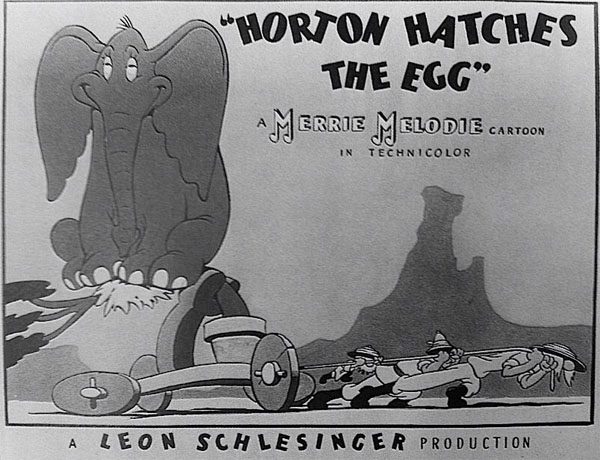
Initially published as a book by Dr. Seuss (Theodor Geisel), in 1940, the book’s popularity eventually brought it to Warner Bros. as an animation project.

Horton Hatches the Egg tells the tale of Horton (Kent Rogers), an elephant who is tricked into sitting on an egg in a nest when the mother, Mayzie (Sara Berner), decides to rest and go on vacation. Horton endures several challenges: stormy weather, ridicule from other animals, hunters, and life in the circus.

Through it all, the steadfast elephant never leaves the egg, keeping his promise to Mayzie and repeatedly stating (in true Seuss rhyme), “I meant what I said, and I said what I meant. An elephant’s faithful, one hundred percent.”

The Warner Bros. artists remained close to the book. In fact, they wrote and sketched ideas for the short, right on the pages as they adapted them. Director Robert Clampett and his team, which included Robert McKimson, Bill Melendez, and Virgil Ross, inserted their unique brand of humor, which includes moments where Mayzie breaks into a brief impression of Katherine Hepburn.

Like the book upon which it is based, Horton Hatches the Egg is an innocent, endearing tale about nurturing and loyalty that is perfect for Mother’s Day, “one hundred percent.”


Bringing Up Mother, UPA (1954) – also suggested by Frederick Weigand

In a film noir-style opening, a police car drives slowly through the night street, calling all cars to be on the lookout for a John Smith. The shadow of a figure walking along a street passes by. He narrates: “Yeah, it’s me they want. I’m the guy, alright. But what could I do? She drove me to it. It was the only way out, and I took it.”

What we come to see through flashbacks is that this isn’t a thriller, and that isn’t the talk of a man who committed a crime, but instead a young boy who has run away from home, after his parents bring home his baby brother from the hospital, and the attention he received has shifted.

Don’t worry, there’s a happy ending: the police find John and cheerfully bring him home. But in the flashbacks throughout the short, the audience gets sharply written insight (by Tedd Pierce and director William Hurtz) into the relationship between the young boy and his mother, dating back to his infancy.

This includes a scene where Johnny, wearing a sailor hat and sucking his thumb, is told by his mother that “sailors don’t suck their thumbs.” So, Johnny proceeds to take off his sailor hat. In his full cowboy outfit and playing with his friend (in the role of the horse), Johnny is told by his mother that they’re “going to have a little baby to play with.” “I’d rather have a horse,” replies Johnny.

But when he’s promised a baby sister (which he’s excited for, as there will be a cowgirl in the house) and instead gets a baby brother, that’s when he runs away.

The short has a wonderful, stylish design, by Robert Danko, in everything from backgrounds to characters, that is such a part of all UPA did, and is coupled with great voice work from Jerry Hausner as Johnny, Marvin Miller as the friendly police officer and Marian Richman as mom.

Bringing Up Mother is a great tribute to all mothers and what they deal with while raising one child, with another on the way.


Scooby-Doo, Where Are You?, “Jeepers, It’s the Creeper,” (1970) – suggested by Christopher Cook

There’s a slight Mother’s Day connection here, but a fun one, nonetheless. As Scooby and the gang look to hide from the ghoulish Creeper, Scooby (Don Messick) and Shaggy (Casey Kasem) sneak into in a chicken house. Scooby sits on an egg, which hatches, and the little chick imprints on Scoob, thinking he’s his mom.

The chick even begins barking and spends the remainder of the episode on Scooby’s nose (even when Scooby reveals the real identity of the creeper, at the end).

“Jeeper’s, It’s the Creeper” is an entertaining Scooby-Doo episode that offers a maternal subplot for those who crave classic Saturday morning memories.

Here’s the clip from the episode where the chick adopts Scooby Doo as his mother:

• If this clip isn’t enough for you and you need to see the whole episode – you can wait for it to come around on MeTV Toons – or you can buy the complete series on blu ray – or you can watch a slanted version of it online at DailyMotion.

Feel free to suggest some of your favorite cartoon shorts and episodes for Mother’s Day in the comments, and here’s wishing all a very Happy Mother’s Day.

  • ✇Cartoon Research
  • “The Crystal Gazer” (1941) Steve Stanchfield
    Columbia really made some bizarre cartoons! This week’s selection in no exception. But first — in brief Thunderbean news: This is “reviews” week at CCS, the College for Creative Studies, where I teach. It’s a crazy busy week where we look at every students work, in teams of professors. My brain in generally mush afterwords, but watching a Columbia cartoon and talking a little about it was a nice break. I can’t wait to get some quality time over some days just concentrating on Thunderbean thin
     

“The Crystal Gazer” (1941)

7 May 2026 at 07:01

Columbia really made some bizarre cartoons! This week’s selection in no exception.

But first — in brief Thunderbean news:

This is “reviews” week at CCS, the College for Creative Studies, where I teach. It’s a crazy busy week where we look at every students work, in teams of professors. My brain in generally mush afterwords, but watching a Columbia cartoon and talking a little about it was a nice break.

I can’t wait to get some quality time over some days just concentrating on Thunderbean things. “Cartoons for Victory” is the title getting the most attention at the moment here as we get it closer to finish. We’ll be talking about that title more in the coming weeks, along with some other projects that are coming together.

The last of a big batch of special discs just went out today, and the next ones are getting prepared. I’m especially happy with this batch of stuff, and the next ones are pretty enjoyable too. We’ve launched two new ones today, but I’m not sure how much longer we’ll do them. We’ve also opened ‘The Vault’ of the older special discs for a week. It’s been a lot of fun doing them.


Now– this week’s cartoon!

The Crystal Gazer (1941) is a Columbia I hadn’t seen before scanning a print. It’s a spoof of live “Psychic” prediction shows, with Mel Blanc lending his voice (and some sound effects). The plot of cartoon consists of a show featuring “Famous Astrologist Professor Ja Ja Rajah”, who is almost the same character in design and demeanor that stars in the all time classic Columbia Cartoon The Cuckoo I.Q. My favorite summery of *that* cartoon comes from a review in the old Mindrot ‘zine that said a better title for it would be “Seven Minutes of Color Film”.

An audience member asks the question “Should I put Whipped Cream in My Potato Salad?” prompting the professor to go through a series of fairly uninspired convulsions until he gazes into a Crystal Ball, leading to a vision that is a much more interesting cartoon that it looked like it would be.

For some reason, his vision starts with him riding a camel in Egypt. They arrive at a tomb where mummies sing, play checkers, dance and make telephone calls. Mummies are hard to screw up, and this section of the cartoon makes the whole venture worth while, or at least makes it close to worth while. Please let me know if you agree or disagree!

Sadly, after that vision we return back to the original plot of the cartoon- but knowing Columbia it wouldn’t have been unlikely that they didn’t return to it.

All of that said, I’m glad Columbia kept making cartoons, even if they’re not on anyone’s favorite list. Heck, maybe this one is someone’s favorite.

Have a good week all!

  • ✇Cartoon Research
  • The Last Five “Screen Gems” Cartoons Jerry Beck
    The 1948-49 Season of cartoon short subjects from Columbia Pictures consisted of just eight new cartoons. Among them some of the worst the Screen Gems studio ever produced. But also among the eight were a few real gems, the first offerings from the game changing UPA studio. This was the transitional year. Columbia had closed their Screen Gems studio (formerly Charles Mintz’s studio) in November 1946, after years of operating in the red. Luckily, Columbia had over two years of cartoons in the b
     

The Last Five “Screen Gems” Cartoons

14 April 2026 at 07:01

The 1948-49 Season of cartoon short subjects from Columbia Pictures consisted of just eight new cartoons. Among them some of the worst the Screen Gems studio ever produced. But also among the eight were a few real gems, the first offerings from the game changing UPA studio. This was the transitional year. Columbia had closed their Screen Gems studio (formerly Charles Mintz’s studio) in November 1946, after years of operating in the red.

Luckily, Columbia had over two years of cartoons in the backlog – enabling the studio to release a steady stream through their 1946-47 and 1947-48 season. Color cartoons were still in high demand in movie theaters throughout the 1940s and 1950s – especially as television invaded the media landscape – and the movie studios and exhibitors teamed up to fight off the new technology. Columbia still needed cartoons – but perhaps produced at a lower cost. Enter UPA.

Columbia made a deal with UPA for four cartoons to test the waters – three Fox & Crow and one “whatever they wanted”, a miscellaneous cartoon for a new series to be called “Jolly Frolics”. Combined with the last five Screen Gems shorts, those first three from UPA gave Columbia a respectable eight subjects. (If you think that was a small release slate – just check Walter Lantz’ output for United Artists that same season (48-49): a measly five Woody Woodpecker/Andy Panda subjects).

For Columbia, this season became a win-win. Three Fox and Crow – including one of the best ever, an Oscar nominee, The Magic Fluke – and another that was a real hit with the public: Ragtime Bear, featuring the first appearance of Mr. Magoo.

What a mixed bag. Those last Screen Gems films – despite the crew of cast-off Warner Bros/Lantz/Disney personnel, including an uncredited Bob Clampett – were poor by any measure. Let’s take a look at that season – in the order of their release – the year that introduced UPA to the general public and changed animation forever.

PICKLED PUSS (September)

What’s funnier than a drunken cat? Nothing – certainly nothing in this cartoon – not even a drunken cat (or a “pickled puss”). The final Columbia cartoon from ex-Disney animator Howard Swift – who went on to create an independent shop that did everything from animating Superman (in the Columbia serials) to pioneering TV commercials. I’m sure this looked hilarious in the story boards; the animation is sufficient – it has the “look” of an average Hollywood cartoon of the era – but it’s just plain unfunny.


LO, THE POOR BUFFAL (November)

Buffalo Billingsly (cross Yosemite Sam with Foghorn Leghorn) hunts a forlorn Buffalo and a Native American. Alex Lovy was a capable director – but it takes team to make a cartoon, and the team at Columbia just didn’t have the incentive – or sense of humor. Sometimes I watch these late Columbia cartoons, squint my eyes, and try to figure out what they thought was going to get laughs here… They don’t have a vocal talent like Mel Blanc, they don’t have the music of Carl Stalling or Scott Bradley (or Winston Sharples, for that matter). Weak.


ROBIN HOODLUM (December)

The first UPA entertainment theatrical short… and what a beauty it is. They threw out the Fox & Crow playbook (if there ever was one) and just have them play Robin Hood. There’s a story that animators from Chuck Jones unit did scenes when the production fell behind. All and all a vast improvement over Screen Gems shorts.


COO-COO BIRD DOG (February)

Have I mentioned how much I do not like the voice work of Cal Howard and Jack Mather in these later Screen Gems cartoons? Here’s a cartoon that has “should be directed by Art Davis” written all over it… but it was directed by his old partner Sid Marcus. This may be the best of the Screen Gems bunch here today… but that’s not saying much.


All of these cartoons are now telecast regularly on MeTV Toons – please watch the channel and spread the word.

Here’s the first Magoo… and by now there was no turning back. Columbia would have the hottest cartoons of the decade – and with this, the rest is history.

RAGTIME BEAR (September)


These last five Screen Gems cartoons do not portend or predict what could have been if the Screen Gems studio were to continue. It was somewhat a lost cause. Their ending allowed UPA to flourish and animation became a better place.

CAT-TASTROPHY (June)


…and this might be one of the worst Fox & Crow shorts ever. I can’t get past the Fox’s stupid voice.

GRAPE NUTTY (April)


MAGIC FLUKE (March)

Back to UPA and this one is quite perfect. Might be my second most favorite John Hubley UPA short (after Rooty Toot Toot).


  • ✇Cartoon Research
  • Krazy Kat in “Ritzy Hotel” (1932) Steve Stanchfield
    The Scrappy cartoons have always been a favorite of mine, and maybe always will be-but, in the past,the collectors of 16mm cartoons I was often chatting with would often here a less-than-favorable review of them – saying “The Krazy Kats are better”. While I *had* a lot of Krazy Kats, I usually wouldn’t pursue them in the same way I would the Scrappys, so I ended up with a lot of Scrappys and only a handful of Krazys comparatively over the years. That isn’t to say I didn’t enjoy them. They were j
     

Krazy Kat in “Ritzy Hotel” (1932)

2 April 2026 at 07:01

The Scrappy cartoons have always been a favorite of mine, and maybe always will be-but, in the past,the collectors of 16mm cartoons I was often chatting with would often here a less-than-favorable review of them – saying “The Krazy Kats are better”. While I *had* a lot of Krazy Kats, I usually wouldn’t pursue them in the same way I would the Scrappys, so I ended up with a lot of Scrappys and only a handful of Krazys comparatively over the years. That isn’t to say I didn’t enjoy them. They were just in a category somewhere below the Scrappys, and when I found some for sale, the Scrappy I didn’t have would be bought first.

Now, all these years later, I’m way, way less likely to focus on collecting film and more about restoring things from film. There’s just too much to do, but I do think, possibly, at some point, I’ll still want to get more Krazys than I have currently.

Of course, The Columbia Krazy Kat isn’t really Krazy Kat at all, at least not in the sense of the brilliant comic strip. The Columbia Krazys are their own entity, bearing more a resemblance to every other studio’s cute 30s characters and the expected population of animals. I have to admit I really like most anything with that formula, so, in that way, the early ones are great. This one, Ritzy Hotel (1932) has all the elements of the best of the series – great animation, funny gags and a happy Joe DeNat score. What could be better?

Ben Harrison and Manny Gould were exclusively helming the direction of the series from 1926, when Mitnz’s studio was in New York, moved to the west coast into the beginning of the sound era though 1933, then continuing to direct some of the cartoons along with the Color Rhapsodies series. It was a popular enough series through those early 30s years, then really began to lose steam in the mid-30s as so many cartoon series do.

I’ve been really enjoying reading your thoughts on these cartoons, and the information each person brings as well. I can’t wait until the end of the school year and the current giant pile of restoration and Blu-ray stuff I’m sorting through to be a little less overwhelming so I can spend a little time writing a little more too!

This week’s print is from Tommy Stathes’ collection- he was kind enough to lend. It’s sadly warping a little here and there, but still a good watch. Thanks Tommy, and have a good week all!

  • ✇Cartoon Research
  • Screen Gems’ “Mutt ‘n Bones” (1944) Steve Stanchfield
    Happy Thursday! First, at Thunderbean: Things are humming as we get out a bunch of the special discs and Mid Century Modern 2, now back in stock. We’ve put up the titles we’re sending this week in case anyone missed them as well. I had a chance over this last week to get out to New York and scan a bunch of things. I was also able to visit my friend and collaborator Tommy Stathes, who was nice enough to lend this week’s cartoons and many more. Thanks Tommy! Now, onto this week’s film: Maybe Co
     

Screen Gems’ “Mutt ‘n Bones” (1944)

19 March 2026 at 07:01

Happy Thursday!

First, at Thunderbean:
Things are humming as we get out a bunch of the special discs and Mid Century Modern 2, now back in stock. We’ve put up the titles we’re sending this week in case anyone missed them as well. I had a chance over this last week to get out to New York and scan a bunch of things. I was also able to visit my friend and collaborator Tommy Stathes, who was nice enough to lend this week’s cartoons and many more. Thanks Tommy!


Now, onto this week’s film:

Maybe Columbia’s Mutt ’N Bones is the closest any studio got to making a Pluto cartoon besides Disney. In this WW2 outing, a dog dreams of being the “king of the bones” but wakes to none. In his local newspaper (“The Hard Times”) he reads about a bone drive to support the war, then spends the rest of the film competing with a Bulldog to bring bones to the bone drive, looking for a bigger one than he already has.

Compared to Disney’s Pluto, Columbia’s dog here is a little more worldly. He completely understands what he reads in the paper, and, like Tom and Jerry, seems to lead a human life even while living like a dog. It’s nice to see such an altruistic animal supporting the war at the expense of the thing he’d like most in the world.

Columbia cartoons from this period tend to be really dialogue heavy, often at the expense of much action. Mutt N’ Bones is refreshing in that it’s a visual gag cartoon without dialogue. While clearly taking cues from both Disney and Tom and Jerry cartoons, it still holds its own. There’s lots and lots of personality poses in the fun animation along the way, and plenty of gags- and while it’s far from the finest entertainment you’ll have this year, it’s enjoyable in the way it’s enjoyable to read the funny papers, and after all, that’s what it was designed to be.

Have a good week everyone!

❌
Subscriptions