vinyl transfer by M3.This item belongs to: audio/hifidelity_potpourri.This item has files of the following types: Archive BitTorrent, Item Tile, JPEG, JPEG Thumb, Metadata, PNG, Spectrogram, VBR MP3
Pirate treasure and shiny coins typically come to mind when an old shipwreck is discovered. These bits of maritime history are usually studied, preserved, and placed in a museum or private collection—not made into a dress worthy of Paris Fashion Week.
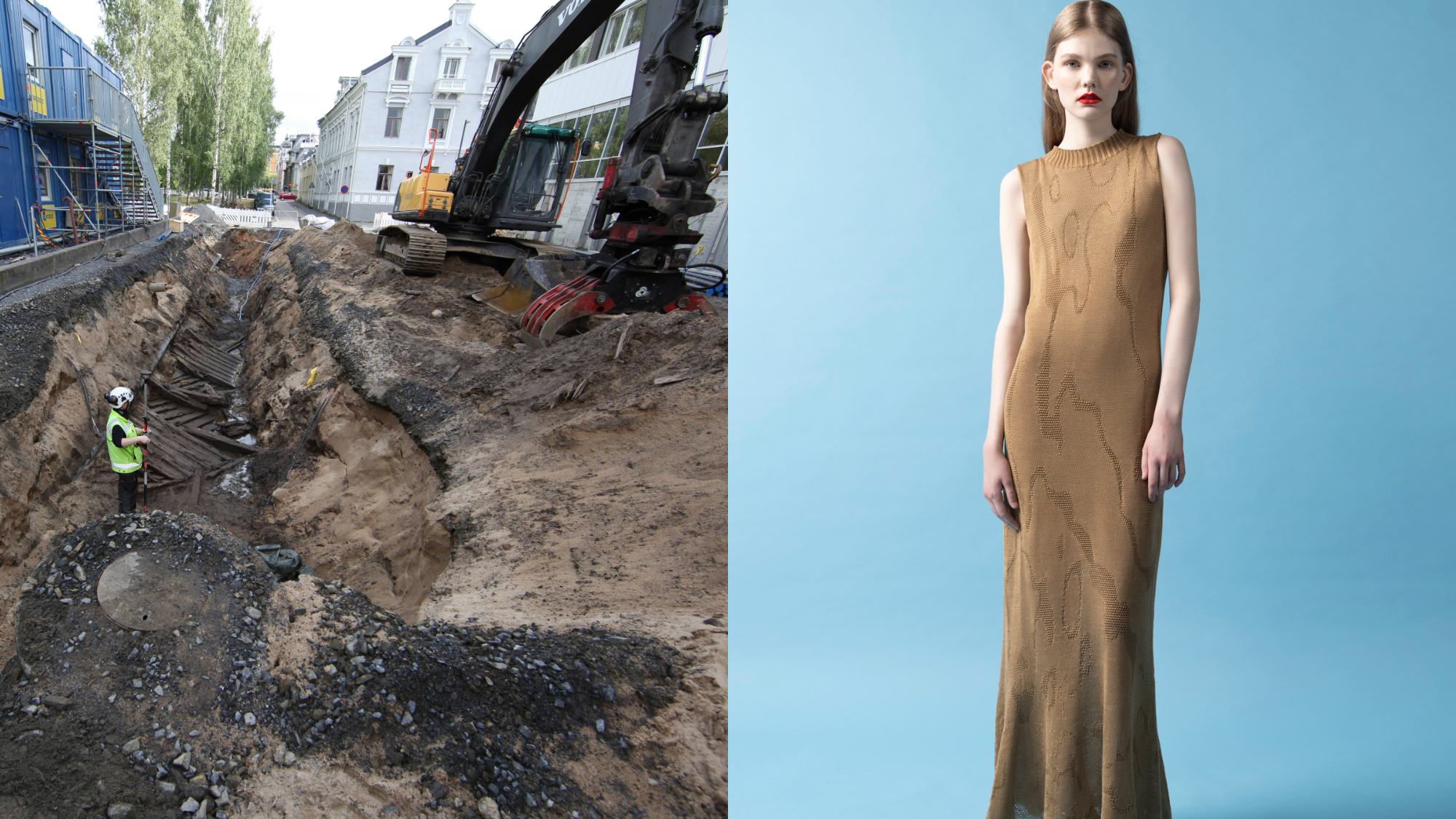
Using the surplus wood from a shipwreck dating back to the 1600s, archeologists, chemists, and textile experts in Finland turned the raw material into a textile fiber. They then spun the fibers into a workable yarn and knit it into a dress with
Pirate treasure and shiny coins typically come to mind when an old shipwreck is discovered. These bits of maritime history are usually studied, preserved, and placed in a museum or private collection—not made into a dress worthy of Paris Fashion Week.
Using the surplus wood from a shipwreck dating back to the 1600s, archeologists, chemists, and textile experts in Finland turned the raw material into a textile fiber. They then spun the fibers into a workable yarn and knit it into a dress with the help of AI-assisted technology. The Shipwreck Dress represents over two years of collaboration between scientists and designers. This unique piece of clothing is also an opportunity to bring history to new audiences.
“Underwater cultural heritage is often invisible, but the Shipwreck Dress brings it into people’s everyday environments,” Minna Koivikko, a maritime archaeologist with the Finnish Heritage Agency, said in a statement. “It’s almost like a spokesperson for history—with a modern twist.”
The color of the dress comes directly from the Hahtiperä wreck. Dress designer Anna-Mari Leppisaari says that sustainability thinking has increased interest in using undyed naturally colored yarns in the textile industry. Image: Aalto University.
The Hahtiperä wreck
The wreckage of a 17th century cargo ship was discovered in the central Finnish town of Oulu in 2019. The ship was made from tree timber dating back to 1684 and the unnamed vessel was eventually called the Hahtiperä wreck. The wood for the vessel grew in the forests of Ostrobothnia in southwest Finland in the 17th century.
Some of the leftover pieces of wood risked ending up thrown in the trash after years of conservation work, leaving archeologists wondering how to give the wood a second life in the 21st century.
“The wreck had only partially survived, and not everything could be preserved, even though every piece was documented,” said Koivikko. “It felt unfortunate, and I began wondering whether the wood fragments could still be of use.”
Koivikko joined forces with design and textile experts, chemists, and forestry specialists, to find a way to transform this historical wood into something new.
UNESCO recommends that underwater archaeological cultural heritage should be left at its discovery site. However, wrecks may be raised and conserved for justified reasons. The Hahtiperä wreck was conserved because it is the oldest shipwreck discovery in Northern Finland. Image: Minna Koivikko.
Turning waterlogged wood into workable fibers
Bioengineer Inge Schlapp-Hackl oversaw the highly technical process of converting the more than 300-year-old wood into a workable textile fiber. She removed the outer layer to expose the wood’s core, which was then shredded and processed into a dissolving pulp. She then used a patented Ioncell® process to turn the pulp into fiber. Ioncell® uses a solvent called ionic liquid to convert the cellulose from old textiles, wood pulp, and newspapers into fibers, without using other chemicals. The fibers can then be made into long-lasting fabrics.
“Ioncell® fibres have a silky feel and are stronger than cotton,” said Schlapp-Hackl. “In addition to new and reclaimed wood, the Ioncell® method can utilise recycled materials like paper, cardboard, textile waste and straw for fibre production.”
According to the team, the finished yarn is surprisingly strong. It has a subtle sheen and a brown hue, and remains undyed and unbleached. That brown coloring directly originates from the Hahtiperä wreck.
The preserved section is about 23-feet-wide and around 65-feet-long. Image: Minna Koivikko.
“The pulp made from the wreck contained very few impurities and was surprisingly easy to process,” added Schlapp-Hackl. “This project demonstrated that the Ioncell® method can be used to produce fibre from practically any cellulose-based material.”
The team then used an experimental design program to generate patterns on a local computer. According to the team, this process minimizes energy consumption and so that the designer and AI can work together.
Aalto University textile expert Anna-Mari Leppisaari designed and knitted two identical dresses from yarn, and the surface pattern is inspired by wood grain and digital noise. She knit the dress on a Shima Seiki knitting machine as a single, seamless, three-dimensional piece to keep from wasting any of the fabric.
A lesson in waste
For Aalto University textile artist and designer Pirjo Kääriäinen, raising awareness of the need to reduce consumption of natural resources has been a lifelong mission. She and her colleagues have spent over 15 years researching how different biomasses and raw materials can be used as raw materials for textile fibers.
The team says that the Shipwreck Dress demonstrates the possibilities that exist when technology and design are tested and that the dress’ historical origins encourage fresh thinking about sustainable consumption.
By studying the wood material, researchers discovered that the pine trees used to build the vessel grew in the forests of Ostrobothnia in the 17th century. Producing the fiber required many stages of processing. Image: EsaKapila / Aalto University.
“Of course, a shipwreck is an exceptional case, but it’s also a story that makes people pause and appreciate materials in a new way,” said Kääriäinen. “If something this beautiful can be made from centuries-old wood, why do we keep throwing away materials that could still be circulated and reused?”
The Shipwreck Dress will be exhibited at the Oulu Museum of Art beginning on Friday May 22. Its twin piece will be shown at Aalto University’s Designs for a Cooler Planet 2026 exhibition beginning on September 1.
Urban VIII corresponded with Francisco de Quevedo, Alexander VII spent his leisure time as pope writing little poems in Latin, and John Paul II — who had studied St. John of the Cross in his youth — even published a collection of poems, Roman Triptych (2003), while still occupying the Chair of Saint Peter. Seguir leyendo
Urban VIII corresponded with Francisco de Quevedo, Alexander VII spent his leisure time as pope writing little poems in Latin, and John Paul II — who had studied St. John of the Cross in his youth — even published a collection of poems, Roman Triptych (2003), while still occupying the Chair of Saint Peter.
CD transfer by M3 (11/15/17).This item belongs to: audio/hifidelity_potpourri.This item has files of the following types: Archive BitTorrent, Item Tile, JPEG, JPEG Thumb, Metadata, PNG, Spectrogram, VBR MP3
The Mad Capsule Markets - The Best.This item belongs to: audio/hifidelity_potpourri.This item has files of the following types: Archive BitTorrent, Item Tile, JPEG, JPEG Thumb, Metadata, PNG, RAR, Spectrogram, VBR MP3
vinyl transfer by M3.This item belongs to: audio/hifidelity_potpourri.This item has files of the following types: Archive BitTorrent, Item Tile, JPEG, JPEG Thumb, Metadata, PNG, Spectrogram, VBR MP3
CD transfer by M3.This item belongs to: audio/hifidelity_potpourri.This item has files of the following types: Archive BitTorrent, Item Tile, JPEG, JPEG Thumb, Metadata, PNG, Spectrogram, VBR MP3
US President Donald Trump on Friday warned Taiwan against declaring formal independence after concluding his visit to China, whose leader Xi Jinping had pressed him not to support the self-ruling island.
US President Donald Trump and Chinese President Xi Jinping tour the Hall of Prayer of Good Harvest at the Temple of Heaven in Beijing on May 14, 2026. Photo: The White House, via Flickr.
Trump ended the state visit claiming to have made “fantastic” trade deals, although the details were v
US President Donald Trump on Friday warned Taiwan against declaring formal independence after concluding his visit to China, whose leader Xi Jinping had pressed him not to support the self-ruling island.
US President Donald Trump and Chinese President Xi Jinping tour the Hall of Prayer of Good Harvest at the Temple of Heaven in Beijing on May 14, 2026. Photo: The White House, via Flickr.
Trump ended the state visit claiming to have made “fantastic” trade deals, although the details were vague, and he did not appear to secure any breakthrough with China over his stalemated war on Iran.
Trump invited Xi for a reciprocal visit to Washington in September, signalling both sides will likely seek stability in the often turbulent relationship between the world’s two largest economies.
On a key issue for Xi, Trump made clear he opposed a declaration of independence by Taiwan and appeared to question why the United States would defend the island in case of attack.
“I’m not looking to have somebody go independent. And, you know, we’re supposed to travel 9,500 miles to fight a war. I’m not looking for that,” he told Fox News’ “Special Report with Bret Baier.”
“I want them to cool down. I want China to cool down,” Trump said.
“We’re not looking to have wars, and if you kept it the way it is, I think China’s going to be OK with that.”
The United States recognizes only Beijing and does not support formal independence by Taiwan, but historically has stopped short of explicitly saying it opposes independence.
Under US law, the United States is required to provide weapons to Taiwan for its defence, but it has been ambiguous on whether US forces would come to the island’s aid.
Xi had begun the summit with a warning on Taiwan, whose President Lai Ching-te considers the island already independent, making a declaration unnecessary.
Xi told Trump that missteps on the sensitive issue could cause “conflict”.
Referring to comments by Secretary of State Marco Rubio, who said US policy toward Taipei was unchanged, Taiwan’s foreign ministry thanked the United States for showing “it supports and values Taiwan Strait peace and stability”.
No details on ‘fantastic’ deals
On Friday, Boeing confirmed that China had made an “initial commitment” to buy 200 aircraft, a deal previously announced by Trump. The company said more orders could follow.
Trump also said Beijing would buy American oil and soybeans.
US President Donald Trump and Chinese President Xi Jinping at Zhongnanhai in Beijing on May 15, 2026,. Photo: The White House, via Flickr.
“We’ve made some fantastic trade deals, great for both countries,” he said after a walk with Xi in the gardens of Zhongnanhai, a central leadership compound next to Beijing’s Forbidden City.
“We’ve settled a lot of different problems that other people wouldn’t have been able to solve,” Trump added, without providing specifics.
Xi promised to send Trump rose seeds for the White House Rose Garden and said it was a “milestone visit”.
But beyond Boeing, there were no other formal announcements from companies or from China on trade deals.
The reserve on the Chinese side echoes the tone of the summit as a whole, where Trump’s overtures to Xi — whom he described as a “great leader” and “friend” — were met with a more muted response.
“Trump got the optics he was looking for and the Chinese were happy to give them to him,” said Jacob Stokes, a senior fellow at the Centre for a New American Security.
Little on Iran
Trump had delayed the trip once due to the war in Iran, which has rebuffed his appeals for a peace agreement and retaliated by exerting control over the key Strait of Hormuz, sending global oil prices soaring.
US President Donald Trump and Chinese President Xi Jinping at Zhongnanhai in Beijing on May 15, 2026. Photo: The White House, via Flickr.
Trump said Xi had assured him that China was not preparing military aid to Iran. Israel has alleged that Beijing has provided key missile technology to Tehran.
The Chinese foreign ministry on Friday released a statement on Iran saying “shipping lanes should be reopened as soon as possible”.
Trump also acknowledged that he could not persuade Xi to free Jimmy Lai, the imprisoned Hong Kong pro-democracy media tycoon whose cause is broadly backed in Washington.
“He told me, Jimmy Lai is a tough one for him to do,” Trump told reporters.
Bonnie Glaser, managing director of the German Marshall Fund’s Indo-Pacific program, noted that Trump had already sounded half-hearted in his public comments on Lai.
“My sense is that the Chinese see that this is not a top priority for the United States,” she said.
“What Trump seems to want most is purchases of American products — that appears to be his highest priority.”
The two leaders had been expected to discuss extending the one-year tariff truce that paused their frenetic 2025 trade war, struck during their last meeting in October.
But Trump told reporters on the way home that it “wasn’t brought up”.
By Montira Rungjirajittranon
Two Chinese Uyghur men were sentenced to death Thursday for carrying out a 2015 attack on a Bangkok shrine that killed 20 people, a long-awaited verdict in Thailand’s deadliest bombing case.
Bilal Mohammed (centre) and Yusufu Mieraili (back right), defendants in the 2015 Erawan shrine bombing case, arrive at a military court in Bangkok on February 16, 2016. File photo: Nicolas Asfouri/AFP.
A Bangkok court convicted Yusufu Mieraili and Bilal Mohammed of prem
Two Chinese Uyghur men were sentenced to death Thursday for carrying out a 2015 attack on a Bangkok shrine that killed 20 people, a long-awaited verdict in Thailand’s deadliest bombing case.
Bilal Mohammed (centre) and Yusufu Mieraili (back right), defendants in the 2015 Erawan shrine bombing case, arrive at a military court in Bangkok on February 16, 2016. File photo: Nicolas Asfouri/AFP.
A Bangkok court convicted Yusufu Mieraili and Bilal Mohammed of premeditated and attempted murder for their role in planting a bomb at the popular Erawan Shrine in the capital’s commercial heart.
The blast tore apart the site where worshippers and tourists had gathered, wounding more than 100 people and leaving the shrine to the Thai representation of Brahma littered with motorbike fragments and singed debris.
Seven Chinese tourists were among the fatalities when explosives — apparently left in a backpack — detonated.
“The defendants committed a single act that violated multiple laws. The court therefore imposed the harshest penalty available under the law, the death sentence,” one member of the four-judge panel said Thursday as the lengthy verdict was read out.
The defendants — both Chinese nationals who arrived in court in prison garb — were acquitted of charges stemming from a separate bombing at a Bangkok pier.
Following the verdict, Mieraili said: “RIP Thailand’s justice system. I don’t accept any of this. I didn’t do anything wrong.”
Choochat Kanpai, the defendants’ lawyer, told reporters they “will appeal the ruling because there are many aspects of the case that the court has not fully considered, including the treatment of the defendants during the proceedings”.
The decade-long trial was beset by delays due to coronavirus disruptions and problems securing translators.
The blast came weeks after Thailand’s then-ruling junta forcibly repatriated 109 Uyghurs to China, prompting speculation that it was part of a revenge plot.
Beijing welcomed the death sentences.
“The attackers were totally inhumane and extremely heinous,” foreign ministry spokesman Lin Jian told reporters.
Chinese foreign ministry spokesman Lin Jian during a press conference on March 20, 2026. Photo: China’s Ministry of Foreign Affairs.
“China supports Thailand in conducting the trial in accordance with the law and severely punishing the murderers.”
Delays and drugs
Shortly after the bombing, police named 17 suspects, but only Mieraili and Mohammed were initially apprehended.
Thailand’s junta authorities were criticised for a murky investigation that appeared to wind down shortly after the arrest of the two men.
They went on trial in 2016, accused of planting the explosives.
But the proceedings — which have involved hundreds of witness testimonies — have been delayed multiple times, once because the translator for the accused was hit with drugs charges.
In 2017 a Thai woman called Wanna Suansan was detained on arrival in Bangkok on a warrant linked to the shrine blast — making her the third named suspect arrested by police.
She was charged with attempted murder, associated murder and possession of bombs and weapons, but was acquitted in 2024.
The Uyghurs, a Turkic minority, primarily hail from China’s westernmost region, Xinjiang.
Beijing has been accused of detaining more than a million Uyghurs and other Muslims since 2017, part of a campaign that the United Nations previously said could constitute crimes against humanity.
China vehemently denies these allegations, saying its policies have rooted out extremism in Xinjiang and boosted economic development.
Thailand deported dozens of Uyghurs to China in February 2025 despite warnings from human rights groups that they would face persecution on their return, drawing swift condemnation from the United Nations.
Erawan Shrine in Bangkok on January 16, 2015, seven months before the deadly bombing. Photo: Wikimedia Commons.
The Erawan Shrine remains a popular draw for Chinese and other tourists to the Thai capital, and dozens of visitors made traditional offerings of marigold garlands and incense as usual on Thursday.
Devotee and online vendor Satiwan Phobangwai, 45, approved of the sentences.
“As a Buddhist, I was taught to only do good deeds and good things, right? It’s like karma, as the saying goes, ‘you reap what you sow,'” she said.
“So they must face the consequences of the wrongdoing they committed.”

 Login
Login