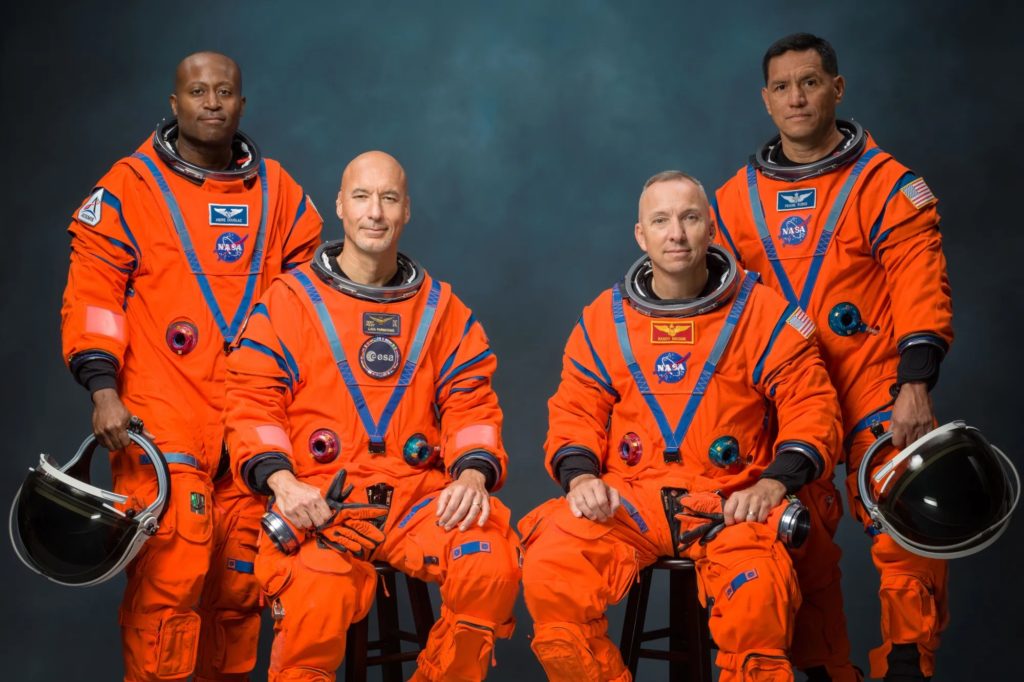
Luca Parmitano to pilot all-male crew of four paving way for planned first human landing on Artemis IV in 2028Jared Isaacman, the Nasa administrator, hailed the creation of “Earth’s first starfleet” on Tuesday as he revealed the Artemis III crew and details of the next stages of the space agency’s project to return humans to the moon.An Italian astronaut, Luca Parmitano of the European Space Agency (ESA), will be the pilot of the planned two-week mission to lower Earth orbit next year that will
Luca Parmitano to pilot all-male crew of four paving way for planned first human landing on Artemis IV in 2028
Jared Isaacman, the Nasa administrator, hailed the creation of “Earth’s first starfleet” on Tuesday as he revealed the Artemis III crew and details of the next stages of the space agency’s project to return humans to the moon.
An Italian astronaut, Luca Parmitano of the European Space Agency (ESA), will be the pilot of the planned two-week mission to lower Earth orbit next year that will test lunar landers from private companies Blue Origin and SpaceX.
Indeed c’est le weekend, and while there are a lot of very important political issues to address, to quote Shakespeare or possibly Harold Pinter, “Tragedy tomorrow; Comedy tonight.”Besides, I don’t have enough information about the president’s physical beyond the release from the White House, where they report that he’s 6’3″ and weighs 238 pounds, so […]
Indeed c’est le weekend, and while there are a lot of very important political issues to address, to quote Shakespeare or possibly Harold Pinter, “Tragedy tomorrow; Comedy tonight.”Besides, I don’t have enough information about the president’s physical beyond the release from the White House, where they report that he’s 6’3″ and weighs 238 pounds, so […]
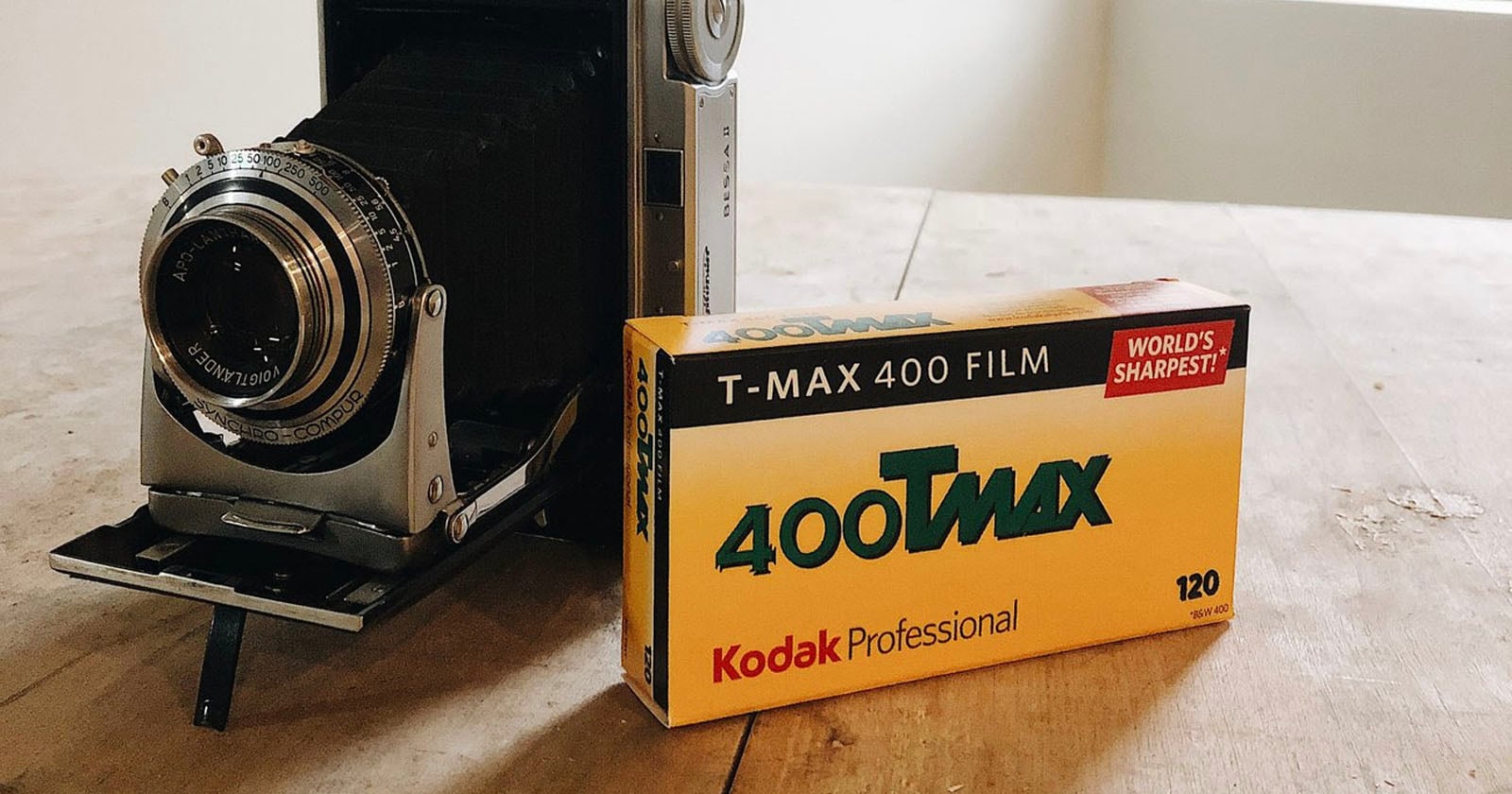
TMax 400 came into the world in 1986, at the same time as its slower speed brother. You can think of them as near identical twins, in fact. Since its introduction, TMax 400 has helped define a whole new generation of black and white films with its tabular grain structure, high resolution, and sharp image details.
[Read More]
TMax 400 came into the world in 1986, at the same time as its slower speed brother. You can think of them as near identical twins, in fact. Since its introduction, TMax 400 has helped define a whole new generation of black and white films with its tabular grain structure, high resolution, and sharp image details.
It is a truism that the deficit falls under Democratic administrations and rises under Republican administrations, and that the last three presidents to lower the deficit were Clinton, Obama and Biden.It is also a truism that if you laid every economist in the country end to end, they would not reach a conclusion. It’s a […]
It is a truism that the deficit falls under Democratic administrations and rises under Republican administrations, and that the last three presidents to lower the deficit were Clinton, Obama and Biden.It is also a truism that if you laid every economist in the country end to end, they would not reach a conclusion. It’s a […]
For the first time in more than 50 years, NASA launched a mission to the Moon. A lot has changed since 1972, when we last checked in on the enormous, rocky satellite, but there is much to learn—and revisit—when it comes to traveling through deep space and considering what, as NASA describes it, a “long-term return” to our lunar companion could look like. The Artemis II mission, which is currently underway and scheduled to last a total of 10 days, has also released some remarkable images of ou
For the first time in more than 50 years, NASA launched a mission to the Moon. A lot has changed since 1972, when we last checked in on the enormous, rocky satellite, but there is much to learn—and revisit—when it comes to traveling through deep space and considering what, as NASA describes it, a “long-term return” to our lunar companion could look like. The Artemis II mission, which is currently underway and scheduled to last a total of 10 days, has also released some remarkable images of our home planet.
A striking image of the Earth “setting” behind the cratered Moon takes a truly unique view of our planet and prompts us to consider our perspective. It’s reminiscent of one of the most iconic photographs of all time, known as “Earthrise,” which was snapped by astronaut William Anders during the 1968 Apollo 8 mission—the first crewed trip to the Moon.
The Earth setting beyond the Moon
Artemis II is scheduled to return to Earth on the evening of April 10, when the crew will splash down into the Pacific Ocean off the California coast.
The Moon’s cratered surfaceThe far side of the Moon
Manuel Gual posted a photo:
Echoes of the Delta: A Visual Journey Through the Soul of the Blues
Description
This collection captures the raw, unyielding spirit of the American Deep South and the enduring legacy of blues music. From the mythical dirt crossroads under a midnight moon to the neon-lit doorways of bustling juke joints, these scenes weave a powerful narrative of hardship, resilience, and musical salvation. You can feel the steady rhythm in the weathered hands strumming a worn aco
Echoes of the Delta: A Visual Journey Through the Soul of the Blues
Description
This collection captures the raw, unyielding spirit of the American Deep South and the enduring legacy of blues music. From the mythical dirt crossroads under a midnight moon to the neon-lit doorways of bustling juke joints, these scenes weave a powerful narrative of hardship, resilience, and musical salvation. You can feel the steady rhythm in the weathered hands strumming a worn acoustic guitar on a wooden porch, hear the soulful wails echoing through smoky recording studios, and observe the quiet, melancholic contemplation in a lonely diner at dawn. It is a visual tribute to the pioneers of rhythm and blues, the rural landscapes where the sorrow songs were born, and the dusty highways that carried those melodies across the country. Every portrait—whether it is a passionate singer pouring his heart into a microphone, lifelong friends sharing a laugh over a quiet evening, or a lone traveler leaning against a vintage pickup truck—embodies the authentic, vibrant pulse of Americana folklore.
These images were generated by Artificial Intelligence.
The solar system is bathed in galactic cosmic rays: protons and atomic nuclei traveling, nearly at the speed of light, from all directions. Earth’s magnetic field and atmosphere shield us from most of this harmful radiation, but outside of that shelter, the bombardment is strong enough to prove a threat to astronauts.
But a new analysis of data from the Chang’e-4 lunar lander published in Science Advances revealed an extended cosmic ray shelter stretching from Earth at an unexpected angle at
The solar system is bathed in galactic cosmic rays: protons and atomic nuclei traveling, nearly at the speed of light, from all directions. Earth’s magnetic field and atmosphere shield us from most of this harmful radiation, but outside of that shelter, the bombardment is strong enough to prove a threat to astronauts.
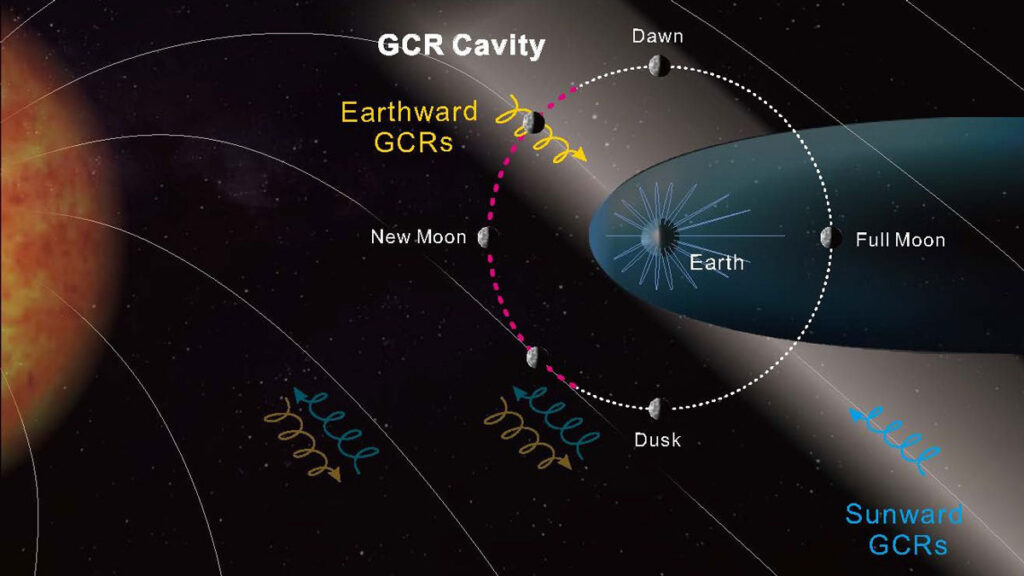
But a new analysis of data from the Chang’e-4 lunar lander published in Science Advances revealed an extended cosmic ray shelter stretching from Earth at an unexpected angle at least as far as the Moon, though exactly how far is unclear. When the Moon passes through this shelter in its orbit of Earth, the lunar surface experiences a roughly 20% reduction in the galactic cosmic ray flux.
“We found Earth casts kind of a shadow in the galactic cosmic ray space,” said Robert F. Wimmer-Schweingruber, a space physicist at Kiel University in Germany. “This was unexpected, and to me that was the cool part of this paper.”
The surprise came in part because the shape of Earth’s magnetic field is well understood: It forms a strong protective region around the planet known as the magnetosphere, with a long “tail” shaped by the solar wind of charged particles streaming from the Sun.
If the magnetotail is like a person’s shadow cast behind them by sunshine, this newly discovered bubble would be like if that shadow extended to the front of the person as well.
“You would expect an effect inside the tail or as [the Moon goes] through the tail, but we find an effect of the tail ahead of the tail,” said Wimmer-Schweingruber. He noted that if the magnetotail is like a person’s shadow cast behind them by sunshine, this newly discovered bubble would be like if that shadow extended to the front of the person as well and tilted rather than lying along a line connecting Earth, the Sun, and the Moon.
“The observed region of reduced [galactic cosmic ray] flux on the sunward side of the Moon’s orbit outside the geomagnetic field where it is compressed by the solar wind is unexpected,” Brian Flint Rauch wrote in an email. Rauch, a cosmic ray physicist at Washington University in St. Louis who was not involved in the Chang’e-4 study, added that any reduction in cosmic ray exposure is noteworthy for potential astronauts on the Moon.
A 20% decrease in flux during part of the lunar orbit is unlikely to make a large difference in determining when it’s safest for astronauts go out onto the lunar surface. But it might help guide individual decisions in the moment because while spacesuits won’t protect astronauts from cosmic rays, the metal of a habitat or lander would.
Shelter from the Storm
The China National Space Administration’s Chang’e-4 spacecraft was the first successful mission to the lunar farside, landing in the Von Kármán crater on 3 January 2019. As part of its suite of scientific instruments, the probe carried the Lunar Lander Neutron and Dosimetry experiment (LND) developed by Wimmer-Schweingruber and collaborators at Kiel University in an astonishingly rapid 18 months. This detector was designed in part to gauge conditions for human exploration by measuring the radiation on the Moon’s surface, including cosmic rays.
LND collected data between January 2019 and January 2022. Though Apollo astronauts carried radiation dosimeters, those instruments did not provide detailed information about fluctuations in exposure, making LND the primary source for such information from the lunar surface. For that reason, it provided the best data on galactic cosmic rays, which consist mostly of protons accelerated to nearly the speed of light in the remnants of supernovas.
Measurements show the ambient radiation dose on the lunar surface is more than twice as high as on the ISS and nearly 200 times as high as on Earth.
These protons arrive in the solar system from every direction, often undeflected by the magnetic fields of stars or planets. However, Earth’s magnetosphere is strong enough to repel many galactic cosmic rays in low orbit, where the International Space Station (ISS) resides. Meanwhile, measurements show the ambient radiation dose on the lunar surface is more than twice as high as on the ISS and nearly 200 times as high as on Earth, which is a matter of concern for long-term human presence on the Moon.
All of these reasons are why everyone was surprised when LND data revealed Earth’s magnetic protection extends far beyond the magnetosphere and at an angle to the line connecting Earth and the Sun. Lead author Wensai Shang of Shandong University in Weihai, China, worked out that the angle corresponds to the twisting of the Sun’s magnetic field.
“As the Sun rotates, it pulls the solar wind along the solar magnetic field,” Wimmer-Schweingruber said. “That produces a spiral.” Apparently, an unanticipated interaction between this twist in the solar magnetic field and Earth’s magnetic field produces the cosmic ray shelter revealed by LND.
Wimmer-Schweingruber noted that he was extremely skeptical that such results were possible at first. He warned Shang, a graduate student he worked with, that he might be wasting his time looking for cosmic ray anomalies in the Chang’e-4 data. It was only after Shang provided ironclad analyses ruling out other possibilities that he was swayed.
With the LND instrument shut off, researchers need other sources of data to continue the work. Wimmer-Schweingruber expressed particular interest in understanding how cosmic rays produce secondary radiation—especially neutrons, which are very dangerous to humans—when they impact the lunar soil. In the meantime, the general understanding of the radiation environment provided by Chang’e-4 shows we still have some surprises in store as humans explore the solar system.
Citation: Francis, M. R. (2026), Moon mission data reveal unexpected cosmic ray “shadow,” Eos, 107, https://doi.org/10.1029/2026EO260137. Published on 4 May 2026.
Since a good many crime movies have a “crime doesn’t pay” thing going on (especially those made some time ago), it’s not exactly the happiest of genres. Even crime movies that focus on good people can showcase bad things happening to them, and then the really effective ones can also make you feel bad for people who themselves are doing bad things.
Since a good many crime movies have a “crime doesn’t pay” thing going on (especially those made some time ago), it’s not exactly the happiest of genres. Even crime movies that focus on good people can showcase bad things happening to them, and then the really effective ones can also make you feel bad for people who themselves are doing bad things.
Today is May Day, which is International Workers Day, aka Labour Day, marking the Haymarket Square Riots, which began May 1, 1886, and culminated in the explosion four days later.Whamond notes the calls this year for a general strike, but I don’t think America is a general-striking sort of country. I recall that the Mai-Juin […]
Today is May Day, which is International Workers Day, aka Labour Day, marking the Haymarket Square Riots, which began May 1, 1886, and culminated in the explosion four days later.Whamond notes the calls this year for a general strike, but I don’t think America is a general-striking sort of country. I recall that the Mai-Juin […]
Source: Water Resources Research
This is an authorized translation of an Eos article. 本文是Eos文章的授权翻译。
如果人类想要在太空生活,无论是在航天器里还是在火星上,首先要解决的一个问题就是如何获取水,来满足饮用、卫生需求以及为维持生命所需的植物提供水分。即便只是将水运送到近地轨道上的国际空间站(ISS),也需要花费数万美元。因此,找到在太空中高效、持久且可靠地获取和再利用水资源的方法,对于长期在太空居住至关重要。
目前的系统,比如国际空间站上的环境控制与生命支持系统(ECLSS),为闭合式水回收提供了蓝图,但它们还需要改进才能适应未来的应用。与此同时,近期的技术和科学进步正为在严苛环境下寻找、净化和管理水资源开辟新的途径。在一篇新的综述中,Olawade等人概述了地外水资源管理的现状,以及该领域的前景和挑战。
作者指出,太空水系统需要具备闭环、高效和持久耐用的特性,同时还要满足低能耗的要求。目前,ECLSS能耗过高,其效率可能也不足以满足长期任务的需求。未来建议采用的过
When it comes to photo dumps, NASA has upped the ante. The organization has added thousands of snapshots from the Artemis II mission to the Gateway to Astronaut Photography of Earth archive. The album now holds 12,217 images by cosmic travelers Reid Wiseman, Victor Glover, Christina Koch, and Jeremy Hansen during their more than 250,000-mile, 10-day flyby mission around the moon.
According to PetaPixel, a couple of Nikons and an iPhone 17 were the cameras of choice for the journey. And eve
When it comes to photo dumps, NASA has upped the ante. The organization has added thousands of snapshots from the Artemis II mission to the Gateway to Astronaut Photography of Earth archive. The album now holds 12,217 images by cosmic travelers Reid Wiseman, Victor Glover, Christina Koch, and Jeremy Hansen during their more than 250,000-mile, 10-day flyby mission around the moon.
According to PetaPixel, a couple of Nikons and an iPhone 17 were the cameras of choice for the journey. And even though many of the thousands of recently uploaded images are very similar—some are even quite blurry—scrolling through them gives the impression of being seated right next to the “Moonfarers” as they marvel at Earth and its satellite and simply can’t put the camera down—just like we tend to snap way too many photos of a beautiful sunset.
Some of the most impactful photos include the reflections of the astronauts’ hands and faces in the window of their vehicle, the Orion module. Juxtaposed with meticulously engineered equipment, the earth and moon seem somehow less abstracted from this unique vantage point, in which these orbs appear somehow more resonant and precious—and vulnerable.
Explore more of our favorites below, and learn about the Artemis II mission on NASA’s site.

 Login
Login