Normal view

  • ✇Dawn Newspaper Pak
  • COMMENT: Trust the signals, but verify the policy none@none.com (Baqir Sajjad Syed)
    INDIAN army chief Gen Upendra Dwivedi’s recent provocation, asking Pakistan to choose whether to remain part of “geography or history”, has once again exposed the contradictions that continue to define India’s policy towards its western neighbour. The statement came barely days after an unusual chorus seemed to be emerging within sections of India’s strategic and ideological establishment, one that seemed to be creating space for engagement with Islamabad. This led many to believe that New Delhi
     

COMMENT: Trust the signals, but verify the policy

INDIAN army chief Gen Upendra Dwivedi’s recent provocation, asking Pakistan to choose whether to remain part of “geography or history”, has once again exposed the contradictions that continue to define India’s policy towards its western neighbour.

The statement came barely days after an unusual chorus seemed to be emerging within sections of India’s strategic and ideological establishment, one that seemed to be creating space for engagement with Islamabad. This led many to believe that New Delhi’s political ecosystem was quietly preparing domestic opinion for a limited thaw with Islamabad.

The signal came not from the government directly, rather from its ideological forebears, the Rashtriya Swayamsevak Sangh (RSS), with its General Secretary Dattatreya Hosabale arguing that doors for dialogue with Pakistan should not be permanently shut.

The remarks were striking because they came from the ideological nerve centre of the broader ‘Sangh Parivar’, at a time when official Indian discourse has become increasingly securitised after the 2025 conflict with Pakistan.

From the pro-dialogue chorus to Gen Dwivedi’s provocation, India seems to be testing domestic waters about the possibility of a ‘limited thaw’ with Pakistan

Mr Hosabale’s intervention was not an isolated incident, and was followed up by an article on similar lines in Organizer, an RSS publication. Former Indian army chief Gen Manoj Naravane and some other Indian figures also publicly backed the idea of preserving communication channels and people-to-people engagement.

All of this came against the backdrop of a constant trickle of reports in Indian media that Track-II and Track-1.5 contacts involving retired officials, diplomats and strategic figures from both sides had taken place.

None of this necessarily means that Narendra Modi’s government has decided to alter its policy of not engaging Pakistan, but what was striking was that none of the usual suspects — Mr Modi, National Security Adviser Ajit Doval or Foreign Minister S. Jaishankar — contradicted the RSS leader’s remarks.

India’s Ministry of External Affairs also did not dismiss media reporting regarding ‘quiet contacts’.

The silence was meaningful, because in India, silence from the top on Pakistan is often used to preserve deliberate ambiguity, rather than the absence of a position.

The RSS statement was, therefore, interpreted in some quarters less as a policy declaration and more as a trial balloon. It may have been intended to test domestic reaction, gauge international response and slowly prepare political ground should New Delhi eventually decide that some form of controlled engagement with Pakistan had again become strategically necessary.

Pakistan’s Foreign Office also showed similar scepticism, with Spokesman Tahir Andrabi telling his weekly media briefing that while the emergence of pro-dialogue voices was a welcome development, it was New Delhi’s official policy that actually mattered.

Tactical flexibility?

There are multiple reasons why such signalling by India may have emerged now. The geopolitical environment after the 2025 conflict did not evolve in India’s favour.

Pakistan, instead, gained far more relevance because of the conflict in the Gulf. The strains in the Modi-Trump personal equation also helped.

In this situation, some think the Modi government may be quietly encouraging such signals to buy some time. One view is that India may be seeking tactical flexibility, rather than strategic reconciliation, through such signals.

The RSS also has an interest in adopting a pro-dialogue posture, as projecting moderation internationally serves its goals. In recent years, it has attempted to present itself abroad as a culturally-rooted organisation, rather than the hardline Hindu movement it is largely viewed as.

Therefore, calling for dialogue with Pakistan costs little domestically, while helping soften external perceptions.

None of this should be mistaken for a policy shift in Delhi, though. One must not forget that the Pakistan file in India remains tightly controlled by the Prime Minister’s Office and the national security establishment. On core security issues, particularly Pakistan, authority rests far less with ideological organisations or retired officials, and more with the small circle around Mr Modi, Doval and Co.

This is what makes Gen Dwivedi’s intervention interesting. His remarks were delivered at a public interaction event, held around the first anniversary of ‘Operation Sindoor’, and were aimed at reinforcing deterrent messaging toward Pakistan.

Yet, the real question is whether the statement reflects an institutional veto by the Indian military against dialogue, or is tactical signalling aligned with domestic nationalist sentiment.

There is little evidence that the Indian army chief independently shapes New Delhi’s Pakistan policy.

India’s armed forces operate within a centralised civilian decision-making structure and while the Indian army chief may be an important voice, it is definitely not the principal architect of strategic policy toward Pakistan.

If the political leadership in New Delhi decides that engagement with Pakistan would serve India’s interests, the military establishment will almost certainly fall in line. Historically, Indian army chiefs have reflected prevailing political direction rather than independently determining it.

For its part, Pakistan’s military establishment has long argued that India’s armed forces have become politicised and integrated into domestic nationalist narratives and Gen Dwivedi’s remarks will likely reinforce those perceptions in Rawalpindi.

The deeper issue may not be politicisation alone, rather the extent to which Pakistan policy in India has itself become trapped within the theatre of domestic politics.

Dialogue between India and Pakistan has always been difficult precisely because it was never driven purely by bilateral calculations.

India’s contradictory signals reflect uncertainty inside the system itself about how to manage Pakistan after years of escalation, hardened public attitudes and shrinking diplomatic space.

The old principle still applies: trust the signals if necessary, but verify the policy.

Published in Dawn, May 20th, 2026

  • ✇Dawn Newspaper Pak
  • No more politics, only social work: Jahangir Khan Tareen none@none.com (Zulqernain Tahir)
    LAHORE: Former Istehkam-i-Pakistan Party (IPP) patron-in-chief Jahangir Khan Tareen said he has quit politics, but will continue social work in the education sector. Speaking at the inauguration of a modern computer laboratory at Government Progressive Girls High School on Tuesday, he said: “I have quit politics but I will continue to serve [the] education sector.” Tareen bid farewell to active politics following his party’s defeat in the 2024 polls. The IPP was carved out of Imran Khan’s PTI in
     

No more politics, only social work: Jahangir Khan Tareen

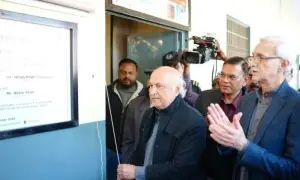
LAHORE: Former Istehkam-i-Pakistan Party (IPP) patron-in-chief Jahangir Khan Tareen said he has quit politics, but will continue social work in the education sector.

Speaking at the inauguration of a modern computer laboratory at Government Progressive Girls High School on Tuesday, he said: “I have quit politics but I will continue to serve [the] education sector.”

Tareen bid farewell to active politics following his party’s defeat in the 2024 polls. The IPP was carved out of Imran Khan’s PTI in the wake of the May 9 riots, and is currently being run by Federal Minister Aleem Khan.

Tareen claimed that this was the sixth computer lab established in Lahore by his foundation within the span of one month.

Inaugurates computer lab at girls’ school

“The aim of the lab is to provide students with modern and high-quality digital educational facilities. We have built a lab comparable to those in elite schools so that children from low-income communities can access the same opportunities available to privileged students.”

Tareen said providing equal opportunities to both rich and underprivileged children was a fundamental right. “It has always been my desire and priority to work in the field of education, particularly for students with limited resources. Digital education is the key to securing the future of our children.”

He said merely constructing a computer lab was not enough, it was equally important to provide an environment that enhanced students’ ability to learn and understand.

Tareen further stated that he had observed that whether schools were in Lahore or in remote areas of south Punjab, educational institutions with limited resources faced almost similar challenges. “If high-performing students gain admission to universities abroad, my foundation will provide support, guidance and possible assistance to help talented young individuals represent Pakistan at the global level,” he said.

Present at the ceremony, District Education Authority Chief Executive Officer Tariq Mahmood appreciated Jahangir Khan Tareen’s efforts and stated that these initiatives represent an important step in the right direction for the education sector. He said he was grateful to Jahangir Khan Tareen for prioritising the needs of government schools and the students studying there.

He further informed that uninterrupted electricity supply has been ensured through solar panels in the lab established by Tareen Education Foundation, enabling students to continuously benefit from modern educational facilities.

Published in Dawn, May 20th, 2026
  • ✇Dawn Newspaper Pak
  • Moral failure none@none.com (Murad Moosa Khan)
    “To be wealthy and honoured in an unjust society is a disgrace” — Confucius I OFTEN wonder that if I ever come to be awarded one of Pakistan’s civil honours (not that I deem myself worthy of one!), would I accept it? After all, many of my colleagues have done so and flaunt them with great pride. I am not sure I would. My discomfort would be this: what does success mean in an unjust system? In today’s Pakistan, where social and economic injustice, political patronage and selective accountability
     

Moral failure

“To be wealthy and honoured in an unjust society is a disgrace” — Confucius

I OFTEN wonder that if I ever come to be awarded one of Pakistan’s civil honours (not that I deem myself worthy of one!), would I accept it? After all, many of my colleagues have done so and flaunt them with great pride. I am not sure I would.

My discomfort would be this: what does success mean in an unjust system? In today’s Pakistan, where social and economic injustice, political patronage and selective accountability shape public life, this question is not philosophical but deeply personal and political.

Wealth and honour are typically seen as rew­a­r­ds for hard work, perseverance or talent. Yet it forces us to examine the moral context in which such rewards are given. If a society is structured in ways that systematically disadvantage the many while privileging the few, then personal success within that system cannot be morally neutral.

In Pakistan, the narrative of meritocracy coexists with societal inequality. Access to quality education, healthcare, and employment opportunities is unevenly distributed, determined by socioeconomic status, geography, or connections. Elite institutions, nepotism and entrenched patronage create pathways that are accessible to a few but closed to others.

Success devoid of ethical grounding is not only hollow; it is dishonourable.

In such a system, achievement is rarely just the product of individual effort. It is often facilitated by inherited advantage, political connections or the ability to manipulate the system. When individuals rise within these structures and are celebrated as symbols of success, the broader question of fairness is conveniently sidelined. If the playing field is fundamentally unequal, then the honours and awards bestowed upon those who ‘succeed’ are deeply flawed.

When wealth and political influence are intertwined, it further complicates the moral landscape. Business elites in the country often have close ties with those in power, benefiting from fa­­vourable policies, contracts or regulatory relief. In return, they offer financial support, legitimacy or silence. This symbiotic relationship blurs the line between economic success and political complicity, giving rise to a class of individuals whose wealth is not merely economic capital but also a form of political currency. Their ‘honour’, which is manifested through awards, social status or public recognition, becomes part of a system that sustains inequality. The absence of accountability means that those who benefit from unjust systems do not simply go unchallenged but are, in fact, celebrated. Their success stories are amplified, their lifestyles admired, and their influence normalised.

This is not a sign of societal progress, but one of moral failure. This is one of the most insidious effects of an unjust system and how it shapes aspirations. In Pakistan, whether it is the normalisation of corruption, the acceptance of academic dishonesty or the reluctance to challenge unethical practices in public life, the moral cost of aspiration is high. Young people, in particular, internalise the idea that achieving such success is the ultimate goal, regardless of the means, creating a dangerous cycle. Instead of questioning the system, individuals adapt to it. Ethical compromises become normalised. Shortcuts are justified. Silence is preferred over dissent and the pursuit of success becomes detached from considerations of justice or integrity. Those who become wealthy and honoured by operating within or who benefit from flawed structures, become benchmarks of success for others. Success devoid of ethical grounding is not only hollow; it is dishonourable.

The widening gap between the privileged and the marginalised in Pakistan has led to moral distancing. For those who are economically well off, the daily struggles of the common man — poverty, unemployment, rising inflation and violence — become abstract or invisible. This allows individuals to live in their bubbles and enjoy their status without having to confront conditions that make such disparities possible. Inequality is seen as unfortunate, rather than as being unjust and immoral.

Yet, the moral burden does not disappear simply because it is ignored. To be wealthy in such a context is to be implicated, whether directly or indirectly, in the structures that produce inequality.

An unjust society often sustains itself through the control of narrative. In Pakistan, the few voices that challenge inequality, corruption or abuse of power are frequently subjected to legal, social and institutional pressure. Journalists, activists and academics who attempt to raise their voice are met with censorship, intimidation and marginalisation. This narrows the space for critical dialogue and accountability. Under these conditions, those who enjoy wealth and honour have a choice to either remain silent and benefit from the status quo, or use their position to advocate for change. Silence in the face of injustice becomes a form of endorsement.

What constitutes true honour in an unjust society? Confucian philosophy points toward integrity, fairness, and a commitment to the common good as the foundations of ethical living. In practical terms, this means redefining success, ie, valuing transparency over expediency, accountability over influence, and social responsibility over personal gain. It requires individuals — particularly those in positions of privilege — to critically examine how their success is achieved and what impact it has on others.

An unjust system is not sustained by a few individuals, but by a whole network of behaviours, incentives and norms. A collective effort is needed to change such a system. This would include strengthening institutions to ensure fairness and accountability, promoting equitable access to opportunities, and fostering a culture that values integrity over mere success. It would mean citizens holding leaders and elites accountable, and questioning narratives that glorify wealth without examining its origins.

It begins with recognising that the pursuit of wealth and honour cannot be divorced from the moral context in which they are obtained. To ignore this is to accept a diminished moral standard.

The writer is professor emeritus, psychiatry, Aga Khan University.

mmkarticle@gmail.com

Published in Dawn, May 20th, 2026
  • ✇Dawn Newspaper Pak
  • ‘Why don’t you take questions, Mr Modi?’ none@none.com (Monitoring Desk)
    INDIAN PM Narendra Modi’s penchant for not taking questions during interactions with the press did not go down well with journalists in Norway, who wanted to quiz the visiting dignitary. Mr Modi is on a six-day, five-nation tour, and landed in Oslo on Monday to attend the third India-Nordic Summit. According to The Hindustan Times, the episode unfolded at a joint press statement by PM Modi and his Norwegian counterpart Jonas Gahr Støre. As the two leaders were leaving the venue after their brief
     

‘Why don’t you take questions, Mr Modi?’

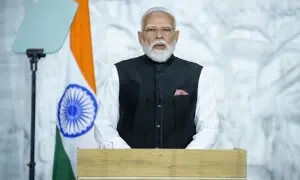
INDIAN PM Narendra Modi’s penchant for not taking questions during interactions with the press did not go down well with journalists in Norway, who wanted to quiz the visiting dignitary.

Mr Modi is on a six-day, five-nation tour, and landed in Oslo on Monday to attend the third India-Nordic Summit.

According to The Hindustan Times, the episode unfolded at a joint press statement by PM Modi and his Norwegian counterpart Jonas Gahr Støre. As the two leaders were leaving the venue after their briefing, which did not include a Q&A, a voice rang out across the room: “Prime Minister Modi, why don’t you take some questions from the freest press in the world?”

The voice belonged to Helle Lyng, a journalist with the local newspaper Dagsavisen, who was part of the media contingent covering the visit.

“Prime Minister of India, Narendra Modi, would not take my question, I was not expecting him to,” she subsequently posted on X.

She later also attended the Ministry of External Affairs (MEA) briefing on PM Modi’s Norway visit later, where she pressed MEA officials on the prime minister not taking questions.

“Why should we trust you,” she asked, adding, “Can you promise you will stop the human rights violation that goes on in your country?”

While the journalist sought a “straight answer”, MEA’s Sibi George said: “If anyone whose rights are violated, they have the right to go to court. We are proud to be a democracy”.

Published in Dawn, May 20th, 2026
  • ✇Dawn Newspaper Pak
  • Sexual abuse by Israel none@none.com (Zahid Hussain)
    THE harrowing details of the widespread torture and sexual violence inflicted on Palestinian prisoners — men, women and children — by Israeli forces, as chronicled by New York Times columnist Nicholas Kristof, are a damning indictment of the so-called civilised world that looks the other way when war crimes are committed by the Zionist state. Kristof’s account, published last week, is based on interviews with a number of Palestinians who have experienced sexual violence at the hands of “soldiers
     

Sexual abuse by Israel

THE harrowing details of the widespread torture and sexual violence inflicted on Palestinian prisoners — men, women and children — by Israeli forces, as chronicled by New York Times columnist Nicholas Kristof, are a damning indictment of the so-called civilised world that looks the other way when war crimes are committed by the Zionist state. Kristof’s account, published last week, is based on interviews with a number of Palestinians who have experienced sexual violence at the hands of “soldiers, settlers, interrogators in the Shin Bet internal security agency and, above all, prison guards”.

Among the victims interviewed was freelance journalist Sami al-Sai, 46, who was detained by Israeli authorities in 2024. The description of his experience in prison is as horrific as that of countless other Palestinian men and women who have endured brutal acts of sexual violence. The journalist linked his abuse to pressure from the Israeli authorities to turn informer. Pride in his profession kept him from yielding to their demand. Many others in his place would have succumbed to the pressure.

A number of these stories are so harrowing that they cannot be repeated here. Thousands of Palestinian men, women and children are languishing in Israeli prisons in subhuman conditions, with many routinely subjected to sexual abuse.

Often, upon being released, the prisoners are warned by the Israeli authorities to stay quiet or face the consequences. The other reason they prefer silence is because “Arab society discourages discussing the topic for fear of hurting the morale of prisoners’ families and undermining the Palestinian narrative of defiant and heroic detainees”. Conservative norms also inhibit discussion on the subject. Survivors worry that speaking openly will ruin the matrimonial prospects of their sisters and daughters.

Western leaders have turned a blind eye to Israel’s crimes against humanity.

This is not the first time reports have surfaced regarding Israel’s consistent use of sexual violence against the Palestinian population. And yet, nothing seems to shake Western leaders who continue to lecture the world on human rights while turning a blind eye to Israel’s atrocities. There has been a marked increase in such crimes with Israel’s ongoing genocidal war in Gaza aided and abetted by the US and others in the Western sphere.

In a report issued in March 2025, the UN detailed how sexual and gender-based violence — including rape and brutal assaults by prison guards and soldiers — is systematically employed by Israel as a tool of war and a way to humiliate and intimidate Palestinians. These abuses are not isolated incidents but rather “standard operating procedures” and a significant aspect of the mistreatment of Palestinians.

The Geneva-based Euro-Med Human Rights Monitor has extensively reported on how Israel employs “systematic sexual violence” as part of organised state policy. The report titled Another Genocide Behind Walls: Sexual Violence in Israeli Prisons and Detention Centres and Engineered Impunity (October 2023-October 2025) details the horrible conditions that prevail inside Israeli prisons.

Post-Oct 7, 2023, “Israeli forces have conducted sweeping and arbitrary arrests of thousands of Palestinians, including healthcare workers, journalists, women and children,” the Monitor notes. With Israel attempting to conceal conditions in its prisons by blocking visits from the International Committee of the Red Cross and lawyers, the report is based on released detainees’ direct testimonies. The findings “are supported by rare testimonies from Israeli whistleblowers, including doctors and soldiers, who have admitted to serious medical violations”. Medical reports indicate severe injuries and bodies returned to Gaza have shown signs of torture. Many former detainees don’t want to testify “due to fears of security reprisals” that include the targeting of their families.

According to the Monitor, prisoners and detainees are trapped in “physical and legal black holes”. In the detention and interrogation centres, they encounter conditions described as resembling “state-run torture camps, where they face severe violations that include systematic sexual violence as a means of subjugation and destruction”. Cases are mentioned “where victims experienced severe psychological breakdowns while trying to speak out, with some breaking down into crying fits” as they relived their trauma.

“Deliberate and medical neglect” often accompany the abuse. The report categorises them “as war crimes and crimes against humanity” which are “central to ongoing genocide”. These atrocities are ‘legitimised’ through “a complex system of laws, military directives and emergency regulations, including activating the ‘Unlawful Combatants Law’ and broadening detention powers without judicial oversight”.

This year, Israel’s parliament celebrated after passing a draconian bill that mandates military courts in occupied West Bank to sentence Palestinians convicted of killing Israelis in so-called ‘terror’ acts to death. The move is not only discriminatory against Palestinians but also contravenes international law, as Israel can’t legislate for territories that are not a part of it. Such actions can be viewed as war crimes.

In 2024, the International Criminal Court issued arrest warrants for Israeli Prime Minister Benjamin Netanyahu and his former defence minister, accusing them of war crimes and crimes against humanity committed in Gaza post Oct 7, 2023. Despite this, no significant action has been taken. This inaction reflects the complicity of Western nations and Arab countries, whose silence gives Israel a sense of impunity.

It is particularly ironic that many Arab nations, as well as Pakistan, are engaging with a war criminal responsible for the ongoing genocidal conflict in Gaza through the Board of Peace, led by US President Donald Trump, which claims to be focused on the ‘rehabilitation’ of Gaza. Reports from the NYT, the UN and international human rights organisations detail only a fraction of Israel’s crimes against humanity. But they should be enough to galvanise the international community.

The writer is an author and journalist.

zhussain100@yahoo.com

X: @hidhussain

Published in Dawn, May 20th, 2026
  • ✇Dawn Newspaper Pak
  • Hormuz gamble none@none.com (Editorial)
    THE fragile ceasefire between Iran and the US may have slowed the fighting, but the conflict driving it remains unresolved. Interior Minister Mohsin Naqvi’s meetings in Tehran over the weekend show the urgency of the crisis and the narrowing space for diplomacy. Even as President Donald Trump warned that “the clock is ticking” for Iran, reports suggest diplomacy may already have helped avert another escalation after Tehran submitted a revised proposal through Islamabad. That underlines how conse
     

Hormuz gamble

THE fragile ceasefire between Iran and the US may have slowed the fighting, but the conflict driving it remains unresolved. Interior Minister Mohsin Naqvi’s meetings in Tehran over the weekend show the urgency of the crisis and the narrowing space for diplomacy.

Even as President Donald Trump warned that “the clock is ticking” for Iran, reports suggest diplomacy may already have helped avert another escalation after Tehran submitted a revised proposal through Islamabad. That underlines how consequential Pakistan’s role has become.

Islamabad is increasingly acting as a conduit through which proposals move between Tehran and Washington. Prime Minister Shehbaz Sharif’s contacts with Qatar and Egypt further demonstrate Pakistan’s attempt to position itself at the centre of regional diplomacy when few reliable communication channels remain open.

The negotiations themselves, however, remain deeply troubled. Iranian media reports suggest Washington’s latest proposal still demands sweeping nuclear concessions while offering little relief in return. Tehran is reportedly being asked to scale back much of its nuclear infrastructure, transfer enriched uranium abroad and begin talks before broader hostilities end. Iran, meanwhile, continues demanding sanctions relief, access to frozen assets, reparations for wartime damage and guarantees against future attacks.

Yet beneath the public posturing, there are faint signs both sides may be probing for compromise. Reports indicate Iran may be willing to suspend parts of its nuclear programme, transfer some enriched uranium abroad and gradually reopen the Strait of Hormuz if sanctions are eased and security guarantees materialise. Publicly, however, neither Washington nor Tehran wishes to appear politically weakened by flexibility.

The Strait of Hormuz has become the real centre of the confrontation. Earlier phases of the crisis revolved around nuclear restrictions. Today, the dispute concerns who shapes the Gulf’s security order and controls one of the world’s most vital energy corridors. Iran continues to use Hormuz as leverage while the US and Gulf states insist unrestricted navigation is non-negotiable.

This leaves the region hanging between diplomacy and renewed conflict. Gulf governments fear the economic consequences of another escalation, while Iran appears convinced that surviving months of military and economic pressure has strengthened its negotiating position. Washington, meanwhile, still seems to believe sustained pressure can force Tehran into larger concessions.

For Pakistan, mediation offers diplomatic relevance but also growing risk. The longer the crisis drags on, the harder it will become for Islamabad to balance relations with Tehran, Washington and the Gulf states. For now, the ceasefire survives because all sides understand the cost of its collapse. But unless negotiations soon give way to progress rather than competing ultimatums, the Middle East may be heading not towards peace, but a prolonged era of recurring crises.

Published in Dawn, May 20th, 2026

  • ✇Dawn Newspaper Pak
  • ECC allows NLC to take over shipping corporation none@none.com (Khaleeq Kiani)
    ISLAMABAD: The Economic Coordination Committee (ECC) of the Cabinet on Tuesday approved the transfer of management control, along with a 30 per cent shareholding, in Pakistan National Ship­ping Corporation (PNSC) to the National Logistics Corporation (NLC) for optimum and integrated freight transport through shipping and road networks. The ECC meeting, presided over by Finance Minister Muhammad Aurangzeb, also approved more than a 70pc increase in the subsistence allowance for Kashmiri refugees
     

ECC allows NLC to take over shipping corporation

ISLAMABAD: The Economic Coordination Committee (ECC) of the Cabinet on Tuesday approved the transfer of management control, along with a 30 per cent shareholding, in Pakistan National Ship­ping Corporation (PNSC) to the National Logistics Corporation (NLC) for optimum and integrated freight transport through shipping and road networks.

The ECC meeting, presided over by Finance Minister Muhammad Aurangzeb, also approved more than a 70pc increase in the subsistence allowance for Kashmiri refugees of 1989 and seven supplementary grants worth around Rs8.634 billion.

An official statement said the ECC “granted in-principle approval for restructuring of PNSC of the Ministry of Maritime Affairs through sale of 30pc shareholding and transfer of management control to NLC” — an army-run logistics firm working under the Ministry of Planning, Development and Special Initiatives.

The summary for restructuring and divestment to NLC was moved by the Ministry of Maritime Affairs following an earlier approval by the prime minister in February this year.

The ECC directed the authorities concerned to expedite the restructuring and consolidation process to tap emerging maritime and transhipment opportunities.

PNSC is Pakistan’s national shipping carrier engaged in the transportation of dry bulk and liquid cargoes across the globe. It operates a fleet of 12 ships with a carrying capacity of 938,876 tonnes of deadweight. It also has a real estate business and a ship repair workshop.

According to official sources, the consolidation is aimed at expanding the national shipping fleet and reducing foreign freight costs. Under the prime minister’s approval, the vessel fleet is to be expanded from 12 to more than 50 in five years, with projected annual foreign exchange savings of $5bn to $6bn in freight costs by handling more sea-route cargo.

At present, the national carrier handles around 12pc of Pakistan’s sea-route cargo requirements, resulting in foreign exchange outflows on freight payments.

PNSC’s profit during the first three quarters (July-March) of the current fiscal year stood at around Rs7.5bn, almost half of the Rs15.4bn recorded in the same period last year.

The ECC also approved a request of the Ministry of Kashmir Affairs and Gilgit-Baltistan for enhancement of the monthly subsistence/Guzara allowance for Jammu and Kashmir refugees of 1989 from Rs3,500 to Rs6,000 per person with effect from Feb 1, 2026.

It also approved a supplementary grant of Rs578.838 million for the period ending June 30, 2026. The committee directed the ministry to take up future budgetary requirements with the Finance Division for the next budget cycle.

The ECC approved a request of the Ministry of Federal Education and Professional Training for a supplementary grant of Rs3.915bn for the Prime Minister’s Youth Skill Development Programme through NAVTTC and the establishment of Daanish Schools in Azad Jammu and Kashmir, Gilgit-Baltistan and Balochistan.

The committee also approved two summaries of the Ministry of Interior and Narcotics Control, including Rs160m for repair and maintenance of the Prime Minister’s Office during FY26 and Rs480m for recurring operational requirements of Frontier Corps KP (North) Hospital at Shakas in Khyber district.

The committee approved another Rs1.5bn grant to the Ministry of National Health Services, Regulations and Coordination for the Prime Minister’s National Health Programme during PSDP 2025-26.

The ECC also granted Rs1bn to the Ministry of Railways for payment of outstanding liabilities under the Prime Minister’s Assistance Package and directed the Railways Division to undertake a review of its pension liabilities.

The committee also directed the Establishment Division to review the overall policy framework relating to the Prime Minister’s Assistance Package.

Another Rs1bn grant was approved for the Ministry of National Food Security and Research for the operationalisation of the National Agri-Trade and Food Safety Authority (NAFSA).

The ECC also approved the National Policy to Realise Pakistan’s Gemst­one Potential 2026-30, submitted by the Industries and Production Division.

The policy aims to formalise the gemstone sector, promote value addition and modern mining practices, and enhance exports and regional economic development, particularly in Gilgit-Baltistan, Khyber Pakhtunkhwa and Azad Jammu and Kashmir.

Published in Dawn, May 20th, 2026

  • ✇Dawn Newspaper Pak
  • Pakistan can buy Russian oil none@none.com (Anwar Iqbal)
    WASHINGTON: Pakistan is among the countries that could benefit from a new United States temporary licence allowing selected energy-importing nations to access Russian oil, diplomatic sources told Dawn. The US has introduced a 30-day general licence issued by the US Department of the Treasury to ease immediate supply pressures in global crude markets and provide relief to energy-vulnerable countries. Diplomatic sources said the arrangement may also apply to Pakistan, though they cautioned that Is
     

Pakistan can buy Russian oil

WASHINGTON: Pakistan is among the countries that could benefit from a new United States temporary licence allowing selected energy-importing nations to access Russian oil, diplomatic sources told Dawn.

The US has introduced a 30-day general licence issued by the US Department of the Treasury to ease immediate supply pressures in global crude markets and provide relief to energy-vulnerable countries.

Diplomatic sources said the arrangement may also apply to Pakistan, though they cautioned that Islamabad might not be able to fully take advantage of the concession due to limited technical capacity.

US offers 30-day relief to energy-vulnerable countries

They noted that Pakistan has not previously imported Russian crude at scale and may lack the refining infrastructure required to process such shipments. US Treasury Secretary Scott Bessent said on a social media post released on Monday that his department is issuing a temporary 30-day general licence to “provide the most vulnerable nations with the ability to temporarily access Russian oil currently stranded at sea.”

“This extension will provide additional flexibility, and we will work with these nations to provide specific licences as needed,” he wrote in a post on X. “This general licence will help stabilise the physical crude market and ensure oil reaches the most energy-vulnerable countries.”

Bessent added that the licence will also help reroute existing supply to countries most in need by “reducing China’s ability to stockpile discounted oil”.

Published in Dawn, May 20th, 2026

❌
Subscriptions